A detailed immigration lawsuit filed this year can decide whether a family stays together or gets split apart within days. Right now, more than a dozen major immigration cases are working through federal courts at the same time, something that has not happened at this pace in years.
This guide breaks down the biggest 2026 immigration lawsuits in plain language. You will learn who qualifies, what money is actually on the table, and what to do next.
Here is a number that should get your attention. One pending detainee wage settlement alone could affect tens of thousands of people who were paid just one dollar a day for their labor.
We built this guide using real court filings, not guesswork. Every date, dollar figure, and case name below comes from actual dockets and press statements.
Related: Recent Immigration Lawsuit 2026: Settlements & Claims Guide
Detailed Immigration Lawsuit 2026 Overview
A detailed immigration lawsuit in 2026 refers to one of several active federal cases challenging ICE, DHS, or USCIS policies and practices. These are not small disputes. They involve class actions, Supreme Court rulings, and government agencies accused of breaking federal law.
The cases fall into two broad buckets. Some are policy lawsuits trying to stop a rule or practice. Others are damages class actions where plaintiffs want money for harm already done.
Knowing which bucket a case falls into tells you a lot. Policy cases rarely pay individuals directly. Damages cases sometimes do, once a settlement fund gets approved.
Quick Facts:
- At least 12 major immigration lawsuits are active as of late November 2026
- Cases span detention conditions, surveillance, benefits cuts, and arrest practices
- Courts involved include Colorado, Washington D.C., Georgia, Rhode Island, and Virginia federal districts
- One Supreme Court immigration ruling already landed in 2026, with another case decided in June
Think of this landscape like a dozen separate storms hitting at once. Each one has its own path, its own timeline, and its own damage report. You cannot treat them as one single event, even though headlines often lump them together.
Latest Immigration Lawsuit News This Week
The latest immigration lawsuit news centers on a federal class action over secret government surveillance of ICE critics online. The American Civil Liberties Union filed a federal class action in Washington seeking to block Trump administration grand jury subpoenas aimed at identifying social media critics of U.S. Immigration and Customs Enforcement.
The case was not always public. Chief Judge James Boasberg ordered the ACLU case unsealed, and on Friday, November 27, 2026, the ACLU filed its federal class action in Washington.
That same week, a second case also went public. Lawfully present immigrants who receive Supplemental Security Income and lost their Medicaid coverage on October 1, 2026 are the subject of a proposed nationwide class action filed in Rhode Island federal court on November 24, 2026.
| News Item | Date Filed | Court |
|---|---|---|
| ACLU Investigation 18 lawsuit | November 27, 2026 (public) | D.C. federal court |
| Medicaid/SSI class action | November 24, 2026 | Rhode Island federal court |
| GEO Group settlement announced | November 2, 2026 | District of Colorado |
Two major filings landing within days of each other shows how active this legal space has become heading into December.
Biggest Immigration Lawsuit Cases to Watch in 2026
The biggest immigration lawsuit cases this year span detention, surveillance, and public benefits. Three cases stand out above the rest in terms of how many people they affect.
The first is the GEO Group detainee wage case. On November 2, 2026, on the morning of trial, class counsel announced a settlement with GEO on behalf of a class of tens of thousands of people previously detained at GEO’s immigration detention center in Aurora, Colorado.
The second is the ACLU’s surveillance case. While the plaintiffs’ initial filings point to 35 subpoenas related to Investigation 18, they suggest the true number is likely far higher.
The third involves a Supreme Court ruling that reshaped asylum law. In a 6 to 3 ruling split along ideological lines, the Court held that a non-citizen “arrives in the United States” under the Immigration and Nationality Act only when they cross the border.
- GEO Group wage settlement: tens of thousands of former detainees, Colorado
- ACLU Investigation 18: anonymous social media users nationwide
- Mullin v. Al Otro Lado: asylum seekers waiting outside the U.S. border
Key Takeaway: The three biggest 2026 immigration cases, the GEO Group settlement, the ACLU surveillance lawsuit, and the Supreme Court’s border asylum ruling, each reshape a different part of immigration law at the same time.
Who Qualifies for an Immigration Lawsuit Settlement
Qualifying for an immigration lawsuit settlement depends entirely on which specific case you are asking about, since each class is defined differently by the court. There is no universal eligibility test across all immigration lawsuits.
For the GEO Group case, eligibility traces back to work performed at one specific facility. Between 2004 and 2014, GEO held the class members at the Denver Contract Detention Facility in Aurora, Colorado, and Alejandro Menocal brought the case in 2014 on behalf of himself and others held there.
For the re-detention case out of the Southeast, eligibility centers on a specific policy reversal. In November 2026, four individuals filed a class action lawsuit challenging the unlawful re-detention of immigrant community members following the Department of Homeland Security’s abrupt and unexplained reversal of longstanding federal immigration policy.
| Case | Who May Qualify |
|---|---|
| GEO Group settlement | Former detainees at Aurora, Colorado facility, 2004 to 2014 |
| Medicaid/SSI class action | Lawfully present immigrants on SSI who lost Medicaid October 1, 2026 |
| ACLU Investigation 18 | Social media users who received unmasking subpoenas |
| Re-detention lawsuit (Southeast) | Immigrants re-detained after release under reversed DHS policy |
Each lawsuit is its own closed door with its own key. You have to check the specific case, not assume general immigration status makes you part of a class.
Immigration Lawsuit Eligibility Requirements
Immigration lawsuit eligibility requirements are set by the specific class definition approved or proposed in each case’s complaint. A class definition usually names a location, a time period, and an exact harm suffered.
Take the Medicaid and SSI case as an example. The lawsuit alleges that the Centers for Medicare and Medicaid Services directed states to end Medicaid coverage contrary to the statute the agency itself cited, affecting lawfully present immigrants on SSI. That means the requirement is narrow: lawful status, SSI enrollment, and a coverage cutoff date.
Compare that to the warrantless arrest cases in the West. The core legal claim centers on warrantless arrests without probable cause, affecting a region spanning Colorado, Oregon, Washington, Montana, Idaho, and parts of California.
Common eligibility factors across most 2026 immigration cases:
- Specific facility or geographic region named in the complaint
- A defined date range when the harm occurred
- Documented immigration status at the time (detained, lawfully present, asylum seeker, etc.)
- Connection to the exact government action challenged (arrest, benefit cut, subpoena, etc.)
Reading the actual complaint, not just a news headline, is the only reliable way to check if you fit a class definition.
How Much Can You Get From an Immigration Lawsuit Settlement
How much you can get from an immigration lawsuit settlement depends on whether money has even been approved yet, and most 2026 cases have not reached that stage. Many of the headline cases right now are policy lawsuits seeking court orders, not cash.
The GEO Group case is the closest to an actual payout, but even there, numbers are not final. Menocal estimates at least 300 immigrant detainees are owed more than $5 million in wage violations. That estimate came from the original complaint, filed more than a decade before the 2026 settlement announcement.
As of early November, the exact payout remained undisclosed. As of November 4, 2026, the settlement amount is not public, no court has approved anything, and there is no claim form.
| Case | Settlement Status | Estimated Payout |
|---|---|---|
| GEO Group (Aurora, CO) | Settled, terms pending | Est. $5 million+ for 300+ claimants (pre-2026 estimate) |
| ACLU Investigation 18 | Seeking injunction only | No individual payout expected |
| Medicaid/SSI class action | Complaint filed, no ruling | Too early to estimate |
| Re-detention lawsuit (Southeast) | Active litigation | No payout structure set |
Key Takeaway: Most 2026 immigration lawsuits are still fighting over policy, not money, so patience matters more than speed when tracking a potential payout.
GEO Group Immigration Lawsuit Settlement Explained
The GEO Group immigration lawsuit settlement resolves a 12 year legal fight over detainee labor at a Colorado detention facility. Menocal et al. v. The GEO Group, Inc. was filed in the U.S. District Court for the District of Colorado on October 22, 2014.
The underlying claim was straightforward but serious. GEO Group operates the Aurora Immigration Processing Center under an ICE contract, which ran a Voluntary Work Program where detainees could work for compensation of $1.00 per day, prompting Menocal to sue under the Trafficking Victims Protection Act and Colorado’s prohibition against unjust enrichment.
The case even reached the Supreme Court on a procedural question before heading back to trial. The Supreme Court case was argued November 10, 2025 and decided February 25, 2026.
Then came the twist, right before trial was set to begin. GEO Group and the detainees announced a proposed settlement of the Aurora, Colorado case on November 2, 2026, the morning trial was set to start, and the terms are due in court by December 11, 2026.
Quick Facts Box:
- Filed: October 22, 2014
- Settlement announced: November 2, 2026
- Terms due in court: December 11, 2026
- Pay at issue: $1 per day
No claim form exists yet, so anyone contacted about “filing now” for this case should be skeptical.
ACLU Investigation 18 ICE Lawsuit Explained
The ACLU Investigation 18 ICE lawsuit challenges a secret government effort to unmask anonymous critics of immigration enforcement online. The ACLU filed a federal class action seeking to stop Justice Department and DHS grand-jury subpoenas that aim to reveal the identities of anonymous social-media users criticizing immigration enforcement, with four unnamed users challenging dozens of subpoenas issued by the Justice Department and DHS.
The subpoenas targeted specific platforms. The subpoenas, directed at Meta, Bluesky and X, are described by the ACLU as a bad-faith fishing expedition that threatens First Amendment protections.
Named officials face direct accountability in the filing. Defendants include Jeanine Pirro, Attorney General Todd Blanche and DHS Secretary Markwayne Mullin, with the investigation internally labeled Investigation 18.
A hearing date is already set. Chief Judge James Boasberg unsealed the filing and scheduled a preliminary-injunction hearing for January 6, giving the government until December 14 to file a response.
| Detail | Info |
|---|---|
| Filed | November 27, 2026 (public) |
| Court | U.S. District Court, Washington D.C. |
| Known Subpoenas | At least 35 |
| Hearing Date | January 6, 2027 |
This case matters beyond the four named plaintiffs. Anyone who has posted strong criticism of ICE online should pay close attention to how this plays out.
ICE Warrantless Arrest Lawsuit Update
The ICE warrantless arrest lawsuit accuses federal agents of detaining people without warrants or probable cause across multiple states. The lawsuit by six Virginia residents and an immigrant rights group accuses immigration officials of arresting thousands without warrants or probable cause.
A similar fight already produced a court order further west. The Colorado ICE lawsuit ruling in November 2026 ordered federal agents to stop making warrantless arrests statewide.
The Oregon front of this fight focuses on something different: lawyer access. The Oregon immigration lawsuit challenges ICE for allegedly blocking detainees from reaching their attorneys, with two Oregon immigrant rights advocacy groups suing three federal immigration agencies for purposefully denying people in detention centers access to their lawyers before transferring them out of state.
- Virginia: six residents plus an advocacy group, filed November 16, 2026
- Colorado: statewide court order issued November 2026
- Oregon: lawsuit over blocked attorney access during transfers
- Montana: lawsuit demanding a halt to warrantless arrests
Picture these cases like separate brush fires in different states, each one testing the same legal theory in a different courtroom.
Immigration Detainee Re-Detention Lawsuit
The immigration detainee re-detention lawsuit challenges DHS for re-arresting immigrants who had already been lawfully released. Four individuals filed a class action lawsuit challenging the unlawful re-detention of immigrant community members following the Department of Homeland Security’s abrupt and unexplained reversal of longstanding federal immigration policy.
The named plaintiffs come from several Southeastern states. Plaintiffs include Livinton Sosa Martinez, a 41-year-old Nicaraguan man who resides in Greensboro, North Carolina, and Raquel Mariona Ebora, a 39-year-old Honduran woman who resides in Dunn, North Carolina.
The lawsuit’s goal goes beyond the four named plaintiffs. This lawsuit seeks to hold the federal government accountable, restore longstanding protections against unlawful re-detention, and prevent immigration officers from taking away people’s freedom without an individualized justification.
Quick Facts:
- Filed: November 12 to 13, 2026
- Court: U.S. District Court for the Northern District of Georgia
- States affected: North Carolina, South Carolina, Georgia
- Represented by: ACLU affiliates plus national ACLU
Key Takeaway: Being released once does not guarantee safety from re-arrest, which is exactly the harm this lawsuit is trying to stop nationwide.
Medicaid and SSI Immigration Lawsuit
The Medicaid and SSI immigration lawsuit challenges a federal policy that cut health coverage for lawfully present immigrants. Lawfully present immigrants who receive Supplemental Security Income and lost their Medicaid coverage on October 1, 2026 are the subject of a proposed nationwide class action filed in Rhode Island federal court on November 24, 2026.
The legal argument hinges on agency authority. The lawsuit alleges that the Centers for Medicare and Medicaid Services directed states to end that coverage contrary to the statute the agency itself cited.
This case has not moved far yet. No ruling, no certified class exists as of the complaint filing, which came with an accompanying motion for class certification.
| Detail | Info |
|---|---|
| Filed | November 24, 2026 |
| Court | Rhode Island federal court |
| Coverage cutoff | October 1, 2026 |
| Status | Complaint filed, no class certified |
This one deserves close attention if you or a family member relies on SSI and recently lost Medicaid without warning.
Immigration Class Action Lawsuit Timeline 2026
An immigration class action lawsuit timeline in 2026 moves through distinct phases: filing, class certification, motions, and eventually settlement or trial. An immigration class action lawsuit timeline in 2026 typically moves through filing, class certification, years of motions, and finally settlement or trial.
The year started fast and never really slowed down. Nearly 200 immigrants, including six from Massachusetts, sued the federal government after their immigration applications were abruptly paused following the expansion of the Trump administration’s travel ban, in a case filed in Boston’s federal court.
By spring, a Supreme Court case was already being argued. Oral arguments were heard on March 24, 2026, as part of the 2025 term, and the Court issued its decision on June 25, 2026.
| Date | Event |
|---|---|
| January 2, 2026 | USCIS pause lawsuit filed in Boston |
| March 24, 2026 | Mullin v. Al Otro Lado argued at Supreme Court |
| June 25, 2026 | Supreme Court decides Mullin v. Al Otro Lado |
| November 2, 2026 | GEO Group settlement announced |
| November 27, 2026 | ACLU Investigation 18 lawsuit filed publicly |
Eleven months in, 2026 has already produced one of the busiest immigration litigation calendars in recent memory.
How to Join an Immigration Class Action Lawsuit
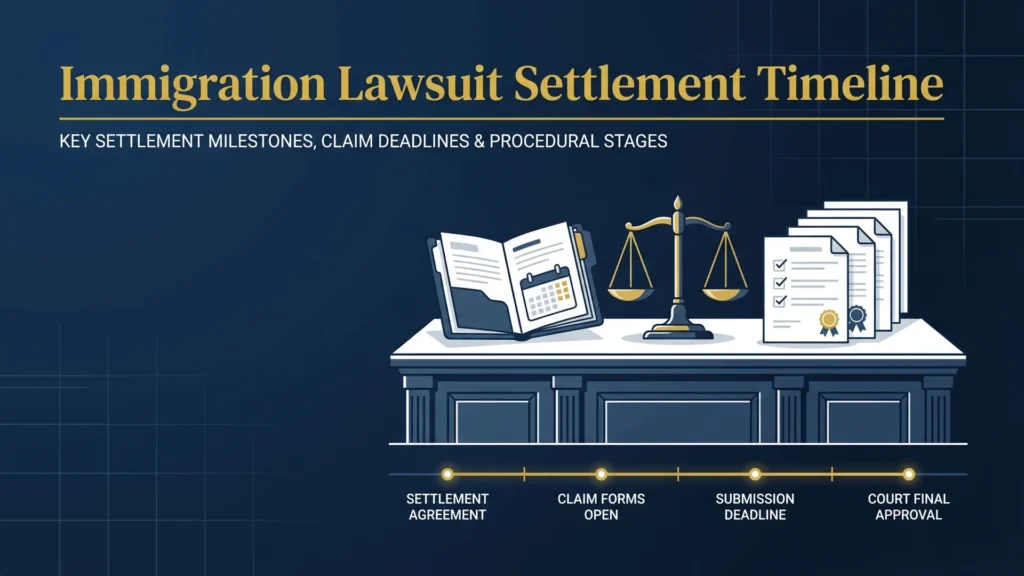
Joining an immigration class action lawsuit depends on whether the case is still pre-certification or already has an approved settlement with a claims process. How to join an immigration class action lawsuit depends on whether a case is still pre-certification or already has an approved settlement.
Before certification, you generally cannot “sign up.” The named plaintiffs and their attorneys represent the proposed class until a judge formally certifies it. After certification, notices typically go out to known class members.
Once a case reaches settlement, the process becomes more concrete. In a class action settlement, an administrator sets up a claims process and notices go out to eligible class members.
Steps to check your status:
- Search the case name and docket number on the relevant federal court’s electronic record system
- Watch for a formal notice by mail or email once a class is certified
- Contact the class counsel’s office listed in the official complaint
- Avoid any third party demanding payment to “register” you for a class action
No legitimate immigration class action ever requires you to pay money upfront to join.
Immigration Lawsuit Filing Deadlines 2026
Immigration lawsuit filing deadlines in 2026 vary case by case, with some tied to statutes of limitations and others tied to settlement claim windows. There is no single universal deadline across all immigration lawsuits.
The GEO Group settlement has a specific court deadline right now. The terms are due in court by December 11, 2026.
The ACLU’s surveillance case also has firm dates on the calendar. The government has until December 14 to file a response, with a preliminary-injunction hearing scheduled for January 6.
| Deadline | What Happens |
|---|---|
| December 11, 2026 | GEO Group settlement terms due in Colorado court |
| December 14, 2026 | Government response due in ACLU Investigation 18 case |
| January 6, 2027 | Preliminary injunction hearing, ACLU case |
Mark these dates if you are following either case closely, since missed deadlines often trigger the next major filing or ruling.
Supreme Court Immigration Lawsuit Rulings 2026
Supreme Court immigration lawsuit rulings in 2026 have already reshaped two major areas of law: asylum access and detainee litigation procedure. Two separate decisions landed within months of each other.
The bigger of the two dealt with asylum seekers waiting at the border. A non-citizen “arrives in the United States” under the Immigration and Nationality Act only when they cross the border, so the INA neither entitles a non-citizen standing in Mexico to apply for asylum nor requires an immigration officer to inspect them.
The underlying complaint had raised several legal theories before the Court narrowed the question. The complaint included claims under APA section 706(1) for withholding agency action, APA section 706(2), the INA’s inspection and asylum-eligibility provisions, the Alien Tort Statute, and the Due Process Clause of the Fifth Amendment.
The second ruling involved the GEO Group case and a narrower procedural issue. The GEO Group, Inc. v. Menocal was argued November 10, 2025 and decided February 25, 2026.
Key Takeaway: Two Supreme Court rulings in 2026, one on border asylum access and one on detainee case procedure, now shape how every lower immigration lawsuit gets argued going forward.
What Happens After an Immigration Lawsuit Settles
What happens after an immigration lawsuit settles is a multi-step process that can take months before anyone sees a payment. Settlement announcement is only the first step, not the finish line.
The GEO Group case shows this pattern clearly. No amount, claim form, or deadline exists as of November 4, 2026, since the settlement amount is not public and no court has approved anything yet.
Court approval is the next required step before any claims process opens. A judge reviews the settlement terms, checks whether they are fair to the class, and often holds a hearing before signing off. Only after approval does a claims administrator typically send notices and open a claim window.
Typical post-settlement steps:
- Settlement terms filed with the court (for GEO Group: due December 11, 2026)
- Judge reviews terms for fairness to the class
- Claims administrator appointed
- Notices mailed or emailed to known class members
- Claim window opens with a filing deadline
- Approved payments distributed
Patience is not optional here. Even a well publicized settlement can take six months to a year before checks actually go out.
Frequently Asked Questions
What is the detailed immigration lawsuit everyone is talking about in 2026?
There is no single case. Multiple major immigration lawsuits are active right now, including the GEO Group detainee wage settlement and the ACLU’s Investigation 18 surveillance case.
Each one covers a different group of people and a different legal claim.
Who qualifies for an immigration lawsuit settlement in 2026?
Qualification depends entirely on the specific case’s class definition. Most require a specific location, time period, and type of harm, like detention at a named facility during a set date range.
Check the actual complaint rather than relying on general headlines.
How much money can I get from an immigration lawsuit?
Most 2026 immigration cases have no finalized payout amount yet. The GEO Group case estimated over $5 million for roughly 300 claimants in its original complaint, but the current settlement terms remain undisclosed.
Policy lawsuits like the ACLU’s Investigation 18 case seek court orders, not individual payments.
How do I know if I am part of an immigration class action lawsuit?
You typically receive a formal notice once a class is certified. Before certification, named plaintiffs represent the proposed class and you cannot sign up directly.
Checking the court docket for the specific case name is the most reliable method.
When will immigration lawsuit settlements actually pay out?
Payouts follow court approval of settlement terms, which can take months after a settlement is first announced. For the GEO Group case, terms are due in court by December 11, 2026, with no claim form available yet.
Final payments usually come after a separate claims process is set up.
Final Word on the Detailed Immigration Lawsuit Landscape
Tracking a detailed immigration lawsuit in 2026 means watching several moving cases at once, not just one headline. The GEO Group settlement, the ACLU’s Investigation 18 case, and the re-detention and Medicaid lawsuits are all evolving week by week.
Check official court dockets before trusting any third party claiming to process your claim. Bookmark this page and revisit it as settlement terms, deadlines, and rulings get finalized in the coming months.