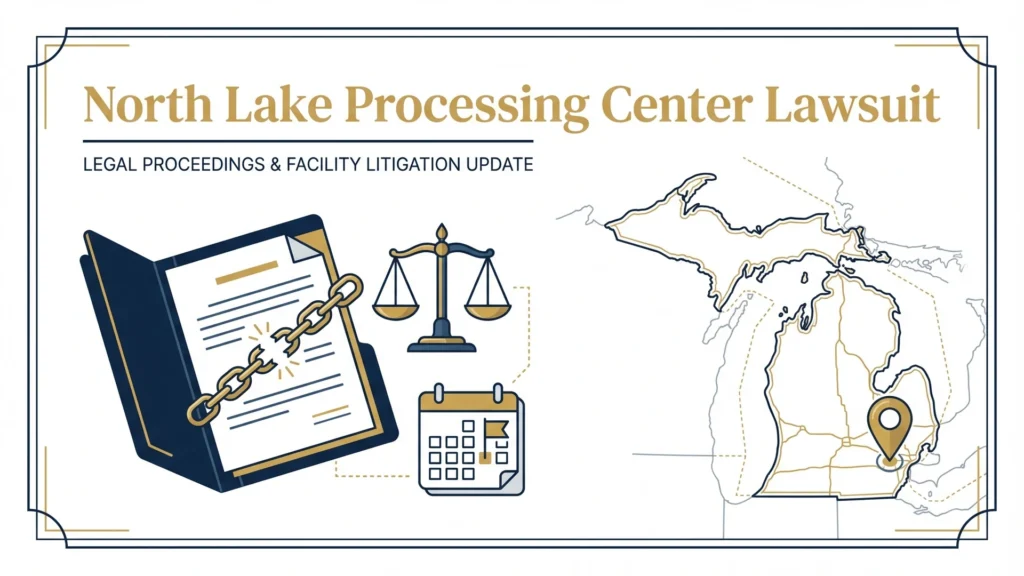
The immigration lawsuit north Michigan families are watching in 2026 centers on one place: the North Lake Processing Center in Baldwin, Michigan. Hundreds of detainees have filed habeas corpus petitions, and federal judges keep ruling their detention was unlawful.
This isn’t some small local dispute. North Lake Correctional Facility is a privately owned medium and maximum security prison that reopened in 2025 as the North Lake Processing Center, and it is now the largest immigrant detention center in the Midwest.
In this guide, you’ll learn who qualifies for relief, how the filing process works, what bond amounts look like, and what’s happening right now at the facility. We’ll also cover the hunger strike, the ongoing investigations, and where the case law stands heading into 2026’s final months.
One stat should grab your attention first. The average daily population at the North Lake facility in Michigan has ballooned to more than 1,300 people. That’s a small city locked inside one building in rural Lake County.
Related: Full Immigration Lawsuit 2026: Cases, Payouts, Deadlines
What Is the North Lake Processing Center Lawsuit
The North Lake Processing Center lawsuit is really hundreds of individual federal habeas corpus cases, not one single class action. Each case challenges whether a specific detainee is being held legally.
As the population in the privately run North Lake Processing Center in Baldwin grew in September 2025, habeas corpus petitions started to show up in Michigan’s federal district courts. That flood has not slowed down.
Since it reopened as an immigration detention center last summer, North Lake has detained thousands of people arrested in an unprecedented deportation campaign. Most petitions get filed under 28 U.S.C. § 2241, the federal habeas corpus statute.
Quick Facts Box:
- Facility location: Baldwin, Lake County, Michigan
- Reopened: June 2025, as a privately run ICE facility
- Legal vehicle: Writ of habeas corpus under 28 U.S.C. § 2241
- Court: U.S. District Court, Western District of Michigan
Who Qualifies for a Habeas Corpus Petition at North Lake
You qualify to file a habeas corpus petition if you are currently detained at North Lake and believe your confinement violates federal law or the Constitution. This isn’t limited to people with strong immigration cases; it’s about whether the detention itself follows the rules.
Many petitioners argue they’re being held under the wrong legal framework. Immigration officials have applied mandatory detention statutes to people who should instead be entitled to a bond hearing before an immigration judge.
Noncitizens held in custody under 8 U.S.C. § 1226(a) while their petitions for review of removal orders are pending are entitled to a bond hearing before an immigration judge. That single legal distinction has decided hundreds of cases.
Common petitioner profiles include:
- People detained after routine traffic stops
- Long-term U.S. residents with pending immigration cases
- Asylum seekers awaiting a bond determination
- People transferred to North Lake from other states, including Illinois and Chicago-area arrests
How to File an Immigration Lawsuit in Michigan
Filing starts with a petition for writ of habeas corpus in the Western District of Michigan, not a typical civil complaint. Detainees can file pro se (without a lawyer) or through counsel, though represented petitioners tend to move faster.
A United States Immigration and Customs Enforcement detainee at the North Lake Processing Center can initiate this type of action by filing a pro se petition for a writ of habeas corpus. That said, most successful petitions in 2026 have been counseled filings.
The petition typically asks the court to:
- Accept jurisdiction over the case
- Declare the detention unconstitutional under the Fifth Amendment
- Order release or a prompt bond hearing
- Award attorney’s fees and costs where applicable
Key Takeaway: Filing a habeas corpus petition in Western District of Michigan is the main legal path for North Lake detainees, and the outcome often hinges on which detention statute the court decides actually applies.
North Lake Processing Center Bond Hearing Rules
Bond hearing rules at North Lake depend entirely on which statute ICE claims covers the detainee. If the government applies mandatory detention rules, no bond hearing happens at all, which is exactly what many petitions challenge.
Judges in the Western District of Michigan have pushed back hard on this practice. Courts have concluded that detention under the mandatory detention framework set forth in § 1225(b)(2)(A) violates due process rights and have ordered the government to provide a bond hearing under 8 U.S.C. That ruling pattern repeats across dozens of North Lake cases.
Once a bond hearing is ordered, courts expect speed. This court has adopted a standard practice of requiring such a hearing within five business days.
| Detention Type | Bond Hearing Allowed | Typical Court Response |
|---|---|---|
| § 1226(a) discretionary detention | Yes | Bond hearing scheduled promptly |
| § 1225(b)(2) mandatory detention (misapplied) | No, until challenged | Often ordered within 5 business days after habeas win |
| Post removal order detention (§ 1231) | Limited | Case by case review |
Mandatory Detention Versus Bond Hearing Eligibility
Mandatory detention means ICE holds someone with no bond option, while bond hearing eligibility means a judge can set release terms. The difference between these two tracks is the single biggest legal fight happening at North Lake right now.
One judge’s language has become the rallying point for petitioners across the facility. A judge wrote that the recent shift to use the mandatory detention framework is not only wrong but also fundamentally unfair. Other judges have repeatedly referenced that language as they grant hundreds of habeas petitions coming out of the North Lake Processing Center.
Think of it like being arrested for a traffic ticket but held like you’re facing a murder charge. The classification determines everything that follows, including whether you see a judge at all.
- Mandatory detention: no bond hearing, used for people deemed inadmissible at entry
- Discretionary detention under § 1226(a): bond hearing available, flight risk and danger assessed
- Courts increasingly side with detainees who argue mandatory detention was wrongly applied
North Lake Michigan ICE Detention Conditions and Hunger Strike
Conditions at North Lake became a national story in spring 2026 when detainees organized a hunger strike over treatment inside the facility. On April 20, 2026, detainees at the processing center began a hunger strike.
The protest drew attention to overcrowding tied to the facility’s rapid population growth. With more than 1,300 people held daily, advocates say medical and legal access has suffered.
A retired West Michigan pastor has become a familiar face at the facility. Dale Dalman, a retired pastor in West Michigan, makes a point of visiting immigrants held at the North Lake Processing Center a few times a week.
Quick Facts Box:
- Hunger strike start: April 20, 2026
- Average population: 1,300 plus detainees
- Community response: ongoing visits from local clergy and advocates
- Oversight demand: independent investigation calls followed shortly after
Average North Lake Detention Bond Amounts
Bond amounts at North Lake typically fall in the range of several thousand dollars once a judge grants a hearing. Families describe scrambling to raise cash on short notice once bond is finally set.
One documented example shows how this plays out in real life. An immigration rights advocate posted a $10,000 bond to secure her nephew’s release from the North Lake detention center in January. That case involved a 19 year old relative detained at the facility.
| Bond Scenario | Approximate Range | Notes |
|---|---|---|
| Low risk, no criminal history | $1,500 to $5,000 | Faster approval once hearing is granted |
| Moderate risk cases | $5,000 to $10,000 | Common range reported by families |
| Higher scrutiny cases | $10,000 and up | Longer negotiation, possible appeal |
Not every petition ends in release on bond. In at least one case, a petitioner transported to North Lake after an illegal reentry conviction was denied habeas relief because he had not shown the required grounds a second time.
Key Takeaway: Bond amounts at North Lake vary widely, but winning the underlying habeas petition is usually the step that unlocks any bond hearing at all.
Timeline of the North Lake Processing Center Lawsuit
The North Lake litigation timeline stretches from a quiet facility reopening in mid-2025 to a wave of court rulings dominating headlines throughout 2026. Understanding the sequence helps explain why so many cases are moving through the courts at once.
| Date | Event |
|---|---|
| June 16, 2025 | Facility reopens as North Lake Processing Center |
| September 2025 | Habeas petitions begin flooding Western District of Michigan |
| February 2026 | Dalveilys Pineda’s habeas petition granted after nearly four months detained |
| March 2026 | Michigan Public reports hundreds of unlawful detention rulings |
| April 20, 2026 | Hunger strike begins inside the facility |
| April 2026 | Civil rights groups call for independent investigation |
| October to November 2026 | Continued individual habeas rulings, mixed outcomes |
A West Michigan judge granted Dalveilys Pineda’s habeas petition in February after nearly four months in detention at North Lake. That case is one of hundreds following a similar pattern.
Western District of Michigan Immigration Court Process
The Western District of Michigan handles the federal habeas corpus side of these cases, while a separate immigration court handles bond and removal proceedings. These are two different systems working in parallel, which confuses a lot of families.
Petitioners detained at North Lake have filed counseled petitions for writ of habeas corpus in the Western District of Michigan, challenging the lawfulness of their detention under the Immigration and Nationality Act. Meanwhile, bond requests often get routed through Detroit Immigration Court.
Some petitioners hit a wall there first. A petitioner contends he is entitled to a bond hearing under 8 U.S.C. § 1226 after pending removal proceedings, even after an immigration court initially found it lacked authority to hear the request.
Process Snapshot:
- Step 1: Detainee requests bond hearing at immigration court
- Step 2: If denied or ignored, petitioner files habeas corpus in federal district court
- Step 3: Court orders government to show cause within days
- Step 4: Judge rules on legality of detention
- Step 5: If granted, bond hearing ordered or immediate release
Who Is Being Sued in the North Lake Lawsuit
The named respondents in these cases are typically federal officials and the facility’s on site administrators, not the private company that owns the building. That distinction matters for anyone trying to figure out who holds legal responsibility.
Court records name specific officials repeatedly. Cases list the Warden of North Lake Processing Center alongside Immigration and Customs Enforcement, though courts have sometimes dismissed the warden as a respondent while keeping ICE in the case.
Higher level officials also appear as named defendants. Courts in at least one case declined to dismiss DHS Secretary Noem as a respondent given jurisdiction in the Western District of Michigan.
- Named respondents commonly include: ICE field office directors, facility wardens (sometimes dismissed), DHS Secretary Kristi Noem
- Private operator: owns and runs daily facility operations but is rarely the direct habeas respondent
- Related litigation: separate lawsuits target warrantless arrests and re-detention policies nationwide
Key Takeaway: Winning a case at North Lake usually means proving the federal government, not the private prison operator, violated detention law.
How Much Compensation Can Immigration Detainees Recover
Most North Lake habeas cases aim for release or a bond hearing, not cash compensation, but some petitions do seek attorney’s fees and costs. That’s an important distinction from typical personal injury or class action settlements covered elsewhere on this site.
Petitioners have asked courts to order their immediate release, declare their detention unconstitutional, and award attorney’s fees and costs for the action. Courts have granted the release and bond hearing portions far more often than monetary awards.
Separately, broader immigration lawsuits filed in 2026 do pursue financial and injunctive relief tied to wrongful detention practices. Attorneys representing affected families have said their clients complied with every condition of release, only to be systematically stripped of longstanding protections and arbitrarily re-detained. That re-detention lawsuit, filed in November 2026 across North Carolina, South Carolina, and Georgia, seeks broader court orders rather than individual payouts.
| Type of Relief Sought | How Common | Example |
|---|---|---|
| Immediate release | Very common | Most successful North Lake habeas wins |
| Bond hearing order | Very common | Ordered within 5 business days typically |
| Attorney’s fees and costs | Occasional | Requested alongside release |
| Broad injunctive relief | Growing in 2026 | Re-detention and warrantless arrest suits |
North Lake Processing Center Investigation and Oversight
Civil rights organizations formally called for an independent investigation into North Lake in April 2026, following the hunger strike and mounting habeas rulings. That call came directly from watchdog groups monitoring detention conditions nationwide.
Civil rights organizations called for an independent investigation into the Michigan ICE detention center in April 2026. That followed closely behind reporting on medical and legal access concerns inside the facility.
The facility’s financial performance drew separate scrutiny. The company that owns the Michigan ICE detention center reported a $254 million profit alongside record new business in 2025. That figure fueled criticism that population growth at North Lake was tied to profit incentives rather than capacity need.
- April 2026: Civil rights groups demand independent review
- Reported concern areas: medical access, legal visitation, overcrowding
- Financial context: facility operator posted record 2025 profits during the same period
What Happens After a Habeas Corpus Petition Is Granted
When a habeas corpus petition is granted, the court orders either immediate release or a prompt bond hearing, usually within days. This is the moment families wait for, often after months of uncertainty.
In one granted case, the court ordered respondents to release the petitioner from detention, subject to an order of supervision, within five days of the opinion and judgment. That five day window has become a common pattern in recent rulings.
Not every grant means the person walks free immediately. Some orders instead require a bond hearing rather than outright release, meaning the fight shifts to the immigration court for the actual bond amount.
Quick Facts Box:
- Typical compliance window after a grant: 3 to 5 business days
- Outcome type 1: Immediate release with order of supervision
- Outcome type 2: Bond hearing ordered, amount set separately
- Appeals: Government can appeal, which may delay release
How to Find a Lawyer for an ICE Detention Case in Michigan
Finding a lawyer for a North Lake case starts with immigration attorneys who specifically handle federal habeas corpus petitions, not general immigration paperwork. This is a narrower specialty than most people expect.
Legal aid groups and bar association referral services in West Michigan have been fielding a surge of these requests since late 2025. Private immigration attorneys near Grand Rapids and Detroit have also expanded habeas corpus practices specifically because of North Lake’s caseload.
When vetting a lawyer, ask about:
- Direct experience filing 28 U.S.C. § 2241 petitions
- Familiarity with Western District of Michigan judges and local rules
- Track record with North Lake specific cases
- Clear fee structure, since many families are managing costs on short notice
Community advocates have also stepped in where formal legal help is scarce. An immigrant rights advocate in Detroit had to scramble to get her own nephew out of the North Lake detention center after he was arrested by ICE, despite years of experience working on immigration issues. That story shows even experienced advocates find the process confusing.
Latest Updates on the North Michigan Immigration Lawsuit 2026
The latest development heading into the end of 2026 is a steady split between petitions that win and petitions that lose, depending heavily on each detainee’s specific facts. Courts are not treating every North Lake case the same way.
Recent rulings show both outcomes. In one case decided in 2026, the court denied a habeas petition without prejudice after the petitioner failed to show the required grounds a second time. Meanwhile, other petitioners continue winning bond hearings on similar underlying facts.
Beyond North Lake, 2026 has also seen a wave of related filings nationwide. A separate class action lawsuit filed in the Western District of North Carolina accuses ICE and CBP officers of detaining people without the legal standard required for a warrantless arrest, pointing to a January 2026 ICE memo that broadened what counts as flight risk.
Key Takeaway: The North Michigan immigration lawsuit landscape in late 2026 is active and evolving, with individual case facts mattering more than ever to the outcome.
Frequently Asked Questions
What is the immigration lawsuit in North Michigan about?
It centers on hundreds of habeas corpus petitions filed by detainees held at the North Lake Processing Center in Baldwin, Michigan.
Petitioners argue they are being wrongly held under mandatory detention rules instead of getting a bond hearing.
Federal judges in the Western District of Michigan have granted many of these petitions in 2026.
Who qualifies to file a habeas corpus petition at North Lake?
Any detainee currently held at North Lake who believes their detention violates federal law or due process can file.
This includes people denied a bond hearing despite not meeting mandatory detention standards.
Both pro se and attorney represented filings are accepted in the Western District of Michigan.
How much does it cost to get someone out of North Lake on bond?
Bond amounts reported by families have ranged from about $1,500 to $10,000 or more.
The exact figure depends on flight risk, criminal history, and the specific judge.
A bond hearing must be ordered first, which usually requires winning a habeas corpus case.
How long does a habeas corpus case take in Western District of Michigan?
Courts often order a bond hearing or release within three to five business days once a petition is granted.
The underlying habeas case itself can take weeks to months depending on court backlog.
Represented petitioners generally see faster movement than pro se filers.
Is the North Lake Processing Center still under investigation in 2026?
Yes, civil rights organizations called for an independent investigation in April 2026 after a hunger strike and reports of limited medical access.
The facility’s private operator also faced scrutiny over record profits during the same period.
As of late 2026, oversight calls remain active alongside ongoing habeas litigation.
Closing
North Lake has become the center of one of 2026’s biggest immigration detention fights, and the outcome still depends case by case. Hundreds have already won release or a bond hearing through federal court.
If you or a family member is detained at North Lake, don’t wait to act. Talk to an immigration attorney about a habeas corpus filing, track your court dates closely, and keep checking for updates as more rulings come down.
================================================================