The immigration lawsuit q2 2026 stretch, April through June, delivered more courtroom decisions than most years see in total. Three Supreme Court rulings landed in a single week. Lower courts vacated major asylum policies while denaturalization filings quietly hit an all-time high.
This article walks through every major development from the quarter. You’ll get the rulings, the raw numbers, who they affect, and what comes next.
Here’s one number that stops people cold: naturalization lawsuits were nearly double what they were a year earlier, and that was before the quarter even started heating up.
No legal jargon. No fluff. Just what happened and what it means for you.
Related: Trending NFL Lawsuit 2026: Every Major Case Explained Now
Immigration Lawsuit Q2 2026 Update: What Happened
The immigration lawsuit Q2 2026 update centers on three Supreme Court rulings, one major asylum case resolution, and a record spike in denaturalization filings. April through June saw courts move fast on cases that had been building for months.
Heading into the quarter, filings were already surging.
The latest available data from the federal courts showed that during March 2026 the government reported 9,911 new lawsuits filed involving immigration matters, up 9.2 percent over the previous month when the number totaled 9,077. That momentum carried straight into Q2.
By late June, three separate Supreme Court decisions landed within days of each other. The Court issued its decision in Mullin v. Al Otro Lado on June 25, 2026, ruling 6-3 that a non-citizen “arrives in the United States” only when they cross the border.
Quick Facts:
- June 5, 2026: Court vacated four federal asylum policies
- June 25, 2026: Two Supreme Court immigration rulings issued same day
- June 30, 2026: First birthright citizenship executive order struck down
Each of these threads gets its own breakdown below.
Q2 2026 Immigration Lawsuit Filings: By The Numbers
Q2 2026 immigration lawsuit filings kept pace with the record-breaking trend that started earlier in the year. The twelve-month period leading into the quarter already showed explosive growth across nearly every category of immigration litigation.
During the twelve months, an unprecedented total of 41,887 federal suits classified as involving immigration matters were filed, most of these challenging actions of the federal government. That’s not a typo. That’s tens of thousands of separate federal cases.
Civil immigration filings were up 1,278 percent from levels reported in March 2021. Think about that kind of jump. It’s the legal equivalent of a small creek turning into a flood.
| Filing Category | Year-Over-Year Change |
|---|---|
| Habeas Corpus | Up 85x |
| Naturalization | Up 1.8x |
| Overall Civil Filings | Up 1,278% since 2021 |
While many categories of immigration litigation were little changed over the past year, marked growth occurred for naturalization and habeas corpus lawsuits, with habeas lawsuits increasing by over 85 times. That single statistic explains why court dockets across the country felt overwhelmed this quarter.
Biggest Immigration Lawsuits Q2 2026: Top Cases To Know
The biggest immigration lawsuits Q2 2026 produced span asylum policy, refugee status, border crossing rules, and state-level enforcement fights. Several cases moved from filing to ruling within the same three-month window.
Here’s a rundown of the cases that mattered most:
- Dorcas International Institute v. USCIS: Challenged four asylum-related USCIS policies
- Mullin v. Al Otro Lado: Decided whether asylum seekers in Mexico can apply at the border
- Mullin v. Doe (Syrian TPS case): Determined whether Syrian nationals keep deportation protection
- Akari Angye et al v. ICE: Filed in Texas, ongoing as of May 2026
- Barco Mercado v. Mullin: Filed in New York, ongoing as of May 2026
- Lucy v. Skrmetti: Tennessee class action over state immigration enforcement law HB 1704
The American Civil Liberties Union, ACLU of Tennessee, and National Immigration Law Center filed a federal class-action lawsuit challenging a new Tennessee law, HB 1704, that unconstitutionally usurps federal immigration enforcement power by making it a crime for certain immigrants to remain in the state. That case landed right at the tail end of Q2.
Each case above gets a deeper breakdown further down this page.
Key Takeaway: Q2 2026 wasn’t one big story, it was five or six major legal fights happening simultaneously across asylum policy, border law, and state enforcement.
Immigration Lawsuit Statistics Q2 2026: What The Data Shows
Immigration lawsuit statistics Q2 2026 point to one conclusion: litigation volume kept climbing even as courts issued major rulings. The data trail leading into and through the quarter shows sustained, not slowing, growth.
Two districts had over 2,000 suits filed during this period: the Eastern District of California (Sacramento) with 2,797 filings and the Southern District of Texas (Houston) with 2,305 lawsuits filed. That’s two single courthouses handling more cases than many entire states see in a year.
The pattern wasn’t limited to a couple of hot spots either.
| District | Filings |
|---|---|
| E.D. California (Sacramento) | 2,797 |
| S.D. Texas (Houston) | 2,305 |
| S.D. California (San Diego, habeas only) | 1,740 |
| Arizona (habeas only, six months) | 1,104 |
Widespread news coverage had been given to unprecedented ICE-targeted immigration enforcement actions in each of these districts. The filing numbers simply tracked the enforcement activity happening on the ground.
Denaturalization Lawsuit Surge Q2 2026: Why Cases Spiked
The denaturalization lawsuit surge Q2 2026 saw a sharp jump in complaints filed in May and June, a trend that kept accelerating into the following month. This category had been relatively rare for years, which made the spike stand out.
Immigration fraud, specifically false identity, was the largest single underlying basis for denaturalization complaints historically and remained so for May and June 2026, according to a review TRAC painstakingly compiled. That means the government wasn’t chasing new legal theories, it was leaning hard into an existing one.
The numbers tell the story clearly.
| Period | False Identity/Fraud Complaints |
|---|---|
| January 2008 to April 2026 | 8 |
| May 1 to June 12, 2026 | 6 |
By the following month, the trend had turned into a record. Denaturalization lawsuits reached an all-time high in July 2026, with at least 50 complaints filed in a single month. That surge started building during Q2 and broke records right after it ended.
Habeas Corpus Immigration Lawsuits Q2 2026: The Numbers Behind The Surge
Habeas corpus immigration lawsuits Q2 2026 made up the single largest share of all immigration litigation filed during the quarter. These petitions challenge detention itself, and detainees filed them at a pace nobody had seen before.
A total of 31,357 habeas lawsuits were filed, at a rate of 92.2 per unit measured, with Texas’s Western District ranking first with 3,448 lawsuits filed and a rate of 425.4. That single district alone outpaced entire regions of the country.
Two border districts stood out specifically.
Two of these were located along the southwest border with Mexico: the Southern District of California (San Diego) with 1,740 habeas lawsuits and Arizona with 1,104 suits filed during the last six months. Detention centers near the border simply generated more legal challenges.
- Western District of Texas: 3,448 habeas filings, highest in the country
- San Diego: 1,740 filings
- Arizona: 1,104 filings in six months
Key Takeaway: Habeas corpus filings alone account for the overwhelming majority of the entire immigration litigation surge, meaning most of this fight is about detention, not deportation rulings themselves.
Birthright Citizenship Lawsuit Ruling June 2026: What The Supreme Court Decided
The birthright citizenship lawsuit ruling June 2026 struck down the administration’s first attempt to limit automatic citizenship for children born in the United States. The ruling came at the very close of the quarter and reshaped the entire legal fight going forward.
The Supreme Court struck down President Trump’s first attempt in a 6-3 ruling in June, and a federal judge blocked his second attempt in November. The administration didn’t wait long to try again.
| Event | Date |
|---|---|
| First EO struck down (SCOTUS) | June 30, 2026 |
| Second EO signed | August 6, 2026 |
| Second EO blocked | November 25, 2026 |
This back-and-forth pattern became a theme across multiple immigration policy fights this year. Courts strike down a policy, the administration issues a revised version, and litigation starts over.
For families affected, the practical upshot during Q2 was simple: birthright citizenship protections held, at least temporarily, through the end of June.
Asylum Policy Lawsuit Q2 2026: Dorcas Institute v. USCIS Explained
The asylum policy lawsuit Q2 2026 centerpiece was Dorcas International Institute v. USCIS, a case that went from filing to full victory in just three months. Few cases move that fast through the federal court system.
On March 5, 2026, a coalition of nonprofit organizations filed a lawsuit against USCIS, challenging four of its adjudication and review policies: the Global Asylum Hold, Benefits Hold, Travel Ban Re-Review, and Country-Specific Factors Policy. Just under a month later, plaintiffs pushed for a fast resolution.
On April 3, 2026, the plaintiffs filed a motion for summary judgment asking the court to strike down the challenged policies. The court didn’t take long to decide.
On June 5, 2026, the court granted the motion for summary judgment, vacating all four policies and declaring them unlawful. That’s a complete win for plaintiffs on every policy they challenged.
- March 5, 2026: Lawsuit filed
- April 3, 2026: Summary judgment motion filed
- June 5, 2026: All four policies vacated
This case now stands as one of the fastest major immigration policy wins of the year.
Syrian TPS Supreme Court Ruling Q2 2026: Mullin v. Doe Breakdown
The Syrian TPS Supreme Court ruling Q2 2026 ended protections for Syrian nationals living under Temporary Protected Status, siding with the administration on nearly every claim. The case had been building since late 2025.
Oral arguments were heard April 29, 2026, and the Supreme Court issued its 6-3 ruling against the plaintiffs on June 25, 2026. That decision stripped deportation protections that had shielded thousands of Syrian nationals.
| Date | Event |
|---|---|
| October 2025 | Lawsuit filed in SDNY |
| February 2026 | Second Circuit upheld delay order |
| April 29, 2026 | Supreme Court oral arguments |
| June 25, 2026 | Ruling issued, 6-3 against plaintiffs |
Not every claim died with this ruling. The surviving claims are narrow, and the real fight has shifted toward Congress and parallel cases involving other countries. So the case isn’t fully closed, it’s just narrowed significantly.
Key Takeaway: Three separate Supreme Court rulings landed within days of each other at the end of Q2, making late June 2026 one of the busiest stretches for immigration law in recent memory.
Mullin v. Al Otro Lado Ruling Explained
The Mullin v. Al Otro Lado ruling settled a years-long fight over whether asylum seekers waiting in Mexico have a legal right to apply for protection at the U.S. border. The Supreme Court sided against them.
The Court held that a non-citizen “arrives in the United States” under the Immigration and Nationality Act only when they cross the border, so the INA neither entitles a non-citizen standing in Mexico to apply for asylum nor requires an immigration officer to inspect them. That’s a narrow reading of the law with wide practical consequences.
The case moved through the system over several months.
Oral arguments were heard on March 24, 2026, as part of the 2025 term. The decision followed three months later, matching the timing of the other major June rulings.
- Ruling date: June 25, 2026
- Vote: 6-3, split along ideological lines
- Effect: No asylum right for those waiting outside the border
This ruling directly affects anyone waiting across the border hoping to apply for asylum once they reach U.S. soil.
Immigration Court Backlog Q2 2026: Why Closures Hit A Record
The immigration court backlog Q2 2026 situation improved in raw numbers even as the system strained under record caseloads. June alone saw more cases closed than any month on record, almost entirely through removal orders.
Case closures during June 2026 climbed to an all-time high of 100,773, largely driven by a 30 percent jump in removals ordered by Immigration Judges. That’s a staggering number for a single month.
The shift toward removal orders accelerated through the quarter.
During the March through June 2026 period, removal orders accounted for a larger proportion of all case closures, rising from 70% to 78%, and over two-thirds (68%) of individuals were not present at the court hearing where they were ordered removed. Most people weren’t even in the room when their case closed.
| Metric | June 2026 |
|---|---|
| Total case closures | 100,773 |
| Removal order share | 78% |
| Individuals absent at hearing | 68% |
Despite record closures, the overall backlog stayed enormous heading out of the quarter, sitting above three million pending cases nationwide.
Who Qualifies For An Immigration Lawsuit Settlement In 2026
Qualifying for an immigration lawsuit settlement in 2026 depends entirely on which case applies to your situation. There’s no single settlement covering everyone, each case has its own class definition and timeline.
Here’s how eligibility breaks down across the major 2026 cases:
| Case Type | Who Typically Qualifies |
|---|---|
| GEO Group detainee case | People detained at GEO facilities, forced labor claims |
| Birthright citizenship cases | Families with U.S.-born children affected by the EO |
| Syrian TPS case | Syrian nationals holding or applying for TPS status |
| Asylum policy cases | Applicants affected by vacated USCIS holds |
| Denaturalization defense | Naturalized citizens facing fraud-based complaints |
If you believe one of these categories fits your situation, the next step is documentation. Gather any notices, denial letters, or court filings tied to your case.
Class action notices typically arrive by mail or email once a settlement administrator takes over. Watch for official court communications rather than unsolicited calls or texts claiming to represent your case.
Key Takeaway: Eligibility in 2026 immigration litigation is case-specific, so the single most useful thing you can do is identify exactly which lawsuit matches your circumstances before assuming you qualify for anything.
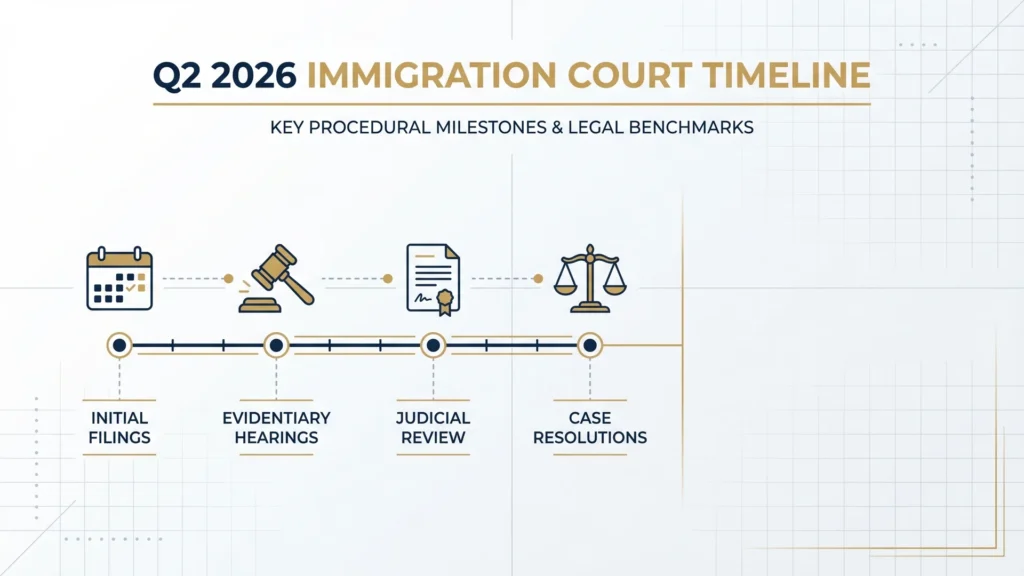
Immigration Lawsuit Timeline Q2 2026: Month By Month
The immigration lawsuit timeline Q2 2026 shows a clear pattern: April built momentum, May brought a wave of new filings, and June delivered nearly every major ruling at once.
| Month | Major Events |
|---|---|
| April 2026 | Summary judgment motion filed in Dorcas v. USCIS (April 3); Supreme Court oral arguments in Syrian TPS case (April 29) |
| May 2026 | Akari Angye v. ICE filed in Texas; Barco Mercado v. Mullin filed in New York; denaturalization filings begin climbing |
| June 2026 | Dorcas v. USCIS summary judgment granted (June 5); Mullin v. Al Otro Lado and Syrian TPS rulings issued (June 25); birthright citizenship EO struck down (June 30); Lucy v. Skrmetti filed in Tennessee; immigration court closures hit record high |
Notice how much concentrated in the final week of June. That’s not unusual for the Supreme Court, which often clears its biggest decisions right before summer recess.
One 2026 case went from filing to a full court ruling in just three months: the lawsuit was filed March 5, 2026, a motion for summary judgment followed April 3, 2026, and the court granted that motion on June 5, 2026, vacating all four challenged policies. That pace is unusually fast for federal litigation.
What Happens After An Immigration Lawsuit Q2 2026 Ruling
What happens after a Q2 2026 immigration lawsuit ruling depends on whether the losing side appeals and whether the ruling created a certified class. Most of these cases don’t simply end with a single decision.
For rulings that strike down a policy, like the Dorcas Institute case, the government can either comply, appeal, or attempt to issue a revised version of the policy. The birthright citizenship fight already shows this pattern playing out, with a second executive order signed just weeks after the first was struck down.
For rulings that favor the government, like the Syrian TPS and Mullin v. Al Otro Lado decisions, affected individuals often shift strategy toward narrower constitutional claims or legislative advocacy instead of further appeals.
- Policy struck down: Government may appeal or reissue a revised policy
- Class action settlement: Administrator sets up claims process, notices go out
- Ruling against plaintiffs: Remaining narrow claims may continue in lower courts
Settlement administration, when it applies, typically takes months to organize after a ruling. Payment timelines vary widely depending on how many claimants come forward and how the court structures distribution.
Immigration Lawsuit News This Week 2026: What To Watch Next
Immigration lawsuit news this week in 2026 keeps building on the foundation set during Q2, with new cases emerging through the fall tied directly back to the quarter’s major rulings.
The ACLU filed a case on November 16, 2026, in Washington D.C., asking the court to block the government’s practice of using the grand jury process to investigate ICE critics. That case traces its roots to the enforcement environment that intensified throughout the year.
The denaturalization trend that started in Q2 kept accelerating too. By July, filings had already broken records, and advocacy groups expect that pace to continue into 2027.
- Watch for: Appeals in the Dorcas Institute asylum case
- Watch for: Second birthright citizenship executive order litigation
- Watch for: Continued denaturalization filing records
Key Takeaway: Nearly every major immigration legal fight happening right now traces its roots directly back to decisions and filings that started during the Q2 2026 window.
Frequently Asked Questions
What is the immigration lawsuit Q2 2026 about?
It refers to the cluster of major federal immigration rulings and filings between April and June 2026.
This includes Supreme Court decisions on asylum, TPS, and birthright citizenship.
It also covers a record surge in denaturalization and habeas corpus filings.
How many immigration lawsuits were filed in Q2 2026?
Exact Q2-only totals aren’t broken out separately, but the surrounding twelve-month period saw 41,887 federal immigration suits filed.
Habeas corpus cases made up the largest single category.
Filing volume stayed elevated throughout the quarter.
What was the biggest immigration lawsuit ruling in Q2 2026?
The biggest ruling was arguably the Supreme Court’s June 25, 2026 decision in Mullin v. Al Otro Lado.
It determined that asylum seekers in Mexico have no right to apply for asylum before crossing the border.
Two other major rulings, on Syrian TPS and asylum policy, landed within days of it.
Did the Supreme Court rule on birthright citizenship in Q2 2026?
Yes, the Supreme Court struck down the administration’s first birthright citizenship executive order on June 30, 2026.
The vote was 6-3.
A second executive order followed weeks later in August.
What happens next after the Q2 2026 immigration lawsuit rulings?
Appeals, revised policies, and new filings are already underway as of late 2026.
The denaturalization surge that began in Q2 broke records by July.
New cases, including an ACLU filing in November, trace directly back to the quarter’s events.
Q2 2026 reshaped immigration law faster than almost any stretch in recent memory. Asylum policy, TPS protections, and birthright citizenship all saw major court action within the same three months.
If any of these cases might apply to your situation, start gathering documentation now. Settlement notices and class certifications often move quickly once a ruling lands.
Keep checking for updates. This area of law isn’t slowing down, and the cases that started in Q2 are still shaping headlines today.
================================================================