A superior court case lookup lets you find public court records online or in person. You can search by name, case number, or filing date. Millions of Americans search court records every single year. They do it for background checks, legal disputes, or personal reasons.
In 2026, most states now offer digital access to superior court databases. This guide walks you through every search method available today. You will learn how to find both civil and criminal cases fast.
We also cover sealed records and certified document requests. Over 80 percent of U.S. counties now provide online case search tools. The whole process is far simpler than most people think. Let us break it all down.
Superior Court Case Lookup
A superior court case lookup is a search tool that retrieves case records from a state trial court. These courts handle the most serious civil and criminal matters in each county.
Related: Court Case Lookup 2026: The Complete Free Search Guide
Every state structures its superior courts slightly differently. California calls them Superior Courts. Arizona uses the same name. New York calls its equivalent the Supreme Court. The function is the same regardless of the label.
Think of it like a library catalog for legal cases. You enter a name or number. The system returns matching case files and docket entries.
Most lookups reveal the case type, filing date, parties involved, and current status. Some systems also show hearing dates and final judgments.
Quick Fact: Over 100 million case records are filed in U.S. state courts each year.
| Search Detail | What You Get |
|---|---|
| Case Type | Civil, criminal, family, probate |
| Filing Date | When the case was opened |
| Parties | Plaintiff and defendant names |
| Status | Active, closed, or pending |
How to Search Superior Court Records Online
You can search superior court records online through your state or county court website. Most jurisdictions launched upgraded digital portals between 2023 and 2025.
Start by visiting the official court website for the county where the case was filed. Look for a tab labeled “Case Search” or “Public Access.” Enter your search criteria and review the results.
Some states use a unified system for all counties. California uses a single portal for all 58 counties. Other states require you to visit each county site separately.
The search is usually free for basic information. Detailed documents may require a small fee per page. Expect to pay between $0.50 and $1.00 per page for downloads.
- Visit the official county or state court site
- Select the case search or public access portal
- Enter a name, case number, or date range
- Review results and download available documents
Key Takeaway: A superior court case lookup is your starting point for finding any trial court record, and most states now let you search online for free.
Find Court Case by Name
Finding a court case by name is the most common search method available. You enter the full legal name of a plaintiff or defendant into the search field.
The system returns all cases associated with that name in the selected jurisdiction. Common names may return hundreds of results. Narrow your search by adding a middle initial or date range.
Name searches work best when you know the exact spelling used on court filings. Legal documents use formal legal names, not nicknames. A search for “Bill Smith” may miss a case filed under “William J. Smith.”
Some courts also allow partial name searches. You can type the first few letters of a last name. The system will suggest matching records.
| Name Search Tip | Why It Matters |
|---|---|
| Use full legal name | Avoids missed results |
| Add middle initial | Filters out common names |
| Try name variations | Catches maiden or married names |
| Use date range | Narrows large result sets |
Superior Court Case Number Search
A superior court case number search is the fastest and most precise way to find a specific case. Every case gets a unique number when it is first filed with the court clerk.
Case numbers follow a standard format in most states. They typically include the year, case type code, and a sequential filing number. A California example looks like this: 24CV-001234.
The “24” means the case was filed in 2024. “CV” stands for civil. The final digits are the sequential case number for that year. Criminal cases might use “CR” instead.
If you have the case number, skip the name search entirely. Enter the number directly into the search field. You will get one exact match in seconds.
- Locate the case number on any court document you received
- Enter it into the court’s online search portal
- Verify the case type and parties match your records
- Download the docket or case file as needed
Key Takeaway: Searching by name works well for general lookups, but a case number search gives you instant, exact results every time.
Superior Court Docket Search
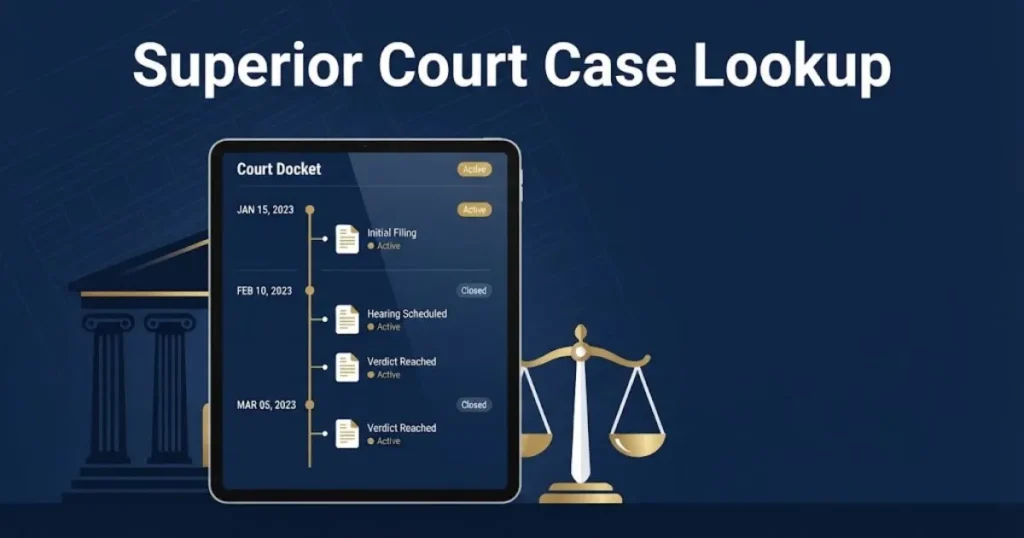
A superior court docket search retrieves the chronological log of every action taken in a case. The docket is essentially the case timeline.
Each docket entry shows a date, a description of the event, and the document filed. You will see entries for complaints, motions, hearings, orders, and judgments.
Think of the docket like a receipt log at a store. Every transaction gets a timestamp and a description. The docket does the same for legal actions.
Docket searches are available on most county court websites. Some states charge a small fee for full docket access. Basic docket summaries are often free.
| Docket Entry Type | What It Means |
|---|---|
| Complaint Filed | The lawsuit was officially started |
| Motion Filed | A party asked the court for a ruling |
| Hearing Scheduled | A court date was set |
| Judgment Entered | The case reached a final decision |
Superior Court Civil Case Lookup
A superior court civil case lookup retrieves records for non-criminal legal disputes. These include personal injury claims, contract disputes, property cases, and family law matters.
Civil cases make up roughly 60 percent of all superior court filings nationwide. The most common types are debt collection, divorce, and personal injury.
When you search for a civil case, you will see the plaintiff and defendant names. You will also see the amount in dispute if it was stated in the complaint.
Civil case records are almost always public. The main exceptions involve minors, trade secrets, or sealed settlements. Most details are available to anyone who searches.
- Personal Injury: Car accidents, slip and fall, medical malpractice
- Contract Disputes: Breach of contract, unpaid invoices
- Family Law: Divorce, custody, child support
- Property: Boundary disputes, eviction, foreclosure
Key Takeaway: Docket searches give you the full timeline of a case, while civil case lookups let you explore the most common type of court filing in America.
Superior Court Criminal Case Search
A superior court criminal case search pulls records for felony charges and serious misdemeanor cases. Superior courts handle the most serious criminal matters in each state.
Criminal case records show the defendant name, charges filed, arraignment date, and case disposition. You can see whether the case ended in a conviction, acquittal, or dismissal.
These records are public in most states. However, some details may be redacted to protect victims or witnesses. Juvenile criminal records are almost always sealed.
A criminal case search is commonly used for employment background checks. Landlords also use them during tenant screening. The Fair Credit Reporting Act governs how these records can be used.
| Record Detail | Availability |
|---|---|
| Defendant Name | Public |
| Charges Filed | Public |
| Court Hearings | Public |
| Victim Information | Often Redacted |
| Juvenile Records | Sealed |
County Superior Court Records Access
County superior court records access varies depending on where the case was filed. Each county manages its own records and search systems.
Large urban counties like Los Angeles, Maricopa, and Cook have advanced online portals. You can search, view, and download records from home. Rural counties may still require an in-person visit to the courthouse.
In 2026, roughly 82 percent of U.S. counties offer some form of online case access. That number has grown steadily since 2020. The remaining counties rely on public access terminals inside the courthouse.
If your county lacks online access, call the court clerk’s office directly. They can confirm whether records are available by mail or fax. Processing times for mail requests typically range from 5 to 15 business days.
- Check the county court website first
- Call the clerk’s office if no portal exists
- Visit in person for older or archived records
- Request mail delivery if you cannot travel
Key Takeaway: Criminal case searches reveal charges and outcomes, while county-level access determines whether you can search from home or need to visit the courthouse.
Court Case Lookup by Defendant Name
A court case lookup by defendant name lets you find all cases filed against a specific person. This is one of the most targeted search methods available.
Enter the defendant’s full legal name into the court search portal. Select “defendant” as the party type if the system offers that filter. This eliminates cases where the person was the plaintiff.
This type of search is popular among landlords, employers, and attorneys. It helps identify patterns of litigation or outstanding legal issues. A single defendant may have multiple cases across different counties.
Keep in mind that name matches do not guarantee identity. Two people can share the same name. Always verify the date of birth or address to confirm you have the right person.
| Search Filter | Purpose |
|---|---|
| Party Type: Defendant | Shows only cases against the person |
| Date Range | Limits results to a specific period |
| Case Type | Filters by civil or criminal |
| Jurisdiction | Narrows to a specific county |
Superior Court Case Status Check
A superior court case status check tells you whether a case is active, pending, or closed. This is the quickest way to see where a case stands right now.
Most online portals display the status prominently at the top of the case summary. Common status labels include “Active,” “Pending Trial,” “Settled,” “Dismissed,” and “Judgment Entered.”
If a case shows “Active,” it means the court is still processing it. Hearings may be scheduled. Motions may be pending. A “Closed” status means the case is fully resolved.
Case status updates are not always instant. Some courts update their systems only once per week. Others update in real time. Check the court website for its specific update schedule.
- Active: Case is ongoing with pending actions
- Pending: Awaiting a hearing or ruling
- Settled: Parties reached an agreement
- Dismissed: Case was dropped by the court or plaintiff
- Judgment Entered: Final decision has been made
Key Takeaway: Searching by defendant name helps you find all cases against a person, and a status check tells you exactly where each case stands today.
Free Public Court Records Search
A free public court records search is available in most states for basic case information. You can view case summaries, party names, and filing dates at no cost.
The free tier typically covers the case index and docket summary. You can see what happened and when. You cannot usually download full documents for free.
Some states offer more generous free access than others. California provides free online access to case summaries in all 58 counties. Texas offers free access through its statewide judicial portal. New York limits free access to basic index information.
If you need full documents, expect to pay a per-page fee. Most courts charge between $0.25 and $1.00 per page for printed copies. Electronic downloads may cost slightly less.
| Access Level | Cost | What You Get |
|---|---|---|
| Basic Index | Free | Case number, parties, filing date |
| Docket Summary | Free | Timeline of case events |
| Full Documents | $0.25 to $1.00/page | Motions, orders, judgments |
| Certified Copies | $5 to $25/document | Official sealed copies |
Superior Court Calendar and Hearing Search
A superior court calendar and hearing search lets you find upcoming court dates and scheduled hearings. This is useful if you need to attend a hearing or track a case timeline.
Most court websites have a dedicated “Calendar” or “Court Schedule” section. You can search by judge name, courtroom number, case number, or date. The results show all hearings scheduled for that day or week.
Calendar searches are especially helpful for attorneys and self-represented litigants. You can confirm your hearing time and courtroom assignment. Some systems also show whether a hearing was continued or canceled.
Hearing calendars are typically updated daily. Check the calendar the morning of your hearing for any last-minute changes. Courtrooms sometimes shift assignments due to scheduling conflicts.
- Search by case number for your specific hearing
- Filter by judge or courtroom for broader schedules
- Check daily for updates or continuances
- Arrive early to allow time for security screening
Key Takeaway: Free searches cover basic case details, while calendar searches help you track upcoming hearings and courtroom assignments in real time.
Superior Court Filing and Document History
Superior court filing and document history shows every document submitted to the court in a specific case. This includes the original complaint, all motions, responses, and final orders.
The filing history is part of the official case record. Each entry includes the filing date, document title, and the party who submitted it. You can trace the entire life of a case through these entries.
Electronic filing has become the standard in most superior courts. Over 90 percent of new cases in major counties are now filed electronically. This means digital records are more complete than ever before.
Older cases may have incomplete digital records. Cases filed before 2010 often exist only on paper or microfilm. You may need to visit the court archives to access these older documents.
| Filing Era | Record Format | Access Method |
|---|---|---|
| 2015 to 2026 | Electronic | Online portal |
| 2005 to 2014 | Mixed | Online and in-person |
| Before 2005 | Paper/Microfilm | In-person at courthouse |
How to Access Sealed Court Records
Sealed court records are case files that a judge has ordered to be hidden from public view. You cannot access them through a standard online search.
Records are typically sealed to protect minors, trade secrets, or sensitive personal information. Some settlements include confidentiality clauses that require sealing. Criminal cases involving juvenile defendants are almost always sealed by law.
Accessing sealed records requires a formal court motion. You must file a petition explaining why you need access. A judge will review your request and decide whether to grant it.
The process can take 30 to 90 days depending on the court. There is no guarantee your request will be approved. You may need an attorney to help draft the petition.
- Identify the specific case and court
- File a motion to unseal with the court clerk
- Provide a compelling legal reason for access
- Attend a hearing if the judge requires one
- Wait for the court’s written decision
Key Takeaway: Filing histories give you the full document trail of a case, but sealed records require a formal legal process to access.
How to Request Certified Court Documents
Certified court documents are official copies bearing the court seal and clerk’s signature. You need them for legal proceedings, immigration applications, and official background checks.
A regular printout from an online portal is not a certified copy. It may show the same information, but it lacks the official seal. Government agencies and courts require certified copies for legal purposes.
To request certified documents, contact the court clerk’s office in the county where the case was filed. You can usually submit your request in person, by mail, or through an online form.
Processing times vary by county. In-person requests are often fulfilled the same day. Mail requests typically take 7 to 14 business days. Fees range from $5 to $25 per document.
| Request Method | Processing Time | Typical Fee |
|---|---|---|
| In Person | Same day | $5 to $15 |
| By Mail | 7 to 14 days | $10 to $25 |
| Online Form | 3 to 7 days | $10 to $20 |
Frequently Asked Questions
How do I look up a superior court case for free?
Visit your county or state court website and use the public case search portal. Basic case information like party names, filing dates, and case status is free in most jurisdictions. Full document downloads may require a small per-page fee.
Can I search court records by someone’s name?
Yes, most court search portals allow you to search by plaintiff or defendant name. Use the person’s full legal name for the best results. Add a date range or middle initial to narrow down common names.
How long does it take to get court documents?
In-person requests at the clerk’s office are often fulfilled the same day. Mail requests typically take 7 to 14 business days. Online document downloads are usually instant once payment is processed.
Are all superior court cases public record?
Most superior court cases are public record and available to anyone. Exceptions include sealed cases, juvenile proceedings, and cases involving sensitive personal information. A judge must issue a specific order to seal a case file.
What is the difference between a docket and a case file?
A docket is a chronological log of every action taken in a case. A case file contains the actual documents filed, such as complaints, motions, and orders. The docket tells you what happened. The case file shows you the paperwork behind it.
Your next step is simple. Visit your county court website and try a basic name or case number search. Check the filing history, review the docket, and download any documents you need. If records are sealed or unavailable online, contact the court clerk directly. Stay proactive and keep checking back for updates on active cases.