The Dred Scott court case is the 1857 Supreme Court ruling that declared enslaved people and their descendants were not United States citizens. It remains one of the most studied, and most criticized, decisions in American legal history.
This article breaks down what actually happened, who was involved, and why the ruling still gets discussed in classrooms and courtrooms nearly 170 years later.
Here’s a fact that surprises a lot of people: Dred Scott was freed just months after he lost his Supreme Court case, through a private transaction that had nothing to do with the ruling itself.
You’ll get the timeline, the legal reasoning, the dissents, and the amendments that eventually wiped the decision off the books.
Related: Los Angeles Superior Court Case Summary: Full 2026 Guide
Dred Scott Court Case Overview
The Dred Scott court case is the common name for Dred Scott v. Sandford, a Supreme Court decision issued on March 6, 1857. The case had profound implications for the status of African Americans and the legality of slavery in the United States.
At its core, this was a freedom suit. An enslaved man sued for his liberty, arguing that time spent in free territory had legally freed him.
Instead, the Court ruled against him on nearly every point raised. The decision did more than settle one man’s status. It reshaped the national conversation on slavery just years before the Civil War began.
Quick Facts:
- Decided: March 6, 1857
- Vote: 7 to 2 against Scott
- Chief Justice who wrote the majority opinion: Roger B. Taney
- Citation: 60 U.S. 393 (1857)
Key Takeaway: The Dred Scott court case was a freedom lawsuit that the Supreme Court turned into a sweeping ruling against Black citizenship, helping push the country toward civil war.
Who Was Dred Scott
Dred Scott was an enslaved Black man born around 1795 in Virginia who later became the center of one of the most important lawsuits in American history. Dred Scott was about 50 years old when the case began.
His legal journey started because of where his life took him, not because of anything he did wrong. John Emerson, a military surgeon stationed at Jefferson Barracks, purchased Scott and Scott accompanied him to posts in Illinois and the Wisconsin Territory, where slavery had been prohibited by the Missouri Compromise of 1820.
While stationed at these free posts, Scott’s life changed in another major way. During this period, Scott married Harriet Robinson, also enslaved, at Fort Snelling.
That marriage mattered later because Harriet’s freedom claim became legally combined with his own. Here is a quick snapshot of who was involved:
- Dred Scott: enslaved plaintiff seeking freedom for himself and his family
- Harriet Scott: his wife, whose case was combined with his
- John Emerson: the military surgeon who originally enslaved him
- John Sanford: Emerson’s brother in law, later named as defendant
Key Takeaway: Dred Scott’s claim to freedom was built entirely on the fact that he had lived for years on free soil before returning to a slave state.
Dred Scott v Sandford Summary
Dred Scott v. Sandford was a lawsuit asking whether living in free territory had made Dred Scott and his family legally free. Dred Scott, an enslaved black man whose owners had taken him from Missouri, a slave-holding state, into Illinois and the Wisconsin Territory, where slavery was illegal, sued for his freedom and claimed that because he had been taken into “free” U.S. territory, he should be considered free.
The case bounced between courts for over a decade before reaching its final, famous conclusion. On April 6, 1846, Dred and Harriet Scott each filed separate petitions in suits against Irene Emerson in the St. Louis Circuit Court to obtain their freedom from slavery.
It did not stay simple for long. The case kept climbing through state and federal courts for years, and each stop added a new legal wrinkle.
- 1846: Freedom suits filed in Missouri state court
- 1850: A jury sided with Scott
- 1852: Missouri’s highest court reversed that win
- 1853 to 1857: Federal courts, then the U.S. Supreme Court, took over
Key Takeaway: What began as a straightforward freedom suit in a local Missouri courtroom eventually became the single most consequential Supreme Court case of the pre Civil War era.
Dred Scott Case Timeline
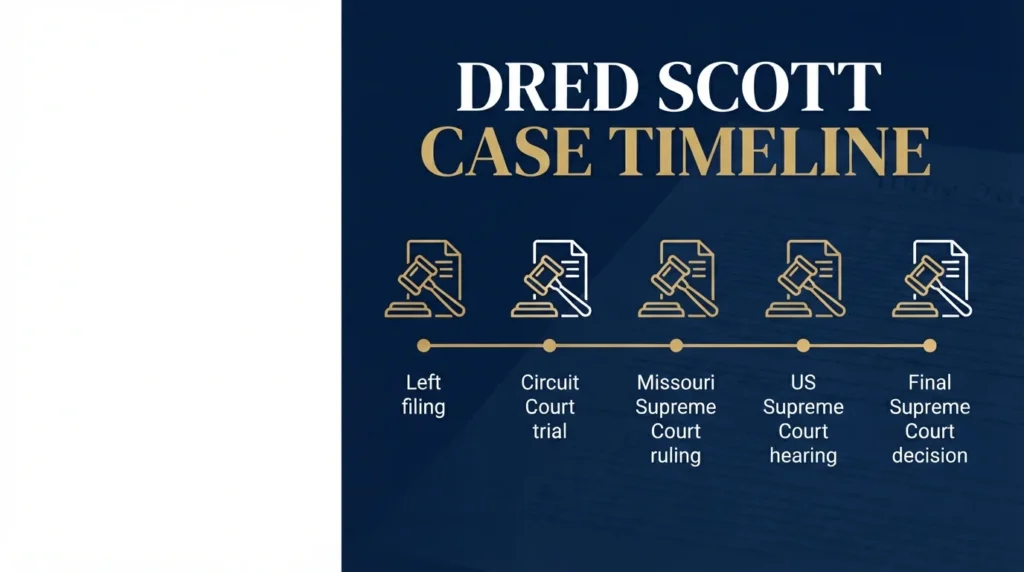
The Dred Scott case timeline spans more than a decade, from a local lawsuit in 1846 to a Supreme Court ruling in 1857. Here is the full sequence laid out clearly.
| Year | Event | Outcome |
|---|---|---|
| 1846 | Scott files freedom suit in St. Louis | Case begins |
| 1847 | First trial held | Case came to trial on June 30, 1847, in the St. Louis circuit court |
| 1850 | Second state trial | The state court finally declared Scott free |
| 1852 | Missouri Supreme Court appeal | Missouri Supreme Court combined the cases and reversed the lower court’s decision, making Dred Scott and his family enslaved again |
| 1853 | Federal lawsuit filed | Scott filed a federal lawsuit with the United States Circuit Court for the District of Missouri |
| 1856 | Supreme Court hears arguments | The United States Supreme Court did not hear the case until February 1856 |
| 1857 | Final ruling issued | The Supreme Court issued a 7 to 2 decision against Scott |
This back and forth shows just how long Scott and his family fought. Eleven years is a long time to wait for a verdict that, in the end, went against you.
Key Takeaway: The Dred Scott case dragged through three separate court systems over eleven years before the Supreme Court delivered its final, devastating ruling.
Dred Scott Supreme Court Ruling Explained
The Supreme Court ruled that Dred Scott could not sue for his freedom because he was not considered a U.S. citizen. Writing for the majority of the Court, Chief Justice Taney concluded that enslaved people and their descendants were not considered citizens of the United States. To reach this decision, the Court looked at who were considered citizens at the time the Constitution was adopted.
The reasoning did not stop at citizenship. Taney’s opinion went further, addressing property rights and congressional power over the territories.
One line from the opinion still gets quoted in history classes today, describing Black Americans as “beings of an inferior order” who “had no rights which the white man was bound to respect.” That phrase alone explains why this ruling is remembered as one of the Court’s darkest moments.
The ruling rested on three main legal conclusions:
- Enslaved people and their descendants were not U.S. citizens
- Scott therefore had no standing to sue in federal court
- Congress had no power to ban slavery in U.S. territories
Key Takeaway: The ruling went far beyond Dred Scott’s personal case, setting a legal standard that stripped an entire group of people of constitutional protection.
Dred Scott Case Citation and Court Details
The official legal citation for this case is 60 U.S. 393 (1857). That citation marks its place in the official United States Reports from the Supreme Court term.
Knowing the citation matters if you ever want to find the original opinion. The case was argued February 11 through 14, 1856, reargued December 15 through 18, 1856, and decided March 6, 1857.
Even the defendant’s name carries a small historical footnote. Because Sanford was a citizen of New York, Scott’s lawyer, Montgomery Blair, acting on the grounds that the litigants in the case were residents of different states, sued for Scott’s freedom in the United States circuit court in Missouri, though the defendant’s name was misspelled in the official Court records.
Case Snapshot:
| Detail | Info |
|---|---|
| Citation | 60 U.S. 393 (1857) |
| Decided | March 6, 1857 |
| Vote | 7 to 2 |
| Chief Justice | Roger B. Taney |
| Defendant’s actual name | Sanford (not Sandford) |
Key Takeaway: The official case name misspells the defendant’s last name, a small clerical error that has stuck in the history books for over 150 years.
Missouri Compromise Dred Scott
The Missouri Compromise was the 1820 federal law that banned slavery in certain U.S. territories, and the Supreme Court struck it down as part of this ruling. After ruling on the issues surrounding Scott, Taney struck down the Missouri Compromise because, by prohibiting slavery in those territories, Congress had exceeded its constitutional authority.
This part of the ruling shocked even more people than the citizenship decision. The Supreme Court ruled that Congress had exceeded its authority in the Missouri Compromise because it had no power to forbid or abolish slavery in the territories west of Missouri and north of latitude 36°30′.
That single finding reshaped national politics almost overnight. The decision destroyed the major platform of the Republican Party by denying the authority of Congress to legislate on slavery in the territories.
Think of it like a referee overturning not just one play, but the entire rulebook the game had been played under for decades. That is roughly how politicians on both sides experienced this part of the decision.
Key Takeaway: Striking down the Missouri Compromise meant slavery could legally expand into territories where it had been banned for nearly 40 years.
Dred Scott Dissenting Opinions
Two justices dissented from the majority ruling, arguing that the Court got both the law and the facts wrong. Justices McLean and Curtis both wrote dissenting opinions.
The lineup of opinions looked like this:
| Position | Justices |
|---|---|
| Majority opinion | Chief Justice Taney |
| Concurring opinions | Wayne, Campbell, Catron, Daniel, Nelson, Grier |
| Dissenting opinions | McLean, Curtis |
Not every justice who agreed with the outcome agreed with the reasoning. Of the nine Justices who sat on the case, six concurred with the full ruling, two dissented, while one agreed with the ruling itself but differed in his reasoning.
The dissents argued free Black citizens had existed and voted in several states at the time the Constitution was ratified, directly challenging Taney’s historical claims.
Key Takeaway: Even in 1857, two Supreme Court justices publicly rejected the majority’s history and logic, a dissent that history ultimately proved correct.
Dred Scott Case Outcome
The outcome of the Dred Scott case was a complete legal loss for Scott and his family, though he personally gained freedom soon after through separate means. In what is now one of the most infamous decisions of the Court’s history, Dred Scott lost his case for freedom.
The legal loss did not end his personal story. In spite of the United States Supreme Court’s decision that Dred Scott was a slave, he did finally receive his freedom.
That freedom came from the Blow family, his original owners, who purchased and then manumitted him shortly after the ruling. Dred Scott took a job as a porter at Barnum’s Hotel at Second and Walnut streets in St. Louis. He died free about a year later, in 1858.
Key Takeaway: Dred Scott lost in court but gained personal freedom within months, a bittersweet ending that the ruling itself never provided.
Dred Scott Case Significance
The significance of the Dred Scott case lies in how it redefined citizenship and property rights for an entire class of people. Under the Court’s ruling, all federal territories were legally opened to slavery, and Congress was obliged to protect slaveholders’ possession of their property.
The ruling’s reach went well beyond one courtroom. The ruling intensified sectional tensions, as it pleased Southern slaveholders while outraging abolitionists and Republicans in the North.
It is widely regarded today as one of the worst decisions ever issued by the nation’s highest court, a label historians rarely apply so bluntly.
- Denied citizenship to an entire racial group
- Struck down a 37 year old federal compromise law
- Became a rallying point for the growing anti slavery movement
Key Takeaway: The Dred Scott ruling turned a personal freedom lawsuit into the legal foundation that justified slavery’s expansion nationwide.
Dred Scott Case Effect on the Civil War
The Dred Scott case is widely credited with pushing the country closer to civil war by deepening the divide over slavery. Historians agree that the Dred Scott decision was a major disaster for the United States and dramatically inflamed tensions leading to the Civil War.
Political leaders reacted almost immediately. By the end of 1858, Abraham Lincoln was openly warning of the threat that the next Supreme Court ruling might require slavery to be permitted across the United States.
A future Chief Justice later summed up the damage in blunt terms, calling the ruling a “public calamity” that would undermine confidence in the Court for years.
Key Takeaway: Fewer than four years after this ruling, the United States was at war with itself, and this case is consistently named as one of the sparks.
Dred Scott Case and the Fourteenth Amendment
The Fourteenth Amendment is the constitutional change that directly reversed the citizenship portion of the Dred Scott ruling. The Fourteenth Amendment later overturned the citizenship ruling.
It was not the only amendment needed to fully undo the decision. Following the Civil War, the Reconstruction Congress passed, and the states ratified, the Thirteenth, Fourteenth, and Fifteenth Amendments, all of which directly overturned the Dred Scott decision.
| Amendment | Ratified | What It Reversed |
|---|---|---|
| Thirteenth | 1865 | Abolished slavery nationwide |
| Fourteenth | 1868 | Guaranteed citizenship regardless of race |
| Fifteenth | 1870 | Protected voting rights regardless of race |
Key Takeaway: It took three separate constitutional amendments after a bloody civil war to fully undo what one Supreme Court ruling had decided.
Dred Scott Case Legacy Today
The legacy of the Dred Scott case is that it stands as a permanent warning about how courts can get constitutional interpretation badly wrong. The decision remains a pivotal point in discussions about race, citizenship, and legal rights in American history.
Law schools still teach it, not as a model to follow, but as a cautionary example. Constitutional scholars regularly cite it when discussing judicial restraint and the dangers of overreach.
It also shapes how we read the Fourteenth Amendment’s citizenship clause, since that clause was written specifically to prevent a repeat of this ruling.
Key Takeaway: Nearly 170 years later, this case is still used as the clearest historical example of why citizenship rights needed explicit constitutional protection.
Dred Scott Case Facts You Might Not Know
A few lesser known facts make this case even more compelling than the standard textbook summary. Dred and Harriet Scott and roughly 300 other enslaved people found the courage to come to the Old Courthouse in St. Louis seeking freedom through similar lawsuits.
Scott did not fight alone, and his case drew national attention well before it reached the Supreme Court. By the time it reached the high court, the case had gained notoriety, and Scott received support from many abolitionists, including powerful politicians and high profile attorneys.
- Over 300 other enslaved individuals filed similar freedom suits in the same St. Louis courthouse
- Scott’s original owners, the Blow family, financially backed his lawsuit
- The case citation misspells the defendant’s actual surname
- Scott died a free man about a year after losing his case
Key Takeaway: Dred Scott’s lawsuit was part of a much larger wave of freedom suits filed in the same courthouse, not an isolated legal event.
Dred Scott Case APUSH Study Guide
For APUSH students, the Dred Scott case is best understood as a failed attempt to legally settle the slavery question in the territories. For APUSH purposes, Dred Scott is a failed attempt to settle slavery in the territories, argued from proslavery claims of Black inferiority and constitutional protection for slave property, and an answer to the period’s citizenship debate.
Exam questions typically test three things: the ruling’s legal reasoning, its political fallout, and its eventual reversal.
Exam Cheat Sheet:
- Decided: 1857
- Key doctrine struck down: Missouri Compromise
- Political fallout: strengthened the Republican Party’s anti slavery message
- Reversed by: Thirteenth, Fourteenth, and Fifteenth Amendments
Key Takeaway: If you remember one thing for the exam, remember that this ruling tried to settle slavery permanently and instead helped trigger the Civil War.
Common Myths About the Dred Scott Case
The biggest myth about the Dred Scott case is that Scott never gained his freedom, when in fact he did, just not through the courts. In spite of the Supreme Court’s decision that Dred Scott was a slave, he did finally receive his freedom.
Another common misconception is that the ruling was unanimous or close to it. In reality, two justices wrote detailed dissents challenging the majority’s history and logic.
- Myth: Scott died enslaved. Fact: He was freed within months and died free.
- Myth: The ruling was unanimous. Fact: It passed 7 to 2 with strong dissents.
- Myth: One amendment fixed everything. Fact: It took three separate amendments.
Key Takeaway: The real story of this case is more complicated, and in some ways more hopeful, than the simplified version most people remember.
Frequently Asked Questions
What was the Dred Scott court case about?
The Dred Scott court case was a lawsuit over whether living in free territory made an enslaved man and his family legally free.
The Supreme Court ruled against him in 1857.
It also struck down the Missouri Compromise.
When was the Dred Scott case decided?
The Supreme Court decided the case on March 6, 1857.
The vote was 7 to 2 against Scott.
Chief Justice Roger Taney wrote the majority opinion.
Why was the Dred Scott decision considered wrong?
The decision denied citizenship to Black Americans based on flawed historical claims about the founding era.
Two justices dissented at the time, arguing the majority misread the facts.
The Fourteenth Amendment later directly reversed its citizenship ruling.
Did Dred Scott ever gain his freedom?
Yes, Dred Scott gained his freedom just months after losing his Supreme Court case.
His original owners, the Blow family, purchased and freed him.
He died free about a year later, in 1858.
Which amendments overturned the Dred Scott ruling?
The Thirteenth, Fourteenth, and Fifteenth Amendments together overturned the ruling.
The Thirteenth ended slavery nationwide in 1865.
The Fourteenth guaranteed citizenship regardless of race in 1868.
The Dred Scott court case remains one of the clearest examples of a Supreme Court ruling that history firmly rejected. Understanding its timeline, its reasoning, and its reversal helps explain why citizenship rights are written directly into the Constitution today.
If this topic interests you, keep digging into the Fourteenth Amendment’s citizenship clause next. It was written specifically because of this case, and it still shapes legal debates happening right now.