If you have ever paid a fee to pull cash from an ATM that was not owned by your bank, you may be owed money right now. The ATM class action lawsuit sign up process is open for one active settlement worth $167.5 million, and you have until early 2027 to file.
This case has been building for almost two decades. It started as a fight between independent ATM operators and the two biggest card networks in the country.
In this guide, you will learn exactly who qualifies, how to sign up, what documents you need (spoiler: none), and when payments might land in your account. One surprising fact up front: the earlier related settlement drew over 63 million claims, but only a tiny fraction were ever verified as valid.
That detail matters a lot for what happens next.
Related: Colgate Class Action Lawsuit Claim Form 2026: How To File
ATM Class Action Lawsuit 2026
The ATM class action lawsuit in 2026 refers to a group of connected legal cases accusing Visa, Mastercard, and several banks of inflating ATM surcharge fees for nearly two decades. There are actually three separate settlements tied to this story, and mixing them up is the single biggest source of confusion online.
The first is Mackmin v. Visa, a $197.5 million deal that already finished its claims process and moved into payment distribution. The second is a smaller Bank of America settlement tied to 7-Eleven ATMs. The third, and the one still accepting new sign ups, is Burke v. Visa.
Visa and Mastercard agreed to a $167.5 million class action settlement alleging the companies violated federal and state antitrust law by prohibiting independent ATM operators from charging lower access fees for transactions processed on non-Visa or non-Mastercard networks, and the settlement received preliminary approval on August 14, 2026.
Here is a quick snapshot of where things stand:
| Settlement | Status in 2026 | Amount |
|---|---|---|
| Mackmin v. Visa | Closed, paying out | $197.5 million |
| Bank of America / 7-Eleven | Closed as of June 2026 | $2.25 million |
| Burke v. Visa | Open for sign up | $167.5 million |
Only Burke is still accepting new claims as of this writing.
How to Sign Up for ATM Class Action Lawsuit
Signing up for the ATM class action lawsuit means filling out a short online claim form on the official settlement website, and it takes most people under ten minutes. No lawyer, no fee, and no paperwork pile required.

The process works like this:
- Go to the official settlement site directly (never click a link from a random text message).
- Confirm you used an independent, non-bank ATM between October 24, 2007 and August 14, 2026.
- Estimate how many times you paid a surcharge that your bank did not fully reimburse.
- Sign the form under penalty of perjury.
- Submit online or mail a paper version.
The form asks for an estimate of how many times you paid such a surcharge during the class period, entered as a whole number up to four digits, along with a signature and date certifying the information is accurate.
You do not need bank statements ready to go. You do not need an attorney, you do not need to pay anyone, and you should visit the official settlement website, complete the form, and save your confirmation number.
Quick Fact: Filing is completely free. Anyone asking for payment to “register” you is not part of the real process.
Think of it like mailing in a rebate form, except the company already admitted (without admitting fault) that it owes a pool of money to people like you.
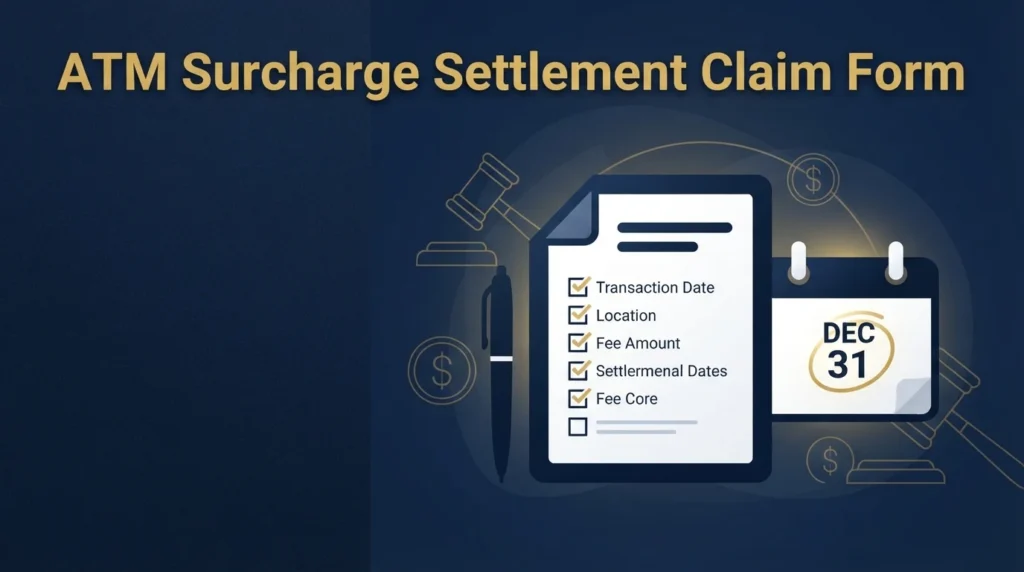
ATM Surcharge Settlement Claim Form
The ATM surcharge settlement claim form is the official document you must submit to receive a share of the settlement money. It is short, asks for an estimate rather than exact receipts, and takes just a few minutes online.
No third party pre filing service or paid registration is ever required, since the only legitimate way to file is the free official claim form on the settlement website. That single sentence should be tattooed on every claimant’s memory, because copycat sites love to pop up around big settlements like this one.
Here is what the form typically requests:
| Field | What You Provide |
|---|---|
| Transaction window | October 2007 to August 2026 |
| Fee type | Independent ATM surcharge, not reimbursed |
| Estimate | Number of surcharged withdrawals (up to 4 digits) |
| Certification | Signature under penalty of perjury |
The claim form is submitted under penalty of perjury and asks for an estimate of how many times you paid an unreimbursed surcharge to withdraw cash from an independent ATM during the class period.
That estimate matters a lot. The more surcharged withdrawals you honestly claim, the larger your eventual pro rata share, assuming the number holds up during review.
Key Takeaway: The entire ATM class action lawsuit sign up process runs through one official claim form that asks for an honest estimate, not receipts, and costs nothing to submit.
Who Qualifies for ATM Class Action Lawsuit
You qualify for the ATM class action lawsuit if you paid an unreimbursed surcharge fee at an independent, non-bank ATM in the United States between late 2007 and August 2026. That is the core test, and it is broader than most people assume.
You qualify if you are anyone in the U.S. who was charged a surcharge to withdraw cash at an independent, non-bank ATM between October 24, 2007 and August 14, 2026, and were not fully reimbursed by your bank.
It does not matter which bank issued your debit card. It does not matter whether the ATM was inside a gas station, a bar, or a hotel lobby.
- You used a debit or PIN-based card, not a credit card cash advance.
- The ATM displayed a company name, not a bank name.
- You paid a fee the machine’s owner charged.
- Your own bank did not refund that specific fee.
These independent machines are typically found in convenience stores, hotels, bars and gas stations, which means almost anyone who has traveled or avoided their home bank’s ATM network for nearly two decades is likely covered.
ATM Class Action Lawsuit Eligibility
Eligibility for this lawsuit comes down to three simple checks: the type of ATM, the time frame, and whether your bank reimbursed the fee. Miss any one of those and you may not be part of the class.
The notice generally covers unreimbursed surcharges for withdrawals from a deposit account using an ATM or PIN debit card at an independent ATM in the United States, including its territories, from October 24, 2007 through August 14, 2026, while credit card cash advances and prepaid card transactions are excluded.
So a prepaid gift card withdrawal does not count. Neither does a credit card cash advance, even if a surcharge applied.
| Eligibility Factor | Counts | Does Not Count |
|---|---|---|
| Card type | Debit or PIN-debit | Credit card, prepaid card |
| ATM owner | Independent, non-bank | Bank-owned machine |
| Reimbursement | Fee not refunded | Fee already refunded by bank |
| Date range | Oct 24, 2007 to Aug 14, 2026 | Outside that window |
If you genuinely cannot remember your exact usage, that is fine. The form only wants a reasonable estimate, not a perfect record.
NonbankATMSurchargeSettlement.com
NonbankATMSurchargeSettlement.com is the one official website for the Burke v. Visa settlement, and it is the only place you should enter your personal information for this case. Anything that looks similar but has a different domain deserves suspicion.
The site states you must submit a valid claim form to get a payment no later than February 10, 2027, and to receive a payment you must complete and timely submit a valid Claim Form by that date, either online or by calling the settlement hotline.
You can also reach the administrator directly by phone rather than typing your details into a search engine ad. Filing by phone is available at 1-866-893-1052, or by a mailed form postmarked by February 10, 2027 to the Non-Bank ATM Surcharge Fee Settlement address.
Quick Facts:
- Official site only: NonbankATMSurchargeSettlement.com
- Phone option: 1-866-893-1052
- Mail option: available for those without internet access
Bookmark the real site. Do not rely on memory when searching again later, because paid ads sometimes lead to lookalike pages.
Key Takeaway: Eligibility hinges on using an independent ATM with a debit card during the class window, and the only safe place to file is the official settlement domain.
ATM Class Action Lawsuit Claim Form Online
Filing the ATM class action lawsuit claim form online is the fastest route to getting your claim on record, and most people finish in under ten minutes. The online version mirrors the paper form field for field.
Filing takes less than 10 minutes, and no initial receipts or bank statements are required to submit your claim, since you visit the court approved portal, go directly to the official settlement website, and click the submit a claim option.
Here is the general online flow:
- Visit the official claim page.
- Confirm your eligibility dates and card type.
- Enter your estimated surcharge transaction count.
- Provide contact information for payment updates.
- Sign electronically under penalty of perjury.
- Save or screenshot your confirmation number.
That confirmation number is your proof you filed. Treat it the same way you would treat a tax filing confirmation, because you may need it later if questions come up.
Paper forms remain an option for anyone without reliable internet, mailed to the administrator and postmarked by the deadline.
ATM Class Action Lawsuit Payout Amount
There is no fixed payout amount for this lawsuit, and anyone promising you an exact dollar figure before the deadline passes is guessing. Payments are calculated pro rata, meaning your share depends on everyone else’s claims too.
Because this is a pro rata claims process, your payout will depend on how many people file valid claims, how many qualifying transactions are approved, and how much is left after court approved fees and costs.
Here is the math in plain terms. The $167.5 million fund shrinks after legal fees and administrative costs, then gets divided among everyone with a valid claim, weighted by how many surcharges each person reports.
Someone who paid 300 of these fees would be eligible for ten times the share of someone who paid 30, so your honest transaction estimate directly shapes your result.
| Cost Deducted First | Approximate Share |
|---|---|
| Attorneys fees | Up to 30% of fund |
| Class representative awards | Up to $17,500 each |
| Administration costs | Several million dollars |
| Remaining | Net Settlement Fund for claimants |
That remaining pool is what gets split among valid claims.
How Much Will I Get From ATM Class Action Lawsuit
How much you will get from the ATM class action lawsuit depends entirely on your reported surcharge transactions compared to everyone else who files. There is no published flat rate, and there will not be one until after the deadline passes.
Individual settlement payments will likely depend on how many valid claims are filed, how the court approves the distribution plan, how much money is deducted for attorneys fees and administrative costs, and whether the final plan treats different class categories differently, so the total settlement fund is known but the per consumer payout is not.
A look at the closed sister case helps set expectations. In the related Mackmin settlement, only 296,877 claims were identified as valid and received payouts from the $197.5 million fund, which made the per person share larger than originally anticipated.
That is the pattern worth remembering. Fewer valid claims generally mean bigger checks for the people who filed correctly.
Quick Facts:
- Payout type: pro rata, not flat rate
- Based on: number of surcharges claimed versus total valid claims
- Historical pattern: smaller claim pools produced larger individual checks
Key Takeaway: Nobody can promise you a dollar amount today, but filing an honest, higher transaction estimate generally improves your eventual share.
ATM Class Action Lawsuit Payment Date
The payment date for this lawsuit has not been set yet because the claims window is still open and the settlement has not received final court approval. Checks or digital payments typically follow months after the claim deadline closes.
The final approval hearing is set for February 17, 2027, which comes just one week after the claims deadline, and payments generally cannot begin until after that hearing and any appeal period passes.
Compare that to the closed Mackmin case for a realistic timeline. Payments could not begin until the court approved the final distribution plan, which it did on December 3, 2025, with digital payments issued between April and June 2026.
That is roughly a four to six month gap between court approval and actual money landing in accounts. Applying that same pattern to Burke suggests a realistic payment window sometime in mid to late 2027, though nothing is guaranteed.
| Milestone | Date |
|---|---|
| Preliminary approval | August 14, 2026 |
| Opt out / objection deadline | December 11, 2026 |
| Claim filing deadline | February 10, 2027 |
| Final approval hearing | February 17, 2027 |
| Estimated payment window | Later in 2027 |
Patience matters here. Settlement administrators move carefully to avoid distributing funds before appeals are resolved.
Burke v. Visa Settlement
Burke v. Visa is the federal antitrust case behind the currently open $167.5 million ATM settlement, and it has been working through the courts since 2011. The case is formally known as Burke et al. v. Visa Inc. et al., filed under case number 1:11-cv-01882, and ended a lawsuit alleging Visa and Mastercard illegally prohibited independent ATM operators from charging lower access fees on certain transactions.
The legal theory traces back to an earlier related complaint from ATM operators themselves. The lawsuit claims Mastercard and Visa enacted ATM Access Fee Rules that violate federal antitrust laws by requiring the same surcharge for all networks at an ATM, and the lawsuit seeks money for the class for inflated network acquirer fees.
A federal judge has already weighed in on the deal’s structure. Judge Richard J. Leon granted preliminary approval on August 14, 2026, and the administrator, A.B. Data, opened the official settlement website with the court approved claim form within the time the order allowed.
Quick Facts:
- Case number: 1:11-cv-01882
- Court: U.S. District Court for the District of Columbia
- Judge: Richard J. Leon
- Administrator: A.B. Data
This is the case most people mean when they search for an open ATM lawsuit right now.
Visa Mastercard ATM Fee Lawsuit
The Visa Mastercard ATM fee lawsuit centers on claims that the two card networks forced independent ATM operators to charge identical surcharges regardless of which network processed the transaction. That rule, plaintiffs argued, blocked competition and kept fees artificially high for everyday consumers.
Visa is slated to pay $88.775 million while Mastercard will pay $78.725 million, which will be sent to a settlement fund used to pay people who were hit by the fees.
Both companies have been here before. The earlier Mackmin settlement involved banks directly rather than independent operators, and it resolved separately.
JPMorgan Chase, Wells Fargo and Bank of America had previously settled with Visa and Mastercard for $67 million, and Visa and Mastercard did not admit to any wrongdoing through either settlement. Denying wrongdoing while still paying out is standard practice in antitrust class actions like this one, not an admission that anything improper actually happened.
Key Takeaway: Burke v. Visa is the live, current chapter of a much longer Visa and Mastercard ATM fee legal fight that has already produced hundreds of millions in settlements.
ATM Class Action Lawsuit Deadline
The deadline to file a claim in the open ATM class action lawsuit is February 10, 2027. Miss that date and you lose your chance at a share of the $167.5 million fund.
The administrator confirms claims can be submitted online at the official settlement website or by mail postmarked no later than February 10, 2027.
There are actually three dates that matter, not just one. Confusing them is one of the most common mistakes claimants make.
| Date | What Happens |
|---|---|
| December 11, 2026 | Last day to opt out or object |
| February 10, 2027 | Last day to submit a claim form |
| February 17, 2027 | Final approval hearing |
December 11, 2026 is the exclusion and objection deadline, and the two use different verbs, which trips people up more than any other part of this settlement.
As of late November 2026, that leaves a shrinking window. Mark your calendar now rather than relying on a future reminder.
ATM Class Action Lawsuit Opt Out
Opting out of the ATM class action lawsuit means giving up your right to a settlement payment in exchange for keeping the right to sue Visa and Mastercard separately on your own. Most people never need to do this, but the option exists for a reason.
Excluding yourself is the only option that allows you to sue Visa or Mastercard on your own, or as part of any other lawsuit, for the claims in this case, though if you exclude yourself you will not be eligible to get a payment from the settlement.
Staying in the class means accepting the court’s final decision, whatever it turns out to be. If you stay in the class, you will be legally bound by all orders of the court, and you will not be able to sue or continue to sue Mastercard or Visa for these claims as part of any other lawsuit.
There is also a built in escape hatch for the companies. The companies kept one way out: either can cancel the deal if six million or more people ask to be excluded from it. That threshold is unlikely to be reached, but it shows how seriously the opt out mechanism is treated.
Key Takeaway: Filing before February 10, 2027 keeps you eligible for payment, while opting out by December 11, 2026 preserves your right to sue independently instead.
Is the ATM Class Action Lawsuit Real or Scam
The ATM class action lawsuit is real, court approved, and legitimate, not a scam. The ATM class action settlement is real, funded, and accepting claims now, which answers the single most common doubt people type into search bars before filing anything.
That said, scams genuinely do cluster around real settlements like this one. Fraudsters build lookalike sites hoping panicked claimants will hand over banking details.
Fraudulent attempts to send digital payments to class members have been made, and class members are warned not to click links in those emails, since some payment emails are genuine and some are not, so it is safer to reach the administrator by going to the settlement website directly rather than following an emailed link.
Red flags to watch for:
- Anyone asking for an upfront “processing fee” to file your claim
- Links in unsolicited texts instead of the official domain
- Pressure to act within hours instead of the actual court deadline
- Requests for your full Social Security number up front
As of recent checks, the only open ATM surcharge claim form is Burke’s, hosted on the official administrator’s domain, which is the single detail that separates a legitimate filing from a copycat one.
Frequently Asked Questions
How do I sign up for the ATM class action lawsuit?
You sign up by filing a claim form on the official Burke v. Visa settlement website.
The form asks for your estimated surcharge transaction count and a signature under penalty of perjury.
No attorney or fee is required to file.
Who qualifies for the ATM class action settlement?
Anyone who paid an unreimbursed surcharge at an independent, non-bank ATM in the U.S. between October 24, 2007 and August 14, 2026 qualifies.
Credit card cash advances and prepaid card transactions do not count.
Your own bank must not have already refunded the fee.
How much will I get from the ATM class action lawsuit?
There is no fixed payout amount because payments are calculated pro rata.
Your share depends on how many surcharges you report compared to everyone else who files.
A similar closed settlement produced larger than expected checks once the valid claim pool turned out smaller than predicted.
What is the deadline to file an ATM class action claim?
The claim filing deadline is February 10, 2027.
The opt out and objection deadline is earlier, on December 11, 2026.
A final approval hearing is scheduled for February 17, 2027.
Is the ATM class action lawsuit sign up site a scam?
No, the official settlement website is real and court approved.
Scammers do create lookalike sites, so only use the official domain or phone number.
Never pay a fee or click a link from an unsolicited text message to file.
Closing
The ATM class action lawsuit sign up window will not stay open forever, and February 10, 2027 is the hard stop for new claims. Filing costs nothing and takes minutes, so there is little reason to wait.
Check your eligibility today, gather a rough estimate of your ATM usage since 2007, and submit your claim through the official settlement site. Then watch for updates as the February 2027 hearing approaches.
================================================================