

The WP Engine lawsuit is one of the biggest legal fights in the history of open source software. What started as a public feud between WP Engine and Automattic CEO Matt Mullenweg in September 2024 has turned into a sprawling federal court battle that could reshape how WordPress works for millions of people.
This case involves trademark disputes, antitrust allegations, and questions about who really controls the open source tools that power roughly 40% of the internet. If you run a website on WordPress or use WP Engine hosting, this lawsuit touches your digital life whether you realize it or not.
Here is everything you need to know about the WP Engine lawsuit in 2026: the latest court rulings, the key claims, who is affected, and where this case is headed.
One striking fact: WP Engine serves over 1.5 million websites worldwide. The fallout from this dispute has already disrupted plugin access, community events, and trust across the entire WordPress ecosystem.
WP Engine Lawsuit 2026: Where the Case Stands Now
The WP Engine lawsuit in 2026 remains active in the U.S. District Court for the Northern District of California. The case has moved past early motions and into the discovery phase, with both sides exchanging documents, depositions, and evidence.
Judge Araceli Martinez-Olguin has presided over the case since its filing. Several key motions have been decided, but no trial date has been set as of early 2026.
Both WP Engine and Automattic have expanded their claims since the original filings. WP Engine’s complaint grew to include antitrust allegations, while Automattic filed counterclaims asserting trademark infringement by WP Engine.
| Detail | Status |
|---|---|
| Court | U.S. District Court, N.D. California |
| Judge | Araceli Martinez-Olguin |
| Phase | Discovery |
| Trial Date | Not yet scheduled |
| Settlement | No public settlement as of 2026 |
The stakes keep climbing. Legal fees alone are estimated in the tens of millions for both sides. Neither party has shown any willingness to back down.
This is not a minor trademark squabble. It’s a fight over control of one of the world’s most important software platforms.
Latest WP Engine Lawsuit Update
The most recent WP Engine lawsuit update involves rulings on motions to dismiss filed by both sides. In late 2025, the court allowed most of WP Engine’s claims to proceed, including the antitrust and unfair business practices allegations.
Automattic’s counterclaims for trademark infringement also survived dismissal. That means the court found enough substance in both sides’ arguments to warrant a full trial.
Discovery has produced thousands of pages of internal communications. Some leaked emails and Slack messages from Automattic have fueled media coverage, revealing internal debates about the strategy against WP Engine.
- WP Engine’s antitrust claims survived the motion to dismiss
- Automattic’s trademark counterclaims remain active
- Discovery is producing internal company communications
- No settlement talks have been publicly confirmed
The case is also being closely watched by the broader tech industry. Other managed hosting providers are paying attention because the outcome could set precedent for how open source trademarks are enforced.
Legal analysts expect the discovery phase to continue through mid-2026. A trial, if it happens, would likely fall in late 2026 or early 2027.
WP Engine Lawsuit: What Happened to Start This Fight
The WP Engine lawsuit began after a very public conflict at WordCamp US in September 2024. Matt Mullenweg, the co-creator of WordPress and CEO of Automattic, called WP Engine a “cancer to WordPress” during his keynote address.
That single remark set off a chain reaction. Mullenweg accused WP Engine of profiting from WordPress without contributing enough back to the open source project. He specifically criticized WP Engine for disabling post revision history by default, which he framed as a poor experience for WordPress users.
WP Engine fired back with a cease-and-desist letter. Automattic responded with its own cease-and-desist. Within days, Automattic blocked WP Engine’s access to WordPress.org resources, including plugin updates and the theme directory.
This access ban affected every website hosted on WP Engine. Sites couldn’t receive automatic security patches or plugin updates through normal channels. For WP Engine’s 1.5 million hosted sites, this was a serious disruption.
WP Engine filed its lawsuit on October 2, 2024. The complaint named both Automattic Inc. and Matt Mullenweg personally as defendants.
Think of it like a landlord changing the locks on a tenant’s apartment after a public argument. WP Engine paid to live in the WordPress ecosystem, and suddenly the doors were shut.
Key Takeaway: The WP Engine lawsuit started with a public insult at a conference and escalated into a federal court battle after Automattic cut off WP Engine’s access to critical WordPress infrastructure.
WP Engine vs Automattic Lawsuit Breakdown
The WP Engine vs Automattic lawsuit involves claims and counterclaims from both companies. WP Engine is the original plaintiff. Automattic is the defendant and also filed counterclaims.
WP Engine’s Main Claims:
- Tortious interference with business relationships
- Unfair competition under federal and state law
- Attempted extortion (alleging Mullenweg demanded a licensing fee or else)
- Computer fraud (related to the WordPress.org access ban)
- Antitrust violations (monopolistic control of WordPress resources)
Automattic’s Counterclaims:
- Trademark infringement (WP Engine’s use of “WordPress” and “WP” in its branding)
- False designation of origin (consumers allegedly confused about WP Engine’s relationship to WordPress)
- Unfair business practices (profiting from WordPress trademark without authorization)
| Party | Role | Key Claims |
|---|---|---|
| WP Engine | Plaintiff | Extortion, antitrust, unfair competition, computer fraud |
| Automattic Inc. | Defendant/Counterplaintiff | Trademark infringement, false designation |
| Matt Mullenweg | Individual Defendant | Personal liability for extortion and interference |
The financial exposure is enormous. WP Engine is seeking damages that could reach hundreds of millions of dollars. Automattic’s counterclaims also seek significant damages plus injunctive relief that could force WP Engine to rebrand entirely.
WP Engine Automattic Dispute Explained Simply
The WP Engine Automattic dispute boils down to a fight about money, control, and the meaning of open source. Here’s the simple version.
WordPress is free, open source software. Anyone can use it. But the WordPress brand, the .org website, and the plugin directory are controlled by Automattic and the WordPress Foundation, both closely tied to Matt Mullenweg.
WP Engine built a billion-dollar hosting business around WordPress. They make it easy for people to run WordPress sites without technical headaches. Automattic felt WP Engine was taking too much and giving too little.
Mullenweg wanted WP Engine to pay a trademark licensing fee, reportedly 8% of revenue. WP Engine refused. That’s when things went sideways.
Imagine two neighbors sharing a well. One neighbor starts charging the other for water, even though the well was supposed to be communal. The other neighbor says the first one doesn’t own the well. They end up in court.
The core question is whether Automattic has the right to control who gets access to WordPress.org resources, and whether threatening to revoke that access amounts to extortion when a licensing fee is demanded in return.
- WordPress software is open source and free
- WordPress.org resources are controlled by Automattic
- WP Engine refused to pay a licensing fee
- Automattic blocked WP Engine’s access as retaliation
This case could define the limits of corporate power over open source communities for years to come.
Matt Mullenweg’s Role in the WP Engine Lawsuit
Matt Mullenweg is personally named as a defendant in the WP Engine lawsuit. That’s unusual for a corporate dispute and signals how central his actions were to this conflict.
WP Engine alleges that Mullenweg personally orchestrated the campaign against the company. The complaint describes his WordCamp speech, social media posts, and direct communications as evidence of a deliberate effort to damage WP Engine’s business.
Mullenweg controls both Automattic (the for-profit company) and has significant influence over the WordPress Foundation (the nonprofit that holds the WordPress trademark). WP Engine argues he blurred the lines between these roles to weaponize WordPress.org against a competitor.
In the weeks after the dispute went public, Mullenweg posted extensively on his personal blog and social media. He added a “loyalty checkbox” to WordPress.org login pages asking contributors to confirm they had no affiliation with WP Engine. This move drew widespread criticism from the WordPress community.
| Action | Date | Significance |
|---|---|---|
| WordCamp keynote attack | September 20, 2024 | Public escalation |
| WordPress.org access ban | September 25, 2024 | Operational disruption |
| Loyalty checkbox added | October 2024 | Community backlash |
| Personal blog posts | Ongoing | Evidence in lawsuit |
Mullenweg’s personal involvement raises the question of individual liability. If the court finds he acted outside the scope of his corporate role, he could face personal financial consequences.
Key Takeaway: Matt Mullenweg’s personal actions, from public speeches to social media posts to loyalty checkboxes, are central to WP Engine’s claims and could expose him to individual liability.
WP Engine WordPress Lawsuit and the Open Source Question
The WP Engine WordPress lawsuit raises fundamental questions about who owns open source. WordPress software is released under the GPL (General Public License), which means anyone can use, modify, and distribute it freely.
But “freely available software” and “freely available infrastructure” are two different things. The WordPress.org website, its plugin repository, and its update servers are not governed by the GPL. They’re controlled by Automattic.
This distinction matters because WP Engine’s entire hosting product depends on seamless access to WordPress.org. When that access was cut, WP Engine had to build emergency workarounds to keep its customers’ sites running.
The open source community is divided. Some agree with Mullenweg that large companies like WP Engine should contribute more. Others argue that using access to WordPress.org as leverage is a betrayal of open source principles.
- GPL covers the WordPress software code
- GPL does not cover WordPress.org infrastructure
- Plugin updates and security patches flow through WordPress.org
- Cutting access affects millions of end users
Several prominent WordPress developers have resigned from Automattic over this dispute. Over 150 employees accepted buyout offers in October 2024 after Mullenweg gave staff an ultimatum about supporting his position.
The outcome of this case could establish legal precedent for how companies interact with open source projects they profit from, and how project leaders can exercise control.
WP Engine Trademark Lawsuit Claims
The WP Engine trademark lawsuit claims are at the heart of Automattic’s counterclaims. Automattic alleges that WP Engine’s use of “WP” and “WordPress” in its branding creates consumer confusion.
Automattic argues that customers believe WP Engine is officially affiliated with WordPress. The “WP” in WP Engine’s name, combined with marketing that heavily references WordPress, allegedly crosses the line into trademark infringement.
WP Engine responds that “WP” is a generic abbreviation widely used across the WordPress ecosystem. Dozens of companies use “WP” in their names: WPBeginner, WPForms, WP Rocket. WP Engine argues that singling them out is selective enforcement motivated by the business dispute, not genuine trademark protection.
| Claim | Automattic’s Position | WP Engine’s Position |
|---|---|---|
| “WP” usage | Trademark infringement | Generic abbreviation |
| WordPress references | Creates false affiliation | Accurate product description |
| Consumer confusion | Customers think WP Engine is WordPress | No reasonable confusion exists |
The WordPress Foundation transferred the “WordPress” trademark to Automattic in a deal that itself has drawn scrutiny. Critics question whether that transfer was proper and whether Automattic is now using the trademark offensively rather than defensively.
Trademark cases often come down to consumer surveys. Both sides will likely present survey evidence about whether real customers are actually confused about the relationship between WP Engine and WordPress.
WP Engine Antitrust Claims Against Automattic
WP Engine’s antitrust claims allege that Automattic holds monopoly power over the WordPress ecosystem and has abused that power to harm a competitor. These are among the most serious allegations in the case.
The argument goes like this: Automattic controls WordPress.org, which is the central hub for plugin distribution, theme access, and software updates. By cutting WP Engine off from this hub, Automattic used its market dominance to punish a rival hosting company.
WP Engine draws a parallel to classic antitrust cases where a company controlling essential infrastructure uses that control to crush competitors. Think of a railroad company owning the only bridge across a river and refusing to let competing trains cross.
- WordPress powers roughly 40% of all websites globally
- WordPress.org is the primary distribution channel for plugins and themes
- Automattic controls WordPress.org access
- No equivalent alternative distribution channel exists
The antitrust claims survived the motion to dismiss, which is significant. Federal judges rarely let weak antitrust claims proceed past that stage. The court found that WP Engine plausibly alleged monopoly power and anticompetitive conduct.
If WP Engine prevails on antitrust grounds, damages could be trebled (tripled) under federal law. That would dramatically increase the financial exposure for Automattic.
Key Takeaway: WP Engine’s antitrust claims survived early dismissal, and if successful, could result in triple damages and force Automattic to change how it governs WordPress.org access.
WP Engine Lawsuit Court Rulings So Far
The WP Engine lawsuit court rulings so far have mostly favored letting the case proceed on both sides. Neither party has won a knockout blow in early motions.
The most significant ruling came on the preliminary injunction. WP Engine sought an emergency order forcing Automattic to restore its access to WordPress.org. The court granted a temporary restraining order in late 2024, requiring Automattic to reinstate WP Engine’s access while the case continued.
On motions to dismiss, the court allowed the majority of WP Engine’s claims to survive, including the antitrust and extortion allegations. Automattic’s trademark counterclaims also survived, setting up a full battle on both fronts.
| Ruling | Date | Result |
|---|---|---|
| Temporary restraining order | October 2024 | Granted (access restored) |
| Preliminary injunction | Late 2024 | Partially granted |
| WP Engine’s motion to dismiss counterclaims | 2025 | Partially denied |
| Automattic’s motion to dismiss | 2025 | Mostly denied |
| Discovery disputes | 2025-2026 | Ongoing |
There have been several discovery disputes as well. Both sides have fought over the scope of document production, particularly around internal communications from Automattic and financial records from WP Engine.
The judge has signaled impatience with delay tactics from both parties. Court orders have emphasized the need to move the case toward resolution efficiently.
Is There a WP Engine Class Action Lawsuit
There is no certified WP Engine class action lawsuit as of 2026. The current case is a direct dispute between WP Engine and Automattic, not a class action brought on behalf of consumers.
However, the possibility of class action claims has been discussed in legal circles. WP Engine customers who experienced service disruptions, security vulnerabilities from missed updates, or forced migrations could potentially have grounds for a separate consumer class action.
Any such class action would likely target both parties. WP Engine customers might argue that WP Engine failed to maintain adequate service, while simultaneously arguing that Automattic’s access ban was the root cause of the disruption.
- No class action has been filed or certified
- Individual WP Engine customers have not joined the current case
- Service disruptions could support future consumer claims
- Both WP Engine and Automattic could face consumer liability
For a class action to proceed, a plaintiff would need to show that a definable class of people suffered similar harm. The 1.5 million websites on WP Engine’s platform represent a large potential class, but proving uniform damages would be challenging.
Some legal observers believe a class action is more likely after the main case resolves. The court’s findings on liability could pave the way for follow-on consumer claims.
WP Engine Lawsuit Impact on WordPress Users
The WP Engine lawsuit impact on WordPress users has been real and measurable, even for people who don’t use WP Engine hosting. This dispute has sent shockwaves through the entire WordPress community.
For WP Engine customers specifically, the most immediate impact was the temporary loss of access to WordPress.org plugin updates. During the access ban period, sites hosted on WP Engine couldn’t receive automatic security patches, leaving them vulnerable.
The broader WordPress community has also felt the effects. The Advanced Custom Fields (ACF) plugin, one of the most popular WordPress plugins with millions of active installations, was forked by Automattic into a new plugin called Secure Custom Fields. This move alarmed developers who depend on ACF.
Effects on Different User Groups:
- WP Engine customers: Service disruptions, security update delays, uncertainty about platform stability
- WordPress developers: Community division, loss of trusted plugin maintainers, exodus of Automattic employees
- All WordPress users: Reduced trust in WordPress governance, concerns about future access restrictions
- Small business owners: Fear of being caught in crossfire, considering platform alternatives
Over 150 Automattic employees left the company following the dispute. Several were prominent contributors to WordPress core development. Their departure has slowed development on WordPress itself.
Some WordPress users have started exploring alternatives like Ghost, Webflow, or custom CMS solutions. While WordPress remains dominant, the lawsuit has cracked the assumption that the platform’s open source nature makes it immune to corporate power struggles.
Key Takeaway: The WP Engine lawsuit has disrupted plugin access, fractured the developer community, and pushed some WordPress users to consider alternative platforms for the first time.
Who Is Affected by the WP Engine Lawsuit
Everyone who uses WordPress is affected by the WP Engine lawsuit to some degree. The most directly impacted groups are WP Engine customers, WordPress plugin developers, and Automattic employees.
| Group | How They’re Affected | Severity |
|---|---|---|
| WP Engine customers (1.5M+ sites) | Service disruptions, update delays, migration concerns | High |
| ACF plugin users (2M+ sites) | Plugin forked, uncertain future support | High |
| WordPress plugin developers | Ecosystem instability, distribution concerns | Medium |
| Automattic employees | Layoffs, resignations, internal conflict | High |
| General WordPress users | Governance concerns, potential future restrictions | Low to Medium |
| Competing hosting providers | Watching for precedent on .org access | Medium |
Small business owners on WP Engine felt the most acute pain. Many rely on their websites for revenue and had no warning before the disruption began. Some incurred costs migrating to other hosting providers as a precaution.
Plugin developers who distribute through WordPress.org have grown nervous. If Automattic can cut off one company, what stops them from restricting others? This fear has prompted some developers to build alternative distribution channels.
Web agencies that build sites on WordPress for clients are reconsidering their platform strategy. The lawsuit has introduced business risk that didn’t exist before September 2024.
Even people who’ve never heard of WP Engine should care. The case will likely set precedent for how open source projects with corporate backing handle disputes about contribution, access, and control.
WP Engine Lawsuit Settlement Possibilities
No WP Engine lawsuit settlement has been reached or publicly announced as of 2026. Both sides appear prepared for a full trial, though settlement remains possible at any stage.
Settlement talks in federal litigation typically happen during or after discovery, when both sides have a clearer picture of the evidence. With discovery ongoing through 2026, a settlement could emerge once the full scope of internal communications and financial records is revealed.
Possible Settlement Scenarios:
- Licensing deal: WP Engine agrees to pay a trademark licensing fee, but at a lower rate than the 8% Mullenweg originally demanded
- Access guarantee: Automattic formally commits to non-discriminatory access to WordPress.org for all hosting providers
- Rebranding compromise: WP Engine modifies its branding to reduce “WP” prominence without a full name change
- Financial settlement: One side pays damages to the other, case dismissed with prejudice
- Governance reform: Creation of an independent body to oversee WordPress.org access, removing Automattic’s unilateral control
The private equity dynamics complicate settlement. WP Engine is backed by Silver Lake, which invested at a valuation reportedly exceeding $1 billion. Silver Lake has the resources and incentive to fight aggressively.
Automattic is also well-funded, with a valuation above $7 billion. Neither side is under financial pressure to settle cheaply.
If the case does settle, the terms may be confidential. That would leave the WordPress community without the clear legal precedent that a trial verdict would provide.
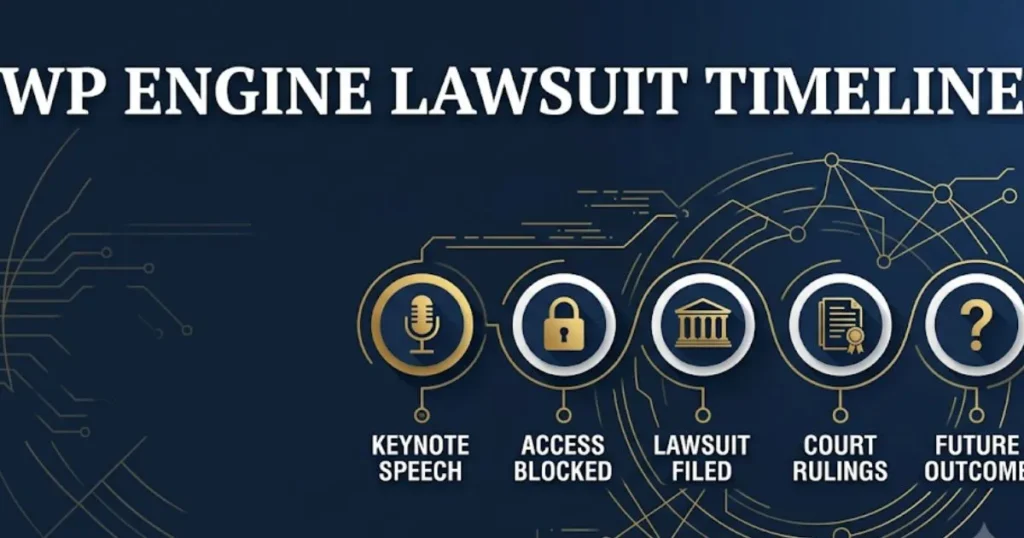
WP Engine Lawsuit Timeline of Key Events
The WP Engine lawsuit timeline spans from September 2024 through the present. Here is every major event in chronological order.
| Date | Event |
|---|---|
| September 20, 2024 | Matt Mullenweg calls WP Engine “a cancer to WordPress” at WordCamp US |
| September 23, 2024 | WP Engine sends cease-and-desist letter to Automattic |
| September 24, 2024 | Automattic sends its own cease-and-desist to WP Engine |
| September 25, 2024 | Automattic blocks WP Engine access to WordPress.org |
| October 2, 2024 | WP Engine files federal lawsuit in N.D. California |
| October 2024 | Automattic offers employee buyouts; 150+ employees leave |
| October 2024 | Mullenweg adds “loyalty checkbox” to WordPress.org |
| October 2024 | Automattic forks ACF into Secure Custom Fields |
| October 2024 | Court grants temporary restraining order restoring access |
| Late 2024 | Automattic files counterclaims for trademark infringement |
| Early 2025 | Motions to dismiss argued by both sides |
| Mid 2025 | Court denies most motions to dismiss; case proceeds |
| Late 2025 | Discovery phase begins |
| Early 2026 | Discovery ongoing; depositions scheduled |
| Mid 2026 (projected) | Discovery completion expected |
| Late 2026/Early 2027 | Trial possible if no settlement |
The pace of this litigation is relatively fast for a federal case of this complexity. The judge has kept things moving, denying multiple requests for extensions.
Each new discovery deadline brings the possibility of leaked documents or surprising revelations that could shift public opinion or settlement dynamics.
Key Takeaway: The WP Engine lawsuit has moved from a public argument to federal court in record time, with discovery ongoing in 2026 and a trial possible by late 2026 or early 2027.
WP Engine Lawsuit Outcome: What Could Happen Next
The WP Engine lawsuit outcome will depend on which claims survive summary judgment and, potentially, what a jury decides at trial. Several scenarios are realistic.
Scenario 1: WP Engine Wins on Core Claims
If the court finds that Automattic engaged in anticompetitive conduct and tortious interference, WP Engine could be awarded hundreds of millions in damages. Antitrust trebling could push the total past $1 billion. Automattic might be forced to establish independent governance for WordPress.org.
Scenario 2: Automattic Wins on Trademark
If the court rules that WP Engine’s branding infringes on WordPress trademarks, WP Engine could be forced to rebrand entirely. That would mean changing its name, domain, and all marketing materials. The financial and operational cost would be staggering.
Scenario 3: Split Decision
The most likely outcome may be a mixed result. WP Engine could win on some claims while losing on trademark issues. This would lead to a complex settlement negotiation where both sides have leverage.
Scenario 4: Settlement Before Trial
Federal cases settle at high rates. The pressure of a trial date often forces compromise. A settlement could include financial payments, licensing terms, and governance reforms.
| Scenario | Likelihood | Impact |
|---|---|---|
| WP Engine wins big | Moderate | Restructures WordPress governance |
| Automattic wins on trademark | Low to moderate | WP Engine forced to rebrand |
| Split decision | High | Negotiated compromise |
| Pre-trial settlement | Moderate to high | Terms likely confidential |
The WordPress community is watching closely. Whatever happens, this case will define the rules for open source commercialization for the next decade.
For WP Engine customers, the practical advice is to maintain backup hosting options and stay informed. Sudden changes to service availability remain possible until the case is fully resolved.
Frequently Asked Questions
What is the WP Engine lawsuit about?
The WP Engine lawsuit is a federal court dispute between WP Engine and Automattic over trademark rights, access to WordPress.org, and alleged anticompetitive conduct.
WP Engine sued after Automattic blocked its access to critical WordPress resources following a public feud.
Automattic countersued, claiming WP Engine’s branding infringes on WordPress trademarks.
Has the WP Engine lawsuit been settled in 2026?
No settlement has been reached or publicly announced as of 2026.
The case is in the discovery phase, with trial potentially set for late 2026 or early 2027.
Both sides appear prepared to litigate fully rather than settle early.
How does the WP Engine lawsuit affect my WordPress website?
If you use WP Engine hosting, your site experienced temporary disruptions to plugin updates and security patches during the initial access ban.
Access has since been restored by court order.
All WordPress users should monitor the case because the outcome could change how WordPress.org operates.
Can WP Engine customers join a class action lawsuit?
No class action lawsuit has been filed or certified in connection with this case as of 2026.
The current dispute is between the two companies, not a consumer class action.
Future consumer claims are possible depending on the trial outcome.
What is the expected outcome of the WP Engine vs Automattic case?
Legal analysts consider a split decision or pre-trial settlement the most likely outcomes.
A full WP Engine victory could result in damages exceeding $1 billion due to antitrust trebling.
The case is expected to set lasting precedent for open source trademark enforcement and platform governance.
The WP Engine lawsuit is far from over. It’s shaping up to be one of the most consequential tech legal battles of the decade, with implications for everyone who depends on WordPress.
Stay informed as new court rulings emerge in 2026. If you’re a WP Engine customer, check your hosting provider’s status page regularly for service updates related to the case.
This fight will determine who controls the future of the world’s most popular website platform. The answer matters whether you run one site or one thousand.







