

Yes, homeowners insurance will typically cover a civil lawsuit, but only certain kinds. Your policy’s personal liability section, known as Coverage E, pays for legal defense and damages when someone sues you for covered incidents like injuries on your property or accidental property damage.
But here’s what most people don’t realize: standard policies won’t touch business disputes, intentional harm, or contract disagreements. Those exclusions catch homeowners off guard every year.
The average homeowner carries $100,000 to $300,000 in liability coverage. That sounds like a lot until you learn that the median jury award in personal injury cases now exceeds $250,000. Knowing exactly what your policy covers could save you from financial ruin.
This article breaks down every type of civil lawsuit your homeowners insurance will and won’t cover in 2026. You’ll learn about exclusions, coverage limits, defense costs, dog bite claims, defamation cases, and what to do when a judgment exceeds your policy.
Will Homeowners Insurance Cover a Civil Lawsuit?
Homeowners insurance covers many civil lawsuits through the personal liability section of your policy. This coverage kicks in when someone files a lawsuit claiming you caused them bodily injury or property damage through negligence or accident.
The standard HO-3 policy form, used by most insurers in the United States, includes Section II liability coverages. These are split into two parts: Coverage E for personal liability and Coverage F for medical payments to others.
Coverage E is the one that matters for lawsuits. It pays for both your legal defense and any damages a court awards to the person suing you. The insurance company has a duty to defend you, which means they must provide a lawyer even if the lawsuit turns out to be frivolous.
| Coverage Type | What It Does | Typical Limit |
|---|---|---|
| Coverage E (Personal Liability) | Pays legal defense and court-ordered damages | $100,000 to $500,000 |
| Coverage F (Medical Payments) | Pays minor medical bills without a lawsuit | $1,000 to $5,000 |
There’s an important catch, though. The incident that caused the lawsuit must qualify as a covered occurrence under your policy. That means it must be accidental or negligent, not intentional.
Think of it this way: if your kid accidentally breaks a neighbor’s window with a baseball, you’re covered. If you deliberately smash it during an argument, you’re on your own.
Does Homeowners Insurance Cover Lawsuits Against You?
Yes, homeowners insurance covers lawsuits filed against you, as long as the claim involves a covered liability event. Your insurer steps in to handle the defense and pay any settlements or judgments up to your policy limit.
This only works when you are the defendant. If you want to sue someone else, your homeowners policy won’t pay for your attorney or court fees. The coverage is strictly one-directional.

When you get served with a lawsuit, the clock starts ticking. Most policies require you to notify your insurance company as soon as reasonably possible. Waiting too long can give the insurer grounds to deny your claim.
Your insurance company will then assign a defense attorney to represent you. You don’t get to pick the lawyer in most cases, though some states allow you to request independent counsel under certain conditions.
Here’s something that surprises a lot of people: even if the lawsuit has no merit, your insurer still pays for your defense. A baseless slip-and-fall claim on your property still triggers the duty to defend. That alone can save you $10,000 to $50,000 in legal fees.
- Your insurer pays for attorney fees
- Your insurer pays for court filing costs
- Your insurer pays for investigation expenses
- Your insurer pays judgments or settlements up to your limit
The protection is broad, but it has boundaries. Your policy won’t cover lawsuits related to your business, your car, or harm you caused on purpose.
Homeowners Insurance Liability Coverage for Lawsuits
Homeowners insurance liability coverage is the financial shield that protects you when a civil lawsuit lands on your doorstep. It’s the part of your policy specifically designed to cover legal costs and damage awards.
Most standard policies in 2026 come with $100,000 in personal liability coverage as the default. You can increase this to $300,000 or $500,000 for a relatively small annual premium increase, often just $20 to $50 more per year.
The liability coverage operates on an occurrence basis. That means it covers incidents that happen during the policy period, regardless of when the lawsuit is actually filed. Someone could slip on your icy sidewalk in January 2026 and not file a lawsuit until 2027. You’d still be covered under your 2026 policy.
| Liability Limit | Average Annual Cost | Best For |
|---|---|---|
| $100,000 | Included in base policy | Renters and low-asset homeowners |
| $300,000 | $15 to $30 extra per year | Average homeowners |
| $500,000 | $30 to $60 extra per year | Homeowners with pools or dogs |
Two separate obligations fall on your insurer. First is the duty to defend, which means paying for lawyers and legal proceedings. Second is the duty to indemnify, which means paying the actual judgment or settlement.
The duty to defend is broader than the duty to indemnify. Your insurer must defend you if there’s even a possibility that the lawsuit falls under your policy. They only have to pay damages if the final claim actually qualifies as a covered occurrence.
Key Takeaway: Your homeowners liability coverage pays for legal defense and damage awards in covered civil lawsuits, but the default $100,000 limit may not be enough for serious claims in 2026.
What Lawsuits Does Home Insurance Cover?
Home insurance covers civil lawsuits that stem from bodily injury or property damage caused by your negligence on or off your property. The list of covered scenarios is wider than most homeowners expect.
Here are the most common lawsuit types covered by a standard homeowners policy:
- Slip and fall injuries on your property
- Dog bites (in most states and for most breeds)
- Accidental property damage to a neighbor’s belongings
- Sports and recreation injuries caused by you or your family
- Falling tree limbs from your property onto a neighbor’s home
- Swimming pool accidents involving guests
- Accidental injuries caused by your children
One thing people miss is that liability coverage follows you beyond your property. If you accidentally injure someone at a park, a store, or on vacation, your homeowners insurance can still cover the resulting lawsuit.
The technical requirement is that the event must be an occurrence, which the ISO policy defines as an accident, including continuous or repeated exposure to conditions. It must result in bodily injury or property damage during the policy period.
| Lawsuit Type | Covered? | Notes |
|---|---|---|
| Slip and fall on your property | Yes | Must be due to negligence |
| Dog bite | Yes (usually) | Some breeds excluded by certain insurers |
| Child injures another child | Yes | Accidental only |
| Falling tree damages neighbor’s fence | Yes | Natural causes or negligence |
| Assault or intentional harm | No | Intentional acts excluded |
| Business customer injury at home | No | Business activity excluded |
Water damage lawsuits from a burst pipe that floods a neighbor’s unit are also covered. So are claims where a guest is injured by a defective railing or staircase on your property.
Homeowners Insurance Lawsuit Exclusions
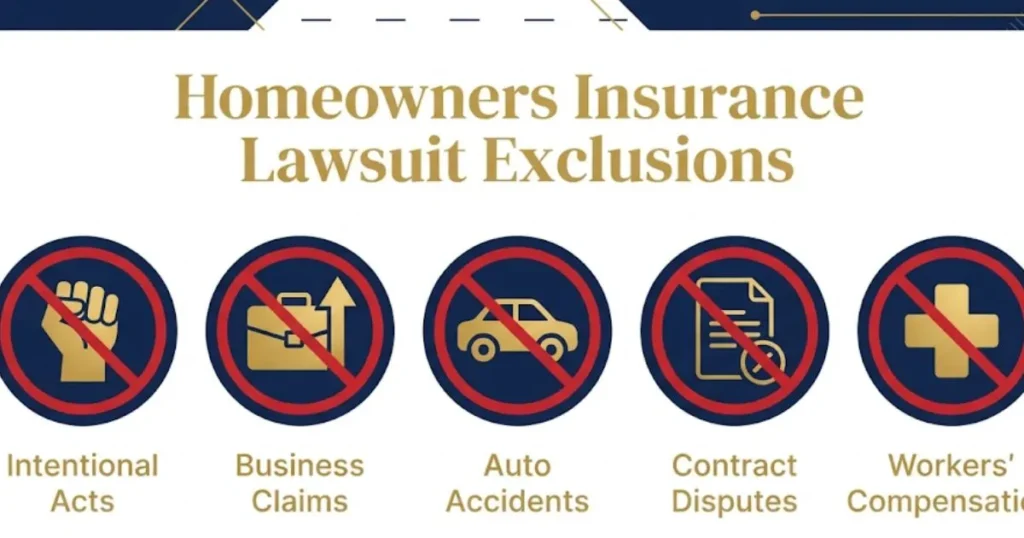
Homeowners insurance will not cover lawsuits involving intentional acts, business activities, motor vehicles, or contractual disputes. These exclusions are written directly into the standard policy language and apply in every state.
The intentional act exclusion is the biggest one. If you deliberately harm someone or damage their property, your insurer won’t pay a penny. Courts look at whether you intended the act itself, not necessarily the outcome. Punching someone but claiming you didn’t mean to break their nose won’t get you covered.
Business-related claims are another major blind spot. If you run a home bakery, teach piano lessons, or operate any business from your house and a client gets hurt, your homeowners policy excludes that claim. You’d need a separate business liability policy.
Here are the most common exclusions:
- Intentional injury or damage you cause on purpose
- Business activities conducted from your home
- Motor vehicle accidents (covered by auto insurance instead)
- Watercraft liability for boats over 26 feet or with engines over 25 horsepower
- Workers’ compensation claims from household employees
- Contractual liability you assume through a written agreement
- Communicable disease transmission (added after 2020 in many policies)
- Sexual misconduct or molestation allegations
Professional liability is another gap. If a neighbor sues you for bad financial advice you gave them, your homeowners insurance won’t cover it. Professional errors need a separate errors and omissions policy.
| Exclusion | Why It’s Excluded | Alternative Coverage |
|---|---|---|
| Intentional acts | Not accidental; violates policy terms | None available |
| Business liability | Separate risk category | Business owners policy (BOP) |
| Auto accidents | Covered elsewhere | Auto liability insurance |
| Professional errors | Specialized risk | Errors and omissions (E&O) |
| Workers’ comp | Statutory requirement | Workers’ compensation policy |
Some exclusions can be modified with endorsements. You can add a home business endorsement for small-scale operations. But the intentional act exclusion is absolute. No endorsement will override it.
Does Home Insurance Cover Defamation Lawsuits?
Home insurance can cover defamation lawsuits under the personal liability section, but only if the defamatory statements were not made intentionally or as part of a business activity. This is one of the trickiest coverage areas in homeowners insurance.
Most standard HO-3 policies include coverage for personal injury liability, which is a separate concept from bodily injury. Personal injury in insurance terms includes defamation, libel, slander, invasion of privacy, and false arrest.
However, there’s a critical distinction. Some policies include personal injury coverage automatically. Others require you to add it through an endorsement or rider. You need to read your actual policy declarations page to know which category you fall into.
If your neighbor sues you because you told other neighbors they were a thief (and it wasn’t true), your policy may cover the defense costs and any damages. But if you posted the same accusation on social media as part of a business dispute, the business exclusion would likely apply.
- Coverage applies to accidental or negligent defamatory statements
- Coverage does not apply to intentional, malicious defamation
- Online defamation (social media posts, reviews) is a gray area
- Some insurers now specifically exclude cyber liability claims
The rise of social media defamation cases has made this more relevant in 2026. Insurers are increasingly adding exclusions for online conduct. Check your policy for any electronic communications exclusion or cyber liability exclusion that might limit coverage.
Key Takeaway: Defamation lawsuits may be covered under your homeowners policy’s personal injury liability section, but intentional statements, business-related claims, and online posts face growing exclusions in 2026.
Does Homeowners Insurance Cover Dog Bite Lawsuits?
Homeowners insurance covers most dog bite lawsuits under personal liability coverage. Dog bites account for more than one-third of all homeowners insurance liability claims, costing insurers over $1.1 billion annually according to the Insurance Information Institute.
The average dog bite claim in the United States now exceeds $64,000. That number has risen steadily over the past decade due to increasing medical costs and larger jury awards.
Most policies cover dog bites without any breed restrictions. But some insurers maintain excluded breed lists that can void coverage entirely. Common breeds on these lists include:
- Pit Bulls and American Staffordshire Terriers
- Rottweilers
- German Shepherds
- Doberman Pinschers
- Akitas
- Wolf hybrids
If your dog’s breed is on your insurer’s exclusion list, you have zero liability coverage for a bite claim. Some states, including Michigan, Pennsylvania, and New York, have laws that prohibit insurers from discriminating based solely on breed. But many states allow it.
| Factor | Impact on Coverage |
|---|---|
| First bite with no history | Usually covered in full |
| Dog with prior bite history | May be excluded or surcharged |
| Excluded breed | No coverage unless state law prohibits breed restrictions |
| Bite at a park (off property) | Covered under off-premises liability |
| Bite during home business | Excluded under business activity exclusion |
Strict liability states hold dog owners responsible for bites regardless of whether they knew the dog was dangerous. In these states, your insurer can’t argue that you had no reason to expect the bite. States with strict liability include California, Florida, Illinois, and New Jersey.
If your dog has bitten someone before, your insurer may add an animal liability exclusion at renewal. This removes all dog-related claims from your policy. You’d need a separate canine liability policy to maintain coverage.
Does Homeowners Insurance Cover Negligence Claims?
Homeowners insurance covers negligence claims when your failure to maintain safe conditions on your property causes someone else’s injury or property damage. Negligence is actually the foundation of most covered liability claims.
To win a negligence lawsuit against you, the injured person must prove four things:
- You had a duty of care (like keeping your sidewalk clear)
- You breached that duty (you didn’t shovel the ice)
- The breach caused the injury (they slipped on the ice)
- They suffered actual damages (broken arm, medical bills)
Your homeowners policy covers these claims because negligence is, by definition, unintentional. You didn’t mean to hurt anyone. You just failed to prevent a foreseeable hazard.
Common negligence lawsuits covered by homeowners insurance include failing to repair broken steps, not warning guests about a loose railing, letting your yard become a hazard, or neglecting to fix a known plumbing leak that damages a neighbor’s property.
| Negligence Scenario | Covered? | Average Claim Cost |
|---|---|---|
| Icy sidewalk slip and fall | Yes | $20,000 to $50,000 |
| Broken stair railing collapse | Yes | $30,000 to $100,000 |
| Unfenced pool drowning | Yes | $100,000+ |
| Tree falls on neighbor’s car | Yes | $5,000 to $25,000 |
| Known hazard with no warning | Yes | Varies by injury severity |
Gross negligence can complicate things. If a court finds that your behavior was so reckless it bordered on intentional, some insurers may argue the claim falls outside coverage. This is rare, but it happens in cases involving extreme disregard for safety, like knowingly leaving exposed electrical wiring accessible to guests.
Your insurer will investigate the facts and determine whether the claim qualifies as a covered occurrence. They’ll hire adjusters and sometimes independent investigators before accepting or denying the claim.
Does Homeowners Insurance Cover Property Damage Lawsuits?
Homeowners insurance covers property damage lawsuits when you accidentally damage someone else’s belongings or their real property. Coverage E specifically includes legal liability for property damage under the standard policy.
If your tree falls onto a neighbor’s roof during a storm, your policy can cover their repair costs and your legal defense if they sue. The same goes for water damage from a burst pipe that leaks into a downstairs apartment, or a fire that starts in your unit and spreads next door.
The key requirement is that the damage must be accidental. Deliberately destroying someone’s property would trigger the intentional act exclusion and void your coverage.
- Accidental fire spreading to a neighbor’s home: covered
- Water leak damaging a shared wall: covered
- Your child breaking a neighbor’s window: covered
- Construction debris from your renovation damaging a car: covered
- Deliberately cutting down a neighbor’s tree: not covered
Property damage claims tend to be smaller than bodily injury claims, but they can still add up quickly. A fire that spreads to a neighboring home can easily result in a lawsuit exceeding $200,000.
| Damage Type | Typical Lawsuit Range | Coverage Status |
|---|---|---|
| Fallen tree on neighbor’s property | $5,000 to $30,000 | Covered |
| Water damage to adjacent unit | $10,000 to $75,000 | Covered |
| Fire spread to neighbor’s home | $50,000 to $500,000+ | Covered |
| Accidental destruction of property | $1,000 to $50,000 | Covered |
| Intentional property destruction | Any amount | Not covered |
One area that confuses people is damage caused by their own property maintenance failures. If you let your gutters overflow for months and the runoff erodes your neighbor’s yard, they can sue you for negligence. Your policy should cover this because it’s negligent, not intentional.
Key Takeaway: Property damage lawsuits from accidents, storms, water leaks, and fallen trees are covered under your homeowners liability, but any intentional destruction is excluded without exception.
Does Homeowners Insurance Cover Court Costs?
Homeowners insurance covers court costs as part of its legal defense obligation. These costs are typically paid in addition to your liability coverage limit, not subtracted from it.
This is a detail that many homeowners overlook. If you have a $300,000 liability limit, your insurer pays court costs on top of that amount. The $300,000 is reserved for the actual judgment or settlement. Defense expenses come from a separate bucket.
The standard HO-3 policy lists these as supplementary payments under Section II. They include:
- Attorney fees and hourly rates
- Court filing fees
- Costs of depositions and witness testimony
- Expert witness fees
- Document production and discovery costs
- Investigation expenses
- Appeal costs (in some cases)
The insurance company also covers your lost wages if you miss work to attend court proceedings. Most policies pay up to $250 per day for court attendance.
| Court Cost Type | Paid By Insurer? | From Which Bucket? |
|---|---|---|
| Attorney fees | Yes | Supplementary payments (separate) |
| Filing fees | Yes | Supplementary payments (separate) |
| Expert witnesses | Yes | Supplementary payments (separate) |
| Lost wages for court | Yes, up to $250/day | Supplementary payments (separate) |
| Judgment/settlement | Yes | Coverage E liability limit |
| Punitive damages | Rarely | Depends on state law |
There’s one big exception. If your insurer offers to settle the case for an amount within your policy limits and you refuse, you may become responsible for any additional defense costs and damages beyond that point. This is known as the failure to settle scenario.
Punitive damages are another gray area. Many states prohibit insurance companies from paying punitive damages because they are intended to punish the wrongdoer personally. In those states, you pay punitive damages out of your own pocket.
Homeowners Insurance Legal Defense Coverage
Homeowners insurance legal defense coverage means your insurer hires and pays for an attorney to defend you against covered lawsuits. This is one of the most valuable parts of your policy because legal fees alone can be devastating.
The average cost of defending a personal injury lawsuit in the United States ranges from $15,000 to $75,000, depending on complexity and location. Cases that go to trial can exceed $100,000 in defense costs alone, before any judgment.
Your insurer selects the defense attorney in most situations. They contract with law firms that specialize in insurance defense litigation. These firms handle hundreds of similar cases each year.
You might not love this arrangement. The attorney technically works for you, but the insurance company is paying the bills. This creates a potential conflict of interest, especially if the insurer wants to settle for a low amount and you want to fight.
Some states give you the right to independent counsel when a conflict of interest exists. This is called the Cumis counsel rule, named after a California court case. States that follow this rule include California, Alaska, and Connecticut.
- Panel counsel: Attorney chosen and paid by the insurer
- Cumis/independent counsel: Attorney chosen by you, paid by the insurer (only in conflict situations)
- Reservation of rights: Insurer defends you but reserves the right to deny coverage later
A reservation of rights letter is something every homeowner should understand. If your insurer sends you one, it means they’ll provide a defense but haven’t decided whether the claim is actually covered. They’re protecting their option to deny payment later if the facts show the claim falls outside your policy.
Getting a reservation of rights letter doesn’t mean you’re in trouble. It’s standard procedure when coverage is uncertain. But it does mean you should pay close attention to how the case develops.
Homeowners Insurance and Personal Liability Lawsuits
Personal liability lawsuits are the primary type of civil case that homeowners insurance is designed to cover. Coverage E, the personal liability section, responds to third-party claims for bodily injury or property damage caused by your negligence.
Personal liability under a homeowners policy is broader than most people think. It covers incidents that happen both on and off your property. If you accidentally knock someone off their bike while jogging in the park, your homeowners insurance can cover the lawsuit.
The coverage extends to you, your spouse, and any resident relatives in your household. Your children are covered for their actions too, which matters because kids are involved in a surprising number of liability claims.
| Who’s Covered | Examples |
|---|---|
| Named insured (you) | Any accidental injury or damage you cause |
| Spouse or domestic partner | Same coverage as named insured |
| Resident relatives | Children, parents, siblings living with you |
| Students away at school | Children under 24 at college |
| Legal guardianship | Foster children in your care |
Personal liability coverage does not extend to non-resident family members, roommates who aren’t relatives, or tenants renting a room in your house. Those individuals need their own renters or homeowners policies.
Key Takeaway: Your personal liability coverage under homeowners insurance protects you, your spouse, and resident relatives against civil lawsuits for accidental bodily injury or property damage, both on and off your property.
Can You Be Sued Beyond Homeowners Insurance Limits?
Yes, you can absolutely be sued for more than your homeowners insurance covers. There is no cap on how much a plaintiff can demand in a civil lawsuit, and if a judgment exceeds your policy limit, you are personally responsible for the difference.
This is called an excess judgment, and it’s the nightmare scenario for homeowners. If you carry $100,000 in liability coverage and a jury awards $400,000 to an injured guest, you owe $300,000 out of your own assets.
The plaintiff can pursue your personal assets to collect, including:
- Bank accounts and savings
- Investment portfolios and retirement funds (protections vary by state)
- Real estate equity in your home
- Future wages through garnishment
- Personal property of significant value
Some states offer homestead exemptions that protect a portion of your home equity from judgment creditors. Florida and Texas have unlimited homestead exemptions, meaning a plaintiff can’t force the sale of your primary residence. Other states cap the exemption at amounts ranging from $5,000 to $600,000.
| State | Homestead Exemption | Can They Take Your Home? |
|---|---|---|
| Florida | Unlimited | No (primary residence protected) |
| Texas | Unlimited | No (primary residence protected) |
| California | $300,000 to $600,000 | Depends on equity and county |
| New York | $89,975 to $179,950 | Depends on equity and county |
| Illinois | $15,000 | Yes, if equity exceeds exemption |
The best defense against excess judgments is carrying higher liability limits and adding an umbrella insurance policy. Bumping your liability from $100,000 to $500,000 costs very little. An umbrella policy adds $1 million or more on top of that.
What Happens When a Lawsuit Exceeds Homeowners Insurance?
When a lawsuit exceeds your homeowners insurance limits, you face personal financial exposure for the amount above your coverage. Your insurer pays up to the policy limit and then their obligation ends.
The process typically unfolds like this. Your insurer defends you throughout the lawsuit. If a settlement or judgment comes in above your limit, the insurer pays its maximum and sends you a letter explaining that you’re responsible for the rest.
At that point, the plaintiff can take legal action to collect the excess from your personal assets. They can file liens against your property, garnish your wages, and seize bank accounts depending on your state’s collection laws.
Here is what the timeline looks like:
| Stage | What Happens |
|---|---|
| Lawsuit filed | Insurer assigns defense counsel |
| Verdict or settlement reached | Insurer evaluates against policy limit |
| Amount within limit | Insurer pays in full; case closed |
| Amount exceeds limit | Insurer pays up to limit; you owe the rest |
| Excess collection | Plaintiff pursues your personal assets |
There’s another risk here. If your insurer had a chance to settle the case within your policy limit and refused, you may have a claim against them for insurance bad faith. Bad faith means the insurer acted unreasonably in handling your claim, causing you financial harm.
Bad faith claims can actually result in the insurer paying the entire judgment, including the excess. Courts take these cases seriously because the insurer’s duty to protect the policyholder is a core part of the insurance contract.
If you receive a settlement demand near your policy limit, make sure your insurer responds promptly. Document all communications. Delay or refusal to settle within limits is one of the most common triggers for bad faith lawsuits against insurers.
Umbrella Insurance for Lawsuit Protection
Umbrella insurance provides an extra layer of liability protection above your homeowners and auto insurance limits. A standard umbrella policy adds $1 million in coverage and costs between $150 and $300 per year.
Think of it as a safety net that catches you when a lawsuit blows past your homeowners policy. If your homeowners liability limit is $300,000 and you get hit with a $1 million judgment, the umbrella policy covers the remaining $700,000.
Umbrella policies also cover some claims that homeowners insurance excludes, including:
- Defamation and libel (broader coverage than homeowners)
- False arrest or detention claims
- Invasion of privacy lawsuits
- Landlord liability for rental properties (in some policies)
- Worldwide liability for incidents abroad
To purchase an umbrella policy, most insurers require you to first carry minimum underlying limits on your homeowners and auto policies. The typical requirement is $300,000 to $500,000 on homeowners and 250/500 on auto liability.
| Umbrella Coverage | Annual Premium | Total Protection (with $300K HO limit) |
|---|---|---|
| $1 million | $150 to $300 | $1.3 million total |
| $2 million | $250 to $450 | $2.3 million total |
| $5 million | $400 to $700 | $5.3 million total |
| $10 million | $600 to $1,200 | $10.3 million total |
Who needs umbrella insurance? Anyone with assets worth protecting. If you own a home, have savings, earn a good income, own rental property, have a swimming pool, or own a dog, an umbrella policy is one of the smartest insurance purchases you can make.
The cost-to-coverage ratio is almost unbeatable. Paying $200 a year for $1 million in protection works out to about 55 cents per day.
Key Takeaway: Umbrella insurance is the most cost-effective way to protect yourself against civil lawsuits that exceed your homeowners policy limits, offering $1 million or more in extra coverage for less than a dollar a day.
How to File a Homeowners Insurance Liability Claim
Filing a homeowners insurance liability claim starts with notifying your insurer immediately after you learn about a potential lawsuit or injury. Speed matters because most policies require prompt notice as a condition of coverage.
Here is the step-by-step process for filing a liability claim in 2026:
Step 1: Report the Incident
Call your insurance company’s claims line or report through their mobile app. Provide details about what happened, when, where, and who was involved.
Step 2: Preserve Evidence
Take photos of the scene. Save any text messages, emails, or communications related to the incident. Do not dispose of anything that could be relevant.
Step 3: Do Not Admit Fault
Be careful about what you say to the injured party or their attorney. Anything you admit can be used against you in the lawsuit. Let your insurer handle communications.
Step 4: Cooperate With the Investigation
Your insurer will assign a claims adjuster who will investigate the facts. Cooperate fully. Provide all requested documents and answer questions honestly.
Step 5: Work With Assigned Counsel
If a lawsuit is filed, your insurer assigns a defense attorney. Meet with them, review the case strategy, and provide any information they need.
| Filing Step | Timeline | Your Action |
|---|---|---|
| Report incident | Within 24 to 48 hours | Call insurer or use app |
| Preserve evidence | Immediately | Photos, messages, records |
| Claims investigation | 1 to 4 weeks | Cooperate with adjuster |
| Attorney assignment | Upon lawsuit filing | Meet with defense counsel |
| Resolution | 3 to 18 months | Follow counsel’s guidance |
One mistake that homeowners make is waiting until they receive a formal lawsuit to report the incident. Don’t wait. Report any injury or significant property damage claim right away, even if the other person hasn’t mentioned a lawsuit yet. Early reporting gives your insurer the best chance of resolving the matter before it reaches court.
Homeowners Insurance Lawsuit Settlement Process
The homeowners insurance lawsuit settlement process typically takes between 3 and 18 months from the initial claim to final resolution. Most covered liability claims settle without ever going to trial.
Your insurer controls the settlement negotiation in most cases. The standard policy gives them the right to settle or defend any claim as they see fit. This means they can agree to a settlement without your permission, as long as it falls within your policy limits.
Here’s how the typical settlement process works:
Phase 1: Investigation (1 to 4 weeks)
The claims adjuster reviews the facts, interviews witnesses, and evaluates the strength of the plaintiff’s case.
Phase 2: Demand and Negotiation (1 to 6 months)
The plaintiff’s attorney sends a demand letter specifying the amount they want. Your insurer’s adjuster or defense attorney negotiates a lower amount.
Phase 3: Mediation (optional, 1 to 3 months)
If direct negotiation fails, both sides may agree to mediation. A neutral mediator helps facilitate a compromise.
Phase 4: Settlement or Trial (varies)
Most cases settle during negotiation or mediation. If not, the case proceeds to trial, where a judge or jury decides the outcome.
| Settlement Phase | Typical Duration | Key Activity |
|---|---|---|
| Investigation | 1 to 4 weeks | Fact-finding and evaluation |
| Demand/negotiation | 1 to 6 months | Back-and-forth on dollar amount |
| Mediation | 1 to 3 months | Neutral third-party facilitation |
| Trial (if needed) | 6 to 18 months | Courtroom proceedings |
| Payment | 2 to 6 weeks after agreement | Insurer issues check to plaintiff |
Settlements are almost always confidential. You won’t see the exact dollar amounts made public. The plaintiff typically signs a release agreement that prevents them from pursuing any further claims related to the same incident.
If a settlement offer is on the table and it’s within your policy limits, your insurer will likely encourage you to accept. Going to trial is expensive and unpredictable. Juries can award far more, or far less, than what the plaintiff originally demanded.
After a settlement, your insurer may increase your premiums at renewal. A single liability claim can raise your homeowners insurance rate by 10% to 25% depending on the severity and your insurer’s rating methodology.
Key Takeaway: Most homeowners insurance liability lawsuits settle within 3 to 18 months without going to trial, but your insurer controls the settlement decision and your premiums may increase afterward.
Frequently Asked Questions
Does homeowners insurance pay for a lawyer if I get sued?
Yes, your homeowners insurance pays for a defense attorney if someone sues you for a covered liability claim.
The insurer selects and pays the lawyer directly as part of the duty to defend.
Legal defense costs are paid in addition to your liability coverage limit, not subtracted from it.
What types of civil lawsuits are not covered by home insurance?
Lawsuits involving intentional harm, business disputes, auto accidents, and professional errors are not covered.
Contract disputes, workers’ compensation claims, and sexual misconduct allegations are also excluded.
Any claim arising from deliberate conduct falls outside your policy.
How much liability coverage do most homeowners policies include?
Most standard homeowners policies include $100,000 in personal liability coverage by default.
You can increase this to $300,000 or $500,000 for a small additional premium.
Adding an umbrella policy provides $1 million or more in extra protection.
Will my homeowners insurance rates go up after a lawsuit?
Yes, filing a liability claim typically raises your premium by 10% to 25% at renewal.
The exact increase depends on the claim amount, your insurer, and your claims history.
Some insurers offer claims forgiveness for your first liability claim.
Can someone sue me for more than my homeowners insurance covers?
Yes, there is no legal cap on how much a plaintiff can sue you for in a civil case.
If a judgment exceeds your policy limit, you are personally responsible for the difference.
An umbrella policy is the best way to protect against excess judgments.
What to Do Right Now
If you’re facing a civil lawsuit, check your homeowners policy declarations page today. Confirm your liability limit and look for any exclusions that might apply to your situation.
Report any incident to your insurer immediately. Don’t wait for the lawsuit to be officially filed.
Consider increasing your liability coverage to at least $300,000 and adding an umbrella policy. For a few hundred dollars a year, you can protect yourself against lawsuits that could otherwise wipe out your savings and home equity.







