

The current status of the Zantac lawsuit is complicated but far from over. While a federal judge dismissed thousands of cases in 2022, state court lawsuits across California, Illinois, and other states are still active and pushing toward trial.
If you took Zantac and later developed cancer, you still have options. Some state courts have allowed expert testimony that federal courts rejected, keeping the door open for real payouts.
This article breaks down every angle of the Zantac litigation in 2026. You will learn about settlement estimates, who qualifies, filing deadlines, and which courts are still hearing cases. Over 100,000 claims were originally filed, and this fight is not finished.
One fact worth knowing: Zantac was once the world’s best-selling drug. More than 15 million Americans were taking it when the FDA pulled it off shelves in 2020.
What Is the Current Status of the Zantac Lawsuit
The current status of the Zantac lawsuit in 2026 is that federal cases remain dismissed while state court cases in several jurisdictions continue to move forward. The litigation is split across two tracks, and understanding that split is the key to understanding where things stand.
In December 2022, Judge Robin Rosenberg dismissed all federal Zantac cases in MDL 2924. She ruled that the plaintiffs’ expert witnesses did not meet the Daubert standard for scientific reliability. That decision effectively shut down thousands of federal claims in the Southern District of Florida.
But that ruling only applied to federal court. State courts operate under different evidence rules. California, for example, uses a more flexible standard for expert testimony. Lawsuits in California, Illinois, Delaware, and several other states survived and are progressing.
| Court System | Status in 2026 | Key Detail |
|---|---|---|
| Federal MDL (Florida) | Dismissed (Dec 2022) | Daubert ruling excluded expert testimony |
| California State Court | Active | Bellwether trials scheduled |
| Illinois State Court | Active | Cases moving through discovery |
| Delaware State Court | Active | Litigation ongoing |
The bottom line: if you only follow federal court news, you might think Zantac lawsuits are dead. They are not. State courts are where the action is happening right now.
Zantac Lawsuit Update 2026
The biggest Zantac lawsuit update for 2026 is that California state court cases are closest to trial, and early bellwether results could trigger settlement talks. This is the year that could define the entire litigation.
Throughout 2025, attorneys on both sides spent months in discovery. Drug manufacturers including Sanofi, GSK, Pfizer, and Boehringer Ingelheim fought hard to keep internal documents sealed. Plaintiffs’ lawyers pushed for access to company research that allegedly showed manufacturers knew about NDMA risks for years.
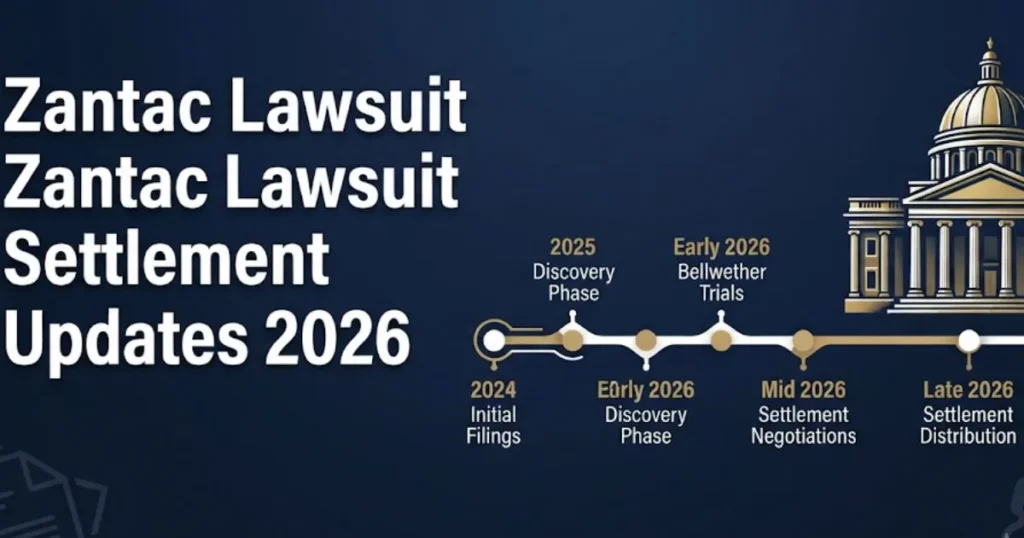
By early 2026, California courts had set schedules for bellwether cases. These test trials help both sides gauge how juries respond to the evidence. If plaintiffs win even one bellwether, it puts enormous pressure on manufacturers to settle.
Other states are watching California closely. Illinois and Delaware courts have similar cases in the pipeline, and a favorable ruling in one state tends to influence proceedings elsewhere.
Think of it like dominoes. California goes first. If it tips the right way, other states follow fast.
Key developments to watch in 2026:
- California bellwether trial dates and outcomes
- Potential settlement negotiations after initial verdicts
- New scientific studies on NDMA and cancer risk
- Legislative changes to statutes of limitations in certain states
Zantac Lawsuit Settlement Amounts
Zantac lawsuit settlement amounts have not been officially established yet because no global settlement has been reached. However, legal analysts and attorneys handling these cases have provided estimated ranges based on case strength and cancer type.
Individual settlement values depend on several factors. The type of cancer matters most. So does the length of time you used Zantac, your medical records, and whether you can prove you actually purchased the drug.
| Cancer Type | Estimated Settlement Range | Case Strength |
|---|---|---|
| Bladder Cancer | $150,000 to $400,000 | Strong (most studied link) |
| Stomach Cancer | $200,000 to $500,000 | Strong |
| Liver Cancer | $100,000 to $350,000 | Moderate |
| Esophageal Cancer | $100,000 to $300,000 | Moderate |
| Pancreatic Cancer | $150,000 to $400,000 | Moderate |
| Kidney Cancer | $75,000 to $250,000 | Developing |
| Colorectal Cancer | $75,000 to $200,000 | Developing |
These numbers are attorney estimates, not guaranteed payouts. Real settlement values will depend on how bellwether trials play out in state courts throughout 2026.
Cases with strong medical documentation and long-term Zantac use tend to fall at the higher end of these ranges. Cases with limited proof or shorter usage periods fall lower.
Key Takeaway: No Zantac settlement has been finalized yet, but state court trials in 2026 could force manufacturers to the negotiating table with payouts potentially ranging from $75,000 to $500,000 per case depending on cancer type.
Zantac Settlement Payout Per Person
The Zantac settlement payout per person will vary significantly based on individual circumstances, but most legal experts project payments between $75,000 and $500,000 for qualifying cancer claims. No checks have been mailed yet.
Why the wide range? Every case is different. A person who took Zantac daily for ten years and developed bladder cancer has a stronger claim than someone who used it occasionally for six months.
Several factors influence your individual payout:
- Type of cancer diagnosed (bladder and stomach cancers have the strongest scientific support)
- Duration of Zantac use (longer use generally means higher compensation)
- Medical documentation (hospital records, prescriptions, pharmacy receipts)
- Age at diagnosis (younger plaintiffs may receive more due to lost earning potential)
- Other risk factors (smoking, family history, or other exposures can reduce payout value)
If a global settlement is reached, payouts would likely use a tiered system. Tier 1 cases with the strongest evidence would receive the most. Tier 3 cases with weaker documentation would receive less.
Right now, the most realistic comparison is the Camp Lejeune litigation. That mass tort involved contaminated water and NDMA exposure. Early settlement offers in that case ranged from $100,000 to over $1 million depending on injury severity.
Who Qualifies for the Zantac Lawsuit
You may qualify for the Zantac lawsuit if you took Zantac or generic ranitidine regularly and were later diagnosed with cancer. Both prescription and over-the-counter users can file claims.
The eligibility criteria are fairly straightforward, but each law firm and court may have slight variations. Here is what most attorneys consider when evaluating your case:
Basic eligibility requirements:
- You used Zantac (brand name or generic ranitidine) for at least several months
- You received a cancer diagnosis after using the drug
- Your cancer type is one that has been linked to NDMA exposure
- You can provide some form of proof of purchase or use (pharmacy records, prescriptions, medical history)
| Eligibility Factor | Qualifies | May Not Qualify |
|---|---|---|
| Used Zantac regularly (6+ months) | Yes | One-time use only |
| Diagnosed with linked cancer | Yes | No cancer diagnosis |
| Has pharmacy or medical records | Strong case | No proof of use |
| Used OTC or prescription Zantac | Both qualify | Neither applies |
| Diagnosed before Zantac use began | No | Already had cancer |
Family members of deceased Zantac users may also qualify to file a wrongful death claim. If your loved one took Zantac and died from a linked cancer, you could pursue compensation on their behalf.
One common misconception: you do not need to have kept your Zantac receipts from ten years ago. Pharmacy databases, insurance records, and medical charts can all serve as proof of use.
How to File a Zantac Lawsuit
To file a Zantac lawsuit in 2026, you need to contact a product liability attorney who is actively handling Zantac cancer claims in state court. The process starts with a free case evaluation.
Here is how the filing process typically works, step by step:
- Contact an attorney who handles Zantac or pharmaceutical litigation
- Provide your medical records showing your cancer diagnosis
- Share your Zantac usage history including approximate dates and frequency
- The attorney reviews your case and determines if it meets the criteria
- A complaint is filed in the appropriate state court
- Discovery begins where both sides exchange evidence
- Your case either settles or goes to trial
Most attorneys take Zantac cases on a contingency fee basis. That means you pay nothing upfront. The lawyer only gets paid if you win or settle.
You do not need to join a class action to file. Most Zantac cases are individual lawsuits filed within a mass tort. Each person’s case is evaluated on its own facts.
Key Takeaway: Filing a Zantac lawsuit is free upfront through contingency-fee attorneys, and the process begins with gathering your medical records, cancer diagnosis, and any evidence of Zantac use.
Zantac Lawsuit Deadline 2026
The Zantac lawsuit deadline depends on which state you live in and when you were diagnosed with cancer. Statutes of limitations vary by state, and some deadlines are approaching fast.
Most states give you two to three years from the date you discovered (or should have discovered) that Zantac caused your illness. This is called the “discovery rule.” The clock does not always start when you took the drug. It often starts when you learned the drug may have caused your cancer.
| State | Statute of Limitations | Notes |
|---|---|---|
| California | 2 years from discovery | Active bellwether cases |
| Illinois | 2 years from discovery | Cases in progress |
| Florida | 4 years from discovery | Federal MDL dismissed, state options limited |
| New York | 3 years from discovery | Filing still possible |
| Texas | 2 years from discovery | Strict deadline enforcement |
| Pennsylvania | 2 years from discovery | Standard product liability rules |
Some states have enacted special tolling provisions for pharmaceutical cases, which can extend your deadline. Others have shortened windows for certain claim types.
Waiting is risky. Even if your state allows a generous window, evidence gets harder to gather over time. Pharmacy records get purged. Medical records get archived. Witnesses move or pass away.
If you think you might have a case, checking your deadline should be the first thing you do. Not next month. Now.
Zantac Cancer Lawsuit Explained
The Zantac cancer lawsuit is a mass tort action alleging that the heartburn drug Zantac contained a cancer-causing chemical called NDMA that manufacturers knew about but failed to disclose. Thousands of people who took the drug and later developed cancer are seeking damages.
NDMA stands for N-Nitrosodimethylamine. It is classified as a probable human carcinogen. In 2019, an independent pharmacy called Valisure discovered that Zantac tablets released extremely high levels of NDMA, especially when stored at elevated temperatures.
The core allegation is simple: drug companies sold a product they knew was dangerous and told nobody. Plaintiffs argue that Sanofi, GSK, Pfizer, and Boehringer Ingelheim all had access to research showing ranitidine was chemically unstable and could produce NDMA inside the human body.
The legal claims typically include:
- Product liability (defective design and failure to warn)
- Negligence (failure to test for known risks)
- Breach of warranty (the drug was not safe as promised)
- Fraud and concealment (hiding known dangers from consumers)
These are not minor allegations. Internal company documents have surfaced showing that some manufacturers may have been aware of NDMA contamination risks as far back as the 1980s.
If proven true, these claims could result in both compensatory damages (covering medical bills and lost wages) and punitive damages (punishing the companies for misconduct).
Key Takeaway: The Zantac cancer lawsuit centers on one claim: manufacturers sold a drug they knew could produce a carcinogen inside the body, and they hid that information from millions of consumers for decades.
Zantac MDL Dismissal: What Happened in Federal Court
The Zantac MDL dismissal occurred in December 2022 when Judge Robin Rosenberg excluded all general causation experts and dismissed all federal cases in MDL 2924 in the Southern District of Florida. It was a massive blow to plaintiffs, but it did not end the litigation entirely.
MDL stands for multidistrict litigation. It is a system where similar federal cases from across the country get grouped together before one judge for efficiency. The Zantac MDL consolidated over 75,000 cases.
Judge Rosenberg held a Daubert hearing to evaluate the scientific evidence. Under the Daubert standard, expert testimony must be based on reliable scientific methods. The judge found that the plaintiffs’ experts used flawed methodologies, extrapolated beyond their data, and relied on studies that did not specifically prove ranitidine causes cancer in humans.
| MDL Detail | Information |
|---|---|
| MDL Number | 2924 |
| Court | Southern District of Florida |
| Judge | Robin Rosenberg |
| Cases Consolidated | 75,000+ |
| Dismissal Date | December 2022 |
| Reason | Expert testimony excluded under Daubert |
The ruling was devastating. But here is the part most people miss: it only applied to federal court. State courts use different evidence standards. California, for instance, uses the Kelly/Frye standard, which is more permissive than Daubert.
That is why the Zantac fight shifted to state courts after the federal dismissal. Attorneys refiled or continued cases in jurisdictions where the science could still be presented to a jury.
Zantac State Court Lawsuits Still Moving Forward
Zantac state court lawsuits are active in California, Illinois, Delaware, and several other states as of 2026. These cases survived because state courts apply different rules for evaluating scientific expert testimony.
After the federal MDL collapsed, plaintiffs’ attorneys pivoted to state courts. California became the primary battleground. The California Superior Court in Alameda County has been managing a coordinated proceeding for Zantac cases, sometimes called a JCCP (Judicial Council Coordination Proceeding).
Illinois also has a significant number of active cases. Courts there have allowed certain experts to testify that were excluded in federal court. Delaware and other states have smaller dockets but are still moving cases through the system.
Why state courts matter:
- Different evidence standards (often more favorable to plaintiffs)
- Jury pools that may be more sympathetic
- State consumer protection laws that can add additional claims
- State-specific statutes of limitations that may still be open
The California cases are the ones to watch most closely. If bellwether plaintiffs win jury verdicts there, it creates immediate pressure for settlement negotiations. Manufacturers do not want to face hundreds of individual trials. A few losses can change their math entirely.
Think of state courts as the backup generator. When the main power (federal court) went out, the backup kicked in and kept the lights on.
Zantac Bellwether Trials and What They Mean
Zantac bellwether trials are test cases selected from the larger pool of lawsuits to be tried first, and their outcomes will heavily influence whether a global settlement happens. California is expected to hold the first bellwether trials in 2026.
A bellwether trial works like a test run. Both sides pick a small number of representative cases and try them before a jury. The results tell everyone involved what a typical verdict might look like.
Why bellwether trials matter so much:
- They reveal how juries respond to the scientific evidence
- They set a benchmark for settlement values
- A plaintiff win puts massive pressure on manufacturers to settle
- A defense win could discourage future claims
| Bellwether Factor | Detail |
|---|---|
| Expected Location | California Superior Court |
| Expected Timing | 2026 |
| Number of Test Cases | Typically 3 to 6 |
| Impact | Sets tone for all remaining cases |
In other mass torts, bellwether trials have been the turning point. The Roundup litigation is a good example. After early bellwether juries awarded billions in damages, Bayer (Monsanto’s parent company) agreed to a $10.9 billion settlement.
Zantac manufacturers are watching closely. If juries find the NDMA evidence convincing in state court, settlement talks could begin quickly. If juries side with the defense, the litigation could stall or shrink dramatically.
Key Takeaway: Bellwether trials in California during 2026 will likely determine the future of the entire Zantac litigation, including whether manufacturers agree to a global settlement.
Zantac NDMA Contamination: The Science Behind the Claims
NDMA contamination in Zantac refers to the presence of N-Nitrosodimethylamine, a probable human carcinogen, in ranitidine tablets. The chemical forms when ranitidine breaks down, especially in warm conditions or inside the human body.
In June 2019, the online pharmacy Valisure ran independent tests on Zantac tablets. They found NDMA levels far exceeding the FDA’s acceptable daily intake limit of 96 nanograms. Some tablets produced over 3,000,000 nanograms of NDMA when heated.
The FDA’s acceptable limit was based on a lifetime exposure standard. Exceeding that limit by thousands of times raised immediate alarm. The FDA began its own investigation and requested that manufacturers voluntarily recall ranitidine products. By April 2020, the FDA ordered all ranitidine products removed from the market.
Key scientific points:
- NDMA is classified as a Group 2A carcinogen by the International Agency for Research on Cancer (IARC)
- Ranitidine is chemically unstable and can convert to NDMA at body temperature (37 degrees Celsius)
- The longer ranitidine is stored, the more NDMA it produces
- Higher storage temperatures accelerate NDMA formation
- The human body’s internal conditions may trigger NDMA production after ingestion
The scientific debate centers on whether the NDMA levels from Zantac are high enough to actually cause cancer in humans. Manufacturers argue that the levels are too low to matter. Plaintiffs argue that decades of daily exposure creates a cumulative cancer risk.
This debate is exactly what will be argued in front of juries during bellwether trials. State courts that allow this testimony could produce very different outcomes than the federal court that rejected it.
Types of Cancer Linked to Zantac
The types of cancer linked to Zantac include bladder cancer, stomach cancer, liver cancer, esophageal cancer, pancreatic cancer, kidney cancer, and colorectal cancer. Bladder and stomach cancers have the strongest scientific support in the current litigation.
Not every cancer qualifies for a Zantac claim. Attorneys and courts focus on cancers that have been associated with NDMA exposure in medical literature and epidemiological studies.
| Cancer Type | Strength of Link to NDMA | Status in Litigation |
|---|---|---|
| Bladder Cancer | Strong | Primary focus of many claims |
| Stomach Cancer | Strong | Well-supported by studies |
| Liver Cancer | Moderate to Strong | Included in most claims |
| Esophageal Cancer | Moderate | Accepted in most filings |
| Pancreatic Cancer | Moderate | Growing body of evidence |
| Kidney Cancer | Moderate | Included in some claims |
| Colorectal Cancer | Developing | Newer area of research |
| Breast Cancer | Under Review | Limited current support |
| Prostate Cancer | Under Review | Limited current support |
If your cancer type is not on this list, it does not automatically mean you have no case. New research continues to emerge. Some attorneys are evaluating claims for additional cancer types as the science evolves.
The timing of your diagnosis relative to your Zantac use also matters. Cancers diagnosed while you were actively taking the drug or within a few years of stopping tend to have stronger causal arguments.
Key Takeaway: Bladder and stomach cancers have the strongest connection to Zantac’s NDMA contamination, but several other cancer types are being actively litigated in state courts across the country.
Is There a Zantac Class Action Lawsuit
There is no Zantac class action lawsuit. The Zantac litigation is a mass tort, which means each person files their own individual lawsuit. This is a critical distinction that many people misunderstand.
In a class action, one or a few plaintiffs represent an entire group. Everyone in the class gets the same outcome. A mass tort is different. Each plaintiff has their own case, their own evidence, and their own potential payout.
| Feature | Class Action | Mass Tort (Zantac) |
|---|---|---|
| Individual cases | No, one case for all | Yes, each person has their own |
| Payout amounts | Same for everyone | Varies by case strength |
| Control over your case | Very little | You and your attorney decide |
| Settlement timing | All at once | Can vary by case |
| Evidence requirements | General | Specific to your situation |
Mass torts are better for cases like Zantac because every plaintiff has a different cancer type, different usage history, and different level of harm. A class action would force everyone into the same box, which is not fair when injuries vary so widely.
When you hear someone say “join the Zantac lawsuit,” they mean file your own individual claim within the mass tort. You are not joining a group. You are bringing your own case.
This distinction matters for payouts too. In a mass tort, strong cases with solid evidence can recover significantly more than weaker cases. Your outcome depends on your facts, not the group average.
Zantac Recall History
The Zantac recall started in September 2019 and ended with a full FDA-ordered market withdrawal in April 2020. The recall happened in stages as more testing confirmed dangerous levels of NDMA in ranitidine products.
Here is how the recall unfolded:
September 2019: Valisure, an online pharmacy, filed a citizen petition with the FDA reporting extremely high levels of NDMA in ranitidine tablets. The FDA issued a public alert and began its own investigation.
October 2019: Sanofi voluntarily recalled certain lots of Zantac OTC in the United States and Canada. Other generic manufacturers followed with their own partial recalls.
November 2019 to March 2020: The FDA continued testing and found that NDMA levels in ranitidine increased over time, especially when stored above room temperature. Multiple additional recalls were issued by generic manufacturers.
April 1, 2020: The FDA requested that all manufacturers withdraw ranitidine products from the U.S. market immediately. This was a full market withdrawal, not just a voluntary recall.
| Date | Event |
|---|---|
| June 2019 | Valisure discovers NDMA in Zantac |
| September 2019 | FDA issues public alert |
| October 2019 | Sanofi begins voluntary recall |
| November 2019 to March 2020 | Rolling recalls from multiple manufacturers |
| April 1, 2020 | FDA orders full market withdrawal |
Before the recall, Zantac had been sold for nearly 40 years. It was first approved in 1983 and became available over the counter in the mid-1990s. At its peak, Zantac generated over $1 billion in annual sales.
The recall affected both brand-name Zantac and all generic versions of ranitidine, regardless of manufacturer.
Key Takeaway: The FDA pulled Zantac from the market entirely in April 2020 after testing confirmed that ranitidine tablets produce dangerous and increasing levels of NDMA over time, especially when stored in warm conditions.
Zantac Lawsuit Timeline: Key Dates From Start to Now
The Zantac lawsuit timeline spans from 2019 to the present, with major developments including the FDA recall, the federal MDL formation, the MDL dismissal, and the ongoing state court proceedings that continue into 2026.
Here is the full timeline of key events:
| Date | Event |
|---|---|
| June 2019 | Valisure discovers NDMA contamination in Zantac |
| September 2019 | FDA issues alert; first lawsuits filed |
| October 2019 | Sanofi initiates voluntary Zantac recall |
| February 2020 | Federal MDL 2924 created in Southern District of Florida |
| April 2020 | FDA orders complete ranitidine market withdrawal |
| 2020 to 2022 | MDL consolidates 75,000+ cases; discovery and Daubert hearings proceed |
| December 2022 | Judge Rosenberg dismisses all federal MDL cases |
| January 2023 | Plaintiffs refile and continue in state courts |
| 2023 to 2025 | California, Illinois, Delaware state cases advance through discovery |
| 2026 | California bellwether trials expected; potential settlement talks |
The timeline shows a clear pattern. The litigation started fast, hit a wall in federal court, and then pivoted to state courts. The real resolution is still ahead.
From start to finish, this litigation has taken over six years. That is not unusual for a mass tort of this size. The Roundup litigation took nearly a decade before reaching its massive settlement. Tobacco litigation stretched even longer.
Patience is part of the process. But 2026 looks like the year where the waiting could finally pay off, especially if California juries side with plaintiffs.
Frequently Asked Questions
What is the current status of the Zantac lawsuit in 2026?
The Zantac lawsuit is active in state courts across California, Illinois, Delaware, and other states.
Federal cases were dismissed in December 2022, but state court cases survived under different evidence rules.
Bellwether trials in California are expected in 2026 and could trigger settlement negotiations.
How much money can I get from the Zantac lawsuit?
Most legal experts estimate individual payouts between $75,000 and $500,000.
The amount depends on your cancer type, length of Zantac use, and strength of medical documentation.
No settlements have been finalized yet, so these are projections based on case evaluations.
Who qualifies to file a Zantac lawsuit?
You may qualify if you took Zantac or generic ranitidine regularly and were later diagnosed with cancer linked to NDMA exposure.
Both prescription and over-the-counter users are eligible.
Family members of deceased users can file wrongful death claims.
Is there a deadline to file a Zantac lawsuit?
Yes, statutes of limitations vary by state, typically ranging from two to four years from the date you discovered Zantac may have caused your cancer.
Some states have tolling provisions that can extend deadlines.
Checking your state’s specific deadline as soon as possible is strongly recommended.
Was the Zantac lawsuit dismissed?
The federal MDL was dismissed in December 2022 by Judge Robin Rosenberg in Florida.
However, state court lawsuits were not affected by that ruling and continue to move forward.
The litigation is very much alive in multiple state jurisdictions heading into 2026.
The Zantac lawsuit is not over. State courts in California and other states are moving closer to trial, and 2026 could bring the first jury verdicts that shape the entire litigation.
If you took Zantac and developed cancer, check your state’s filing deadline. Gather your medical records and pharmacy history. Talk to a product liability attorney who handles Zantac cases.
The window to act is open, but statutes of limitations do not wait. Get your eligibility reviewed before deadlines pass.







