

The uterine cancer lawsuit is one of the largest mass tort cases in the United States right now. Thousands of women are suing major hair relaxer manufacturers after being diagnosed with uterine or endometrial cancer. If you used chemical hair straightening products for years and later got a cancer diagnosis, this case could matter to you.
As of 2026, the litigation is heating up. Bellwether trials are shaping settlement talks. Estimated payouts range from $100,000 to over $1 million depending on case severity.
This article breaks down everything you need to know. You will find out who qualifies, how much money is on the table, which companies are being sued, and exactly how to file your own claim. One key fact worth knowing right now: a 2022 NIH study found that frequent hair relaxer users had more than double the risk of developing uterine cancer.
What Is the Uterine Cancer Lawsuit
The uterine cancer lawsuit is a mass tort case alleging that chemical hair relaxer products caused uterine and endometrial cancer in thousands of women. These lawsuits claim that manufacturers knew their products contained dangerous chemicals but failed to warn consumers about the cancer risks.
This litigation is consolidated in a multidistrict litigation (MDL) in the Northern District of Illinois. The case is known as MDL No. 3060, and Judge Mary M. Rowland is overseeing it.
The lawsuits began gaining momentum in late 2022, right after a major study from the National Institute of Environmental Health Sciences made headlines. That study, part of the Sister Study, tracked over 33,000 women and found a clear statistical link between hair relaxer use and uterine cancer.
| Detail | Info |
|---|---|
| Case Name | In Re: Hair Relaxer Marketing, Sales Practices, and Products Liability Litigation |
| MDL Number | 3060 |
| Court | U.S. District Court, Northern District of Illinois |
| Presiding Judge | Judge Mary M. Rowland |
| Number of Cases Filed | Over 10,000 as of early 2026 |
Women across the country are filing claims. The vast majority of plaintiffs are Black women, who have historically been the primary consumers of chemical hair straightening products.
Uterine Cancer Lawsuit Update for 2026
The uterine cancer lawsuit update for 2026 centers on bellwether trial selections and potential settlement framework discussions. Courts are moving these cases closer to trial, which puts pressure on defendants to negotiate.
In late 2025, Judge Rowland ruled on key Daubert hearings regarding expert testimony. The court allowed several plaintiffs’ expert witnesses to testify on general causation. That was a significant win for claimants because it means the science linking hair relaxers to cancer will be presented to juries.
The first bellwether trials are expected to begin in mid-to-late 2026. These are test cases designed to gauge how juries react to the evidence. Bellwether outcomes often set the tone for global settlement talks.
- Daubert rulings in late 2025 favored plaintiffs on general causation
- Bellwether trial pool selections are underway in early 2026
- Over 10,000 individual claims are pending in the MDL
- Settlement framework discussions could begin after initial trial outcomes
The pace of this litigation has been relatively fast compared to other mass torts. The asbestos and talcum powder cases took over a decade. This MDL could see meaningful settlement activity within 4 to 5 years of its formation.
Uterine Cancer Lawsuit Settlement Amounts
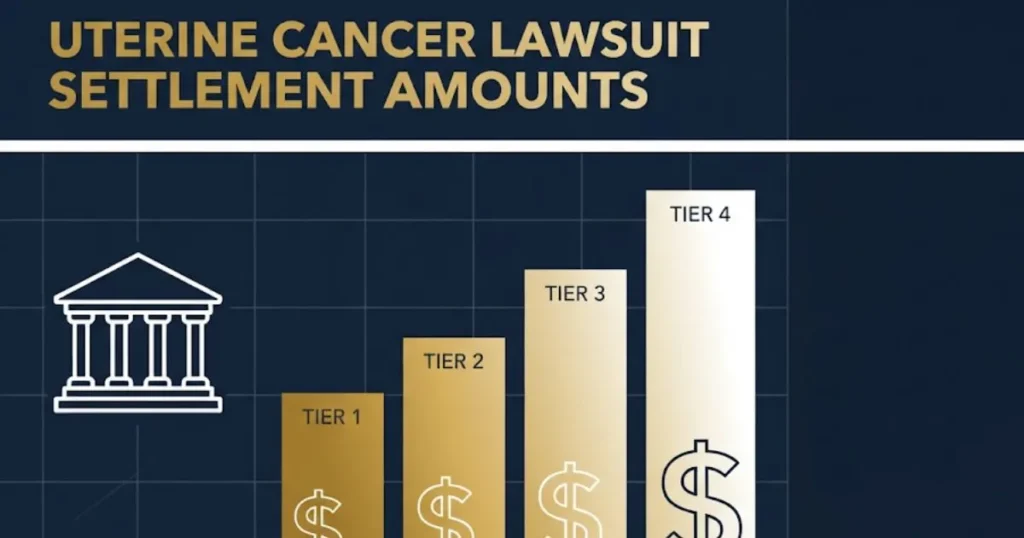
Uterine cancer lawsuit settlement amounts are estimated to range from $100,000 to $1.5 million per claim, depending on the severity of the cancer, duration of product use, and strength of medical evidence. No global settlement has been reached yet as of early 2026, but legal analysts have projected these figures based on similar mass tort cases.
Think of it like a tier system. The worse the cancer outcome and the longer the product exposure, the higher the potential payout.
| Settlement Tier | Cancer Severity | Estimated Payout Range |
|---|---|---|
| Tier 1 (Highest) | Stage III or IV uterine cancer, or death | $750,000 to $1,500,000 |
| Tier 2 | Stage II uterine or endometrial cancer | $300,000 to $750,000 |
| Tier 3 | Stage I uterine or endometrial cancer | $100,000 to $300,000 |
| Tier 4 | Pre-cancerous conditions with strong evidence | $50,000 to $100,000 |
These are projections, not guaranteed figures. Actual settlement values will depend on bellwether trial results and the final negotiated settlement grid.
For comparison, the talcum powder lawsuits against Johnson and Johnson resulted in individual verdicts ranging from $25 million to $4.69 billion. While hair relaxer cases may not reach those peaks, the parallels are strong.
Key Takeaway: The uterine cancer lawsuit is a major MDL involving over 10,000 claims, with bellwether trials expected in 2026 and estimated payouts ranging from $100,000 to $1.5 million based on cancer severity.
Hair Relaxer Uterine Cancer Lawsuit Explained
The hair relaxer uterine cancer lawsuit specifically targets manufacturers of chemical hair straightening products sold to consumers over the past several decades. The core allegation is simple: these companies sold products containing known or suspected carcinogens without adequate warnings.
Chemical hair relaxers work by breaking down the protein bonds in hair to make it straight. That process requires harsh chemicals. Many of the chemicals used, including formaldehyde, phthalates, and parabens, have been identified as endocrine disruptors. They can mimic estrogen in the body.
Uterine cancer is an estrogen-driven cancer. When chemicals that act like estrogen enter the body through the scalp repeatedly over years, the risk of developing uterine cancer increases. That’s the scientific foundation of these lawsuits.
The products were marketed heavily to Black women. Advertising campaigns portrayed relaxed, straightened hair as professional and desirable. Many women started using these products as children and continued for 20 or 30 years.
- Products were used by millions of women, with highest usage among Black women
- Chemical exposure occurred through the scalp, which absorbs substances efficiently
- Repeat use over decades compounded the cancer risk
- Manufacturers allegedly knew about the chemical risks for years
This isn’t just a product liability case. It’s a case about corporate responsibility and who bears the cost when a product silently harms its users for decades.
Who Qualifies for the Uterine Cancer Lawsuit
You may qualify for the uterine cancer lawsuit if you were diagnosed with uterine cancer or endometrial cancer after using chemical hair relaxer or hair straightener products for an extended period. The typical qualifying criteria focus on product usage history and medical diagnosis.
Most law firms handling these cases look for the following:
| Qualification Factor | Requirement |
|---|---|
| Product Type | Chemical hair relaxer or straightener (not heat tools) |
| Duration of Use | At least 2 to 4 years of regular use |
| Frequency | Used products 4 or more times per year |
| Diagnosis | Uterine cancer, endometrial cancer, or ovarian cancer |
| Timing | Diagnosis occurred after prolonged product use |
You do not need to remember every brand you used. Medical records and purchase history can help build your case.
If a family member passed away from uterine cancer after using these products, surviving family members may qualify to file a wrongful death claim. That’s a separate pathway covered later in this article.
The key thing to understand is that these lawsuits are individual claims, not a class action. Each person files their own case. Your payout depends on your specific circumstances.
Uterine Cancer Lawsuit Eligibility Requirements
Uterine cancer lawsuit eligibility depends on meeting specific medical and product-use criteria. You need both a qualifying diagnosis and a documented history of chemical hair relaxer use.
Here are the eligibility factors broken down clearly:
- Diagnosis: You must have been diagnosed with uterine cancer, endometrial cancer, endometriosis, uterine fibroids (in some cases), or ovarian cancer
- Product use: You must have used chemical hair relaxer or straightener products regularly for at least 2 years
- Timing: Your diagnosis must have come after your period of product use
- Age: There is no age restriction, but most plaintiffs are women over 30
- Location: You must be filing in the United States
Some attorneys accept cases involving pre-cancerous conditions like endometrial hyperplasia, but these claims are typically valued lower.
Proof matters. Gather any medical records showing your diagnosis date and type. If you have receipts, photos of products used, or salon records, those help too. Testimony from family members or hairstylists about your usage history can fill in gaps.
One detail many people miss: you don’t have to prove that hair relaxers were the only cause of your cancer. You just need to show they were a substantial contributing factor.
Key Takeaway: You may qualify if you used chemical hair relaxers regularly for 2 or more years and were later diagnosed with uterine cancer, endometrial cancer, or related conditions.
How to File a Uterine Cancer Lawsuit
Filing a uterine cancer lawsuit starts with contacting a law firm that handles mass tort or product liability cases. Most attorneys in this space work on a contingency fee basis, meaning you pay nothing upfront. They only get paid if you win.
Here is the typical filing process:
| Step | What Happens |
|---|---|
| Step 1: Free Case Review | Attorney evaluates your product use history and medical diagnosis |
| Step 2: Gather Documents | Collect medical records, pathology reports, and any product receipts |
| Step 3: Retain an Attorney | Sign a retainer agreement with the law firm |
| Step 4: File the Complaint | Attorney files your individual lawsuit, usually in the MDL |
| Step 5: Discovery and Litigation | Your case moves through the legal process with the rest of the MDL |
You do not need to go to court yourself in most cases. The MDL process handles the heavy lifting through bellwether trials and group proceedings.
Pick an attorney who has experience with hair relaxer litigation specifically. Ask how many cases they’ve filed. Ask about their communication process. A good firm will keep you updated without you having to chase them.
One thing worth knowing: filing sooner is better. Statutes of limitations vary by state, and the earlier your claim is on file, the stronger your position in any future settlement grid.
Hair Relaxer Cancer Lawsuit Payout Estimates
Hair relaxer cancer lawsuit payout estimates vary widely based on individual circumstances. Legal analysts predict that average settlements could fall between $150,000 and $750,000 for most qualifying claims. Cases involving death or stage IV cancer could exceed $1 million.
These figures are informed by outcomes in similar mass torts:
| Comparable Mass Tort | Average Individual Settlement |
|---|---|
| Talcum Powder (J&J) | $100,000 to $1,000,000+ |
| Roundup (Bayer) | $100,000 to $200,000 (average) |
| Camp Lejeune Water Contamination | $150,000 to $500,000 (projected) |
| 3M Earplugs | $30,000 to $300,000 |
The hair relaxer case sits in a similar range to the talcum powder litigation because both involve personal care products, cancer diagnoses, and allegations that companies hid known risks.
Your individual payout depends on several factors:
- Type and stage of cancer at diagnosis
- Length of time you used chemical hair relaxers
- Number of different products used
- Strength of your medical documentation
- Whether your case goes to trial or settles
If the first bellwether trials produce large plaintiff verdicts in 2026, expect settlement values to climb. Defendants tend to increase their offers when juries send strong signals.
Uterine Cancer Lawsuit Filing Deadline
The uterine cancer lawsuit deadline depends on your state’s statute of limitations for personal injury or product liability claims. Most states give you 2 to 3 years from the date you were diagnosed, or from the date you reasonably should have known that hair relaxers caused your cancer.
| State | Statute of Limitations |
|---|---|
| California | 2 years from diagnosis |
| New York | 3 years from diagnosis |
| Texas | 2 years from diagnosis |
| Florida | 2 years from knowledge of cause |
| Illinois | 2 years from diagnosis |
| Georgia | 2 years from diagnosis |
The “discovery rule” is important here. Many women were diagnosed years ago but only recently learned about the connection between hair relaxers and uterine cancer. In those cases, the clock may start from the date they discovered (or should have discovered) the link, not from the diagnosis date itself.
Do not wait to see if a settlement is announced before filing. If your statute of limitations expires, you lose your right to file entirely. No exceptions.
The safest move is to file as early as possible. Even if a settlement is years away, having your claim on record protects your rights.
Key Takeaway: Filing deadlines vary by state but are typically 2 to 3 years from diagnosis or discovery of the cause; filing early protects your claim regardless of when a settlement happens.
Chemicals in Hair Relaxers That Cause Cancer
The chemicals in hair relaxers that cause cancer include several compounds classified as endocrine disruptors and suspected carcinogens. These substances can be absorbed through the scalp during application and enter the bloodstream.
Here are the primary chemicals of concern:
| Chemical | Role in Product | Health Concern |
|---|---|---|
| Formaldehyde | Preservative and straightening agent | Known human carcinogen (IARC Group 1) |
| Phthalates | Fragrance carrier and plasticizer | Endocrine disruptor, mimics estrogen |
| Parabens | Preservative | Estrogenic activity, linked to hormone-sensitive cancers |
| Diethanolamine (DEA) | Emulsifier and pH adjuster | Possible carcinogen, organ toxicity |
| Cyclosiloxanes (D4, D5) | Conditioning agents | Endocrine disruption, reproductive toxicity |
The problem is cumulative exposure. Using a product once probably won’t cause cancer. But applying these chemicals to your scalp every 4 to 8 weeks for 10, 20, or 30 years creates a persistent chemical load in the body.
The scalp is one of the most absorbent areas of skin. Chemicals applied there enter the bloodstream more efficiently than chemicals applied to, say, your hands. This is why hair relaxers pose a different risk than other personal care products containing similar ingredients.
Think of it like this: one cigarette won’t give you lung cancer, but a pack a day for 20 years might. The same dose-over-time logic applies to chemical hair relaxer exposure.
Uterine Cancer Lawsuit Evidence and Studies
The uterine cancer lawsuit evidence is built on a growing body of scientific research linking chemical hair products to cancer. The most significant study came from the National Institute of Environmental Health Sciences in October 2022.
The Sister Study (2022):
This NIH-funded study followed 33,497 women aged 35 to 74 over approximately 11 years. Women who reported using chemical hair straighteners more than four times per year were about 2.5 times more likely to develop uterine cancer than women who did not use them.
That’s not a small increase. That’s a 150% higher risk.
Additional supporting evidence includes:
- A 2021 study published in Carcinogenesis found that hair products used predominantly by Black women contained higher concentrations of endocrine-disrupting chemicals
- Research published in the International Journal of Cancer connected hair dye and chemical straightener use to increased breast cancer risk
- The Journal of the National Cancer Institute published findings linking personal care product chemicals to hormone-sensitive cancers
- FDA testing has confirmed the presence of formaldehyde in products labeled “formaldehyde-free”
The defense will argue that correlation is not causation. But plaintiffs’ expert witnesses have been allowed to testify on general causation following the Daubert hearings. That means the court has determined the science is reliable enough for a jury to consider.
Hair Relaxer Lawsuit Defendants
The hair relaxer lawsuit defendants include some of the largest cosmetics and personal care companies in the world. These companies manufactured, marketed, and sold the chemical hair relaxer products at the center of the litigation.
Here are the primary defendants:
| Company | Key Products |
|---|---|
| L’Oreal USA | Dark and Lovely, SoftSheen-Carson, Mizani |
| Revlon | Revlon Realistic, Creme of Nature |
| Strength of Nature (now House of Charis) | African Pride, Elasta QP |
| Namaste Laboratories | ORS Olive Oil Relaxer |
| Dabur International | Amla Legend |
| Godrej Consumer Products | TCB Naturals |
L’Oreal is the largest defendant by market share. The company’s Dark and Lovely brand has been one of the best-selling hair relaxer lines in the United States for decades, especially within Black communities.
The lawsuits allege that these companies:
- Knew their products contained carcinogenic or endocrine-disrupting chemicals
- Failed to warn consumers about cancer risks on product labels
- Continued selling products even after internal or external research suggested health dangers
- Targeted marketing toward Black women and girls without disclosing known risks
Some defendants have argued that their products meet FDA regulations. But meeting minimum regulatory standards is not the same as being safe, and plaintiffs argue that the regulatory framework for cosmetics has been historically weak.
Key Takeaway: Major cosmetics companies including L’Oreal, Revlon, and Strength of Nature are defendants in the hair relaxer MDL, accused of selling products they knew contained harmful chemicals without adequate warnings.
Uterine Cancer from Hair Straightener Products
Uterine cancer from hair straightener products develops through repeated chemical exposure over time. The cancer typically originates in the endometrium, which is the lining of the uterus. Hormonal imbalances caused by endocrine-disrupting chemicals can trigger abnormal cell growth in this tissue.
Here is how the exposure pathway works:
- Chemicals are applied to the scalp during hair straightening treatments
- The scalp absorbs these chemicals into the bloodstream
- Endocrine-disrupting compounds mimic estrogen in the body
- Excess estrogenic activity stimulates the endometrial lining
- Over years of repeated exposure, abnormal cells may develop into cancer
Women who used chemical hair straighteners from a young age face higher risk. Many started using these products as children, sometimes as young as 8 or 10 years old. That means decades of cumulative exposure before any diagnosis.
Symptoms of uterine cancer include abnormal vaginal bleeding, pelvic pain, unexplained weight loss, and pain during intercourse. Many women attributed early symptoms to menopause or other conditions, delaying diagnosis.
The connection between these products and cancer was not widely known until the 2022 Sister Study made national news. Before that, most consumers had no reason to suspect their hair care routine could be making them sick.
Endometrial Cancer Hair Relaxer Lawsuit
The endometrial cancer hair relaxer lawsuit is part of the same MDL but focuses specifically on endometrial cancer diagnoses. Endometrial cancer is the most common form of uterine cancer, accounting for about 95% of all uterine cancer cases.
Endometrial cancer starts in the cells lining the uterus. It is strongly driven by estrogen. When the body receives excess estrogenic stimulation from external chemicals, the risk of endometrial cancer rises.
| Cancer Type | Percentage of Uterine Cancers | Link to Hair Relaxers |
|---|---|---|
| Endometrial Carcinoma (Type I) | About 80% | Strongly linked to estrogen exposure |
| Serous Carcinoma (Type II) | About 10% | Less dependent on estrogen, but still studied |
| Uterine Sarcoma | About 5 to 8% | Fewer cases in the MDL, still eligible |
If you were diagnosed with endometrial cancer and have a history of chemical hair relaxer use, your case fits squarely within this litigation. Endometrial cancer cases make up the majority of claims in the MDL.
Treatment for endometrial cancer often involves hysterectomy, radiation, chemotherapy, or a combination. The physical and emotional toll is enormous. Lawsuits seek compensation not just for medical expenses but for pain, suffering, loss of fertility, and diminished quality of life.
Hair Relaxer MDL Update for 2026
The hair relaxer MDL update for 2026 reflects a litigation that has moved faster than many legal observers expected. As of early 2026, the MDL has passed several critical milestones.
Key developments:
- Daubert hearings completed: The court evaluated the reliability of plaintiffs’ expert testimony on general causation. Several key experts were allowed to testify, a major procedural win.
- Bellwether case selection: A pool of representative cases has been selected for trial. These cases will be the first to go before a jury.
- First trials anticipated: The initial bellwether trials are expected in mid to late 2026. Outcomes will heavily influence settlement negotiations.
- Case count growing: Over 10,000 individual lawsuits have been filed in the MDL as of early 2026, with new cases still being added monthly.
| MDL Milestone | Status as of 2026 |
|---|---|
| MDL Formation | December 2022 |
| Daubert Hearings | Completed late 2025 |
| Bellwether Selection | Underway early 2026 |
| First Trial Date | Expected mid to late 2026 |
| Global Settlement | Not yet reached |
| Total Cases Filed | Over 10,000 |
If bellwether juries return strong verdicts for plaintiffs, defendants will face enormous pressure to settle. A single eight-figure verdict can change the entire trajectory of settlement talks overnight.
Key Takeaway: The hair relaxer MDL is on track for its first bellwether trials in 2026, with over 10,000 cases filed and key expert testimony rulings already favoring plaintiffs.
Uterine Cancer Lawsuit Wrongful Death Claims
Uterine cancer lawsuit wrongful death claims allow surviving family members to sue on behalf of a loved one who died from uterine cancer after using chemical hair relaxer products. These claims carry some of the highest potential payouts in the litigation.
Wrongful death claims are filed by a representative of the deceased person’s estate. Typically, this is a surviving spouse, adult child, or parent. The specific rules vary by state.
| Factor | Details |
|---|---|
| Who Can File | Spouse, children, parents, or estate representative |
| Basis of Claim | Death was caused or contributed to by hair relaxer use |
| Types of Damages | Medical bills, funeral costs, lost income, pain and suffering, loss of companionship |
| Time Limit | Usually 2 to 3 years from the date of death (varies by state) |
| Payout Range | Estimated $500,000 to $1,500,000+ |
Wrongful death claims tend to settle for more because the harm is the ultimate harm. Juries are typically more sympathetic, and the damages are higher.
If your mother, sister, wife, or daughter passed away from uterine cancer and she used chemical hair relaxers for years, you should explore this option immediately. These claims have their own statutes of limitations, and the clock is ticking.
Gather the deceased’s medical records, death certificate, and any information about her hair relaxer usage history. Even testimony from friends and family about products she used can support the claim.
How Long Does a Uterine Cancer Lawsuit Take
A uterine cancer lawsuit typically takes 3 to 5 years from filing to resolution. Some cases may settle faster, particularly if bellwether trials produce strong results. Others could take longer if defendants fight aggressively.
Here is a general timeline:
| Phase | Estimated Duration |
|---|---|
| Filing and Initial Review | 1 to 3 months |
| Discovery (evidence exchange) | 6 to 18 months |
| Bellwether Trials | 2026 to 2027 (expected) |
| Settlement Negotiations | Could begin after first trial verdicts |
| Payout Distribution | 6 to 12 months after settlement approval |
Mass tort timelines are unpredictable. The Roundup litigation took about 5 years from the first major MDL filings to a global settlement. The talcum powder cases took closer to 8 years and are still ongoing in some form.
The hair relaxer MDL is tracking faster. The science is newer but strong. The Daubert rulings have gone well for plaintiffs. The case count is large enough to pressure defendants.
What you should not do is wait for a settlement before filing. If your statute of limitations runs out, you’re locked out permanently. The time to act is now, even if a payout is still a year or two away.
Think of it like getting in line. The earlier you file, the better positioned you are when the money starts flowing. Waiting costs you nothing if you have a contingency attorney, but waiting too long could cost you everything.
Key Takeaway: Most uterine cancer lawsuits take 3 to 5 years to resolve, and filing early is the single most important step you can take to protect your right to compensation.
Frequently Asked Questions
How much money can I get from a uterine cancer lawsuit in 2026?
Most claimants can expect estimated settlements between $100,000 and $1.5 million.
The exact amount depends on your cancer stage, duration of hair relaxer use, and medical documentation.
No global settlement has been finalized yet, so these are projections based on similar mass tort cases.
Do I qualify for the hair relaxer uterine cancer lawsuit?
You may qualify if you used chemical hair relaxers regularly for at least 2 years and were diagnosed with uterine or endometrial cancer.
A cancer diagnosis and documented product use history are the two main requirements.
Wrongful death claims are available for families of deceased users.
What is the deadline to file a uterine cancer lawsuit?
The deadline depends on your state’s statute of limitations, which is typically 2 to 3 years from diagnosis or discovery of the cause.
Some states apply a discovery rule that extends the filing window.
Filing as soon as possible is strongly recommended to avoid losing your right to sue.
Which hair relaxer brands are named in the lawsuit?
The major brands include Dark and Lovely, African Pride, ORS Olive Oil, Just for Me, Motions, and TCB Naturals.
Their parent companies, including L’Oreal, Revlon, and Strength of Nature, are the primary defendants.
Additional brands and manufacturers may be added as the litigation progresses.
How long will the uterine cancer lawsuit take to settle?
The overall litigation is expected to take 3 to 5 years from the MDL’s formation in December 2022.
Bellwether trials expected in 2026 could accelerate settlement talks significantly.
Individual payouts would likely begin 6 to 12 months after any global settlement is approved.
The uterine cancer lawsuit is moving forward with real momentum in 2026. Bellwether trials, strong science, and thousands of filed claims are pushing this case toward resolution.
If you used chemical hair relaxers and were diagnosed with uterine or endometrial cancer, now is the time to file. Get your medical records together and connect with an experienced mass tort attorney.
Don’t wait for a settlement announcement to take action. Filing early keeps your options open and puts you in the strongest position possible.







