

Truck accident lawsuit settlements in 2026 range from $75,000 for minor injuries to well over $5 million for catastrophic harm or wrongful death. These numbers keep climbing because trucking companies carry massive insurance policies and juries are awarding bigger verdicts each year.
If you or someone you love got hit by a commercial truck, this is the breakdown you need. You will learn exact settlement ranges by injury type, who you can sue, what evidence wins cases, and how the 2026 filing process works.
Here is one number that puts it in perspective. The average car accident settlement sits around $20,000 to $25,000. Truck accident settlements run five to ten times higher because of the severe damage these 80,000 pound vehicles cause.
This guide covers everything from wrongful death payouts to statute of limitations deadlines across all 50 states.
Truck Accident Lawsuit Settlements in 2026
Truck accident lawsuit settlements in 2026 reflect a clear upward trend in compensation values. Insurance companies are paying out more because injuries are more severe, medical costs keep rising, and juries have grown less tolerant of trucking safety violations.
The settlement range depends heavily on the type and severity of injuries.
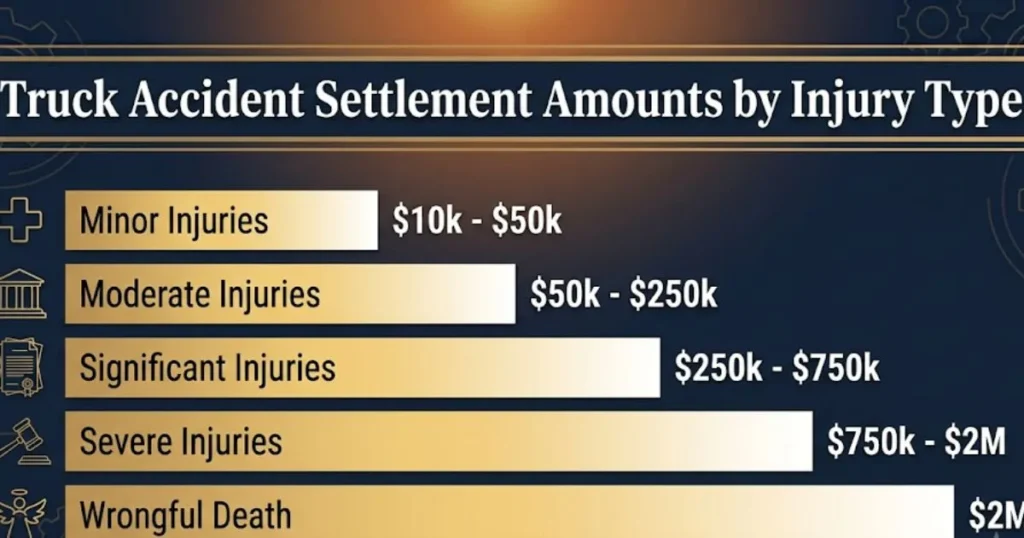
| Injury Severity | 2026 Settlement Range |
|---|---|
| Minor (whiplash, sprains) | $75,000 to $200,000 |
| Moderate (broken bones, herniated discs) | $200,000 to $750,000 |
| Severe (TBI, spinal cord damage) | $750,000 to $3 million |
| Catastrophic (paralysis, amputation) | $2 million to $10 million |
| Wrongful Death | $3 million to $20 million+ |
Several factors are pushing 2026 settlements higher than previous years. The FMCSA tightened its enforcement of Hours of Service violations in 2025. Electronic logging device data now makes it easier to prove a driver was fatigued or over hours.
Medical inflation is another driver. Hospital bills after a serious truck crash can easily top $500,000 for surgeries, rehabilitation, and long term care.
Trucking companies know this. Their legal teams often push for early settlements to avoid trial verdicts that could be even larger.
Average Truck Accident Settlement Amounts
The average truck accident settlement amount in 2026 falls between $300,000 and $800,000 for cases involving moderate to serious injuries. That number jumps significantly when permanent disability or death is involved.
These averages are just that: averages. Your case could land above or below depending on a handful of specific variables.
Here is how averages break down by accident type:
| Accident Type | Average Settlement |
|---|---|
| Rear-end truck collision | $150,000 to $400,000 |
| Jackknife accident | $400,000 to $1.5 million |
| Underride crash | $1 million to $5 million |
| Rollover accident | $500,000 to $2 million |
| Tire blowout crash | $200,000 to $800,000 |
| Wide turn accident | $100,000 to $500,000 |
One reason truck settlements are so much bigger than car accident payouts is insurance coverage. Most commercial trucking policies carry minimums of $750,000 to $1 million in liability coverage. Large carriers often have policies worth $5 million or more.
That means there is more money available to pay your claim. The pool of funds is simply larger than what a typical auto insurance policy provides.
Keep in mind that published “averages” can be misleading. A few multi-million dollar verdicts pull the average way up while thousands of smaller claims bring it down.
How Much Is a Truck Accident Lawsuit Worth
Your truck accident lawsuit is worth the total of your economic damages plus non-economic damages, and sometimes punitive damages on top of that. Think of it as three buckets of money that all add up to your final number.
Economic damages are the things you can put a receipt on:
- Medical bills (past and future)
- Lost wages and lost earning capacity
- Property damage
- Rehabilitation and therapy costs
- Home modification costs for disability
- Out of pocket expenses
Non-economic damages are harder to calculate but often worth more:
- Pain and suffering
- Emotional distress
- Loss of enjoyment of life
- Loss of consortium (for spouses)
- Disfigurement and scarring
Punitive damages come into play when the trucking company did something truly reckless. Maybe they knew the brakes were bad and sent the truck out anyway. Or maybe they pushed a driver to exceed hours of service limits.
A case with $200,000 in medical bills, significant pain and suffering, and clear trucking company negligence could easily be worth $1 million to $2 million when everything is added up.
The math is not as simple as multiplying your medical bills by three, despite what some online calculators suggest.
Key Takeaway: Truck accident settlements in 2026 average $300,000 to $800,000 for serious injuries, but catastrophic cases regularly exceed $5 million because commercial trucking policies carry much higher coverage limits than personal auto insurance.
18 Wheeler Accident Settlement Amounts
18 wheeler accident settlement amounts tend to be the highest of all truck accident categories. These vehicles weigh up to 80,000 pounds fully loaded. When they hit a passenger car, the damage is almost always catastrophic.
| 18 Wheeler Injury Type | Settlement Range |
|---|---|
| Soft tissue injuries | $100,000 to $300,000 |
| Broken bones requiring surgery | $300,000 to $900,000 |
| Traumatic brain injury | $1 million to $5 million |
| Spinal cord injury with paralysis | $3 million to $15 million |
| Wrongful death | $5 million to $20 million+ |
Imagine dropping a bowling ball on a soda can. That is roughly the size and weight difference between an 18 wheeler and a Honda Civic. Physics alone explains why these injuries are so severe.
Several major 18 wheeler verdicts from 2024 and 2025 set the stage for even higher 2026 values. A Texas jury awarded $730 million in a single trucking case in 2024 involving a major carrier. While most cases never reach that level, these headline verdicts do push insurance companies to settle for higher amounts.
The companies that own 18 wheelers typically carry insurance policies between $1 million and $10 million. Some of the largest carriers like Werner Enterprises, Swift Transportation, and JB Hunt maintain even higher umbrella coverage.
That bigger insurance pool is exactly why 18 wheeler cases command premium settlement values.
Truck Accident Wrongful Death Settlement
Truck accident wrongful death settlements in 2026 typically range from $3 million to $20 million or more. These cases carry the highest values because a family has lost a loved one permanently.
Wrongful death settlements account for several types of damages:
- Loss of financial support the deceased would have provided
- Loss of companionship, guidance, and consortium
- Funeral and burial expenses
- Medical bills incurred before death
- Pain and suffering the deceased endured before passing
- Punitive damages if the trucking company acted recklessly
Who can file a wrongful death claim depends on state law. In most states, the surviving spouse, children, or parents can file. Some states allow the estate to file on behalf of all beneficiaries.
| Claimant Type | Typical Recovery |
|---|---|
| Surviving spouse | $2 million to $10 million+ |
| Minor children | $1 million to $5 million each |
| Adult children | $500,000 to $3 million |
| Parents (of deceased adult child) | $1 million to $5 million |
A 2025 wrongful death case against a major trucking company in Georgia resulted in a $42 million verdict after evidence showed the company ignored repeated maintenance warnings. Verdicts like that influence how insurance adjusters value similar cases in 2026.
The emotional weight of these cases is immense. But financially, they often produce the largest settlements because juries understand that no amount of money replaces a life.
Truck Accident Injury Compensation
Truck accident injury compensation covers every financial and personal loss caused by the crash. The type and severity of your injury is the single biggest factor in determining your payout.
Here is a breakdown of compensation values by common truck accident injuries:
| Injury | Compensation Range |
|---|---|
| Whiplash/neck strain | $75,000 to $200,000 |
| Herniated disc | $150,000 to $500,000 |
| Broken ribs or collarbone | $100,000 to $400,000 |
| Crushed limbs | $500,000 to $2 million |
| Internal organ damage | $300,000 to $1.5 million |
| Burns (severe) | $500,000 to $3 million |
| Traumatic brain injury | $1 million to $5 million |
| Spinal cord injury | $2 million to $15 million |
| Amputation | $1.5 million to $10 million |
Your compensation is not just about today’s medical bills. It must cover future treatment too. Someone with a spinal cord injury might need $2 million to $5 million in lifetime medical care alone.
Lost wages matter as well. If you cannot return to your previous job, your compensation should reflect decades of lost income. A 35 year old earning $60,000 per year who can never work again has $1.8 million in lost future earnings even before adjusting for raises and inflation.
Pain and suffering adds another layer. Texas and many other states use a multiplier method, often 1.5 to 5 times your economic damages, depending on severity.
Key Takeaway: The type of injury determines more about your settlement value than almost any other factor, and compensation must include both current medical expenses and the full lifetime cost of your injury.
Truck Accident Settlement Calculator
A truck accident settlement calculator estimates your case value based on medical bills, lost income, pain level, and liability factors. These online tools give rough ballpark numbers, but they cannot replace a detailed case evaluation.
Here is how most calculators work:
Step 1: Total your medical expenses (past and projected future).
Step 2: Add your lost wages and lost future earning capacity.
Step 3: Apply a pain and suffering multiplier (typically 1.5x to 5x your economic damages).
Step 4: Adjust for liability. If you were partially at fault, reduce by your percentage of blame.
| Calculation Component | Example Amount |
|---|---|
| Medical bills (past) | $150,000 |
| Future medical care | $300,000 |
| Lost wages | $80,000 |
| Lost future earnings | $200,000 |
| Subtotal (economic damages) | $730,000 |
| Pain/suffering multiplier (3x) | $2,190,000 |
| Estimated case value | $2,190,000 |
The catch with online calculators is that they cannot account for the strength of your evidence, the specific trucking company’s history, or local jury tendencies. A case worth $2 million in Dallas might settle for $1.2 million in rural Mississippi because jury pools differ dramatically.
Think of a settlement calculator like a home value estimator. It gives you a starting point, but the real price depends on the specific buyer, the neighborhood, and the condition of the house.
Use calculators to set your expectations. Do not use them as your final number.
Factors That Affect Truck Accident Settlements
The factors that affect truck accident settlements include injury severity, evidence strength, insurance policy limits, the defendant’s conduct, and your own share of fault. Each of these can push your case value up or pull it down significantly.
Factors that increase your settlement:
- Severe or permanent injuries
- Clear evidence of trucking company violations
- Hours of service or ELD violations
- Driver intoxication or distraction
- Multiple liable parties (driver, company, manufacturer)
- High insurance policy limits
- Documented pre-crash safety complaints
- Punitive damages eligibility
Factors that decrease your settlement:
- Pre-existing medical conditions
- Gaps in your medical treatment
- Shared fault (comparative negligence)
- Low insurance policy limits
- Weak or missing evidence
- Late filing near the statute of limitations
The difference between a strong case and a weak one can be millions of dollars. A truck crash with clear ELD violations, a clean victim record, and catastrophic injuries might settle for $5 million. The same injuries with shared fault and missing evidence might bring $800,000.
Insurance adjusters use a scoring system to evaluate claims. They weigh each factor and assign a range. Your ability to document and prove each factor is what determines where in that range you land.
Who Is Liable in a Truck Accident
Multiple parties can be liable in a truck accident, not just the driver behind the wheel. This is one of the biggest differences between a truck crash and a regular car accident. More defendants means more insurance policies, which means more money available.
Here are the potentially liable parties:
- Truck driver: For speeding, fatigue, distraction, or intoxication
- Trucking company: For negligent hiring, poor training, or pressuring unsafe schedules
- Cargo loading company: For overloading or improperly securing freight
- Truck manufacturer: For defective brakes, tires, or mechanical parts
- Maintenance company: For failing to inspect or repair the vehicle
- Government entity: For dangerous road design or missing signage
| Liable Party | Common Violation | Insurance Coverage |
|---|---|---|
| Truck driver | Fatigued driving, DUI | Personal + employer’s policy |
| Trucking company | Hours of service violations | $1M to $10M+ policies |
| Cargo company | Overweight or shifted load | $1M to $5M policies |
| Manufacturer | Defective brakes or steering | Product liability coverage |
| Maintenance provider | Failed inspection | $1M to $3M policies |
The legal concept of “vicarious liability” is powerful here. If the truck driver was on the job when the crash happened, their employer is typically liable for the driver’s actions. That means even if the driver has no personal assets, the company’s deep pockets and large insurance policy are on the hook.
Key Takeaway: Identifying all liable parties is critical because each one brings a separate insurance policy to the table, which directly increases the total compensation pool available for your settlement.
Trucking Company Negligence Lawsuits
Trucking company negligence lawsuits target the employer rather than just the individual driver. In many cases, the company’s own failures caused or contributed to the crash.
Common forms of trucking company negligence include:
- Negligent hiring: Putting a driver with a bad safety record or DUI history behind the wheel
- Negligent supervision: Failing to monitor driver behavior, hours, or drug testing
- Negligent maintenance: Skipping required inspections or delaying brake repairs
- Pressuring violations: Encouraging drivers to exceed Hours of Service limits to meet delivery deadlines
- Falsifying records: Doctoring maintenance logs or driver qualification files
The FMCSA requires trucking companies to keep detailed records. When a crash happens, these records become gold. If the company destroyed or altered them, that is called “spoliation of evidence” and can lead to additional penalties.
A 2025 case in Florida resulted in $18 million in punitive damages after evidence showed a trucking company knew its driver had failed drug tests but kept him on the road. Punitive damages exist specifically to punish this kind of corporate recklessness.
Going after the company instead of just the driver is not about being greedy. It is about holding the organization accountable for systemic safety failures that put everyone on the road at risk.
These lawsuits also create a financial incentive for trucking companies to actually follow safety rules. When ignoring regulations costs them millions, they pay attention.
Truck Driver Fatigue Accident Lawsuits
Truck driver fatigue accident lawsuits are among the strongest cases you can bring. Fatigue is a leading cause of commercial truck crashes, and federal regulations exist specifically to prevent it.
The FMCSA’s Hours of Service (HOS) rules set clear limits:
| HOS Rule | Requirement |
|---|---|
| 11 Hour Driving Limit | Max 11 hours driving after 10 consecutive hours off duty |
| 14 Hour Window | Cannot drive beyond 14 hours after coming on duty |
| 30 Minute Break | Required after 8 cumulative hours of driving |
| 60/70 Hour Limit | Cannot drive after 60/70 hours on duty in 7/8 consecutive days |
| Restart Provision | 34 consecutive hours off duty restarts the weekly clock |
When a driver violates these rules, the electronic logging device (ELD) records it. Since December 2019, nearly all commercial trucks have been required to use ELDs. These devices track engine hours, miles driven, and duty status in real time.
Fatigue impairment is comparable to alcohol impairment. Studies by the NHTSA show that being awake for 18 hours produces impairment equal to a 0.05% blood alcohol level. At 24 hours awake, it matches a 0.10% BAC, which exceeds the legal limit in every state.
If ELD data shows the driver exceeded their hours, your case becomes significantly easier to prove. The violation is documented electronically and very hard for the trucking company to explain away.
Truck Accident Evidence and Black Box Data
Truck accident evidence and black box data can make or break your case in 2026. Modern commercial trucks are rolling data centers, and the information they record is powerful courtroom evidence.
The event data recorder (EDR), often called the truck’s “black box,” captures critical information:
- Speed at the moment of impact
- Brake application timing and force
- Throttle position
- Steering input
- Seatbelt status
- Engine RPM
- Time of the event
Beyond the black box, other key evidence includes:
- ELD records showing hours of service compliance
- Dashcam footage from the truck and nearby vehicles
- GPS tracking data showing route and stops
- Maintenance and inspection records
- Driver qualification files (license status, medical certifications, drug test results)
- Dispatch communications and text messages
- Cargo manifests and weight records
| Evidence Type | What It Proves | Preservation Deadline |
|---|---|---|
| EDR/Black box | Speed, braking, impact force | 30 days (auto-overwrite risk) |
| ELD data | Hours driven, rest periods | 6 months (FMCSA requirement) |
| Dashcam footage | Visual record of crash | Varies (often 30 to 72 hours) |
| Maintenance logs | Vehicle condition | 1 year minimum |
| Drug test results | Driver impairment | 5 years (FMCSA requirement) |
Time is your enemy when it comes to evidence. Black box data can be overwritten in as few as 30 days. Dashcam footage often loops every 72 hours. A preservation letter must go out to the trucking company immediately to prevent destruction of this data.
Key Takeaway: Electronic evidence from the truck’s black box, ELD, dashcam, and GPS systems is the most powerful tool in a 2026 truck accident case, but much of it auto-deletes within days or weeks if not preserved immediately.
How to File a Truck Accident Lawsuit
To file a truck accident lawsuit, you start by documenting the crash, preserving evidence, getting medical treatment, and then formally filing a complaint in court. The process is more complex than a regular car accident case because of the multiple parties and federal regulations involved.
Step by step process:
Step 1: Get immediate medical attention. Your medical records become the foundation of your injury claim. Gaps in treatment give the defense ammunition to argue your injuries are not serious.
Step 2: Preserve evidence. Send a spoliation letter to the trucking company demanding they preserve the black box data, ELD records, dashcam footage, maintenance logs, and driver files.
Step 3: Investigate the crash. Obtain the police report. Photograph the scene, vehicles, and injuries. Identify witnesses.
Step 4: Identify all defendants. Determine whether the driver, trucking company, cargo loader, manufacturer, or maintenance provider bear responsibility.
Step 5: File the complaint. Your attorney files a formal lawsuit in the appropriate court (state or federal depending on the parties involved).
Step 6: Discovery phase. Both sides exchange evidence, take depositions, and hire expert witnesses.
Step 7: Negotiate or proceed to trial. Most cases settle during or after discovery. If not, the case goes before a jury.
| Filing Step | Typical Timeframe |
|---|---|
| Evidence preservation | Within 24 to 72 hours |
| Medical documentation | Ongoing throughout case |
| Investigation | 1 to 3 months |
| Filing complaint | 30 to 90 days after hiring attorney |
| Discovery | 6 to 12 months |
| Settlement negotiation | 3 to 6 months |
Do not wait to start this process. Evidence disappears, witnesses forget details, and statutes of limitations run out. Acting fast is not optional in truck accident cases.
Truck Accident Lawsuit Process
The truck accident lawsuit process follows a predictable path from initial filing through resolution. Most cases take 12 to 24 months from start to finish, though complex cases can stretch to 36 months or longer.
Phase 1: Pre-litigation (1 to 3 months)
Your attorney investigates the crash, gathers evidence, calculates damages, and sends a demand letter to the trucking company’s insurance carrier.
Phase 2: Filing and pleadings (1 to 2 months)
The formal complaint is filed. The defendant files an answer. Motions may be filed to dismiss or transfer the case.
Phase 3: Discovery (6 to 12 months)
This is the longest phase. Both sides exchange documents, take depositions from witnesses and experts, and build their cases. Truck accident discovery is more complex than car accident cases because of the volume of regulated records involved.
Phase 4: Mediation (1 to 2 months)
Many courts require mediation before trial. A neutral third party helps both sides negotiate. About 60% of truck accident cases settle during mediation.
Phase 5: Trial (1 to 4 weeks)
If mediation fails, the case goes to trial. A jury hears evidence and decides both liability and damages. Truck accident trials tend to produce higher verdicts than settlement offers because juries respond emotionally to severe injuries and corporate negligence.
| Phase | Duration | What Happens |
|---|---|---|
| Pre-litigation | 1 to 3 months | Investigation and demand letter |
| Filing | 1 to 2 months | Complaint filed in court |
| Discovery | 6 to 12 months | Evidence exchange, depositions |
| Mediation | 1 to 2 months | Settlement negotiations |
| Trial | 1 to 4 weeks | Jury verdict if no settlement |
The entire process feels slow when you are injured and dealing with bills. But rushing to settle usually means leaving money on the table. Patience during discovery is where the biggest payouts are built.
Truck Accident Statute of Limitations
The truck accident statute of limitations is the legal deadline for filing your lawsuit. Miss it and your case is dead, regardless of how strong your evidence is or how severe your injuries are.
Every state sets its own deadline, and they vary significantly:
| State | Statute of Limitations |
|---|---|
| Texas | 2 years |
| California | 2 years |
| Florida | 2 years (changed from 4 in 2024) |
| New York | 3 years |
| Illinois | 2 years |
| Georgia | 2 years |
| Pennsylvania | 2 years |
| Ohio | 2 years |
| Michigan | 3 years |
| Tennessee | 1 year |
| Kentucky | 1 year |
| Louisiana | 1 year |
Tennessee, Kentucky, and Louisiana have the shortest deadlines at just one year. If your crash happened in one of these states, the clock is ticking fast.
Some exceptions can extend or pause the deadline:
- Minors: The clock typically does not start until the child turns 18
- Incapacitated victims: If you were in a coma or mentally incapacitated, the deadline may toll
- Discovery rule: In some states, the clock starts when you discovered (or should have discovered) your injury
- Government defendants: Claims against government vehicles or roads often have shorter deadlines of 6 months to 1 year and require special notice filings
Do not assume you have plenty of time. Even if the deadline is two years away, evidence degrades and witnesses vanish. Filing early gives your attorney maximum time to build the strongest possible case.
Key Takeaway: Your statute of limitations varies by state and can be as short as one year; missing this deadline permanently kills your case, so identifying your state’s specific deadline should be your first priority.
Commercial Truck Accident Claims
Commercial truck accident claims differ from regular auto accident claims in scale, complexity, and the number of parties involved. The word “commercial” means the truck was being used for business purposes, which triggers federal regulations and higher insurance requirements.
Types of commercial trucks covered include:
- Semi-trucks and tractor-trailers
- 18 wheelers
- Delivery trucks (FedEx, UPS, Amazon)
- Tanker trucks
- Flatbed trucks
- Dump trucks
- Garbage trucks
- Moving trucks (U-Haul, Penske)
- Box trucks over 10,001 pounds
Federal law requires commercial vehicles over 10,001 pounds to carry minimum insurance of $750,000. Vehicles hauling hazardous materials must carry $1 million to $5 million in coverage.
| Vehicle Type | Minimum Required Insurance |
|---|---|
| General freight carriers | $750,000 |
| Household goods carriers | $750,000 |
| Oil haulers | $1,000,000 |
| Hazardous materials carriers | $5,000,000 |
| Passenger carriers (small) | $1,500,000 |
| Passenger carriers (large) | $5,000,000 |
These higher insurance minimums are exactly why commercial truck claims pay more than standard auto claims. The money is there. The question is building a strong enough case to access it.
Commercial claims also involve regulatory violations that do not exist in car accident cases. FMCSA regulations on driver qualifications, drug testing, vehicle maintenance, and hours of service create multiple avenues for proving negligence.
Truck Accident Settlement Timeline
The truck accident settlement timeline from crash to check typically runs 12 to 24 months for straightforward cases and 24 to 48 months for complex or high-value cases. Very few truck accident cases resolve in under a year.
Here is a realistic timeline breakdown:
| Phase | Time After Crash |
|---|---|
| Emergency treatment and stabilization | Day 1 to Week 1 |
| Ongoing medical treatment | Months 1 to 12 |
| Attorney investigation and evidence gathering | Months 1 to 3 |
| Demand letter sent to insurer | Months 6 to 12 |
| Insurance company response | Months 7 to 14 |
| Lawsuit filed (if no early settlement) | Months 6 to 12 |
| Discovery phase | Months 12 to 24 |
| Mediation | Months 18 to 30 |
| Trial (if needed) | Months 24 to 48 |
| Settlement check received | 30 to 90 days after agreement |
Once a settlement is reached, the actual payment takes another 30 to 90 days to process. The check goes to your attorney’s trust account, liens and fees are deducted, and you receive the remainder.
Several things can speed up or slow down the timeline:
Speed it up:
- Clear liability with strong evidence
- Completed medical treatment (reached maximum medical improvement)
- Single defendant with adequate insurance
Slow it down:
- Disputed liability
- Ongoing medical treatment
- Multiple defendants pointing fingers at each other
- Appeals after trial verdict
Waiting until you reach “maximum medical improvement” before settling is usually smart. If you settle too early, you might not account for future surgeries or complications that have not shown up yet.
Frequently Asked Questions
What is the average settlement for a truck accident in 2026?
The average truck accident settlement in 2026 ranges from $300,000 to $800,000 for cases with moderate to severe injuries.
Wrongful death cases average significantly higher, often reaching $3 million to $20 million.
The exact amount depends on injury severity, evidence strength, and the number of liable parties.
How long does a truck accident lawsuit take to settle?
Most truck accident lawsuits settle within 12 to 24 months from the date of filing.
Complex cases with disputed liability or multiple defendants can take 36 months or longer.
Once a settlement agreement is signed, payment typically arrives within 30 to 90 days.
Can I sue the trucking company and not just the driver?
Yes, you can sue the trucking company directly under the legal doctrine of vicarious liability.
If the driver was working at the time of the crash, the employer is typically responsible for the driver’s actions.
You can also sue the company for its own negligence in hiring, training, supervision, or vehicle maintenance.
What happens if I was partially at fault in a truck accident?
In most states, you can still recover damages even if you were partially at fault.
Your compensation is typically reduced by your percentage of blame under comparative negligence rules.
A few states (Alabama, Maryland, North Carolina, Virginia, and Washington D.C.) bar recovery completely if you share any fault.
Do most truck accident cases settle or go to trial?
Approximately 95% of truck accident cases settle before reaching a jury trial.
Insurance companies prefer to settle because jury verdicts in truck cases tend to be unpredictably large.
Cases that do go to trial often produce higher payouts, but they also carry the risk of receiving nothing.
The bottom line on truck accident lawsuit settlements in 2026 is this: they are bigger, better documented, and more complex than ever before. Technology like ELDs and black boxes has made it easier to prove trucking company negligence, which drives up settlement values.
If you were hurt in a truck crash, act fast. Preserve evidence, document your injuries, and know your state’s filing deadline. The difference between a strong case and a missed opportunity often comes down to timing.
Your next step is checking your eligibility and understanding what your specific case might be worth based on the injury and settlement ranges outlined above.







