

The Toyota RAV4 driving habits tracking lawsuit alleges that Toyota secretly collected detailed driving data from RAV4 owners and shared it with insurance companies and data brokers. If you own or lease a RAV4, your driving behavior may have been monitored without your real consent.
This case has picked up serious steam heading into 2026. Multiple lawsuits have been filed across federal courts, and a class action structure is forming.
In this guide, you will learn exactly what Toyota allegedly did, which vehicles are affected, what kind of payout you might see, and how to protect your rights. One striking detail: some drivers reportedly saw their insurance premiums spike after Toyota transmitted data they never agreed to share.
Here is everything you need to know about this lawsuit right now.
Toyota RAV4 Driving Habits Tracking Lawsuit Explained
The Toyota RAV4 driving habits tracking lawsuit is a group of legal claims alleging that Toyota Motor Corporation collected granular driving behavior data from RAV4 vehicles and transmitted that data to third parties without proper disclosure or consent. The core accusation is straightforward: Toyota turned its connected vehicle systems into a surveillance tool.
Plaintiffs say Toyota used its connected services platform to record data points like hard braking events, rapid acceleration, speed thresholds, trip duration, and even the time of day someone drove. That information was then allegedly packaged and sold to insurance data brokers.
Think of it like this: imagine someone riding in your back seat with a clipboard, writing down every time you hit the brakes too hard or drove after midnight. Then imagine that person handing those notes to your insurance company. That is essentially what plaintiffs claim happened, except the “person” was software embedded in the car itself.
The lawsuits draw on several legal theories including violations of state wiretapping laws, the Federal Wiretap Act, the Electronic Communications Privacy Act, and various state consumer protection statutes. Some plaintiffs have raised claims under the California Consumer Privacy Act as well.
| Key Detail | Information |
|---|---|
| Defendant | Toyota Motor Corporation and related entities |
| Legal Claims | Wiretapping, privacy violations, consumer fraud |
| Data Allegedly Collected | Speed, braking, acceleration, trip data |
| Third Parties Involved | Insurance data brokers like Verisk and LexisNexis |
| Courts | Multiple U.S. District Courts |
Toyota has not admitted to wrongdoing. The company has stated that its connected services are disclosed in vehicle purchase agreements. Plaintiffs disagree sharply with that characterization.
Toyota RAV4 Data Privacy Class Action Overview
The Toyota RAV4 data privacy class action is a consolidated legal effort bringing together individual claims from RAV4 owners across the country. Rather than each driver filing a separate lawsuit, these cases are being grouped to increase efficiency and legal pressure.
Class action status means one group of named plaintiffs represents thousands of others in the same situation. If you drove a connected RAV4 during the relevant period, you may already be part of the proposed class without having done anything.
Several law firms filed initial complaints in 2024 and early 2025. By mid-2025, motions for class certification were underway. The class definition typically includes anyone who owned or leased a Toyota RAV4 equipped with connected vehicle technology during a specific window of years.
This is not just about the RAV4 either. Toyota faces similar allegations involving other models. But the RAV4 is the best-selling model in Toyota’s lineup, which means the potential class size is enormous. Millions of RAV4 units were sold in the U.S. between 2018 and 2024.
The legal teams pushing these cases have experience with automotive privacy litigation. Some of them handled the General Motors OnStar data sharing lawsuits, which followed a nearly identical pattern of allegations.
- Named plaintiffs represent the entire class
- Class certification hearings are expected in 2026
- The proposed class may include millions of RAV4 owners
- Related lawsuits target other Toyota models too
The strength of a class action lies in numbers. One driver suing Toyota over data sharing would barely register. Millions of drivers filing together is a different story entirely.
Toyota Driving Data Lawsuit 2026 Status
As of 2026, the Toyota driving data lawsuit is in active litigation with several key developments unfolding. Courts have not dismissed the claims, and the case is progressing toward class certification and potential discovery phases.
In late 2025, federal judges denied Toyota’s initial motions to dismiss in at least two jurisdictions. That was a significant win for plaintiffs. It means the courts found enough substance in the allegations to let the case move forward.
Discovery is the phase where both sides exchange evidence. For plaintiffs, this is where internal Toyota emails, engineering documents, and third-party data sharing contracts could surface. If Toyota’s internal records confirm that driving data was systematically packaged and sold, the case becomes much harder for Toyota to defend.
| 2026 Milestone | Expected Timing |
|---|---|
| Class Certification Hearing | Mid-2026 |
| Discovery Phase | Ongoing through 2026 |
| Potential Settlement Talks | Late 2026 or early 2027 |
| Trial Date (if no settlement) | 2027 or later |
Settlement discussions sometimes begin once discovery reveals damaging evidence. That is exactly what happened in the GM OnStar case, where internal documents showed the company knew drivers were unaware of data sharing.
Keep your eyes on mid-2026. If class certification is granted, Toyota will face enormous pressure to negotiate.
Key Takeaway: The Toyota RAV4 data tracking lawsuit is real, active, and moving forward in federal courts as of 2026, with class certification and discovery as the next major hurdles.
Toyota RAV4 Tracking Lawsuit Settlement Details
No official settlement has been reached in the Toyota RAV4 tracking lawsuit as of early 2026. The case is still in pre-settlement litigation phases. But the trajectory of this case suggests a settlement is more likely than a trial.
Automaker data privacy cases tend to settle. The reason is simple: trials are unpredictable, expensive, and create public records that can fuel additional lawsuits. Toyota’s legal team knows this. So do the plaintiff attorneys.
When a settlement does happen, it will likely include several components. Based on comparable cases, here is what a Toyota data tracking settlement could look like:
| Settlement Component | Likely Provision |
|---|---|
| Cash Payments to Class Members | $50 to $500 per person |
| Injunctive Relief | Toyota required to change data practices |
| Disclosure Requirements | Clearer consent forms for data collection |
| Attorney Fees | 25% to 33% of total settlement fund |
| Claims Administration | Third-party administrator handles payouts |
The GM OnStar data sharing settlement offered affected drivers between $50 and $350 depending on their data exposure. The Hyundai and Kia data privacy cases followed a similar range. Toyota’s settlement, when it comes, will probably land in that ballpark.
One thing to watch: injunctive relief. Even if cash payments are modest, forcing Toyota to change how it collects and shares data would be a significant outcome. That kind of structural change affects every Toyota owner going forward.
Nothing is finalized yet. But the pieces are moving in the direction of resolution.
Toyota RAV4 Lawsuit Payout Estimate
Most individual claimants in the Toyota RAV4 lawsuit can expect to receive between $50 and $500 if a settlement is reached. The exact amount will depend on factors like vehicle model year, length of ownership, and whether data sharing caused direct financial harm like increased insurance premiums.
Let’s be real about how class action payouts work. The total settlement fund gets split among all class members who file valid claims. If the fund is $100 million and 500,000 people file claims, that is $200 per person before attorney fees.
Drivers who can show direct harm may receive more. If your insurance rates went up and you can connect that increase to Toyota’s data sharing, you sit in a higher payment tier. Expect settlement administrators to create two or three tiers based on proof of harm.
| Payout Tier | Estimated Range | Requirements |
|---|---|---|
| Basic (no proof of harm) | $50 to $100 | Valid claim form, proof of ownership |
| Mid-Tier (some evidence of harm) | $100 to $300 | Ownership proof plus insurance premium changes |
| Enhanced (documented financial harm) | $300 to $500 | Ownership proof, insurance records, documented rate increase |
These numbers are estimates based on similar automotive data privacy settlements. They could change depending on the size of the final class, the total fund, and court approval.
Do not expect a life-changing payout. Class actions rarely deliver that for individual members. The real value is in forcing Toyota to stop the behavior.
Who Qualifies for the Toyota Data Tracking Lawsuit
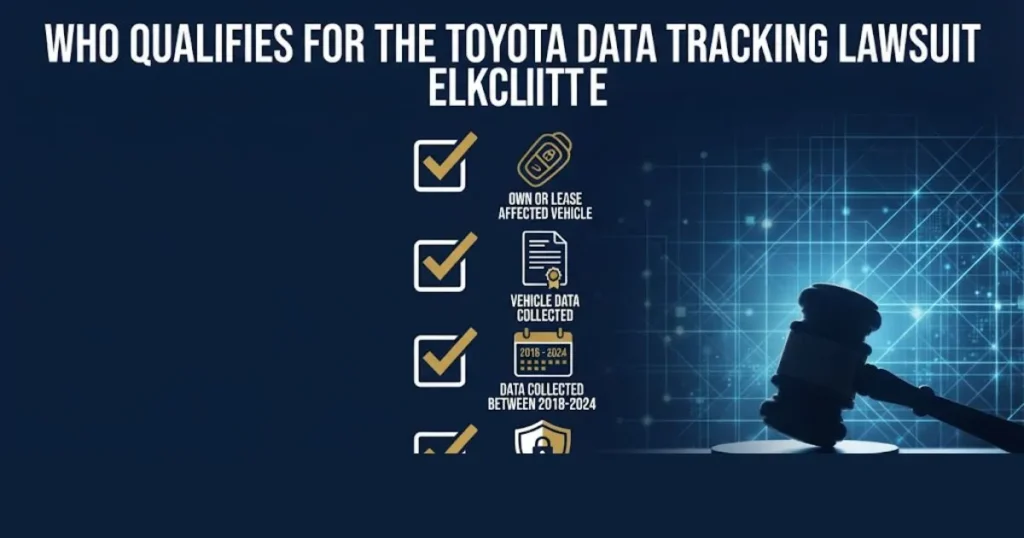
You likely qualify for the Toyota data tracking lawsuit if you owned or leased a Toyota RAV4 equipped with Toyota Connected Services, Safety Connect, or any telematics-enabled system during the relevant time period. The proposed class generally covers vehicles from model years 2018 through 2024.
Qualification does not require proof that you personally suffered harm. The legal theory is that unauthorized data collection is itself a violation of your rights. If Toyota transmitted your driving data without proper consent, you have standing.
Here are the basic eligibility criteria based on current filings:
- You owned or leased a Toyota RAV4 (2018 to 2024 model years)
- Your vehicle was equipped with connected services or telematics hardware
- You resided in the United States during the ownership period
- You did not knowingly and explicitly consent to detailed driving data sharing with third-party insurers or data brokers
Some complaints reference specific states with stronger privacy protections. If you live in California, Illinois, Texas, or Washington, your claims may carry extra weight under state-specific privacy statutes.
You do not need to have activated Toyota Connected Services. Many of these systems transmit data by default once cellular connectivity is established. Plaintiffs allege that even owners who never set up an account still had data collected from their vehicles.
Key Takeaway: If you owned or leased a connected RAV4 from 2018 to 2024, you likely qualify for the class action regardless of whether you experienced a direct financial loss.
Toyota RAV4 Privacy Lawsuit Eligibility Requirements
Eligibility for the Toyota RAV4 privacy lawsuit requires proof of vehicle ownership or a lease agreement for a qualifying RAV4 model. The bar for entry is intentionally low because the alleged harm, unauthorized data collection, affected everyone with a connected vehicle.
Here is what you typically need to participate:
| Requirement | Details |
|---|---|
| Proof of Ownership/Lease | Title, registration, lease agreement, or purchase contract |
| Vehicle Model | Toyota RAV4 |
| Model Years | 2018 through 2024 |
| Residency | United States |
| Connected Services | Vehicle equipped with telematics (standard on most trims) |
You do not need a lawyer to be part of the class. Class actions include all qualifying individuals automatically unless they opt out. If you want to file an individual claim for greater damages, that is a separate decision.
One important point: if you signed a purchase agreement with an arbitration clause, Toyota may argue that you agreed to resolve disputes outside of court. Several plaintiffs have already challenged these arbitration clauses, arguing they do not cover secret data sharing because that activity was never disclosed in the first place.
If you bought your RAV4 used, you may still qualify. The data collection allegedly continued regardless of who owned the vehicle at any given time. The telematics hardware stayed active through ownership transfers.
Check your vehicle’s build sticker or VIN lookup to confirm whether your RAV4 has connected vehicle hardware. Most RAV4 trims from 2018 onward included it as standard equipment.
What Driving Data Does Toyota Collect
Toyota allegedly collects a wide range of driving behavior data including speed, braking force, acceleration patterns, trip timestamps, GPS location, and distance traveled. This data is far more detailed than most drivers realize.
Here is a breakdown of the specific data points identified in court filings:
- Speed events: Records of how fast you drove, including instances exceeding posted speed limits
- Hard braking: Every time you hit the brakes suddenly
- Rapid acceleration: Instances of quick starts from stops
- Trip duration and timing: When you started and ended each drive
- Distance traveled: Total mileage logged per trip
- GPS coordinates: Where you went (in some configurations)
- Idle time: How long the vehicle sat running without moving
- Seatbelt usage: Whether the driver buckled up
This is essentially a driving report card. Insurance companies use exactly this type of data to build risk profiles. A driver who brakes hard frequently and drives late at night gets rated as higher risk, which means higher premiums.
The data was allegedly transmitted through Toyota’s onboard cellular modem. Your RAV4 has a built-in SIM card that connects to cellular networks. That connection allows the vehicle to send data back to Toyota’s servers continuously.
Most owners had no idea this was happening. Toyota’s terms of service mentioned “connected vehicle services” in broad language, but plaintiffs argue those disclosures were buried in dense legal text and did not clearly state that driving behavior data would be shared with insurance companies.
Key Takeaway: Toyota allegedly collected detailed driving behavior data, including speed, braking, and trip timing, and transmitted it through the vehicle’s cellular connection without clear driver knowledge.
Toyota Sharing Driving Data With Insurance Companies
Toyota allegedly shared collected driving data with insurance companies and data intermediaries like Verisk Analytics and LexisNexis Risk Solutions. These companies then packaged the data into driver risk scores that insurers used to set premiums.
Here is how the pipeline allegedly worked:
| Step | What Happened |
|---|---|
| 1. Data Collection | Toyota’s telematics system recorded driving behavior |
| 2. Transmission | Data sent via cellular modem to Toyota’s servers |
| 3. Broker Handoff | Toyota shared data with Verisk or LexisNexis |
| 4. Risk Scoring | Brokers created driving risk profiles |
| 5. Insurance Pricing | Insurers used profiles to adjust premiums |
Some RAV4 owners reported sudden insurance rate increases that they could not explain. When they pulled their LexisNexis consumer disclosure reports, they found detailed driving behavior records they never authorized.
This is the part that hits your wallet directly. If Toyota shared your driving data and it showed frequent hard braking or late-night driving, your insurer may have quietly raised your rates. You would never know why unless you dug into your consumer data reports.
The data sharing was not a one-time event. Plaintiffs allege it happened continuously over months and years. Every trip you took was potentially feeding a data pipeline that ended with your insurance company.
Insurance companies like State Farm, Allstate, and Progressive have all been named as participants in telematics data purchasing programs. The lawsuits focus on Toyota as the source of the data rather than the insurers who bought it.
Can Toyota Track My Driving Without Consent
Yes, according to the lawsuit, Toyota can and did track driving habits without meaningful consent from vehicle owners. Plaintiffs allege that the consent mechanisms Toyota used were legally insufficient.
The core problem is how Toyota defined “consent.” When you bought or leased a RAV4, you signed a stack of paperwork. Somewhere in that stack was a reference to connected vehicle services. Toyota claims that signature counts as consent.
Plaintiffs see it differently. They argue that:
- The data sharing disclosure was buried in pages of fine print
- The language did not specifically mention insurance companies or data brokers
- Drivers were not given a clear, separate opt-in choice for driving behavior tracking
- The system began collecting data before many owners even set up their accounts
Under laws like the California Consumer Privacy Act, consent needs to be informed and specific. Saying “we may share data with third parties” is not the same as saying “we will record your braking patterns and send them to your insurance company.”
Several state wiretapping laws require all-party consent before communications are intercepted. If Toyota’s telematics system captured and transmitted data without explicit agreement, that could constitute a wiretap violation in states like Illinois, California, and Pennsylvania.
The consent question is the legal heart of this case. If courts rule that Toyota’s disclosures were adequate, the case weakens. If courts rule that the consent was insufficient, Toyota faces massive liability.
Toyota Connected Vehicle Data Collection Lawsuit
The Toyota connected vehicle data collection lawsuit is part of a broader wave of litigation targeting automakers who built data harvesting capabilities into modern cars. Toyota is not alone. GM, Hyundai, Kia, Honda, and Subaru all face similar allegations.
What makes the Toyota case significant is the sheer volume of affected vehicles. The RAV4 is the best-selling non-truck vehicle in America. Toyota sold over 2.5 million RAV4 units in the U.S. between 2018 and 2024. If even half of those had connected vehicle hardware, the class size is staggering.
Connected vehicle technology was marketed as a safety and convenience feature. Emergency roadside assistance, stolen vehicle locator services, and remote start all rely on the same cellular connection. But plaintiffs say Toyota used that connection for an entirely different purpose: commercial data harvesting.
| Automaker | Similar Lawsuit Status |
|---|---|
| General Motors (OnStar) | Settled in 2025 |
| Hyundai / Kia | Active litigation |
| Honda | Filed in 2024 |
| Subaru | Filed in 2025 |
| Toyota | Active, progressing in 2026 |
The GM OnStar case is the closest comparison. GM settled after internal documents revealed the company knowingly shared driving data with insurance brokers. That settlement provides a roadmap for how the Toyota case might resolve.
Toyota’s connected vehicle ecosystem includes Toyota Connected North America, a subsidiary specifically designed to manage vehicle data. Plaintiffs argue this subsidiary was the engine behind the data sharing operation.
Key Takeaway: Toyota’s connected vehicle data lawsuit is part of an industry-wide reckoning over automakers secretly monetizing driving behavior data, and the RAV4’s massive sales volume makes this one of the largest potential classes.
How to Join the Toyota RAV4 Class Action
Joining the Toyota RAV4 class action does not require any immediate action in most cases. If you qualify as a class member, you are automatically included unless you choose to opt out.
Here is the general process:
| Step | Action Required |
|---|---|
| 1. Wait for class certification | No action needed yet |
| 2. Receive class notice | Watch your mail and email |
| 3. Review the notice | Understand your options |
| 4. File a claim (if settlement occurs) | Submit claim form with proof of ownership |
| 5. Receive payment | After court approval of settlement |
Right now, the case is pre-certification. That means the court has not yet formally defined the class or approved the class structure. Once certification happens, a class notice will be sent to all potential members.
If you want to take a more active role, you can contact one of the law firms handling the case. They can add you as a named plaintiff or provide updates on the litigation. You do not need to pay anything upfront. Class action attorneys work on contingency, meaning they only get paid if the case wins.
Keep records of your RAV4 purchase or lease. Save your registration documents, purchase agreement, and any correspondence from Toyota about connected services. If a settlement requires proof of ownership, you will need these documents.
One smart move: request your LexisNexis consumer disclosure report. This free report will show whether any driving behavior data has been recorded under your name. It serves as evidence that your data was collected and shared.
Toyota RAV4 Lawsuit Court Update 2026
The most significant court development in 2026 is the progression toward class certification hearings in federal district court. Judges have denied Toyota’s motions to dismiss, clearing the path for the case to advance.
Here is where things stand:
- Motions to dismiss: Denied in late 2025 in at least two jurisdictions
- Discovery: Active; both sides exchanging documents and data
- Class certification briefing: Scheduled for mid-2026
- Possible MDL consolidation: Under consideration by the Judicial Panel on Multidistrict Litigation
- Settlement talks: Not publicly confirmed but likely happening behind the scenes
If the Judicial Panel on Multidistrict Litigation (JPML) consolidates the cases, all Toyota data privacy lawsuits would be assigned to a single federal judge. This speeds up the process and creates a unified timeline.
Discovery could be a turning point. Plaintiff attorneys are seeking internal Toyota communications about the purpose and scope of data sharing agreements. If those documents show that Toyota executives knew drivers were unaware of the data collection, it mirrors what happened in the GM case.
Toyota is expected to argue that its disclosures were adequate and that connected vehicle services provide safety benefits that justify data collection. The court will have to weigh those arguments against the plaintiffs’ evidence of inadequate consent.
Expect significant movement by the end of 2026. Either settlement discussions will accelerate or the case will be set for trial in 2027.
Toyota RAV4 Surveillance Lawsuit Filing Deadline
There is no single fixed filing deadline for the Toyota RAV4 surveillance lawsuit at this time because the case is still in active litigation and no settlement has been finalized. However, statute of limitations periods apply to individual claims.
Here is what you need to know about timing:
| Legal Theory | Typical Statute of Limitations |
|---|---|
| Federal Wiretap Act | 2 years from discovery of violation |
| State Wiretapping Laws | 1 to 3 years depending on state |
| Consumer Protection (state) | 2 to 4 years depending on state |
| California Consumer Privacy Act | 2 to 3 years |
| General Negligence | 2 to 3 years |
The “discovery rule” is important here. Your clock does not start ticking from the date Toyota collected your data. It starts from the date you discovered or should have discovered the violation. Since many drivers only learned about the data sharing through news coverage in 2024 and 2025, the window is still open for most people.
If a settlement is reached, there will be a formal claims deadline. Class members will receive notice with a specific date by which they must submit claim forms. These deadlines are typically 60 to 120 days after the notice is sent.
Do not wait too long. Even though no hard deadline exists right now, documenting your ownership and pulling your consumer data reports now puts you in a stronger position later. Evidence gets harder to gather as time passes.
Key Takeaway: No firm filing deadline exists yet, but statute of limitations rules mean RAV4 owners should start gathering ownership documents and data reports now rather than waiting.
Toyota Connected Services Privacy Rights
Your privacy rights regarding Toyota Connected Services depend on where you live and which federal and state laws apply to your situation. Several major statutes provide protections against unauthorized data collection and sharing.
Here are the key laws that apply:
- California Consumer Privacy Act (CCPA): Gives California residents the right to know what data is collected, request deletion, and opt out of data sales
- Federal Wiretap Act (18 U.S.C. 2511): Prohibits interception of electronic communications without consent
- Electronic Communications Privacy Act: Protects stored electronic communications from unauthorized access
- State Wiretapping Laws: States like Illinois, Pennsylvania, and Washington require all-party consent for electronic monitoring
- State Consumer Protection Acts: Most states have laws prohibiting deceptive business practices
Under the CCPA, you have the right to submit a data access request to Toyota. The company must tell you what personal data it has collected, who it shared that data with, and why. You can also request that Toyota delete your data and stop selling it.
Even if you do not live in California, federal wiretapping protections apply everywhere. If Toyota intercepted your driving data communications without proper consent, that is potentially a federal offense regardless of your state.
Toyota offers an opt-out process through its connected services portal. However, plaintiffs argue that the opt-out option was not prominently presented and that data collection may continue even after opting out in some vehicle configurations.
Know your rights. Pull your data reports. Submit access requests. These steps protect you now and strengthen any future claim.
Toyota Data Breach Class Action
The Toyota data breach class action is a related but distinct set of claims from the driving habits tracking lawsuit. While the tracking case focuses on intentional data sharing, data breach claims address instances where Toyota’s data security failures exposed customer information to unauthorized parties.
Toyota has experienced several documented data security incidents:
| Incident | Details |
|---|---|
| 2023 Cloud Misconfiguration | Toyota disclosed that vehicle data for 2.15 million customers was exposed due to a cloud database left accessible for over a decade |
| Connected Services Data Exposure | Customer location data, vehicle identification numbers, and telematics records were potentially accessible |
| Third-Party Vendor Breaches | Data shared with vendors like Verisk and LexisNexis is subject to those companies’ security practices |
The 2023 cloud misconfiguration is particularly relevant. Toyota admitted that a database containing vehicle location data and identification numbers was publicly accessible from November 2013 to April 2023. That is nearly ten years of exposed data.
These breach claims strengthen the driving habits tracking lawsuit because they show a pattern of negligent data handling. It is one thing to collect data with questionable consent. It is worse to collect that data and then fail to protect it.
If you are a Toyota owner affected by both the tracking lawsuit and data breach incidents, you may have claims under both legal theories. This could increase your potential recovery.
Data breach class actions often settle faster than privacy violation cases because the evidence of harm is more concrete. Exposed data is harder to defend than debatable consent language.
Key Takeaway: Toyota’s data breach history adds another layer to the driving habits lawsuit, showing a pattern of negligent data handling that strengthens the overall case against the company.
Frequently Asked Questions
How much money can I get from the Toyota RAV4 driving habits tracking lawsuit?
Most class members can expect between $50 and $500 if a settlement is reached.
The exact amount depends on proof of ownership and whether you can show direct financial harm like insurance premium increases.
Payments would begin after court approval of any settlement, likely in late 2026 or 2027.
Does the Toyota RAV4 data tracking lawsuit cover leased vehicles?
Yes, the proposed class includes both owners and lessees of qualifying Toyota RAV4 vehicles.
Lease agreements do not exclude you from the class because the data collection allegedly occurred regardless of ownership structure.
You will need your lease agreement as proof of vehicle possession.
What years and models of Toyota RAV4 are included in the lawsuit?
The lawsuit primarily covers Toyota RAV4 models from 2018 through 2024 equipped with connected vehicle technology.
Most RAV4 trims during this period included telematics hardware as standard equipment.
Some related lawsuits also target other Toyota models, but the RAV4 is the primary focus.
How do I know if Toyota shared my driving data with my insurance company?
Request a free LexisNexis consumer disclosure report to see if driving behavior data appears under your name.
If the report shows driving scores, trip data, or risk assessments you did not authorize, your data was likely shared.
You can also contact your insurance company directly and ask whether they used telematics data in your premium calculation.
Is there a deadline to join the Toyota RAV4 class action lawsuit?
There is no formal claims deadline yet because the case has not reached the settlement stage.
Once a settlement is approved, class members will receive notice with a specific filing deadline, typically 60 to 120 days out.
Statute of limitations rules vary by state, so gathering your documents now is the smartest move.
The Toyota RAV4 driving habits tracking lawsuit is one of the most important automotive privacy cases of 2026. Millions of RAV4 owners may have had their driving data harvested and sold without real consent.
If you own or lease a qualifying RAV4, start gathering your purchase documents and request your LexisNexis report now. Those two steps take minutes and could be worth hundreds of dollars later.
Stay informed as this case progresses. The next few months will be decisive.







