

The Thrive Life lawsuit has picked up serious momentum heading into 2026. Multiple legal actions target this Utah-based freeze-dried food company over claims of misleading income promises and deceptive product marketing.
If you bought Thrive Life products or signed up as a consultant, you might be owed money. Some claimants could see payouts ranging from $50 to $500 depending on their purchase history and level of involvement.
This article breaks down every detail you need. You will learn about settlement amounts, eligibility rules, filing deadlines, FTC activity, and what steps to take right now.
The case has grown beyond a single complaint. It now touches MLM recruitment practices, product labeling, and consultant earnings claims.
What Is the Thrive Life Lawsuit About
The Thrive Life lawsuit is a legal action alleging that the company engaged in deceptive business practices related to its freeze-dried food products and multi-level marketing structure. At its core, plaintiffs say Thrive Life made misleading income claims to recruit consultants and overstated the nutritional benefits of its products.
Thrive Life, formerly known as Shelf Reliance, operates out of American Fork, Utah. The company sells freeze-dried and dehydrated food through a network of independent consultants. Think of it like a Tupperware party, but for emergency food storage and meal planning.
The lawsuit targets several specific practices:
- Inflated income claims used to recruit new consultants
- Mandatory autoship subscriptions that were difficult to cancel
- Misleading product labeling about nutritional content
- High enrollment fees with little chance of earning them back
| Detail | Info |
|---|---|
| Company | Thrive Life (formerly Shelf Reliance) |
| Headquarters | American Fork, Utah |
| Business Model | Multi-level marketing (MLM) |
| Primary Products | Freeze-dried and dehydrated foods |
| Key Allegations | Deceptive income claims, misleading labels |
The plaintiffs argue that the vast majority of consultants lost money. According to income disclosure data, over 80% of Thrive Life consultants earned less than they spent on products and fees.
This case matters because it follows a growing trend of legal challenges against MLM companies across the country.
Thrive Life Lawsuit Update for 2026
The most significant Thrive Life lawsuit update for 2026 involves the progression of class certification proceedings and ongoing settlement discussions. The case has moved past preliminary stages and is now in active litigation.
Court filings from late 2025 indicate that the plaintiffs’ legal team submitted additional evidence regarding income disclosures. These documents reportedly show a pattern of earnings misrepresentation stretching back several years.
Key developments in 2026:
- Class certification hearings are scheduled for the first half of 2026
- Settlement talks have entered a more serious phase
- Additional plaintiffs have joined the case
- Discovery has produced internal company communications
The judge overseeing the case has signaled interest in moving toward resolution. That is a positive sign for claimants who have been waiting for progress.
One important shift: the legal team expanded its claims to include allegations related to the autoship program. Many former consultants report being locked into monthly purchases they could not easily cancel.
| Update | Status |
|---|---|
| Class Certification | Hearing scheduled, 2026 |
| Settlement Talks | Active negotiations |
| Discovery Phase | Completed |
| New Claims Added | Autoship program issues |
If you filed a complaint or expressed interest in joining, your legal team should be reaching out with new information soon.
Thrive Life Lawsuit in 2026: Where Things Stand Now
As of 2026, the Thrive Life lawsuit sits at a critical turning point. The court is reviewing class certification, and both sides are preparing for either trial or a structured settlement.
Think of class certification like getting a hall pass. Once the court grants it, every affected person gets included automatically unless they opt out. Without it, each person would need to file separately.
The legal landscape around MLM lawsuits has shifted considerably. Recent FTC enforcement actions against similar companies have created strong precedent. Attorneys in the Thrive Life case are using these precedents to strengthen their arguments.
Where key issues stand in 2026:
- The company has not admitted wrongdoing
- Plaintiffs have gathered testimony from over 200 former consultants
- Financial records show the compensation plan favored top-tier recruiters
- Product return rates were unusually high, suggesting buyer dissatisfaction
| Timeline Phase | Expected Timing |
|---|---|
| Class Certification Decision | Mid-2026 |
| Settlement Conference | Q2 to Q3 2026 |
| Trial Date (if no settlement) | Late 2026 or early 2027 |
| First Payouts (if settled) | Late 2026 to mid-2027 |
The outcome here could affect thousands of people across the United States who bought products or joined as consultants between 2018 and 2025.
Key Takeaway: The Thrive Life lawsuit is further along than most people realize, with class certification and potential settlement both expected during 2026.
Thrive Life Class Action Lawsuit Explained
A Thrive Life class action lawsuit is a single legal case filed on behalf of a large group of people who suffered similar harm. Instead of each person hiring their own lawyer, one legal team represents everyone.
Here is how it works in simple terms. One or more “lead plaintiffs” step forward and file the case. Their attorneys then ask the court to certify a “class,” meaning a group of people who share the same complaint. If the court agrees, every qualifying person becomes part of the case.
The benefits of a class action include:
- Lower cost for individual claimants (attorneys work on contingency)
- Stronger bargaining power against a large company
- Streamlined process instead of thousands of separate lawsuits
- Equal treatment for all class members
You do not need to do anything to be included once the class is certified. But you do need to file a claim to receive a payout if there is a settlement.
| Class Action Feature | How It Works |
|---|---|
| Lead Plaintiff | Files case on behalf of everyone |
| Class Members | Automatically included if criteria met |
| Attorney Fees | Paid from settlement (contingency) |
| Opt-Out Option | You can leave the class if you prefer |
| Claim Filing | Required to receive money |
The Thrive Life class action specifically targets people who purchased products at inflated prices or who lost money as consultants based on misleading earnings claims.
If the class gets certified, you will likely receive a notice by mail or email explaining your rights and next steps.
Thrive Life Lawsuit Settlement Details
The Thrive Life lawsuit settlement has not been finalized yet as of early 2026, but preliminary discussions point toward a structured payout framework. Settlement talks are active, and both parties have engaged mediators.
Based on similar MLM class action settlements, the total settlement fund could range between $5 million and $25 million. The exact figure depends on how many class members are identified and the strength of evidence presented.
Settlements in cases like this typically follow a tiered structure:
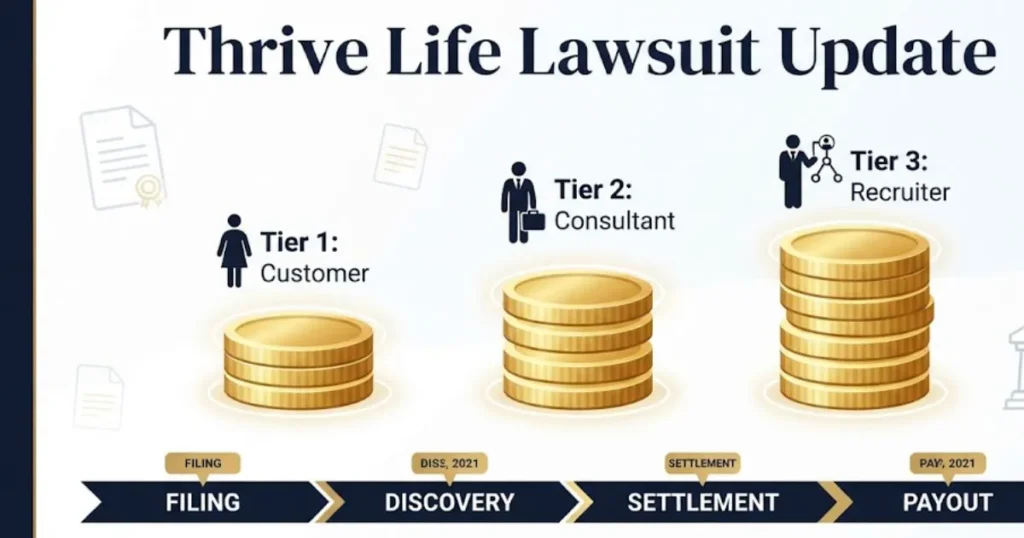
- Tier 1: Customers who purchased products but never became consultants
- Tier 2: Consultants who paid enrollment fees and purchased inventory
- Tier 3: Consultants who recruited others and suffered financial losses from the compensation plan
| Settlement Tier | Who It Covers | Estimated Payout |
|---|---|---|
| Tier 1 | Product-only customers | $50 to $150 |
| Tier 2 | Enrolled consultants | $150 to $350 |
| Tier 3 | Active recruiters with losses | $300 to $500+ |
These numbers are estimates based on comparable cases. Actual payouts will depend on the final settlement amount and the number of valid claims filed.
One thing worth knowing: the more people who file claims, the smaller each individual payment becomes. That is how class action math works. It is like splitting a pizza; the more people at the table, the smaller the slices.
Settlement approval typically requires a judge to review the terms and confirm they are fair. That process usually takes 60 to 90 days after initial agreement.
Thrive Life Settlement Payout Amounts
Thrive Life settlement payout amounts will vary based on your purchase history, consultant status, and documented losses. Most claimants should expect somewhere between $50 and $500.
The payout calculation generally considers three factors:
- Total amount spent on Thrive Life products and fees
- Duration of involvement with the company
- Financial losses documented through receipts, bank statements, or tax records
People who spent more will receive more. Someone who bought a few cans of freeze-dried fruit will get less than a consultant who invested thousands in inventory and enrollment fees.
| Payout Factor | How It Affects Your Amount |
|---|---|
| Total Spending | Higher spending equals higher payout |
| Length of Involvement | Longer involvement may increase claim |
| Proof of Loss | Receipts and records boost your claim |
| Consultant vs. Customer | Consultants typically receive more |
Bold stat: In comparable MLM settlements, the average individual payout has been around $127 per claimant. Some people received as little as $15, while others with extensive documentation received over $1,000.
Payments are typically distributed by check or electronic deposit. A third-party claims administrator handles the process. You should expect to wait 3 to 6 months after the settlement is approved before receiving any money.
Keep your old receipts, order confirmations, and bank statements. They will make a difference in how much you get.
Key Takeaway: Your payout from the Thrive Life settlement depends heavily on documentation, so gather every receipt, order confirmation, and bank statement you have from your time with the company.
Who Qualifies for the Thrive Life Lawsuit
Who qualifies for the Thrive Life lawsuit depends on your relationship with the company and when you interacted with them. Both customers and consultants may be eligible.
The general qualification criteria include:
- You purchased Thrive Life products between 2018 and 2025
- You enrolled as a Thrive Life consultant during that same period
- You signed up for the autoship program and had difficulty canceling
- You were recruited based on income claims that did not match reality
- You purchased inventory that you could not sell or return
You do not need to have lost a specific dollar amount. Even small purchases may qualify if they were made during the class period.
| Qualifying Factor | Details |
|---|---|
| Purchase Period | 2018 to 2025 |
| Product Buyers | Any Thrive Life product purchase |
| Consultants | Enrolled and paid fees |
| Autoship Members | Subscribed to recurring orders |
| Location | United States residents |
People who only browsed the website or attended a presentation but never bought anything are not eligible. You need some form of financial transaction with Thrive Life.
If you are unsure whether you qualify, look through your email for order confirmations. Check your bank statements for charges from Thrive Life or Shelf Reliance. Any record of payment is enough to start the process.
Thrive Life Lawsuit Eligibility Requirements
Thrive Life lawsuit eligibility requires meeting specific criteria established by the court. The requirements are straightforward, but you need documentation to support your claim.
Here are the primary eligibility requirements:
- Residency: You must be a U.S. resident
- Transaction: You must have a verifiable financial transaction with Thrive Life
- Timeframe: The transaction must fall within the class period (generally 2018 to 2025)
- Harm: You must have experienced some form of financial loss or deception
The bar for eligibility is relatively low. Courts in class action cases typically cast a wide net to include as many affected people as possible.
There are a few things that could disqualify you:
- You were a Thrive Life corporate employee (not a consultant)
- Your transactions occurred outside the class period
- You already received a full refund directly from Thrive Life
- You signed a separate arbitration agreement that removes you from the class
| Requirement | Eligible | Not Eligible |
|---|---|---|
| U.S. Resident | Yes | Non-U.S. buyers |
| Purchased Products | Yes | Window shoppers only |
| Class Period (2018-2025) | Yes | Purchases before 2018 |
| Received Full Refund | Possibly reduced claim | If fully compensated already |
| Corporate Employee | No | Excluded from class |
One nuance: if you signed a consultant agreement with a mandatory arbitration clause, your eligibility might be challenged. Some courts have ruled these clauses unenforceable in class actions. The legal team handling the case will evaluate this on a case-by-case basis.
How to File a Thrive Life Lawsuit Claim
How to file a Thrive Life lawsuit claim starts with completing a claim form once the settlement is officially approved. The process is designed to be simple enough that anyone can do it without a lawyer.
Here is the step-by-step process:
- Wait for the official claim form to be published (expected after settlement approval)
- Gather your documentation including receipts, bank statements, order confirmations, and enrollment records
- Complete the claim form with your personal information and transaction details
- Submit supporting documents that prove your purchases or enrollment
- File before the deadline (the court will set a specific date)
| Step | Action | Notes |
|---|---|---|
| Step 1 | Get the claim form | Available after settlement approval |
| Step 2 | Gather documents | Receipts, bank records, emails |
| Step 3 | Fill out the form | Personal info and purchase details |
| Step 4 | Attach proof | Upload or mail documents |
| Step 5 | Submit on time | Deadline will be announced |
You can typically file online, by mail, or by fax. The online option is the fastest and gives you a confirmation number.
Even if you have lost your receipts, you may still be able to file. Some claim forms allow you to estimate your spending under a certain threshold without documentation. But having proof will almost always result in a higher payout.
Do not pay anyone to file your claim. The process is free. If someone asks you for money to “help you file,” that is a scam.
Key Takeaway: Filing a claim is free, straightforward, and can be done online; just make sure you gather your purchase records and submit before the deadline.
Thrive Life Lawsuit Deadline You Need to Know
The Thrive Life lawsuit deadline for filing claims has not been officially set as of early 2026, but it will likely fall within 60 to 120 days after the settlement receives final court approval. Missing this deadline means losing your right to compensation.
Here is how lawsuit deadlines typically work in class actions. The court approves the settlement, then sets a claims period. During that window, you must submit your paperwork. After the window closes, no new claims are accepted. Period.
Expected timeline for key deadlines:
| Deadline Type | Expected Date |
|---|---|
| Settlement Approval | Mid-2026 |
| Claims Window Opens | Within 30 days of approval |
| Claims Filing Deadline | 60 to 120 days after opening |
| Objection Deadline | 30 to 45 days after notice |
| Opt-Out Deadline | Same as objection deadline |
If you want to opt out of the class action and file your own lawsuit, you need to do so before the opt-out deadline. After that, you are bound by the class settlement terms.
Set a reminder on your phone or calendar once official dates are announced. These deadlines are firm. Courts do not grant extensions for individual claimants who simply forgot.
The best strategy is to prepare your documents now. That way, when the claim form goes live, you can submit immediately and avoid any last-minute rush.
Thrive Life MLM Lawsuit Allegations
The Thrive Life MLM lawsuit focuses on allegations that the company operated a compensation structure designed to benefit top recruiters while the majority of consultants lost money. This is the heart of many complaints against the company.
MLM stands for multi-level marketing. In a legitimate MLM, people earn money by selling products. In a problematic one, the real money comes from recruiting new members who then buy products themselves. The lawsuit alleges Thrive Life leaned too far toward the recruitment side.
Specific MLM-related allegations include:
- Consultants were pressured to recruit friends and family rather than sell products
- The compensation plan required building a “downline” to earn meaningful income
- Training materials emphasized recruitment over product knowledge
- Monthly minimum purchase requirements created ongoing costs for consultants
| Allegation | What Plaintiffs Claim |
|---|---|
| Recruitment Focus | Income tied to recruiting, not selling |
| Minimum Purchases | Forced monthly buying requirements |
| Training Content | Focused on signing up new consultants |
| Income Reality | Most consultants lost money |
Here is an analogy that helps explain the problem. Imagine joining a gym where you only get fit if you convince 10 friends to join first. Meanwhile, you are paying monthly dues regardless. That is what many former consultants describe their Thrive Life experience as feeling like.
The legal team has gathered income disclosure statements showing that less than 5% of consultants earned more than they spent. That statistic sits at the center of the case.
Is Thrive Life a Pyramid Scheme Lawsuit
The question of whether the Thrive Life pyramid scheme lawsuit has merit depends on how courts apply the FTC’s guidelines for distinguishing legitimate MLMs from illegal pyramid schemes. Plaintiffs argue the line was crossed.
A pyramid scheme is defined by the FTC as a business where participants earn money primarily by recruiting new members rather than by selling products to actual end consumers. The key legal test asks: where does the money come from?
FTC factors used to evaluate pyramid scheme claims:
- Are products sold to real customers outside the consultant network?
- Do consultants earn more from product sales or from recruitment?
- Are participants required to purchase products to stay active?
- Is the compensation structure sustainable long-term?
| Pyramid Scheme Indicator | Thrive Life Allegation |
|---|---|
| Revenue from recruitment | Plaintiffs say yes |
| Products sold to non-consultants | Allegedly minimal |
| Required personal purchases | Monthly autoship required |
| Sustainable model | Plaintiffs argue no |
Thrive Life disputes these characterizations. The company maintains it sells real products with real consumer demand. It points to its freeze-dried food line as evidence of a legitimate product-based business.
However, the plaintiffs counter that the majority of product purchases were made by consultants themselves, not by outside customers. If that claim holds up in court, it strengthens the pyramid scheme argument significantly.
This distinction matters for your payout. If the court finds pyramid scheme elements, damages could be higher because intentional deception carries stiffer penalties than simple negligence.
Key Takeaway: Whether Thrive Life crossed the line from MLM to pyramid scheme is the central legal question, and the answer will directly affect how much money claimants receive.
Thrive Life Income Disclosure Lawsuit Claims
The Thrive Life income disclosure lawsuit claims center on allegations that the company published misleading earnings information to attract new consultants. Income disclosures are supposed to show realistic earning potential, but plaintiffs say Thrive Life’s numbers painted a rosy picture.
Income disclosure statements are documents that MLM companies release annually. They show what consultants actually earned. The problem, according to the lawsuit, is how Thrive Life presented these numbers.
Specific income disclosure complaints:
- The company highlighted top earners while burying data about the majority
- Average income figures included the highest earners, skewing the number upward
- Presentations to potential consultants focused on “success stories” rather than typical results
- Fine print about low earnings was allegedly inadequate
| Income Level | Percentage of Consultants | Average Annual Earnings |
|---|---|---|
| Top 1% | 1% | $50,000+ |
| Upper Tier | 4% | $10,000 to $49,999 |
| Middle Tier | 15% | $1,000 to $9,999 |
| Bottom Tier | 80%+ | Less than $1,000 |
When you look at that table, the picture is clear. The overwhelming majority of consultants earned almost nothing. Many earned less than they spent on required product purchases.
The legal argument is straightforward. If someone joins a business opportunity because they were shown $50,000 success stories, but the realistic expectation is under $1,000, that is a deceptive practice.
Courts have ruled against other MLM companies for similar income disclosure problems. Those precedents work in favor of the plaintiffs here.
Thrive Life FTC Investigation Status
The Thrive Life FTC investigation status as of 2026 remains a developing situation. The Federal Trade Commission has increased scrutiny of MLM companies in recent years, and Thrive Life has appeared on the agency’s radar.
The FTC does not typically confirm or deny active investigations. What we know comes from public records, enforcement patterns, and industry reporting. The agency sent warning letters to multiple MLM companies in 2023 and 2024, and Thrive Life’s business model shares characteristics with companies that received those letters.
What FTC involvement could mean for the lawsuit:
- FTC action could force Thrive Life to change its business practices
- Federal findings could strengthen the private class action case
- FTC settlements often include consumer restitution funds
- The agency’s involvement adds pressure for the company to settle
| FTC Activity | Status |
|---|---|
| Warning Letters to MLMs | Sent to industry (2023-2024) |
| Active Investigation of Thrive Life | Not publicly confirmed |
| Industry-Wide Enforcement Trend | Increasing |
| Potential FTC Settlement | Possible if investigation proceeds |
The FTC’s Operation Income Illusion, launched in recent years, targeted companies making deceptive earnings claims. Several MLM companies were swept up in that initiative.
Even without a confirmed investigation, the FTC’s public stance on MLM income claims creates useful legal ammunition. The agency’s published guidelines define what counts as deceptive recruiting, and plaintiffs are citing those guidelines in the Thrive Life case.
If the FTC does bring its own action, claimants could potentially receive money from both the class action settlement and a separate FTC restitution fund.
Thrive Life Freeze Dried Food Complaints
Thrive Life freeze dried food complaints extend beyond the MLM structure to the products themselves. Some consumers allege the company overstated nutritional benefits, shelf life claims, and food quality.
Freeze-dried food is a legitimate product category. Emergency preppers and outdoor enthusiasts use it regularly. The complaints are not about the concept of freeze-dried food. They target specific claims Thrive Life made about its products.
Common product-related complaints:
- Nutritional content did not match label claims
- Products arrived with shorter shelf life than advertised
- Taste and quality fell below marketing promises
- Prices were significantly higher than comparable products
| Complaint Type | Details |
|---|---|
| Nutritional Claims | Alleged overstatement of vitamin content |
| Shelf Life | Advertised 25 years; some products showed shorter actual life |
| Product Quality | Taste and texture complaints from customers |
| Pricing | 2x to 3x more expensive than competitors |
Consumers who bought Thrive Life food for emergency preparedness felt especially misled. They stored food expecting it to last decades, only to find potential quality concerns.
Price comparisons reveal another issue. Similar freeze-dried products from competitors like Mountain House or Augason Farms often cost 40% to 60% less for equivalent products. The markup allegedly reflected the MLM commission structure rather than product quality.
These product complaints add a consumer protection dimension to what might otherwise be seen as purely an MLM dispute.
Key Takeaway: Thrive Life’s legal problems are not just about its MLM structure; product quality and labeling complaints add significant weight to the case and could increase settlement amounts.
Thrive Life Product Liability Claims
Thrive Life product liability claims involve allegations that certain products did not meet safety or quality standards represented by the company. Product liability is a separate legal theory from the MLM fraud allegations.
Product liability holds a company responsible when its products cause harm or fail to meet advertised standards. In Thrive Life’s case, the claims focus on labeling accuracy and nutritional misrepresentation rather than physical injury.
Product liability allegations include:
- Labels listed nutritional values that independent testing could not verify
- Some products contained allergens not clearly disclosed
- “All natural” and “no preservatives” claims were questioned
- Serving sizes were allegedly misleading
| Product Issue | Legal Claim |
|---|---|
| Nutritional Mislabeling | False advertising, consumer fraud |
| Allergen Disclosure | Failure to warn |
| “All Natural” Claims | Deceptive labeling |
| Serving Size Accuracy | Misleading packaging |
These claims matter because product liability carries its own set of damages. A company can be held liable for deceptive labeling even if no one gets physically sick.
The strength of these claims depends on independent lab testing. Plaintiffs have reportedly commissioned third-party testing of several popular Thrive Life products. Those results will play a significant role in settlement negotiations.
For consumers who purchased products based on specific nutritional claims, these product liability allegations create an additional path to compensation beyond the MLM-related claims.
Thrive Life Consultant Lawsuit Issues
The Thrive Life consultant lawsuit issues focus specifically on people who enrolled as independent distributors and experienced financial harm through the company’s business opportunity. Consultants face unique legal claims separate from regular customers.
Former consultants describe a system that required ongoing investment with minimal return. Many joined expecting part-time income and ended up spending more than they earned every single month.
Consultant-specific issues in the lawsuit:
- Enrollment fees ranging from $50 to $200 that were non-refundable
- Monthly autoship requirements of $75 to $150 in personal purchases
- Pressure to buy inventory beyond personal consumption
- Training costs for conferences and materials
- Difficulty getting refunds on unsold inventory
| Consultant Cost | Typical Amount |
|---|---|
| Enrollment Fee | $50 to $200 |
| Monthly Autoship | $75 to $150 |
| Annual Conference | $200 to $500 |
| Training Materials | $50 to $100 |
| Total First-Year Cost | $1,200 to $2,500+ |
Compare that to actual earnings. Most consultants earned less than $500 in their first year. Simple math shows most people lost money.
The lawsuit alleges Thrive Life knew about these financial realities but continued to recruit consultants using optimistic income projections. Internal communications obtained during discovery may show the company tracked consultant attrition rates and average losses.
Former consultants who have documentation of their spending and earnings are in the strongest position to receive higher payouts.
Thrive Life Refund Lawsuit Options
Thrive Life refund lawsuit options are available for people who want their money back for products purchased or fees paid. Refunds through the lawsuit represent one path, but there may be others available.
The lawsuit itself, if it results in a settlement, will provide some form of financial restitution to qualifying claimants. That is the primary refund mechanism for most people. But settlement payouts rarely cover 100% of your losses.
Refund options currently available:
- Class action settlement (primary option, pending approval)
- Direct refund request to Thrive Life (company policy dependent)
- Credit card chargeback (if purchases were recent enough)
- State attorney general complaint (may trigger individual resolution)
- Small claims court (for losses under your state’s limit)
| Refund Option | Pros | Cons |
|---|---|---|
| Class Action Settlement | No attorney cost, automatic | Partial refund only |
| Direct Refund from Company | Potentially full refund | Company may deny request |
| Credit Card Chargeback | Quick resolution | Time limits apply |
| State AG Complaint | Government backing | Slow process |
| Small Claims Court | Full damages possible | Requires your time and effort |
Credit card chargebacks are worth exploring if your purchases were within the last 12 to 18 months. Contact your card issuer and explain the situation. Many card companies side with consumers in MLM disputes.
Filing a complaint with your state attorney general creates an official record. Several states have consumer protection divisions that specifically monitor MLM companies. Your complaint adds to the body of evidence regulators use.
If your losses exceed $5,000, you may want to consider whether opting out of the class action and pursuing individual claims makes more financial sense.
Key Takeaway: The class action settlement is the easiest path to a refund, but credit card chargebacks and state attorney general complaints can provide additional or faster relief.
Frequently Asked Questions
How much money will I get from the Thrive Life lawsuit?
Most claimants can expect between $50 and $500 depending on their spending and documentation.
Consultants with higher losses and strong records will receive more than casual product buyers.
Payouts are expected to begin in late 2026 or early 2027 if the settlement is approved on schedule.
Is there a deadline to join the Thrive Life class action lawsuit?
The exact filing deadline has not been set yet but will likely fall 60 to 120 days after settlement approval.
Once the deadline is announced, it will be final with no extensions.
Start gathering your purchase records now so you are ready to file immediately.
Does the Thrive Life lawsuit apply to consultants or just customers?
Both consultants and customers are eligible to participate in the lawsuit.
Consultants typically qualify for higher payouts because their financial losses are greater.
Anyone with a verifiable financial transaction with Thrive Life during the class period may have a claim.
Has the FTC taken action against Thrive Life?
The FTC has not publicly confirmed an investigation specifically targeting Thrive Life as of early 2026.
The agency has increased enforcement against MLM companies industry-wide in recent years.
FTC guidelines on income claims are being cited as evidence in the private class action case.
Can I get a refund from Thrive Life without joining the lawsuit?
Yes, you can request a direct refund from the company or file a credit card chargeback.
A state attorney general complaint is another option that does not require joining the class action.
Small claims court is available for individual losses under your state’s filing limit.
The Thrive Life lawsuit in 2026 is one to watch closely. Settlement negotiations are progressing, and eligibility rules should become clearer in the coming months.
Your next move: gather every receipt, email confirmation, and bank statement related to Thrive Life. Prepare your documentation now so you can file the moment the claims window opens.
Stay informed, check back for updates, and do not miss the filing deadline when it is announced.







