

Texas lawsuit loans give plaintiffs cash before their case settles. If you’re waiting months or years for a payout, this funding can cover rent, medical bills, and daily expenses while your attorney fights for a fair deal.
In 2026, the Texas lawsuit funding market has more options than ever. But not every company plays fair. Interest rates can range from 24% to over 60% annually, and the fine print matters more than most people realize.
This guide breaks down how Texas lawsuit loans actually work this year. You’ll learn who qualifies, what the real costs are, which companies rank best, and how to avoid the traps that drain your settlement.
One stat worth knowing right away: the average Texas personal injury case takes 18 to 24 months to settle. That’s a long time to go without income.
Texas Lawsuit Loans
Texas lawsuit loans are cash advances given to plaintiffs who have a pending legal case. They are not traditional loans in the strictest sense because you only repay them if you win or settle your case.
These advances are technically called “non-recourse funding.” That means the funding company takes on the risk. If your case loses, you owe nothing back. Zero. The funding company absorbs the loss.
In Texas, this type of funding is available for personal injury claims, car accident lawsuits, slip and fall cases, medical malpractice suits, and wrongful death claims. Workers’ compensation cases generally do not qualify.
The amount you receive depends on the estimated value of your case. Most funding companies advance between 10% and 20% of the projected settlement amount.
| Quick Facts | Details |
|---|---|
| What it is | Cash advance on a pending lawsuit |
| Repayment required if you lose | No |
| Common advance range | $500 to $500,000 |
| Typical case types | Personal injury, car accidents, medical malpractice |
| Credit check required | No |
Your attorney must cooperate with the funding company. That means signing a lien acknowledgment and providing case documents. Without your lawyer’s participation, no funding company will approve you.
How Do Lawsuit Loans Work in Texas
Lawsuit loans in Texas work through a simple three-step process: you apply, the funding company reviews your case, and if approved, you receive cash within 24 to 48 hours.
Here’s the step-by-step breakdown:
- Step 1: You submit an application with your name, attorney information, and basic case details.
- Step 2: The funding company contacts your attorney and reviews case documents, medical records, and liability assessments.
- Step 3: If the case has strong merit and a likely payout, the company offers you a specific dollar amount.
Once you accept the offer, the money hits your bank account fast. Some companies wire funds the same day. Others take up to 72 hours.
The funding company places a lien on your future settlement proceeds. When your case settles, your attorney pays back the advance plus fees directly from the settlement check. You never write a personal check.
Think of it like this: the funding company is betting on your case. They only get paid if you win. That’s why they’re picky about which cases they fund. Strong liability and clear damages make approval much easier.
If your case takes two years to settle, the fees keep growing. That’s the trade-off. You get money now, but it costs you more from your final payout later.
Pre-Settlement Funding Texas
Pre-settlement funding in Texas refers to any cash advance a plaintiff receives while their lawsuit is still active and unresolved. It covers the period between filing a case and reaching a settlement or verdict.
This type of funding exists because lawsuits take time. The average Texas personal injury case doesn’t wrap up in 30 days. Insurance companies stall. Discovery takes months. Depositions get rescheduled. Meanwhile, bills pile up.
Pre-settlement funding fills that gap. It keeps plaintiffs from accepting lowball settlement offers just because they’re desperate for cash.
| Pre-Settlement Funding vs. Personal Loan | Pre-Settlement Funding | Personal Loan |
|---|---|---|
| Credit check | No | Yes |
| Employment required | No | Usually yes |
| Repayment if you lose | None | Full repayment required |
| Interest rates | Higher (24% to 60%+) | Lower (6% to 36%) |
| Collateral | Your lawsuit | Varies |
The biggest advantage is the no-risk structure. If your case gets dismissed or you lose at trial, you walk away owing nothing. A personal loan doesn’t offer that protection.
Texas doesn’t classify pre-settlement funding as a “loan” under state lending laws. That distinction matters because it affects how fees are regulated and disclosed. More on that in the regulations section below.
Key Takeaway: Texas lawsuit loans give you cash before your case settles, and you owe nothing if you lose, but the fees can significantly reduce your final settlement amount.
Texas Lawsuit Loan Requirements
Texas lawsuit loan requirements center on the strength of your case, not your personal finances. Funding companies care about liability, damages, and insurance coverage, not your credit score or job history.
Here are the standard requirements most Texas funding companies use in 2026:
- Active lawsuit: You must have a filed or soon-to-be-filed lawsuit in Texas.
- Attorney representation: You need a lawyer working on your case, typically on contingency.
- Clear liability: Someone else must be at fault, and there should be evidence supporting that.
- Sufficient damages: Medical bills, lost wages, pain and suffering, or other documented harm.
- Insurance coverage or assets: The defendant must have insurance or assets to pay a judgment.
Your personal credit score, employment status, and income level are irrelevant. Funding companies run no credit checks. They don’t pull your FICO score. They don’t care if you’re unemployed.
What they do care about is the defendant’s insurance policy limits. If the at-fault driver only has $30,000 in liability coverage, the funding company knows the maximum recovery. That limits what they’ll advance you.
Cases with government defendants can be trickier. Texas sovereign immunity caps and notice requirements add layers of uncertainty that make some funding companies shy away.
Bankruptcy also complicates things. If you’ve filed for bankruptcy, the lawsuit may become part of your bankruptcy estate. Most funding companies won’t advance cash in that situation.
Texas Personal Injury Lawsuit Loans
Texas personal injury lawsuit loans are cash advances specifically tied to personal injury claims filed in Texas courts. These represent the most common type of lawsuit funding in the state.
Personal injury cases include slip and fall accidents, dog bites, workplace injuries (not workers’ comp), assault cases, defective product injuries, and premises liability claims.
Funding companies favor personal injury cases because they typically have clear liability and documented damages. Medical records, police reports, and witness statements create a paper trail that makes case evaluation straightforward.
| Personal Injury Case Type | Average Funding Amount | Approval Rate |
|---|---|---|
| Slip and fall | $2,000 to $15,000 | Moderate |
| Dog bite | $1,500 to $10,000 | High |
| Workplace injury | $3,000 to $25,000 | Moderate |
| Product liability | $5,000 to $50,000 | Varies |
| Premises liability | $2,000 to $20,000 | Moderate |
The amounts above are estimates based on typical Texas case values. Your actual advance depends on your specific injuries, medical expenses, and the defendant’s insurance limits.
One thing that surprises people: you can get funded even if you’re still treating. Many plaintiffs apply while they’re still going to physical therapy or awaiting surgery. The funding company factors future treatment costs into their case valuation.
Having strong medical documentation is the single biggest factor in getting approved and getting a higher advance. Gaps in treatment, delayed care, or missing records hurt your chances.
Texas Car Accident Lawsuit Loans
Texas car accident lawsuit loans are the most frequently approved type of lawsuit funding in the state. Car accident cases have clear police reports, insurance policies, and medical records that make them easy for funding companies to evaluate.
Texas had over 4,000 traffic fatalities in 2024, and hundreds of thousands of injury crashes. The sheer volume of car accident litigation in the state means funding companies have deep experience pricing these cases.
If you were hit by another driver and suffered injuries, you’re a strong candidate for funding. Rear-end collisions, T-bone crashes, and drunk driving accidents get the highest approval rates because fault is usually obvious.
Here’s what makes car accident cases attractive to funders:
- Police reports document the crash and often assign fault
- The at-fault driver’s insurance policy is identifiable
- Medical treatment creates a clear damages record
- Texas follows a modified comparative fault rule at 51%, so partial fault doesn’t automatically disqualify you
If you were 50% or less at fault, you can still recover damages in Texas. That means you can still qualify for funding. But if you’re found 51% or more at fault, your case is worth nothing, and no funding company will touch it.
Uninsured motorist claims can also qualify, but only if you have UM/UIM coverage on your own policy. Without it, there may be no source of recovery.
Key Takeaway: Car accident and personal injury cases are the easiest to fund in Texas because they have clear evidence, identifiable insurance, and predictable settlement ranges.
How Much Can I Get from a Lawsuit Loan in Texas
Most Texas plaintiffs receive between $500 and $100,000 from a lawsuit loan, depending on their case value. The typical advance for a standard car accident case falls between $2,500 and $25,000.
Funding companies generally advance 10% to 20% of the estimated settlement value. So if your case is projected to settle for $150,000, you might qualify for $15,000 to $30,000.
Several factors determine your advance amount:
- Severity of injuries: Broken bones, surgeries, and permanent disabilities get higher advances than soft tissue injuries.
- Total medical bills: Higher treatment costs usually mean higher case value.
- Lost wages: Documented income loss strengthens the case valuation.
- Insurance policy limits: The defendant’s coverage caps the maximum recovery.
- Liability strength: Clear fault means less risk for the funder.
| Estimated Case Value | Typical Advance Range |
|---|---|
| $25,000 | $2,500 to $5,000 |
| $50,000 | $5,000 to $10,000 |
| $100,000 | $10,000 to $20,000 |
| $250,000 | $25,000 to $50,000 |
| $500,000+ | $50,000 to $100,000+ |
Some funding companies allow multiple advances on the same case. You might take $5,000 now and come back for another $5,000 six months later. Each advance adds its own set of fees, though. Stacking advances is expensive.
Be careful about taking too much. If your fees and advances eat up 40% or 50% of your settlement, you’ll walk away with far less than expected. Ask your attorney to calculate the net impact before accepting any offer.
Texas Lawsuit Loan Interest Rates
Texas lawsuit loan interest rates typically range from 24% to 60% per year in 2026, with some companies charging even higher rates for riskier cases. These rates are expressed as annualized fees, not monthly percentages.
Here’s why rates are so high compared to traditional loans: the funding company gets nothing if you lose. That risk premium drives up the cost. A bank can repossess your car or garnish your wages. A lawsuit funding company has no recourse if your case fails.
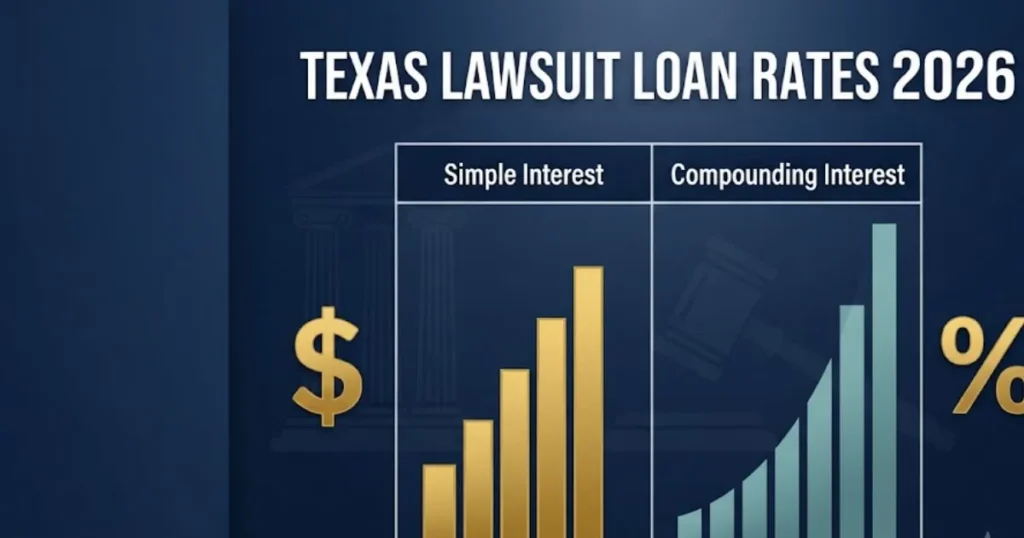
Most companies use one of two fee structures:
- Simple interest: Fees calculated on the original advance amount only. If you borrow $10,000 at 36% simple interest, you owe $3,600 per year in fees regardless of how long the case takes.
- Compounding interest: Fees calculated on the growing balance. Your interest earns interest. This adds up fast over multi-year cases.
| Fee Structure | $10,000 Advance | After 1 Year | After 2 Years | After 3 Years |
|---|---|---|---|---|
| Simple (36%) | $10,000 | $13,600 | $17,200 | $20,800 |
| Compounding (36%) | $10,000 | $13,600 | $18,496 | $25,155 |
The difference between simple and compounding becomes enormous over time. On a two-year case, compounding costs you an extra $1,296 on a $10,000 advance. By year three, the gap widens to over $4,300.
Always ask whether the rate is simple or compounding. Get it in writing. If a funding company won’t clearly answer this question, walk away.
Some Texas funding companies now offer rate caps. These cap the total fees at a certain percentage of the advance, like 100% or 150%. That means on a $10,000 advance with a 100% cap, you’d never owe more than $20,000 total, no matter how long your case takes.
Texas Lawsuit Loan Regulations 2026
Texas lawsuit loan regulations in 2026 remain less strict than many other states, but the regulatory environment is slowly tightening. Texas does not currently cap interest rates on lawsuit funding through a specific statute.
Texas classifies pre-settlement funding as a purchase of a future receivable, not as a loan. That classification matters because it means traditional lending laws, like usury caps, don’t apply to lawsuit funding transactions.
The Texas Finance Code governs most consumer lending. But because lawsuit funding isn’t classified as lending, the Texas Office of Consumer Credit Commissioner has limited authority over these transactions.
Here’s what Texas does require of funding companies in 2026:
- Written agreement: All terms, fees, and conditions must be in a signed contract.
- Right to cancel: Borrowers typically have a short rescission period after signing.
- Attorney acknowledgment: The plaintiff’s attorney must sign a lien acknowledgment letter.
- Fee disclosure: Total cost must be disclosed, though the format varies.
| Regulation Area | Texas (2026) | National Average |
|---|---|---|
| Rate caps | None specific | Varies by state |
| Licensing required | Limited | Many states require it |
| Mandatory disclosures | Basic | More detailed in regulated states |
| Right to cancel | Yes, varies by contract | Yes, commonly 5 days |
| Attorney consent required | Yes | Yes |
Several states like Arkansas, Indiana, and Oklahoma have passed specific lawsuit funding statutes. Texas legislators introduced bills in recent sessions, but none passed as of early 2026.
The American Legal Finance Association (ALFA) provides voluntary best practices guidelines. Some Texas funding companies follow ALFA standards, but membership is not mandatory.
Without strong state regulation, the burden falls on you to read every line of the contract. Compare offers from multiple companies. Ask your attorney to review the terms before you sign anything.
Key Takeaway: Texas has minimal regulations on lawsuit funding in 2026, so comparing multiple offers and reading every contract detail is your best protection against excessive fees.
Non-Recourse Lawsuit Funding Texas
Non-recourse lawsuit funding in Texas means you repay the advance only if your case results in a settlement or court award. If you lose, you owe zero. The funding company eats the loss entirely.
This is the defining feature that separates lawsuit funding from every other type of borrowing. A credit card doesn’t care if you lose your job. A car loan doesn’t vanish if your engine dies. But lawsuit funding disappears completely if your case goes south.
The “non-recourse” label means the funding company’s only source of repayment is your lawsuit proceeds. They cannot:
- Sue you personally for repayment
- Garnish your wages
- Report the debt to credit bureaus
- Place liens on your home or other property
- Come after your bank accounts
This structure creates a powerful safety net for plaintiffs. You get cash when you need it most, and you risk nothing personally.
But here’s the flip side. Because the funding company absorbs all the risk, they charge higher rates. They also reject cases they consider weak. If your liability is questionable or your damages are low, you’ll get denied.
Funding companies do extensive due diligence before approving a non-recourse advance. They review medical records, police reports, expert opinions, and your attorney’s demand letter. They’re essentially underwriting the risk of your lawsuit, not your personal creditworthiness.
Make sure your contract explicitly states the funding is non-recourse. Some predatory operators have tried to sneak recourse provisions into agreements. If the contract says you owe money regardless of your case outcome, that’s a red flag.
Texas Lawsuit Funding Companies
Texas lawsuit funding companies include both national operators and Texas-based firms. In 2026, plaintiffs have dozens of options, but quality and pricing vary dramatically between providers.
Here are some of the most active funding companies serving Texas plaintiffs:
| Company | Headquarters | Rate Type | Typical Approval Time | Minimum Advance |
|---|---|---|---|---|
| Oasis Financial | Illinois | Compounding | 24 to 48 hours | $500 |
| USClaims | Pennsylvania | Simple | 24 to 72 hours | $500 |
| Baker Street Funding | New York | Varies | 24 hours | $1,000 |
| Express Legal Funding | Texas | Simple | Same day possible | $500 |
| Uplift Legal Funding | Multiple | Compounding | 24 to 48 hours | $500 |
| Peachtree Financial | Georgia | Varies | 48 to 72 hours | $1,000 |
Express Legal Funding stands out as one of the few companies actually headquartered in Texas. Local presence can matter for customer service and familiarity with Texas courts and insurance practices.
When evaluating companies, look beyond the marketing. Ask these questions before signing:
- Is the rate simple or compounding?
- Is there a fee cap?
- What is the annual percentage rate, including all origination fees?
- Can I cancel within a certain number of days?
- Will you send all terms in writing before I commit?
Some companies charge origination fees, processing fees, or administrative fees on top of the stated interest rate. Those extras can add 5% to 15% to your total cost. Demand a full cost breakdown.
Your attorney’s experience with specific funding companies matters too. Lawyers who’ve worked with a particular funder know how fast they process applications and how reasonable their terms tend to be.
Best Lawsuit Loans Texas
The best lawsuit loans in Texas for 2026 combine low rates, transparent terms, fast funding, and a reputation for fair dealing. No single company is perfect, but some clearly outperform others.
Based on rate structures, customer reviews, industry reputation, and contract transparency, here’s how the top options stack up:
| Ranking Factor | Top Tier Companies | Mid Tier Companies |
|---|---|---|
| Lowest rates | Express Legal Funding, USClaims | Baker Street Funding |
| Fastest approval | Express Legal Funding, Oasis Financial | Uplift Legal Funding |
| Best transparency | USClaims, Express Legal Funding | Baker Street Funding |
| Fee caps available | Select companies (ask directly) | Varies |
| Texas-specific expertise | Express Legal Funding | National companies |
Here’s what separates the best from the rest:
- Rate caps: The best companies put a ceiling on total fees. You’ll never owe more than a set multiple of your advance.
- Simple interest only: Companies that charge simple interest save you thousands on long cases compared to compounding.
- No hidden fees: The best operators include all costs in one clear rate. No origination fees. No processing charges.
- Fast communication: Top companies keep you updated and respond quickly to your attorney’s requests.
Don’t just pick the first company you find online. Get quotes from at least three providers. Show those quotes to your attorney. Let your lawyer help you compare the real costs.
Key Takeaway: The best Texas lawsuit loans offer simple interest, rate caps, full fee transparency, and fast approval, so always compare at least three offers before committing.
How to Apply for a Lawsuit Loan in Texas
Applying for a lawsuit loan in Texas takes about 10 to 15 minutes for the initial application. The entire process from application to cash in your account typically takes 24 to 72 hours.
Here’s the step-by-step application process:
Step 1: Gather basic information
You’ll need your full name, contact details, your attorney’s name and phone number, and a brief description of your case.
Step 2: Submit an application
Most funding companies accept applications by phone or through their website. You fill out a short form with your case details.
Step 3: Attorney verification
The funding company contacts your attorney’s office. They request case documents including the complaint, medical records, police reports (if applicable), and any demand letters sent to the insurance company.
Step 4: Case review and underwriting
The funding company’s team evaluates your case. They assess liability, damages, insurance coverage, and estimated settlement value. This step takes anywhere from a few hours to two business days.
Step 5: Receive an offer
If approved, you get a specific dollar amount and a written contract outlining all fees, rates, and terms.
Step 6: Accept and receive funds
Once you sign the agreement and your attorney signs the lien acknowledgment, funds are wired to your bank account. Some companies can process same-day transfers.
| Application Step | Time Required |
|---|---|
| Fill out application | 10 to 15 minutes |
| Attorney contact and document gathering | 4 to 24 hours |
| Case evaluation | 4 to 48 hours |
| Offer presentation | Within 24 to 48 hours |
| Funds deposited | Same day to 72 hours after acceptance |
One important tip: tell your attorney before you apply. Your lawyer needs to cooperate with the funding company. If your attorney refuses to share case documents, the application stalls. Some attorneys have preferred funding companies they’ve worked with before, which can speed things up.
Lawsuit Cash Advance Texas
A lawsuit cash advance in Texas is functionally the same thing as a lawsuit loan. The term “cash advance” is actually more legally accurate because the transaction isn’t a loan under Texas law.
The distinction matters for regulatory reasons. Since Texas treats these transactions as purchases of future settlement proceeds rather than loans, different rules apply. Traditional lending protections like usury limits don’t kick in.
For you as the plaintiff, the practical experience is identical. You apply. You get approved. You receive cash. You repay from your settlement.
Companies use different terms for marketing purposes:
- Lawsuit loan
- Pre-settlement funding
- Litigation financing
- Lawsuit cash advance
- Legal funding
- Settlement advance
All of these refer to the same basic product. Don’t get confused by the different labels. What matters is the contract terms, not the marketing language.
The cash advance structure works well for plaintiffs who need money quickly. Unlike a bank loan, there’s no application fee, no credit pull, and no monthly payment schedule. You get a lump sum and deal with repayment later, only if your case succeeds.
Typical uses for lawsuit cash advances in Texas include:
- Covering rent or mortgage payments
- Paying medical bills not covered by insurance
- Covering car repairs after an accident
- Handling everyday living expenses while unable to work
- Avoiding credit card debt accumulation during the case
Texas Lawsuit Loan Risks
The biggest risk of a Texas lawsuit loan is that fees consume a massive portion of your settlement. On a case that takes three years to resolve, compounding interest can eat 40% to 60% of your advance amount on top of the principal.
Here’s a real-world scenario. You take a $10,000 advance at 40% compounding interest. Your case settles three years later.
| Year | Balance Owed |
|---|---|
| Year 0 | $10,000 |
| Year 1 | $14,000 |
| Year 2 | $19,600 |
| Year 3 | $27,440 |
After three years, you owe $27,440 on a $10,000 advance. If your total settlement is $75,000 and your attorney takes 33%, you net about $50,000. After paying back the funding company, you’re left with roughly $22,500 instead of $50,000.
Other risks to consider:
- Stacking advances: Taking multiple advances on the same case multiplies the fee burden. Each advance carries its own interest clock.
- Pressure to settle early: Some plaintiffs feel pressured to accept lower settlements to stop the interest from growing.
- Misleading rate quotes: Some companies quote monthly rates that look small but translate to enormous annual percentages. A rate of “3% per month” sounds minor. It’s actually 36% per year simple, or more if compounding.
- Contract complexity: Funding agreements can be dense and confusing. Terms buried on page seven can cost you thousands.
The best protection is simple: read everything, compare offers, and ask your attorney to review the contract before you sign.
Key Takeaway: Lawsuit loan fees can consume a surprising chunk of your settlement, especially with compounding interest over multi-year cases, so always calculate the total repayment cost before accepting an offer.
Lawsuit Loan Repayment Texas
Lawsuit loan repayment in Texas happens automatically from your settlement proceeds. You never write a personal check, set up autopay, or send monthly payments to the funding company.
Here’s exactly how repayment works:
Your attorney receives the settlement check. Before distributing any money, your lawyer pays all liens, including the funding company’s lien. The funding company gets their principal plus accrued fees. Then your attorney takes their contingency fee. Whatever remains goes to you.
The order of payment from a typical Texas settlement looks like this:
| Payment Order | Recipient | Typical Amount |
|---|---|---|
| 1 | Medical liens | Varies |
| 2 | Lawsuit funding repayment | Principal + fees |
| 3 | Attorney fee (contingency) | 33% to 40% of settlement |
| 4 | Case expenses | Filing fees, expert costs |
| 5 | Plaintiff (you) | Remainder |
Notice where you fall on that list. Last. Every dollar paid to a funding company is a dollar subtracted from your share. That’s why keeping the advance amount small and the interest rate low matters so much.
If your case settles for less than expected, the funding company may negotiate a reduced payoff. This isn’t guaranteed, but it happens. Funding companies would rather recover something than force a case to collapse.
If your case loses entirely, you owe nothing. The funding company writes off the loss. There’s no collections process, no credit impact, and no legal obligation on your part.
One scenario catches people off guard: switching attorneys. If you change lawyers mid-case, the new attorney must acknowledge the existing funding lien. Some attorneys refuse to take cases with existing funding liens, which can create complications.
Frequently Asked Questions
Do I need good credit to get a lawsuit loan in Texas?
No, credit scores are irrelevant for Texas lawsuit loans.
Funding companies evaluate your case strength, not your financial history.
Employment status and income level also don’t factor into the decision.
What happens if I lose my case after getting a lawsuit loan in Texas?
You owe nothing if your case loses.
Texas lawsuit loans are non-recourse, meaning the funding company absorbs the entire loss.
There’s no repayment obligation, no collections, and no credit bureau reporting.
How long does it take to get approved for a Texas lawsuit loan?
Most applicants receive a decision within 24 to 48 hours.
Some companies offer same-day approval and funding for straightforward cases.
Complex cases involving disputed liability may take up to 72 hours for review.
Can I get more than one lawsuit loan on the same Texas case?
Yes, many funding companies allow multiple advances on the same case.
Each additional advance carries its own fees and interest, which compounds the total cost.
Your attorney and the funding company must agree that the case value supports the additional advance.
Are Texas lawsuit loans taxable income?
Lawsuit loan proceeds are generally not considered taxable income when received.
The IRS treats them as advances against a future settlement, not as earnings.
However, the underlying settlement itself may have tax implications depending on the type of damages awarded.
Texas lawsuit loans can be a lifeline when bills are piling up and your case is months from resolution. The key is choosing the right funding company, understanding the true cost, and keeping your advance amount reasonable.
Get quotes from at least three companies before committing. Have your attorney review every contract. Calculate the total payback amount, not just the monthly rate.
The money should help you hold out for a fair settlement, not drain it before you ever see it







