

The talcum lawsuit against Johnson & Johnson is heading toward a potential resolution in 2026, with billions of dollars on the line for tens of thousands of claimants. If you used talcum powder and developed cancer, this could be the most important year to pay attention.
J&J has proposed an $8 billion settlement plan through its subsidiary Red River Talc LLC. That plan needs enough claimant votes to move forward. The outcome will shape whether individual payouts happen this year or the fight continues.
This article covers every major question. You will find settlement amounts, payout estimates per person, eligibility rules, filing deadlines, and a full timeline of where this case stands heading into 2026.
One fact that still shocks people: Johnson & Johnson reportedly knew about asbestos contamination in its talc as early as the 1970s, according to internal documents uncovered by Reuters in 2018.
Talcum Powder Lawsuit 2026: What You Need to Know
The talcum powder lawsuit in 2026 centers on whether Johnson & Johnson’s latest settlement proposal will gain enough support from claimants to end the litigation. This is the most significant year for the case since the first trials began over a decade ago.
J&J created a subsidiary called Red River Talc LLC to handle the talc liabilities. That entity filed for bankruptcy protection as part of a strategy to resolve all claims through a single trust fund.
The company proposed paying $8 billion over 25 years to settle roughly 100,000 pending claims. Claimants must vote on the plan, and it needs at least 75% approval from voting claimants to proceed.
| Key Fact | Detail |
|---|---|
| Total Settlement Proposed | $8 billion over 25 years |
| Number of Pending Claims | Approximately 100,000 |
| Bankruptcy Entity | Red River Talc LLC |
| Approval Threshold | 75% of voting claimants |
| Expected Vote Period | 2025 into early 2026 |
If the plan fails, individual cases will continue in state and federal courts. Some legal experts believe another bankruptcy attempt could follow. Either way, 2026 is the year that likely determines the path forward.
Talcum Powder Lawsuit Update for 2026
The most recent talcum powder lawsuit update involves Red River Talc LLC’s third attempt at using bankruptcy to resolve J&J’s talc liabilities. Two prior attempts through a different subsidiary, LTL Management, were rejected by federal courts.
In September 2025, J&J announced a revised plan after its previous versions failed to meet legal standards. The U.S. Third Circuit Court of Appeals had ruled that LTL Management’s bankruptcy filings were not filed in “good faith” because the subsidiary was not in genuine financial distress.
Red River Talc took a different approach. This time, the company sought a prepackaged bankruptcy, meaning it negotiated terms with claimant representatives before filing.
Early reports suggest the voting process has been contentious. Some claimant groups support the deal because it guarantees payment. Others argue the $8 billion figure undervalues the claims, especially given that jury verdicts in individual cases have reached hundreds of millions.
- The voting period ran through late 2025 and into early 2026
- Preliminary results are expected in the first half of 2026
- If approved, the plan would go before a bankruptcy judge for confirmation
- If rejected, cases return to the traditional court system
Think of it like a massive negotiation where 100,000 people have to agree on splitting a pie. Some think the pie is big enough. Others say it should be three times larger.
Johnson and Johnson Talcum Lawsuit Background
The Johnson and Johnson talcum lawsuit began with individual product liability cases filed in the early 2010s by women who developed ovarian cancer after years of using Baby Powder for feminine hygiene. The litigation grew into one of the largest mass torts in American legal history.
The first major verdict came in 2016 when a St. Louis jury awarded $72 million to the family of Jacqueline Fox, who died of ovarian cancer. That verdict sent shockwaves through the legal world and opened the floodgates for thousands more lawsuits.
By 2018, Reuters published an investigation revealing that J&J had known for decades that its talc products sometimes contained asbestos fibers. Internal company memos showed awareness dating back to the 1970s.
J&J pulled its talc-based Baby Powder from North American shelves in 2020. The company said the decision was driven by declining sales and “misinformation,” not safety concerns. That same product remained available in other countries until 2023, when J&J announced a worldwide discontinuation.
| Milestone | Year |
|---|---|
| First major lawsuit filed | 2013 |
| First jury verdict ($72M) | 2016 |
| Reuters asbestos investigation published | 2018 |
| Baby Powder pulled from North America | 2020 |
| LTL Management first bankruptcy filing | 2021 |
| Global Baby Powder discontinuation | 2023 |
| Red River Talc bankruptcy filing | 2025 |
J&J has consistently denied that its talc products cause cancer. The company maintains that decades of scientific testing show their talc was safe and asbestos-free.
Key Takeaway: The talcum powder lawsuit has been building for over a decade, and 2026 is the year that could determine whether a massive settlement resolves the cases or whether individual trials continue.
Talcum Powder Settlement Amounts Explained
Talcum powder settlement amounts vary widely based on the type of cancer diagnosed, the severity of illness, and the strength of evidence linking talc use to the diagnosis. No single flat payment applies to every claimant.
Under J&J’s proposed $8 billion plan, individual payments would be distributed from a settlement trust. The trust would categorize claims into tiers based on several factors.
Claimants with ovarian cancer who used talcum powder in the genital area for extended periods would likely receive higher payments. Mesothelioma claimants, whose disease is directly linked to asbestos exposure, could see even larger amounts.
Past jury verdicts give some context for potential ranges:
| Verdict/Settlement | Amount | Year | Cancer Type |
|---|---|---|---|
| Ingham v. J&J (Missouri) | $4.69 billion (reduced on appeal) | 2018 | Ovarian cancer (22 plaintiffs) |
| Leavitt v. J&J (New Jersey) | $750 million (reduced to $500M) | 2024 | Mesothelioma |
| Eva Echeverria case (California) | $417 million (later reduced) | 2017 | Ovarian cancer |
| Mark Lanier trial (consolidated) | $2.1 billion (affirmed on appeal) | 2020 | Ovarian cancer |
These are jury verdicts, not settlement payouts. Actual settlement trust payments will be significantly lower than trial awards. Think of jury verdicts as the ceiling and settlement payments as a more modest, but guaranteed, floor.
Talcum Powder Lawsuit Payout Per Person
The talcum powder lawsuit payout per person through the proposed settlement trust is estimated to range from $3,000 to over $750,000, depending on the claim category. Most average claims are expected to fall between $50,000 and $200,000.
The trust would use a point-based system. Each claimant receives points based on specific criteria. More points mean a higher payout.
Factors that increase your point total include:
- Cancer type: Mesothelioma claims score highest, followed by ovarian cancer
- Duration of use: Using talc products for 10 or more years scores higher
- Frequency of use: Daily use scores higher than occasional use
- Medical documentation: Strong medical records with confirmed pathology reports
- Age at diagnosis: Younger claimants may receive more due to lost life years
- Death: Wrongful death claims from surviving family members often score higher
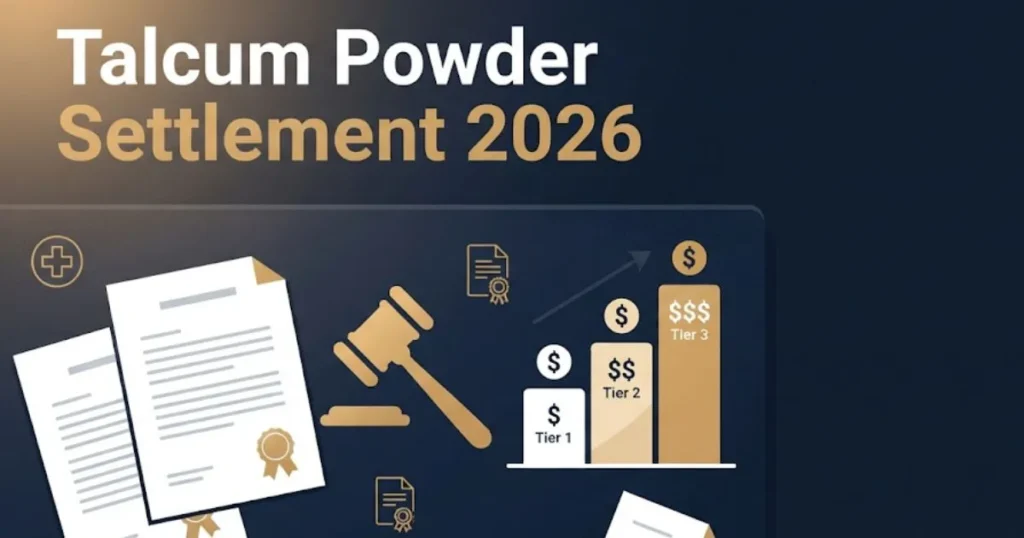
| Claim Tier | Estimated Payout Range |
|---|---|
| Expedited Review (minimal proof) | $3,000 to $10,000 |
| Standard Ovarian Cancer Claim | $50,000 to $200,000 |
| Severe Ovarian Cancer / Death | $150,000 to $500,000 |
| Mesothelioma Claim | $200,000 to $750,000+ |
These figures are estimates based on analysis of the proposed plan and comparable asbestos trust fund payouts. Final amounts will depend on the total number of approved claims and the available trust funding.
How Much Is the Talcum Powder Lawsuit Worth?
The talcum powder lawsuit is worth an estimated $8 billion under J&J’s current settlement proposal, though some plaintiff attorneys argue the true value exceeds $20 billion based on jury verdict trends and the number of affected individuals.
That $8 billion figure would be paid over 25 years into a trust fund. J&J would make annual contributions. Claimants would receive payments from the trust on a rolling basis as claims are processed and approved.
To put that number in perspective, J&J reported $85.2 billion in total revenue for 2024. The proposed settlement represents roughly 9% of one year’s revenue, spread over a quarter century. Critics say the company can afford significantly more.
Individual jury verdicts have totaled over $10 billion across all talc cases that went to trial. Most of those awards were reduced on appeal or reversed, but they signal what juries believe the harm is actually worth.
- Total proposed settlement: $8 billion
- Payment period: 25 years
- Number of claimants: ~100,000
- Average per claim (simple math): ~$80,000
- Adjusted average (after trust expenses and tiering): $50,000 to $200,000 for most
The “worth” of this lawsuit is not just about dollars. It is about accountability for a product that potentially harmed hundreds of thousands of people over several decades.
Key Takeaway: Individual payouts from the talcum powder settlement trust are projected to range from a few thousand dollars to over $750,000, with most claimants likely receiving between $50,000 and $200,000 based on claim strength and cancer type.
Who Qualifies for the Talcum Powder Lawsuit?
Anyone diagnosed with ovarian cancer or mesothelioma after regular use of talcum powder products may qualify for the talcum powder lawsuit. The connection between your talc use and your cancer diagnosis is the central qualifying factor.
You do not need to have used Johnson & Johnson’s Baby Powder specifically. Other talc-containing products from various manufacturers may also qualify. However, the vast majority of claims target J&J products.
Basic qualifying criteria include:
- You used a talcum powder product regularly (at least several times per month)
- You were diagnosed with ovarian cancer, mesothelioma, or another talc-related cancer
- Your cancer diagnosis came after a period of talc product use
- You can provide some form of documentation (medical records, purchase history, or personal testimony)
| Qualifying Factor | What Courts Look For |
|---|---|
| Product Used | J&J Baby Powder, Shower to Shower, or other talc products |
| Area of Application | Genital area (for ovarian cancer claims) or inhalation (for mesothelioma) |
| Duration of Use | Longer use strengthens the claim |
| Cancer Diagnosis | Confirmed by medical records and pathology reports |
| Timing | Diagnosis after a meaningful period of product use |
Family members of deceased talc users can file wrongful death claims. Spouses, children, or estate representatives may qualify to bring a claim on behalf of the person who passed away.
Talcum Powder Lawsuit Eligibility Requirements
Talcum powder lawsuit eligibility requires meeting specific medical, product use, and legal criteria that vary slightly depending on whether you are filing through the settlement trust or pursuing an individual lawsuit. Both paths have distinct requirements.
For the settlement trust (if the bankruptcy plan is approved):
- Submit a claim form to the trust administrator
- Provide proof of talcum powder use (personal statement under oath is often sufficient)
- Provide medical records confirming a qualifying cancer diagnosis
- Meet the trust’s minimum exposure requirements
For an individual lawsuit (if the bankruptcy plan fails):
- File within your state’s statute of limitations
- Work with a qualified attorney who handles talc litigation
- Provide medical expert testimony linking talc use to your cancer
- Be prepared for discovery, depositions, and potentially a trial
What strengthens your eligibility:
- Pathology reports confirming talc particles or asbestos fibers in tissue samples
- Long history of talc product use documented through medical history or personal records
- No other significant risk factors for your type of cancer (such as BRCA gene mutations for ovarian cancer)
- Testimony from family members or friends confirming your regular use of talcum products
Eligibility is not the same as guaranteed payment. Meeting the basic criteria means you can file. The strength of your evidence determines how much you receive.
How to File a Talcum Powder Lawsuit in 2026
Filing a talcum powder lawsuit in 2026 starts with gathering your medical records and documenting your history of talc product use. The filing process differs depending on whether the J&J settlement trust is operational or cases are proceeding individually.
Step-by-step filing process:
- Collect your medical records. Get copies of your cancer diagnosis, pathology reports, treatment records, and any imaging studies.
- Document your talc use. Write down which products you used, how often, where on your body, and for how many years. Be as specific as possible.
- Contact a mass tort attorney. Look for law firms experienced in talcum powder litigation. Most work on contingency, meaning you pay nothing upfront.
- Your attorney evaluates your claim. They will review your medical history and product use to determine claim strength.
- File the claim. If the settlement trust is active, your attorney submits a claim form. If individual lawsuits are proceeding, your attorney files a complaint in the appropriate court.
- Wait for processing. Trust claims may take 6 to 18 months to process. Individual lawsuits can take years.
| Filing Step | What You Need |
|---|---|
| Medical Records | Diagnosis confirmation, pathology, treatment history |
| Product Use Documentation | Personal statement, photos, purchase receipts if available |
| Legal Representation | Mass tort or product liability attorney |
| Claim Submission | Trust claim form or court complaint |
| Processing Time | 6 to 18 months (trust) or 1 to 5 years (individual suit) |
You do not need receipts from 20 years ago. Courts understand that people do not save grocery receipts. A sworn statement about your product use carries legal weight.
Key Takeaway: Filing a talcum powder claim in 2026 requires medical records, a documented history of talc use, and a mass tort attorney who can guide you through either the settlement trust process or individual litigation.
Talc Lawsuit Deadline in 2026
The talc lawsuit deadline in 2026 depends on your state’s statute of limitations and whether the J&J bankruptcy settlement plan is confirmed. No single national deadline applies to every potential claimant.
If the settlement trust moves forward after bankruptcy court confirmation, there will be a specific claims filing deadline set by the trust. This deadline has not been finalized yet but is expected to allow at least 12 to 24 months from the trust’s activation date for claimants to submit.
For individual lawsuits filed outside the bankruptcy process, each state has its own statute of limitations for personal injury and wrongful death claims:
| State | Personal Injury Statute of Limitations | Discovery Rule Applies? |
|---|---|---|
| California | 2 years from diagnosis | Yes |
| Texas | 2 years from diagnosis | Yes |
| New York | 3 years from diagnosis | Limited |
| Florida | 2 years from diagnosis (changed in 2024) | Yes |
| Illinois | 2 years from diagnosis | Yes |
| Missouri | 5 years from injury | Yes |
| New Jersey | 2 years from diagnosis | Yes |
The discovery rule is important. It means the clock starts when you learned (or should have learned) that talcum powder may have caused your cancer, not when you first used the product.
If you are concerned about deadlines, the safest approach is to speak with an attorney sooner rather than later. Waiting does not help your case.
Is It Too Late to File a Talcum Powder Lawsuit?
It is not too late to file a talcum powder lawsuit in 2026 for most people, especially if you were recently diagnosed or only recently learned that talcum powder could be connected to your cancer. The discovery rule extends filing windows in most states.
Many people assume they missed their chance because they used the product years ago. That is a common misunderstanding. The statute of limitations typically begins at the point of diagnosis or discovery of the link, not at the point of product use.
You likely still have time if:
- You were diagnosed with cancer within the last 2 to 5 years (depending on your state)
- You only recently became aware that talcum powder might have caused your illness
- You are a family member of someone who recently died from a talc-related cancer
- The settlement trust has not yet set and passed its final filing deadline
You may face challenges if:
- You were diagnosed many years ago and already knew about the talc-cancer connection
- Your state has a strict statute of limitations with no discovery rule exception
- You previously signed a release or settlement in an earlier talc case
Even if you think it might be too late, it costs nothing to have a mass tort attorney evaluate your situation. Most offer free case reviews.
Talcum Powder Cancer Lawsuit: The Science
The talcum powder cancer lawsuit is built on decades of scientific research linking talc use, particularly in the genital area, to ovarian cancer and linking asbestos-contaminated talc to mesothelioma. This science forms the backbone of every claim.
The International Agency for Research on Cancer (IARC), part of the World Health Organization, classified genital use of talc-based body powder as “possibly carcinogenic to humans” (Group 2B) in 2006. In 2024, IARC reviewed additional evidence and is considering upgrading talc’s classification.
Key scientific findings include:
- A 1982 study by Dr. Daniel Cramer at Harvard was among the first to identify a statistical link between perineal talc use and ovarian cancer
- A 2016 meta-analysis published in Epidemiology reviewed 27 studies and found a 24% increased risk of ovarian cancer among women who used talc in the genital area
- The FDA conducted testing in 2019 and 2020 that found asbestos contamination in some Johnson & Johnson Baby Powder samples
- Internal J&J documents revealed the company’s own testing sometimes found asbestos fibers but those results were not disclosed publicly
| Scientific Finding | Source | Year |
|---|---|---|
| First epidemiological link to ovarian cancer | Dr. Daniel Cramer, Harvard | 1982 |
| IARC Group 2B classification (genital talc use) | WHO/IARC | 2006 |
| 24% increased ovarian cancer risk (meta-analysis) | Epidemiology journal | 2016 |
| FDA finds asbestos in J&J Baby Powder samples | U.S. FDA | 2019 to 2020 |
J&J disputes these findings. The company points to other studies, including a large Women’s Health Initiative study, that found no statistically significant link. This scientific disagreement is central to every trial.
Key Takeaway: The scientific case against talcum powder rests on decades of research, FDA testing that found asbestos contamination, and IARC’s classification of genital talc use as possibly carcinogenic.
Talcum Powder Ovarian Cancer Lawsuit Details
The talcum powder ovarian cancer lawsuit represents the largest category of claims in the talc litigation, with tens of thousands of women alleging that years of applying Baby Powder to their genital area caused them to develop ovarian cancer.
The theory is straightforward. Talc particles applied to the genital area can travel through the reproductive tract and reach the ovaries. Once there, the particles may cause chronic inflammation, which over time can trigger cancerous cell changes.
Pathologists have found talc particles embedded in ovarian tumor tissue in multiple cases. This physical evidence has been powerful in courtrooms. It directly connects the product to the disease site.
Profile of a typical ovarian cancer claimant:
- Female, age 40 to 80 at diagnosis
- Used Baby Powder or similar talc product on the genital area
- Applied the product multiple times per week for 10 or more years
- Diagnosed with epithelial ovarian cancer (the most common type)
- No BRCA1 or BRCA2 gene mutation
Some of the largest jury verdicts have been in ovarian cancer cases. The 2018 Ingham verdict in Missouri awarded $4.69 billion to 22 women with ovarian cancer. While the award was later reduced, it sent a clear message about how juries view these claims.
Ovarian cancer has a relatively low survival rate. The five-year survival rate is approximately 50% when caught at all stages. Many claimants have died during the litigation process, and their families continue the cases as wrongful death claims.
Talcum Powder Mesothelioma Lawsuit Claims
Talcum powder mesothelioma claims allege that talc products contaminated with asbestos fibers caused users to develop mesothelioma, a rare and aggressive cancer of the lining of the lungs, abdomen, or heart. These claims tend to carry the highest individual values.
Mesothelioma is almost exclusively caused by asbestos exposure. When claimants can show that their only known asbestos exposure came from talcum powder products, the causal connection is strong.
The key evidence in these cases comes from geological science. Talc and asbestos are minerals that naturally occur together in the earth. Mining talc from deposits near asbestos veins can result in contamination.
J&J’s talc was primarily sourced from mines in:
- Vermont (operated by Imerys and predecessor companies)
- Italy
- China
Internal company documents have shown that some batches of talc contained trace amounts of tremolite, anthophyllite, and chrysotile asbestos. These are specific asbestos fiber types that have been identified in both the raw talc and the finished products.
| Mesothelioma Claim Factor | Detail |
|---|---|
| Cancer Type | Mesothelioma (pleural, peritoneal, or pericardial) |
| Cause | Asbestos fibers in talc products |
| Average Latency Period | 20 to 50 years after exposure |
| Typical Claimant | Men and women, any age at diagnosis |
| Claim Value | Among the highest, often $200,000 to $750,000+ from trust |
Mesothelioma cases are fewer in number than ovarian cancer claims but tend to settle for more money per case. Juries show strong sympathy for mesothelioma patients because the disease is almost always fatal.
J&J Talc Settlement 2026: Latest Developments
The J&J talc settlement in 2026 hinges on the outcome of the Red River Talc LLC bankruptcy plan vote, which represents J&J’s third attempt to resolve its talc liabilities through the bankruptcy system. This is likely the company’s last viable shot at a global settlement.
After two failed attempts through LTL Management LLC in 2021 and 2023, J&J restructured its approach. Red River Talc LLC assumed the liabilities and filed a prepackaged Chapter 11 bankruptcy plan that had been pre-negotiated with some claimant representatives.
What’s different this time:
- J&J increased its settlement offer from an earlier $6.5 billion proposal to $8 billion
- The plan includes compensation for future claimants who have not yet been diagnosed
- J&J secured support from some plaintiff law firms before filing
- The company obtained a temporary injunction pausing all pending talc lawsuits while the vote takes place
What happens next depends on the vote:
| Scenario | Outcome |
|---|---|
| 75%+ of claimants vote yes | Plan goes to bankruptcy court for confirmation hearing |
| Less than 75% vote yes | Bankruptcy plan fails; lawsuits resume in state and federal courts |
| Court confirms the plan | Settlement trust begins processing and paying claims |
| Court rejects the plan | J&J may attempt another restructuring or face mass trials |
Some plaintiffs’ attorneys have urged their clients to reject the deal. They argue that jury trials could yield far more money than the trust would pay. Others counter that trials are risky, take years, and many claimants may not live long enough to see a verdict.
Key Takeaway: J&J’s $8 billion settlement offer through Red River Talc’s bankruptcy plan is the most significant development of 2026, and the claimant vote will determine whether this case ends in a global settlement or returns to courtrooms across the country.
J&J Bankruptcy and Talc Claims Explained
J&J’s bankruptcy strategy for talc claims involves a legal maneuver called the “Texas Two-Step,” where a company creates a subsidiary, assigns it all the legal liabilities, and then puts that subsidiary into bankruptcy. This approach has been controversial and heavily contested.
Here is how it works in plain terms. Imagine you owe a bunch of people money. Instead of paying them directly, you create a new company, transfer all your debts to that new company, and then that new company says it is broke. The original company keeps operating normally with its billions in revenue.
J&J did this first with LTL Management LLC in October 2021. The Third Circuit Court of Appeals dismissed that bankruptcy in January 2023, ruling that LTL was not in real financial distress.
J&J tried again in April 2023 with a second LTL filing. That was also dismissed in 2024 after the court found that the subsidiary still did not meet the legal threshold for bankruptcy.
The third attempt through Red River Talc LLC uses a different approach. Instead of just filing bankruptcy, J&J pre-negotiated the terms with some claimant groups. This “prepackaged” strategy is designed to pass the good faith test that the prior filings failed.
Why this matters to you as a claimant:
- If the bankruptcy succeeds, your payout comes from a trust with a fixed amount of money
- If it fails, you can pursue an individual lawsuit with potentially higher (but uncertain) payouts
- During the bankruptcy process, all lawsuits are paused under an automatic stay
- The bankruptcy approach limits J&J’s total exposure compared to facing unlimited jury trials
Talcum Powder Class Action Lawsuit vs. Mass Tort
The talcum powder litigation is technically a mass tort, not a class action lawsuit, though many people use the terms interchangeably. The distinction matters because it affects how your claim is handled and how much you can receive.
In a class action, one lawsuit represents everyone. All class members get the same outcome. The settlement is divided equally (or by simple formula) among all participants.
In a mass tort, each person has their own individual case. Your claim is evaluated based on your specific injuries, product use history, and evidence. Payouts vary dramatically from person to person.
| Feature | Class Action | Mass Tort |
|---|---|---|
| Individual claim evaluation | No | Yes |
| Payout varies by claimant | No (usually equal) | Yes (based on case strength) |
| You need your own attorney | Not always | Yes |
| You control your own case | No (lead plaintiffs decide) | Yes (you approve any settlement) |
| Typical structure | One lawsuit for everyone | Consolidated but separate cases |
The talc cases are consolidated in MDL 2738 (Multi-District Litigation) in the U.S. District Court for the District of New Jersey. An MDL groups cases together for pretrial proceedings like discovery and motion practice, but each case can go to trial individually.
This means your case is yours. If you do not like a settlement offer, you can reject it and go to trial. In a class action, you would not have that option. You would be bound by whatever the class representatives agreed to.
Talc Litigation Timeline: Key Dates Through 2026
The talc litigation timeline spans over a decade of lawsuits, trials, appeals, bankruptcy filings, and settlement negotiations. Here is a chronological breakdown of the most important dates and events.
| Date | Event |
|---|---|
| 2013 | First talc cancer lawsuits filed against J&J |
| February 2016 | First major verdict: $72 million to Jacqueline Fox’s family (Missouri) |
| October 2016 | MDL 2738 established in District of New Jersey |
| May 2018 | $4.69 billion verdict in Ingham v. J&J (22 plaintiffs, Missouri) |
| December 2018 | Reuters publishes investigation on J&J’s knowledge of asbestos in talc |
| May 2020 | J&J discontinues talc-based Baby Powder in North America |
| October 2021 | LTL Management LLC files Chapter 11 bankruptcy (first attempt) |
| January 2023 | Third Circuit dismisses LTL bankruptcy (bad faith) |
| April 2023 | LTL files second bankruptcy petition |
| July 2024 | Second LTL bankruptcy dismissed by court |
| August 2023 | J&J announces worldwide discontinuation of talc Baby Powder |
| 2025 | Red River Talc LLC files prepackaged Chapter 11 with $8B plan |
| Early 2026 | Claimant voting results expected |
| Mid 2026 | Bankruptcy court confirmation hearing (if vote passes) |
| Late 2026 | Trust activation and initial claim processing (if confirmed) |
The litigation has gone through multiple phases. Early years focused on individual trials. Middle years saw massive jury verdicts. Recent years have been dominated by J&J’s bankruptcy maneuvering.
If the settlement trust is confirmed in 2026, the first payments could begin flowing to claimants by late 2026 or early 2027. If the plan fails, expect another round of trials and potentially years of additional litigation.
Each phase of this timeline represents real people waiting for answers. Some claimants have been waiting since 2013. For many families, the person who filed the original claim has already passed away.
Key Takeaway: The talc litigation timeline shows a case that has been fought for over a decade, with 2026 serving as the potential turning point where either a global settlement resolves the matter or the fight continues in courtrooms.
Frequently Asked Questions
How much money can I get from a talcum powder lawsuit in 2026?
Most claimants can expect between $50,000 and $200,000 from the proposed settlement trust.
Mesothelioma claims may receive $200,000 to $750,000 or more.
The exact amount depends on your cancer type, duration of talc use, and the strength of your medical evidence.
Who qualifies to file a talcum powder lawsuit?
Anyone diagnosed with ovarian cancer or mesothelioma after regular use of talcum powder products may qualify.
You need medical records confirming your diagnosis and a history of talc product use.
Family members of deceased talc users can file wrongful death claims.
What is the deadline to file a talcum powder lawsuit in 2026?
There is no single national deadline; each state has its own statute of limitations, typically 2 to 5 years from diagnosis.
If the settlement trust is activated, it will set its own filing deadline, expected to allow 12 to 24 months for submissions.
The discovery rule may extend your deadline if you only recently learned about the talc-cancer connection.
Is the Johnson and Johnson talc settlement finalized?
No, the J&J talc settlement is not finalized as of early 2026.
The proposed $8 billion plan through Red River Talc LLC is currently in the voting and court approval phase.
If 75% of voting claimants approve and the bankruptcy court confirms the plan, it will become final.
Can I still file a talcum lawsuit if I was diagnosed years ago?
Yes, you may still be able to file even if your diagnosis was several years ago.
The discovery rule in most states starts the clock when you learned (or should have learned) that talc may have caused your cancer.
An attorney can evaluate whether your claim falls within your state’s filing window.
The talcum powder lawsuit in 2026 stands at a crossroads. Whether J&J’s settlement plan survives the vote or cases head back to trial, the outcome will affect tens of thousands of families.
If you used talcum powder and developed cancer, now is the time to gather your medical records and explore your options. Do not assume you have missed your chance.
The people who act early in this process tend to get the strongest results. Your claim has value, and 2026 may be the year that value gets recognized.







