

Suboxone lawsuit lawyers are helping thousands of people file claims for severe dental damage caused by the sublingual film. If you took Suboxone and suffered tooth decay, tooth loss, or dental erosion, you may qualify for significant compensation in 2026.
This litigation is one of the largest pharmaceutical mass torts active right now. Over 3,000 cases sit in a federal MDL in Ohio, and bellwether trials are on the horizon.
The FDA issued a warning in 2022 about serious dental problems tied to buprenorphine medications dissolved under the tongue. That warning strengthened claims against Indivior, the company behind Suboxone film.
In this article, you will learn who qualifies, what settlement payouts could look like, filing deadlines, how to find the right lawyer, and what to expect from the case timeline through 2026.
Suboxone Lawsuit Lawyers
Suboxone lawsuit lawyers are attorneys who represent patients harmed by the sublingual film in mass tort and individual claims against Indivior. These lawyers work on a contingency fee basis, meaning you pay nothing upfront and they only collect a percentage if you win or settle.
The right lawyer makes a real difference in these cases. Think of it like hiring a guide for a trail you have never hiked. You could go alone, but someone who knows the terrain gets you there faster and safer.
Not every personal injury attorney handles pharmaceutical litigation. You want a firm with specific experience in drug injury cases, mass torts, or MDL proceedings.
| What to Look For in a Lawyer | Why It Matters |
|---|---|
| Mass tort or MDL experience | These cases have unique federal court procedures |
| Pharmaceutical lawsuit track record | Shows they understand drug injury science |
| Contingency fee structure | You pay nothing unless they recover money for you |
| No upfront consultation fees | Most reputable firms offer free case reviews |
| Staff to gather medical records | Documentation is everything in these claims |
A good Suboxone lawsuit lawyer will evaluate your dental records, Suboxone prescription history, and the timeline of your injuries. They handle all the paperwork and court filings so you can focus on your health.
Most firms handling these cases have teams dedicated to Suboxone litigation specifically. They know the MDL process, the judge, and the defense strategies Indivior will use.
Suboxone Lawsuit Settlement Amounts 2026
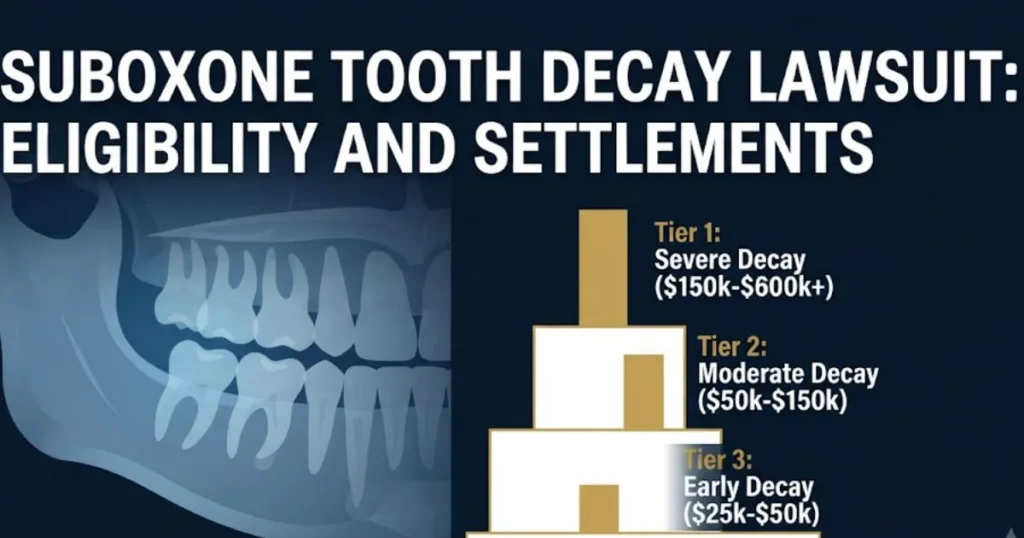
Suboxone lawsuit settlement amounts in 2026 are estimated to range from $50,000 to $500,000 or more per claimant, depending on the severity of dental injuries. No global settlement has been finalized yet, but early indicators from similar pharmaceutical cases provide a reasonable projection.
Several factors will determine where an individual claim falls on the payout spectrum. The most important factor is the extent of dental damage you can prove with records.
| Injury Severity | Estimated Settlement Range | Examples |
|---|---|---|
| Mild | $30,000 to $75,000 | Multiple cavities, minor dental work |
| Moderate | $75,000 to $200,000 | Root canals, crowns, partial tooth loss |
| Severe | $200,000 to $500,000+ | Full tooth extractions, dental implants, dentures |
These estimates draw from historical pharmaceutical settlement data. Cases like Zantac and 3M earplugs offer benchmarks for how drug manufacturers settle large MDLs.
Your payout will also depend on how long you took Suboxone, your age when dental problems started, and whether you had pre-existing dental conditions. Strong documentation from your dentist is the single biggest factor in maximizing your claim value.
Lawyers expect settlement talks to intensify after bellwether trial results come in. Those trial outcomes set the negotiating tone for every remaining case.
Who Qualifies for Suboxone Lawsuit
Anyone who took Suboxone sublingual film and developed dental problems may qualify to file a lawsuit. The key requirement is a documented connection between your Suboxone use and dental injuries that occurred during or after treatment.
You do not need to have perfect teeth before taking Suboxone. The claim centers on whether the drug made your dental health worse than it should have been.
Basic qualification criteria include:
- You were prescribed Suboxone sublingual film (not the tablet, in most cases)
- You used the film for a period of weeks, months, or years
- You developed tooth decay, dental erosion, cavities, tooth fractures, or tooth loss
- You have dental records showing treatment during or after Suboxone use
- Your dental problems were not solely caused by another known factor
People who used the generic buprenorphine/naloxone sublingual film may also qualify. The lawsuit targets the film formulation because of its direct contact with tooth surfaces during dissolution.
Children and adolescents prescribed Suboxone film have particularly strong claims. Their developing teeth are more vulnerable to the acidic effects of the dissolving medication.
Key Takeaway: You likely qualify if you took Suboxone film, experienced dental damage, and have dental records to prove it.
How to File a Suboxone Lawsuit
Filing a Suboxone lawsuit starts with contacting a mass tort attorney who handles pharmaceutical cases and completing a free case evaluation. The process is simpler than most people expect.
Here is how it works, step by step:
| Step | What Happens | Your Role |
|---|---|---|
| 1. Free consultation | Lawyer reviews your situation | Share your Suboxone history and dental issues |
| 2. Case evaluation | Attorney determines if you qualify | Provide prescription records and dental records |
| 3. Retainer agreement | You sign a contingency fee agreement | Review the fee percentage (typically 33% to 40%) |
| 4. Record gathering | Law firm collects medical and dental records | Sign release forms for records access |
| 5. Complaint filing | Attorney files your case in the MDL or state court | Review the complaint for accuracy |
| 6. Litigation | Discovery, depositions, and trial prep | May need to answer questions or provide testimony |
You will not need to travel to Ohio where the MDL sits. Most of the process happens remotely.
Your lawyer handles the heavy lifting. They request pharmacy records, dental treatment histories, and medical charts. They work with dental experts to build the causation argument.
The entire filing process usually takes two to four weeks from your first call to having your case officially on the docket. After that, your case joins the larger MDL pipeline.
Suboxone Lawsuit Payout Per Person
The Suboxone lawsuit payout per person will vary widely based on individual circumstances, but early projections suggest a range of $50,000 to over $500,000. People with the most severe dental injuries and the strongest documentation will land at the higher end.
Think of it like car insurance claims. A fender bender pays differently than a totaled vehicle. The same logic applies to dental damage claims.
Factors that increase your payout:
- Multiple tooth extractions directly tied to Suboxone use
- Need for dental implants, bridges, or full dentures
- Long duration of Suboxone film use
- Young age at the time of dental damage
- Strong dental records showing a before-and-after comparison
- No significant pre-existing dental conditions
Factors that may reduce your payout:
- Pre-existing dental disease before Suboxone use
- Poor oral hygiene unrelated to the medication
- Limited dental records or gaps in documentation
- Short duration of Suboxone film use
Attorney fees typically run 33% to 40% of your total recovery. This is standard for contingency-based mass tort cases. If your case settles for $200,000 and the fee is 33%, you would receive roughly $134,000 before case costs.
No one can guarantee a specific payout. But the strength of the evidence against Indivior suggests meaningful compensation for people with legitimate injuries.
Suboxone Tooth Decay Lawsuit
The Suboxone tooth decay lawsuit alleges that Indivior and related companies failed to warn patients and doctors about the serious risk of dental damage from the sublingual film. This litigation is the core of the entire Suboxone MDL.
When you dissolve a Suboxone film under your tongue, it creates an acidic environment in your mouth. That acid sits against your teeth and gums for several minutes during each dose.
Over weeks, months, and years of daily use, this repeated acid exposure erodes tooth enamel. The result is cavities, cracked teeth, tooth infections, and tooth loss.
What makes this lawsuit strong:
- The FDA issued a required label change in January 2022, adding a warning about dental problems
- Indivior knew about dental reports for years before the FDA acted
- Internal company documents may show the manufacturer was aware of the risk
- Thousands of adverse event reports were filed with the FDA before the warning
The fact that Indivior did not add a dental warning until the FDA forced them to is a central argument. Plaintiffs say the company put profits over patient safety.
Dental experts testifying in these cases explain that the film’s pH level and its placement against lower front teeth create a perfect storm for enamel destruction. No other route of medication delivery causes this specific pattern of damage.
Key Takeaway: The Suboxone tooth decay lawsuit is built on a strong foundation: the FDA itself confirmed the dental risk, and the manufacturer failed to warn patients for years.
Suboxone Lawsuit Deadline to File
The Suboxone lawsuit deadline to file depends on your state’s statute of limitations for product liability or personal injury claims. Most states allow two to three years from the date you discovered (or should have discovered) that Suboxone caused your dental injuries.
This is not a single national deadline. Each state sets its own rules.
| State | Statute of Limitations | Clock Starts |
|---|---|---|
| California | 2 years | Date of injury discovery |
| Texas | 2 years | Date of injury discovery |
| New York | 3 years | Date of injury discovery |
| Florida | 2 years (as of 2024 reform) | Date of injury discovery |
| Pennsylvania | 2 years | Date of injury discovery |
| Ohio | 2 years | Date of injury discovery |
| Illinois | 2 years | Date of injury discovery |
The “discovery rule” is important here. Your clock does not start when your teeth first decayed. It starts when you knew or reasonably should have known that Suboxone caused the damage.
For many people, the FDA’s January 2022 warning is the point when they could have reasonably connected Suboxone to their dental problems. That means some filing windows may close in 2024 or 2025 depending on the state.
If you are reading this in 2026, you should act immediately. Some states may still allow your claim, especially if you discovered the connection recently. But waiting is risky.
Do not assume you have plenty of time. A five-minute phone call to a lawyer can tell you if your window is still open.
Suboxone Lawsuit Eligibility Requirements
Suboxone lawsuit eligibility requirements focus on three core elements: you used the sublingual film, you suffered dental injuries, and you can connect the two with medical records. Meeting all three gives you a viable claim.
Required elements for eligibility:
- Product use: You took Suboxone sublingual film (brand name or generic buprenorphine/naloxone film)
- Dental injury: You experienced tooth decay, dental erosion, tooth fracture, tooth loss, or needed significant dental work
- Causation link: Your dental problems developed during or after Suboxone film use
- Documentation: You have prescription records and dental treatment records
Who is NOT eligible:
- People who only took Suboxone tablets (the tablet dissolves differently and is generally excluded)
- People whose dental problems clearly pre-dated their Suboxone use with no worsening
- People with no dental records to support their claims
You do not need to have filed an FDA adverse event report. You do not need to have complained to your doctor about the connection. You just need the records.
Some attorneys will accept cases where dental records are incomplete if pharmacy records show long-term Suboxone film use and the patient can provide a dentist’s statement linking the damage to medication use.
Suboxone MDL Update 2026
The Suboxone MDL (Multidistrict Litigation No. 3092) is proceeding in the U.S. District Court for the Northern District of Ohio under Judge Dan Aaron Polster. As of 2026, the litigation is in an advanced stage with bellwether case selection and trial preparation underway.
Current MDL status highlights:
- Over 3,000 individual cases consolidated in the MDL
- Bellwether cases have been selected for trial preparation
- Discovery (document exchange and depositions) is ongoing
- Expert witness reports on dental causation are being filed
- Settlement discussions have reportedly begun in preliminary form
| MDL Milestone | Status as of 2026 |
|---|---|
| Case consolidation | Complete |
| Discovery phase | Advanced/ongoing |
| Bellwether selection | Complete |
| Expert reports | Being filed |
| Bellwether trials | Scheduled |
| Global settlement | Not yet reached |
The MDL process works like a sorting system. Thousands of cases get pooled together for efficiency. A handful of bellwether cases go to trial first. Those trial results then guide settlement negotiations for every other case.
New cases can still be added to the MDL in 2026 if they meet the filing criteria. The court has not closed the door on new plaintiffs joining the litigation.
Key Takeaway: The Suboxone MDL is moving toward bellwether trials in 2026, which will be the most important event yet in determining settlement values for all claimants.
Suboxone Class Action Settlement
The Suboxone litigation is technically not a class action. It is a mass tort MDL, which means each person files their own individual case rather than joining a single class action. This distinction matters because individual cases can result in different payout amounts based on each person’s specific injuries.
Here is why this is actually good news for claimants. In a class action, everyone gets the same small check. In a mass tort, your payout reflects your actual damages.
| Feature | Class Action | Mass Tort MDL |
|---|---|---|
| Filing | One case for the whole class | Each person files individually |
| Payout | Same amount for everyone | Varies by injury severity |
| Attorney | One firm represents the class | Your own lawyer represents you |
| Control | Minimal individual control | More control over your case |
| Typical payout | Lower per person | Higher per person |
Some people search for “Suboxone class action” because they are familiar with that term. What they are really looking for is the Suboxone mass tort, which gives them a better shot at meaningful money.
If a global settlement is reached, a claims administrator will likely create a tiered payment structure. People with severe injuries and strong records will receive more. People with minor injuries will receive less.
No global settlement has been announced as of early 2026. Both sides are still in active litigation.
Suboxone Lawsuit Timeline
The Suboxone lawsuit timeline stretches from the first individual filings in 2023 through expected resolution in 2026 or 2027. The pace depends on bellwether trial outcomes and whether Indivior decides to settle or fight.
| Date | Event |
|---|---|
| January 2022 | FDA requires dental warning on buprenorphine medications |
| 2022 to 2023 | Individual lawsuits filed across the country |
| February 2024 | MDL 3092 created in Northern District of Ohio |
| 2024 | Cases consolidated, discovery begins |
| 2025 | Bellwether case selection, expert discovery |
| 2026 | Bellwether trials expected, settlement talks may accelerate |
| 2026 to 2027 | Potential global settlement or continued trials |
The timeline could shorten if bellwether verdicts go strongly against Indivior. Large plaintiff verdicts pressure defendants to settle quickly.
On the other hand, if Indivior wins early trials, the process could drag on. Defense verdicts give the company leverage to offer lower settlements or push for more trials.
Most pharmaceutical MDLs take three to five years from consolidation to resolution. Based on the February 2024 MDL creation date, a resolution window of late 2026 to mid 2027 is realistic.
Patients filing new claims in 2026 can still participate. Their cases would enter the MDL pipeline, though they may not resolve as quickly as earlier-filed cases.
Suboxone Film Lawsuit
The Suboxone film lawsuit specifically targets the sublingual film formulation of Suboxone, not the tablet version. This matters because the film dissolves directly against the teeth and gum tissue, creating prolonged acid exposure that the tablet does not cause in the same way.
Indivior transitioned the market from tablets to film around 2013. They aggressively promoted the film as more convenient and easier to use. At the time, they did not disclose the dental risks.
Why the film is the focus:
- The film adheres to the mouth’s mucosal tissue and dissolves slowly
- During dissolution, it creates a low-pH (acidic) environment
- The acid directly contacts the lower front teeth and nearby enamel
- Daily use over months or years causes cumulative enamel erosion
- The tablet dissolves differently and does not cause the same pattern of damage
Some generic versions of the sublingual film are also included in the litigation. If you took a generic buprenorphine/naloxone sublingual film, you may still qualify.
The film-versus-tablet distinction is one of the strongest parts of the plaintiffs’ case. It shows that the delivery method itself is the problem, not just the active drug ingredient.
Key Takeaway: The sublingual film’s unique dissolution process is what causes the dental damage, which is why the film is targeted while the tablet generally is not.
Suboxone Side Effects Teeth
Suboxone side effects on teeth include severe tooth decay, enamel erosion, tooth fractures, tooth infections, and complete tooth loss. The FDA confirmed these dental risks in January 2022 after reviewing hundreds of adverse event reports.
The dental damage follows a specific pattern. It typically starts with the lower front teeth because that is where the film dissolves. Over time, it spreads to surrounding teeth.
Reported dental side effects include:
- Rapid onset cavities in previously healthy teeth
- Enamel erosion that appears as thin, translucent, or chipped teeth
- Tooth fractures from weakened enamel
- Dental abscesses and infections
- Need for root canals, crowns, or extractions
- Complete tooth loss requiring dentures or implants
- Gum recession and soft tissue damage
The FDA reviewed 305 cases of dental problems reported with buprenorphine medications dissolved in the mouth. Of those, 151 were classified as serious, including hospitalizations and tooth extractions.
Many patients describe the experience as shocking. They had normal dental checkups before starting Suboxone, then within a year or two, their teeth began crumbling. One common description is teeth “cracking like glass.”
The acidic pH of the dissolving film ranges between 2.5 and 3.5, which is comparable to lemon juice or vinegar. No dentist would recommend holding lemon juice against your teeth twice a day, yet that is essentially what the film does.
Suboxone Lawsuit Dental Problems
Suboxone lawsuit dental problems are the injuries that form the basis of each individual claim, and the severity of these problems directly determines your potential compensation. Courts and settlement administrators categorize dental injuries into tiers.
Tier 1 (Mild dental problems):
- Multiple new cavities during Suboxone use
- Fillings required on several teeth
- Minor enamel wear
Tier 2 (Moderate dental problems):
- Root canals needed on multiple teeth
- Dental crowns placed on damaged teeth
- Partial tooth loss (1 to 5 teeth)
- Gum disease requiring treatment
Tier 3 (Severe dental problems):
- Extraction of 6 or more teeth
- Need for dental implants
- Full or partial dentures required
- Jaw bone damage from infections
- Permanent disfigurement
Your dental records are the single most important piece of evidence. Before-and-after comparisons from your dentist carry enormous weight.
If you saw a dentist regularly before starting Suboxone, those clean checkups serve as your baseline. The contrast between pre-Suboxone dental health and post-Suboxone dental damage tells the story more powerfully than any expert witness could.
Patients who did not see a dentist regularly can still file claims. Pharmacy records showing long-term Suboxone film use combined with dental records showing extensive sudden damage can establish the connection.
Key Takeaway: Document every dental visit, every procedure, and every dollar spent on dental repairs. Your records are your claim’s backbone.
Suboxone Bellwether Trial Dates
Suboxone bellwether trial dates are expected in 2026, with specific scheduling determined by Judge Dan Aaron Polster in MDL 3092. Bellwether trials are the test cases that set the stage for global settlement negotiations.
What is a bellwether trial?
It is a trial of a small number of representative cases chosen from the larger MDL. Both sides agree on which cases to try. The outcomes tell everyone what juries think about the evidence.
| Bellwether Element | Details |
|---|---|
| Number of cases selected | Typically 4 to 8 for trial |
| Court | Northern District of Ohio |
| Judge | Dan Aaron Polster |
| Expected trial dates | 2026 |
| Purpose | Test jury reactions, guide settlement talks |
If juries award large verdicts to plaintiffs, Indivior faces pressure to settle the remaining cases quickly. A $10 million bellwether verdict, for example, would signal that fighting every case individually would cost the company billions.
If Indivior wins bellwether trials, they gain negotiating strength. Defense wins do not kill the litigation, but they can significantly reduce settlement offers.
Historically, about 85% of pharmaceutical MDLs settle after bellwether trial results come in. The trial outcomes create a pricing framework that both sides use to negotiate.
Bellwether trial preparation is intense. The selected plaintiffs undergo detailed depositions and their dental experts face cross-examination. These cases are handpicked to represent different injury levels and demographics.
Suboxone Lawsuit Lawyers Near Me
Suboxone lawsuit lawyers near you are available regardless of where you live in the United States. Because this is a federal MDL, your lawyer does not need to practice in Ohio where the case is consolidated. They file on your behalf from anywhere.
How to find a qualified Suboxone lawyer in your area:
- Search for mass tort attorneys in your state
- Look for firms advertising Suboxone or pharmaceutical litigation experience
- Check attorney review sites for client feedback
- Verify bar membership and disciplinary history through your state bar association
- Confirm they work on contingency (no fee unless you win)
You should interview at least two or three firms before choosing one. Ask about their caseload, their experience with pharmaceutical MDLs, and how they communicate with clients.
Questions to ask during your consultation:
- How many Suboxone cases are you currently handling?
- What is your contingency fee percentage?
- Will you personally handle my case or delegate it?
- How often will you update me on my case status?
- What is your estimate of my claim’s value?
Large national firms handle many Suboxone cases. Smaller local firms sometimes partner with national firms to give clients local access and national resources. Either approach can work well.
The most important thing is to choose someone you trust. You may work with this attorney for one to three years, so comfort and communication matter.
What Is the Suboxone Lawsuit About
The Suboxone lawsuit is about Indivior’s failure to warn patients and healthcare providers that Suboxone sublingual film causes severe dental problems. Plaintiffs allege the company knew about the risk and chose not to disclose it.
Here is the backstory. Suboxone is a prescription medication that combines buprenorphine and naloxone. Doctors prescribe it to treat opioid use disorder. It works, and it has helped millions of people overcome addiction.
The problem is the delivery method. The sublingual film dissolves under the tongue, and during that process, it bathes the teeth in acid. Patients were never told this could destroy their teeth.
The core legal claims include:
- Failure to warn: Indivior did not include dental risks on the product label until the FDA forced them to in 2022
- Design defect: The film formulation itself is inherently dangerous to teeth
- Negligence: The company knew about adverse dental reports and did not act
- Fraud/misrepresentation: Marketing materials downplayed or omitted dental risks
Indivior generated billions of dollars in revenue from Suboxone. The film version dominated the market after the company transitioned away from tablets.
Many patients feel betrayed. They trusted their doctors, who trusted the drug label. Without a dental warning on the label, nobody had the information they needed to make an informed decision.
The irony is painful. People took Suboxone to save their lives from opioid addiction. In return, they lost their teeth.
Key Takeaway: The lawsuit centers on one simple question: did Indivior know Suboxone film destroyed teeth and hide that information from patients and doctors? The evidence strongly suggests they did.
Frequently Asked Questions
How much money can I get from a Suboxone lawsuit?
Most claimants can expect between $50,000 and $500,000 depending on injury severity.
Cases involving tooth extractions, implants, or dentures fall at the higher end.
Payouts depend on your dental records, duration of use, and the strength of your documentation.
Is there a deadline to file a Suboxone tooth decay lawsuit in 2026?
Yes, deadlines vary by state and are typically two to three years from when you discovered Suboxone caused your dental damage.
Many states use the FDA’s January 2022 warning as the discovery date.
If you are considering a claim in 2026, contact a lawyer immediately because some windows may be closing.
Do I need a lawyer to file a Suboxone lawsuit?
You technically can file alone, but it is strongly discouraged for pharmaceutical cases.
Mass tort litigation requires specialized legal knowledge, expert witnesses, and extensive document handling.
Suboxone lawsuit lawyers work on contingency, so there is no financial reason to go without representation.
Does the Suboxone lawsuit cover the tablet form or only the film?
The lawsuit primarily covers the sublingual film formulation, not the tablet.
The film dissolves directly against teeth and creates acid exposure that the tablet does not replicate in the same way.
Some attorneys may evaluate tablet cases on an individual basis, but the film is the primary target.
How long will the Suboxone lawsuit take to settle?
Most legal experts expect the MDL to reach resolution in late 2026 to mid 2027.
Bellwether trial results in 2026 will be the biggest driver of settlement timing.
Individual payouts could take several additional months after a global settlement is announced.
The Suboxone lawsuit is one of the most significant pharmaceutical cases heading toward resolution in 2026. If you took the sublingual film and suffered dental damage, your window to file may be narrowing.
Check your eligibility with a qualified attorney now. Gather your dental records and Suboxone prescription history.
The strongest claims come from people who act early, document everything, and work with experienced suboxone lawsuit lawyers who know this litigation inside and out.







