

A Riverside lawsuit loan gives you cash now while your case is still pending. You don’t pay it back unless you win or settle.
If you are waiting on a personal injury or accident case in Riverside County, you already know how slow things move. The average Riverside civil case can take 18 to 30 months to reach a settlement. Bills pile up fast during that wait.
This guide covers everything about getting a lawsuit loan in Riverside in 2026. You will learn who qualifies, what it costs, how interest works, and what to watch out for before signing anything.
Here is one fact most funding companies will not tell you: a $10,000 lawsuit loan can cost you $15,000 to $25,000 by the time your case settles, depending on the rate and how long your case takes. Knowing the real numbers matters before you borrow.
What Is a Riverside Lawsuit Loan
A Riverside lawsuit loan is a cash advance given to a plaintiff while their lawsuit is still active. It is not technically a loan in the traditional sense.
The correct term is “pre-settlement funding” or “litigation financing.” The difference matters. Unlike a bank loan, you owe nothing if you lose your case. The funding company takes the risk.
In California, these transactions are regulated under California Civil Code Sections 1799.40 through 1799.416. The law requires funding companies to disclose all fees, interest rates, and total repayment amounts before you sign.
| Detail | Info |
|---|---|
| What It Is | Cash advance against future settlement proceeds |
| Who Provides It | Third-party legal funding companies |
| Repayment Trigger | Only if you win or settle |
| California Regulation | Civil Code Sections 1799.40 to 1799.416 |
| Risk to Plaintiff | None if case is lost |
Riverside lawsuit loans are available for personal injury, car accidents, slip and fall, medical malpractice, and some workers compensation cases. The funding company evaluates your case strength, not your credit score.
Think of it like selling a small slice of your future settlement. You get cash today. They get a bigger amount later. If there is no settlement, they eat the loss.
How Lawsuit Loans Work in Riverside
Lawsuit loans in Riverside work by advancing you money based on the expected value of your pending case. The process involves three parties: you, your attorney, and the funding company.
First, you apply with a funding company. They contact your attorney to review your case file. The attorney provides details about liability, damages, insurance coverage, and estimated settlement value.

The funding company then decides two things: whether to approve you and how much to offer. Most offers range from 10% to 20% of the estimated settlement value.
Once approved, money can hit your account within 24 to 72 hours. You sign a contract agreeing to repay the advance plus fees from your settlement proceeds.
Here is how the money flows:
- You apply and authorize your attorney to share case details
- The funding company reviews your case within 24 to 48 hours
- If approved, you receive an offer with full cost disclosure
- You sign the agreement and get funds via direct deposit or check
- When your case settles, the funding company gets paid from settlement proceeds
- Your attorney handles the repayment directly from the settlement check
Your attorney must cooperate for this to work. Most personal injury attorneys in Riverside are familiar with the process and will assist with the application.
Who Qualifies for a Lawsuit Loan in Riverside
You qualify for a lawsuit loan in Riverside if you have a pending legal case with a reasonable chance of a settlement or verdict. Your credit score, employment status, and income do not matter.
The funding company cares about one thing: your case. Specifically, they want to know whether you are likely to win or settle, and for how much.
Basic qualification requirements:
- You must have an active, filed lawsuit or claim
- You must have a licensed attorney representing you on contingency
- Your case must involve clear liability (the other party is at fault)
- There must be insurance coverage or assets to pay a judgment
- The expected settlement must be large enough to cover the advance plus fees
| Qualification Factor | What They Look At |
|---|---|
| Case Status | Must be active and filed (or about to be filed) |
| Attorney | Must have legal representation |
| Liability | Clear fault by the defendant |
| Damages | Medical bills, lost wages, pain and suffering |
| Insurance | Defendant must have insurance or assets |
| Credit Score | Not checked |
| Employment | Not relevant |
Some case types get approved more easily than others. Car accident cases with police reports and clear fault get fast approvals. Medical malpractice cases with strong expert opinions also do well.
Cases that struggle to get approved include those with disputed liability, low policy limits, or cases still in very early stages with no medical documentation.
Key Takeaway: A Riverside lawsuit loan is a non-recourse cash advance based on your case value, not your credit. You pay nothing if you lose.
Riverside Personal Injury Lawsuit Loan
A Riverside personal injury lawsuit loan provides funding to plaintiffs who have been physically injured due to someone else’s negligence. This is the most common type of lawsuit loan in Riverside County.
Personal injury cases cover a wide range of situations. Dog bites, premises liability, assault, defective products, and medical errors all fall under this category. If someone else caused your injury and you filed a claim, you may be eligible.
Funding amounts for personal injury cases in Riverside typically range from $2,500 to $100,000. The exact amount depends on the severity of your injuries, your total medical bills, and the estimated settlement value.
Common personal injury case types funded in Riverside:
- Motor vehicle collisions (cars, trucks, motorcycles)
- Slip and fall on commercial or public property
- Dog bite attacks
- Defective product injuries
- Medical malpractice
- Assault and battery (civil claims)
- Wrongful death (family members of the deceased)
The stronger your injury documentation, the faster and larger your approval will be. Cases with extensive medical records, ongoing treatment, and significant lost wages tend to get the best offers.
One thing to keep in mind for 2026: Riverside County has seen an increase in personal injury filings over the past three years. More cases in the system means longer wait times for everyone, which is exactly why more plaintiffs are turning to lawsuit loans.
Riverside Car Accident Lawsuit Funding
Riverside car accident lawsuit funding is the fastest and most commonly approved type of legal financing in the area. If you were hurt in a car wreck and it was not your fault, you are a strong candidate.
Riverside County sits along the I-15, I-215, and SR-91 corridors. These are some of the most dangerous highways in Southern California. The California Highway Patrol reported over 3,500 injury-producing collisions in Riverside County in recent years. That volume of accidents translates to a high volume of lawsuit loan applications.
Car accident cases get approved quickly because they usually have clear evidence. Police reports establish fault. Insurance policies are verifiable. Medical records are straightforward.
| Car Accident Funding Detail | Typical Range |
|---|---|
| Funding Amount | $3,000 to $75,000 |
| Approval Time | 24 to 48 hours |
| Interest Rate (annual) | 24% to 60% compounding |
| Repayment | From settlement proceeds only |
| Required Documentation | Police report, medical records, attorney letter |
Types of car accident cases funded:
- Rear-end collisions
- T-bone crashes at intersections
- Head-on collisions
- Multi-vehicle pileups on I-15 or I-215
- Rideshare accidents (Uber, Lyft)
- Uninsured or underinsured motorist claims
- Hit and run cases (if defendant is identified or UM coverage exists)
Your attorney’s willingness to cooperate with the funding company speeds up the process. Most Riverside personal injury attorneys handle this regularly and know what paperwork to send.
How Much Can I Get from a Lawsuit Loan in Riverside
Most Riverside plaintiffs can get between $2,500 and $100,000 from a lawsuit loan, depending on their case value. The typical first-time advance falls in the $5,000 to $25,000 range.
Funding companies generally offer 10% to 20% of the estimated settlement value. If your case is expected to settle for $150,000, you might be offered $15,000 to $30,000.
Several factors determine your offer amount:
- Severity of injuries: Spinal cord injuries, traumatic brain injuries, and multiple surgeries lead to higher advances
- Total medical bills: Higher treatment costs signal higher settlement values
- Lost wages: Documented income loss adds to your case value
- Liability clarity: Cases with clear fault get larger offers
- Insurance policy limits: The defendant’s coverage caps what the funding company can recover
- Case stage: Cases closer to settlement get better offers
| Estimated Settlement Value | Typical Loan Offer (10% to 20%) |
|---|---|
| $50,000 | $5,000 to $10,000 |
| $100,000 | $10,000 to $20,000 |
| $250,000 | $25,000 to $50,000 |
| $500,000 | $50,000 to $100,000 |
You can often request additional funding later if your case takes longer than expected. This is called a “second draw” or “top-up.” Just know that each additional advance adds more cost to your total repayment.
Getting the largest possible advance might feel tempting. But borrowing only what you need is smarter. Every dollar you borrow grows with interest until your case resolves.
Key Takeaway: Funding amounts depend on your case value, not your needs. Borrow only what you must because interest compounds until settlement day.
Lawsuit Loan Interest Rates in Riverside
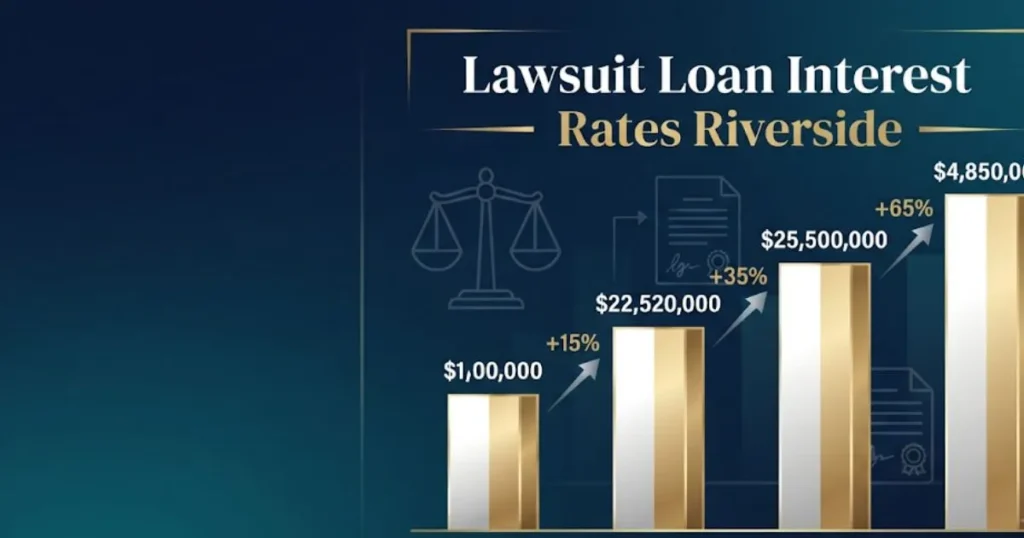
Lawsuit loan interest rates in Riverside typically range from 2% to 5% per month, which equals 24% to 60% annually. Most rates compound monthly, meaning you pay interest on top of interest.
This is the part most funding companies downplay in their marketing. A “low” monthly rate of 3% sounds reasonable until you see what it does over 18 months.
Here is a real-world example of what a $10,000 advance costs at different rates and timelines:
| Monthly Rate | 6 Months Total Owed | 12 Months Total Owed | 18 Months Total Owed | 24 Months Total Owed |
|---|---|---|---|---|
| 2.0% | $11,262 | $12,682 | $14,282 | $16,084 |
| 3.0% | $11,941 | $14,258 | $17,024 | $20,328 |
| 3.5% | $12,293 | $15,111 | $18,575 | $22,833 |
| 5.0% | $13,401 | $17,959 | $24,066 | $32,251 |
At a 3% monthly rate, your $10,000 advance becomes $20,328 after two years. At 5%, it balloons to over $32,000. These numbers are real and they catch many plaintiffs off guard.
California law requires funding companies to disclose the total cost before you sign. Under Civil Code Section 1799.404, they must provide a written contract showing the funded amount, all fees, the rate, and the total amount you will owe.
Always compare at least three offers. Rates vary dramatically between companies. A difference of just 1% monthly can save you thousands over the life of your case.
Pre-Settlement Funding in Riverside CA
Pre-settlement funding in Riverside CA refers to the same product as a lawsuit loan, just described with a legally accurate term. California law specifically calls it a “litigation financing transaction.”
The distinction matters because California regulators treat these transactions differently from traditional loans. Banks and consumer lending laws do not govern them. Instead, California Civil Code Sections 1799.40 to 1799.416 provide the regulatory framework.
Under California law, funding companies must:
- Provide the contract in writing before you sign
- Disclose the funded amount, all fees, and the total repayment amount
- Include a clear explanation of the non-recourse nature (you pay nothing if you lose)
- Give you the right to cancel within five business days after signing
- Send a copy of the contract to your attorney
Quick Facts: California Pre-Settlement Funding Rules (2026)
| Regulation | Requirement |
|---|---|
| Written Contract | Mandatory before funding |
| Cancellation Period | 5 business days |
| Attorney Notification | Copy of contract must be sent to your lawyer |
| Fee Disclosure | All fees and total cost must be itemized |
| Non-Recourse Disclosure | Must clearly state you owe nothing if you lose |
| Regulatory Body | California DFPI |
The California Department of Financial Protection and Innovation (DFPI) oversees complaints about funding companies. If a company violates disclosure requirements, you can file a complaint with the DFPI.
One practical tip: always use a California-based or California-licensed funding company. Out-of-state companies sometimes try to apply their home state’s less protective laws to your transaction. Stick with companies that explicitly follow California rules.
Lawsuit Cash Advance in Riverside
A lawsuit cash advance in Riverside is money you receive before your case concludes, drawn against your expected settlement. The term “cash advance” and “lawsuit loan” are used interchangeably by consumers, though the legal industry prefers “litigation financing.”
The speed of a cash advance is the main selling point. Most companies promise funding within 24 to 72 hours of approval. In practice, the timeline depends on how quickly your attorney responds to the funding company’s request for case information.
Here is what a typical Riverside lawsuit cash advance timeline looks like:
| Step | Timeline |
|---|---|
| Submit Application | Day 1 (takes 10 to 15 minutes) |
| Funding Company Contacts Attorney | Day 1 to 2 |
| Attorney Provides Case File | Day 2 to 5 (this is usually the bottleneck) |
| Underwriting Review | Day 3 to 7 |
| Offer Presented to Plaintiff | Day 4 to 8 |
| Contract Signed | Day 5 to 9 |
| Funds Deposited | Day 5 to 10 |
The biggest delay is almost always the attorney response time. If your lawyer sends case documents quickly, you can have money in hand within a week. If they are slow or unresponsive, it can take two to three weeks.
Before you sign for a cash advance, confirm three things: the total repayment amount, whether the interest compounds monthly or is simple interest, and whether there are any additional administrative or processing fees buried in the contract.
Key Takeaway: A lawsuit cash advance gets money in your hands fast, but the real timeline depends on how quickly your Riverside attorney provides case documents.
How to Apply for a Lawsuit Loan in Riverside
To apply for a lawsuit loan in Riverside, you fill out an application with a funding company, authorize them to contact your attorney, and wait for a case review. The process is simpler than applying for a credit card.
You do not need good credit. You do not need a job. You do not need collateral. The only thing that matters is your case.
Step-by-step application process:
- Choose a funding company. Research at least three companies. Compare rates and reviews.
- Fill out the application. Provide your name, contact info, attorney’s name and phone number, case type, and a brief description of what happened.
- Sign an authorization form. This lets the funding company request your case file from your attorney.
- Wait for case review. The company’s underwriters evaluate liability, damages, and estimated settlement value.
- Receive your offer. The company tells you how much they will advance and what the total cost will be.
- Review the contract carefully. Check the interest rate, compounding schedule, all fees, and total repayment amount.
- Sign and receive funds. Money arrives via direct deposit or check, usually within one to three business days after signing.
What you will need to apply:
- Your full legal name and contact information
- Your attorney’s name, firm, and phone number
- The type of case (car accident, slip and fall, etc.)
- A brief description of the incident
- Date of the incident
You do not need to provide medical records, police reports, or legal documents yourself. The funding company gets those from your attorney.
One important note for 2026: some Riverside attorneys have started refusing to work with certain funding companies that charge excessively high rates. If your attorney pushes back on a specific company, listen to them. They have likely seen other clients get burned by that company’s terms.
Riverside Lawsuit Loan Repayment Terms
Riverside lawsuit loan repayment happens only when your case settles or you win a verdict. You never make monthly payments. Your attorney pays the funding company directly from your settlement check.
This is the core feature that separates lawsuit loans from traditional debt. There is no payment schedule while your case is active. No collector calls. No minimum payments. No impact on your credit if the case takes years.
How repayment works in practice:
- Your case settles for $100,000
- Your attorney takes their contingency fee (typically 33% to 40%), which is $33,000 to $40,000
- The funding company gets their repayment (advance plus interest and fees)
- Medical liens and other case costs are paid
- You receive what is left
| Settlement Distribution Example | Amount |
|---|---|
| Total Settlement | $100,000 |
| Attorney Fee (33%) | $33,000 |
| Lawsuit Loan Repayment ($15,000 advance at 3%/month for 18 months) | $25,536 |
| Medical Liens | $12,000 |
| Case Costs | $3,000 |
| Your Take-Home | $26,464 |
That example is eye-opening. On a $100,000 settlement, you might take home just over $26,000 after a lawsuit loan and other deductions. Without the loan, you would have taken home about $52,000.
This is why borrowing only what you absolutely need is so important. Every dollar in funding reduces your final payout significantly.
California law requires the funding company to provide a clear written disclosure of the total repayment amount before you sign. Read that number carefully. If it shocks you, it should.
Non-Recourse Lawsuit Funding in Riverside California
Non-recourse lawsuit funding means you owe nothing if your case loses at trial or gets dismissed. The funding company absorbs the loss entirely. This is the defining feature of lawsuit loans in Riverside and across California.
“Non-recourse” is a legal term that means the funding company can only collect from your settlement or verdict. They cannot come after your personal bank account, your home, your car, or any other assets.
If your attorney tries the case and the jury returns a defense verdict, you walk away. The funding company loses its investment. You keep whatever personal assets you have.
What non-recourse covers:
- Case dismissed by the court: you owe nothing
- Jury verdict in favor of the defendant: you owe nothing
- Settlement is less than the total repayment amount: varies by contract
- Case settles for zero: you owe nothing
The last bullet point needs a closer look. Some contracts include a provision that if your settlement is smaller than expected, the funding company takes a reduced amount. Others require full repayment even if the settlement barely covers it. Read the fine print.
Non-recourse vs. traditional loan comparison:
| Feature | Non-Recourse Lawsuit Funding | Traditional Bank Loan |
|---|---|---|
| Credit Check | No | Yes |
| Monthly Payments | None | Required |
| Collateral | Your case only | Personal assets |
| What Happens If You Lose | You owe nothing | You still owe the full amount |
| Interest Rate | Higher (24% to 60%/year) | Lower (6% to 15%/year) |
| Risk | On the funding company | On you |
The higher interest rates on lawsuit loans exist precisely because the funding company takes on the risk of losing everything. They price that risk into every deal. Not every case they fund wins, so the ones that do win must cover the losses from the ones that don’t.
Key Takeaway: Non-recourse means the funding company takes the loss if you lose your Riverside case. You never owe a penny from your own pocket.
Riverside Slip and Fall Lawsuit Loan
A Riverside slip and fall lawsuit loan provides cash to plaintiffs injured in falls caused by dangerous conditions on someone else’s property. These cases are common in Riverside County and generally qualify for funding.
Slip and fall cases in Riverside happen at grocery stores, shopping centers, restaurants, apartment complexes, parking lots, and public sidewalks. Wet floors, broken steps, poor lighting, uneven pavement, and missing handrails are the usual culprits.
Factors that affect slip and fall lawsuit loan approval:
- Evidence of the hazard: Photos, incident reports, or witness statements proving the dangerous condition existed
- Notice: Evidence the property owner knew about the hazard or should have known
- Injury severity: Broken bones, herniated discs, and traumatic brain injuries get higher approvals
- Medical treatment: Ongoing care and surgery strengthen your case value
- Liability clarity: Cases where the property owner clearly failed to maintain safe conditions get approved fastest
| Slip and Fall Funding Detail | Typical Range |
|---|---|
| Average Funding Amount | $3,000 to $30,000 |
| Approval Rate | Moderate (depends on liability evidence) |
| Common Challenge | Proving the owner had notice of the hazard |
| Best Evidence | Surveillance video showing the hazard before the fall |
Slip and fall cases can be trickier to fund than car accidents. The reason is liability. In a car crash, a police report often establishes fault. In a slip and fall, the plaintiff must prove the property owner knew about the danger and did nothing.
If you have strong evidence, like a store’s incident report or surveillance footage, your odds of getting approved and getting a larger advance go up significantly.
Riverside Workers Comp Lawsuit Advance
A Riverside workers comp lawsuit advance is harder to obtain than funding for personal injury cases. Most lawsuit loan companies do not fund standard workers compensation claims.
The reason is structural. Workers comp cases in California are handled through the administrative system, not the civil courts. Benefits are determined by schedules set by the state, and the payout amounts are more limited and predictable. Funding companies prefer cases with higher potential settlements.
However, there are exceptions. If your workplace injury involved third-party liability, you may qualify. Third-party liability means someone other than your employer caused your injury.
Examples of fundable workers comp related cases:
- You were injured by a defective machine at work (product liability claim against the manufacturer)
- You were hurt in a car accident during work hours caused by another driver (personal injury claim against that driver)
- You were injured at a construction site due to another contractor’s negligence
- You suffered toxic exposure caused by a chemical supplier’s negligence
| Workers Comp Funding Detail | Info |
|---|---|
| Standard Workers Comp Claim | Usually NOT fundable |
| Third-Party Liability Claim | Fundable if filed as a separate civil case |
| Typical Funding Range | $5,000 to $50,000 (for third-party claims) |
| Key Requirement | Must have a civil lawsuit filed, not just a workers comp claim |
If you are only pursuing a standard workers comp claim through the California Workers Compensation Appeals Board, most funding companies will decline your application. Ask your attorney whether your situation includes a viable third-party claim.
Best Lawsuit Loan Companies in Riverside
The best lawsuit loan companies for Riverside plaintiffs are those that offer transparent pricing, follow California disclosure laws, and provide competitive interest rates. No single company is “best” for every case.
Choosing a funding company is like choosing any financial service. You compare rates, read reviews, check their regulatory compliance, and ask tough questions before signing.
What to look for in a funding company:
- California compliance: They must follow Civil Code Sections 1799.40 to 1799.416
- Rate transparency: They should tell you the exact monthly rate, whether it compounds, and the total repayment amount upfront
- No hidden fees: Watch for “processing fees,” “underwriting fees,” “administrative fees,” and “broker fees” that inflate your total cost
- Attorney familiarity: Your Riverside attorney has likely worked with several companies and can recommend ones with fair terms
- Reputation: Check reviews on the Better Business Bureau and consumer complaint databases
Questions to ask every funding company before signing:
- What is the monthly interest rate?
- Does the interest compound monthly, or is it simple interest?
- What is the total amount I will owe if my case takes 12, 18, and 24 months?
- Are there any fees beyond the interest charge?
- Is there a cap on the total repayment amount?
- Can I pay off the advance early without a penalty?
- Are you licensed to operate in California?
Some companies offer rate caps. A cap means the total repayment amount cannot exceed a set multiple of the original advance, like 2x or 2.5x. For a $10,000 advance with a 2x cap, you would never owe more than $20,000 regardless of how long your case takes. Companies that offer caps are generally more consumer-friendly.
Key Takeaway: Always compare at least three funding companies, ask for total cost projections at 12, 18, and 24 months, and look for rate caps.
Risks of Lawsuit Loans in Riverside County
The biggest risk of a lawsuit loan in Riverside County is that the compounding interest can eat a massive portion of your settlement. You could win your case and still walk away with very little money.
This is not a scare tactic. It is math. Go back to the repayment table earlier in this article. A $10,000 advance at 3% monthly becomes $20,328 after two years. If your case drags on for three years, that number keeps climbing.
Other risks to understand:
- Reduced settlement pressure: Some attorneys worry that once clients get funded, they feel less financial pressure and are willing to wait longer, which sounds good but actually increases the total cost of the advance
- Multiple advances compounding: Taking a second or third advance stacks interest on top of interest
- Lowball settlements become more tempting: If your repayment amount grows large, you might feel pressure to accept a lower settlement just to be done
- Not all companies are ethical: Some funding companies use aggressive sales tactics, hide fees in fine print, or charge rates well above market averages
Red flags to watch for:
- The company refuses to provide a total repayment schedule
- The contract includes fees you were not told about during the application
- The company pressures you to borrow more than you asked for
- The rate is above 4% monthly with no cap
- The company is not registered or licensed in California
Your attorney is your best protection against bad deals. Before signing any funding agreement, have your lawyer review the contract. Most experienced Riverside personal injury attorneys will flag problematic terms immediately.
If something about the deal feels wrong, trust your gut and walk away. There are plenty of companies competing for your business. You have options.
Riverside County Lawsuit Settlement Timeline
Most personal injury cases in Riverside County take between 12 and 30 months to reach a settlement. Complex cases, like medical malpractice or multi-vehicle accidents, can take three years or longer.
The timeline depends on several factors that are specific to Riverside County and the California court system.
Typical Riverside County lawsuit timeline:
| Phase | Estimated Duration |
|---|---|
| Medical Treatment and Documentation | 3 to 12 months |
| Filing the Lawsuit | 1 to 2 months |
| Discovery (exchanging evidence) | 6 to 12 months |
| Mediation or Settlement Negotiations | 1 to 3 months |
| Trial (if no settlement) | 12 to 24 months after filing |
Factors that extend the timeline:
- Serious injuries requiring ongoing treatment (you typically wait for maximum medical improvement before settling)
- Multiple defendants or parties
- Insurance companies that deny or delay claims
- Court backlogs in Riverside County Superior Court
- Defense attorneys who file excessive motions
Riverside County Superior Court has dealt with significant backlogs. The COVID-19 pandemic created a massive backlog of civil cases that the court is still working through in 2026. Jury trials were delayed for years, and that ripple effect pushed settlement timelines out for many plaintiffs.
This extended timeline is the primary reason lawsuit loans exist. When a case that should take 12 months takes 24 or 30 months, plaintiffs run out of money. Bills do not pause while the court catches up.
Riverside County Court Case Delays and Lawsuit Funding
Riverside County court case delays are a direct driver of demand for lawsuit funding in 2026. The longer your case takes, the more financial pressure you face, and the more appealing a cash advance becomes.
Riverside County Superior Court handles one of the largest caseloads in California. With courthouses in Riverside, Indio, Hemet, Murrieta, and Banning, the county’s court system serves over 2.4 million residents. That population has grown faster than the court system’s capacity.
What causes delays in Riverside County courts:
- Judicial vacancies and underfunding
- Pandemic-era case backlog that persists into 2026
- High volume of personal injury and civil filings
- Scheduling conflicts in high-demand courtrooms
- Continuances requested by defense attorneys seeking to delay payouts
These delays directly affect your lawsuit loan decision in two ways.
First, the longer your case takes, the more interest accumulates on any funding you receive. A case that settles in 12 months versus 24 months can mean the difference between owing $14,000 and $20,000 on a $10,000 advance.
Second, Riverside’s court delays make it harder to predict your settlement timeline accurately. Funding companies know this. Some use it to justify higher rates, arguing that Riverside cases carry more risk because of unpredictable timelines.
| Delay Factor | Impact on Lawsuit Loan Cost |
|---|---|
| Case takes 12 months instead of 6 | Repayment roughly doubles |
| Case takes 24 months instead of 12 | Repayment roughly doubles again |
| Trial required (no settlement) | Adds 12 to 18 months and significant interest |
| Multiple rounds of funding | Each advance compounds separately |
The bottom line: Riverside County’s court system is overburdened. If you are going to get a lawsuit loan, factor in the possibility that your case will take longer than your attorney initially estimates. Build that extra time into your cost calculations.
Key Takeaway: Riverside County court delays mean your case may take longer than expected. Calculate your lawsuit loan costs based on a worst-case timeline, not the best-case scenario.
Frequently Asked Questions
Do I have to pay back a lawsuit loan if I lose my case in Riverside?
No, you do not have to pay back anything if you lose your case.
Lawsuit loans in Riverside are non-recourse, meaning the funding company only collects from your settlement.
If there is no settlement or verdict in your favor, the company absorbs the entire loss.
How long does it take to get approved for a lawsuit loan in Riverside?
Most applications are reviewed within 24 to 72 hours after the funding company receives your case file from your attorney.
The total process from application to receiving funds usually takes 5 to 10 business days.
The biggest variable is how quickly your Riverside attorney responds to the funding company’s request for case documents.
Can I get a lawsuit loan in Riverside with bad credit?
Yes, you can get a lawsuit loan with bad credit, no credit, or even a bankruptcy on your record.
Funding companies do not run credit checks because the advance is secured by your case, not your personal finances.
Your case strength is the only thing that determines approval.
What types of cases qualify for lawsuit loans in Riverside County?
Most personal injury cases qualify, including car accidents, truck accidents, slip and fall injuries, medical malpractice, product liability, and wrongful death.
Workers compensation cases generally do not qualify unless there is a separate third-party liability claim.
The case must have an attorney working on it and clear evidence of liability.
How much does a lawsuit loan actually cost in Riverside?
A typical lawsuit loan in Riverside costs between $1.40 and $2.50 for every $1.00 borrowed, depending on the interest rate and how long your case takes.
A $10,000 advance at 3% monthly interest will cost approximately $17,000 after 18 months or $20,300 after 24 months.
Always ask for total cost projections at multiple timeline scenarios before signing any contract.
What to Do Next
Getting a Riverside lawsuit loan is a significant financial decision. The cash helps you survive while your case works through the system. But the cost is real and can eat deeply into your settlement.
Compare at least three funding companies. Ask for total repayment projections at 12, 18, and 24 months. Have your attorney review every contract before you sign.
Borrow only what you need to cover immediate expenses. Stay informed about your case timeline. Make sure your financial decision today does not leave you with regrets when settlement day arrives.







