Latest update (November 17, 2026): Two borrower lawsuits name Wahido Lending, which does business as River Valley Loans: Fisher v. Welch (S.D. Cal. No. 3:25-cv-01698), a proposed class action under RICO, and Rehfeldt v. Wahido Lending (S.D. Ind. No. 1:23-cv-01756). In September 2025, the defendants in Fisher asked the court to strike the class claims and send the case to arbitration, and we found no later ruling or settlement.
What’s next: Watch for a ruling on the arbitration motion in Fisher and any activity in Rehfeldt. No settlement, claim form or payout exists, and the allegations have not been proven. We’ll update this page if new details emerge.
Last updated: November 2026
The River Valley Loans lawsuit is really two lawsuits by borrowers who say River Valley Loans, an online lender tied to the Crow Creek Sioux Tribe, charged interest far above state limits and used the tribe’s sovereign status to avoid state law. The defendants dispute the claims, and no court has ruled that the loans were unlawful.
Related: Capital One Lawsuit Payout Delay 2026: Full Status Guide
This guide explains both cases, what the borrowers allege, what the lender’s side has argued and what borrowers can do now.
What Is the River Valley Loans Lawsuit?
River Valley Loans operates under the name Wahido Lending, which is affiliated with the Crow Creek Sioux Tribe of South Dakota. Borrowers allege the tribal affiliation is a “rent-a-tribe” arrangement meant to claim sovereign immunity and avoid state interest-rate caps. They also name CreditServe, Inc. and Eric Welch as defendants.
| Case | Court | Details |
|---|---|---|
| Rehfeldt v. Wahido Lending | U.S. District Court, Southern District of Indiana (No. 1:23-cv-01756) | Filed September 29, 2023 by an Indiana borrower; claims under the Indiana Uniform Consumer Credit Code and RICO |
| Fisher v. Welch | U.S. District Court, Southern District of California (No. 3:25-cv-01698, Judge William Q. Hayes) | Proposed class action under RICO by a California borrower; filed in 2025 |
What Do the River Valley Loans Borrowers Allege?
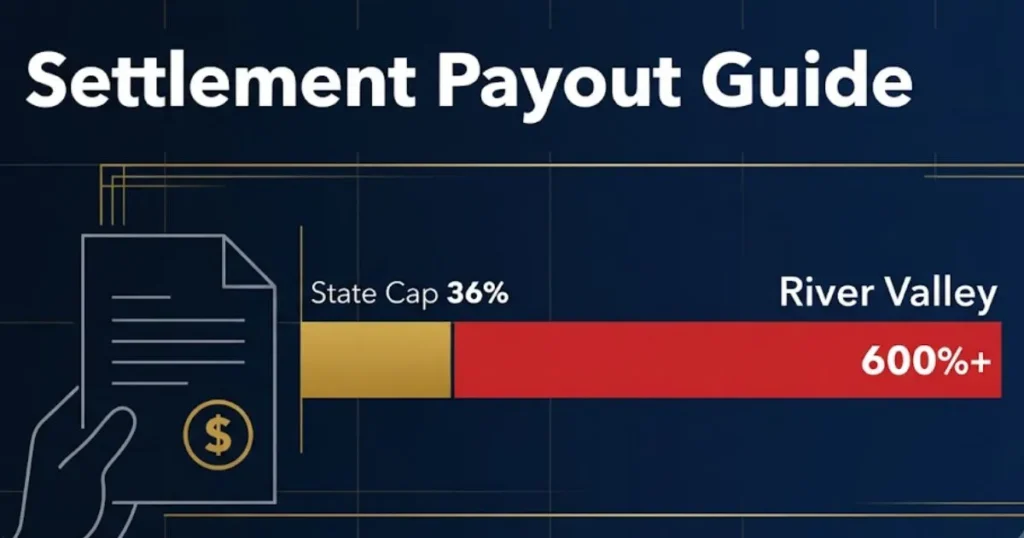
The Indiana complaint alleges interest rates above Indiana’s legal limit, generally 36% a year for consumer loans, with rates reported to exceed 400%. It also alleges a pattern of racketeering and seeks treble damages under RICO.
The California case makes similar claims on behalf of a proposed class, saying the lender and its executives ran a predatory short-term lending scheme involving the Crow Creek Sioux Tribe and that the rates were usurious.
These are allegations. The defendants’ public filings have focused on procedure rather than conceding the claims.
What Has Happened in Court?
In Fisher v. Welch, company executives asked the court in September 2025 to strike the class allegations and compel arbitration, arguing the lead plaintiff waived class actions in his loan agreement. We did not find a reported ruling on that request.
For Rehfeldt, we found no reported ruling, settlement or class certification. In both cases we found no class settlement, administrator website or claim form.
Key Takeaway: The River Valley Loans lawsuits are pending, no class has been certified in the sources we found, and there is no settlement or payout to claim.
Is River Valley Loans Licensed? What Regulators Say
On June 30, 2026, the Washington Department of Financial Institutions published a consumer alert saying the Crow Creek Sioux Tribe and four business names, including River Valley Loans, are not licensed by the department or registered to do business in Washington. The department said it received complaints from Washington consumers. The alert does not mention a lawsuit.
The alert also warns not to confuse this lender with River Valley Credit Union, which is unrelated.
Is There a River Valley Loans Class Action Settlement or Payout?
No. We found no settlement, settlement fund, eligibility rules, claim form or deadline for any River Valley Loans case. Some websites list payout ranges and filing deadlines. We could not verify them, and a legitimate settlement would be run through a court-approved administrator.
What Can River Valley Loans Borrowers Do?
- Keep your records: loan agreements, payment history, bank statements and any collection messages
- Check your agreement for an arbitration or class waiver clause, which can affect how a claim is handled
- Know your state’s rate cap and whether the lender is licensed there; many states cap consumer loan rates far below triple digits
- File a complaint with your state financial regulator or attorney general and the CFPB if you believe you were overcharged
- Talk to a consumer attorney about your options before signing anything or paying a third party to “recover” money
Frequently Asked Questions
What is the River Valley Loans lawsuit about?
Borrowers allege River Valley Loans, doing business as Wahido Lending, charged interest above state limits and used a tribal affiliation to avoid state law.
There are two cases, one in Indiana and one in California.
The defendants dispute the claims.
Is there a River Valley Loans class action settlement?
We found no settlement or claim process.
The California case is a proposed class action, but we found no ruling certifying a class.
We will update this page if that changes.
How do I join the River Valley Loans lawsuit?
There is no public claim form or sign-up for either case.
Borrowers with their own claims can talk to a consumer attorney.
Be wary of anyone charging a fee to join.
Is River Valley Loans a legitimate lender?
River Valley Loans is an online lender tied to the Crow Creek Sioux Tribe.
The Washington Department of Financial Institutions said in June 2026 that it is not licensed there.
Check your state regulator’s license lookup before borrowing.
What interest rates does River Valley Loans charge?
The Indiana complaint alleges rates above 400%.
The rates your loan carried are stated in your loan agreement.
Many states cap consumer loan rates at 36% or lower.
The River Valley Loans cases are still in the early stages. Check back for updates on the arbitration motion and any class ruling.