

The big picture loans lawsuit has become one of the most watched predatory lending cases in the country, and 2026 brings critical updates for borrowers. This case accuses Big Picture Loans of hiding behind tribal sovereignty to charge interest rates that would be illegal under state law. Some borrowers paid annual percentage rates above 600% on short term installment loans.
If you borrowed from Big Picture Loans, you might be owed money. This article breaks down everything happening with the lawsuit right now.
You will learn who qualifies, what the settlement could look like, how to file a claim, and what recent court rulings mean for your case. We are covering every angle so you can figure out your next move.
The numbers in this case are staggering. Thousands of borrowers across multiple states were caught in a debt cycle driven by triple digit interest rates.
What Is the Big Picture Loans Lawsuit
The Big Picture Loans lawsuit is a legal action accusing the online lender of operating an illegal predatory lending scheme disguised as a tribal enterprise. Borrowers allege the company charged interest rates that violated state usury laws while claiming protection under tribal sovereign immunity.
Big Picture Loans LLC was nominally owned by the Lac Vieux Desert Band of Lake Superior Chippewa Indians, a federally recognized tribe in Michigan. But the lawsuit argues the tribe was essentially a front. The real operator, according to court filings, was a non-tribal businessman named Matt Martorello.
The core allegation is simple. Martorello used the tribe’s sovereign status as a shield to avoid state lending regulations. This setup let the company issue loans with interest rates that no licensed state lender could legally charge.
| Detail | Info |
|---|---|
| Defendant | Big Picture Loans LLC |
| Tribal Affiliation | Lac Vieux Desert Band of Lake Superior Chippewa Indians |
| Alleged Operator | Matt Martorello / Bellicose Capital |
| Primary Allegation | Predatory lending using tribal immunity as a shield |
| Legal Claims | RICO, state usury violations, unjust enrichment |
Multiple lawsuits were filed in federal court. The cases were consolidated over time into a broader action that has wound its way through appeals and procedural battles for years.
Big Picture Loans Lawsuit Update for 2026
As of 2026, the Big Picture Loans lawsuit has moved past several major procedural hurdles. Courts have ruled on the key question of tribal sovereign immunity, and those rulings largely favor the borrowers.
The Fourth Circuit Court of Appeals previously found that Big Picture Loans could not claim tribal sovereign immunity because the lending operation was not genuinely controlled by the tribe. That ruling was a turning point. It stripped away the company’s main legal defense and opened the door for the case to proceed on the merits.
In 2025, additional discovery and pre-trial motions shaped the battlefield. By early 2026, settlement discussions gained traction as the defendants faced increasing pressure from the court’s findings.
- The tribal immunity defense has been rejected by appellate courts
- Discovery revealed the extent of Martorello’s control over lending operations
- Settlement negotiations are reported to be active in 2026
- Class certification has been pursued on behalf of thousands of borrowers
The case is now in a phase where resolution, either through trial or settlement, is closer than ever. Borrowers should pay close attention to announcements in the coming months.
Big Picture Loans Class Action Explained
The Big Picture Loans class action is a lawsuit filed on behalf of a large group of borrowers who took out loans from the company. Instead of each borrower filing individually, the class action lets one case represent everyone who was similarly harmed.
Class action status is important because it gives small dollar borrowers a realistic path to recovery. Most people who borrowed from Big Picture Loans took out loans between $200 and $3,000. The legal costs of suing individually would far exceed what any one person could recover.
The proposed class includes borrowers from states where the interest rates charged by Big Picture Loans exceeded the legal limits. That covers a significant portion of the country. State usury caps vary, but many states cap rates far below the 400% to 700% APR range that Big Picture Loans allegedly charged.
| Class Action Element | Details |
|---|---|
| Lead Plaintiffs | Individual borrowers from multiple states |
| Proposed Class | All borrowers charged interest rates exceeding their state’s legal cap |
| Class Size (Estimated) | Thousands of borrowers |
| Legal Basis | RICO, state consumer protection statutes, usury violations |
The class has not yet received final certification in all related proceedings, but courts have shown willingness to allow the case to move forward on a class basis.
Key Takeaway: The Big Picture Loans lawsuit is a class action accusing the lender of using tribal immunity to charge illegal interest rates, and 2026 court developments have removed the company’s main legal shield.
Big Picture Loans Settlement Details
A Big Picture Loans settlement has not been finalized as of early 2026, but settlement negotiations are actively underway. The rejection of the tribal immunity defense put enormous pressure on the defendants to negotiate.
Settlement talks typically accelerate once a defendant loses their strongest legal argument. That is exactly what happened here. Without sovereign immunity as a shield, Big Picture Loans and its associated entities face potential liability for millions of dollars in restitution.
If a settlement is reached, it would likely include several components:
- Debt cancellation for outstanding balances owed to Big Picture Loans
- Cash refunds for borrowers who paid excessive interest
- Credit reporting corrections to remove negative marks placed by the lender
- Injunctive relief preventing the defendants from operating similar schemes
The exact terms will depend on the total pool of affected borrowers and the assets available from the defendants. Settlements in similar tribal lending cases have ranged from a few million to tens of millions of dollars.
Any settlement will require court approval before it becomes final. Borrowers will receive notice explaining the terms and their options.
Big Picture Loans Lawsuit Payout Estimates
Big Picture Loans lawsuit payout amounts will depend on several factors, but borrowers can look at comparable cases for a rough idea of what to expect.
In similar tribal lending lawsuits, individual payouts have ranged from $50 to $1,500 per borrower. The amount typically depends on how much you borrowed, how much interest you paid, and how long you were in the repayment cycle.
Borrowers who took out multiple loans or who paid back significantly more than they borrowed are likely to receive larger payouts. Those who defaulted early may still qualify but could receive smaller amounts.
| Payout Factor | Impact on Amount |
|---|---|
| Total Interest Paid | Higher payments = higher payout |
| Number of Loans | Multiple loans increase your claim value |
| State of Residence | States with lower usury caps may see higher claims |
| Loan Default Status | Defaulted borrowers may receive less but still qualify |
| Proof of Payments | Documentation strengthens your claim |
Think of it like a car insurance claim. The more damage you can prove, the more you receive. Your “damage” here is the illegally high interest you were charged.
No official payout schedule has been released. Once a settlement is approved, a claims administrator will handle distribution.
Who Qualifies for the Big Picture Loans Lawsuit
You likely qualify for the Big Picture Loans lawsuit if you took out a loan from Big Picture Loans and were charged an interest rate that exceeded your state’s legal lending cap.
The qualification criteria boil down to a few key questions:
- Did you borrow from Big Picture Loans LLC? The loan documents or your bank statements should show the lender name.
- Were you a resident of a state with usury caps? Most states have some form of interest rate limit for consumer loans.
- Did you pay interest rates above your state’s legal limit? Big Picture Loans commonly charged APRs of 400% or higher.
- Did you take out the loan during the relevant class period? This typically covers loans issued from approximately 2013 through 2020.
If you answer yes to these questions, you are very likely a class member.
You do not need to have fully repaid your loan to qualify. Borrowers who defaulted, made partial payments, or had their debt sent to collections may still be eligible.
The biggest hurdle for most people is simply proving they borrowed from Big Picture Loans. Check old emails, bank statements, or credit reports for records.
Key Takeaway: Most people who took out a Big Picture Loans loan during the class period and were charged interest above their state’s legal cap will qualify, even if they defaulted on the loan.
How to File a Claim Against Big Picture Loans
Filing a claim against Big Picture Loans will require submitting a proof of claim form once a settlement is approved and the claims process opens.
As of early 2026, the formal claims process has not yet opened because the settlement has not been finalized. But here is what to expect based on how similar class action settlements work:
Step 1: Watch for a class notice. Once a settlement is approved, all identified class members will receive notice by email or mail.
Step 2: Visit the official settlement website (which will be announced in the class notice). Download and complete the claim form.
Step 3: Gather supporting documents. Bank statements, loan agreements, payment confirmations, or emails from Big Picture Loans will strengthen your claim.
Step 4: Submit your claim before the deadline. Late claims are almost always rejected.
| Filing Step | What You Need |
|---|---|
| Receive Class Notice | Check email and physical mail |
| Complete Claim Form | Personal info, loan details, estimated payments |
| Supporting Documents | Bank statements, loan agreements, email confirmations |
| Submit by Deadline | Exact date TBD, typically 60 to 120 days after notice |
If you cannot find your old loan documents, your bank records should show payments made to Big Picture Loans or related entities like Ascension Technologies or SourcePoint.
Big Picture Loans Predatory Lending Allegations
The predatory lending allegations against Big Picture Loans center on a straightforward claim: the company deliberately targeted financially vulnerable people with loans designed to trap them in debt.
Predatory lending is not just about high interest rates. It is about the entire system built around those rates. Big Picture Loans allegedly structured repayment schedules so that early payments went almost entirely toward interest, not principal. A borrower might make months of payments and barely reduce what they owed.
The typical borrower was someone with poor credit who could not qualify for a bank loan. They needed money quickly for an emergency. Big Picture Loans marketed itself as a fast, easy solution. What borrowers got instead, according to the lawsuit, was a debt trap.
- Loans were marketed to people with low credit scores
- Repayment structures prioritized interest collection over principal reduction
- Borrowers often paid back two to three times the original loan amount
- Refinancing and repeat borrowing were encouraged
This pattern mirrors what regulators call a “debt treadmill.” You borrow, you pay, you barely reduce your balance, and you borrow again.
The Consumer Financial Protection Bureau (CFPB) has identified these exact practices as predatory across the tribal lending industry.
Big Picture Loans Interest Rates Exposed
Big Picture Loans interest rates frequently exceeded 600% APR on short term installment loans, according to court filings and borrower complaints.
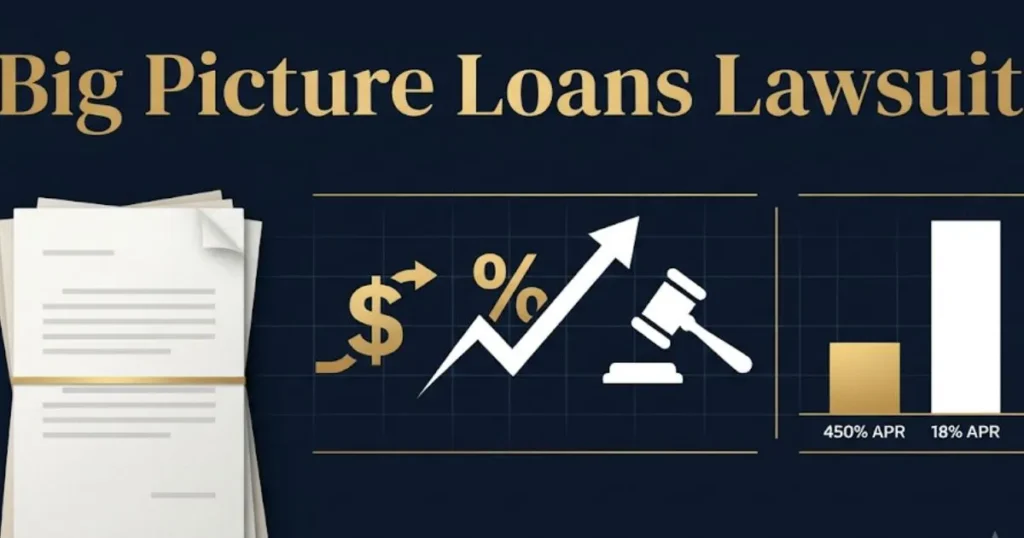
To put that in perspective, the average credit card interest rate in the United States hovers around 20% to 25% APR. A typical personal loan from a bank runs 8% to 15% APR. Big Picture Loans was charging rates 30 to 40 times higher than a standard personal loan.
Here is what that looks like in real dollars:
| Loan Amount | APR Charged | Total Repaid (Estimated) | Interest Paid |
|---|---|---|---|
| $500 | 600% | $1,500 to $2,000 | $1,000 to $1,500 |
| $1,000 | 650% | $3,000 to $4,000 | $2,000 to $3,000 |
| $2,000 | 700% | $6,000 to $8,000 | $4,000 to $6,000 |
| $3,000 | 500% | $7,500 to $10,000 | $4,500 to $7,000 |
These are not outlier numbers. They represent the standard terms borrowers reported.
Most states cap small loan interest rates between 24% and 36% APR. A few states allow higher rates for certain loan products, but none come close to permitting 600% APR.
The gap between what Big Picture Loans charged and what state law allows is the foundation of the entire lawsuit.
Key Takeaway: Big Picture Loans charged interest rates 30 to 40 times higher than standard personal loans, and those rates violated usury caps in virtually every state where borrowers lived.
Were Big Picture Loans Illegal
Big Picture Loans were likely illegal in most states where borrowers resided, according to the allegations in the lawsuit and subsequent court rulings.
State usury laws exist to protect consumers from exactly this kind of lending. Every state sets maximum allowable interest rates for consumer loans. Big Picture Loans routinely exceeded those caps by enormous margins.
The company argued its loans were legal because the lender was a tribal entity. Tribal sovereign immunity, the argument went, meant state laws did not apply. Courts have largely rejected that argument in this case.
Three specific legal violations are at the core of the case:
- State usury law violations: Charging interest rates above the legal limit
- RICO claims: Alleging the lending operation functioned as a racketeering enterprise
- Unjust enrichment: Profiting from illegal activity at borrowers’ expense
The fact that courts allowed the case to proceed after stripping the tribal immunity defense strongly suggests the loans themselves were unlawful.
If you took out a Big Picture Loan in a state with interest rate caps below what you were charged, your loan was very likely issued in violation of state law.
Big Picture Loans and the Tribal Lending Model
The tribal lending model used by Big Picture Loans is sometimes called a “rent-a-tribe” scheme by critics and regulators. The model works by having a tribal entity serve as the nominal lender while a non-tribal company handles all actual operations.
Here is how it worked with Big Picture Loans:
The Lac Vieux Desert Band was listed as the owner of Big Picture Loans LLC. On paper, the tribe controlled the lending business. But according to court evidence, Matt Martorello and his companies, including Bellicose Capital and Ascension Technologies, ran every aspect of the operation.
Martorello’s companies handled loan origination, underwriting, marketing, collections, and technology. The tribe received a small percentage of the revenue. Martorello and his entities kept the vast majority.
| Role | Who Did It |
|---|---|
| Named Owner | Lac Vieux Desert Band |
| Actual Operations | Bellicose Capital / Ascension Technologies |
| Loan Origination | Martorello’s companies |
| Marketing and Customer Acquisition | Martorello’s companies |
| Revenue Split | Tribe received minority share; Martorello received majority |
This arrangement let the operation claim tribal sovereign immunity. If the tribe owns the business, state regulators cannot touch it. Or so the argument goes.
Courts saw through it. The Fourth Circuit called the arrangement what it was: a structure designed to evade the law, not a genuine tribal enterprise.
Big Picture Loans Sovereign Immunity Defense
Sovereign immunity was the single most important legal defense Big Picture Loans tried to use, and it failed. The company argued that because it was owned by a federally recognized tribe, it could not be sued in state or federal court without the tribe’s consent.
Tribal sovereign immunity is a real and legitimate legal doctrine. Tribes, like states and the federal government, generally cannot be sued without their permission. It protects genuine tribal enterprises from outside legal interference.
The problem for Big Picture Loans was that courts determined the lending business was not a genuine tribal enterprise. The Fourth Circuit Court of Appeals applied what is called the “arm of the tribe” test. This test examines whether the entity actually functions as part of the tribe or just borrows its name.
The court found that:
- Martorello controlled day to day operations
- The tribe had minimal involvement in business decisions
- Most revenue flowed to non-tribal entities
- The tribal structure was adopted specifically to avoid state regulation
Based on these findings, the court ruled Big Picture Loans could not claim sovereign immunity. This ruling was a massive blow to the defense and opened the path for the lawsuit to reach the merits.
Key Takeaway: Courts ruled that Big Picture Loans could not hide behind tribal sovereign immunity because the business was controlled by a non-tribal operator, not the tribe itself.
Big Picture Loans Virginia Lawsuit Background
The Big Picture Loans Virginia lawsuit was filed in the United States District Court for the Eastern District of Virginia. Virginia became the venue because the lead plaintiffs resided there and because the lending operation had significant contacts with the state.
Virginia has been an active jurisdiction for tribal lending litigation. The state’s usury laws prohibit most consumer lenders from charging the kinds of rates Big Picture Loans imposed. Virginia caps interest on many consumer loans at 12% per year for unlicensed lenders, though licensed lenders can charge somewhat higher rates depending on the loan type.
The borrowers who filed suit in Virginia claimed they were charged APRs between 400% and 700%, far exceeding any rate Virginia law permits.
| Case Detail | Info |
|---|---|
| Court | U.S. District Court, Eastern District of Virginia |
| Key Defendants | Big Picture Loans LLC, Matt Martorello, Bellicose Capital |
| Tribal Entity | Lac Vieux Desert Band of Lake Superior Chippewa Indians |
| Plaintiffs | Individual Virginia borrowers representing a proposed class |
| Key Legal Claims | RICO, Virginia usury violations, unjust enrichment |
The Eastern District of Virginia is sometimes called the “Rocket Docket” because cases there move quickly. That reputation has contributed to the relatively steady pace of this litigation despite its complexity.
Key Court Rulings in the Big Picture Loans Case
Several court rulings have shaped the trajectory of the Big Picture Loans case. Each one chipped away at the defendants’ ability to avoid accountability.
Ruling 1: Denial of Motion to Dismiss (District Court)
The trial court rejected Big Picture Loans’ argument that the case should be dismissed based on tribal sovereign immunity. The judge found enough evidence to question whether the tribal entity genuinely controlled the business.
Ruling 2: Fourth Circuit Affirms (Appellate Court)
On appeal, the Fourth Circuit agreed with the lower court. The appellate panel applied the arm of the tribe test and concluded that Big Picture Loans was not entitled to sovereign immunity. This ruling set binding precedent within the circuit.
Ruling 3: Discovery Orders
The court ordered the defendants to produce internal documents showing the financial relationship between Martorello’s companies and the tribe. These documents reportedly revealed that Martorello received the vast majority of revenue.
Ruling 4: Class Certification Proceedings
Courts have entertained motions for class certification, allowing the case to potentially proceed on behalf of all affected borrowers rather than just the named plaintiffs.
- Each ruling moved the case closer to trial or settlement
- The sovereign immunity defeat was the most significant turning point
- Discovery findings strengthened the borrowers’ claims considerably
These rulings collectively tell a clear story: the courts believe there is serious merit to the borrowers’ claims.
Borrower Rights in the Big Picture Loans Case
Borrower rights in the Big Picture Loans case are protected by a combination of federal and state laws designed to shield consumers from predatory lending practices.
Every borrower has the right to be charged interest rates that comply with the laws of their home state. This is a fundamental consumer protection. When a lender violates these caps, borrowers have the right to seek restitution.
Here are the specific rights at play:
- Right to legal interest rates: State usury laws cap the interest a lender can charge.
- Right to transparent loan terms: Federal truth in lending laws require clear disclosure of APR, fees, and total repayment amounts.
- Right to sue for damages: Borrowers harmed by illegal lending can pursue legal action individually or as part of a class.
- Right to debt cancellation: If a loan was issued illegally, courts can void the remaining balance.
- Right to credit repair: Negative credit reporting from illegal loans can be challenged and removed.
You do not lose these rights just because you signed a loan agreement. Contracts that violate the law are generally unenforceable. A lender cannot make an illegal loan legal just by getting you to sign paperwork.
If Big Picture Loans reported negative information to credit bureaus based on an illegal loan, borrowers may have grounds to dispute and remove that information.
Key Takeaway: Borrowers have strong legal protections against predatory lending, and signing a loan agreement does not waive your right to challenge interest rates that violate state law.
Can You Get a Refund from Big Picture Loans
Getting a refund from Big Picture Loans is a real possibility for borrowers, but it depends on how the case resolves and whether you file a claim.
If the lawsuit results in a settlement or a judgment in favor of borrowers, refunds would come in the form of restitution payments. These payments would reimburse borrowers for the difference between what they paid and what they would have owed under legal interest rates.
The refund amount varies by borrower. Someone who paid $3,000 in interest on a $500 loan has a much larger claim than someone who made only one or two payments before defaulting.
There are a few ways refunds could be distributed:
- Direct cash payments to borrowers who file valid claims
- Debt forgiveness for borrowers who still owe a balance
- Credit for payment amounts that exceeded legal interest limits
- Credit bureau corrections that remove negative marks
In similar tribal lending cases, refunds have taken anywhere from 6 to 18 months after a settlement is finalized. Patience matters, but the process does eventually deliver.
The key step is filing a claim when the time comes. If you do nothing, you may receive nothing, even if you qualify.
Big Picture Loans Lawsuit Filing Deadline
The filing deadline for the Big Picture Loans lawsuit has not been officially set as of early 2026 because the settlement has not been finalized.
Once a settlement receives preliminary court approval, the court will set a claims deadline. This deadline typically falls 60 to 120 days after class members receive notice.
Here is a general timeline for how it works:
| Phase | Expected Timeframe |
|---|---|
| Settlement Agreement | Negotiations ongoing in 2026 |
| Preliminary Court Approval | Expected after agreement is reached |
| Class Notice Sent | Within 30 to 60 days of preliminary approval |
| Claims Filing Deadline | 60 to 120 days after notice is sent |
| Final Approval Hearing | 30 to 90 days after claims deadline |
| Payout Distribution | 3 to 6 months after final approval |
Missing the deadline almost certainly means forfeiting your right to a payout. Courts rarely grant extensions for individual claimants.
The smartest thing you can do right now is make sure your contact information is up to date. If you moved since you took out the loan, the class notice might not reach you.
Start gathering your loan documents, bank statements, and any correspondence from Big Picture Loans now. Being prepared when the deadline hits gives you the best chance of filing a successful claim.
Is Big Picture Loans Still Operating in 2026
Big Picture Loans is not actively issuing new loans in 2026. The company’s website is no longer operational, and the lending platform has been shut down amid the ongoing litigation.
The combination of legal pressure, loss of the sovereign immunity defense, and regulatory scrutiny effectively ended the company’s ability to originate new loans. Borrowers who had existing loans may still have outstanding balances, but no new lending activity is occurring.
This does not mean the legal entity has been dissolved. Big Picture Loans LLC and its associated companies still exist as parties in the ongoing litigation.
- The lending website is no longer active
- No new loans are being issued
- Existing loan balances may still be on borrowers’ records
- The company remains a defendant in the class action
- Related entities like Bellicose Capital are also part of the litigation
If you are still receiving collection calls or notices about a Big Picture Loans debt, you should document everything. That information could be relevant to your claim.
The fact that the company stopped operating does not affect your right to recover money. The lawsuit is about past conduct, not current business operations.
Key Takeaway: Big Picture Loans has stopped issuing new loans, but the lawsuit continues, and borrowers can still seek restitution for past illegal lending activity.
Frequently Asked Questions
How much money will I get from the Big Picture Loans lawsuit?
Most borrowers can expect payouts ranging from $50 to $1,500, depending on how much they borrowed and how much interest they paid.
The exact amount will be determined by the settlement terms and your individual loan history.
Payouts are expected to begin several months after a settlement receives final court approval.
Is there a deadline to join the Big Picture Loans class action?
No deadline has been set yet because the settlement has not been finalized.
Once a settlement is approved, class members will typically have 60 to 120 days to file a claim.
Watch for a class notice by email or mail for the exact date.
Does Big Picture Loans still exist in 2026?
Big Picture Loans is no longer issuing new loans or operating an active lending platform.
The legal entity still exists as a defendant in the ongoing class action lawsuit.
Related companies like Bellicose Capital and Ascension Technologies are also part of the litigation.
What interest rates did Big Picture Loans charge?
Big Picture Loans routinely charged APRs between 400% and 700% on short term installment loans.
These rates are 30 to 40 times higher than typical personal loan rates from banks.
Most state usury laws cap consumer loan rates far below these levels.
How do I know if I qualify for the Big Picture Loans settlement?
You likely qualify if you took out a loan from Big Picture Loans and were charged interest above your state’s legal limit.
Check old bank statements or emails for payment records to Big Picture Loans, Ascension Technologies, or SourcePoint.
Borrowers who defaulted on their loans may still be eligible to file a claim.
The Big Picture Loans lawsuit is heading toward a resolution that could put real money back in borrowers’ pockets. If you borrowed from this lender, you have a legitimate shot at recovery.
Start pulling together your records now. Loan agreements, bank statements, and old emails all matter.
When the claims process opens, file quickly and file completely. The borrowers who get paid are the ones who take action before the deadline passes







