

A raw chicken class action lawsuit could put money back in the hands of consumers who got sick from contaminated poultry. Several lawsuits are now active or pending across the United States in 2026, targeting major chicken producers and retailers accused of selling unsafe products.
If you bought raw chicken and ended up with salmonella, campylobacter, or another foodborne illness, you may have a valid claim. Thousands of people have already filed.
This guide covers everything you need to know. You will learn which lawsuits are active, who qualifies, how much you could receive, and exactly how to file.
Here is one stat that puts this in perspective: the CDC estimates salmonella alone causes roughly 1.35 million infections per year in the U.S., and poultry is the single largest source.
Raw Chicken Class Action Lawsuit
A raw chicken class action lawsuit is a legal case where a group of consumers collectively sues a chicken producer, processor, or retailer for selling contaminated poultry products. Instead of each person filing individually, one lawsuit represents everyone who was harmed.
These cases typically fall under product liability law. The central argument is straightforward: the company sold a product that was unreasonably dangerous due to bacterial contamination.
Class actions work well for food contamination cases because individual damages are often small. One person’s hospital bill might be $3,000. But when 10,000 people share the same problem, the case becomes worth millions.
| Key Detail | Information |
|---|---|
| Case Type | Product liability, class action |
| Defendants | Chicken producers, processors, retailers |
| Legal Basis | Negligence, strict liability, breach of warranty |
| Plaintiffs | Consumers who purchased and were harmed by contaminated raw chicken |
The lawsuits allege that companies failed to maintain proper sanitation, ignored positive contamination tests, or continued selling products they knew were tainted.
Some cases have been consolidated into multidistrict litigation, or MDL. This speeds up the pretrial process by putting all related cases under one federal judge.
The key bacteria involved are salmonella and campylobacter. Both can survive on raw chicken if it was processed in unsanitary conditions or not handled with proper cold chain management.
Raw Chicken Class Action Lawsuit Update 2026
As of 2026, several raw chicken class action cases are progressing through federal and state courts. New filings have increased compared to prior years, partly because the USDA tightened its salmonella framework for poultry in late 2025.
The most significant development in 2026 is that the USDA’s Food Safety and Inspection Service declared salmonella an adulterant in certain raw poultry products. This regulatory shift gives plaintiffs stronger legal footing because it reframes contaminated chicken as an illegal product rather than just an unfortunate one.
Several cases targeting Tyson Foods, Pilgrim’s Pride, and Foster Farms are in active discovery. Court documents reveal internal emails discussing contamination rates that exceeded company benchmarks.
| 2026 Development | Status |
|---|---|
| USDA salmonella adulterant rule | Finalized late 2025, enforceable 2026 |
| Tyson Foods MDL | Discovery phase |
| Foster Farms class action | Pending class certification |
| Pilgrim’s Pride cases | Settlement negotiations reported |
| New state-level filings | At least 7 new cases filed in Q1 2026 |
Attorneys involved in these cases have noted that the regulatory change could accelerate settlements. When the government officially labels something an adulterant, companies have less room to argue the product was safe.
Class certification hearings are expected in mid-2026 for at least two major cases. If classes are certified, settlement talks could begin before year’s end.
Raw Chicken Lawsuit
A raw chicken lawsuit is any legal claim filed against a company involved in the production, processing, distribution, or sale of contaminated raw chicken. These lawsuits can be individual cases or part of a larger class action.
Think of it like this: a class action is one type of raw chicken lawsuit, but not all raw chicken lawsuits are class actions. Some people file solo, especially if their injuries were severe enough to justify a standalone case.
Individual lawsuits tend to produce higher payouts because the plaintiff’s specific damages take center stage. A person hospitalized for two weeks with a drug-resistant salmonella infection might recover six figures in an individual case.
- Individual lawsuits focus on one plaintiff’s injuries and damages
- Class actions combine many plaintiffs with similar, smaller claims
- MDL cases consolidate related lawsuits for pretrial efficiency but keep individual claims separate
- Mass torts involve many individual claims handled together but not as one class
The choice between filing individually or joining a class action depends on how badly you were hurt. Mild food poisoning with a quick recovery fits a class action. Hospitalization, lasting health effects, or a death in the family warrants an individual suit.
Your attorney can advise which path makes the most sense for your situation. The statute of limitations varies by state, so timing matters.
Key Takeaway: Multiple types of raw chicken lawsuits are active in 2026, and the USDA’s new salmonella adulterant rule has significantly strengthened the legal position of consumers who got sick from contaminated poultry.
Raw Chicken Salmonella Lawsuit
A raw chicken salmonella lawsuit targets companies whose poultry products contained salmonella bacteria and caused illness in consumers. Salmonella is the most common pathogen linked to raw chicken contamination.
The CDC tracks salmonella outbreaks aggressively. In recent years, dozens of outbreaks have been directly traced back to specific chicken processing facilities. These traceback investigations create a paper trail that plaintiffs’ attorneys use as evidence.
Salmonella infections from chicken can range from mild gastric distress to life-threatening sepsis. The bacteria are especially dangerous for children under five, adults over 65, pregnant women, and anyone with a compromised immune system.
| Salmonella Fact | Detail |
|---|---|
| Annual U.S. infections | Approximately 1.35 million |
| Hospitalizations per year | About 26,500 |
| Deaths per year | Roughly 420 |
| Most common food source | Poultry |
| Incubation period | 6 hours to 6 days after exposure |
Lawsuits allege that chicken producers knew their facilities had high salmonella contamination rates and continued operating without adequate corrective action. Internal testing data, which companies are required to keep, often shows repeated positive results.
Some strains of salmonella found in chicken are antibiotic resistant. This makes treatment harder and infections more dangerous. Drug-resistant strains have been a focal point in several 2026 filings.
If you were diagnosed with salmonella after eating chicken, your medical records become the most important piece of evidence. A stool culture confirming salmonella, combined with a traceback to a specific product, builds a strong case.
Raw Chicken Food Poisoning Lawsuit
A raw chicken food poisoning lawsuit covers all types of foodborne illness caused by contaminated poultry, not just salmonella. This includes infections from campylobacter, E. coli, clostridium perfringens, and other pathogens.
Food poisoning from raw chicken is far more common than most people realize. The USDA has acknowledged that a significant percentage of raw chicken sold in the U.S. tests positive for at least one harmful bacteria at the point of sale.
These lawsuits hinge on proving two things. First, the chicken was contaminated. Second, the contamination caused your illness.
- Campylobacter is actually more common on raw chicken than salmonella but receives less media attention
- Clostridium perfringens causes symptoms within 6 to 24 hours and is linked to improperly handled cooked chicken
- E. coli is less common in poultry but has appeared in cross-contamination scenarios
- Listeria is rare in chicken but extremely dangerous when present
The legal theory is simple: companies have a duty to sell food that won’t make you sick. When they fail that duty through negligence, cutting corners on sanitation, or ignoring test results, they are liable for the harm they cause.
Medical documentation is critical. Visit a doctor as soon as symptoms appear. Request a stool culture. Keep records of everything: the chicken packaging, your receipt, and photos if you still have them.
Raw Chicken Contamination Lawsuit
A raw chicken contamination lawsuit focuses specifically on how and why the chicken became contaminated before it reached your kitchen. The contamination can happen at multiple points in the supply chain.
Picture the journey chicken takes from a farm to your dinner plate. At every stage, there is an opportunity for bacterial contamination: the farm, the slaughterhouse, the processing plant, the packaging facility, the distribution warehouse, the retail store.
Lawsuits target whichever company or companies were responsible for the breakdown. Sometimes it is the processor. Sometimes it is the retailer for improper refrigeration. Often, it is both.
| Contamination Point | Common Issue |
|---|---|
| Farm | Overcrowding, unsanitary conditions |
| Slaughter | Fecal contamination during evisceration |
| Processing | Cross-contamination between batches |
| Packaging | Equipment not properly sanitized |
| Distribution | Cold chain breaks during transport |
| Retail | Improper storage temperatures at store |
USDA inspectors are supposed to catch these problems. But inspection resources are stretched thin. The agency inspects roughly 9 billion chickens per year in the U.S. with a limited workforce.
Contamination lawsuits often rely on USDA inspection records, company audit reports, and whistleblower testimony. Former plant employees have provided damaging testimony in several active cases.
The stronger the evidence showing that a company knew about contamination risks and failed to act, the stronger the lawsuit. Willful negligence can lead to punitive damages on top of compensatory awards.
Key Takeaway: Raw chicken can become contaminated at any point from farm to store shelf, and lawsuits in 2026 are targeting producers, processors, and retailers whose negligence allowed harmful bacteria to reach consumers.
Who Qualifies for Raw Chicken Lawsuit
You may qualify for a raw chicken lawsuit if you purchased contaminated raw chicken and suffered a documented foodborne illness as a result. Qualification depends on several factors, but the bar is not as high as many people assume.
The most important qualification factor is proof of illness. A doctor’s diagnosis of salmonella, campylobacter, or another foodborne pathogen is the strongest evidence. Lab-confirmed stool cultures are especially powerful.
You do not necessarily need to prove which exact piece of chicken made you sick. If your illness matches an outbreak strain linked to a specific producer, epidemiological evidence can connect the dots.
General qualification requirements:
- You purchased raw chicken from a retailer or restaurant during the relevant time period
- You became ill within a reasonable timeframe after consuming or handling the chicken (typically 12 hours to 7 days)
- Your illness was medically documented
- Your illness matches a pathogen strain linked to a recalled or investigated product
- You suffered damages (medical bills, lost wages, pain and suffering)
Some class actions have broader qualification standards. In certain cases, anyone who purchased a recalled product may qualify for a small refund even without proof of illness.
Family members who cared for someone sickened by contaminated chicken may also have claims. If you missed work to care for a child hospitalized with salmonella, those lost wages count.
Raw Chicken Lawsuit Eligibility
Raw chicken lawsuit eligibility varies depending on whether the case is an individual lawsuit, a class action, or part of a mass tort. Each type has different criteria.
For class actions, eligibility is often defined by the class description that the court approves. A typical class might include “all persons in the United States who purchased Brand X raw chicken products between January 2023 and December 2025.”
Individual lawsuits have stricter evidentiary requirements but no class boundaries. You just need to prove your specific case.
| Eligibility Factor | Class Action | Individual Lawsuit |
|---|---|---|
| Proof of purchase | Helpful but not always required | Strongly recommended |
| Medical records | Required for injury claims | Required |
| Lab-confirmed diagnosis | Strengthens claim significantly | Often required |
| Geographic restriction | Depends on class definition | Your state’s jurisdiction |
| Time period of purchase | Must fall within class period | Within statute of limitations |
| Severity of illness | Any level qualifies | More severe = stronger case |
One thing that surprises people: you might be eligible even if you did not get sick. Some class actions include “economic loss” claims where you paid for a product that was defective regardless of whether it harmed you physically.
If you are unsure about your eligibility, most attorneys handling these cases offer free case evaluations. They review your situation and tell you whether you have a viable claim.
Can I Sue for Raw Chicken Food Poisoning
Yes, you can sue for raw chicken food poisoning if you can show that a specific company’s product caused your illness. Product liability law protects consumers who are harmed by unsafe products, including food.
Many people hesitate because they think food poisoning is just “one of those things.” It is not. Companies have a legal obligation to sell food that is reasonably safe. When chicken leaves a processing plant crawling with dangerous bacteria, someone failed.
Three legal theories support these claims:
- Strict liability: The product was defective (contaminated), and it caused harm. You do not need to prove the company was careless. The defect itself is enough.
- Negligence: The company failed to exercise reasonable care in producing, testing, or distributing the chicken.
- Breach of implied warranty: The chicken was sold with an implied promise that it was fit for consumption. Contaminated chicken breaks that promise.
The strongest cases combine medical records with traceback data from the CDC or USDA. When investigators identify a specific production facility as the outbreak source, it becomes much harder for the company to deny responsibility.
You can file a lawsuit even if the chicken was eventually recalled. In fact, a recall often strengthens your case because it shows the company or regulators identified a safety problem with the exact product you bought.
Key Takeaway: Most consumers who got sick from contaminated raw chicken qualify for some form of legal action in 2026, whether through a class action, individual lawsuit, or mass tort filing, and you do not always need a receipt to participate.
Raw Chicken Class Action Settlement
A raw chicken class action settlement is a negotiated agreement where the defendant company pays a set amount of money to resolve claims from all class members. Settlements avoid the uncertainty of a trial for both sides.
No massive, headline-grabbing raw chicken class action settlement has been finalized yet in 2026. However, settlement negotiations are reportedly underway in at least two major cases. Based on similar food contamination settlements, attorneys project certain payout ranges.
Past food contamination class actions provide a useful benchmark:
| Prior Food Settlement | Year | Total Amount | Per-Person Range |
|---|---|---|---|
| Foster Farms salmonella (California) | 2022 | $4.75 million | $50 to $500 |
| ConAgra peanut butter recall | 2020 | $11.2 million | $15 to $525 |
| Blue Bell ice cream listeria | 2023 | $19.35 million | $100 to $7,500 |
| Chipotle E. coli class action | 2020 | $25 million | $68 to $250 |
Settlement amounts in raw chicken cases will depend on the number of class members, severity of documented injuries, and the strength of evidence against the defendants.
Companies prefer settling because trials create bad publicity and risk even larger jury verdicts. A jury that hears about a company knowingly selling contaminated chicken can award punitive damages that dwarf the actual losses.
When a settlement is reached, class members receive notice by mail or email. You then file a claim form, provide supporting documentation, and wait for payment distribution.
Raw Chicken Lawsuit Payout
Raw chicken lawsuit payouts vary dramatically depending on the type of case and the severity of injury. Individual lawsuits typically yield much larger payouts than class action settlements.
For class action participants, estimated payouts in pending 2026 cases range from $50 to $500 for those who purchased recalled products, and $500 to $5,000 for those with documented illness. These are estimates based on comparable food contamination settlements.
Individual lawsuits can produce significantly higher recoveries:
| Injury Level | Estimated Payout Range |
|---|---|
| Purchased recalled product, no illness | $25 to $100 (class action refund) |
| Mild food poisoning, brief illness | $500 to $3,000 |
| Moderate illness requiring doctor visits | $3,000 to $15,000 |
| Hospitalization (short-term) | $15,000 to $75,000 |
| Extended hospitalization, complications | $75,000 to $250,000 |
| Long-term health effects or disability | $250,000 to $1 million+ |
| Wrongful death | $500,000 to several million |
These figures include medical expenses, lost income, and pain and suffering. Wrongful death cases involving children or elderly victims tend to produce the highest verdicts.
The payout you receive depends on what you can prove. Strong medical records, clear connection to a contaminated product, and significant damages push payouts higher.
Attorney fees in class actions are typically paid from the settlement fund, not out of your individual payout. In individual cases, most food poisoning attorneys work on contingency, meaning they take a percentage of your recovery (usually 33% to 40%).
Raw Chicken Lawsuit Compensation
Compensation in a raw chicken lawsuit covers several categories of damages. Courts recognize that food poisoning causes more harm than just a stomachache.
The goal of compensation is to make you “whole” again, meaning to put you in the financial position you would have been in if the contamination had never happened.
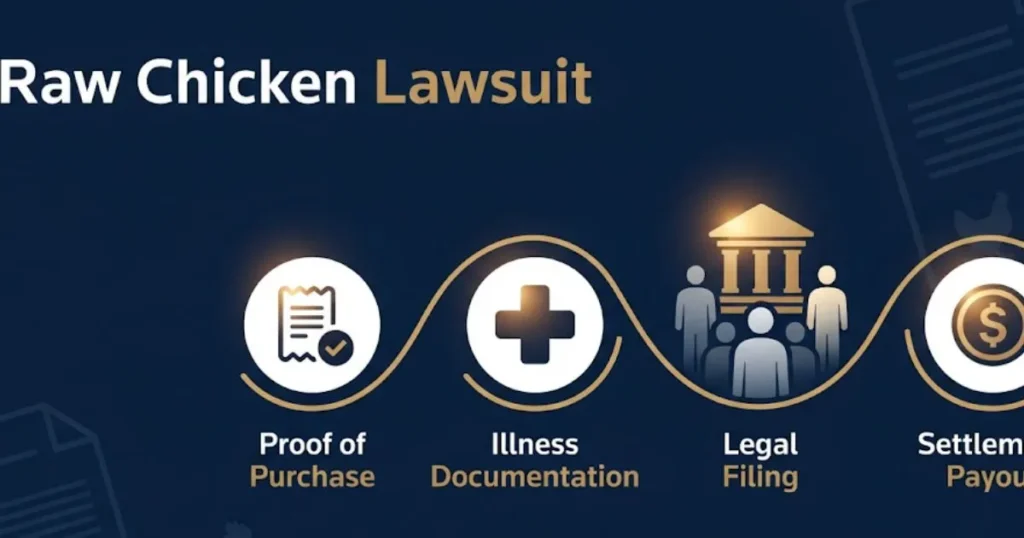
Compensable damages include:
- Medical expenses: Emergency room visits, hospitalization, medications, follow-up appointments, lab tests
- Lost wages: Time missed from work during illness and recovery
- Future medical costs: Ongoing treatment for complications like reactive arthritis or irritable bowel syndrome triggered by the infection
- Pain and suffering: Physical discomfort, emotional distress, anxiety about food safety
- Loss of enjoyment of life: Inability to eat certain foods, fear of cooking, lifestyle disruption
- Punitive damages: Additional penalties meant to punish the company for egregious conduct (only awarded in some cases)
Salmonella infections can trigger lasting health problems. About 5% to 10% of salmonella victims develop reactive arthritis, a painful joint condition that can persist for months or years. These long-term effects significantly increase compensation amounts.
If a family member died from contaminated chicken, wrongful death compensation covers funeral expenses, loss of companionship, lost future income, and emotional suffering of surviving family members.
Documentation is everything. Save every medical bill, pharmacy receipt, pay stub showing missed work, and any correspondence related to your illness.
Key Takeaway: Payouts in raw chicken lawsuits range from under $100 for simple class action refunds to over $1 million for severe individual cases, and your compensation depends heavily on how well you document your injuries and financial losses.
How to File Raw Chicken Lawsuit
Filing a raw chicken lawsuit involves several steps, but the process is more straightforward than most people expect. You can either join an existing class action or file an individual claim.
Step-by-step process for joining a class action:
- Confirm that an active class action covers your situation (same brand, time period, location)
- Register through the claims administrator’s official filing system
- Complete the claim form with your personal information and purchase details
- Submit supporting documentation (receipts, medical records, lab results)
- Wait for claim verification and settlement distribution
Step-by-step process for filing an individual lawsuit:
- Consult a food poisoning or product liability attorney (most offer free evaluations)
- Gather your evidence: medical records, receipts, product packaging photos, lab results
- Your attorney files a complaint in the appropriate court
- The case enters discovery, where both sides exchange evidence
- Settlement negotiations or trial
| Filing Method | Best For | Typical Timeline |
|---|---|---|
| Class action claim | Mild illness, small damages | 6 to 18 months from filing to payout |
| Individual lawsuit | Serious illness, hospitalization | 12 to 36 months |
| Mass tort claim | Moderate to severe illness | 12 to 24 months |
You do not need to pay anything upfront to join a class action. For individual lawsuits, most attorneys in this area work on contingency, so they only get paid if you win.
Act quickly. Evidence degrades over time. Medical records are easier to obtain while they are recent. And statutes of limitations create hard deadlines.
Raw Chicken Lawsuit Deadline
The deadline to file a raw chicken lawsuit depends on your state’s statute of limitations for personal injury and product liability claims. Missing the deadline means losing your right to sue permanently.
Most states set the statute of limitations for food poisoning cases between one and three years from the date of injury. Some states start the clock from the date you discovered (or should have discovered) that your illness was caused by a specific product.
| State | Statute of Limitations (Personal Injury) |
|---|---|
| California | 2 years |
| Texas | 2 years |
| New York | 3 years |
| Florida | 2 years (changed from 4 in 2023) |
| Illinois | 2 years |
| Pennsylvania | 2 years |
| Ohio | 2 years |
| Georgia | 2 years |
For class actions, separate deadlines apply. Once a settlement is reached, class members typically receive a specific claims filing deadline, often 60 to 120 days from the date of notice.
If you think you might have a claim, do not wait. Even if you are within the statute of limitations, filing sooner preserves evidence and strengthens your case. Witnesses forget details. Medical records get archived. Product lots become harder to trace.
Some exceptions exist. Minors typically have extended deadlines. The clock may not start until they turn 18. Wrongful death cases may also have different deadlines depending on the state.
Raw Chicken Recall Lawsuit
A raw chicken recall lawsuit is filed after a specific chicken product is pulled from store shelves due to contamination. Recalls create a direct link between a product and a known safety hazard, making lawsuits easier to win.
USDA recalls for raw chicken happen more often than you might think. In 2024 and 2025 alone, FSIS issued over 30 recall notices related to poultry products contaminated with salmonella, listeria, or foreign materials.
When a recall happens, the company is essentially admitting (or the government is declaring) that the product was unsafe. That admission becomes evidence in your lawsuit.
Types of USDA poultry recalls:
- Class I: Reasonable probability of serious health consequences or death
- Class II: Remote probability of health consequences
- Class III: Not likely to cause health problems but violates regulations
Class I recalls are the strongest foundation for lawsuits. If you purchased a product subject to a Class I recall, your case starts on solid ground.
| Recent Notable Chicken Recalls | Products | Reason |
|---|---|---|
| Various 2024-2025 FSIS actions | Multiple brands | Salmonella contamination |
| Tyson Foods recalls | Breaded chicken, raw tenders | Possible listeria, foreign materials |
| BrucePac recall (Oct 2024) | Ready-to-eat poultry | Listeria monocytogenes |
| Foster Farms actions | Raw chicken | Salmonella Heidelberg |
Check the USDA FSIS recall database to see if any chicken products you purchased were recalled. Save any packaging you still have. Even a photo of the label with the establishment number and production date helps.
Key Takeaway: Filing a raw chicken lawsuit is free for class action participants and contingency-based for individual claims, but strict deadlines apply, so acting quickly is essential to preserving your rights and evidence.
Chicken Salmonella Outbreak 2026
Chicken salmonella outbreaks in 2026 are being tracked by the CDC and state health departments across the country. Several active investigations are linking illness clusters to specific poultry products and processing facilities.
The CDC’s PulseNet system uses whole genome sequencing to match salmonella strains from sick patients to strains found in food products. This technology has gotten extremely precise. When the CDC says an outbreak is linked to a chicken producer, the genetic evidence is hard to dispute.
As of early 2026, at least three multistate salmonella outbreak investigations are ongoing with connections to raw chicken products. Exact details are updated regularly through CDC outbreak notices.
- Outbreak investigations in 2026 involve multiple salmonella serotypes, including Enteritidis and Infantis
- Several states have reported hospitalization rates higher than average for these outbreaks
- Antibiotic-resistant strains have been identified in at least one active investigation
- The USDA’s new enforcement framework is being tested for the first time in some of these cases
The relationship between outbreaks and lawsuits is direct. Every CDC-confirmed outbreak linked to raw chicken generates new legal claims. Attorneys monitor these outbreak announcements and begin building cases as soon as the source is identified.
If you got sick in 2026 and suspect chicken was the cause, report your illness to your local health department. They can test your sample and determine if it matches a known outbreak strain. That match becomes powerful evidence.
Raw Chicken Lawsuit Proof of Purchase
Proof of purchase for a raw chicken lawsuit means any documentation showing that you bought the contaminated product. This is one of the most common concerns for potential plaintiffs, and the answer may surprise you.
You do not always need a receipt. While having one makes your case stronger, there are several other ways to prove you bought the chicken in question.
Acceptable forms of proof of purchase:
- Store receipts (paper or digital)
- Credit or debit card statements showing a purchase at the relevant store
- Loyalty card or rewards program purchase history
- Photos of the product packaging (with lot numbers, use-by dates, establishment numbers)
- Grocery delivery app order history (Instacart, Walmart delivery, Amazon Fresh)
- Testimony from family members or others who were present during the purchase or meal
| Proof Type | Strength | How to Obtain |
|---|---|---|
| Original receipt | Strong | Check your files, purse, car |
| Digital receipt | Strong | Store app or email confirmation |
| Bank/card statement | Moderate | Download from your bank |
| Loyalty card data | Moderate to strong | Request from the store |
| Product packaging photo | Moderate | Check your phone’s photo gallery |
| Delivery app records | Strong | Check order history in the app |
| Witness testimony | Weak to moderate | Written statement from family |
In class actions with large classes, courts sometimes relax proof of purchase requirements. A sworn declaration stating that you purchased the product may be sufficient for smaller claims.
The lesson here is simple: do not assume you have no case just because you tossed the receipt. There are almost always digital breadcrumbs that can confirm your purchase. Check your bank statements and store loyalty accounts first.
Key Takeaway: You do not necessarily need a physical receipt to participate in a raw chicken lawsuit. Bank statements, loyalty card records, delivery app history, and even product photos can serve as valid proof of purchase.
Frequently Asked Questions
How much money can I get from a raw chicken class action lawsuit?
Most class action participants can expect between $50 and $500 for purchase refunds and $500 to $5,000 for documented illness.
Individual lawsuits involving hospitalization can produce recoveries of $15,000 to $250,000 or more.
The exact amount depends on your injury severity and supporting documentation.
What is the deadline to file a raw chicken lawsuit in 2026?
The deadline depends on your state’s statute of limitations, which is typically one to three years from the date of illness.
For active class action settlements, claims deadlines are usually 60 to 120 days from the notice date.
File as soon as possible to protect your rights and preserve evidence.
Do I need a receipt to join the raw chicken class action?
No, a receipt is helpful but not always required.
Bank or credit card statements, loyalty card purchase history, and delivery app records can substitute.
Some class actions accept a sworn declaration that you purchased the product.
Can I sue if raw chicken gave me salmonella?
Yes, you can absolutely sue if contaminated raw chicken caused a salmonella infection.
You will need medical records confirming the diagnosis and evidence linking your illness to a specific product.
Both individual lawsuits and class actions are available options.
Which chicken brands are involved in the 2026 lawsuits?
Several major brands are facing lawsuits or investigations in 2026, including Tyson Foods, Pilgrim’s Pride, and Foster Farms.
Specific brands and products may change as new outbreaks are identified and recalls are issued.
Check USDA FSIS recall notices for the most current list of affected products.
The raw chicken class action lawsuit landscape in 2026 is more active than ever. Stronger regulations, ongoing outbreaks, and growing consumer awareness are all driving new filings.
If you got sick from contaminated chicken, gather your medical records, check for proof of purchase, and explore your legal options now. Deadlines are real and evidence fades with time.
Your health matters. Your financial losses matter. And the law is on your side.







