

Railroad workers diagnosed with leukemia are filing lawsuits at record rates in 2026. A railroad lawsuit leukemia claim allows workers to seek compensation when toxic chemical exposure on the job caused their blood cancer. If you or someone you love worked on the rails and got sick, this is your guide to understanding every angle of these cases.
Thousands of railroad employees handled benzene, diesel exhaust, and other known carcinogens for years. Many had no protective equipment. Some didn’t even know the chemicals were dangerous.
The facts here are striking. According to published medical research, railroad workers face a significantly elevated risk of developing acute myeloid leukemia compared to the general population. Settlements and jury verdicts in FELA cases have reached into the millions.
This article breaks down who qualifies, what the lawsuits are worth, how filing works, and what deadlines apply in 2026. Every section is designed to give you a clear, direct answer.
Railroad Lawsuit Leukemia: What You Need to Know
A railroad lawsuit leukemia case is a legal claim filed under federal law when a railroad worker develops leukemia from on-the-job chemical exposure. These cases fall under the Federal Employers Liability Act, known as FELA, which lets railroad employees sue their employers for negligence.
Unlike typical workers’ compensation claims, FELA cases require proving that the railroad company was at least partly at fault. That fault usually comes from failing to provide safe working conditions or adequate protective gear around toxic substances.
The most common chemicals involved are benzene, diesel exhaust particles, creosote, and industrial solvents. Railroad workers in maintenance, track repair, locomotive servicing, and switching yards tend to face the highest exposure levels.
| Key Fact | Detail |
|---|---|
| Law Used | Federal Employers Liability Act (FELA) |
| Type of Claim | Negligence, not workers’ comp |
| Common Chemicals | Benzene, diesel exhaust, creosote, solvents |
| Cancer Types | AML, CLL, MDS, other leukemias |
| Who Files | Current or former railroad employees |
These lawsuits are not class actions. Each case is individual. Your diagnosis, exposure history, and employment records determine the strength of your claim.
The railroad industry has known about these chemical risks for decades. Internal documents from major rail companies show awareness of benzene hazards dating back to the 1970s and 1980s.
Railroad Lawsuit Acute Myeloid Leukemia Explained
A railroad lawsuit acute myeloid leukemia claim focuses specifically on AML, the most aggressive and most commonly linked leukemia subtype in benzene exposure cases. AML attacks the bone marrow and floods the bloodstream with abnormal white blood cells.
Medical literature has firmly established benzene as a cause of AML. The International Agency for Research on Cancer, or IARC, classifies benzene as a Group 1 carcinogen. That’s the highest classification, meaning there is sufficient evidence it causes cancer in humans.
Railroad workers encounter benzene in fuel, solvents, degreasers, and diesel exhaust. Many of these workers handled these products daily for 10, 20, or even 30 years without respirators or proper ventilation.
AML has a latency period that typically ranges from 2 to 20 years after exposure. So a worker who left the railroad in 2010 could be diagnosed with AML in 2025 or 2026 and still have a valid claim.
- AML accounts for roughly 80% of adult acute leukemias
- Five-year survival rates for AML hover around 30%
- Benzene-induced AML cases often show specific chromosomal abnormalities
- These chromosomal markers can actually strengthen a legal case
Because AML is so closely tied to benzene, these cases tend to be among the strongest railroad leukemia claims from a causation standpoint. Juries understand the science, and defense attorneys have a harder time arguing the cancer came from somewhere else.
Railroad Worker Leukemia Lawsuit 2026 Updates
As of 2026, railroad worker leukemia lawsuits are gaining significant momentum in federal and state courts across the country. Several major cases against BNSF Railway, CSX Transportation, Union Pacific, and Norfolk Southern are either in active litigation or approaching trial dates.
In late 2025, a jury in a FELA case awarded a former railroad maintenance worker over $4 million after he developed AML following decades of benzene exposure. That verdict sent a clear signal to the industry.
More cases are expected to go to trial in 2026. Legal analysts tracking the railroad toxic exposure docket report that filings have increased by an estimated 25% to 35% compared to three years ago.
| 2026 Case Activity | Status |
|---|---|
| New FELA leukemia filings | Increasing 25% to 35% year over year |
| Major defendants | BNSF, CSX, Union Pacific, Norfolk Southern |
| Recent notable verdict | Over $4 million (AML, benzene exposure) |
| Trial activity | Multiple trials scheduled through 2026 |
| Settlement negotiations | Active for many pending cases |
Railroad companies are fighting back. They’re hiring toxicology experts and arguing that other factors caused the leukemia. But the weight of scientific evidence is heavily on the side of workers who were exposed to benzene.
If you’ve been sitting on a potential claim, 2026 is the year to move. Statutes of limitations are running, and the legal landscape favors plaintiffs right now.
Key Takeaway: Railroad leukemia lawsuits, especially AML cases linked to benzene, are among the strongest toxic exposure claims in 2026, with filings surging and verdicts climbing into the millions.
Who Qualifies for a Railroad Leukemia Lawsuit
You qualify for a railroad leukemia lawsuit if you worked for a railroad company, were exposed to toxic chemicals on the job, and later developed leukemia. The connection between your work environment and your diagnosis is the foundation of the case.
This applies to a wide range of railroad jobs. You don’t have to have worked directly with chemicals to qualify. Proximity matters too.
Jobs with the highest exposure risk include:
- Track maintenance and repair crews
- Locomotive mechanics and engine house workers
- Switching yard operators
- Fuel handlers and refueling crews
- Signal maintainers
- Car repair workers
- Bridge and building department employees
Even conductors and engineers who spent years breathing diesel exhaust in poorly ventilated cabs may qualify. The key question is whether the railroad failed to protect you from known hazards.
Family members of deceased railroad workers can also file claims. Wrongful death FELA lawsuits allow surviving spouses, children, or dependents to seek compensation when a railroad worker dies from leukemia caused by occupational exposure.
You don’t need to still be employed by the railroad. Retired workers, laid-off employees, and those who left the industry years ago can file as long as they meet the statute of limitations requirements.
Railroad Leukemia Lawsuit Eligibility Requirements
Railroad leukemia lawsuit eligibility depends on three core factors: employment with a railroad, documented or provable toxic chemical exposure, and a leukemia diagnosis that medical evidence can link to that exposure.
Here’s the breakdown of each requirement:
| Eligibility Factor | What You Need |
|---|---|
| Employment | Proof you worked for a railroad (pay stubs, W-2s, union records) |
| Exposure | Evidence of contact with benzene, diesel exhaust, solvents, or other carcinogens |
| Diagnosis | Medical records confirming leukemia (AML, CLL, or related blood cancer) |
| Causation Link | Medical opinion connecting your exposure to your cancer |
| Timeliness | Filed within the applicable statute of limitations |
You don’t have to prove your employer intended to harm you. FELA is a negligence standard. That means you only need to show the railroad was careless or failed to take reasonable steps to protect your health.
Even if you smoked or had other risk factors, you can still qualify. FELA uses a comparative fault system. If the railroad was 60% at fault and you were 40% at fault, you still recover 60% of the damages.
One thing that trips people up is thinking they need perfect records. You don’t. An experienced FELA attorney can reconstruct your exposure history using coworker testimony, company safety records, and industrial hygiene data from your era.
Benzene Exposure and Railroad Leukemia
Benzene is the primary chemical linking railroad work to leukemia diagnoses. This colorless, sweet-smelling chemical is present in gasoline, diesel fuel, solvents, degreasers, and various petroleum products that railroad workers handle regularly.
When you breathe benzene vapors or absorb it through your skin, it enters your bloodstream and travels to your bone marrow. There, it damages the DNA of blood-forming cells. Over time, this damage can trigger uncontrolled cell growth, which is leukemia.
The science on this is not debatable. OSHA has set a permissible exposure limit for benzene at 1 part per million over an eight-hour workday. Studies of railroad workers have documented exposure levels that frequently exceeded this limit, especially in enclosed spaces like engine houses, fuel stations, and maintenance shops.
- Benzene is classified as a Group 1 human carcinogen by IARC
- Even low-level chronic exposure increases leukemia risk
- Railroad workers handling fuel are among the most exposed occupational groups
- Exposure can occur through inhalation, skin absorption, or ingestion
Think of it like this: your bone marrow is a factory producing blood cells. Benzene is like a saboteur that sneaks into the factory and starts rewiring the machinery. After enough damage accumulates, the factory starts producing defective cells instead of healthy ones.
The railroad companies knew about benzene’s dangers. Material Safety Data Sheets (MSDS) for benzene-containing products were required to carry warnings. Many railroads failed to distribute these sheets or train workers on the risks.
Key Takeaway: Benzene is a proven cause of leukemia, railroad workers were routinely exposed to it, and the railroads often failed to provide adequate warnings or protective equipment.
Railroad Worker Benzene Exposure and Cancer Risk
Railroad workers face a higher cancer risk than the general population due to repeated benzene exposure in their daily work environments. Research published in occupational health journals has consistently found elevated rates of blood cancers among rail industry employees.
A study published in the American Journal of Industrial Medicine examined cancer mortality among railroad workers and found statistically significant increases in leukemia deaths. The risk was most pronounced among workers with the longest tenure and highest chemical contact.
The jobs with the greatest benzene exposure include:
- Fuel handlers: Direct contact with gasoline and diesel during refueling operations
- Mechanics: Using benzene-based solvents to clean engine parts and equipment
- Track workers: Exposure to creosote-treated ties, which release benzene compounds
- Car cleaners: Working with industrial cleaning agents containing benzene
- Yard workers: Breathing ambient diesel exhaust in switching yards
The risk doesn’t disappear when you clock out. Benzene accumulates in the body over time. A worker exposed to low levels daily for 15 years may face higher risk than someone with a single high-dose exposure.
What makes this especially troubling is that many railroads provided no respiratory protection. Workers in the 1970s, 1980s, and 1990s often recall working in enclosed areas with visible fumes and zero ventilation. Some were told the chemicals were safe.
Acute Myeloid Leukemia and Railroad Chemicals
Acute myeloid leukemia develops when railroad chemicals, primarily benzene and its metabolites, cause genetic mutations in blood-forming stem cells within the bone marrow. AML is the leukemia subtype most strongly associated with occupational benzene exposure.
Beyond benzene itself, several other railroad chemicals contribute to AML risk:
| Chemical | Where Found on Railroads | Cancer Link |
|---|---|---|
| Benzene | Fuel, solvents, degreasers | Direct cause of AML (IARC Group 1) |
| Diesel exhaust | Locomotives, switching yards | Probable carcinogen (IARC Group 2A for lung cancer; linked to blood cancers in studies) |
| Creosote | Treated railroad ties | Contains polycyclic aromatic hydrocarbons (PAHs); linked to skin and blood cancers |
| Formaldehyde | Cleaning agents, preservatives | IARC Group 1 carcinogen; linked to myeloid leukemia |
| Herbicides | Vegetation control along tracks | Some contain chemicals linked to hematologic cancers |
When multiple chemicals act together, the risk multiplies. A railroad worker exposed to benzene, diesel exhaust, and creosote simultaneously faces a compounded threat. Scientists call this synergistic toxicity.
AML from chemical exposure often shows specific genetic markers. Chromosomal abnormalities like deletions on chromosomes 5 and 7 are commonly seen in benzene-related AML cases. An oncologist can identify these markers through bone marrow biopsy analysis.
These genetic markers don’t just help doctors treat the disease. They also help attorneys prove that benzene caused the cancer rather than some other factor. It’s like a chemical fingerprint left at the scene.
Railroad Toxic Exposure and Leukemia Risk Factors
Railroad toxic exposure increases leukemia risk through several interconnected factors, including chemical type, duration of exposure, intensity of contact, and individual susceptibility. Not every exposed worker develops leukemia, but the elevated risk is well documented.
Several risk factors determine how likely a railroad worker is to develop leukemia:
- Duration of employment: Workers with 10 or more years on the job face significantly higher risk
- Type of job: Maintenance, fueling, and mechanical roles carry the most exposure
- Era of employment: Workers from the 1960s through 1990s often had less protection
- Workplace ventilation: Enclosed shops and engine houses concentrated toxic fumes
- Use of protective equipment: Most railroad workers report having no respirators or gloves
- Genetic predisposition: Some individuals metabolize benzene in ways that increase DNA damage
It’s worth understanding that leukemia is a dose-response disease when it comes to benzene. That means the more you were exposed and the longer the exposure lasted, the higher your risk climbs.
But even short-term, high-intensity exposures can be enough. A worker who spent six months cleaning locomotive fuel tanks in an unventilated shop may have absorbed as much benzene as someone with 10 years of lower-level ambient exposure.
The latency period adds another layer of complexity. AML can develop anywhere from 2 to 20 years after benzene exposure ends. Some cases emerge even later. This means workers who retired decades ago are still being diagnosed today.
Key Takeaway: Your leukemia risk from railroad work depends on how long you worked, what chemicals you contacted, what protective gear you had (or didn’t have), and your individual biological response to toxic exposure.
FELA Lawsuit Leukemia Claims Explained
A FELA lawsuit leukemia claim is a federal negligence action brought by a railroad worker against their employer for failing to provide a safe workplace, resulting in a leukemia diagnosis. FELA, the Federal Employers Liability Act, has been the primary legal tool for injured railroad workers since 1908.
Under FELA (codified at 45 U.S.C. Sections 51 through 60), railroad employees cannot file regular workers’ compensation claims. Instead, they must prove their employer was negligent. This is actually an advantage, because FELA damages are typically much larger than workers’ comp benefits.
To win a FELA leukemia case, you need to establish four elements:
| Legal Element | What It Means |
|---|---|
| Duty | The railroad had a duty to provide a safe workplace |
| Breach | The railroad failed to meet that duty (e.g., no protective equipment, poor ventilation) |
| Causation | The breach caused or contributed to your leukemia |
| Damages | You suffered real harm (medical bills, lost income, pain, suffering) |
The causation standard in FELA is lower than in regular negligence cases. You don’t have to prove the railroad was the sole cause of your leukemia. You only need to show that the railroad’s negligence played “any part, even the slightest” in causing your illness.
This is sometimes called the “featherweight” burden of proof. Courts have interpreted it to mean that if benzene exposure at work contributed even slightly to your AML, you have met the causation standard.
FELA cases can be filed in either federal or state court. Most attorneys choose the venue that gives the best chance of a favorable outcome based on the specific facts.
FELA vs Workers Compensation for Railroad Cancer
FELA and workers’ compensation are completely different legal systems, and railroad workers are covered by FELA, not workers’ comp. This distinction matters enormously because FELA claims can result in much higher compensation.
Here’s a side-by-side comparison:
| Factor | FELA | Workers’ Compensation |
|---|---|---|
| Who it covers | Railroad employees | Most other employees |
| Legal standard | Negligence (must prove fault) | No-fault (automatic coverage) |
| Compensation for pain and suffering | Yes | No |
| Punitive damages | Possible in some cases | No |
| Jury trial | Yes | No (administrative process) |
| Average payout for cancer | $500,000 to $5 million+ | $100,000 to $400,000 typically |
| Attorney involvement | Almost always needed | Often handled without attorney |
| Comparative fault | Reduces award by your percentage of fault | Not applicable |
Think of workers’ comp as a fixed menu at a restaurant. You get what’s listed, nothing more. FELA is more like ordering a la carte. You can claim every category of damages that applies to your situation.
Under FELA, you can recover compensation for medical expenses, lost wages (past and future), pain and suffering, emotional distress, loss of enjoyment of life, and in death cases, loss of support for dependents.
The tradeoff is that you must prove negligence. Workers’ comp pays automatically regardless of fault. But for railroad cancer cases involving clear chemical exposure and employer knowledge of the risks, proving negligence is usually achievable.
Railroad Cancer Lawsuit Settlement Amounts
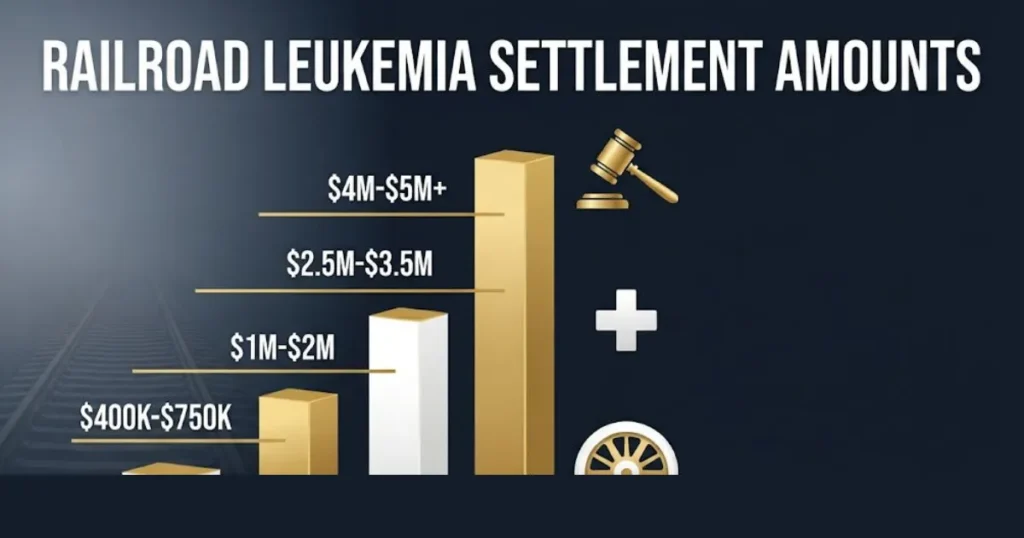
Railroad cancer lawsuit settlement amounts for leukemia cases typically range from $400,000 to over $5 million, depending on the severity of the diagnosis, the strength of the exposure evidence, and the specific railroad company involved.
These are not random numbers. They’re based on historical verdicts and settlements in FELA cancer cases:
| Case Type | Typical Settlement Range |
|---|---|
| AML with strong benzene evidence | $1 million to $5 million+ |
| CLL or other chronic leukemia | $500,000 to $2 million |
| Myelodysplastic syndrome (MDS) | $400,000 to $1.5 million |
| Wrongful death (leukemia) | $1 million to $8 million+ |
| Cases with punitive damage claims | Can exceed $10 million |
Several factors push settlement values higher:
- Long employment history with documented chemical exposure
- Young age at diagnosis (higher future lost earnings)
- Severe diagnosis like AML versus slower-progressing leukemias
- Clear employer negligence such as no protective equipment provided
- Internal company documents showing knowledge of chemical risks
- Dependents who relied on the worker’s income
Railroad companies settle many of these cases before trial. They prefer to avoid the unpredictability of a jury, especially when the evidence of benzene exposure is strong. But they won’t settle for a fair amount unless they believe you’re prepared to go to court.
Your actual settlement depends on facts specific to your case. No two claims are identical. But the range gives you a realistic picture of what’s possible.
Key Takeaway: Railroad leukemia lawsuit settlements commonly reach seven figures, with AML cases and wrongful death claims at the top of the range, especially when exposure evidence and employer negligence are well documented.
Railroad Leukemia Lawsuit Payout Estimates
Railroad leukemia lawsuit payouts are determined by calculating your total economic and non-economic damages, then adjusting for comparative fault. The payout is the actual money you receive after legal fees and case expenses.
Here’s how the math typically works:
| Damage Category | Typical Value Range |
|---|---|
| Past medical expenses | $200,000 to $1 million+ |
| Future medical costs | $100,000 to $500,000+ |
| Lost wages (past) | $50,000 to $500,000 |
| Lost earning capacity (future) | $200,000 to $2 million |
| Pain and suffering | $100,000 to $2 million |
| Loss of enjoyment of life | $50,000 to $500,000 |
| Wrongful death damages | Additional $500,000 to $3 million |
Attorney fees in FELA cases typically run between 25% and 40% of the recovery, depending on whether the case settles early or goes through trial. Case expenses like expert witness fees, medical record retrieval, and deposition costs are usually deducted separately.
So if your case settles for $2 million and your attorney takes 33%, you’d receive roughly $1.34 million before case expenses. After expenses, your net payout might be around $1.2 million.
Payouts can be received as a lump sum or structured settlement. Most leukemia plaintiffs choose a lump sum because the urgency of medical treatment doesn’t allow for waiting on installment payments.
One important detail: FELA settlements are generally not taxable for the portion compensating physical injuries and medical expenses. The IRS treats compensation for physical sickness differently than income. Your attorney and a tax professional can help sort out the specifics.
Railroad Leukemia Settlement Timeline in 2026
Railroad leukemia settlement timelines in 2026 typically range from 12 to 36 months from the date of filing to the date of resolution, though some cases move faster and others take longer.
The timeline depends on several variables:
| Phase | Estimated Duration |
|---|---|
| Initial consultation and case evaluation | 1 to 4 weeks |
| Filing the complaint | 1 to 2 months after evaluation |
| Discovery (document exchange, depositions) | 6 to 18 months |
| Expert reports and medical opinions | 2 to 6 months (often overlaps with discovery) |
| Settlement negotiations | 1 to 6 months |
| Trial (if no settlement) | 1 to 3 weeks, but scheduling can add 3 to 12 months |
| Total from filing to resolution | 12 to 36 months |
Cases against major railroads like BNSF and CSX tend to follow established procedural tracks. These companies have dedicated legal teams for FELA litigation, so the process is somewhat predictable.
Settlement discussions often begin in earnest after discovery closes and both sides have seen the evidence. Many cases settle within 60 to 90 days of expert reports being exchanged.
If the railroad refuses a fair settlement, the case proceeds to trial. Trial itself usually lasts one to three weeks. Juries in FELA cases tend to be sympathetic to workers, which gives plaintiffs leverage in pre-trial negotiations.
For workers with terminal AML diagnoses, attorneys can petition the court for expedited scheduling. Courts recognize that justice delayed can mean justice denied when a plaintiff is seriously ill. Some jurisdictions have fast-track programs specifically for plaintiffs with life-threatening conditions.
How to File a Railroad Leukemia Lawsuit
Filing a railroad leukemia lawsuit starts with contacting an attorney who handles FELA cases. Not all personal injury lawyers are qualified for these claims. You need someone with specific experience in railroad toxic exposure litigation.
Here’s the step-by-step process:
Step 1: Gather your records. Collect employment records, union membership cards, pay stubs, W-2 forms, and any documents showing where you worked and what you did. Also gather all medical records related to your leukemia diagnosis.
Step 2: Get a free case evaluation. Most FELA attorneys offer free consultations. They’ll review your employment history, exposure history, and diagnosis to determine if you have a viable claim.
Step 3: Sign a retainer agreement. FELA cases are handled on a contingency fee basis. You pay nothing upfront. The attorney gets paid only if you win or settle.
Step 4: Your attorney files the complaint. The complaint is the formal legal document that initiates the lawsuit. It names the railroad as the defendant and outlines your allegations of negligence.
Step 5: Discovery begins. Both sides exchange documents, take depositions, and retain expert witnesses. Your attorney will hire medical experts to link your benzene exposure to your AML diagnosis.
Step 6: Negotiate or go to trial. After discovery, the railroad may offer a settlement. If the offer is fair, your attorney will recommend accepting it. If not, you go to trial.
You should not delay. Every day you wait is a day closer to a potential statute of limitations deadline. Contact a FELA attorney as soon as possible after your leukemia diagnosis.
Key Takeaway: Filing a railroad leukemia lawsuit is a structured process that starts with finding an experienced FELA attorney, and it costs nothing out of pocket because these cases work on contingency fees.
Railroad Leukemia Lawsuit Statute of Limitations
The statute of limitations for a railroad leukemia lawsuit under FELA is three years, but the starting date of that clock depends on the specific facts of your case. Getting this wrong can permanently destroy your right to compensation.
Under FELA, the three-year clock generally starts on the date you knew or should have known that your leukemia was caused by your railroad employment. This is called the “discovery rule.”
| Scenario | When the Clock Starts |
|---|---|
| Diagnosed with leukemia and told it’s linked to work | Date of diagnosis or date doctor confirmed the link |
| Diagnosed but unaware of work connection | Date you learned (or reasonably should have learned) about the link |
| Worker dies from leukemia | Date of death (for wrongful death claims) |
| Minor children’s claims | May be tolled until the child reaches 18 |
Here’s where it gets tricky. If you were diagnosed with AML in January 2024 and your oncologist told you right then that benzene exposure caused it, your deadline is January 2027. But if you weren’t told about the connection until later, the clock may start from that later date.
Some states have their own limitations periods that may interact with the FELA deadline. Your attorney will analyze which deadline applies based on where you worked and where you file.
The safest approach is simple: don’t wait. If you have a leukemia diagnosis and you worked for a railroad, talk to a FELA attorney immediately. Waiting only creates risk.
Railroad Leukemia Lawsuit Evidence You Need
Railroad leukemia lawsuit evidence falls into three main categories: employment evidence, exposure evidence, and medical evidence. Strong cases have solid documentation in all three areas.
Employment Evidence:
- W-2 forms or pay stubs showing railroad employment
- Union membership records
- Personnel files (request from former employer)
- Coworker affidavits confirming your job duties and work locations
- Railroad Retirement Board records
Exposure Evidence:
- Job descriptions detailing chemical contact
- Safety data sheets (formerly MSDS) for chemicals used at your workplace
- OSHA inspection records for your worksite
- Industrial hygiene studies or air monitoring data from your era
- Company training records (or lack thereof) regarding chemical safety
- Photographs or videos of working conditions
Medical Evidence:
- Complete medical records from diagnosis through treatment
- Pathology and bone marrow biopsy reports
- Expert medical opinion linking benzene exposure to your specific leukemia type
- Genetic testing showing chromosomal abnormalities consistent with chemical-induced AML
- Treatment records documenting the severity and progression of your disease
You don’t need to have every single document on this list. Missing records can be reconstructed. FELA attorneys routinely subpoena railroad company records during discovery. Those records often reveal safety violations, inadequate training programs, and internal memos acknowledging chemical risks.
Coworker testimony is especially powerful. Fellow employees who worked alongside you and can describe the conditions, the chemicals, the lack of protective gear: that testimony brings a case to life in front of a jury.
Railroad Worker Cancer Diagnosis Legal Options
Railroad workers diagnosed with cancer have several legal options, and choosing the right path depends on your specific diagnosis, work history, and personal situation. A FELA lawsuit is the most common route, but it’s not the only one.
Option 1: FELA Negligence Lawsuit
This is the standard claim for railroad workers. You sue your employer for failing to protect you from known chemical hazards. Covers all damages including pain and suffering.
Option 2: Wrongful Death FELA Claim
If a railroad worker has passed away from leukemia, surviving family members can file this claim. Spouses, children, and dependents are eligible to recover damages for loss of support, funeral costs, and the worker’s pre-death pain and suffering.
Option 3: Third-Party Product Liability Claims
If a specific chemical manufacturer produced the product that caused your exposure, you may have a separate claim against that company. For example, if a particular solvent manufacturer knew their product caused cancer and failed to warn users.
Option 4: Veterans’ Benefits (for those who served)
Some railroad workers are also military veterans. If their toxic exposure occurred during both military service and railroad employment, they may qualify for VA disability benefits on top of a FELA claim.
| Legal Option | Best For | Key Advantage |
|---|---|---|
| FELA lawsuit | Living railroad workers with leukemia | Full range of damages, jury trial |
| Wrongful death FELA | Families of deceased workers | Compensation for loss of support |
| Third-party liability | Cases with identifiable chemical manufacturers | Additional defendant means additional recovery |
| VA benefits | Railroad workers who are also veterans | Separate benefits, does not reduce FELA award |
Don’t assume you only have one option. An experienced attorney will evaluate whether multiple avenues apply to your situation. Pursuing more than one path can significantly increase your total recovery.
Key Takeaway: Railroad workers with leukemia have multiple legal options beyond a standard FELA lawsuit, including wrongful death claims, third-party product liability actions, and potential VA benefits for veterans.
Frequently Asked Questions
Can railroad workers sue for leukemia caused by chemical exposure?
Yes, railroad workers can sue under the Federal Employers Liability Act (FELA) if their leukemia was caused by toxic chemical exposure on the job.
The worker must show the railroad was negligent in providing a safe workplace.
These claims cover AML, CLL, MDS, and other leukemia types linked to benzene and related chemicals.
How much is a railroad leukemia lawsuit worth in 2026?
Most railroad leukemia lawsuits settle for $400,000 to over $5 million depending on the case facts.
AML cases with strong benzene exposure evidence tend to fall in the $1 million to $5 million range.
Wrongful death claims can exceed these amounts.
What chemicals at railroads cause leukemia?
Benzene is the primary chemical causing leukemia in railroad workers.
Diesel exhaust, creosote, formaldehyde, and certain herbicides are also linked to blood cancers.
Workers who handled fuel, solvents, or treated railroad ties faced the highest exposure.
How long do I have to file a railroad leukemia lawsuit?
The FELA statute of limitations is three years from the date you discovered (or should have discovered) that your leukemia is linked to your railroad work.
This deadline is strict, and missing it can permanently bar your claim.
Contact a FELA attorney immediately after your diagnosis to protect your rights.
What evidence do I need for a railroad leukemia claim?
You need employment records, documentation of chemical exposure, and medical records confirming your leukemia diagnosis.
Expert medical opinions linking your benzene exposure to your specific cancer type strengthen the case significantly.
Coworker testimony about working conditions and lack of protective equipment is also valuable.
The bottom line on railroad leukemia lawsuits in 2026 is clear. If you worked on the rails and developed leukemia, the law is on your side.
Gather your employment records and medical documentation. Find an experienced FELA attorney who handles toxic exposure cancer cases.
These cases have real value, real deadlines, and real consequences for waiting too long. Act now while the evidence is fresh and the clock is still running.







