

Railroad workers diagnosed with laryngeal cancer are filing lawsuits against major rail companies in 2026, and many are winning significant settlements. The railroad lawsuit laryngeal cancer wave keeps growing as more scientific evidence ties diesel exhaust, asbestos, and other rail yard toxins directly to throat cancers.
This article covers everything you need to know about these claims right now. You will learn who qualifies, how much settlements are worth, what evidence you need, and how to file before deadlines expire.
Here is a number that matters: the IARC classified diesel exhaust as a Group 1 carcinogen back in 2012. That classification carries the same cancer risk level as asbestos and tobacco smoke. Railroad workers breathed these fumes in for decades, often without proper protection.
If you worked on the rails and now have laryngeal cancer, you have legal options worth understanding.
Railroad Lawsuit Laryngeal Cancer Overview
A railroad lawsuit for laryngeal cancer is a legal claim filed under the Federal Employers Liability Act by a railroad worker who developed cancer of the larynx due to toxic exposure on the job. These cases have been filed against every major Class I railroad in the country.
The core legal argument is straightforward. Railroad companies knew their workers faced cancer risks from diesel exhaust, asbestos, creosote, and other chemicals. They failed to provide adequate protection or warnings.
Unlike typical workers’ compensation cases, railroad cancer claims operate under FELA. This federal law allows injured rail workers to sue their employer directly for negligence. The worker does not need to prove the railroad was 100% at fault, just that the company’s negligence played some role in causing the cancer.
| Key Detail | Information |
|---|---|
| Legal Basis | Federal Employers Liability Act (FELA) |
| Type of Cancer | Laryngeal cancer (cancer of the voice box) |
| Primary Toxins | Diesel exhaust, asbestos, creosote, benzene |
| Who Can File | Current or former railroad employees |
| Burden of Proof | Employer negligence contributed to cancer |
Thousands of railroad workers have already filed. New cases continue to emerge in 2026 as workers who were exposed decades ago receive their diagnoses. The latency period for laryngeal cancer from occupational exposure can range from 10 to 40 years.
That long gap between exposure and diagnosis is exactly why many workers are only now learning they have a valid claim.
Railroad Cancer Lawsuit Settlement Amounts
Railroad cancer lawsuit settlement amounts for laryngeal cancer cases typically range from $400,000 to over $3 million, depending on several factors unique to each claim. Some verdicts have exceeded $8 million when juries found evidence of intentional concealment by the railroad.
Settlement size depends heavily on the severity of your cancer and the strength of your exposure evidence. A worker with Stage IV laryngeal cancer and 25 years of documented diesel exhaust exposure will receive far more than someone with early-stage cancer and limited work records.

Several factors push settlement values higher or lower:
- Cancer stage at diagnosis: Late-stage cancers yield larger settlements
- Duration of railroad employment: Longer careers mean more exposure
- Type and level of toxic exposure: Direct exposure to diesel fumes in enclosed spaces matters most
- Medical costs: Surgery, radiation, and ongoing treatment expenses
- Lost income: Both past and future earning capacity
- Pain and suffering: Physical and emotional impact
| Settlement Factor | Lower Range | Higher Range |
|---|---|---|
| Early-stage laryngeal cancer | $400,000 | $800,000 |
| Advanced laryngeal cancer | $800,000 | $2,000,000 |
| Terminal diagnosis | $1,500,000 | $3,500,000+ |
| Cases with employer concealment | $2,000,000 | $8,000,000+ |
Keep in mind that these numbers come from reported verdicts and settlements through 2025 and early 2026. Every case is different. But the pattern is clear: juries and railroads both recognize the serious harm here.
The largest payouts typically involve workers who can show the railroad actively ignored safety warnings about diesel exhaust or asbestos.
Railroad Cancer Lawsuit Eligibility
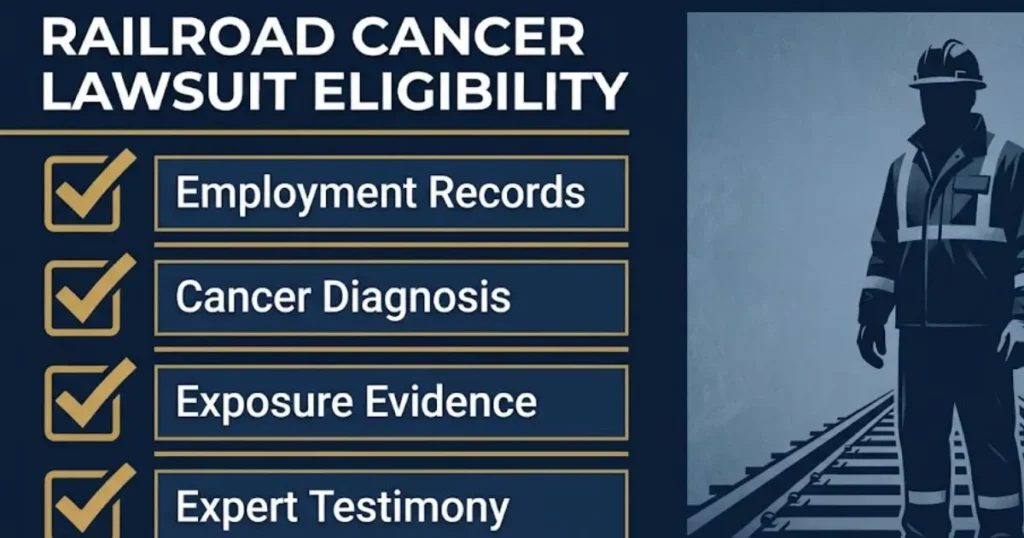
You are eligible to file a railroad cancer lawsuit if you worked for a railroad company, were exposed to carcinogenic substances during your employment, and have been diagnosed with laryngeal cancer. That is the basic framework, though each element requires specific documentation.
FELA does not require you to prove the railroad was your only source of exposure. You just need to show that your work on the railroad contributed to your cancer. This is a lower bar than many people expect.
Here are the primary eligibility requirements:
- You were employed by a railroad (not an independent contractor)
- You were exposed to known carcinogens during your railroad work
- You received a diagnosis of laryngeal cancer
- Your cancer is connected to your occupational exposure
- You are within the statute of limitations for filing
| Eligibility Criteria | Required? | Details |
|---|---|---|
| Railroad Employment | Yes | Must be an employee, not a contractor |
| Carcinogen Exposure | Yes | Diesel exhaust, asbestos, creosote, benzene, or similar |
| Cancer Diagnosis | Yes | Laryngeal cancer confirmed by a physician |
| Causal Connection | Yes | Medical opinion linking exposure to diagnosis |
| Statute of Limitations | Yes | Generally 3 years from diagnosis or discovery |
Family members of deceased railroad workers may file wrongful death claims under FELA. If your loved one died from laryngeal cancer linked to railroad work, you can pursue a claim on their behalf.
Retired workers qualify too. Your employment could have ended years or even decades ago. What matters is the exposure history, not your current employment status.
Key Takeaway: Railroad workers with laryngeal cancer can file lawsuits under FELA for settlements that often range from $400,000 to over $3 million, and eligibility depends on proving employment, exposure, and a cancer diagnosis.
How to File a Railroad Cancer Lawsuit
Filing a railroad cancer lawsuit starts with gathering your employment records, medical records, and exposure history, then contacting an attorney experienced in FELA litigation. The process typically takes several months from initial consultation to filing the complaint.
The steps follow a logical order. First, you document your case. Then you find the right attorney. Then the attorney files the legal claim and begins the discovery process.
Here is the general sequence:
- Collect your employment records from the railroad company, including job titles, work locations, and dates of service
- Obtain your complete medical records showing the laryngeal cancer diagnosis, treatment history, and any physician opinions on causation
- Document your exposure history by listing chemicals and substances you worked around, the duration, and any lack of protective equipment
- Consult a FELA attorney who specializes in railroad cancer cases
- File the FELA complaint in the appropriate federal or state court
- Enter the discovery phase where both sides exchange evidence
- Negotiate settlement or proceed to trial
Most railroad cancer cases settle before reaching trial. The railroads prefer to avoid jury verdicts because juries tend to award large amounts in cancer cases. But having a strong enough case to win at trial gives you the leverage to negotiate a fair settlement.
Think of it like selling a house. You get the best offer when the buyer knows other people want it too. A case that is trial-ready gets the best settlement offers.
Your attorney will handle most of the heavy lifting. Your job is mainly to provide honest, thorough information about your work history and health.
FELA Lawsuit Laryngeal Cancer
A FELA lawsuit for laryngeal cancer is a claim filed under the Federal Employers Liability Act, the federal law that gives railroad workers the right to sue their employer for negligence-related injuries and illnesses. FELA replaces workers’ compensation for railroad employees.
This distinction is critical. Under workers’ comp, you get fixed benefits regardless of fault. Under FELA, you can recover much larger amounts, but you need to prove your employer was negligent.
| Feature | FELA Lawsuit | Workers’ Compensation |
|---|---|---|
| Who it covers | Railroad employees | Most other employees |
| Fault required? | Yes, employer negligence | No, it’s no-fault |
| Damages available | Full compensatory and punitive | Fixed schedule of benefits |
| Right to jury trial | Yes | No |
| Average cancer payout | $400,000 to $3,000,000+ | $100,000 to $300,000 |
Under FELA, negligence can mean many things. It can mean the railroad:
- Failed to provide respirators or ventilation in diesel-heavy areas
- Did not warn workers about known cancer risks
- Ignored federal safety standards for chemical exposure
- Continued using asbestos-containing materials after risks were known
- Did not monitor air quality in roundhouses or engine shops
The negligence bar in FELA cases is lower than in standard personal injury lawsuits. You only need to show that the railroad’s negligence played any part in causing your cancer. Even if your employer was just 1% at fault, you can recover damages, though they would be reduced by your own percentage of fault.
This comparative fault system works in the railroad worker’s favor in most cancer cases. It is hard for a railroad to argue that the worker chose to breathe diesel fumes.
Railroad Worker Cancer Claims 2026
Railroad worker cancer claims in 2026 are expected to increase as more former employees receive delayed cancer diagnoses and as courts continue to apply updated scientific evidence on diesel exhaust carcinogenicity. This year is shaping up to be one of the most active periods for these filings.
Several developments are driving the surge:
- Growing body of medical research continues to strengthen the link between diesel exhaust and laryngeal cancer
- Recent large verdicts encourage more workers to come forward
- Aging workforce from the 1970s through 1990s is reaching the peak latency period for occupational cancers
- Increased awareness through legal advertising and worker advocacy groups
The Federal Railroad Administration has not implemented new exposure regulations in 2026, which remains a point of contention. Plaintiff attorneys argue that continued regulatory inaction strengthens negligence claims.
| 2026 Trend | Impact on Claims |
|---|---|
| New IARC research updates | Strengthens causation arguments |
| Rising medical costs | Increases settlement values |
| More attorneys taking cases | More access for workers |
| Railroad industry pushback | Longer litigation timelines in some cases |
If you have been thinking about filing, 2026 is a strong year to do it. The legal environment, scientific evidence, and public awareness all favor claimants right now.
One thing to watch: some railroads are pushing harder for summary judgment motions, trying to get cases dismissed before trial. Courts have largely rejected these motions when the plaintiff has solid exposure documentation and a credible medical expert.
Key Takeaway: 2026 is a particularly strong year to file a railroad laryngeal cancer claim because of updated scientific evidence, growing public awareness, and a legal environment that increasingly favors workers.
Diesel Exhaust Laryngeal Cancer Railroad
Diesel exhaust is the primary carcinogen linked to laryngeal cancer among railroad workers, and the scientific evidence behind this connection is now considered definitive by major health organizations worldwide. The International Agency for Research on Cancer classified diesel engine exhaust as a Group 1 carcinogen in 2012.
Group 1 is the highest risk category. It means there is sufficient evidence that the substance causes cancer in humans. Other Group 1 carcinogens include asbestos, tobacco smoke, and plutonium. Diesel exhaust sits in that same category.
Railroad workers face especially high exposure levels. Engineers, conductors, brakemen, and yard workers breathe diesel fumes during most of their shifts. Roundhouse workers and maintenance crews often work in enclosed or semi-enclosed spaces where exhaust concentrations are even higher.
The mechanism works like this: diesel exhaust contains tiny particulate matter that penetrates deep into respiratory tissues. These particles carry polycyclic aromatic hydrocarbons and other toxic compounds that damage cellular DNA. Over time, this damage leads to cancer.
The larynx is particularly vulnerable because it sits right in the airway path. Every breath of diesel-contaminated air passes directly over the laryngeal tissues.
- Primary carcinogen in diesel exhaust: Fine particulate matter (PM 2.5)
- Key toxic compounds: Polycyclic aromatic hydrocarbons (PAHs), benzene, formaldehyde
- Exposure duration typical for railroad workers: 8 to 12 hours per shift
- Latency period for laryngeal cancer: 10 to 40 years after first exposure
Studies published in occupational health journals have found that railroad workers have a 40% to 70% higher risk of developing laryngeal cancer compared to the general population. That is not a small increase. It is a statistically significant elevation that holds up across multiple independent studies.
Railroad Toxic Exposure Cancer
Railroad toxic exposure goes beyond diesel exhaust to include a cocktail of carcinogenic substances that workers encountered daily for decades. Asbestos, creosote, benzene, silica dust, and welding fumes all contribute to cancer risk for rail employees.
The problem was not any single chemical. It was the combination of exposures over long careers without proper safety equipment. A track worker might handle creosote-soaked railroad ties in the morning and breathe diesel fumes in the afternoon.
| Toxic Substance | Where Found on Railroad | Cancer Risk |
|---|---|---|
| Diesel exhaust | Locomotives, yards, tunnels | Laryngeal, lung, bladder |
| Asbestos | Brake shoes, insulation, buildings | Laryngeal, lung, mesothelioma |
| Creosote | Railroad ties, utility poles | Laryngeal, skin, bladder |
| Benzene | Fuel, solvents, cleaning agents | Leukemia, laryngeal |
| Silica dust | Ballast, sand, grinding operations | Lung, laryngeal |
| Welding fumes | Repair shops, track maintenance | Laryngeal, lung |
Many railroad workers were exposed to multiple carcinogens simultaneously. Medical research shows that combined exposures create a compounding effect. The cancer risk from breathing diesel exhaust while handling asbestos-containing brake materials is greater than either exposure alone.
Railroads knew about many of these risks for decades before taking action. Internal documents revealed during litigation show that some companies tracked cancer rates among employees but did not share the findings with workers.
This concealment is a critical element in many lawsuits. It moves cases from simple negligence into territory where punitive damages become available.
Laryngeal Cancer from Railroad Work
Laryngeal cancer from railroad work develops when repeated exposure to carcinogenic substances damages the cells lining the larynx, causing mutations that eventually become cancerous. The larynx, or voice box, is positioned where it filters every breath a worker takes.
This type of cancer accounts for roughly 2% of all new cancer diagnoses in the United States each year. But among railroad workers, the rate is significantly higher. That gap is the foundation of every FELA cancer claim.
The cancer typically starts in the squamous cells that line the inside of the larynx. It can affect three areas:
- Supraglottis: The upper part above the vocal cords
- Glottis: The middle section containing the vocal cords (most common site)
- Subglottis: The lower part between the vocal cords and the trachea
Railroad workers tend to develop glottic and supraglottic laryngeal cancers at higher rates. Research suggests this is because inhaled particles and fumes make direct contact with these tissues during normal breathing.
The diagnosis often comes late because early symptoms mimic common conditions. A persistent hoarse voice gets blamed on age. A sore throat gets treated with antibiotics. By the time the cancer is identified, it may have progressed to an advanced stage.
This late diagnosis pattern actually strengthens legal claims. It demonstrates that workers were not monitored for occupational cancers and that the railroad did not implement screening programs despite knowing the risks.
Key Takeaway: Diesel exhaust, asbestos, creosote, and other railroad toxins create a compounding cancer risk, and the larynx is especially vulnerable because it sits directly in the airway path of every inhaled chemical.
Railroad Cancer Lawsuit Payout
Railroad cancer lawsuit payouts for laryngeal cancer have ranged from $250,000 in lower-value settlements to over $8 million in jury verdicts based on reported cases through early 2026. The average successful claim falls in the $600,000 to $1.5 million range.
Payouts come in two forms: negotiated settlements and jury verdicts. Settlements are more common and typically lower than verdicts, but they are faster and guaranteed. Jury verdicts can be massive, but they carry the risk of appeal.
Here is what drives payout amounts:
| Payout Factor | How It Affects Amount |
|---|---|
| Total medical expenses | Higher bills mean higher payouts |
| Lost wages (past and future) | Calculated based on career earnings potential |
| Pain and suffering | Subjective but often the largest component |
| Loss of quality of life | Inability to speak, eat, or work normally |
| Punitive damages | Available when railroad concealed known risks |
| Comparative fault reduction | Payout reduced by worker’s percentage of fault |
Quick Facts:
- Most FELA laryngeal cancer cases settle within 12 to 24 months
- Jury verdicts average 2 to 3 times higher than settlements
- Wrongful death claims for railroad cancer can exceed settlements for living claimants
- Attorney fees in FELA cases typically run 25% to 40% of the total recovery
One important detail: the railroad cannot offset your settlement with workers’ compensation benefits. FELA operates outside the workers’ comp system entirely. Your full settlement is separate from any disability or retirement benefits you receive.
The biggest payouts tend to come from cases where the worker can prove the railroad had internal knowledge of cancer risks and chose not to act. Those documents, when they exist, are worth millions at trial.
Railroad Cancer Lawsuit Evidence Needed
The evidence needed for a railroad cancer lawsuit includes employment records, medical records showing your diagnosis, exposure documentation, and expert testimony linking your cancer to your work on the railroad. Without these four pillars, your case will struggle.
Let’s break down each type of evidence you need:
Employment Records:
- Personnel files showing job titles and dates of employment
- Work location assignments (yards, roundhouses, track crews)
- Job duty descriptions
- Union records and seniority lists
Medical Records:
- Pathology reports confirming laryngeal cancer diagnosis
- Treatment records (surgery, radiation, chemotherapy)
- Medical opinions on causation from treating physicians
- Imaging studies (CT scans, MRIs, PET scans)
Exposure Documentation:
- Air quality testing results from your work locations (if available)
- Safety data sheets for chemicals used at your jobsite
- Photographs of working conditions
- Coworker statements about exposure conditions
Expert Testimony:
- Oncologist or occupational medicine physician linking your cancer to railroad exposures
- Industrial hygienist calculating your cumulative exposure levels
- Epidemiologist explaining population-level cancer risk data
| Evidence Type | Who Provides It | Why It Matters |
|---|---|---|
| Employment records | Railroad company (via subpoena) | Proves you worked there |
| Medical records | Your doctors and hospitals | Confirms the cancer diagnosis |
| Exposure evidence | Industrial hygienists, coworkers | Shows what you were exposed to |
| Expert opinions | Medical and scientific experts | Connects exposure to cancer |
Start collecting this evidence as soon as possible. Employment records can disappear. Coworkers retire and become harder to locate. Medical records from decades ago may no longer be available.
Your attorney will handle subpoenas and expert witness coordination. But you can help by writing down everything you remember about your working conditions, including the chemicals you smelled, the equipment you used, and the ventilation (or lack of it) at your work sites.
Railroad Asbestos Exposure Laryngeal Cancer
Railroad asbestos exposure is a significant cause of laryngeal cancer among rail workers, with asbestos-containing materials historically found in locomotive brakes, pipe insulation, building materials, and engine components throughout the rail industry. The link between asbestos and laryngeal cancer was confirmed by the Institute of Medicine in 2006.
Railroad workers encountered asbestos in specific ways:
- Brake shoes and pads: Grinding and replacing brakes released asbestos fibers into the air
- Locomotive insulation: Steam-era and early diesel locomotives used asbestos insulation extensively
- Railroad buildings: Roundhouses, engine houses, and offices contained asbestos in walls, floors, and ceilings
- Pipe covering: Steam pipes and heating systems used asbestos wraps
The asbestos fibers, once inhaled, lodge in the tissues of the larynx and cause chronic irritation. Over years and decades, this irritation triggers cellular mutations that can develop into squamous cell carcinoma.
| Asbestos Source | Workers Most Affected | Risk Level |
|---|---|---|
| Brake materials | Carmen, mechanics | High |
| Locomotive insulation | Engineers, machinists | High |
| Building materials | All indoor workers | Moderate |
| Pipe insulation | Boilermakers, pipefitters | High |
Many railroads continued using asbestos-containing materials well into the 1980s and even 1990s in some applications. Workers who handled these materials daily for years accumulated dangerous levels of fiber exposure.
The combination of asbestos and diesel exhaust exposure is particularly dangerous. Research shows the two carcinogens interact synergistically, meaning the combined cancer risk is greater than the sum of each individual risk. A worker exposed to both faces a substantially elevated chance of developing laryngeal cancer.
Key Takeaway: Railroad cancer lawsuit evidence requires four pillars: employment records, medical records, exposure documentation, and expert testimony, and collecting this evidence early is essential because records can disappear over time.
FELA Claims for Railroad Workers with Cancer
FELA claims for railroad workers with cancer allow employees to recover full compensatory damages by proving their employer’s negligence contributed to their cancer. This is fundamentally different from workers’ compensation and generally results in much larger financial recoveries.
Under FELA, a railroad employee can recover damages for:
- Past and future medical expenses
- Past and future lost wages
- Pain and suffering
- Emotional distress
- Loss of enjoyment of life
- Disfigurement (relevant for laryngeal cancer patients who undergo surgery)
The negligence standard in FELA is intentionally worker-friendly. Congress designed the law in 1908 specifically to protect railroad workers because their jobs were so dangerous. Courts have consistently interpreted FELA liberally in favor of workers.
Think of it this way: if you worked in a kitchen and your boss told you the stove was cold when it was actually burning hot, and you got hurt, that boss would be liable. Railroad companies did something similar. They knew diesel exhaust caused cancer and didn’t tell their workers.
| FELA Claim Element | What You Must Show |
|---|---|
| Employment | You worked for a railroad |
| Negligence | The railroad failed to provide a safe workplace |
| Causation | Railroad negligence contributed to your cancer |
| Damages | You suffered real harm (cancer, medical bills, lost income) |
One common misconception: you do NOT need to prove the railroad was the sole cause of your cancer. Under FELA, you only need to show that railroad negligence played any part, even a small part, in causing your illness.
This “any part” standard is why FELA cancer cases succeed at high rates. It is very difficult for a railroad to argue that decades of diesel exhaust exposure played zero role in a worker’s laryngeal cancer.
Railroad Lawsuit Statute of Limitations
The statute of limitations for a railroad lawsuit involving laryngeal cancer is generally three years from the date you knew or should have known that your cancer was caused by your railroad work. This deadline is strict. Miss it, and your claim is permanently barred.
The three-year clock does not start on the date you were exposed. It does not start on the date you were hired. It starts on the date of discovery: when you learned or reasonably should have learned that your cancer was related to your work.
This discovery rule is important because laryngeal cancer has a long latency period. A worker exposed to diesel exhaust in the 1990s might not develop cancer until 2025 or 2026. The clock starts when the diagnosis is made and the connection to railroad work becomes apparent.
| Deadline Detail | Information |
|---|---|
| Federal FELA statute of limitations | 3 years from discovery |
| When the clock starts | Date you knew or should have known about the work connection |
| Can the deadline be extended? | Rarely, and only in extreme circumstances |
| What happens if you miss it? | Your claim is permanently dismissed |
There are some wrinkles to watch for:
- Wrongful death claims have their own three-year window starting from the date of death
- Minors and incapacitated individuals may have extended filing periods
- Fraudulent concealment by the railroad may toll (pause) the statute in some jurisdictions
Do not wait until the last minute. Evidence degrades over time. Witnesses forget details. Records get destroyed. Filing early gives your attorney more time to build the strongest possible case.
If you received your laryngeal cancer diagnosis in 2023, 2024, or 2025, your filing window may already be closing. Act quickly.
Railroad Cancer Settlement Timeline 2026
The railroad cancer settlement timeline in 2026 typically runs 12 to 30 months from the date of filing to the date you receive a settlement check. Complex cases or those that go to trial can take longer, but most FELA laryngeal cancer cases resolve through negotiated settlements.
Here is a typical timeline breakdown:
| Phase | Duration | What Happens |
|---|---|---|
| Initial consultation and case evaluation | 1 to 2 months | Attorney reviews your records and exposure history |
| Filing the complaint | 1 month | Lawsuit officially filed in court |
| Discovery phase | 6 to 12 months | Both sides exchange documents, take depositions |
| Expert reports and medical evaluations | 2 to 4 months | Medical and scientific experts prepare opinions |
| Settlement negotiations | 2 to 6 months | Attorneys negotiate with the railroad |
| Trial (if needed) | 1 to 2 weeks | Jury hears the case and renders a verdict |
| Payment processing | 1 to 3 months | After settlement or verdict, funds are distributed |
Several factors can speed up or slow down your case in 2026:
- Railroad company responsiveness: Some companies settle quickly. Others fight every step.
- Court docket congestion: Federal courts in some districts have long wait times.
- Strength of your evidence: Strong cases settle faster because the railroad knows it will lose at trial.
- Number of pending cases: When hundreds of claims hit the same railroad, processing slows down.
If your case settles without going to trial, you can expect resolution in 12 to 18 months from filing. Trial cases typically take 24 to 36 months from filing to final payment.
The settlement check itself does not arrive on the day the agreement is signed. There is usually a 30 to 90 day processing period for paperwork, lien resolution, and fund distribution.
Key Takeaway: The statute of limitations for railroad cancer lawsuits is three years from discovery, and the typical settlement timeline in 2026 runs 12 to 30 months from filing to payment.
Railroad Companies Named in Cancer Lawsuits
The railroad companies most frequently named in laryngeal cancer lawsuits include BNSF Railway, Union Pacific, CSX Transportation, Norfolk Southern, and Canadian National Railway. These Class I railroads are the largest employers in the industry and have faced hundreds of cancer-related FELA claims.
| Railroad Company | Headquarters | Number of Reported Cancer Lawsuits |
|---|---|---|
| BNSF Railway | Fort Worth, TX | Hundreds of active claims |
| Union Pacific | Omaha, NE | Hundreds of active claims |
| CSX Transportation | Jacksonville, FL | Significant number of claims |
| Norfolk Southern | Atlanta, GA | Significant number of claims |
| Canadian National | Montreal, QC | Growing number of U.S. claims |
| Kansas City Southern | Kansas City, MO | Moderate number of claims |
Smaller regional railroads and short-line railroads have faced lawsuits too. Any railroad that employed workers in environments with diesel exhaust, asbestos, or other carcinogens is potentially liable.
BNSF and Union Pacific have faced the most claims simply because they employ the most workers. Both companies have established internal legal teams dedicated to handling FELA cancer litigation.
Some railroads have been more aggressive in defending claims than others. CSX, for example, has a reputation for fighting cases harder and taking more to trial. Union Pacific and BNSF have historically been more willing to negotiate settlements to avoid large jury verdicts.
Internal documents from several of these companies have revealed that management was aware of cancer risks from diesel exhaust exposure. In some cases, company-funded studies identified elevated cancer rates among employees, but the results were never shared with workers.
These concealment findings have been devastating for the railroads in court. Juries view hidden evidence of known cancer risks as particularly egregious, and they respond with larger damage awards.
Signs of Laryngeal Cancer from Railroad Exposure
The early signs of laryngeal cancer from railroad exposure include persistent hoarseness, a sore throat that does not heal, difficulty swallowing, ear pain, and a lump in the neck or throat. Recognizing these symptoms early can significantly improve treatment outcomes and strengthen a legal claim.
Here are the warning signs to watch for:
- Persistent hoarseness or voice changes lasting more than two weeks
- Chronic sore throat that does not respond to treatment
- Difficulty swallowing (dysphagia)
- Ear pain on one side that does not go away
- Lump or mass in the neck
- Unexplained weight loss
- Persistent cough or feeling of something stuck in the throat
- Breathing difficulties or noisy breathing (stridor)
| Symptom | When to Worry | What to Do |
|---|---|---|
| Hoarseness | If it lasts longer than 2 weeks | See an ENT specialist immediately |
| Sore throat | If antibiotics do not help | Request a laryngoscopy |
| Difficulty swallowing | If it worsens over time | Get imaging and biopsy |
| Neck lump | If it is painless and growing | Urgent medical evaluation |
| Unexplained weight loss | Loss of 10+ pounds without trying | Full cancer screening |
Railroad workers and retirees should be especially alert to these symptoms because of their elevated cancer risk. The problem is that many of these symptoms seem minor at first. A raspy voice after decades of working around loud machinery does not scream “cancer” to most people.
But that is exactly why early screening matters. If you worked on the railroad and experience any combination of these symptoms, request a referral to an ear, nose, and throat specialist. Ask specifically about laryngeal cancer screening.
Early detection does not just improve your health outcomes. It also strengthens your legal case by establishing a clear diagnostic timeline that your attorney can use to connect your cancer to your railroad employment.
Key Takeaway: Persistent hoarseness, a sore throat that will not heal, and difficulty swallowing are the most common early signs of laryngeal cancer, and railroad workers should seek screening immediately if these symptoms appear.
Frequently Asked Questions
Can I sue a railroad company for causing my laryngeal cancer?
Yes, you can sue your railroad employer under the Federal Employers Liability Act if you were exposed to carcinogens like diesel exhaust or asbestos during your employment.
You need to show that the railroad’s negligence contributed to your cancer.
Both current and former employees can file, regardless of when the exposure occurred.
How much is a railroad laryngeal cancer lawsuit worth in 2026?
Most successful laryngeal cancer FELA cases settle for $400,000 to $3 million in 2026.
The exact amount depends on your cancer stage, employment duration, and the strength of your exposure evidence.
Jury verdicts have reached $8 million or more in cases involving employer concealment of known risks.
What is the deadline to file a railroad cancer lawsuit?
The deadline is three years from the date you discovered that your laryngeal cancer was caused by your railroad work.
This is called the discovery rule, and it means the clock starts when you learn about the connection, not when the exposure happened.
Missing this deadline permanently bars your claim.
What chemicals on railroads cause laryngeal cancer?
The primary chemicals include diesel exhaust, asbestos, creosote, benzene, silica dust, and welding fumes.
Diesel exhaust is classified as a Group 1 carcinogen by the IARC, placing it in the same risk category as asbestos and tobacco smoke.
Most railroad workers were exposed to multiple carcinogens simultaneously, which compounds the cancer risk.
Do I need to prove exactly when I was exposed to file a FELA claim?
No, you do not need to prove the exact date or moment of exposure.
You need to show that your overall work environment on the railroad exposed you to carcinogens over time.
An industrial hygienist can estimate your cumulative exposure levels based on your job duties and work locations.
Railroad workers who developed laryngeal cancer from on-the-job toxic exposure have real legal options in 2026. The science is strong. The legal framework under FELA favors workers. And the settlement amounts reflect the serious harm these companies caused.
If you worked on the railroad and have been diagnosed with laryngeal cancer, check your eligibility and gather your employment and medical records now. The three-year statute of limitations is firm, and the sooner you act, the stronger your case will be.
Your health, your career, and your financial future are all at stake. The time to move is now.







