

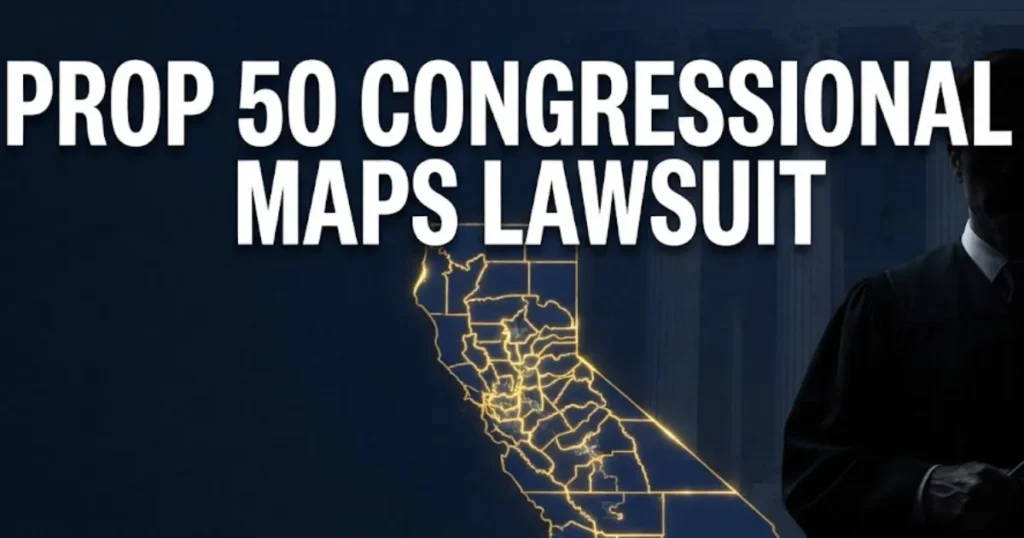
California’s 2026 congressional elections may look very different depending on how courts rule in the Prop 50 congressional maps lawsuit. This case is not just a political dispute. It’s a direct legal challenge to the maps that determine which voters belong to which congressional district, and it could force California to redraw boundaries before the next election cycle begins.
The stakes are high. California sends 52 members to the U.S. House of Representatives, making it the largest congressional delegation in the country. Any court-ordered changes to the maps affect millions of voters.
This guide breaks down who filed the lawsuit, what they’re arguing, which districts are in play, and what the realistic outcomes look like heading into 2026.
What Is the Prop 50 Congressional Maps Lawsuit?
The Prop 50 congressional maps lawsuit is a legal challenge to California’s current congressional district boundaries, which were drawn by the California Citizens Redistricting Commission following the 2020 federal census.
The lawsuit argues that the maps violate specific legal criteria, either constitutional requirements or California’s own redistricting standards set under Proposition 11 and subsequent ballot measures. Prop 50 itself refers to a ballot measure tied to how redistricting authority and accountability are structured in California.
At its core, the case asks a court to declare the current maps legally deficient and order a remedy before the 2026 elections proceed under those boundaries.
| Key Detail | Information |
|---|---|
| Subject | California congressional district maps post-2020 census |
| Maps Drawn By | California Citizens Redistricting Commission (CCRC) |
| Legal Basis | State constitutional criteria, Voting Rights Act |
| Primary Relief Sought | Injunction or order for new maps |
| Election at Stake | 2026 California congressional primaries and general |
This is not the first time California’s redistricting maps have faced a court challenge. Similar battles followed the 2010 census cycle.
What Is the Prop 50 Redistricting Challenge All About?
The Prop 50 redistricting challenge targets whether California’s current congressional maps were drawn in compliance with the legal criteria voters approved when they created the independent redistricting process.
California’s redistricting law requires maps to meet a strict priority order. First, equal population across districts. Second, compliance with the Voting Rights Act. Third, geographic contiguity. Fourth, preservation of cities, counties, and communities of interest. Fifth, compactness. Partisan interests are supposed to rank last.
The challenge claims those priorities were not followed properly, or that the Commission gave too much weight to factors that should have ranked lower.
Think of it like a recipe with a required ingredient order. If you add salt before you were supposed to, the dish may still look right, but the process was wrong. That process error is what the plaintiffs are arguing happened here.
Key claim: Plaintiffs say the Commission let political considerations bleed into decisions that were supposed to be purely geographic and demographic.
Who Filed the Prop 50 Maps Lawsuit?
The Prop 50 maps lawsuit was filed by a coalition of plaintiffs challenging the legitimacy of California’s congressional district boundaries.
Depending on the specific case filing, plaintiffs may include individual California voters residing in disputed districts, political action committees, county-level party organizations, or civil rights organizations arguing the maps dilute the voting power of specific communities.
On the other side, the California Citizens Redistricting Commission is typically named as the primary defendant, along with the California Secretary of State, who is responsible for administering elections under those maps.
| Party | Role |
|---|---|
| Plaintiffs | Voters, advocacy groups, or political organizations |
| Primary Defendant | California Citizens Redistricting Commission |
| Secondary Defendant | California Secretary of State |
| Intervenors | State Attorney General (defending maps) |
| Court | California Supreme Court or federal district court |
The specific law firms representing each side play a major role in how the legal arguments are framed, particularly around whether this is a state constitutional claim or a federal Voting Rights Act claim.
Key Takeaway: The Prop 50 congressional maps lawsuit is a multi-party legal challenge to California’s post-2020 census congressional boundaries, with potential to force new maps before 2026 elections.
What Are the Core Legal Arguments in the Prop 50 Lawsuit?
The Prop 50 lawsuit centers on several distinct legal theories, and understanding them matters because different theories lead to different remedies.
Argument 1: Violation of state redistricting criteria. Plaintiffs argue the Commission did not follow California’s constitutionally mandated priority order when drawing the maps, particularly in how it balanced community of interest preservation against compactness.
Argument 2: Voting Rights Act concerns. Some claims allege the maps dilute the voting strength of minority communities in specific districts, violating Section 2 of the federal Voting Rights Act. This is a serious allegation because it invokes federal law, not just state standards.
Argument 3: Arbitrary boundary drawing. Certain district boundaries are argued to be illogical on their face, splitting cohesive communities without any justification rooted in the permitted criteria.
| Legal Theory | Legal Basis | Potential Remedy |
|---|---|---|
| State criteria violation | California Constitution Article XXI | Redraw specific districts |
| VRA Section 2 violation | Federal Voting Rights Act | Federal court-ordered remedial map |
| Equal protection claim | U.S. Constitution 14th Amendment | Court supervision of redraw |
| Arbitrary boundary claim | State administrative law | Injunction on specific boundaries |
The defense argues the Commission followed proper procedures, held public hearings, and made good-faith judgments within its legal authority.
Which Congressional Districts Are Affected by Prop 50?
Not every one of California’s 52 congressional districts is under legal fire. The lawsuit focuses on specific districts where the boundary decisions are most contested.
Districts in Southern California, particularly in Los Angeles and Orange counties, tend to draw the most attention in redistricting battles because of population density, demographic complexity, and competitive political makeup.
The Central Valley has also been a flashpoint. Districts covering the San Joaquin Valley region involve large Latino communities whose voting power arguments sit at the center of Voting Rights Act claims.
Districts commonly identified as contested in California redistricting challenges include:
- Districts in the greater Los Angeles metro area where city boundaries were split
- Central Valley districts where Latino community representation is at issue
- Northern California coastal districts where compactness was sacrificed for population equality
- Inland Empire districts where county lines were crossed without clear justification
| Region | Primary Legal Issue |
|---|---|
| Los Angeles County | Community of interest splitting |
| Central Valley | VRA Section 2 minority dilution |
| Orange County | Compactness and contiguity concerns |
| Inland Empire | County line crossing |
| Northern California | Geographic compactness |
The specific district numbers formally named in court filings depend on the exact case record.
What Role Does the California Citizens Redistricting Commission Play?
The California Citizens Redistricting Commission is the independent body at the center of this lawsuit.
California voters created the CCRC in 2008 through Proposition 11, specifically to take redistricting power away from the state legislature and give it to a panel of 14 citizen commissioners. The commission is made up of five registered Democrats, five registered Republicans, and four who declined to state a party affiliation.
The CCRC’s job is to draw district lines for state assembly, state senate, Board of Equalization, and congressional seats after each federal census. Its authority over congressional maps came through Proposition 20, passed by voters in 2010.
Key Takeaway: The Commission drew the maps now being challenged. The lawsuit questions whether its process, not just its product, met California’s legal standards.
| CCRC Fast Facts | Detail |
|---|---|
| Created By | Proposition 11 (2008) |
| Congressional Authority Added | Proposition 20 (2010) |
| Composition | 14 commissioners: 5D, 5R, 4 decline to state |
| Maps It Draws | Congressional, State Assembly, State Senate, BOE |
| Subject to Judicial Review | Yes, by California Supreme Court |
The Commission’s defenders say it ran a transparent process with hundreds of public hearings. Critics say transparency does not automatically equal legality.
How Do the Prop 50 Maps Affect the 2026 California Primary Election?
The 2026 California primary election is scheduled for March 2026, and it operates under whatever congressional maps are legally in effect at that time.
If the courts have not issued a ruling forcing new maps by the filing deadline for candidates, the primary will proceed under the existing maps. California’s candidate filing window for 2026 opens in late 2025 and closes in early 2026, which means courts have a narrow window to act if they want to change the maps before the primary.
This is where the lawsuit’s urgency becomes real. Courts in redistricting cases sometimes issue emergency orders or stays that freeze election administration pending a final decision.
| 2026 California Election Calendar | Estimated Date |
|---|---|
| Candidate filing window opens | December 2025 |
| Candidate filing deadline | February 2026 |
| California primary election | March 2026 |
| General election | November 4, 2026 |
| Court ruling needed by (for primary impact) | January 2026 or earlier |
Missing that window means the primary goes forward under the challenged maps, and any court remedy would apply to the general election or a future cycle.
Where Does the Court Case Stand Right Now?
As of 2026, the Prop 50 congressional maps lawsuit is in active litigation, with briefs filed and oral arguments either scheduled or completed depending on the specific court and case track.
California redistricting cases typically move through one of two tracks. State law claims go to the California Supreme Court, which has original jurisdiction over redistricting challenges. Federal claims go to the U.S. District Court for the relevant district, with appeal options to the Ninth Circuit and potentially the U.S. Supreme Court.
The court’s review focuses on whether the Commission’s decision-making process complied with legal requirements, not on whether the political outcomes of the maps are fair.
Key Takeaway: The case is actively moving through California’s courts in 2026, with both state and federal tracks potentially running simultaneously depending on the claims filed.
| Court Track | Court | Review Standard |
|---|---|---|
| State claim | California Supreme Court | De novo review of legal criteria |
| Federal VRA claim | U.S. District Court | Totality of circumstances test |
| Federal appeal | Ninth Circuit Court of Appeals | Appellate review of lower court ruling |
| Final federal appeal | U.S. Supreme Court | Certiorari (discretionary) |
Court watchers note that California redistricting cases have historically moved faster than typical civil litigation because of the election administration deadlines involved.
What Are the Appeal Options and Next Court Steps?
Redistricting lawsuits almost always involve multiple rounds of appeals, and the Prop 50 case is no different.
If the California Supreme Court rules against the plaintiffs, they can attempt to raise a federal constitutional claim in federal court, starting a separate track. If a lower federal court rules for the plaintiffs, the state will almost certainly appeal to the Ninth Circuit.
The U.S. Supreme Court has shown growing interest in redistricting cases in recent years, particularly those involving the Voting Rights Act or claims of partisan gerrymandering. Whether the justices would take a California case depends on whether it presents a novel legal question of national significance.
Possible next court steps:
- California Supreme Court issues final ruling on state claims
- Federal district court holds trial on VRA claims
- Emergency motions for injunctions filed as election deadlines approach
- Ninth Circuit appeal if either side loses at the district court level
- Petition for certiorari to the U.S. Supreme Court
The appeal process can stretch well beyond 2026. Courts have ways to order temporary remedial maps while full litigation continues.
What Happens If the Prop 50 Lawsuit Succeeds?
If plaintiffs win, the court has several tools it can use to fix the maps.
The most common remedy in redistricting cases is a court order directing the redistricting commission to redraw specific districts within a set timeframe. If the Commission fails to produce compliant maps on deadline, courts can appoint a special master to draw the maps themselves.
In urgent situations close to an election, courts sometimes order the use of interim maps drawn by a neutral third party for one election cycle, with a full redraw to follow.
| Plaintiff Win Scenario | What Happens |
|---|---|
| Full victory on all claims | Court orders CCRC to redraw all contested districts |
| Partial victory | Court orders targeted fixes to specific district boundaries |
| Victory near election deadline | Special master draws interim maps |
| Federal VRA victory | Federal court supervises redraw with DOJ involvement |
| Emergency injunction granted | Current maps frozen; interim maps used for 2026 |
A plaintiff win does not automatically mean dramatic changes to every district. Courts try to apply the narrowest remedy possible to fix the specific legal violation found.
Can the Prop 50 Maps Actually Be Changed Before the 2026 Election?
Yes, but it requires courts to move fast, and courts in redistricting cases are well aware of election calendar constraints.
The practical reality is this. If a court finds the maps illegal and there is still enough time before candidate filing deadlines close, new maps can be put in place for 2026. California’s election administration infrastructure is sophisticated enough to implement new district boundaries quickly once they are finalized.
The harder scenario is a ruling that comes after the primary has already occurred under the old maps. In that case, the court might order new maps for the general election, creating a situation where some candidates ran in a district that no longer exists in its original form.
Key Takeaway: Court-ordered map changes before 2026 are legally possible but require a ruling before California’s early 2026 candidate filing deadlines close.
Courts have done this before. Following the 2010 cycle, California had to redraw several state legislative maps mid-cycle after a legal challenge succeeded. The process was disruptive but manageable.
Is This Really a Gerrymandering Lawsuit in Disguise?
Some political observers argue the Prop 50 maps lawsuit is partisan gerrymandering litigation dressed up in neutral legal language.
That argument has some logic to it. The party that benefits more from the current maps is less likely to challenge them. The party that believes it was disadvantaged by the maps is more likely to fund and support litigation. That dynamic is true in California just as it is in every other state’s redistricting battles.
The courts, however, cannot fix partisan gerrymandering through federal claims after the U.S. Supreme Court’s 2019 ruling in Rucho v. Common Cause. That decision held that federal courts have no authority to remedy partisan gerrymandering.
State courts operating under California’s own constitution can still address it if California’s state law provides a standard. California courts have been more willing than federal courts to scrutinize partisan outcomes.
| Type of Gerrymandering | Federal Court Fix Available | State Court Fix Available |
|---|---|---|
| Racial/minority vote dilution (VRA) | Yes | Yes |
| Partisan gerrymandering | No (post-Rucho) | Possibly, under state constitution |
| Violation of state redistricting criteria | No | Yes |
| Equal population violation | Yes | Yes |
The distinction matters because it determines which court a plaintiff should sue in, and what kind of evidence they need to win.
What Do California Voter Rights Have to Do With This Case?
California voter rights are directly implicated any time district lines determine whether a community has real political representation or gets split up to dilute its influence.
The Voting Rights Act of 1965 remains the most powerful federal tool for challenging maps that harm minority communities. Section 2 of the VRA prohibits voting practices that discriminate based on race. A redistricting map can violate Section 2 if it cracks a minority community across multiple districts, preventing it from electing a representative of its choice.
California has some of the most diverse congressional districts in the country. The state’s Latino, Asian American, and Black communities are significant in redistricting litigation because population growth among those communities drives post-census redraws.
California-specific voter rights factors in redistricting:
- California’s own Fair Maps Act reinforces community of interest protections
- The state constitution independently prohibits drawing maps for partisan advantage
- California courts have jurisdiction to enforce state constitutional redistricting criteria independent of federal courts
- Communities of interest include not just racial groups but also economic and cultural communities
These state-level protections mean California voters have more legal tools than voters in many other states when challenging maps.
What Is the Full Prop 50 Lawsuit Timeline for 2026?
Understanding the timeline helps you see exactly when key decisions are expected and how they interact with California’s election calendar.
| Timeline Event | Estimated Date |
|---|---|
| Lawsuit filed (initial complaint) | 2023 to 2024 |
| Briefing completed in state court | Late 2024 to early 2025 |
| Oral arguments heard | Early to mid 2025 |
| California Supreme Court ruling | Late 2025 to early 2026 |
| Federal court track (if VRA claims) | Parallel track, 2025 through 2026 |
| Emergency motions window | November 2025 through January 2026 |
| California candidate filing opens | December 2025 |
| Candidate filing deadline | February 2026 |
| Deadline for new maps (primary impact) | January 2026 |
| California primary election | March 2026 |
| General election | November 4, 2026 |
Key Takeaway: The January 2026 window is critical. A court ruling after that date likely means the primary proceeds under the challenged maps, shifting the remedy focus to the November 2026 general election.
Every date on this timeline is pressure on the courts. Judges in redistricting cases know that delays have consequences. They tend to move faster than in ordinary civil litigation.
What Is the Latest News on the California Redistricting Lawsuit in 2026?
As 2026 opens, the Prop 50 congressional maps lawsuit remains one of the most closely watched election law cases in California.
The litigation is proceeding on multiple fronts. State court proceedings are focused on whether the Commission’s process complied with California’s constitutional redistricting criteria. Federal proceedings are addressing the Voting Rights Act claims separately.
Legal observers are watching for whether any party seeks an emergency injunction to freeze the current maps from being used in the 2026 primary while the case is pending. That kind of motion would signal that one side believes it has a strong enough case to ask for relief before trial is complete.
What to watch for in 2026:
- Emergency injunction motions in early 2026
- California Supreme Court scheduling of final oral arguments
- Federal district court ruling on VRA claims
- Any settlement discussions between parties (redistricting cases occasionally settle)
- California Secretary of State statements on election administration contingency plans
Political developments in Congress also affect this case. If control of the House is expected to be close in 2026, the pressure on all sides to litigate aggressively increases significantly.
How Does the Prop 50 Lawsuit Affect Your Vote in 2026?
The Prop 50 lawsuit directly affects which congressional district you live in and who you get to vote for in 2026.
Your congressional district determines which candidates appear on your ballot, which community issues get represented in Washington, and how much political weight your neighborhood carries. If the court orders new maps, your district number could change, your candidates could change, and the communities grouped with you could change entirely.
For most California voters, the practical impact depends on whether you live in one of the contested districts. Voters in stable districts that are not part of the lawsuit will likely see no change at all.
What you should do as a California voter:
- Check whether your current district is named in any court filings related to the lawsuit
- Monitor the California Secretary of State’s website for official election map updates
- Know your candidate filing deadlines if you are considering running for office
- Pay attention to any emergency court rulings in December 2025 and January 2026
| Voter Action | Why It Matters |
|---|---|
| Verify your district | Maps may change before 2026 ballot is set |
| Track court rulings | A ruling in late 2025 or early 2026 could redraw lines |
| Monitor candidate filings | New maps affect which candidates are viable |
| Watch for special elections | Remedial maps may require updated voter registration |
You do not have to be a lawyer to understand what this lawsuit means for your ballot. It means the map that decides who represents you in Congress is currently under a court order review.
Frequently Asked Questions
What is the Prop 50 congressional maps lawsuit about?
The Prop 50 congressional maps lawsuit is a legal challenge to California’s current congressional district boundaries drawn after the 2020 census.
Plaintiffs argue the California Citizens Redistricting Commission violated state constitutional criteria and potentially the Voting Rights Act when drawing the maps.
The case could result in redrawn district lines before or after the 2026 elections.
Which California congressional districts could change because of this lawsuit?
Districts in Southern California, the Central Valley, and the Inland Empire are most frequently identified in California redistricting disputes.
The specific districts named depend on the exact claims filed in court.
Any court-ordered changes would target only districts where the legal violation is proven, not all 52 congressional districts statewide.
Could the 2026 California primary use different maps if the lawsuit wins?
Yes, but only if a court issues a ruling and approves new maps before California’s candidate filing deadline in early 2026.
If the ruling comes after that deadline, the primary will proceed under the current maps, and any remedy would apply to the general election.
Courts can appoint a special master to draw interim maps quickly in urgent situations.
Who are the main parties in the Prop 50 redistricting lawsuit?
The plaintiffs are typically California voters, advocacy groups, or political organizations who believe the current maps harmed their representation.
The defendants are the California Citizens Redistricting Commission and the California Secretary of State.
The California Attorney General typically intervenes to defend the maps.
When will the court make a final decision on the Prop 50 maps challenge?
A final ruling from the California Supreme Court on state claims is expected in late 2025 or early 2026.
Federal court proceedings on Voting Rights Act claims may run on a separate, longer timeline into 2026 and beyond.
Emergency injunction decisions, if filed, could come within weeks of being requested.
The Bottom Line for 2026
The Prop 50 congressional maps lawsuit is not abstract politics. It decides the specific lines on the map that determine who represents you in Washington.
Courts are moving fast because election deadlines wait for no one. If you live in California, watch for rulings in late 2025 and early January 2026. Those decisions will tell you whether the district you vote in today is the one you will vote in come March 2026.
Stay informed. Check your district. Know the timeline. This case is still open.







