

The prime drinks lawsuit has turned into one of the biggest consumer beverage legal battles of the decade. Multiple class action cases are now active in 2026, targeting Prime Energy and Prime Hydration products over dangerous caffeine levels, PFAS contamination, and deceptive marketing aimed at children.
If you bought Prime drinks, you might have a claim worth real money. Some legal analysts project individual payouts could range from $25 to $500 depending on the case track and your purchase history.
This article breaks down every active lawsuit, who qualifies, estimated settlement amounts, filing deadlines, and the exact steps to join. A single can of Prime Energy contains 200 mg of caffeine, the same as roughly six cans of Coca-Cola, and it was sold to kids who follow YouTube stars.
That’s not just a bad look. It’s the basis for multiple federal lawsuits.
Prime Drinks Lawsuit: What You Need to Know in 2026
The prime drinks lawsuit refers to several class action and product liability cases filed against Prime Hydration LLC, the company co-founded by social media influencers Logan Paul and KSI. These lawsuits allege that Prime products contain unsafe levels of caffeine, toxic PFAS chemicals, and misleading nutritional labeling.
The cases gained traction in late 2023 and early 2024. By 2026, they have progressed through initial discovery phases in federal courts.
The core problem is simple. Prime marketed an energy drink packed with adult-level stimulants directly to teenagers and children through influencer-driven social media campaigns. Parents bought what they thought was a sports drink. Many didn’t realize their kids were consuming dangerous amounts of caffeine.
| Key Fact | Detail |
|---|---|
| Defendant | Prime Hydration LLC, Congo Brands |
| Founders | Logan Paul, KSI |
| Products Named | Prime Energy, Prime Hydration |
| Main Allegations | Excessive caffeine, PFAS, deceptive marketing |
| Courts | Multiple U.S. District Courts |
| Status in 2026 | Active, discovery phase ongoing |
The lawsuits aren’t going away. If anything, they’re gaining steam as more scientific evidence surfaces about PFAS risks and caffeine toxicity in minors.
Prime Energy Drink Class Action Lawsuit Explained
A prime energy drink class action lawsuit is a legal case where one or more plaintiffs represent a large group of consumers who all suffered similar harm from the same product. Instead of thousands of people filing individual cases, one consolidated lawsuit handles claims for everyone.
Several class actions have been filed in different states. The claims generally fall into three buckets: excessive caffeine content, PFAS contamination, and false advertising.
Class action status matters because it determines how settlements get distributed. If a court certifies a class, every qualifying consumer gets a share of any settlement fund. You don’t need your own lawyer to participate.
Think of it like splitting a restaurant bill. Everyone who ate the bad food gets their portion of the refund, even if only one person complained to the manager.
- Caffeine class actions focus on the 200 mg per can without adequate warnings
- PFAS class actions target the presence of toxic forever chemicals in the drinks
- Marketing class actions argue Prime deliberately targeted minors through influencer campaigns
These aren’t minor regulatory complaints. They carry real financial penalties if the plaintiffs prevail.
Prime Lawsuit Update 2026: Where Things Stand Now
As of 2026, the prime lawsuit cases are moving through discovery and pre-trial motions in multiple federal jurisdictions. No final settlement has been publicly approved yet, but settlement talks are reportedly underway in at least two of the major cases.
The caffeine-focused cases have advanced furthest. Courts have allowed several claims to proceed past the motion-to-dismiss stage, which means judges found enough evidence to warrant a full trial or settlement negotiation.
The PFAS cases are slightly behind. Independent lab testing results are still being submitted as evidence. The science on PFAS health effects continues to strengthen, which helps the plaintiffs.
| Case Track | Status as of 2026 |
|---|---|
| Caffeine Content Claims | Past motion to dismiss, in discovery |
| PFAS Contamination Claims | Evidence submission phase |
| Marketing to Minors Claims | Class certification pending |
| Settlement Discussions | Reportedly active for caffeine cases |
No trial dates have been set publicly. But the pace of litigation suggests that settlement offers could materialize in late 2026 or early 2027.
Key Takeaway: The Prime drinks lawsuits are actively progressing in 2026 with settlement talks underway, and three distinct legal tracks cover caffeine, PFAS, and marketing claims.
Is There a Lawsuit Against Prime Drinks?
Yes, there are multiple active lawsuits against Prime drinks as of 2026. These cases have been filed in federal courts across several states, including New York, California, and Illinois.
The first major lawsuit was filed in 2023 after independent testing revealed that Prime Energy drinks contained 200 mg of caffeine per 12-ounce can. That’s roughly double the caffeine in a Red Bull of similar size.
Parents and consumer advocacy groups drove much of the early legal action. Their argument was straightforward: a drink endorsed by YouTubers beloved by children shouldn’t pack the caffeine punch of a strong espresso without clear, impossible-to-miss warnings.
Senator Chuck Schumer even called on the FDA to investigate Prime Energy in 2023. That political pressure helped accelerate the filing of class action complaints.
- Lawsuits have been filed in at least 5 states
- Federal and state courts are both involved
- Individual personal injury cases exist alongside the class actions
- Logan Paul and KSI are named as defendants in some filings
So yes, the lawsuits are real. They’re not rumors or internet speculation.
Prime Energy Drink Caffeine Lawsuit Details
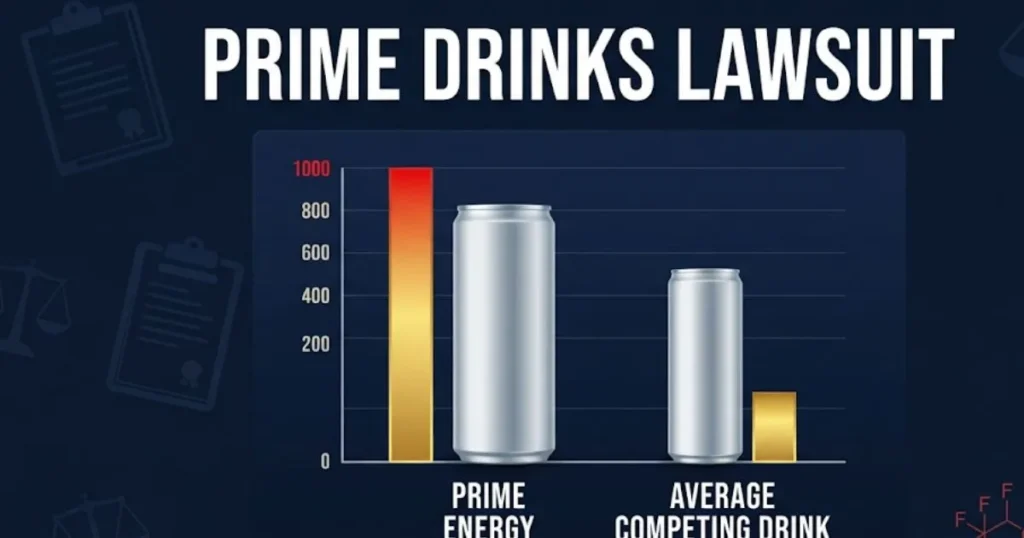
The prime energy drink caffeine lawsuit alleges that Prime Energy contains dangerously high caffeine levels that were inadequately disclosed to consumers. Each 12-ounce can of Prime Energy holds 200 mg of caffeine, which is the FDA’s recommended maximum daily intake for adults, consumed in a single serving.
The lawsuit claims Prime failed to provide sufficient warnings. The label listed the caffeine content, but critics argue the branding and marketing made the drink appear comparable to sports drinks like Gatorade.
Children and teenagers metabolize caffeine differently than adults. Medical experts have testified that 200 mg of caffeine can cause heart palpitations, anxiety, insomnia, and even seizures in young people.
One of the most damning allegations is that Prime knew its target audience skewed young. Logan Paul and KSI’s combined YouTube following exceeds 40 million subscribers, with a significant portion under 18.
| Caffeine Comparison | Amount per 12 oz |
|---|---|
| Prime Energy | 200 mg |
| Red Bull | 111 mg |
| Monster Energy | 120 mg |
| Coca-Cola | 34 mg |
| FDA Daily Max (Adults) | 200 mg |
That table tells the whole story. One can of Prime Energy matches the entire daily recommended caffeine limit for a grown adult.
Prime Drinks Lawsuit Over PFAS Chemicals
The prime drinks lawsuit over PFAS is a separate legal track from the caffeine claims. PFAS, or per- and polyfluoroalkyl substances, are synthetic chemicals often called “forever chemicals” because they don’t break down in the environment or the human body.
Independent laboratory testing detected PFAS in certain Prime products. The specific compounds found include chemicals linked to cancer, thyroid disease, immune system suppression, and reproductive harm.
Plaintiffs argue that Prime Hydration LLC failed to disclose the presence of these chemicals. Consumers had no way of knowing they were drinking PFAS-laced beverages.
The PFAS angle is especially significant because it transforms the case from a labeling dispute into a potential toxic exposure claim. Toxic exposure claims typically carry higher settlement values than standard consumer fraud cases.
- PFAS detected in both Prime Energy and Prime Hydration products
- These chemicals accumulate in the body over time
- No safe level of PFAS exposure has been established by the EPA
- PFAS lawsuits against other companies have resulted in billion-dollar settlements
This isn’t just about misleading labels. This is about what was actually inside the bottle.
Key Takeaway: The PFAS contamination claims represent a potentially larger financial liability for Prime than the caffeine cases, because toxic exposure lawsuits historically produce higher settlements.
Prime Hydration PFAS Contamination Claims
Prime Hydration PFAS contamination claims focus specifically on the non-energy version of Prime drinks. Prime Hydration was marketed as a healthier alternative, a coconut water-based sports drink with electrolytes and vitamins. Many parents bought it thinking it was safe for everyday use.
The discovery of PFAS chemicals in these products hit harder precisely because of that health-focused branding. Consumers felt betrayed.
Lab results submitted in court filings show measurable levels of PFAS compounds. While the exact concentrations vary by batch and product flavor, plaintiffs argue that any detectable level is unacceptable in a product marketed to young people and athletes.
The irony is thick. A drink sold as a hydration solution for active, health-conscious consumers contained chemicals classified as persistent environmental pollutants.
Several states have started passing stricter PFAS regulations for food and beverage products. These new laws could strengthen the plaintiffs’ position as the case progresses through 2026.
| PFAS Claim Detail | Info |
|---|---|
| Products Affected | Prime Hydration, Prime Energy |
| Chemicals Found | PFAS (multiple compounds) |
| Health Risks Alleged | Cancer, thyroid disease, immune damage |
| Regulatory Trend | Stricter state-level PFAS bans expanding |
Prime Energy Drink Side Effects Lawsuit
The prime energy drink side effects lawsuit tracks center on consumers who experienced actual health problems after drinking Prime products. These are personal injury claims, not just consumer fraud allegations.
Reported side effects include heart palpitations, rapid heartbeat, chest tightness, nausea, vomiting, severe headaches, anxiety attacks, and trouble sleeping. Several emergency room visits have been attributed to Prime Energy consumption, particularly among teenagers.
Personal injury claims are different from class action consumer fraud claims. They require proof that the product directly caused a specific medical harm to a specific person.
These cases tend to produce higher individual payouts. If a teenager ended up in the hospital after drinking Prime Energy, that family may recover medical costs, pain and suffering damages, and potentially punitive damages.
- Heart palpitations are the most commonly reported side effect
- Several ER visits documented in court filings
- Pediatricians have publicly warned against Prime Energy for kids
- Individual injury claims can be filed separately from the class action
The side effects lawsuits put real human faces on the broader legal battle. These aren’t abstract consumer protection arguments. These are kids who got sick.
Prime Energy Drink FDA Investigation
The prime energy drink FDA investigation began after political pressure and consumer complaints reached a tipping point in 2023. Senator Chuck Schumer publicly urged the FDA to examine Prime Energy’s caffeine content and marketing practices.
The FDA reviewed whether Prime Energy should be classified as a dietary supplement or a conventional beverage. That classification matters because dietary supplements face different labeling and safety requirements than standard drinks.
Prime Hydration LLC has maintained that its products comply with all FDA regulations. The company argues that Prime Energy is properly labeled and not intended for children.
However, the FDA’s inquiry opened the door for plaintiffs’ attorneys to argue that federal regulators themselves saw a problem. Even if the FDA hasn’t issued a formal enforcement action, the investigation signals concern.
| FDA Investigation Detail | Info |
|---|---|
| Triggered By | Senator Schumer’s 2023 letter, consumer complaints |
| Focus Areas | Caffeine levels, product classification, labeling |
| Company Response | Claims full regulatory compliance |
| Current Status | Review ongoing, no formal enforcement action |
The FDA angle gives the lawsuits extra credibility. When a federal agency takes a closer look at your product, it’s hard to argue everything is fine.
Key Takeaway: The FDA investigation into Prime Energy hasn’t produced formal enforcement, but it bolsters the plaintiffs’ argument that the product raises legitimate safety concerns.
Prime Drinks Marketing to Minors Lawsuit
The prime drinks marketing to minors lawsuit may be the most emotionally charged piece of this legal puzzle. Plaintiffs allege that Prime Hydration LLC intentionally marketed caffeinated energy drinks to children and teenagers through influencer partnerships, social media campaigns, and school-adjacent promotions.
Logan Paul and KSI have massive followings among young people. Their YouTube audiences skew heavily toward viewers aged 10 to 17. When these creators promoted Prime, kids listened.
The marketing claims don’t just focus on social media posts. Plaintiffs point to Prime’s bright, candy-like packaging, its placement next to sports drinks in stores, and its limited-edition drops that created hype among young collectors.
Some schools reportedly had to ban Prime drinks from campus because students were trading them like collectible items.
- Prime’s branding resembles sports drinks, not energy drinks
- Limited-edition flavors created artificial scarcity and hype among teens
- School bans on Prime documented in multiple states
- Influencer marketing regulations for minors are tightening
This is the claim that resonates with juries. The idea that a company knowingly sold a high-caffeine product to kids through their favorite internet celebrities is a powerful argument in any courtroom.
Prime Drink Lawsuit Eligibility Requirements
Prime drink lawsuit eligibility generally requires that you purchased Prime Energy or Prime Hydration products during the relevant class period. The exact dates vary by case, but most class actions cover purchases made between 2022 and 2025.
You don’t need to have gotten sick to qualify for the consumer fraud class actions. If you bought the product and the labeling was misleading, you may be eligible for compensation based on the purchase alone.
Personal injury claims are different. For those, you need to show that you or your child experienced health problems directly linked to drinking Prime products.
| Eligibility Type | Requirements |
|---|---|
| Consumer Fraud Class Action | Purchased Prime during class period |
| PFAS Exposure Claim | Purchased Prime Hydration, can show regular consumption |
| Personal Injury Claim | Medical records showing harm from Prime consumption |
| Marketing to Minors Claim | Purchased for a minor influenced by Prime’s marketing |
Keep any receipts, credit card statements, or other proof of purchase. Digital records from grocery store loyalty programs or online orders count too.
Eligibility is broader than most people think. You don’t need a doctor’s note to join the consumer fraud track.
Who Qualifies for the Prime Drinks Lawsuit?
Anyone who bought Prime Energy or Prime Hydration products in the United States during the class period likely qualifies for at least one of the active lawsuits. The consumer fraud class actions have the widest eligibility net.
Parents who purchased Prime for their children have particularly strong claims, especially under the marketing-to-minors allegations. If your kid asked for Prime because they saw Logan Paul or KSI promoting it, that supports the deceptive marketing argument.
Consumers who experienced health problems after drinking Prime have the strongest individual claims. But even if you felt perfectly fine, you might still qualify if you paid for a product that contained undisclosed PFAS chemicals or was misleadingly labeled.
- U.S. residents who purchased Prime products
- Parents who bought Prime for children under 18
- Consumers who experienced side effects
- Anyone who bought Prime Hydration that tested positive for PFAS
The bar for joining a class action is intentionally low. The whole point is to represent a large group of affected consumers, not just the ones who ended up in the hospital.
Key Takeaway: You likely qualify for the Prime drinks lawsuit if you purchased any Prime product in the U.S. between 2022 and 2025, even if you didn’t experience health problems.
Prime Drink Lawsuit Settlement Amounts
No final prime drink lawsuit settlement has been publicly approved as of early 2026. However, legal analysts and plaintiff attorneys have offered projections based on comparable energy drink and PFAS settlement cases.
Consumer fraud class action settlements in the beverage industry typically range from $25 to $100 per claimant for basic purchase-based claims. If you can document extensive purchase history, that number could be higher.
PFAS exposure claims carry significantly more weight. Settlements in major PFAS cases against companies like 3M and DuPont have reached billions of dollars. While Prime’s exposure is smaller in scale, PFAS claims could push individual payouts into the $200 to $500 range or more.
Personal injury claims operate on a completely different scale. A teenager hospitalized due to caffeine-related cardiac issues could potentially recover $10,000 to $100,000 or more depending on the severity of the injury and medical documentation.
| Claim Type | Estimated Payout Range |
|---|---|
| Basic Consumer Fraud | $25 to $100 |
| PFAS Exposure (documented purchases) | $200 to $500 |
| Personal Injury (mild) | $5,000 to $25,000 |
| Personal Injury (severe) | $25,000 to $100,000+ |
These are projections, not guarantees. Actual settlement amounts will depend on the total number of claimants, the size of the settlement fund, and the court’s distribution plan.
Prime Energy Drink Lawsuit Payout Estimates
Prime energy drink lawsuit payout amounts will depend heavily on which case track you fall under and how many total claimants participate in the settlement. More claimants means the fund gets divided into smaller pieces.
Here’s how settlement math typically works. The defendant agrees to pay a total amount, say $50 million. Attorneys take their fee, usually around 30%. Administrative costs eat another chunk. The remainder gets divided among all valid claimants.
If 500,000 people file valid claims on a $50 million settlement, each person gets roughly $70 before fees. If only 50,000 people file, each person could receive around $700.
That’s why filing your claim matters. The people who actually submit paperwork get paid. The millions who don’t bother get nothing.
- Settlement payouts depend on total claimants and fund size
- Attorney fees typically consume 25% to 33% of the fund
- Early filers don’t get more money, but filing ensures you’re counted
- Proof of purchase increases your share in most distribution plans
Think of it like a pie. The pie is a fixed size. The fewer people at the table, the bigger your slice.
How to Join the Prime Drinks Lawsuit
To join the prime drinks lawsuit, you’ll typically need to submit a claim form through the official settlement website once one is established by the court. Until a settlement is finalized and a claims administrator is appointed, the process involves a few preliminary steps.
Right now, interested consumers can take these actions:
- Gather proof of purchase. Save receipts, bank statements, online order confirmations, or grocery loyalty program records showing Prime purchases.
- Document any health issues. If you or your child experienced side effects, get medical records and written statements from your doctor.
- Contact a participating law firm. Several firms handling the case offer free case evaluations. You can register your interest without committing to anything.
- Watch for class notice. When a class is certified, you’ll receive a notice (by mail or email) explaining your rights and how to file.
- Submit your claim form. Once available, fill out the form completely and attach any supporting documents.
| Step | Action | When |
|---|---|---|
| 1 | Save purchase records | Now |
| 2 | Document health issues | Now |
| 3 | Register with a law firm | Now |
| 4 | Receive class notice | After certification |
| 5 | File your claim | After settlement approval |
Don’t wait for the settlement to be finalized before getting organized. The people who prepare early always have an easier time filing.
Prime Drink Lawsuit Filing Deadline
The prime drink lawsuit filing deadline has not been officially set as of early 2026 because no final settlement has been approved. Filing deadlines, also called claims deadlines, are established by the court after a settlement agreement is reached.
Typically, once a settlement is approved, claimants get 60 to 120 days to submit their claim forms. The court will publicize the deadline through direct notice to class members, media announcements, and the official settlement website.
For personal injury claims filed individually, statutes of limitations apply. These vary by state but generally range from 2 to 3 years from the date of injury. If your child was hospitalized after drinking Prime in 2023, your window to file an individual lawsuit may be closing soon.
| Deadline Type | Timeframe |
|---|---|
| Class Action Claim Filing | 60 to 120 days after settlement approval |
| Personal Injury (most states) | 2 to 3 years from date of injury |
| Consumer Fraud (varies) | 3 to 6 years depending on state |
Missing a deadline means losing your right to compensation entirely. Set a reminder, check for updates regularly, and don’t assume you’ll hear about it automatically.
Key Takeaway: No official filing deadline exists yet for the class action, but personal injury statutes of limitations may expire soon for incidents that occurred in 2023 or 2024.
Prime Hydration Lawsuit 2026: What to Expect
The Prime Hydration lawsuit in 2026 is entering a critical phase. Class certification decisions are expected on several cases, and settlement negotiations are reportedly progressing on the caffeine track.
Here’s what to watch for in the remainder of 2026:
First half of 2026: Courts will likely rule on class certification motions. If classes are certified, the lawsuits gain significant momentum because they officially represent all qualifying consumers.
Mid-2026: Expert reports on PFAS health effects and caffeine toxicity in minors will be submitted. These reports could significantly influence settlement value.
Late 2026 into early 2027: If settlement talks succeed, preliminary settlement agreements could be announced. This would trigger the claims process.
| 2026 Timeline | Expected Development |
|---|---|
| Q1 2026 | Class certification rulings |
| Q2 2026 | Expert reports and discovery completion |
| Q3 2026 | Settlement negotiations intensify |
| Q4 2026 to Q1 2027 | Possible preliminary settlement announcements |
Prime Hydration LLC could also choose to fight at trial. But most companies in this position settle. Trials are expensive, unpredictable, and generate bad press.
The smart money says a settlement offer comes before the end of 2026. Whether it’s fair to consumers remains to be seen. Courts have to approve any deal, and judges often push back on lowball offers.
Frequently Asked Questions
How much money can I get from the Prime drinks lawsuit?
Most consumer fraud claimants can expect between $25 and $100 per claim.
PFAS exposure claims could yield $200 to $500 with documented purchases.
Personal injury claims for serious health effects may recover $10,000 or more.
Is there a deadline to join the Prime energy drink class action?
No official claims deadline has been set as of early 2026.
Deadlines will be announced after a settlement is approved, typically giving 60 to 120 days to file.
Personal injury cases have separate statutes of limitations that may expire sooner.
Does the Prime lawsuit cover both Prime Energy and Prime Hydration?
Yes, both products are named in active lawsuits.
Prime Energy faces caffeine-related claims while Prime Hydration is targeted for PFAS contamination.
Some lawsuits address both product lines under deceptive marketing allegations.
What proof do I need to file a Prime drinks lawsuit claim?
Receipts, bank statements, or online order records showing Prime purchases are ideal.
Medical records are necessary for personal injury claims.
Even without perfect documentation, you may still qualify for the consumer fraud class action.
Has Prime settled any lawsuits yet as of 2026?
No final settlement has been publicly approved as of early 2026.
Settlement negotiations are reportedly underway on the caffeine track.
Preliminary settlement announcements could come in late 2026 or early 2027.
What You Should Do Right Now
The Prime drinks lawsuit is real, active, and potentially worth money to millions of consumers. Whether you bought Prime Energy or Prime Hydration, you probably qualify for at least one of the open cases.
Start gathering your purchase records today. If your child had health issues after drinking Prime, get those medical records organized.
Don’t sit this one out. The only people who get paid in class action settlements are the ones who actually file a claim. Stay informed, prepare your documents, and be ready to act when the claims window opens.







