

The port catheter lawsuit is one of the fastest growing medical device litigations in the United States heading into 2026. Thousands of patients claim that defective port catheters fractured, migrated, or caused life-threatening complications inside their bodies.
If you had a port catheter implanted for chemotherapy or other treatments and suffered serious problems, you may be able to file a claim. Some legal analysts estimate individual settlements could range from $50,000 to over $500,000 depending on injury severity.
This article covers everything happening in 2026. You will find the latest case updates, who qualifies, expected settlement amounts, how to file, and when the first bellwether trials could go before a jury.
By the time you finish reading, you will know exactly where this litigation stands and what it means for you.
Port Catheter Lawsuit
The port catheter lawsuit is a collection of legal claims filed against manufacturers whose implantable port devices allegedly caused serious injuries in patients. These claims center on a simple accusation: the companies knew their devices had design and manufacturing flaws but sold them anyway.
Port catheters are small devices implanted under the skin, usually in the chest area. Doctors use them to deliver chemotherapy drugs, IV fluids, and blood products directly into a patient’s bloodstream. They are supposed to stay in place for months or years without problems.
The trouble started when patients began reporting that catheters were breaking apart inside their bodies. Tiny pieces would snap off and travel through the bloodstream to the heart or lungs. That is called catheter migration or embolization, and it can be fatal.
| Key Fact | Detail |
|---|---|
| Primary Defendant | Becton Dickinson (BD) / C.R. Bard |
| Main Product Accused | Bard PowerPort |
| Number of Pending Cases | Over 3,000 as of early 2026 |
| Primary Court | U.S. District Court, District of Arizona |
| Lead Judge | Judge David G. Campbell |
Patients are not just suing over minor inconveniences. These are claims involving emergency surgeries, organ damage, blood clots, and wrongful death. The stakes are enormous for both sides.
Port Catheter Lawsuit 2026
The port catheter lawsuit in 2026 is entering a critical phase where key legal decisions will shape the entire litigation. Discovery is ramping up, bellwether cases are being selected, and both sides are preparing for potential trial dates.

What makes 2026 different from previous years is momentum. The number of cases filed has roughly doubled since mid-2024. Plaintiff attorneys have built stronger arguments based on internal company documents uncovered during discovery.
Manufacturers are also fighting back harder. Defense teams have filed multiple motions to exclude certain expert testimony and limit the scope of claims. These battles over evidence will likely determine whether the cases settle or go to trial.
Here is what to watch for in 2026:
- Bellwether trial selections expected by mid-2026
- Expert witness challenges (Daubert hearings) scheduled through spring 2026
- Potential settlement talks could begin if bellwether results favor plaintiffs
- New cases still being accepted by law firms nationwide
If you have been sitting on the fence about filing, 2026 is the year to act. The litigation is moving fast, and waiting too long could mean missing key deadlines.
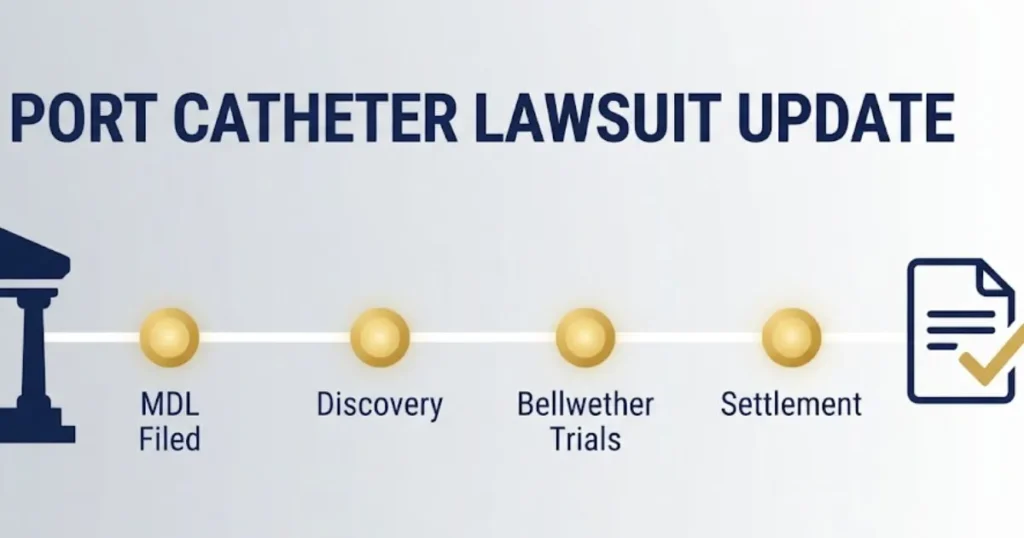
Port Catheter Lawsuit Update
The most significant port catheter lawsuit update involves the growing case count and the court’s push toward bellwether trials. As of early 2026, the MDL has exceeded 3,000 individual claims, up from roughly 1,500 in mid-2024.
Judge David G. Campbell has set an aggressive schedule to keep things moving. Discovery deadlines have been extended for some cases but tightened for the bellwether pool. Both sides have exchanged millions of pages of internal documents.
One major development is the release of internal communications from Bard and its parent company Becton Dickinson. Plaintiffs allege these documents show the company was aware of catheter fracture risks years before taking action.
The FDA’s MAUDE database has also become a focal point. Thousands of adverse event reports involving port catheters have been filed with the agency, and plaintiff attorneys are using that data to support their claims of widespread device failure.
Key Update Summary:
| Development | Status |
|---|---|
| Total MDL Cases | Over 3,000 |
| Discovery Phase | Ongoing, significant documents exchanged |
| Bellwether Selection | In progress |
| Settlement Talks | Not yet formal |
| New Filings Accepted | Yes |
The pace of this litigation suggests 2026 will be the most eventful year yet.
Key Takeaway: The port catheter lawsuit has tripled in size since 2024, and 2026 marks the year when bellwether trials, settlement discussions, and critical court rulings could reshape the entire case.
Port Catheter Lawsuit Update 2026
The port catheter lawsuit update for 2026 shows a litigation that is maturing rapidly, with several pivotal events expected before year’s end. Courts have signaled that the time for procedural delays is over.
Early in 2026, Judge Campbell issued case management orders designed to accelerate the bellwether process. A pool of roughly 20 to 30 cases has been narrowed for potential trial. The court wants at least 2 to 3 bellwether trials scheduled before 2027.
Expert reports have been filed on both sides. Plaintiffs retained biomedical engineers and interventional radiologists who will testify about design defects. The defense has countered with their own experts arguing the devices met FDA standards and performed within expected tolerances.
What the court is really trying to answer in 2026:
- Did Bard know about fracture risks and fail to warn?
- Are the catheter materials (polyurethane) inherently prone to failure?
- Did Bard’s testing protocols meet industry standards?
- Were adverse events properly reported to the FDA?
If bellwether trials go well for plaintiffs, expect settlement negotiations to accelerate. If the defense wins early trials, some weaker cases may be dismissed. Either way, 2026 is the hinge year for this litigation.
Bard PowerPort Lawsuit
The Bard PowerPort lawsuit is the largest segment of the broader port catheter litigation, accounting for the majority of filed claims. C.R. Bard, now owned by Becton Dickinson, manufactured several versions of the PowerPort that plaintiffs say were defective.
The PowerPort was marketed as a power-injectable port, meaning it could handle the high-pressure injection of contrast dyes used in CT scans. That feature made it extremely popular with oncologists and radiologists. Millions of PowerPort devices were implanted in the United States.
The problem, according to lawsuits, is that the catheter portion of the device was prone to fracturing under normal use conditions. When a catheter fractures, the broken piece can travel through the bloodstream and lodge in the heart, lungs, or major blood vessels.
Bard PowerPort Models Named in Lawsuits:
| Model | FDA Cleared | Power Injectable | Material |
|---|---|---|---|
| Bard PowerPort isp | Yes | Yes | Polyurethane |
| Bard PowerPort MRI | Yes | Yes | Polyurethane |
| Bard PowerPort Slim | Yes | Yes | Polyurethane |
| Bard M.R.I. Port | Yes | No | Silicone |
Plaintiffs argue that Bard chose polyurethane over silicone to save money, even though polyurethane degrades faster inside the body. That material choice is at the core of many claims.
Becton Dickinson maintains the devices are safe and that complications are rare relative to the total number implanted. The company has not issued a recall.
Port Catheter Lawsuit Settlement Amounts
Port catheter lawsuit settlement amounts have not been officially determined yet because no settlements have been finalized as of early 2026. However, legal analysts have projected ranges based on comparable medical device MDLs.
Think of it like pricing a house before appraisal. You look at what similar homes sold for in the neighborhood. In medical device litigation, the “neighborhood” includes cases like the IVC filter lawsuits, hernia mesh lawsuits, and hip implant cases.
Based on those comparisons, here are projected settlement ranges:
| Injury Tier | Estimated Settlement Range | Examples of Injuries |
|---|---|---|
| Tier 1 (Severe) | $250,000 to $750,000+ | Cardiac tamponade, wrongful death, permanent organ damage |
| Tier 2 (Serious) | $100,000 to $250,000 | Emergency surgery to retrieve fragment, pulmonary embolism |
| Tier 3 (Moderate) | $50,000 to $100,000 | Catheter fracture requiring removal, deep vein thrombosis |
| Tier 4 (Minor) | $10,000 to $50,000 | Infection requiring extended treatment, minor migration |
These numbers are estimates only. Actual settlement values will depend on bellwether trial outcomes, the strength of individual evidence, and how aggressively Becton Dickinson negotiates.
Cases involving wrongful death or permanent cardiac damage will likely command the highest payouts. Cases where the catheter fractured but was successfully retrieved with minimal complications will fall on the lower end.
Key Takeaway: While no settlements have been paid out yet, projected payouts range from $10,000 for minor injuries to over $750,000 for severe or fatal complications, based on comparable medical device litigation outcomes.
Port Catheter Lawsuit Payout
The port catheter lawsuit payout process will not begin until either a global settlement is reached or individual trials produce verdicts. As of 2026, no payouts have been distributed to claimants.
That said, the timeline for payouts is starting to come into focus. If bellwether trials occur in late 2026 or early 2027 and produce plaintiff-favorable verdicts, settlement talks could begin shortly after. In similar MDLs, global settlements have taken 6 to 18 months to finalize after bellwether results.
Here is a realistic payout timeline projection:
| Phase | Expected Timing |
|---|---|
| Bellwether Trials | Late 2026 to early 2027 |
| Settlement Negotiations | 2027 |
| Settlement Agreement | Mid to late 2027 |
| Claims Processing | Late 2027 to 2028 |
| First Payouts | 2028 |
Several factors will affect individual payout amounts:
- Severity of injury: Life-threatening complications pay more.
- Medical documentation: Strong records of device failure matter.
- Proof of causation: Linking the injury directly to the device is essential.
- Number of surgeries required: Additional procedures increase value.
- Impact on quality of life: Lost wages, ongoing treatment, and disability all factor in.
Patience is required. Medical device MDLs move slowly, but they do move. The IVC filter litigation, a comparable case, took roughly 4 years from MDL formation to significant settlements.
Who Qualifies for Port Catheter Lawsuit
You may qualify for the port catheter lawsuit if you had an implantable port catheter, specifically a Bard PowerPort, and experienced complications like catheter fracture, migration, infection, blood clots, or organ damage.
Qualification is not automatic just because you had a port catheter. You need to show that the device caused you harm.
Basic Eligibility Criteria:
- You had a port catheter implanted (any brand, but especially Bard PowerPort)
- You experienced one or more documented complications
- Your complications required additional medical treatment
- Your claim falls within the applicable statute of limitations
The statute of limitations varies by state. Most states give you 2 to 3 years from the date you discovered (or should have discovered) that your injury was caused by the device. Some states allow longer windows for product liability claims.
Here is a quick eligibility checklist:
| Requirement | Details |
|---|---|
| Device Type | Bard PowerPort, AngioDynamics Smart Port, or similar implantable port |
| Complication | Catheter fracture, migration, thrombosis, infection, cardiac damage |
| Medical Records | Documentation of device-related injury |
| Time Limit | Varies by state, generally 2 to 3 years from discovery |
| Proof of Treatment | Records showing additional surgery, hospitalization, or care |
If you are unsure about your eligibility, the best step is to gather your medical records showing the port implant date, the type of device used, and any records of complications.
Port Catheter Lawsuit Eligibility
Port catheter lawsuit eligibility extends beyond just Bard PowerPort patients, though Bard claims dominate the litigation. Patients who received port devices from other manufacturers may also have valid claims if their device failed.
The key question is not just “did I have a port catheter?” but “did my port catheter injure me?” A patient who had a port successfully removed at the end of treatment with no complications would not have a claim, even if the same device model hurt other patients.
Conditions That Strengthen Eligibility:
- Catheter fractured and a piece migrated to the heart or lungs
- Required emergency surgery to retrieve a broken catheter fragment
- Developed a blood clot (thrombosis) directly related to the port
- Suffered cardiac perforation or tamponade
- Experienced severe infection at the port site that spread systemically
- Port had to be surgically removed ahead of schedule due to malfunction
- Suffered permanent injury or disability as a result
Conditions That May Weaken a Claim:
- Complications were caused by improper implantation technique (surgeon error, not device defect)
- The port was a different brand with no known defect history
- Complications were minor and resolved without additional treatment
- The statute of limitations has expired in your state
An attorney experienced in medical device cases can review your records and determine the strength of your specific claim within a few weeks.
Key Takeaway: You likely qualify if you had a port catheter that fractured, migrated, or caused documented complications requiring additional medical care, but timing and medical records are everything.
Bard PowerPort Complications Lawsuit
The Bard PowerPort complications lawsuit centers on a pattern of device failures that plaintiffs say were predictable and preventable. The most commonly reported complication is catheter fracture, but the list of injuries is much longer than most people realize.
When a polyurethane catheter breaks inside the body, the fragment becomes a projectile in the bloodstream. It can puncture blood vessel walls, lodge in heart chambers, or block blood flow to the lungs. Some patients have died from these events.
Most Common Bard PowerPort Complications Cited in Lawsuits:
- Catheter fracture: The catheter snaps, usually near the connection to the port body
- Catheter migration: The broken piece travels through the bloodstream
- Embolization: The fragment lodges in a vital organ or blood vessel
- Thrombosis: Blood clots form around the catheter
- Infection: Bacterial contamination at the port site or in the bloodstream
- Cardiac perforation: The catheter or fragment punctures the heart wall
- Cardiac tamponade: Fluid accumulates around the heart after perforation
- Extravasation: Fluids leak into surrounding tissue instead of entering the bloodstream
The FDA’s MAUDE database contains thousands of adverse event reports related to port catheters. Many of these reports describe near-fatal outcomes that required emergency intervention.
Plaintiffs argue that Bard received these adverse event reports for years and failed to redesign the product, strengthen warnings, or issue a recall. That failure to act is the foundation of the negligence claims.
Port Catheter Injury Claims
Port catheter injury claims are individual legal actions filed by patients who suffered physical harm from a defective port device. Each claim is unique because each patient’s injuries, medical history, and experience with the device are different.
What separates a strong claim from a weak one is documentation. The more medical evidence you have linking your injury to the port catheter, the stronger your case becomes. Think of medical records as the backbone of your entire claim.
What Makes a Strong Injury Claim:
| Factor | Strong Claim | Weak Claim |
|---|---|---|
| Device Identification | Exact model and lot number documented | Generic “port catheter” in records |
| Injury Documentation | Imaging showing fracture or migration | Verbal complaint only, no imaging |
| Causation Link | Doctor notes attribute injury to device | Records are ambiguous about cause |
| Treatment Records | Emergency surgery, ICU stay, follow-up care | Minor outpatient visit |
| Timeline | Complications within expected device lifespan | Occurred 10+ years after implant |
Some patients do not realize their complications were caused by the device. They may have been told by a doctor that “these things happen” or that the complication was unrelated. If you had port complications and were not given a clear explanation, it is worth having your records reviewed.
The number of injury claims continues to grow. New patients discover the connection between their complications and their port device every month, often after seeing news coverage of the lawsuits.
How to File a Port Catheter Lawsuit
Filing a port catheter lawsuit starts with gathering your medical records and contacting an attorney who handles medical device cases. The process is straightforward, but it does require some preparation on your part.
You do not need to go to court yourself, at least not initially. Most of these cases are handled through the MDL process, meaning your individual claim gets grouped with thousands of others for pretrial proceedings. Your attorney manages the legal work.
Step-by-Step Filing Process:
- Collect your medical records showing the type of port implanted, the date of implantation, and any documented complications
- Identify the device by brand, model, and lot number if available (this information is usually in your surgical records)
- Contact a law firm that specializes in medical device or product liability litigation
- Complete a case evaluation where the attorney reviews your records and injury history
- Sign a retainer agreement if the firm accepts your case (most work on contingency, meaning no upfront cost)
- Your case is filed and added to the MDL or filed in state court depending on strategy
What You Will Need:
- Surgical implant records
- Post-implant complication records
- Imaging (X-rays, CT scans, fluoroscopy showing fracture or migration)
- Hospital discharge summaries
- Pharmacy records if relevant
- A timeline of symptoms and treatments
Most attorneys handle port catheter cases on contingency. That means they get paid only if you win or settle. Typical contingency fees range from 33% to 40% of the recovery amount.
Key Takeaway: Filing is easier than most people expect. Gather your medical records, identify your device, and contact a medical device attorney. Most firms work on contingency, so you pay nothing upfront.
Port Catheter Class Action vs Mass Tort
The port catheter litigation is a mass tort, not a class action. That distinction matters because it affects how much money you could receive and how your case is handled.
In a class action, everyone gets the same payout regardless of individual injuries. One lead plaintiff represents the entire group, and a single settlement amount is divided equally among all members. Class actions work well for cases where everyone suffered the same minor harm, like being overcharged for a product.
Mass torts are different. Each plaintiff files their own individual case with their own specific injuries. Your settlement amount reflects your unique damages: how badly you were hurt, what surgeries you needed, and how the injury affected your life.
Class Action vs Mass Tort Comparison:
| Feature | Class Action | Mass Tort |
|---|---|---|
| Individual Case? | No, one case for the group | Yes, each person has their own case |
| Payout Based On | Equal split among all members | Individual injury and damages |
| Potential Payout | Usually small ($10 to $500 per person) | Can be $50,000 to $750,000+ |
| Attorney Relationship | One attorney for the whole class | Each plaintiff has their own attorney |
| Opt-In Required? | Usually opt-out (you’re included by default) | Must actively file a claim |
| Trial Potential | Rare | Bellwether trials test individual cases |
The mass tort structure means your port catheter case could yield a significantly higher payout than a class action ever would. But it also means you have to actively file a claim. Nobody will add you automatically.
This distinction is one of the most misunderstood aspects of the litigation. People often search for “port catheter class action” when what they really want is the mass tort.
Port Catheter MDL
The port catheter MDL (multidistrict litigation) is the federal legal structure organizing thousands of individual port catheter cases under one judge for pretrial efficiency. The MDL is designated as MDL No. 3081 and is centralized in the U.S. District Court for the District of Arizona.
An MDL is not a trial itself. Think of it as a pretrial staging area. All the federal cases get consolidated so that discovery, expert challenges, and procedural motions happen once instead of thousands of times in different courts. This saves years of duplicated work.
How the MDL Process Works:
- Cases from across the country are transferred to Arizona
- One judge (Judge David G. Campbell) manages all pretrial matters
- Discovery is conducted centrally for all cases
- Bellwether trials are selected from the MDL pool
- If no global settlement is reached, individual cases get sent back to their original courts for trial
| MDL Detail | Information |
|---|---|
| MDL Number | 3081 |
| Court | U.S. District Court, District of Arizona |
| Judge | David G. Campbell |
| Primary Defendant | Becton Dickinson / C.R. Bard |
| Estimated Pending Cases | 3,000+ as of early 2026 |
| Status | Discovery and bellwether selection |
Some state court cases exist outside the MDL. If you filed in state court, your case may proceed on a different timeline. However, MDL rulings often influence state court proceedings and settlement negotiations.
Port Catheter Bellwether Trial 2026
Port catheter bellwether trials in 2026 are the single most important development to watch because their outcomes will likely determine whether a global settlement happens. Bellwethers are test cases that give both sides a preview of how juries respond to the evidence.
The court selects a small number of representative cases from the MDL pool. These cases are chosen to reflect different injury types, different device models, and different factual scenarios. The idea is to test the strongest and weakest versions of both sides’ arguments.
What Bellwether Trials Will Test:
- Whether Bard’s PowerPort had a design defect
- Whether Bard adequately warned doctors and patients about fracture risks
- Whether the polyurethane material was inherently unsuitable for long-term implant use
- The extent of damages for different injury categories
If plaintiffs win the first bellwether trials, Becton Dickinson faces enormous pressure to settle. A single jury verdict of $5 million or more, multiplied across 3,000+ cases, creates a financial incentive to negotiate rather than fight each case individually.
If the defense wins, it signals that the evidence may not be strong enough for large payouts. Some cases might be dismissed, and settlement offers would be lower.
Projected Bellwether Timeline for 2026:
| Milestone | Expected Date |
|---|---|
| Final Bellwether Case Selection | Spring 2026 |
| Pretrial Motions and Daubert Hearings | Spring to Summer 2026 |
| First Bellwether Trial | Late 2026 |
| Second Bellwether Trial | Early 2027 |
The specific cases selected for bellwether trials have not been publicly announced yet. Both sides typically propose candidates and the judge makes the final selection.
Key Takeaway: Bellwether trials expected in late 2026 will be the single biggest factor in determining whether Becton Dickinson settles and how much money claimants ultimately receive.
Port Catheter Lawsuit Timeline
The port catheter lawsuit timeline spans several years, from the earliest individual cases through the current MDL phase and into projected future milestones. Understanding where things stand helps set realistic expectations.
Medical device litigation is a marathon, not a sprint. The IVC filter MDL, which involved similar vascular device claims, took roughly 5 years from consolidation to major settlements. The port catheter litigation appears to be following a comparable path.
Complete Timeline:
| Date | Event |
|---|---|
| 2018 to 2020 | Early individual lawsuits filed against Bard in various state and federal courts |
| 2021 to 2022 | Case filings increase as more patients report complications |
| August 2023 | MDL 3081 established; cases consolidated in Arizona |
| Late 2023 | Judge Campbell appointed; initial case management orders issued |
| 2024 | Discovery phase begins; document production between parties |
| Early 2025 | Plaintiff and defense expert reports filed; case count surpasses 1,500 |
| Mid 2025 | Bellwether case pool identified; Daubert motions filed |
| Early 2026 | Case count exceeds 3,000; discovery ongoing |
| Spring 2026 | Final bellwether selections; pretrial motions |
| Late 2026 | First bellwether trial expected |
| 2027 | Additional bellwether trials; possible settlement negotiations |
| 2027 to 2028 | Global settlement possible; claims processing begins |
| 2028+ | First payouts to claimants if settlement is reached |
This timeline is a projection based on the court’s current schedule and patterns from comparable MDLs. Delays are always possible. Courts get backed up, judges extend deadlines, and parties request continuances.
The key message is this: filing sooner rather than later protects your legal rights and ensures your case is included as things move forward. Waiting until 2027 or 2028 could mean missing important deadlines.
Frequently Asked Questions
How much money can I get from a port catheter lawsuit?
Estimated payouts range from $10,000 to over $750,000 depending on injury severity.
Cases involving wrongful death or cardiac damage are valued highest.
No official settlements have been paid out yet as of early 2026.
Is there a deadline to file a port catheter lawsuit in 2026?
Yes, statutes of limitations apply and vary by state, generally 2 to 3 years from discovery of injury.
Some states have longer windows for product liability claims.
Filing in 2026 while the MDL is active is strongly recommended.
What injuries qualify for the port catheter lawsuit?
Qualifying injuries include catheter fracture, migration, embolization, blood clots, infection, and cardiac damage.
You need documented medical evidence linking your injury to the port device.
Emergency surgery to retrieve a broken fragment is one of the strongest qualifying factors.
Is the port catheter lawsuit a class action?
No, the port catheter lawsuit is a mass tort, not a class action.
Each plaintiff files an individual case with unique injury details.
This structure means payouts are based on your specific damages rather than an equal split.
When will port catheter lawsuit settlements be paid out?
First payouts are projected for 2028 if bellwether trials proceed as scheduled in late 2026 and settlement negotiations follow.
The exact timing depends on trial outcomes and how quickly both sides reach agreement.
Claims processing typically takes 6 to 12 months after a settlement is finalized.
What to Do Right Now
The port catheter lawsuit is building toward its most consequential phase. If you had a port catheter that caused harm, 2026 is the time to file and get your claim on the record.
Pull your medical records. Find out what device was implanted. Look for documentation of any complications you experienced after implantation.
Getting into this litigation before bellwether trials begin gives you the strongest position. The window is open now, but statutes of limitations are always ticking. Act while you still can.







