

Pennsylvania lawsuit loans let plaintiffs access cash from a pending case before it settles. If you’re stuck waiting months or years for your injury case to resolve, this type of funding could keep you financially afloat.
But it comes with real costs. Some funding companies charge rates that can eat up half your settlement. In 2026, the average pre-settlement advance in PA carries annualized rates between 27% and 60%.
This guide breaks down everything Pennsylvania plaintiffs need to know. You’ll learn who qualifies, what it actually costs, how PA law treats these transactions, and whether a lawsuit loan makes sense for your situation.
By the time you finish reading, you’ll know exactly what to watch out for. No sales pitch. Just the facts.
Pennsylvania Lawsuit Loans
Pennsylvania lawsuit loans are cash advances given to plaintiffs while their legal cases are still pending. They are not traditional loans in the banking sense because repayment depends entirely on the outcome of your case.
If you lose, you owe nothing. That’s the core promise of non-recourse funding. The funding company takes on the risk that your case might fail, and in exchange, they charge higher rates than a typical lender would.
In 2026, the lawsuit funding industry in Pennsylvania continues to grow. More companies are competing for plaintiff business across the state, from Philadelphia to Pittsburgh and everywhere in between.
The typical funding range for PA plaintiffs looks like this:
| Detail | Info |
|---|---|
| Minimum Advance | $500 |
| Maximum Advance | $100,000 or more |
| Average Funding | $3,000 to $15,000 |
| Repayment Trigger | Case settlement or verdict |
| Credit Check | Not required |
Most plaintiffs use these funds to cover rent, medical bills, and everyday expenses. The pressure to settle quickly for a lowball offer is real when you can’t pay your bills. Lawsuit loans are designed to relieve that pressure.
Pennsylvania has no specific statute dedicated solely to lawsuit funding. The industry operates under a patchwork of contract law, consumer protection rules, and the PA Loan Broker Act.
What Are Lawsuit Loans in Pennsylvania
Lawsuit loans in Pennsylvania are non-recourse cash advances provided to plaintiffs with active legal claims. The term “loan” is actually a bit misleading because these transactions function more like investments.
A funding company reviews your case. If they believe it has value, they advance you money. You sign an agreement promising to repay the advance, plus fees, from your settlement or verdict.
Here’s the key difference from a bank loan: if your case loses, you walk away owing zero. The funding company absorbs the loss. That risk transfer is what separates lawsuit funding from every other type of borrowing.
Pennsylvania courts have generally treated these agreements as purchases of a portion of future settlement proceeds, not as traditional loans. This distinction matters because it affects which regulations apply.
Think of it like selling a small slice of your future pie. You get cash now, but your pie gets smaller when it finally arrives. The funding company is betting your pie will be big enough to cover their investment and then some.
In 2026, dozens of companies offer this product to PA residents. Competition has driven some rates down, but the range remains wide.
How Do Lawsuit Loans Work in PA
The process starts when a plaintiff contacts a funding company and submits basic case information. The company then reaches out to your attorney to evaluate the strength and estimated value of your claim.
Here’s how the typical process flows in Pennsylvania:
- Step 1: You fill out an application with your name, case type, and attorney details.
- Step 2: The funding company contacts your attorney for case documents.
- Step 3: An underwriter reviews your case’s merits and estimated value.
- Step 4: The company makes you a funding offer with terms and fees.
- Step 5: You accept, sign the agreement, and receive funds.
- Step 6: When your case settles, the company gets repaid from your proceeds.
Your attorney plays a central role. Most funding companies won’t move forward without attorney cooperation. Your lawyer must confirm the case details and agree to direct repayment from settlement funds.
The repayment comes straight off the top of your settlement check. Before you see a dime, the funding company, your attorney, and any medical lienholders all get paid first.
What’s left after all those deductions is yours. That amount can be significantly less than you expected, especially if your case took years to resolve and the funding fees compounded over time.
Key Takeaway: Pennsylvania lawsuit loans are non-recourse advances on pending cases where you owe nothing if you lose, but fees can significantly reduce your final settlement take-home.
Who Qualifies for Lawsuit Loans in Pennsylvania
Qualifying for a lawsuit loan in Pennsylvania depends on the strength of your case, not your credit score. Funding companies care about your claim’s value, not your financial history.
Most companies require these basic criteria:
- You must have an active lawsuit filed in Pennsylvania or involving a PA resident
- You must be represented by an attorney
- Your case must have a reasonable chance of resulting in a settlement or verdict
- The estimated case value must exceed the requested funding amount by a comfortable margin
Here’s what they typically don’t check:
| Factor | Required? |
|---|---|
| Credit Score | No |
| Employment Status | No |
| Income Verification | No |
| Collateral | No |
| Case Filed in PA | Yes |
| Attorney Representation | Yes |
| Liable Defendant | Yes |
The single most important factor is liability. If the defendant is clearly at fault, your case is much more likely to get funded. Cases with disputed liability or shared fault under Pennsylvania’s comparative negligence rules may face rejection.
Your attorney’s reputation matters too. Funding companies prefer working with experienced injury attorneys who have a track record of settling cases successfully. If your lawyer is fresh out of law school with no settlement history, it could slow down or prevent approval.
The amount you qualify for usually ranges from 10% to 20% of your case’s estimated value. A case worth $100,000 might get you $10,000 to $20,000 in funding.
Pennsylvania Personal Injury Lawsuit Loans
Personal injury cases make up the vast majority of lawsuit loan applications in Pennsylvania. These include slip and fall injuries, dog bites, medical malpractice, and premises liability claims.
PA is a modified comparative fault state with a 51% bar. That means you can still recover damages as long as you are less than 51% at fault. Funding companies factor this threshold into every decision they make about your case.
Common personal injury case types funded in Pennsylvania:
- Slip and fall accidents at stores, restaurants, or public properties
- Medical malpractice involving surgical errors, misdiagnosis, or birth injuries
- Premises liability for unsafe building conditions
- Dog bite claims under PA’s strict liability statute
- Nursing home abuse cases
Medical malpractice cases in PA require a Certificate of Merit from a licensed physician before filing. Funding companies view this requirement as a positive signal because it means a medical expert has already reviewed and supported your claim.
Personal injury lawsuit loans in Pennsylvania typically fund faster when the case involves clear liability and documented injuries. Cases with strong medical records and police reports are ideal candidates.
The average personal injury lawsuit loan in PA ranges from $2,500 to $25,000. Larger cases involving catastrophic injuries can receive significantly more.
Car Accident Lawsuit Loans Pennsylvania
Car accident cases are the single most funded case type for Pennsylvania lawsuit loans. Pennsylvania’s unique insurance system creates situations where lawsuit funding becomes especially useful.
PA is a choice no-fault state. When you buy car insurance, you choose between “limited tort” and “full tort” options. If you chose limited tort, your ability to sue is restricted unless you suffered a “serious injury.”
This distinction directly affects lawsuit loan eligibility:
| Insurance Choice | Can You Sue? | Lawsuit Loan Eligible? |
|---|---|---|
| Full Tort | Yes, for any injury | Yes, most cases qualify |
| Limited Tort | Only for serious injuries | Maybe, depends on injury severity |
| Uninsured Motorist | Depends on your policy | Yes, if claim is viable |
Funding companies pay close attention to whether you had full tort or limited tort coverage. Full tort policyholders have much easier paths to funding because they face fewer legal barriers to recovery.
Common car accident scenarios that get funded in PA include rear-end collisions, drunk driving accidents, intersection crashes, and commercial truck accidents. Cases involving commercial vehicles often have higher policy limits, which makes funding companies more willing to advance larger amounts.
If you were in a car accident in Pennsylvania and your case is still pending, you’re likely eligible for a lawsuit loan. The key factor is having an attorney who has already filed or is preparing to file a claim against the at-fault party.
Workers Comp Lawsuit Loans PA
Workers compensation lawsuit loans in Pennsylvania are trickier than other case types. Standard workers comp claims processed through the PA Bureau of Workers Compensation are generally not eligible for lawsuit funding.
Here’s why: workers comp benefits are statutory. They flow through a structured system, not through a lawsuit against a defendant with insurance. Most funding companies can’t attach a lien to workers comp benefits the same way they can with a personal injury settlement.
However, there are exceptions:
- Third-party liability claims where someone other than your employer caused your injury
- Disputed workers comp claims that have gone to litigation before a Workers Compensation Judge
- Cases involving employer negligence beyond normal workers comp scope
If a construction worker gets hurt because of a defective scaffold made by a third-party manufacturer, that worker might have both a workers comp claim and a personal injury lawsuit. The personal injury lawsuit against the manufacturer is what a funding company would advance money against.
| Scenario | Fundable? |
|---|---|
| Standard workers comp claim | No |
| Third-party liability with workers comp | Yes |
| Disputed claim in litigation | Sometimes |
| Federal workers comp (FELA) | Yes |
Railroad workers injured on the job file claims under the Federal Employers Liability Act (FELA), not state workers comp. FELA cases are lawsuit-based, which makes them eligible for pre-settlement funding.
If you’re a PA worker trying to get a lawsuit loan, talk to your attorney about whether your situation involves a third-party claim.
Key Takeaway: Car accident cases with full tort coverage are the easiest to fund in Pennsylvania, while standard workers comp claims almost never qualify unless a third-party lawsuit is involved.
How to Apply for a Lawsuit Loan in Pennsylvania
Applying for a lawsuit loan in Pennsylvania takes about 10 to 15 minutes for the initial application. The entire process from first call to cash in hand can happen within 24 to 72 hours in straightforward cases.
Here’s what you’ll need to get started:
- Your full name and contact information
- Your attorney’s name, firm, and phone number
- The type of case (car accident, slip and fall, etc.)
- The defendant’s name or the incident details
- The county where your case is filed
- An estimate of when the case might settle
Most companies accept applications by phone, online form, or even text message. The real bottleneck is not the application itself but the attorney cooperation step that follows.
After you apply, the funding company contacts your lawyer. They’ll request case documents including police reports, medical records, and any demand letters or settlement offers already on the table.
Your attorney does not work for the funding company. Some lawyers cooperate freely. Others drag their feet because they dislike lawsuit loans or consider them harmful to clients. You have every right to ask your attorney to cooperate, but you can’t force them.
Once the company has the case documents, underwriting begins. A case analyst reviews the merits, estimates the value, and decides how much to offer. The better your documentation, the faster this goes.
Sign the agreement, and funds typically arrive via wire transfer or direct deposit.
How Fast Can You Get a Lawsuit Loan in PA
Most Pennsylvania plaintiffs receive lawsuit loan funds within 24 to 48 hours after approval. The total timeline from application to money depends on how quickly your attorney responds to the funding company’s requests.
Here’s a realistic timeline breakdown:
| Stage | Typical Duration |
|---|---|
| Application Submission | 10 to 15 minutes |
| Attorney Contact | Same day to 2 days |
| Case Document Review | 1 to 3 days |
| Underwriting Decision | 1 to 2 days |
| Contract Signing | Same day |
| Funds Disbursement | 24 hours after signing |
| Total (Best Case) | 24 to 48 hours |
| Total (Average) | 3 to 5 business days |
The biggest delay is almost always your attorney. If your lawyer responds quickly and sends documents the same day, you could have money by tomorrow. If they’re busy, on vacation, or skeptical of funding companies, it could take a week or longer.
Some funding companies advertise “same-day funding.” That’s technically possible but rare. It requires your attorney to be immediately available, your case documents to be ready, and the underwriter to approve on the spot.
In 2026, some PA funding companies offer digital document submission and e-signatures. These tech upgrades have cut processing times compared to even two years ago.
If you need money urgently, call the funding company and tell them. Then call your attorney and ask them to prioritize the document request. Those two calls can shave days off the process.
How Does the Lawsuit Loan Approval Process Work in Pennsylvania
The approval process for Pennsylvania lawsuit loans centers on case merit, not borrower creditworthiness. Underwriters act like case analysts, evaluating whether your lawsuit is likely to produce a recovery large enough to repay the advance.
The underwriting team looks at several factors:
- Liability clarity: Is the defendant clearly at fault?
- Injury severity: How serious are your documented injuries?
- Medical treatment: Have you followed through with doctors and therapy?
- Insurance coverage: Does the defendant have sufficient insurance?
- Case stage: Has discovery been completed? Any depositions taken?
- Attorney track record: Does your lawyer settle cases or go to trial?
Cases further along in the legal process tend to get approved faster and for larger amounts. If your attorney has already sent a demand letter or received a settlement offer, that’s a strong positive signal.
Early-stage cases with no medical records or minimal documentation face higher rejection rates. Funding companies need evidence that your claim has substance, not just your word.
Approval rates vary by company. Industry estimates suggest roughly 40% to 60% of applications get funded. The most common reasons for denial include unclear liability, insufficient medical documentation, and low estimated case value.
One detail PA plaintiffs should know: the funding company will place a lien on your case. This lien means they have a legal right to repayment from your settlement proceeds before you receive your share.
Key Takeaway: Speed of funding depends almost entirely on your attorney’s responsiveness, and approval hinges on case strength, not your credit score or income.
Pennsylvania Lawsuit Loan Interest Rates
Interest rates on Pennsylvania lawsuit loans typically range from 2% to 4% per month, which translates to annualized rates of 27% to 60% or higher. Some companies use compounding interest, which can push the effective rate even higher over time.
These rates shock a lot of people. Compared to a credit card at 20% APR or a personal loan at 10% APR, lawsuit loan rates are extremely expensive.
Here’s why rates are so high: funding companies take on the risk of total loss. If your case fails, they get nothing back. That risk premium gets baked into the price.
| Rate Structure | Monthly Rate | Annual Rate | $5,000 Cost After 12 Months |
|---|---|---|---|
| Simple Interest | 3% per month | 36% | $6,800 |
| Compounding Interest | 3% per month | ~42.6% | $7,130 |
| Flat Fee | One-time 15% | N/A | $5,750 |
The difference between simple and compound interest matters enormously. With compounding, you’re paying interest on top of previous interest. Over two or three years, compounding can nearly double your repayment amount.
In 2026, a small but growing number of funding companies have started offering capped or flat-fee structures in Pennsylvania. These caps limit the total repayment regardless of how long your case takes.
Always ask about the rate structure before signing. Get the total repayment amount in writing. If a company won’t give you a clear answer on what you’ll owe in 12, 18, and 24 months, walk away.
How Much Do Lawsuit Loans Cost in Pennsylvania
The true cost of a lawsuit loan in Pennsylvania depends on three variables: the amount you borrow, the interest rate structure, and how long your case takes to settle. Time is the biggest cost driver.
Let’s look at a real-world example. Say you take a $10,000 advance at 3% monthly compounding interest.
| Time to Settlement | Total Repayment | Total Cost (Fees Only) |
|---|---|---|
| 6 months | $11,941 | $1,941 |
| 12 months | $14,258 | $4,258 |
| 18 months | $17,024 | $7,024 |
| 24 months | $20,328 | $10,328 |
| 36 months | $28,983 | $18,983 |
At the 24-month mark, you’ve paid back more than double what you received. By 36 months, you owe nearly triple. This is why timing matters so much.
PA personal injury cases take an average of 18 to 30 months to settle. Some medical malpractice cases stretch to four years or more. The longer your case takes, the more expensive the funding becomes.
Some companies charge additional fees on top of interest. Application fees, processing fees, and origination fees can add $200 to $500 to your total cost.
Before you sign anything, ask the company to provide a full amortization schedule. This document shows exactly what you’ll owe at every point in time. If they refuse to provide one, that’s a red flag.
Lawsuit Loan Fees and Repayment in PA
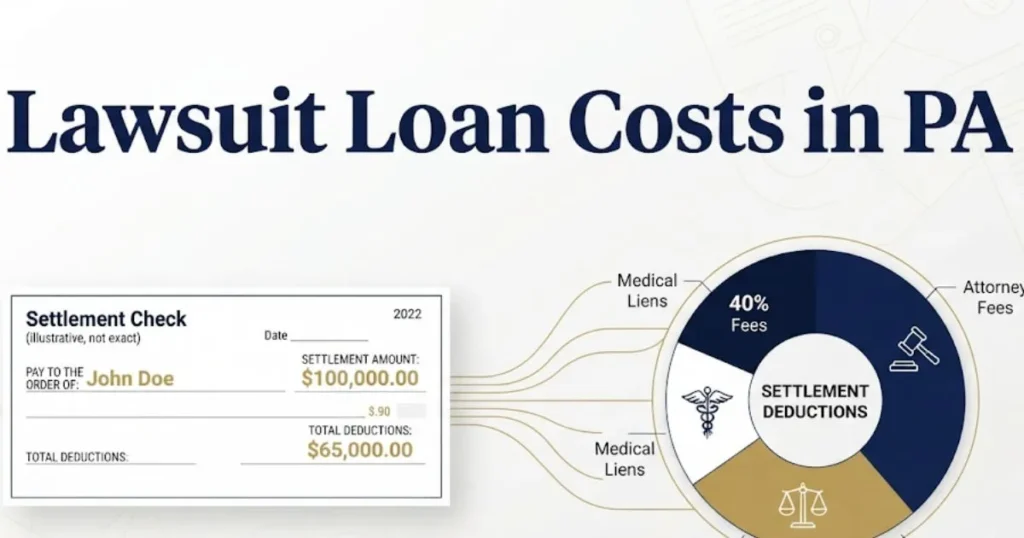
Repayment of lawsuit loan fees in PA happens automatically from your settlement proceeds. You never write a check or make monthly payments. Everything comes out of your final settlement or verdict.
Here’s how the money flows when your case resolves:
- Settlement check arrives at your attorney’s office
- Attorney fees come out first (typically 33% to 40% of the gross settlement)
- Medical liens get paid next
- Lawsuit loan repayment gets deducted
- Case costs (filing fees, expert witnesses, depositions) are subtracted
- Your share is whatever remains
This waterfall structure means every dollar that goes to the funding company is a dollar you don’t get. On a $50,000 settlement, the math can look brutal.
| Deduction | Amount |
|---|---|
| Gross Settlement | $50,000 |
| Attorney Fee (33%) | $16,500 |
| Medical Liens | $8,000 |
| Lawsuit Loan Repayment | $14,000 |
| Case Costs | $3,000 |
| Your Take-Home | $8,500 |
In this scenario, the plaintiff walks away with $8,500 from a $50,000 settlement. That’s 17 cents on the dollar.
Nobody shows you this table when you apply for funding. But this is the reality many Pennsylvania plaintiffs face.
Some funding agreements include a “buyout” option. This lets you repay early at a reduced rate if your case settles quickly. Always check whether your agreement includes early repayment terms.
Hidden fees are a real concern. Watch for administrative charges, wire transfer fees, and renewal fees if you request additional funding. Read every page of the contract before signing.
Key Takeaway: Between attorney fees, medical liens, and lawsuit loan repayment, your take-home from a PA settlement can be a fraction of the total amount, so understand the full cost before borrowing.
Pennsylvania Laws on Pre-Settlement Funding
Pennsylvania does not have a specific statute that directly regulates the lawsuit funding industry. As of 2026, pre-settlement funding operates in a legal gray area under existing consumer protection and contract law.
Several legal frameworks touch on the industry:
- PA Loan Broker Act: Some regulators argue that funding companies function as loan brokers and should register under this act. The industry disputes this classification.
- PA Unfair Trade Practices and Consumer Protection Law (UTPCPL): This broad statute prohibits deceptive business practices and could apply to misleading funding agreements.
- Contract Law: Funding agreements are generally governed by standard contract principles, meaning the terms you sign are enforceable unless proven unconscionable.
The legal question of whether lawsuit funding is a “loan” or a “purchase of future proceeds” remains unsettled in Pennsylvania. Courts in other states have split on this issue. PA courts have not issued a definitive ruling.
Why does this matter to you? If lawsuit funding is classified as a loan, it falls under usury laws that cap interest rates. Pennsylvania’s usury cap is 6% for most consumer transactions. At 36% to 60% annualized rates, every funding company in the state would be in violation.
If it’s classified as a purchase, usury caps don’t apply. The funding company is buying a financial interest in your case, not lending you money. Most companies structure their agreements to support this interpretation.
In 2026, the Pennsylvania legislature has seen proposals to create a dedicated regulatory framework for lawsuit funding. None have passed into law yet. The American Legal Finance Association (ALFA) has lobbied for industry-friendly regulations nationwide.
Until PA passes specific legislation, plaintiffs should treat the funding agreement as a binding contract. Read every word. Ask your attorney to review it before you sign.
Risks of Lawsuit Loans in Pennsylvania
The biggest risk of lawsuit loans in Pennsylvania is the total cost eating into your settlement far more than you anticipated. Many plaintiffs regret the decision once they see their final payout.
Here are the specific risks PA plaintiffs face:
- Compounding interest can turn a $5,000 advance into $15,000 or more over time
- Settlement pressure may increase because your attorney knows the funding balance is growing
- Reduced take-home pay after all deductions can leave you with surprisingly little
- Multiple fundings can stack up if you go back for additional advances
- Predatory companies exist in the market with hidden fees and misleading terms
- Privacy concerns arise because the funding company gains access to your case details
Taking multiple advances is particularly dangerous. Some plaintiffs start with $3,000, then go back for $5,000 more, then another $2,000. Each advance has its own fee structure. The cumulative repayment can consume most of a settlement.
Another risk: settlement timing pressure. Your attorney might push for a faster, lower settlement because the lawsuit loan balance is ballooning. That’s the opposite of what the funding was supposed to accomplish. The whole point was to give you time to hold out for a fair offer.
There’s a psychological risk too. Once you spend the money, you feel locked in. Even if you realize the terms are terrible, you can’t undo the agreement. The funding is already spent on rent and groceries.
Be realistic about your case timeline. If your lawsuit might take three years, the cost of a lawsuit loan could be devastating.
Are Lawsuit Loans Worth It in Pennsylvania
Lawsuit loans are worth it for Pennsylvania plaintiffs who are in genuine financial distress and have strong cases with clear liability. For everyone else, the costs usually outweigh the benefits.
Here’s a framework for deciding:
| Your Situation | Worth It? | Why |
|---|---|---|
| Facing eviction while case is pending | Possibly yes | Housing stability is essential |
| Can’t afford medical treatment | Possibly yes | Untreated injuries weaken your case |
| Want extra spending money | No | Too expensive for non-essential needs |
| Case has weak liability | No | High denial risk and case may lose |
| Case likely to settle within 6 months | Maybe | Short timeline limits cost buildup |
| Case may take 3 or more years | Risky | Compounding costs can be massive |
The best candidates for lawsuit loans are plaintiffs who absolutely cannot wait for their case to resolve. If you’re choosing between homelessness and a lawsuit loan, the math changes. A roof over your head has real value even if it costs you $10,000 in funding fees.
The worst candidates are people who can manage financially but want a cash cushion. At 36% to 60% annual rates, this is the most expensive money you’ll ever borrow. A credit card cash advance at 25% APR is cheaper.
Before taking a lawsuit loan in Pennsylvania, exhaust every other option. Family loans, credit cards, personal lines of credit, medical payment plans, and hardship programs all cost less than pre-settlement funding.
If you still need a lawsuit loan after exploring alternatives, take the minimum amount necessary. Not a penny more.
Lawsuit Loans vs Personal Loans in Pennsylvania
The fundamental difference between lawsuit loans and personal loans in Pennsylvania is who bears the risk. With a personal loan, you owe the money no matter what happens with your case. With a lawsuit loan, you only repay if you win.
That risk transfer comes at a steep price.
| Feature | Lawsuit Loan | Personal Loan |
|---|---|---|
| Credit Check Required | No | Yes |
| Interest Rate (Annual) | 27% to 60%+ | 6% to 36% |
| Repayment if You Lose | None | Full repayment still owed |
| Monthly Payments | None during case | Required |
| Approval Based On | Case strength | Credit and income |
| Impact on Credit Score | None | Yes, positive or negative |
| Speed of Funding | 1 to 5 days | 1 to 7 days |
| Regulatory Oversight | Minimal in PA | Heavily regulated |
If you have decent credit, a personal loan is almost always cheaper. Even a high-interest personal loan at 25% APR costs less than most lawsuit loan agreements. And personal loan interest doesn’t compound the same way.
The catch: personal loans require monthly payments. If you’re injured and not working, you might not be able to make those payments. Missed payments damage your credit and could lead to debt collection.
Lawsuit loans have no monthly payment requirement. You don’t pay anything until your case settles. For a plaintiff with zero income and no credit history, a lawsuit loan might be the only option on the table.
Think about it like renting versus buying. A personal loan is cheaper in total cost, just like buying a house saves money over decades of renting. But if you can’t qualify for the mortgage, renting is your only choice.
Key Takeaway: Lawsuit loans cost significantly more than personal loans, but they offer the safety net of non-recourse repayment, so your financial situation and credit profile should determine which option makes sense.
Frequently Asked Questions
Do I need good credit to get a lawsuit loan in Pennsylvania?
No, credit scores are not a factor in lawsuit loan approvals.
Funding companies evaluate your case’s strength and estimated value instead.
Employment status and income are irrelevant to the decision.
What happens if I lose my case after getting a lawsuit loan in PA?
You owe nothing if your case loses at trial or gets dismissed.
The funding company absorbs the full loss because lawsuit loans are non-recourse.
This applies regardless of how much you received.
How long does it take to receive lawsuit loan funds in Pennsylvania?
Most plaintiffs receive funds within 24 to 48 hours after their application is approved.
The full process from application to funding typically takes 3 to 5 business days.
Attorney response time is the biggest factor affecting speed.
Can my attorney refuse to cooperate with a lawsuit loan company?
Yes, your attorney can decline to provide case documents or sign a cooperation letter.
Some lawyers oppose lawsuit loans because of the high costs to their clients.
You can request cooperation, but you cannot force your attorney to participate.
Is there a cap on lawsuit loan interest rates in Pennsylvania in 2026?
Pennsylvania has no specific cap on lawsuit loan interest rates as of 2026.
The standard usury cap of 6% does not apply because courts generally classify these as purchases, not loans.
Proposed legislation to regulate rates has not yet passed in the PA legislature.
What to Do Next
Pennsylvania lawsuit loans can provide real relief when bills pile up during a pending case. Just make sure you understand the full cost before signing any agreement.
Compare offers from at least three funding companies. Ask each one for a written amortization schedule showing your total repayment at 12, 18, and 24 months.
Have your attorney review the contract. Take the smallest amount you need. And keep your eyes on the prize: a fair settlement that leaves money in your pocket.







