

Paragard lawsuit attorneys are representing thousands of women who suffered injuries when their copper IUD broke during removal. If your Paragard device fractured, embedded in your uterus, or required surgery to extract, you may qualify for significant compensation in 2026.
This litigation has grown into one of the largest medical device mass torts in the country. More than 2,400 cases are now consolidated in federal court. Settlements could range from tens of thousands to hundreds of thousands of dollars depending on injury severity.
In this guide, you will learn who qualifies, how much money is at stake, what attorneys charge, and exactly what steps to take. We also cover the latest MDL updates, bellwether trial progress, and filing deadlines you can’t afford to miss.
One fact worth knowing right away: the Paragard IUD has been on the market since 1984, but the lawsuits center on a design flaw that allegedly makes the device prone to snapping apart inside the body.
Paragard Lawsuit Attorneys
Paragard lawsuit attorneys are lawyers who specialize in representing women injured by the Paragard copper IUD. They handle cases involving device breakage, surgical complications, and related injuries on a contingency fee basis.
These attorneys typically work within mass tort litigation. That means they have experience managing cases that involve thousands of plaintiffs suing the same manufacturer. Think of it like hiring a specialist instead of a general practitioner.
The right attorney will handle everything from gathering your medical records to filing your claim in the correct court. You should not have to pay anything upfront. The lawyer gets paid only if you win or settle.
Not every personal injury lawyer handles Paragard cases. You want someone with specific experience in medical device litigation and familiarity with the Paragard MDL.
| What Paragard Attorneys Do | Details |
|---|---|
| Case Evaluation | Review your medical records for free |
| Filing | Submit your claim to the MDL or state court |
| Evidence Gathering | Obtain surgical reports, imaging, and expert opinions |
| Negotiation | Handle settlement talks with CooperSurgical |
| Trial Representation | Represent you if your case goes to trial |
| Fee Structure | Contingency only, no upfront costs |
A good Paragard attorney will be upfront about your case strength. They should tell you honestly whether your injuries and evidence support a viable claim.
Paragard IUD Lawsuit 2026
The Paragard IUD lawsuit in 2026 is a mass tort action alleging that the copper IUD is defectively designed and prone to fracturing during removal. Women across the country are filing claims against the device manufacturer.

CooperSurgical, the current manufacturer, and Teva Pharmaceuticals, the previous one, are the primary defendants. Plaintiffs claim these companies knew about the breakage risk and failed to adequately warn patients or doctors.
The core allegation is straightforward. The arms of the T-shaped device snap off inside the uterus when a doctor tries to remove it. Broken pieces then embed in uterine tissue, sometimes migrating to other organs.
By early 2026, the MDL (multidistrict litigation) in the Northern District of Georgia includes well over 2,400 individual cases. Judge Leigh Martin May is overseeing the proceedings.
Key facts about the 2026 lawsuit status:
- Cases consolidated under MDL No. 2974
- Filed in the U.S. District Court, Northern District of Georgia
- Defendants: CooperSurgical and Teva Pharmaceuticals
- Primary allegation: design defect causing device fracture
- Secondary allegations: failure to warn, manufacturing defect
- New cases still being accepted in 2026
The litigation is moving toward a critical phase. Bellwether trials are on the horizon, and settlement discussions could accelerate depending on outcomes.
Paragard Lawsuit Settlement Amounts 2026
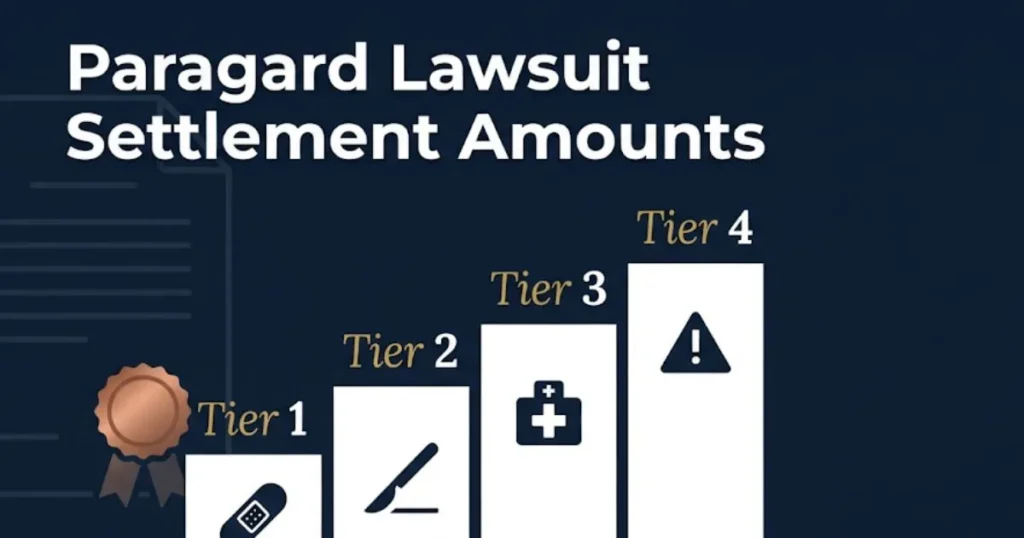
Paragard lawsuit settlement amounts in 2026 have not been publicly finalized, but legal analysts estimate individual payouts could range from $50,000 to over $400,000 depending on injury severity. No global settlement has been reached yet.
Settlement values in medical device cases depend heavily on what happened to you specifically. A woman who needed emergency surgery to remove broken IUD fragments will likely receive more than someone whose fragments were removed without complications.
Here is what attorneys and legal analysts are projecting based on comparable medical device settlements:
| Injury Level | Estimated Settlement Range | Example Scenario |
|---|---|---|
| Tier 1: Minor | $10,000 to $50,000 | Device broke but fragments removed without surgery |
| Tier 2: Moderate | $50,000 to $150,000 | Surgical procedure needed to remove fragments |
| Tier 3: Serious | $150,000 to $300,000 | Uterine perforation, organ damage, multiple surgeries |
| Tier 4: Severe | $300,000 to $400,000+ | Hysterectomy, infertility, or chronic ongoing complications |
These numbers are estimates based on similar mass tort outcomes. The actual settlement grid, if one is established, could look different.
Factors that increase your settlement value:
- Number of surgeries required
- Permanent injuries like infertility
- Duration and severity of pain
- Lost wages and medical expenses
- Emotional distress documentation
Keep in mind that bellwether trial results will heavily influence final settlement numbers. Strong plaintiff verdicts push defendants to offer more.
Key Takeaway: The Paragard lawsuit is a massive, active litigation in 2026 with settlement estimates ranging from $10,000 to $400,000 or more, and the right attorney can file your claim at no upfront cost.
Paragard Lawsuit Eligibility Requirements
You may qualify for a Paragard lawsuit if your IUD broke during removal and you suffered injuries as a result. That is the basic threshold for eligibility.
Not every woman who used Paragard can file. The lawsuit is specifically about device failure, not general dissatisfaction with the product. Your device needs to have fractured, broken apart, or become embedded.
You likely qualify if:
- Your Paragard IUD broke during a removal attempt
- Pieces of the device were left inside your body
- You needed surgery to remove broken fragments
- The device embedded in your uterine wall
- You experienced perforation of the uterus or other organs
- You suffered infections, chronic pain, or infertility linked to the device
You likely do not qualify if:
- Your Paragard was removed without incident
- You experienced side effects unrelated to breakage (like heavier periods)
- Your IUD was a different brand (Mirena, Skyla, Kyleena, Liletta)
| Eligibility Factor | Required? |
|---|---|
| Used Paragard brand specifically | Yes |
| Device broke or fractured | Yes |
| Suffered physical injury | Yes |
| Have medical records documenting the event | Strongly recommended |
| Removed within a certain time period | Varies by state statute of limitations |
Your state’s statute of limitations matters too. Some states give you two years from the date of injury. Others allow more time. An attorney can tell you exactly where you stand.
How to File a Paragard Lawsuit
Filing a Paragard lawsuit starts with contacting a qualified attorney for a free case evaluation. The process itself is simpler than most people expect.
You don’t walk into a courthouse and fill out paperwork yourself. Your attorney handles the legal filings, court communications, and negotiations. Your main job is providing information and medical records.
Step-by-step filing process:
- Contact an attorney who handles Paragard cases for a free consultation
- Share your story and basic medical history during the evaluation
- Sign a retainer agreement (contingency fee, so no money upfront)
- Authorize medical record release so your lawyer can obtain documentation
- Attorney files your complaint in the MDL or appropriate state court
- Discovery phase begins where both sides exchange evidence
- Wait for settlement negotiations or trial scheduling
The entire filing process from first call to official complaint usually takes a few weeks. Some firms can file within days if your case is straightforward.
One common misconception: you do not need to go to Georgia where the MDL is based. Your attorney can file on your behalf no matter where you live. Cases from all 50 states are funneling into the consolidated litigation.
You should gather your medical records before your consultation if possible. Operative reports, imaging results, and your doctor’s notes about the removal attempt are especially valuable.
Best Paragard Lawsuit Lawyers
The best Paragard lawsuit lawyers have specific experience with medical device mass torts and a track record of winning settlements for injured plaintiffs. Not all personal injury firms are equal when it comes to IUD litigation.
Picking the wrong lawyer is like hiring a plumber to fix your roof. They might be skilled, but not at what you need. Look for firms that have handled similar cases against pharmaceutical and medical device companies.
What to look for in a Paragard attorney:
- Experience with MDL (multidistrict litigation) cases
- History of medical device or product liability settlements
- Resources to hire expert witnesses and medical consultants
- No upfront fees (contingency fee arrangement)
- Positive client reviews or testimonials
- Willingness to explain your case honestly, including weaknesses
- Responsive communication and regular case updates
| Quality | Why It Matters |
|---|---|
| MDL experience | The Paragard case is an MDL; your lawyer needs to know this system |
| Medical device focus | Device cases require specialized medical and engineering knowledge |
| Financial resources | Large firms can fund expensive expert testimony and depositions |
| Transparency | You deserve honest assessments, not false promises of huge payouts |
| Communication | You should hear from your attorney regularly, not just at the end |
Ask potential lawyers how many Paragard cases they currently represent. Ask about their role in the MDL. Are they on the leadership committee, or are they referring cases to other firms?
A firm that directly handles your case will typically give you better attention than one that passes it along to another firm for a referral fee.
Key Takeaway: Choose a Paragard lawyer with direct MDL experience, a medical device track record, and a contingency fee structure so you pay nothing unless you win.
Paragard IUD Attorney Fees
Paragard IUD attorney fees are based on contingency, which means you pay nothing upfront and your lawyer takes a percentage of your settlement or verdict. Most firms charge between 25% and 40% of the final recovery.
This is standard for mass tort litigation. The contingency model exists so that people who can’t afford hourly legal rates can still get representation. If you don’t win, you don’t pay.
How the fee structure typically works:
- Contingency percentage: Usually 33% to 40% of the gross settlement
- Case expenses: Some firms deduct costs (filing fees, medical record retrieval, expert witness fees) from your share; others absorb them
- If you lose: You owe nothing in attorney fees
- Fee negotiation: Some firms will negotiate the percentage, especially for strong cases
| Fee Component | Typical Range |
|---|---|
| Attorney contingency fee | 25% to 40% |
| Case costs (filing, records, experts) | $500 to $5,000 (deducted from settlement or absorbed) |
| Upfront cost to you | $0 |
| Payment if you lose | $0 |
Here is where it gets important. Read your retainer agreement carefully before signing. Some firms charge a higher percentage if the case goes to trial versus settling early. Others cap their fees.
Ask your attorney three specific questions: What percentage do you take? Do you deduct case costs from my share or yours? Does the percentage change if we go to trial?
An honest attorney will walk you through every line of the fee agreement. If they rush past it or seem evasive, that’s a red flag.
Paragard Lawsuit Compensation Amounts
Paragard lawsuit compensation amounts depend on the type and severity of your injuries, your medical expenses, and the impact on your daily life. Women with the most severe injuries stand to receive the highest payouts.
Compensation in these cases covers several categories. It’s not just about one lump sum for “getting hurt.” The law breaks damages into distinct buckets.
Types of compensation available:
- Medical expenses: Past and future costs for surgeries, hospital stays, medications, and follow-up care
- Lost wages: Income you missed while recovering or unable to work
- Pain and suffering: Physical pain endured because of the device failure
- Emotional distress: Anxiety, depression, PTSD, and psychological impact
- Loss of fertility: If breakage led to hysterectomy or inability to conceive
- Loss of consortium: Impact on your relationship with a spouse or partner
- Punitive damages: Additional penalty if the court finds the manufacturer acted recklessly (rare but possible)
| Compensation Type | What It Covers |
|---|---|
| Economic damages | Medical bills, lost income, future care costs |
| Non-economic damages | Pain, suffering, emotional distress, loss of enjoyment |
| Punitive damages | Punishment for manufacturer’s conduct (if awarded by jury) |
The biggest payouts will go to women who can document extensive injuries. A detailed paper trail of surgeries, follow-up appointments, therapy sessions, and employment gaps strengthens your claim considerably.
Think of it this way: your medical records are receipts. The more receipts you have, the higher your compensation is likely to be.
Paragard IUD Breakage Lawsuit
The Paragard IUD breakage lawsuit alleges that the device’s T-shaped plastic arms are prone to snapping during routine removal, leaving fragments inside the body. This is the central claim driving the entire litigation.
Paragard is made from a polyethylene frame wrapped with copper wire. Over time, the plastic can become brittle. When a doctor pulls the device out by its strings, one or both arms can fracture.
What happens when breakage occurs:
- The device arms snap off inside the uterus
- Broken fragments can embed in uterine tissue
- Pieces can migrate to the abdomen, pelvis, or other areas
- Removal of fragments often requires invasive surgery
- Some women need multiple procedures to retrieve all pieces
The lawsuit claims this breakage is not a random fluke. Plaintiffs allege it’s a predictable result of a design flaw in the device’s materials. They argue CooperSurgical knew about the risk and did not change the design or add adequate warnings.
Quick Facts: Paragard Breakage
- The device has been sold since 1984
- The arms are made of polyethylene, which can degrade over time
- Breakage risk may increase the longer the device stays in place
- Paragard is approved for up to 10 years of use
- Many breakage incidents occur at the time of routine removal
The FDA has received hundreds of adverse event reports related to Paragard breakage. These reports are publicly available in the FDA’s MAUDE database.
Key Takeaway: Paragard breakage is the core issue in the lawsuit, and the manufacturer allegedly knew about the design flaw in the polyethylene arms that makes fracture predictable during removal.
Paragard IUD Removal Complications Lawsuit
The Paragard IUD removal complications lawsuit covers injuries that arise specifically during or after the removal process. Breakage is the most common complication, but it’s not the only one.
When fragments stay in the body, the consequences can be severe. Some women endure months or years of pain before all pieces are found and removed. Others face permanent reproductive damage.
Documented removal complications include:
- Device fracture with retained fragments
- Uterine perforation (the device or pieces puncture the uterine wall)
- Embedding (device grows into uterine tissue, making removal difficult)
- Migration of fragments to the abdomen or pelvis
- Infection at the removal site or from retained pieces
- Ectopic pregnancy following incomplete removal
- Chronic pelvic pain lasting months or years
- Emergency hysterectomy in the most severe cases
| Complication | Severity Level | Common Outcome |
|---|---|---|
| Fragment retention | Moderate to Serious | Additional surgical procedure |
| Uterine perforation | Serious | Emergency surgery, possible organ damage |
| Device embedding | Moderate | Surgical extraction, tissue damage |
| Infection | Moderate | Antibiotics, possible hospitalization |
| Hysterectomy | Severe | Permanent infertility, major surgery |
Women who experienced any of these complications during Paragard removal should speak with an attorney about their case. The more severe the complication, the stronger the potential claim.
It’s worth noting that many doctors did not warn patients about the breakage risk before removal. This is a separate failure-to-warn allegation that strengthens the lawsuit.
Paragard MDL Update 2026
The Paragard MDL (multidistrict litigation) in 2026 is active and progressing under MDL No. 2974 in the U.S. District Court for the Northern District of Georgia. Judge Leigh Martin May continues to preside over the consolidated cases.
MDL is a federal process that combines similar lawsuits from across the country into one court for pretrial proceedings. It’s designed to save time and avoid conflicting rulings. Each plaintiff still has an individual case, but shared legal issues are handled together.
2026 MDL status highlights:
- Over 2,400 cases consolidated in the MDL
- New cases continue to be filed and added
- Discovery (evidence exchange) is ongoing
- Expert witness testimony and Daubert challenges are being addressed
- Bellwether trial selections are underway
- Settlement discussions may begin or intensify after bellwether outcomes
| MDL Detail | Information |
|---|---|
| MDL Number | 2974 |
| Court | Northern District of Georgia |
| Judge | Leigh Martin May |
| Cases Filed | 2,400+ |
| Status | Active, pretrial proceedings |
| Defendants | CooperSurgical, Teva Pharmaceuticals |
The MDL process is like a funnel. All the cases get poured in, shared issues are resolved, and then individual cases either settle or get sent back to their home courts for trial.
2026 is shaping up to be a pivotal year. If bellwether trials produce plaintiff verdicts, the pressure on CooperSurgical to negotiate a global settlement increases dramatically.
Paragard Lawsuit Bellwether Trials
Paragard lawsuit bellwether trials are test cases selected from the MDL to go to trial first. Their outcomes will shape settlement negotiations for every other case in the litigation.
Think of bellwether trials as a dress rehearsal for both sides. The plaintiff attorneys test their arguments. The defense tests theirs. Juries deliver verdicts. Both sides then use those results to figure out what a fair settlement looks like.
How bellwether trials work:
- A small group of cases (usually 3 to 10) is selected from the MDL pool
- These cases represent a range of injury types and severity levels
- Each case goes to a full trial with a jury
- Verdicts give both sides data on how juries react to the evidence
- Large plaintiff verdicts push defendants toward settlement
- Defense verdicts can reduce settlement pressure
| Bellwether Element | Details |
|---|---|
| Number of trials expected | Typically 3 to 6 initial cases |
| Selection criteria | Cases representing different injury types |
| Court | Northern District of Georgia (MDL court) |
| Purpose | Test legal theories and gauge jury response |
| Impact | Directly influences global settlement negotiations |
As of early 2026, the bellwether selection process is underway. Specific trial dates will depend on the court’s schedule and both sides’ readiness.
If you have a case in the MDL, your individual outcome will be influenced by these bellwether results. Strong plaintiff wins typically accelerate settlement timelines for everyone.
Key Takeaway: Bellwether trials in 2026 will be the single biggest factor in determining whether CooperSurgical agrees to a global settlement and how much it will pay per claim.
Paragard Lawsuit Deadline 2026
The Paragard lawsuit deadline depends on your state’s statute of limitations, which is the legal time limit for filing a claim. Most states set this window at two to three years from the date of injury or the date you discovered the injury.
There is no single national deadline for the Paragard lawsuit. Each state has its own rules. Some are generous with time. Others are not.
Statute of limitations by state (examples):
| State | Statute of Limitations | Notes |
|---|---|---|
| California | 2 years | From date of injury or discovery |
| Texas | 2 years | Strict enforcement |
| New York | 3 years | From date of injury |
| Florida | 2 years | Recently reduced from 4 years |
| Illinois | 2 years | Discovery rule may apply |
| Pennsylvania | 2 years | From date of injury or discovery |
| Georgia | 2 years | Where the MDL is located |
The “discovery rule” matters here. In many states, the clock doesn’t start ticking until you knew (or should have known) that your injury was caused by the Paragard device. If you didn’t realize your pain was from a broken IUD fragment until years later, you may still have time.
Do not assume you’ve missed the deadline without checking. An attorney can review your specific situation and tell you whether your claim is still viable.
If you think you might be close to the cutoff, act fast. Once the statute of limitations expires, your right to file is gone forever. There are very few exceptions.
What Evidence Do I Need for a Paragard Lawsuit
You need medical records that document your Paragard IUD breakage, the injuries you suffered, and the treatments you received. Strong evidence is the backbone of a successful claim.
Your attorney will help gather everything, but starting the process early gives you an advantage. The more organized your documentation, the faster your case can move forward.
Essential evidence for your Paragard case:
- Operative reports from the removal attempt showing device fracture
- Surgical records for any procedures to extract broken fragments
- Imaging results (ultrasound, X-ray, CT scan) showing retained pieces
- Pathology reports if tissue was removed and tested
- Doctor’s notes describing complications during and after removal
- Prescription records for pain medication, antibiotics, or other related treatments
- Therapy records if you sought counseling for emotional distress
- Employment records showing missed work or reduced income
- Photographs of the broken device if available (some doctors save them)
| Evidence Type | Why It Matters |
|---|---|
| Operative reports | Proves the device broke during removal |
| Imaging (X-ray, ultrasound) | Shows fragments still inside your body |
| Surgical records | Documents the severity of your injuries |
| Doctor’s notes | Connects your symptoms to the Paragard device |
| Employment records | Supports lost wages claims |
| Therapy records | Supports emotional distress claims |
If you don’t have all of these, don’t panic. Your attorney can request records from hospitals and doctors on your behalf. Medical facilities are required to provide them.
Start by writing down a timeline of events: when the device was inserted, when removal was attempted, what happened during removal, and every medical visit afterward. This personal timeline helps your lawyer piece together your case quickly.
Paragard IUD Side Effects Lawsuit
The Paragard IUD side effects lawsuit specifically targets injuries caused by the device’s design and material failures, not the normal side effects listed on the product label. There is an important distinction here.
Normal side effects like heavier periods or cramping are expected with any copper IUD. Those alone won’t support a lawsuit. The litigation focuses on injuries that result from the device breaking or malfunctioning.
Side effects and injuries covered by the lawsuit:
- Device arm fracture during removal
- Chronic pelvic pain from retained fragments
- Uterine perforation
- Organ damage from migrating device pieces
- Infection caused by embedded fragments
- Infertility resulting from surgical complications
- Ectopic pregnancy linked to device malfunction
- Copper toxicity symptoms (in some cases)
| Covered by Lawsuit | Not Covered by Lawsuit |
|---|---|
| Device breakage injuries | Heavier menstrual bleeding (normal side effect) |
| Surgical complications from removal | Cramping after insertion (normal) |
| Uterine perforation | Spotting between periods (normal) |
| Infertility from hysterectomy | Temporary discomfort (normal) |
| Chronic pain from fragments | Allergic reaction to copper (separate issue) |
Some women have reported symptoms of copper toxicity, including fatigue, brain fog, and mood changes. Whether these claims will be included in the litigation depends on the evidence linking them to device malfunction versus normal copper exposure.
The strongest cases involve clear, documented injuries from breakage. If your doctor recorded that the device fractured and you needed additional medical intervention, your case fits squarely within the lawsuit.
Key Takeaway: The Paragard lawsuit covers injuries from device failure and breakage, not routine side effects, so your claim needs to involve a malfunctioning device, not just dissatisfaction with normal copper IUD effects.
Paragard Copper IUD Lawsuit
The Paragard copper IUD lawsuit is the only active mass tort against a copper-based intrauterine device in the United States. Paragard is currently the sole copper IUD available on the American market.
Unlike hormonal IUDs (Mirena, Skyla, Kyleena, Liletta), Paragard uses copper wire wrapped around a T-shaped polyethylene frame. The copper creates an environment that’s toxic to sperm, preventing pregnancy without hormones. It was marketed as a long-term, hormone-free birth control option.
The lawsuit does not claim copper IUDs are inherently bad. The allegation is specific: Paragard’s design and manufacturing process result in a device that is unreasonably prone to breaking.
Paragard device facts:
- Originally manufactured by GynoPharma, later by FEI Products
- Teva Pharmaceuticals acquired rights and manufactured it for years
- CooperSurgical (a subsidiary of Cooper Companies) is the current manufacturer
- FDA-approved for up to 10 years of continuous use
- One of the most widely used IUDs in the U.S.
- Over 5 million women have used Paragard since its approval
| Detail | Information |
|---|---|
| Device Type | Copper IUD (non-hormonal) |
| Shape | T-shaped |
| Frame Material | Polyethylene |
| Active Component | Copper wire |
| Approved Duration | Up to 10 years |
| Current Manufacturer | CooperSurgical |
| Previous Manufacturer | Teva Pharmaceuticals |
The lawsuit argues that CooperSurgical and its predecessors prioritized profits over patient safety. Plaintiffs allege the companies had data showing breakage rates were higher than acceptable and chose not to redesign the product.
How Long Does a Paragard Lawsuit Take
A Paragard lawsuit can take anywhere from one to five years to resolve, depending on whether the case settles or goes to trial. Most mass tort cases in the MDL track toward resolution within two to four years of filing.
That’s a wide range, and nobody can give you an exact date. Several factors determine your timeline.
Factors that affect how long your case takes:
- Whether bellwether trials produce settlements or more litigation
- How quickly CooperSurgical enters settlement negotiations
- The complexity of your individual injuries and medical history
- Whether your case is part of the MDL or filed separately in state court
- Court schedules and judge availability
| Timeline Phase | Estimated Duration |
|---|---|
| Initial consultation and filing | 1 to 4 weeks |
| Discovery (evidence exchange) | 6 to 18 months |
| Bellwether trial preparation | 6 to 12 months |
| Bellwether trials | 3 to 6 months |
| Settlement negotiations | 3 to 12 months after bellwether outcomes |
| Individual settlement payouts | 1 to 6 months after agreement |
The process feels slow, and that’s one of the hardest parts. Mass tort litigation moves at the speed of the largest, most complex cases in the pool. Your individual case might be simple, but the system handles everyone together.
Here’s the silver lining: most mass tort cases do eventually settle. Going to trial is expensive for both sides. Once bellwether results give both parties a clear picture of what juries think, settlement talks usually follow.
If you file in 2026, a reasonable expectation for resolution is somewhere between 2027 and 2029. That’s not a guarantee. It’s an informed estimate based on how similar medical device MDLs have played out.
Key Takeaway: Filing sooner gives you the best chance of being included in any global settlement, and while the process takes one to five years, most cases settle without requiring individual trials.
Frequently Asked Questions
How much money can I get from a Paragard lawsuit in 2026?
Estimated settlements range from $10,000 to over $400,000 per case.
Your payout depends on injury severity, medical costs, and required surgeries.
Final amounts will be influenced by bellwether trial results expected in 2026.
Do Paragard lawsuit attorneys charge upfront fees?
No. Paragard attorneys work on contingency, meaning they get paid only if you win.
Most charge between 25% and 40% of your final settlement or verdict.
You should never pay out of pocket to file a Paragard claim.
What is the deadline to file a Paragard IUD lawsuit?
The deadline varies by state, with most statutes of limitations set at two to three years.
The clock typically starts from the date of injury or the date you discovered the injury.
Check with an attorney immediately if you think you might be close to the cutoff.
What injuries qualify for a Paragard lawsuit?
You qualify if your Paragard IUD broke during removal and caused physical harm.
Qualifying injuries include device fracture, uterine perforation, surgical extraction, infection, and infertility.
Normal side effects like heavier periods do not qualify on their own.
How long will the Paragard lawsuit take to settle?
Most cases take one to five years from filing to resolution.
Bellwether trial outcomes in 2026 will likely accelerate settlement negotiations.
If you file in 2026, expect potential resolution between 2027 and 2029.
Take Action on Your Paragard Claim
The Paragard IUD lawsuit is one of the most significant medical device cases moving through the courts in 2026. If your device broke and you were hurt, this is your opportunity to seek compensation.
Gather your medical records. Contact an experienced Paragard lawsuit attorney for a free case review. Filing deadlines are real, and waiting too long can cost you your right to file.
Your claim matters. The evidence is building. The time to act is now.







