

The PA Liquor Control Board lawsuit is challenging how Pennsylvania prices and sells alcohol through its state-run monopoly. If you have bought wine or spirits at a Fine Wine and Good Spirits store, this case could directly affect your wallet.
Pennsylvania is one of only a handful of states where the government controls all liquor retail sales. That system has faced legal scrutiny for years. Now, lawsuits targeting the PLCB’s pricing practices, hidden markups, and the century-old Johnstown Flood Tax have gained serious traction heading into 2026.
This article breaks down the full case, who qualifies, what settlement money might look like, and how to file a claim. One key fact worth knowing: the PLCB adds a 30% markup on top of wholesale prices before any taxes even hit your receipt.
If you have ever wondered whether you have been overpaying for a bottle of wine in Pennsylvania, you probably have. Here is everything you need to know about this lawsuit in 2026.
PA Liquor Control Board Lawsuit: What You Need to Know
The PA Liquor Control Board lawsuit is a legal challenge against the state agency responsible for all wine and spirits sales in Pennsylvania. At its core, the case alleges that the PLCB has engaged in unfair pricing practices that cost consumers millions of dollars every year.
Pennsylvania’s liquor system is unique in America. The state owns and operates roughly 600 Fine Wine and Good Spirits stores. Every bottle of wine, whiskey, vodka, or other spirit sold at retail goes through this single state-controlled channel.
The lawsuit argues this monopoly structure allows the PLCB to add excessive markups, hidden fees, and legacy taxes without any competitive pressure to keep prices fair. Consumers in neighboring states like New Jersey, Delaware, and Ohio often pay significantly less for the same bottles.
| Key Fact | Detail |
|---|---|
| Agency Name | Pennsylvania Liquor Control Board (PLCB) |
| Retail Brand | Fine Wine and Good Spirits |
| Number of Stores | Approximately 600 statewide |
| Year Established | 1933 (post-Prohibition) |
| Primary Allegation | Unfair pricing and excessive markups |
| Affected Consumers | All PA residents who purchase wine or spirits |
Legal teams representing consumers argue the PLCB has operated without accountability for decades. The agency sets its own prices, controls its own supply chain, and faces no real market competition.
That combination, the plaintiffs say, has created a system where everyday Pennsylvanians pay artificially inflated prices. The lawsuit seeks both reform and financial compensation.
PLCB Lawsuit 2026: Where the Case Stands Right Now
The PLCB lawsuit is actively moving through the Pennsylvania court system as of early 2026. Court filings from late 2025 indicate the case has survived initial motions to dismiss, which is a significant procedural win for the plaintiffs.
The Commonwealth Court of Pennsylvania is the primary venue for this litigation. That court handles disputes involving state agencies, making it the natural forum for challenging the PLCB’s practices./
Discovery is currently underway. This means both sides are exchanging internal documents, pricing records, and financial data. Plaintiffs’ attorneys have specifically requested internal PLCB memos that show how markup percentages were determined.
A class certification hearing is expected in mid-2026. If the court certifies the class, every Pennsylvania consumer who purchased wine or spirits from a state store during the relevant period would automatically become part of the lawsuit.
The PLCB has pushed back hard. State attorneys argue the board operates under legislative authority and that its pricing structure is legally authorized by the Pennsylvania General Assembly. They have also raised sovereign immunity as a defense.
- Discovery phase: ongoing through spring 2026
- Class certification hearing: projected for summer 2026
- Trial date: not yet set, likely late 2026 or early 2027
- Settlement talks: informal discussions reported but no formal offer
The next few months will determine whether this case moves toward trial or settles out of court. Either way, 2026 is the year things get real.
Pennsylvania Liquor Control Board Class Action Explained
A class action against the Pennsylvania Liquor Control Board is a single lawsuit filed on behalf of thousands or even millions of consumers who share the same legal complaint. Instead of each person suing individually, one case represents everyone.
Think of it like carpooling. One vehicle carries many passengers to the same destination. A class action works the same way: one legal proceeding carries all affected consumers toward the same resolution.
In this case, the proposed class includes all Pennsylvania residents who purchased wine or spirits from PLCB-operated stores during a specific time window. That window is still being defined but may stretch back five to ten years based on the statute of limitations.
Class actions against government agencies are less common than suits against private companies. That is because state entities often have legal protections. But Pennsylvania law does allow certain claims against state agencies when consumer rights violations are at issue.
The lead plaintiffs, meaning the named individuals on the case, represent the broader group. Their experiences must be typical of what the entire class endured. If you bought a bottle of wine in Pittsburgh and someone else bought bourbon in Philadelphia, you both faced the same markup system.
| Class Action Element | Status |
|---|---|
| Lead Plaintiffs | Named and active |
| Proposed Class Size | Potentially millions of PA consumers |
| Class Period | Under determination (est. 5 to 10 years) |
| Court | Commonwealth Court of Pennsylvania |
| Class Certification | Hearing expected summer 2026 |
If certified, you would not need to do anything to be included. You would automatically be a class member unless you chose to opt out.
Key Takeaway: The PA Liquor Control Board lawsuit is a live, active case in 2026 that could affect every Pennsylvanian who has bought wine or spirits from a state store in the past decade.
PA Liquor Control Board Lawsuit Update for 2026
The latest update on the PA Liquor Control Board lawsuit shows the case gaining momentum in 2026. Court records confirm that plaintiffs’ attorneys have successfully obtained thousands of pages of internal PLCB pricing documents during discovery.
Several key developments have occurred since the start of the year:
- January 2026: Plaintiffs filed an amended complaint adding new allegations about the Johnstown Flood Tax being misrepresented to consumers.
- February 2026: The PLCB’s motion for summary judgment was partially denied, allowing the pricing markup claims to proceed.
- March 2026: Expert witnesses were disclosed, including an economist specializing in state monopoly pricing.
The PLCB has not been sitting idle either. The board’s legal team has argued that the agency operates within its statutory authority. They contend that the Pennsylvania General Assembly, not the PLCB, is responsible for the pricing framework.
Governor Josh Shapiro’s office has been watching this case closely. The administration has previously expressed support for liquor system reform but has not taken a public position on the lawsuit itself.
Media coverage in Pennsylvania has picked up significantly. Major outlets in Philadelphia, Pittsburgh, and Harrisburg have all run stories about the case in the first quarter of 2026. Public awareness is growing, which often puts pressure on both sides to reach a resolution.
The court has scheduled a status conference for April 2026. That hearing will likely set a timeline for the class certification motion and potentially a trial date.
Is the PLCB Overcharging Consumers?
Yes, according to the lawsuit and independent pricing analyses, the PLCB is charging Pennsylvania consumers significantly more than what residents of neighboring states pay for identical products. The core allegation is that the board’s markup system is excessive and lacks transparency.
Here is how the pricing works. The PLCB buys wine and spirits at wholesale prices from distributors. It then applies a standard 30% markup before adding the 18% Johnstown Flood Tax and the 6% state sales tax. In Philadelphia, there is an additional 2% local tax.
Let’s put real numbers to it. A bottle of bourbon that costs $20 at wholesale ends up costing a Pennsylvania consumer roughly $33 to $34 at a Fine Wine and Good Spirits store. That same bottle might retail for $24 to $26 in New Jersey or Delaware.
| Pricing Component | Amount |
|---|---|
| Wholesale Cost | $20.00 |
| PLCB 30% Markup | $6.00 |
| Subtotal | $26.00 |
| Johnstown Flood Tax (18%) | $4.68 |
| State Sales Tax (6%) | $1.84 |
| Total (outside Philly) | $32.52 |
| Philly Local Tax (2%) | +$0.65 |
The Johnstown Flood Tax deserves special mention. It was enacted in 1936 to help rebuild Johnstown after a devastating flood. That flood happened nearly 90 years ago. The tax never went away. It generates over $275 million annually for the state’s general fund.
Critics say this tax has nothing to do with flood relief anymore. It is simply a revenue tool that consumers cannot escape because the state controls all retail liquor sales.
PLCB Markup Lawsuit: Breaking Down the Numbers
The PLCB markup lawsuit focuses specifically on the 30% standard markup that the board applies to nearly every product it sells. Plaintiffs argue this percentage is arbitrary, has no competitive justification, and would not survive in a free market.
In a normal retail environment, stores compete on price. If one shop marks up wine by 30%, a competitor down the street might mark it up by only 15%. Consumers choose the cheaper option. That is how markets self-correct.
Pennsylvania consumers have no such choice. You buy from the state or you drive to another state. There is no legal alternative for purchasing spirits within Pennsylvania’s borders.
The lawsuit presents data comparing PLCB prices to those in bordering states:
| Product Type | PA Average Price | NJ Average Price | Difference |
|---|---|---|---|
| Mid-range bourbon | $34.99 | $26.99 | $8.00 more in PA |
| Popular vodka (750ml) | $24.99 | $18.99 | $6.00 more in PA |
| Table wine (750ml) | $14.99 | $10.99 | $4.00 more in PA |
| Premium scotch | $54.99 | $42.99 | $12.00 more in PA |
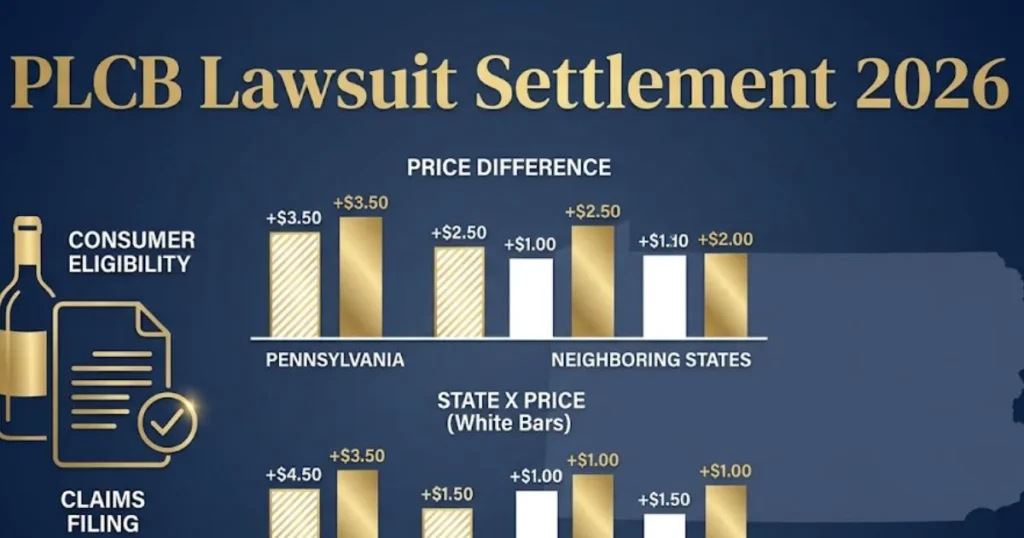
Across a year of moderate purchasing, a typical Pennsylvania household might overpay by $200 to $500 compared to neighboring-state prices. For the state’s roughly 5 million adult consumers, the total overpayment is staggering.
Plaintiffs’ economists estimate that the PLCB collects $400 to $500 million per year in markup revenue above what a competitive market would produce. That number forms the basis of the damages calculation in the lawsuit.
Pennsylvania Liquor Monopoly Lawsuit and Its Legal Basis
The Pennsylvania liquor monopoly lawsuit rests on the argument that the PLCB’s total control over spirits retail violates consumer protection principles embedded in state law. While the monopoly itself is legally established, plaintiffs argue the board has abused its position.
Pennsylvania is one of only two states (along with Utah’s partial system) that maintains complete government control over both wholesale distribution and retail sales of wine and spirits. Every other control state allows some level of private retail participation.
The legal basis involves several claims:
- Unfair trade practices under the Pennsylvania Unfair Trade Practices and Consumer Protection Law
- Unjust enrichment by collecting markups that exceed reasonable operating costs
- Breach of fiduciary duty to the public, since the PLCB is supposed to serve consumers
- Constitutional questions about whether a 1936 emergency tax can be perpetually imposed
The PLCB was created in 1933 after Prohibition ended. Governor Gifford Pinchot reportedly designed the system to “discourage the purchase of alcoholic beverages by making it as inconvenient as possible.” That philosophy, plaintiffs argue, has no place in 2026.
Act 21 of 2016 brought some reforms. It allowed limited wine sales in grocery stores and expanded Sunday hours. But the fundamental monopoly structure remained intact. The PLCB still controls pricing, distribution, and the vast majority of retail sales.
The legal question boils down to this: can a state agency charge monopoly prices and call it public service? The plaintiffs say no.
Key Takeaway: Pennsylvania consumers pay roughly 25% to 40% more for wine and spirits than residents of neighboring states because of the PLCB’s government-controlled monopoly and layered tax structure.
PA State Store Lawsuit: Why State-Run Stores Are Under Fire
PA state stores are under fire because they represent a system that prioritizes revenue generation over consumer value. The lawsuit argues that Fine Wine and Good Spirits locations function more like tax collection points than real retail stores.
Anyone who has shopped at a state store knows the experience. Limited selection compared to private retailers. Inconsistent inventory across locations. Prices that never seem to include sales or meaningful discounts.
Private liquor stores in other states compete aggressively. They run promotions, loyalty programs, and clearance sales. They adjust pricing based on demand. PLCB stores rarely do any of this because there is no incentive. Where would the customer go instead?
Employees of the system have spoken up too. Former PLCB store managers have described a bureaucratic structure where pricing decisions come from Harrisburg with little regard for local market conditions. A store in rural Tioga County charges the same prices as one in downtown Philadelphia.
The lawsuit highlights several specific complaints about state stores:
- Prices set centrally with no local competition adjustments
- Limited product selection compared to free-market states
- Inflexible return policies
- Operating hours that do not match consumer demand
- Antiquated inventory management systems
Reformers have pushed for liquor privatization in Pennsylvania for years. Former Governor Tom Corbett made it a signature issue. The effort has stalled repeatedly in the legislature, partly because the PLCB generates over $2.7 billion in annual revenue for the state.
That revenue number is exactly the problem, according to plaintiffs. The state has a financial incentive to keep prices high. And consumers have no alternative.
PA Liquor Control Board Lawsuit Eligibility Requirements
Eligibility for the PA Liquor Control Board lawsuit is expected to include any adult who purchased wine or spirits from a PLCB-operated store during the class period. If the court certifies the class broadly, millions of Pennsylvanians could qualify.
The specific eligibility criteria will be defined in the class certification order. Based on the current complaint and comparable class actions against state agencies, the likely requirements are:
| Eligibility Factor | Expected Requirement |
|---|---|
| Age | 21 or older at time of purchase |
| Residency | Purchased from a PA state store (residency not strictly required) |
| Time Period | Purchases made during the class period (est. 2016 to 2025) |
| Proof of Purchase | Receipts, credit card statements, or loyalty program records |
| Minimum Spend | Likely no minimum, though larger purchasers may receive more |
You do not need to have saved every receipt. In many class actions, consumers can submit claims based on estimated purchase history. Credit card and debit card records serve as strong supporting evidence.
If you used the PLCB’s Fine Wine and Good Spirits loyalty program, your purchase history is already on file with the agency. That data could be used to verify claims automatically.
One important distinction: this lawsuit covers purchases made at state-operated stores. It does not cover wine purchased at grocery stores or beer bought at distributors. Those are separate retail channels with different pricing structures.
Out-of-state visitors who bought spirits in Pennsylvania may also qualify. The class definition typically covers purchasers, not residents.
Who Can Sue the PA Liquor Control Board?
Anyone who bought wine or spirits from a Pennsylvania state liquor store during the class period can potentially participate in this lawsuit. You do not need to file your own separate case because the class action covers everyone who meets the criteria.
There is a common misconception that you need a lawyer to join a class action. You do not. If the class is certified, you are automatically included unless you actively opt out. Opting out would only make sense if you plan to file your own individual lawsuit, which is rare for consumer cases like this.
Certain groups may have stronger claims than others:
- Heavy purchasers who spent thousands at state stores over the class period
- Business owners like restaurants and bars that buy through the PLCB system
- Event planners and caterers who made bulk purchases
- Wine collectors who regularly bought premium bottles at inflated state prices
Licensed establishments (restaurants, bars, hotels) buy their liquor through the PLCB at a 10% discount off retail prices. But plaintiffs argue that even those discounted prices are inflated due to the underlying markup structure.
Individual consumers do not need to prove they were personally harmed in a unique way. The class action theory holds that everyone who bought through the monopoly system paid the same inflated markup. The harm is systemic, not individual.
If you are a Pennsylvania resident who has purchased even a single bottle from a state store in the last decade, you are likely eligible to participate.
PLCB Lawsuit Payout Amount: What Could You Receive?
The PLCB lawsuit payout amount for individual consumers is projected to range from $25 to $500 or more, depending on your purchase history and how the settlement or judgment is structured. Heavier purchasers would receive proportionally larger payouts.
It is important to understand how class action payouts work. The total settlement or judgment amount gets divided among all claimants, minus legal fees and administrative costs. Attorney fees in class actions typically run 25% to 33% of the total recovery.
Here is a rough breakdown of potential individual payouts based on spending levels:
| Annual PA Liquor Spend | Estimated Class Period Spend (10 years) | Projected Payout Range |
|---|---|---|
| $200/year | $2,000 | $25 to $75 |
| $500/year | $5,000 | $60 to $175 |
| $1,000/year | $10,000 | $125 to $350 |
| $2,000+/year | $20,000+ | $250 to $500+ |
These numbers are estimates based on comparable state agency class actions. The actual amounts depend on several factors:
- Total size of the settlement or judgment
- Number of consumers who file valid claims
- Whether proof of purchase is required or estimated claims are accepted
- Attorney fee percentage approved by the court
In comparable consumer class actions against government entities, total settlements have ranged from $10 million to $200 million. Given Pennsylvania’s population and the scope of PLCB sales, plaintiffs are seeking damages in the range of $100 million or more.
The per-person amount might not change your life. But multiplied across millions of consumers, it represents a significant accountability moment for the PLCB.
Key Takeaway: Individual payouts from the PLCB lawsuit will likely range from $25 to $500 based on your purchase history, with the total settlement potentially exceeding $100 million.
PA Liquor Board Settlement: What a Deal Might Look Like
A PA Liquor Board settlement would likely combine direct consumer payments with structural reforms to the PLCB’s pricing practices. Most class action settlements against government agencies include both monetary and non-monetary components.
Settlement negotiations in cases involving state agencies tend to be complicated. The PLCB does not have a private company’s flexibility to simply write a check. Any large payout would require either legislative approval or allocation from existing agency funds.
Based on similar government-entity settlements across the country, here is what a deal might include:
Monetary Component:
- Direct cash payments to verified class members
- A claims process allowing consumers to submit proof of purchases
- A simplified claims process for smaller purchasers with no receipt requirement
Structural Reform Component:
- Mandatory reduction in the PLCB markup percentage
- Greater pricing transparency on receipts and shelf labels
- Annual public reporting of markup revenue and how it is spent
- Consumer advisory board with voting input on pricing decisions
Possible Non-Cash Benefits:
- Discount vouchers for future state store purchases
- Loyalty program credits
- Free delivery offers
The monetary portion is what most consumers care about. But the structural reforms might save Pennsylvanians far more money in the long run. A 5% reduction in the standard markup would save the average household $50 to $100 per year on liquor purchases, every year going forward.
Settlement talks are reported to be in early stages. Neither side has publicly confirmed formal negotiations. The court may appoint a mediator if direct talks stall, which is standard procedure in large class actions.
PLCB Class Action Settlement Amount Projections
The total PLCB class action settlement amount could reach between $75 million and $250 million based on the scope of the claims and the size of the affected class. These projections come from analyzing the PLCB’s annual markup revenue and comparable government-agency settlements.
The PLCB reports annual sales of approximately $2.7 billion. The 30% markup alone generates roughly $600 million per year in revenue above wholesale costs. Over a 10-year class period, that represents $6 billion in markup revenue.
Plaintiffs are not seeking to recover all of that. Their argument is that a portion of the markup is excessive, meaning it goes beyond what is needed for legitimate operating costs. The “excessive” portion is estimated at 10% to 15% of total sales.
| Settlement Scenario | Estimated Total Amount | Per-Claimant Average |
|---|---|---|
| Conservative | $75 million | $25 to $50 |
| Moderate | $150 million | $50 to $150 |
| Aggressive | $250 million | $100 to $300 |
These scenarios assume a claims rate of about 15% to 25% of eligible class members. In most consumer class actions, only a fraction of eligible people actually file claims. Those who do file receive larger individual amounts as a result.
The PLCB’s own financial reserves could affect the settlement number. The board maintains a reserve fund that has fluctuated between $50 million and $100 million in recent years. Tapping that fund for a settlement would require careful political and legal maneuvering.
There is also the possibility that the Pennsylvania General Assembly could appropriate funds specifically for a settlement. Legislators may prefer a negotiated deal over the uncertainty of a trial verdict.
How to File a Claim Against the PLCB
Filing a claim against the PLCB will become possible once the court certifies the class and either approves a settlement or enters a judgment. Right now, no claims process is open, but you should start preparing your documentation today.
Here are the steps you should take now to be ready:
Step 1: Gather Your Purchase Records
- Pull credit card and debit card statements showing state store purchases
- Check your email for electronic receipts from Fine Wine and Good Spirits
- Log into the PLCB loyalty program to download your purchase history
- Save any paper receipts you may still have
Step 2: Create a Purchase Estimate
If you do not have exact records, estimate your annual spending at state stores. Be honest and reasonable. Most claim administrators accept reasonable estimates for smaller amounts.
Step 3: Watch for the Claims Window
Once a settlement is approved, a claims administrator will open an online portal. You will typically have 90 to 180 days to file your claim. Missing this window means missing your payment.
Step 4: Submit Your Claim
The process is usually straightforward. Fill out an online form, upload any supporting documents, and provide your payment information (direct deposit or check).
| Filing Preparation | Action to Take Now |
|---|---|
| Receipts | Collect and digitize all state store receipts |
| Card Statements | Download statements showing PLCB purchases |
| Loyalty Program | Access your Fine Wine and Good Spirits account |
| Spending Estimate | Calculate your approximate annual spend |
| Email Alerts | Sign up for case updates through the law firm handling the case |
Do not pay anyone to file a claim for you. Legitimate class action claims are free to submit. Any service charging a fee to file your claim is a scam.
PA Liquor Board Consumer Rights You Should Know
Pennsylvania consumers have specific legal rights when dealing with the Liquor Control Board, including the right to fair pricing, transparent fee disclosure, and access to the legal system if those rights are violated.
Many PA residents do not realize they have these protections. The Pennsylvania Unfair Trade Practices and Consumer Protection Law covers transactions with state agencies, not just private businesses. This is the statute that gives the current lawsuit its legal teeth.
Your rights as a PLCB customer include:
- Right to transparent pricing: You are entitled to know exactly what you are paying for, including the breakdown of markup, taxes, and fees.
- Right to fair dealing: The PLCB cannot engage in deceptive practices, even as a state agency.
- Right to legal recourse: You can join or benefit from class actions challenging the PLCB’s practices.
- Right to information: You can file Right-to-Know requests to obtain PLCB pricing data and internal documents.
- Right to opt out: If a class action does not represent your interests, you can opt out and pursue individual claims.
The Pennsylvania Constitution also provides certain protections. Article I, Section 1 protects citizens’ rights to “acquiring, possessing, and protecting property.” Plaintiffs argue that excessive government markups on consumer goods infringe on this principle.
One practical right you should exercise now: download your purchase history from the PLCB loyalty program. That data belongs to you. It may become valuable evidence in the claims process.
Key Takeaway: Pennsylvania consumers have legal rights to fair and transparent pricing at state liquor stores, and the current lawsuit is the mechanism for enforcing those rights.
PLCB Pricing Practices and the Legal Action Behind Them
PLCB pricing practices involve a multi-layered system of markups, taxes, and fees that the lawsuit alleges is deliberately opaque and designed to maximize state revenue at consumers’ expense.
When you pick up a bottle at a state store, the price tag includes several hidden components. The shelf price is not simply the cost of the product plus a reasonable profit margin. It is the product of a bureaucratic formula that has evolved over 90 years.
Here is the pricing formula the PLCB uses:
Wholesale cost + 30% markup + 18% Johnstown Flood Tax + 6% sales tax + local taxes (if applicable) = shelf price
What makes this legally problematic, according to the lawsuit, is that the PLCB does not clearly disclose each component to consumers at the point of sale. Your receipt shows a total price and a tax line. It does not itemize the 30% markup separately.
The Johnstown Flood Tax is a particular sore spot. Most Pennsylvania consumers do not even know it exists. It was created as a temporary emergency measure in 1936. Almost nine decades later, it generates over $275 million per year for the state general fund.
The legal action argues these practices violate transparency requirements under Pennsylvania consumer protection law. Even if each individual component is technically authorized by statute, the failure to clearly disclose them at the point of sale constitutes a deceptive practice.
Several state legislators have called for reform independently of the lawsuit. Bills proposing Johnstown Flood Tax repeal have been introduced in every legislative session for the past decade. None have passed.
Pennsylvania Wine and Spirits Lawsuit History
The Pennsylvania wine and spirits lawsuit has roots going back decades, with the current 2026 case being the latest and most significant legal challenge to the PLCB’s operations. Understanding the history helps explain why this lawsuit matters now.
Legal challenges to Pennsylvania’s liquor system are not new. But previous cases largely targeted the monopoly itself, arguing it should be abolished. Courts consistently ruled that the state has the authority to maintain a government-run liquor system. That question is settled law.
The current lawsuit takes a different approach. It does not ask the court to end the monopoly. Instead, it challenges how the monopoly is operated, specifically the pricing practices within the existing system.
Timeline of Key Legal Events:
| Year | Event |
|---|---|
| 1933 | PLCB created after Prohibition ends |
| 1936 | Johnstown Flood Tax enacted as “temporary” measure |
| 2000s | Multiple privatization bills introduced and defeated |
| 2012 | Governor Corbett pushes liquor privatization; legislature blocks it |
| 2016 | Act 21 passes, allowing limited wine sales in grocery stores |
| 2023 | Initial legal research and plaintiff recruitment begins |
| 2024 | Class action complaint filed in Commonwealth Court |
| 2025 | PLCB motion to dismiss partially denied |
| 2026 | Discovery underway; class certification hearing pending |
The 2016 reforms under Act 21 actually strengthened the current lawsuit in an unexpected way. By allowing wine sales in grocery stores at competitive prices, Act 21 created a direct comparison point. Consumers could see that the same bottle of wine cost less at a grocery store than at a state store.
That price gap gave plaintiffs’ economists concrete evidence that the PLCB’s markup is excessive. If a grocery store can sell wine profitably at a lower price, the state store’s higher price cannot be justified by operating costs alone.
This historical context shows a clear pattern. Pennsylvania has known about the pricing problem for years. The legislature has refused to act. The courts are now the last resort for consumers seeking fairness.
Frequently Asked Questions
Is there a class action lawsuit against the PA Liquor Control Board in 2026?
Yes, an active class action lawsuit is pending against the PLCB in the Commonwealth Court of Pennsylvania as of 2026.
The case challenges the board’s pricing markup practices and the continued imposition of the Johnstown Flood Tax.
A class certification hearing is expected in summer 2026.
How much money could I get from a PLCB lawsuit settlement?
Most individual consumers can expect payouts ranging from $25 to $500 depending on their purchase history.
Heavier purchasers and businesses that bought through the PLCB system may receive higher amounts.
The total settlement is projected between $75 million and $250 million.
Do I qualify for the Pennsylvania Liquor Control Board lawsuit?
You likely qualify if you purchased wine or spirits from a Fine Wine and Good Spirits store during the class period.
You must have been 21 or older at the time of purchase.
Proof of purchase through receipts, card statements, or loyalty program records strengthens your claim.
How do I file a claim against the PLCB?
The claims process will open once the court certifies the class and approves a settlement or judgment.
No claims portal is currently active, but you should gather your purchase records now.
Filing will be free through an online portal managed by a court-appointed claims administrator.
What is the deadline to join the PA liquor board lawsuit?
No specific deadline has been set yet because the class has not been formally certified.
Once certification occurs, there will be a defined window, typically 90 to 180 days, to file claims.
You will be automatically included as a class member unless you choose to opt out.
What to Do Right Now
This lawsuit is real, it is active, and it could put money back in your pocket. If you have bought wine or spirits from a Pennsylvania state store in the past decade, you are likely part of this case.
Start gathering your receipts and card statements today. Check your Fine Wine and Good Spirits loyalty account. Save everything digitally in one folder so you are ready when the claims window opens.
Stay informed on the case as it moves through 2026. The class certification hearing and any settlement announcements will determine what happens next for millions of Pennsylvania consumers.







