

The Ozempic weight loss lawsuit is one of the biggest pharmaceutical mass torts heading into 2026, with thousands of claims alleging Novo Nordisk hid the risk of severe gastrointestinal injuries. If you took Ozempic or Wegovy and ended up in the hospital with stomach paralysis, bowel obstruction, or other serious gut problems, you may be owed compensation.
This article breaks down everything happening with the case right now. You’ll get real numbers on expected settlement payouts, clear eligibility requirements, filing deadlines, and the latest MDL updates.
Here’s one number worth knowing: more than 10,000 lawsuits have been filed or are pending in the federal MDL as of early 2026. That number keeps growing every month.
What Is the Ozempic Weight Loss Lawsuit About
The Ozempic weight loss lawsuit is a mass tort action against Novo Nordisk, the Danish pharmaceutical company that manufactures Ozempic. Plaintiffs claim the company knew about serious gastrointestinal risks but failed to adequately warn patients and doctors.
At the center of these cases is semaglutide, the active ingredient in both Ozempic and Wegovy. Semaglutide slows gastric emptying to help control blood sugar and suppress appetite. But for some users, that slowdown becomes permanent or near-permanent, leading to a condition called gastroparesis.
Thousands of people who used Ozempic for weight loss say they developed:
- Gastroparesis (stomach paralysis)
- Bowel obstruction or intestinal blockage
- Severe vomiting lasting weeks or months
- Pancreatitis
- Gallbladder disease requiring surgery
The lawsuits argue Novo Nordisk’s warning labels were inadequate. The company’s prescribing information mentioned nausea and vomiting as common side effects. But it did not warn about gastroparesis or the risk of permanent stomach damage until the FDA updated labels in October 2023.
| Key Detail | Information |
|---|---|
| Drug Name | Ozempic (semaglutide) |
| Manufacturer | Novo Nordisk |
| Primary Allegation | Failure to warn about severe GI injuries |
| Active Ingredient | Semaglutide |
| Federal Court | U.S. District Court, Eastern District of Pennsylvania |
| MDL Number | MDL No. 3094 |
By the time that label change came, millions of Americans had already been prescribed Ozempic. Many of them had no idea their stomach problems were connected to the drug.
Ozempic Lawsuit 2026: Where Things Stand Right Now
The Ozempic lawsuit in 2026 is in an advanced pretrial phase, with bellwether trials expected to shape the path toward settlement. The federal MDL, consolidated under Judge Gene E.K. Pratter in the Eastern District of Pennsylvania, now includes thousands of individual claims.
Throughout 2025, the court worked through discovery, expert witness qualification, and Daubert hearings to determine which scientific testimony would be allowed at trial. Those rulings will heavily influence how strong the plaintiffs’ position looks heading into 2026 trial dates.
Bellwether trials are the key events to watch. These are test cases selected from the larger pool of lawsuits. Their outcomes typically push both sides toward settlement negotiations.
The first bellwether trials are expected in mid-to-late 2026. If plaintiffs win even one bellwether verdict, it puts enormous pressure on Novo Nordisk to negotiate a global settlement rather than face thousands of individual trials.
Think of bellwether trials like the opening hand in poker. They don’t end the game, but they show everyone at the table what cards are likely in play. A big plaintiff verdict could trigger settlement talks within months.
| 2026 Milestone | Expected Timing |
|---|---|
| Bellwether Trial Selections Finalized | Q1 2026 |
| Expert Testimony Rulings | Q1 to Q2 2026 |
| First Bellwether Trial(s) | Q3 to Q4 2026 |
| Possible Settlement Talks | Late 2026 or Early 2027 |
New cases continue to be filed. The number of pending claims is expected to exceed 15,000 by the end of 2026.
Ozempic Lawsuit Settlement Amounts: What to Expect
Ozempic lawsuit settlement amounts have not been finalized because no global settlement has been reached yet. Based on the severity of injuries alleged and comparisons to past pharmaceutical mass torts, legal analysts project a wide range of potential payouts.
For cases involving severe gastroparesis requiring hospitalization, feeding tubes, or surgery, estimated settlement values range from $150,000 to $500,000 or more. Cases with less severe but documented GI injuries may settle in the $30,000 to $150,000 range.
These projections are not guarantees. They are based on patterns from similar litigation.
| Injury Severity | Estimated Settlement Range |
|---|---|
| Severe gastroparesis with surgery or feeding tube | $150,000 to $500,000+ |
| Hospitalized bowel obstruction | $100,000 to $300,000 |
| Documented gastroparesis without surgery | $50,000 to $150,000 |
| Moderate GI injury with medical records | $30,000 to $100,000 |
| Mild documented side effects | $10,000 to $30,000 |
For context, the Vioxx settlement in 2007 totaled $4.85 billion and paid individual claimants between $5,000 and over $1 million depending on injury severity and documentation. The Ozempic litigation has some structural similarities to Vioxx: a widely prescribed drug, a failure-to-warn theory, and a large plaintiff class.
The total settlement fund, if one is created, could reach billions of dollars given Novo Nordisk’s revenue from semaglutide products alone exceeded $18 billion in 2023.
Key Takeaway: No settlements have been paid yet, but projected individual payouts range from $10,000 to over $500,000 depending on injury severity and documentation strength.
Who Qualifies for the Ozempic Lawsuit
You may qualify for the Ozempic lawsuit if you took Ozempic, Wegovy, or Rybelsus and developed serious gastrointestinal side effects that required medical treatment. The core requirement is a documented injury connected to semaglutide use.
Here’s a breakdown of the typical eligibility criteria attorneys are using to evaluate cases:
- You were prescribed Ozempic, Wegovy, or Rybelsus
- You took the medication for at least several weeks
- You developed a qualifying injury (gastroparesis, bowel obstruction, pancreatitis, gallbladder disease, or severe persistent vomiting)
- You have medical records linking the injury to semaglutide use
- You sought medical treatment (ER visits, hospitalization, surgery, or ongoing care)
It does not matter whether you took Ozempic for weight loss or for Type 2 diabetes. Both groups of users are filing claims.
One thing that strengthens a case significantly is a temporal connection. That means your symptoms started during or shortly after your Ozempic use. If your gastroparesis diagnosis came six months after you stopped taking the drug with no prior symptoms, attorneys will still evaluate your case, but the connection becomes harder to prove.
| Eligibility Factor | Requirement |
|---|---|
| Medication Used | Ozempic, Wegovy, or Rybelsus |
| Duration of Use | At least several weeks |
| Qualifying Injury | Gastroparesis, bowel obstruction, pancreatitis, gallbladder issues |
| Medical Documentation | Hospital records, diagnosis, treatment notes |
| Treatment Required | Yes, documented medical care |
People who experienced only mild nausea that resolved on its own typically do not have strong cases. The lawsuits focus on injuries that are serious, lasting, and medically documented.
Ozempic Lawsuit Update 2026: Latest Court Developments
The latest Ozempic lawsuit update for 2026 centers on bellwether trial preparation and ongoing Daubert challenges regarding expert testimony. The MDL court has been moving at a steady pace through the pretrial process.
In late 2025 and early 2026, several important developments shaped the litigation:
- Daubert hearings were held to challenge plaintiffs’ expert witnesses on the causal link between semaglutide and gastroparesis
- The court denied Novo Nordisk’s motion to dismiss several bellwether cases, allowing them to proceed toward trial
- Discovery disputes over internal Novo Nordisk communications about side effect data were resolved, with the court ordering the company to produce additional documents
- New FDA adverse event reports continued to accumulate, strengthening the plaintiffs’ evidence base
One of the most significant rulings involved internal company emails. Plaintiffs’ attorneys obtained documents suggesting Novo Nordisk scientists discussed gastroparesis risks in internal meetings years before updating the drug’s label. If those documents are presented at trial, they could be devastating for the defense.
Quick Facts:
- MDL case number: 3094
- Presiding judge: Judge Gene E.K. Pratter
- Court location: Eastern District of Pennsylvania
- Total pending cases: Estimated 10,000 to 15,000 as of early 2026
- Bellwether trial target: Q3 to Q4 2026
The court has also established a census process requiring all plaintiffs to submit detailed fact sheets about their injuries, medication use, and medical history. This helps both sides evaluate case strength before trial.
Ozempic Lawsuit Payout Per Person: Realistic Estimates
The Ozempic lawsuit payout per person will depend on individual injury severity, quality of medical evidence, and the outcome of bellwether trials. No one has received a settlement check yet, but attorneys working these cases have shared projected ranges.
Based on conversations with plaintiff firms and analysis of comparable drug litigation, here’s what a realistic payout structure might look like:
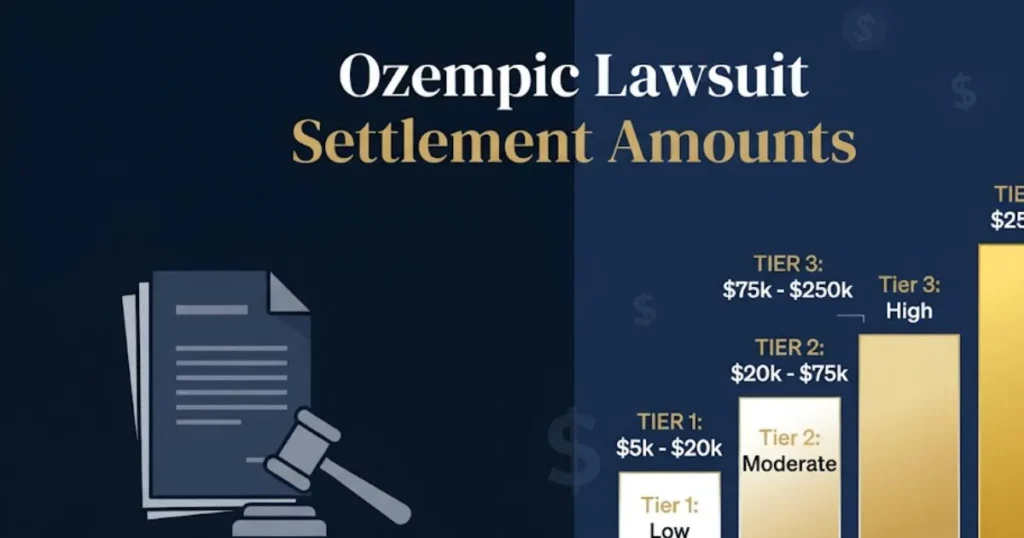
| Payout Tier | Injury Description | Estimated Per-Person Payout |
|---|---|---|
| Tier 1 (Highest) | Gastroparesis requiring surgery or feeding tube, permanent damage | $250,000 to $500,000+ |
| Tier 2 | Hospitalization for bowel obstruction or severe gastroparesis | $100,000 to $250,000 |
| Tier 3 | Documented gastroparesis with ongoing treatment | $50,000 to $100,000 |
| Tier 4 | Moderate GI injury, ER visits, prescription treatment | $20,000 to $50,000 |
| Tier 5 (Lowest) | Documented injury with minimal treatment | $5,000 to $20,000 |
These are educated estimates, not promises. Several factors will shift the final numbers.
Cases with strong medical records showing a clear timeline of Ozempic use followed by injury onset will likely land in higher tiers. Cases where the patient had pre-existing GI conditions may be discounted.
It is worth comparing this to the Belviq litigation. Belviq was another weight loss drug pulled from the market. Its settlement amounts were generally lower because the injury claims (cancer risk) were harder to prove on an individual basis. Ozempic gastroparesis cases tend to have clearer, more immediate medical evidence, which could push payouts higher.
Key Takeaway: Per-person payouts are projected between $5,000 and $500,000 or more, with the strongest cases involving documented gastroparesis, hospitalization, and surgical intervention.
How to File an Ozempic Lawsuit in 2026
To file an Ozempic lawsuit in 2026, you need to contact a law firm handling semaglutide litigation, provide your medical records, and have an attorney file a complaint on your behalf. Most firms take these cases on a contingency fee basis, meaning you pay nothing upfront.
Here’s the step-by-step process:
Step 1: Gather your records. Collect prescription records showing you were prescribed Ozempic, Wegovy, or Rybelsus. Pull together hospital records, ER visit summaries, diagnostic reports, and treatment notes related to your GI injury.
Step 2: Contact an attorney. Look for a law firm experienced in pharmaceutical mass tort litigation. Many firms offer free case evaluations. You can typically complete an initial screening online or over the phone.
Step 3: Case evaluation. The attorney will review your medical history, the timeline of your Ozempic use, and the severity of your injuries. They will determine whether your case meets the criteria for inclusion in the MDL.
Step 4: Filing the complaint. If your case qualifies, the attorney files a complaint in federal court. Your case is then transferred to the MDL in the Eastern District of Pennsylvania.
Step 5: Wait and participate. After filing, you may need to complete a plaintiff fact sheet. From there, the process is largely handled by your attorney and the MDL leadership.
| Filing Step | What Happens |
|---|---|
| Gather Records | Collect prescriptions, hospital records, diagnosis |
| Contact Attorney | Free case evaluation, no upfront cost |
| Case Evaluation | Attorney reviews medical evidence and timeline |
| File Complaint | Lawsuit filed in federal court, transferred to MDL |
| Participate in MDL | Complete fact sheets, respond to discovery requests |
Most attorneys charge a contingency fee between 33% and 40% of any settlement amount. You don’t pay if you don’t win.
Ozempic Lawsuit Eligibility: Full Requirements Breakdown
Ozempic lawsuit eligibility requires proof that you took a semaglutide medication, suffered a serious GI injury, and received medical treatment for that injury. These three pillars form the foundation of every claim.
Let’s get specific about what makes a case strong versus borderline.
Strong cases have all three of these:
- A prescription record for Ozempic, Wegovy, or Rybelsus
- A diagnosed GI condition (gastroparesis, bowel obstruction, pancreatitis) that started during or after semaglutide use
- Medical treatment records (hospitalization, surgery, ongoing care)
Borderline cases may have issues like:
- Using the drug for only a very short period (a few days)
- A pre-existing GI condition that predates Ozempic use
- No formal diagnosis or minimal medical documentation
- Symptoms that resolved quickly without medical intervention
One common question is whether pharmacy records alone are enough if prescription records from a doctor are missing. In most cases, yes. Pharmacy dispensing records can verify you received the medication.
Another question involves people who obtained Ozempic through compounding pharmacies or online telehealth services. These cases are more complex. Some attorneys are accepting them; others are not. The key is whether you can prove what you received was semaglutide and that it caused your injury.
| Eligibility Category | Strong Case | Weak Case |
|---|---|---|
| Medication proof | Prescription or pharmacy records | No documentation |
| Injury documentation | Hospital diagnosis, imaging, biopsy | Self-reported symptoms only |
| Treatment | Surgery, ER visit, specialist care | No medical treatment sought |
| Timeline | Symptoms started during/after use | Symptoms predate Ozempic |
If you’re unsure, get a free evaluation. Most attorneys will tell you within a few days whether your case qualifies.
Ozempic Gastroparesis Lawsuit Claims
Ozempic gastroparesis lawsuits are the single largest category of claims in the semaglutide litigation. Gastroparesis means the stomach muscles stop working properly, causing food to sit in the stomach for hours or even days without being digested.
This condition is sometimes called stomach paralysis. It can be temporary in some cases, but many Ozempic users report symptoms lasting months or becoming permanent.
Common gastroparesis symptoms alleged in these lawsuits include:
- Severe nausea and vomiting (sometimes for weeks without relief)
- Extreme bloating and abdominal pain
- Inability to eat solid food
- Rapid weight loss from malnutrition (ironic for a weight loss drug)
- Need for a feeding tube (jejunostomy or nasogastric tube)
The medical mechanism is fairly straightforward. Semaglutide slows gastric emptying as part of its therapeutic effect. That is how it reduces appetite and controls blood sugar. But in some patients, this slowdown goes too far and the stomach essentially stops moving food through the digestive tract.
Plaintiffs argue Novo Nordisk knew this was a risk. The FDA’s adverse event database, known as FAERS, contained hundreds of gastroparesis reports linked to Ozempic before the label was updated.
Think of it like a dimmer switch on a light. Semaglutide was supposed to dim the stomach’s activity a little. For some people, it turned the switch all the way off.
| Gastroparesis Fact | Detail |
|---|---|
| Medical Term | Gastroparesis (delayed gastric emptying) |
| Common Symptoms | Nausea, vomiting, bloating, inability to eat |
| Severe Complications | Feeding tube, malnutrition, hospitalization |
| FDA Label Update | October 2023 |
| Pre-Update FAERS Reports | Hundreds of adverse events on file |
Key Takeaway: Gastroparesis is the primary injury driving the Ozempic litigation, and plaintiffs allege Novo Nordisk ignored warning signs in its own adverse event data for years.
Ozempic Stomach Paralysis Lawsuit: Injury Details
Ozempic stomach paralysis lawsuits focus on patients whose stomach muscles became partially or fully paralyzed after taking semaglutide. “Stomach paralysis” is the plain-language term for gastroparesis, and it’s the phrase most people search when describing what happened to them.
The injury can range from uncomfortable to life-threatening. In the worst cases, patients have needed emergency surgery to remove impacted food from their stomachs or intestines. Some have had portions of their bowel surgically removed.
Medical records in these cases typically show:
- Gastric emptying studies confirming delayed emptying (the gold standard diagnostic test)
- Endoscopy results showing retained food in the stomach
- CT scans or X-rays revealing bowel distension or blockage
- Surgical records for feeding tube placement or bowel resection
Patients describe the experience as debilitating. Many report being unable to work, eat normally, or participate in daily life for months. Some report permanent dietary restrictions.
One plaintiff in a publicly filed case described vomiting undigested food 18 hours after eating. That’s not normal nausea. That’s a stomach that has stopped doing its job.
The severity of stomach paralysis directly impacts case value. A patient with a confirmed gastroparesis diagnosis, a gastric emptying study, and a feeding tube placement has a significantly stronger case than someone with undiagnosed stomach pain.
Ozempic Side Effects Behind the Lawsuit
The Ozempic side effects driving the lawsuit go far beyond the nausea and mild GI discomfort listed on the original drug label. Plaintiffs allege Novo Nordisk downplayed the severity and frequency of these adverse events.
Here’s a complete list of the side effects being cited in litigation:
- Gastroparesis (stomach paralysis)
- Bowel obstruction (intestinal blockage)
- Pancreatitis (inflammation of the pancreas)
- Gallbladder disease (gallstones, cholecystitis)
- Ileus (complete intestinal shutdown)
- Severe cyclic vomiting
- Aspiration pneumonia (from vomiting stomach contents into the lungs)
- Malnutrition and dangerous weight loss
The FDA’s adverse event reporting system logged a sharp spike in semaglutide-related reports starting in 2022, coinciding with the explosion in off-label weight loss prescriptions.
What’s different about the Ozempic side effects compared to typical drug risks? The issue isn’t that side effects exist. Every drug has them. The issue is that Novo Nordisk allegedly knew about the severity of these particular risks and chose not to update its labeling until forced to by the FDA.
| Side Effect | Severity Level | Included on Original Label? |
|---|---|---|
| Nausea | Mild to moderate | Yes |
| Gastroparesis | Severe | No (added October 2023) |
| Bowel obstruction | Severe, potentially surgical | No (added later) |
| Pancreatitis | Severe | Partially (warning existed but was minimal) |
| Gallbladder disease | Moderate to severe | No |
| Ileus | Life-threatening | No |
Novo Nordisk has maintained that Ozempic’s benefits outweigh its risks when used as directed. But “as directed” originally meant for Type 2 diabetes, not weight loss. That distinction matters in court.
Is the Ozempic Lawsuit a Class Action
The Ozempic lawsuit is not a class action. It is a multidistrict litigation (MDL), which is a different legal structure. Understanding the difference matters because it affects how much money you could personally receive.
In a class action, one lawsuit covers everyone. All class members share the same outcome and typically receive the same payout. Individual circumstances don’t usually affect the amount.
In an MDL, each plaintiff files their own individual lawsuit. Those cases are consolidated in one court for pretrial proceedings (discovery, motions, expert challenges). But when it comes time for trial or settlement, each case is evaluated on its own merits.
This is better for plaintiffs with serious injuries. In a class action, someone with a feeding tube gets the same check as someone with mild nausea. In an MDL, the feeding tube patient’s case is worth significantly more.
| Feature | Class Action | MDL (Ozempic Structure) |
|---|---|---|
| Individual lawsuits? | No, one lawsuit for all | Yes, each plaintiff files separately |
| Same payout for everyone? | Generally yes | No, based on individual injury |
| Pretrial consolidated? | Yes | Yes |
| Trial individualized? | No | Yes |
| Better for severe injuries? | No | Yes |
Think of it like a neighborhood potluck versus a restaurant. In a class action potluck, everyone shares the same dish equally. In an MDL, you order based on what you brought to the table, and your meal is sized accordingly.
The MDL for Ozempic is MDL No. 3094, centralized in Philadelphia under Judge Gene E.K. Pratter.
Key Takeaway: The Ozempic litigation is an MDL, not a class action, meaning your individual injury severity and evidence directly determine your potential payout.
Novo Nordisk Lawsuit: The Company’s Legal Exposure
Novo Nordisk faces massive legal exposure from the semaglutide lawsuits, and the company’s financial capacity to pay settlements is not in question. This is one of the largest pharmaceutical companies in the world.
In 2023, Novo Nordisk reported revenue of approximately $33 billion, with semaglutide products (Ozempic and Wegovy combined) accounting for more than half of that. The company’s market capitalization has exceeded $400 billion at various points, making it the most valuable company in Europe.
The central legal theory against Novo Nordisk is failure to warn. Plaintiffs allege the company:
- Had internal data showing gastroparesis risk before the label was updated
- Marketed Ozempic aggressively while minimizing known side effects
- Benefited financially from the off-label weight loss boom without updating safety information
- Responded too slowly to FDA adverse event signals
Novo Nordisk’s defense strategy has focused on arguing that GI side effects were disclosed on the label and that individual plaintiffs’ injuries may have been caused by other factors. The company has also pointed to the overall safety profile of semaglutide in clinical trials.
But clinical trials have a known limitation. They typically involve controlled populations and shorter durations than real-world use. The surge in adverse events came after millions of people started using Ozempic off-label, at higher doses, and for longer periods than studied in trials.
| Novo Nordisk Financial Detail | Figure |
|---|---|
| 2023 Total Revenue | Approximately $33 billion |
| Semaglutide Product Revenue | Over $18 billion |
| Peak Market Cap | Over $400 billion |
| Number of Pending Lawsuits | 10,000 to 15,000 (as of early 2026) |
The company can afford a multibillion-dollar settlement. The question is whether bellwether trial outcomes will force them to the negotiating table.
Ozempic Bowel Obstruction Lawsuit Claims
Ozempic bowel obstruction lawsuits allege that semaglutide caused intestinal blockages requiring emergency medical intervention, including surgery. These claims represent some of the most severe injuries in the litigation.
A bowel obstruction happens when food, fluid, or gas cannot pass through the intestines normally. When semaglutide slows the entire digestive tract, it can cause contents to back up and create a blockage.
Symptoms of bowel obstruction include:
- Severe abdominal cramping and pain
- Inability to pass gas or have bowel movements
- Abdominal swelling and distension
- Vomiting (sometimes fecal vomiting in severe cases)
- Fever and rapid heart rate (signs of a surgical emergency)
Some patients required emergency surgery to remove the blockage. In the most extreme cases, surgeons had to remove sections of dead bowel tissue, a procedure called bowel resection. This can have lifelong consequences for digestion and nutrition.
Bowel obstruction cases tend to have high case values because the injuries are objectively documented through imaging and surgical records. A CT scan showing a complete intestinal blockage is hard to argue against.
| Bowel Obstruction Detail | Information |
|---|---|
| Medical Term | Intestinal obstruction, ileus |
| Diagnostic Method | CT scan, X-ray, surgical exploration |
| Treatment | Surgery, NG tube decompression, bowel resection |
| Estimated Case Value | $100,000 to $300,000+ |
| Documentation Strength | Very high (imaging and surgical records) |
These cases are particularly strong when medical records show no prior history of bowel problems before Ozempic use.
Ozempic Off-Label Weight Loss Lawsuit: Does Usage Matter
Off-label use of Ozempic for weight loss does not disqualify you from filing a lawsuit. In fact, the majority of plaintiffs in the semaglutide litigation used the drug for weight loss rather than its FDA-approved purpose of treating Type 2 diabetes.
This is an important point because many people worry that using a drug “off-label” means they can’t sue. That’s not how product liability law works.
Manufacturers have a duty to warn about known risks regardless of how the drug is used. If Novo Nordisk knew doctors were prescribing Ozempic for weight loss by the millions (and they absolutely did, since they created Wegovy for exactly that purpose), then they had a duty to ensure adequate warnings reached those patients.
Off-label prescribing is perfectly legal and extremely common in medicine. About one in five prescriptions in the United States is written for an off-label use. The drug company is not responsible for a doctor’s prescribing decision. But they are responsible for the completeness and accuracy of their safety information.
Here’s where it gets interesting for the lawsuit. Novo Nordisk actively promoted Ozempic’s weight loss effects in public communications and investor presentations, even before Wegovy received FDA approval for weight management. Plaintiffs argue this amounts to tacit encouragement of off-label use while withholding safety information.
| Usage Type | Can You File a Lawsuit? | Case Strength Notes |
|---|---|---|
| Prescribed for Type 2 diabetes | Yes | Standard use, strong documentation |
| Prescribed off-label for weight loss | Yes | Majority of plaintiffs, valid claims |
| Obtained from compounding pharmacy | Possibly | More complex, depends on proof |
| Used without prescription (gray market) | Unlikely | Difficult to prove legitimate use |
Your reason for taking Ozempic does not determine whether you have a case. Your injury does.
Key Takeaway: Off-label weight loss use does not disqualify you from the Ozempic lawsuit, and most current plaintiffs took the drug specifically for weight management.
Ozempic MDL Update: Federal Case Consolidation
The Ozempic MDL (Multidistrict Litigation No. 3094) is the centralized federal proceeding where all Ozempic, Wegovy, and Rybelsus lawsuits are being coordinated. It is housed in the U.S. District Court for the Eastern District of Pennsylvania under Judge Gene E.K. Pratter.
MDL consolidation happened because having thousands of nearly identical lawsuits in courts across the country would be wasteful and inconsistent. By bringing them all to one judge, the process becomes more efficient.
Here’s what the MDL consolidation means for your case:
- All pretrial work (discovery, depositions, expert challenges, motions) happens in one place
- Your case is still your individual case with your specific facts
- If the case goes to trial, it may be sent back to the court where it was originally filed
- Settlement negotiations happen at the MDL level, with terms applied to individual cases based on injury tiers
The MDL leadership structure includes lead plaintiffs’ counsel and steering committees made up of experienced mass tort attorneys. These lawyers make strategy decisions that affect all cases.
In terms of size, the Ozempic MDL is growing rapidly. New cases are being transferred into the MDL at a rate of several hundred per month. The Judicial Panel on Multidistrict Litigation (JPML) has continued to transfer newly filed cases from district courts nationwide.
| MDL Detail | Information |
|---|---|
| MDL Number | 3094 |
| Court | Eastern District of Pennsylvania |
| Judge | Gene E.K. Pratter |
| Consolidation Date | 2023 |
| Current Case Count | 10,000 to 15,000 (estimated, early 2026) |
| Monthly New Filings | Several hundred |
| Bellwether Trial Timeline | Q3 to Q4 2026 |
The efficiency of the MDL process is critical. Without consolidation, it could take decades to resolve these cases individually. With the MDL, a bellwether outcome in 2026 could trigger a global settlement that resolves the majority of claims by 2027 or 2028.
Wegovy Lawsuit: How It Connects to Ozempic Claims
The Wegovy lawsuit is part of the same litigation as Ozempic because both drugs contain the exact same active ingredient: semaglutide. The only difference is dosage and FDA-approved indication.
Ozempic is approved for Type 2 diabetes management. Wegovy received FDA approval in June 2021 specifically for chronic weight management. Both are manufactured by Novo Nordisk. Both deliver semaglutide via weekly injection.
If you took Wegovy and experienced gastroparesis, bowel obstruction, or other severe GI injuries, your case falls under the same MDL and the same legal theories as Ozempic claims.
There’s also Rybelsus, which is an oral tablet form of semaglutide. Claims involving Rybelsus are part of the same litigation.
| Product | Active Ingredient | Form | FDA Approved For |
|---|---|---|---|
| Ozempic | Semaglutide | Weekly injection | Type 2 diabetes |
| Wegovy | Semaglutide | Weekly injection | Chronic weight management |
| Rybelsus | Semaglutide | Daily oral tablet | Type 2 diabetes |
Some attorneys have reported that Wegovy cases may actually be slightly stronger than Ozempic weight loss cases in one respect. Because Wegovy uses a higher dose of semaglutide (up to 2.4 mg versus Ozempic’s max of 2.0 mg), the argument that the higher dose caused more severe side effects has additional weight.
The bottom line is simple. If semaglutide hurt you, it doesn’t matter which brand name was on the pen or the pill bottle. The defendant is the same company, the drug is the same molecule, and the failure-to-warn allegations are identical.
Ozempic Lawsuit Deadline 2026: Key Dates to Know
The Ozempic lawsuit deadline depends on your state’s statute of limitations for product liability or personal injury claims. There is no single national deadline, but 2026 is a critical year for many potential plaintiffs.
Most states have a statute of limitations of two to three years from the date you discovered (or should have discovered) that your injury was caused by Ozempic. This is called the discovery rule.
If you were diagnosed with gastroparesis in 2024, for example, and you learned in 2024 that Ozempic may have caused it, your clock may have started then. In a state with a two-year statute, your deadline to file could be 2026.
Here’s a state-by-state snapshot of common statute of limitations periods for product liability:
| State | Statute of Limitations | Potential 2026 Deadline Applies To |
|---|---|---|
| California | 2 years | Injuries discovered in 2024 |
| Texas | 2 years | Injuries discovered in 2024 |
| New York | 3 years | Injuries discovered in 2023 |
| Florida | 2 years (changed in 2023) | Injuries discovered in 2024 |
| Illinois | 2 years | Injuries discovered in 2024 |
| Pennsylvania | 2 years | Injuries discovered in 2024 |
Missing the statute of limitations means your case could be permanently barred. No exceptions. No do-overs. This is the single most important deadline in any lawsuit.
If you think you have a claim, do not wait until the last month of your deadline. Getting medical records and building a case takes time. Starting early gives your attorney the best chance to build a strong file.
Quick Deadline Checklist:
- Identify when you first learned Ozempic may have caused your injury
- Look up your state’s statute of limitations for product liability
- Subtract that date from the present to see how much time you have
- Contact an attorney well before the deadline
Key Takeaway: There is no single national deadline, but many potential plaintiffs face a 2026 statute of limitations cutoff, making it urgent to evaluate and file claims as soon as possible.
Frequently Asked Questions
How much money can I get from the Ozempic weight loss lawsuit?
Projected payouts range from $5,000 to over $500,000 per person depending on injury severity.
Cases involving gastroparesis with surgery or feeding tubes are estimated at the highest tier.
No settlements have been paid yet; these are projections based on similar pharmaceutical litigation.
What side effects qualify for the Ozempic lawsuit?
Qualifying side effects include gastroparesis, bowel obstruction, pancreatitis, gallbladder disease, ileus, and severe persistent vomiting.
The injury must be medically documented with hospital records or a formal diagnosis.
Mild nausea that resolved on its own typically does not qualify.
Is there a deadline to file an Ozempic lawsuit in 2026?
Yes, deadlines depend on your state’s statute of limitations, which is typically two to three years from when you discovered your injury was linked to Ozempic.
Many plaintiffs who discovered their injuries in 2024 face a 2026 filing deadline.
Missing the deadline can permanently bar your claim.
Can I sue if I used Ozempic off-label for weight loss?
Yes, off-label use does not disqualify you from filing a lawsuit.
Most plaintiffs in the litigation took Ozempic for weight loss rather than diabetes.
The manufacturer’s duty to warn applies regardless of how the drug was prescribed.
What is the difference between the Ozempic and Wegovy lawsuits?
There is no functional difference because both drugs contain semaglutide and are made by Novo Nordisk.
Both are part of the same MDL (No. 3094) in the Eastern District of Pennsylvania.
Wegovy cases may be slightly stronger due to the higher semaglutide dose used for weight management.
What You Should Do Right Now
The Ozempic weight loss lawsuit is heading toward its most important phase in 2026. Bellwether trials, if they happen on schedule, will set the tone for every case in the MDL.
If you took Ozempic or Wegovy and suffered serious side effects, the window to act is open but not forever. Gather your medical records, know your state’s filing deadline, and get your case evaluated.
This is not the kind of thing that gets easier to prove with time. Records get harder to find. Memories fade. Deadlines expire. Move now while the evidence is fresh and the litigation is active.







