

The NYT lawsuit is the biggest copyright battle the AI industry has ever faced. The New York Times filed suit against OpenAI and Microsoft in December 2023, claiming they used millions of copyrighted articles to train ChatGPT and other AI tools without permission.
This case could rewrite the rules for how AI companies use published content. Billions of dollars hang in the balance.
If you care about journalism, AI, or copyright, this case matters to you. In this article, you will find the full 2026 case status, damage estimates, the fair use fight, trial date projections, and what it all means for publishers and content creators.
One striking detail: the Times showed that ChatGPT could reproduce near-verbatim passages of its reporting when prompted the right way.
What Is the NYT Lawsuit?
The NYT lawsuit is a federal copyright infringement case filed by The New York Times Company against OpenAI and Microsoft. It accuses both companies of illegally copying and using Times journalism to build and profit from AI products like ChatGPT and Microsoft Copilot.
The case was filed on December 27, 2023, in the U.S. District Court for the Southern District of New York. It carries the case number 1:23-cv-11195 and is assigned to Judge Sidney Stein.
This is not a class action lawsuit. The Times is suing on its own behalf as a single plaintiff. But the outcome will ripple across every newsroom, publishing house, and content creator in the country.
The complaint runs over 60 pages. It includes side-by-side comparisons showing AI outputs that closely match Times articles, sometimes word for word.
| Detail | Info |
|---|---|
| Plaintiff | The New York Times Company |
| Defendants | OpenAI, Microsoft Corporation |
| Filed | December 27, 2023 |
| Court | S.D.N.Y. (Southern District of New York) |
| Case Number | 1:23-cv-11195 |
| Judge | Sidney Stein |
| Type | Copyright Infringement |
Think of it like someone photocopying an entire library, feeding it into a machine, and then selling that machine’s output. That is essentially what the Times says happened here.
NYT Lawsuit Against OpenAI: Core Allegations
The Times makes several distinct legal claims against OpenAI. The most prominent is direct copyright infringement under the U.S. Copyright Act.
The complaint alleges that OpenAI scraped millions of Times articles from the internet. Those articles were then used as training data for GPT-based language models. The Times says this copying was done without a license, without payment, and without permission.
A second major allegation involves DMCA Section 1202. The Times claims OpenAI stripped copyright management information from its articles during the scraping process. Removing author names, publication dates, and copyright notices violates federal law.
The third claim targets what lawyers call “derivative works.” The Times argues that ChatGPT’s outputs are unlicensed derivatives of its copyrighted reporting. When ChatGPT summarizes or paraphrases a Times article, that output competes directly with the original.
Key allegations at a glance:
- Direct copyright infringement for copying articles into training datasets
- Vicarious and contributory infringement by Microsoft for funding and distributing the technology
- DMCA violations for removing copyright metadata
- Unfair competition through creation of AI-generated substitutes for Times content
The Times is not asking for a small correction. It wants OpenAI to destroy any training data and model components that contain its copyrighted material.
Inside the New York Times OpenAI Lawsuit
This case goes deeper than most copyright disputes. The New York Times OpenAI lawsuit raises a question that no court has fully answered yet: can AI companies legally train on copyrighted content at massive scale?
The Times invested billions of dollars over decades building its journalism operation. Thousands of reporters, editors, photographers, and researchers produce the content. OpenAI allegedly took that output and used it as raw material to build a product now valued at over $150 billion.
What makes this case unusual is the evidence. The Times presented examples where ChatGPT reproduced nearly exact passages from its articles. In some tests, the AI output matched Times text with only minor word changes.
OpenAI has acknowledged using publicly available internet data for training. But the company disputes that this amounts to infringement. OpenAI argues its use is transformative, meaning the AI creates something new rather than simply copying.
The relationship between the two parties was not always hostile. Before the lawsuit, the Times and OpenAI held licensing negotiations. Those talks broke down, and the lawsuit followed within weeks.
Key Takeaway: The NYT lawsuit is the first major test of whether large-scale AI training on copyrighted news content crosses the legal line, and both sides have strong arguments.
NYT OpenAI Lawsuit 2026: Where Things Stand
As of 2026, the NYT OpenAI lawsuit is deep into the discovery and pretrial phase. The case survived key motions to dismiss, meaning the court found enough merit in the Times’ claims to let them proceed.
In 2025, Judge Sidney Stein issued several important rulings. He allowed the core copyright infringement claims to move forward. He also permitted the DMCA metadata-stripping claims to continue, which was a significant win for the Times.
However, the judge did narrow some of the Times’ claims. Certain arguments about “hallucinated” content, where ChatGPT fabricated fake Times articles, were dismissed or limited. The court found that fabricated outputs, while problematic, are a different legal issue than copyright infringement.
| Milestone | Status (2026) |
|---|---|
| Complaint Filed | December 2023, completed |
| Motion to Dismiss | Partially denied, key claims survive |
| Discovery Phase | Ongoing through mid-2026 |
| Expert Reports | Expected mid to late 2026 |
| Summary Judgment | Likely late 2026 or early 2027 |
| Trial | Projected for 2027 |
Both sides are now exchanging documents, depositions, and internal communications. This discovery phase is where the real ammunition gets assembled for trial.
OpenAI has been required to produce information about its training data pipeline. That includes details about what content was scraped, when, and how it was processed.
Latest NYT OpenAI Lawsuit Update
The most recent NYT OpenAI lawsuit update shows both parties preparing aggressively for the next stage of litigation. Discovery disputes have generated multiple hearings before Judge Stein.
One major development: the Times filed a motion to compel OpenAI to reveal the full contents of its training datasets. OpenAI resisted, claiming trade secret protections. The court has been balancing these competing interests throughout early 2026.
OpenAI also attempted to add new arguments to its fair use defense. The company pointed to licensing deals it struck with other publishers, including the Associated Press and Axel Springer, as evidence that the market for AI training licenses exists and is developing.
The Times countered that those deals prove its point. If other publishers require payment for AI training use, then OpenAI’s unpaid use of Times content is exactly the kind of market harm that copyright law is designed to prevent.
Both sides have retained high-profile expert witnesses. The Times brought in media economics experts to testify about revenue losses. OpenAI hired AI researchers and copyright scholars to argue that language model training is fundamentally different from traditional copying.
- Discovery disputes remain active in 2026
- Expert witness reports are being prepared
- Amicus briefs from media organizations and tech companies continue to be filed
- Settlement talks have reportedly occurred but produced no agreement
NYT Copyright Lawsuit: What Laws Apply?
The NYT copyright lawsuit rests primarily on the U.S. Copyright Act (Title 17, U.S. Code). This federal statute gives creators exclusive rights to reproduce, distribute, and create derivative works from their content.
Section 106 of the Copyright Act is the backbone of the Times’ case. It grants copyright holders the exclusive right to copy their work. When OpenAI scraped Times articles into its training data, the Times argues, that act of copying was itself an infringement.
Section 107 is equally important, but it works in OpenAI’s favor. This is the fair use provision. It allows limited use of copyrighted material without permission for purposes like criticism, commentary, education, and research.
The four fair use factors that the court will weigh:
- Purpose and character of the use: Was it transformative or just copying?
- Nature of the copyrighted work: Factual reporting vs. creative expression
- Amount used: How much content was copied relative to the whole?
- Market effect: Does the AI product compete with or substitute for the original?
The DMCA also plays a role. Section 1202 prohibits removing copyright management information. The Times says OpenAI stripped author bylines and copyright notices when processing articles.
| Law | Relevance |
|---|---|
| Copyright Act, Section 106 | Exclusive reproduction rights |
| Copyright Act, Section 107 | Fair use defense |
| DMCA Section 1202 | Copyright metadata removal |
| Lanham Act | Potential unfair competition claims |
Key Takeaway: The entire case hinges on whether AI training qualifies as fair use under Section 107, a question that could set legal precedent for a generation.
NYT vs OpenAI: How Both Sides Argue
The NYT vs OpenAI debate comes down to a fundamental disagreement about what AI training actually is. Each side tells a completely different story about the same set of facts.
The Times argues: OpenAI copied millions of articles to build a commercial product. That product now generates billions in revenue. ChatGPT competes directly with the Times by providing news summaries and information that readers would otherwise get by visiting nytimes.com. This is not fair use. It is theft at industrial scale.
The Times also points out that it tried to negotiate a licensing deal. OpenAI refused to pay what the Times considered fair compensation. Filing suit was the next logical step.
OpenAI argues: Training a language model is transformative use. The AI does not store or reproduce articles. It learns patterns, grammar, and knowledge from billions of text sources. The output is something entirely new. This is exactly what fair use was designed to protect.
OpenAI compares AI training to a human reading thousands of books and then writing something original. The reader absorbed the information but created something new. The AI, OpenAI says, does the same thing at machine speed.
- Times’ position: Copying is copying, regardless of scale or technology
- OpenAI’s position: Training is learning, and learning is transformative
- Times’ evidence: Near-verbatim outputs from ChatGPT matching its articles
- OpenAI’s evidence: The vast majority of outputs bear no resemblance to any single source
The near-verbatim reproduction examples are the Times’ strongest cards. They are hard for OpenAI to explain away.
How Much Could NYT Lawsuit Damages Reach?
NYT lawsuit damages could reach into the billions of dollars if the Times wins at trial. The complaint seeks both statutory damages and actual damages, and the numbers are staggering.
Under the Copyright Act, statutory damages range from $750 to $30,000 per work infringed. For willful infringement, that ceiling rises to $150,000 per work. The Times publishes thousands of articles every year and has an archive stretching back over a century.
Even a conservative estimate is enormous. If the court finds infringement on just 100,000 articles at the minimum statutory rate, that equals $75 million. At the willful infringement rate, that number jumps to $15 billion.
| Damages Scenario | Per Work | Total (100,000 works) |
|---|---|---|
| Minimum statutory | $750 | $75 million |
| Standard statutory | $30,000 | $3 billion |
| Willful infringement | $150,000 | $15 billion |
| Actual damages | Varies | TBD based on lost revenue |
The Times is also seeking actual damages, meaning lost subscription revenue, lost advertising revenue, and lost licensing fees. If ChatGPT replaced even a fraction of Times readership, those losses add up fast.
On top of money, the Times wants the court to order OpenAI to destroy any models or datasets that contain its copyrighted content. That kind of injunctive relief could be even more devastating than financial damages.
Some legal analysts think the realistic range for a verdict or settlement falls between $500 million and $5 billion. The exact amount depends on how many works the court finds were infringed and whether it rules the infringement was willful.
NYT AI Copyright Case: Key Evidence
The NYT AI copyright case features some of the most compelling evidence ever presented in an AI-related lawsuit. The Times did its homework before filing, and it shows.
The centerpiece of the evidence is a series of exhibits showing ChatGPT outputs placed side by side with original Times articles. In multiple examples, the AI reproduced text that was nearly identical to published Times reporting. Some passages matched word for word across several sentences.
One example from the complaint showed ChatGPT reproducing a Pulitzer Prize-winning investigation almost verbatim when given the headline as a prompt. That kind of output makes the “transformative use” argument much harder for OpenAI to sustain.
The Times also presented evidence of “regurgitation,” where the AI spit out large chunks of paywalled content. Readers could effectively bypass the Times paywall by asking ChatGPT to reproduce the article.
Key evidence categories:
- Verbatim reproduction exhibits: Side-by-side comparisons of AI output vs. published articles
- Paywall bypass evidence: ChatGPT providing full text of subscriber-only content
- Training data documentation: Records showing Times content in Common Crawl and other datasets used by OpenAI
- Market harm data: Subscriber and traffic analytics showing potential reader diversion
- Internal OpenAI communications: Emails and documents about training data sourcing (under discovery)
OpenAI has challenged the methodology used to generate these examples. The company argues the Times used specific, targeted prompting techniques designed to force regurgitation. In normal use, OpenAI says, ChatGPT does not reproduce copyrighted articles.
Key Takeaway: The near-verbatim reproduction evidence is the strongest weapon in the Times’ legal arsenal, and OpenAI’s biggest challenge is explaining it away under the fair use framework.
NYT Lawsuit Fair Use Defense Explained
The fair use defense is OpenAI’s primary legal shield in the NYT lawsuit. If the court accepts this argument, it could immunize AI training from copyright claims across the board.
Fair use is not a blanket permission to copy anything. It is a balancing test. Courts weigh four factors, and no single factor is automatically decisive.
Factor 1: Purpose and character of the use. OpenAI says training an AI model is transformative because the output serves a different purpose than the original articles. The Times says there is nothing transformative about copying articles into a database to power a commercial chatbot.
Factor 2: Nature of the copyrighted work. News reporting contains both factual elements and creative expression. Courts generally give stronger protection to creative elements like analysis, word choice, and narrative structure.
Factor 3: Amount and substantiality. OpenAI used entire articles, not small excerpts. Using the whole work weighs against fair use, though it is not automatic disqualification.
Factor 4: Effect on the market. This is often the most important factor. If ChatGPT reduces demand for Times subscriptions or diverts traffic from nytimes.com, the market harm argument becomes very powerful.
| Fair Use Factor | Times’ Argument | OpenAI’s Argument |
|---|---|---|
| Purpose | Commercial copying, not transformative | Transformative machine learning |
| Nature of work | Creative journalism deserves strong protection | Factual reporting, less protection |
| Amount used | Entire articles copied | Necessary for model training |
| Market effect | Direct competition, lost subscribers | Different product, different market |
The Supreme Court’s 2023 decision in Andy Warhol Foundation v. Goldsmith is relevant here. That ruling narrowed the definition of “transformative use.” It could work in the Times’ favor by making it harder for OpenAI to claim transformation.
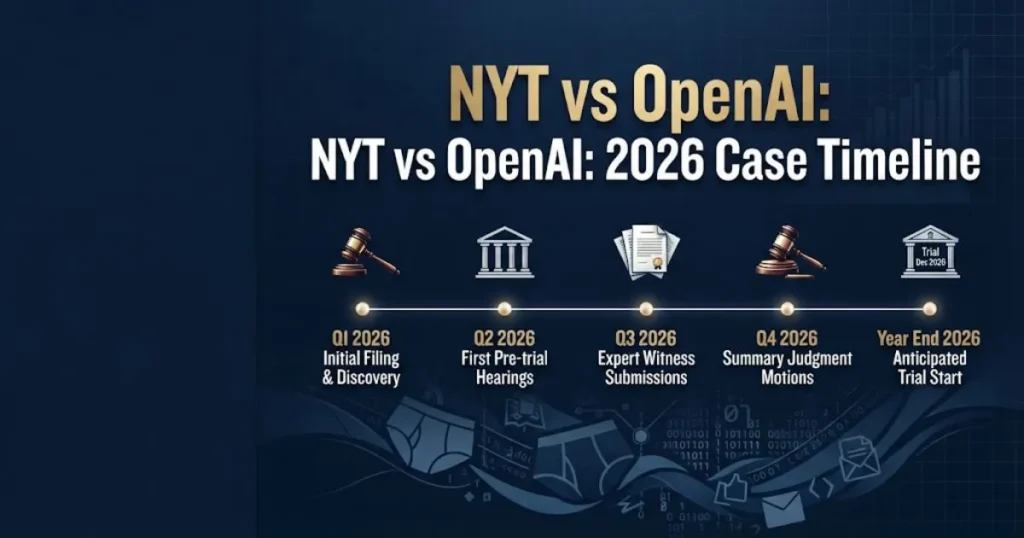
NYT Lawsuit Timeline: From Filing to Trial
The NYT lawsuit timeline stretches from late 2023 through a projected trial date in 2027. Here is every major milestone mapped out.
Before the lawsuit even existed, the Times and OpenAI negotiated behind closed doors throughout much of 2023. Those licensing talks collapsed in the fall. The Times filed suit just days before the new year.
After filing, the standard pretrial process kicked in. OpenAI and Microsoft filed motions to dismiss in early 2024. Briefing on those motions took months. Judge Stein issued rulings throughout 2024 and into 2025, keeping the core claims alive.
| Date | Event |
|---|---|
| Mid-2023 | Licensing negotiations between NYT and OpenAI |
| Fall 2023 | Negotiations collapse |
| December 27, 2023 | Lawsuit filed in S.D.N.Y. |
| Early 2024 | Motions to dismiss filed by OpenAI and Microsoft |
| Mid to Late 2024 | Briefing and oral arguments on motions |
| 2024 into 2025 | Judge Stein rules on motions, most claims survive |
| 2025 | Discovery begins, document exchanges |
| Early to Mid 2026 | Discovery ongoing, deposition phase |
| Late 2026 | Expert reports due, possible summary judgment motions |
| 2027 (projected) | Trial |
Discovery is the longest and most intensive phase. Both sides are exchanging millions of documents. OpenAI’s internal emails about training data sourcing are particularly sought after by the Times’ legal team.
The case could also end before trial. Settlement discussions have reportedly taken place, though neither side has confirmed progress.
When Is the NYT OpenAI Trial Date?
No firm NYT OpenAI trial date has been set as of early 2026. Based on the current pace of litigation, legal observers expect a trial sometime in 2027.
Federal copyright cases of this size and complexity typically take three to four years from filing to trial. The case was filed in December 2023, which puts a 2027 trial right in the expected window.
Several factors could push the date earlier or later. If the court grants summary judgment on key issues, some claims might be resolved without trial. If new discovery disputes arise, delays could push the date into late 2027 or even 2028.
Judge Stein has managed the case at a steady pace. He has not allowed either side to drag out proceedings unnecessarily. That is a good sign for anyone hoping for a resolution.
- Best case scenario: Trial begins in early to mid 2027
- Most likely scenario: Trial in late 2027
- Worst case scenario: Delays push trial to 2028
- Wild card: Settlement ends the case before any trial occurs
It is worth watching the summary judgment phase closely. If Judge Stein rules on the fair use question before trial, it could narrow or even resolve the case entirely. Summary judgment motions are expected in late 2026.
Key Takeaway: The trial is still likely more than a year away, but the pretrial rulings happening right now in 2026 will shape what the jury actually decides.
NYT Microsoft Lawsuit: Why Microsoft Is Named
Microsoft is a co-defendant in the NYT lawsuit because of its deep financial and operational ties to OpenAI. The Times argues Microsoft is jointly responsible for the alleged copyright infringement.
Microsoft invested over $13 billion in OpenAI. That investment gave Microsoft access to OpenAI’s technology, which it integrated into products like Bing Chat (now Microsoft Copilot), Microsoft 365 Copilot, and the Bing search engine.
The legal theory is called vicarious and contributory infringement. Vicarious liability means Microsoft profited from infringement it had the ability to control. Contributory infringement means Microsoft knowingly helped OpenAI infringe by funding and distributing the technology.
Microsoft’s products directly use OpenAI’s models. When a user asks Copilot a question and receives an answer derived from Times reporting, Microsoft is the company delivering that answer to the end user.
| Microsoft Connection | Detail |
|---|---|
| Total Investment | Over $13 billion in OpenAI |
| Products Using OpenAI Tech | Copilot, Bing Chat, Microsoft 365 |
| Legal Theory | Vicarious and contributory infringement |
| Microsoft’s Defense | Technology partner, not direct infringer |
Microsoft has pushed back against its inclusion in the case. The company argues it is a technology partner and investor, not the entity that built the training pipeline or scraped the content.
But the Times sees Microsoft as the deep pocket in the room. With a market cap exceeding $3 trillion, Microsoft has the financial resources that make a large damages award collectible.
Could There Be an NYT OpenAI Settlement?
An NYT OpenAI settlement is possible, and some legal analysts consider it the most likely outcome. Most high-profile copyright cases settle before reaching a verdict.
Both sides have reasons to avoid trial. For the Times, a settlement guarantees a payout and possibly a long-term licensing deal. Going to trial risks a ruling that AI training is fair use, which would give the Times nothing.
For OpenAI, a trial risks a massive damages verdict and a court order to destroy training data. A settlement lets OpenAI control the financial hit and avoid a precedent that could invite lawsuits from every publisher on the planet.
Reports suggest the parties have engaged in settlement discussions at various points. Neither side has confirmed details. The talks have not produced a public agreement as of early 2026.
What a settlement might include:
- Lump sum payment: Estimated range of $100 million to $1 billion
- Ongoing licensing agreement: Annual fees for continued use of Times content
- Content removal provisions: OpenAI agrees to filter or exclude Times content from future training
- Attribution requirements: AI outputs referencing Times reporting must credit the source
- Confidentiality clause: Financial terms kept private
OpenAI has already signed licensing deals with other publishers. The AP deal and Axel Springer agreement provide templates for what a Times deal could look like. But the Times is a much larger and more influential publisher, so the price tag would be significantly higher.
The longer discovery continues, the more pressure builds on both sides. Internal documents and communications revealed during discovery often motivate settlements.
Who Is Affected by the NYT OpenAI Lawsuit?
Everyone who creates, publishes, or consumes written content is affected by the NYT OpenAI lawsuit. The case reaches far beyond two companies fighting over money.
Journalists and writers are watching closely. If the court rules that AI training on published articles is fair use, it sets a precedent that could allow AI companies to use any written content without paying. That would undermine the economic model that supports professional journalism.
Other news publishers have a direct stake. The Washington Post, Wall Street Journal, Reuters, and hundreds of smaller outlets face the same question: should AI companies pay to use their content? The Times’ case will set the template.
Content creators and bloggers are in a similar position. If massive publishers like the Times cannot enforce copyright against AI training, individual creators have even less leverage.
AI companies beyond OpenAI are watching too. Google, Meta, Anthropic, and dozens of startups train their models on similar datasets. The outcome affects their entire business model.
Readers and consumers feel the effects indirectly. If AI undermines the revenue model for journalism, there will be less quality reporting. Fewer newsrooms means less accountability for governments and corporations.
- Journalists and freelance writers: copyright protections at stake
- Publishers large and small: licensing revenue and business models threatened
- AI companies: legal framework for training data in question
- Tech investors: billions in valuations riding on the outcome
- General public: quality of available information could shift
Key Takeaway: This is not just a fight between the Times and OpenAI; it is a case that will define the rules for how AI interacts with copyrighted content for years to come.
NYT Lawsuit Impact on Publishers and Creators
The NYT lawsuit impact on publishers could be transformative for the entire media industry. A Times victory would establish that AI companies must license copyrighted content for training purposes.
Several publishers have already taken action based on the lawsuit’s momentum. Over a dozen news organizations filed similar suits against AI companies in 2024 and 2025. The Intercept, Raw Story, AlterNet, and a coalition of Canadian publishers have all brought claims.
Some publishers chose licensing over litigation. The Associated Press signed a deal with OpenAI. Axel Springer, which owns Politico and Business Insider, struck its own agreement. These deals typically involve annual payments and content attribution requirements.
For smaller publishers and independent creators, the stakes are different. They lack the legal budgets to sue OpenAI individually. But a favorable ruling in the Times case could open the door to class action suits or collective licensing frameworks.
| Publisher Response | Examples |
|---|---|
| Filed lawsuits | The Intercept, Raw Story, AlterNet |
| Signed licensing deals | Associated Press, Axel Springer |
| Blocked AI crawlers | NYT, CNN, Reuters (robots.txt updates) |
| Joined coalitions | News/Media Alliance advocacy efforts |
The publishing industry has also taken technical steps. Many outlets updated their robots.txt files to block OpenAI’s web crawler, GPTBot. This prevents future scraping but does nothing about content already consumed during training.
If the Times wins, a licensing marketplace for AI training data will likely emerge. Publishers would negotiate collectively or individually for training rights. That could create a new revenue stream worth hundreds of millions across the industry.
Freelance writers and independent journalists face the hardest road. Their individual works are harder to track in training datasets. But legal precedent from the Times case would strengthen their position in any future claims.
Frequently Asked Questions
What is the NYT lawsuit against OpenAI about?
The NYT lawsuit accuses OpenAI and Microsoft of using millions of New York Times articles to train AI models like ChatGPT without permission.
The Times claims this is copyright infringement and seeks billions in damages.
The case was filed in December 2023 in federal court in New York.
How much money is the New York Times suing OpenAI for?
The Times seeks billions of dollars in statutory and actual damages.
Statutory damages alone could range from $75 million to $15 billion depending on how many works are found to be infringed.
The exact amount will be determined by the court based on evidence of willfulness and market harm.
When will the NYT vs OpenAI case go to trial?
No official trial date has been set as of early 2026.
Legal experts project a trial in 2027 based on the current pace of pretrial proceedings.
Settlement discussions could end the case before trial.
Does the NYT lawsuit affect other newspapers or writers?
Yes, the outcome will set legal precedent for all publishers and content creators.
If the Times wins, other media companies will have stronger grounds to demand licensing fees from AI companies.
Several other publishers have already filed similar lawsuits based on the same legal theories.
Could OpenAI settle the NYT lawsuit out of court?
Settlement is considered likely by many legal analysts.
OpenAI has already signed licensing deals with other publishers, creating a template for negotiations.
A settlement could include a lump sum payment plus an ongoing licensing agreement worth hundreds of millions of dollars.
The NYT lawsuit against OpenAI is the most important copyright case of the AI era. Its outcome will determine whether AI companies can freely train on copyrighted content or must pay for the privilege.
If you are a journalist, publisher, or content creator, this case directly affects your livelihood. Stay informed about court rulings and timeline updates throughout 2026.
The pretrial phase happening right now will shape everything that follows. Pay attention to the discovery rulings and summary judgment motions expected later this year.







