

Florida borrowers who took out loans from NetCredit may have a real shot at getting money back. The netcredit lawsuit florida situation has heated up as legal challenges mount against the online lender over interest rates that can top 150% APR.
That is not a typo. Some borrowers paid more in interest than the original loan amount.
This article breaks down every angle of the case in 2026. You will learn who qualifies, what the expected payouts look like, whether NetCredit is even legal in Florida, and exactly how to file a claim.
NetCredit, a brand under publicly traded Enova International, has faced scrutiny from multiple states. Florida’s strict usury laws make it one of the most interesting battlegrounds. If you borrowed from NetCredit and live in Florida, keep reading.
NetCredit Lawsuit Florida: What You Need to Know in 2026
The NetCredit lawsuit in Florida centers on allegations that the lender charged interest rates far beyond what state law allows. Florida caps most consumer loan interest at 18% per year under Florida Statute 687.03, yet NetCredit loans regularly carried APRs between 34% and 155%.
Multiple legal actions have targeted NetCredit and its parent company, Enova International. These include individual lawsuits, potential class actions, and regulatory investigations.
The core legal argument is straightforward. NetCredit’s lending model allegedly violates Florida’s usury statute. If a court agrees, borrowers could be entitled to refunds of excess interest charges.
| Detail | Info |
|---|---|
| Defendant | NC Financial Solutions of Utah LLC (NetCredit) |
| Parent Company | Enova International |
| Key Florida Statute | 687.03 (Usury) |
| Alleged APR Range | 34% to 155% |
| Florida Legal Cap | 18% for most consumer loans |
| Status in 2026 | Active litigation and regulatory review |
The stakes are high for both sides. NetCredit has thousands of Florida borrowers on its books. A ruling against the company could mean refunds totaling millions of dollars.
NetCredit Class Action Lawsuit 2026: Current Status
As of 2026, class action efforts against NetCredit are in various stages across multiple jurisdictions. In Florida, plaintiffs’ attorneys have been building cases centered on the usury and predatory lending claims.
Class certification is a big hurdle. NetCredit has fought hard to keep cases in individual arbitration rather than allowing a single large class action. Courts are still weighing these arguments.
Several law firms have been investigating claims from Florida borrowers since late 2024. The momentum picked up throughout 2025, and 2026 is shaping up to be a pivotal year for court decisions on class certification.
Here is where things stand:
- Pre-certification phase: Attorneys are gathering plaintiff data from Florida borrowers
- Arbitration challenges: Courts are reviewing whether NetCredit’s arbitration clause is enforceable
- Regulatory pressure: The Florida Office of Financial Regulation has been examining NetCredit’s licensing status
- Related cases: Similar lawsuits in Virginia, Illinois, and California provide legal precedent
The outcome of the arbitration fight will likely determine whether this becomes a true class action or stays as individual claims.
NetCredit Settlement 2026: Is a Deal on the Table?
No official settlement has been announced in the NetCredit Florida lawsuit as of early 2026. Settlement talks typically happen after class certification or after a major court ruling goes against the defendant.
That said, the pressure on NetCredit is growing. Enova International reported in its SEC filings that legal costs related to state lending challenges have been rising steadily.
Settlement is most likely if a court rules that NetCredit’s interest rates violate Florida’s usury cap. At that point, the company would face a choice: settle for a defined amount or risk a trial verdict that could be much larger.
| Settlement Factor | Current Status |
|---|---|
| Official Settlement Offer | None announced |
| Settlement Talks | Likely in preliminary stages |
| Key Trigger | Court ruling on usury violation |
| Estimated Timeline | Late 2026 to mid 2027 |
| Comparable Settlements | Other online lenders have settled for $5M to $50M+ |
Borrowers should keep records of every loan document, payment receipt, and communication from NetCredit. These will be critical if a settlement fund opens up.
Key Takeaway: The NetCredit lawsuit in Florida is active in 2026, driven by allegations of illegally high interest rates, with no settlement announced yet but growing legal and regulatory pressure on the company.
How Much Is the NetCredit Lawsuit Payout?
Individual payouts from a NetCredit lawsuit could range from a few hundred dollars to several thousand dollars per borrower. The exact amount depends on how much you borrowed, what APR you were charged, and how much excess interest you paid.
Think of it this way. If Florida law caps your interest at 18% and NetCredit charged you 150%, the difference between those two rates, applied to your loan, is your potential recovery.
Here is a simplified example:
| Loan Amount | NetCredit APR | Legal Cap APR | Excess Interest (Est.) |
|---|---|---|---|
| $2,000 | 99% | 18% | $1,620 per year |
| $5,000 | 120% | 18% | $5,100 per year |
| $3,500 | 155% | 18% | $4,795 per year |
Those numbers assume a full year of the loan. Actual payouts would be calculated based on your specific loan term and payment history.
In class action settlements, individual payouts are often lower than raw damage calculations. Administrative costs, attorney fees, and fund caps reduce per-person amounts. But even so, Florida borrowers with larger loans or longer repayment periods stand to recover meaningful money.
If the case goes to trial instead of settling, a jury could award additional damages. Florida’s usury statute allows courts to void the entire interest obligation, not just the excess.
Is NetCredit Legal in Florida?
The legality of NetCredit in Florida is one of the most contested questions in this case. NetCredit operates through NC Financial Solutions of Utah LLC, using Utah’s more permissive lending laws to originate loans that would be illegal under Florida’s rate caps.
Florida requires consumer lenders to hold a state license under Florida Statute Chapter 516. NetCredit has at times operated under a bank partnership model that allowed it to claim exemption from state licensing requirements.
This is where it gets interesting. Florida regulators have questioned whether NetCredit’s lending model genuinely qualifies for those exemptions.
- NetCredit is not a bank. It is a financial technology company.
- It has used partnerships with Republic Bank & Trust to originate some loans.
- The “true lender” question, meaning who is really making the loan, is central to the legal fight.
- If NetCredit is the true lender, it must follow Florida law.
Several states have already ruled that similar online lending models are not protected by bank partnerships. Florida courts are expected to weigh in on this issue as the lawsuit progresses through 2026.
The bottom line: NetCredit may be operating in a legal gray area in Florida, and the lawsuit aims to prove it crossed the line.
NetCredit Predatory Lending in Florida: The Allegations
Plaintiffs allege that NetCredit engaged in predatory lending by targeting financially vulnerable Floridians with loans designed to trap them in debt. The accusations go beyond just high interest rates.
The specific allegations include:
- APRs exceeding 100% on personal installment loans
- Hidden fees rolled into loan balances that inflated the total cost
- Aggressive marketing to consumers with low credit scores who had few alternatives
- Automatic payment withdrawals that drained checking accounts and caused overdraft fees
- Misleading loan disclosures that obscured the true cost of borrowing
Predatory lending is not just a buzzword. Under Florida law, it describes lending practices that are unfair, deceptive, or designed to take advantage of a borrower’s lack of financial sophistication.
One common complaint from Florida borrowers: they were approved quickly online, received funds within 24 hours, but did not fully understand they would repay two to three times the loan amount over the life of the contract.
That fast approval process is part of the problem. Critics argue that NetCredit’s underwriting focused more on maximizing revenue than on evaluating whether borrowers could realistically afford the payments.
Key Takeaway: NetCredit is accused of predatory lending in Florida through sky-high APRs, hidden fees, and aggressive targeting of consumers who could least afford these loans.
NetCredit and Florida Usury Law: Why Rates Matter
Florida’s usury law, codified in Florida Statute 687.03, makes it a criminal offense to charge more than 25% annual interest on loans under $500,000. For most consumer loans, the practical cap is 18% per year.
NetCredit’s typical APRs in Florida have ranged from 34% to 155%. Those rates are not just above the cap. They blow past it by a factor of two to eight times.
Under Florida usury law, a loan with an illegally high interest rate can be declared void. That means the lender loses the right to collect any interest at all, not just the portion above the cap.
| Florida Usury Thresholds | Rate |
|---|---|
| General Interest Cap | 18% APR |
| Criminal Usury Threshold | 25% APR |
| Penalty for Violation | Loan interest voided entirely |
| Statute | Florida Statute 687.03 |
This is a powerful tool for borrowers. If a court finds that NetCredit’s loans violate usury law, every dollar of interest you paid could potentially be refunded.
The defense NetCredit typically raises is that its loans are governed by Utah law or federal preemption through its bank partnerships. Florida courts have not fully accepted this argument, and the legal battle over which state’s law applies remains a key issue in 2026.
The NetCredit Tribal Lending Lawsuit Explained
NetCredit itself is not a tribal lender, but its legal challenges overlap with the broader tribal lending model that many online lenders use. Understanding this model helps explain why NetCredit believes it can charge rates that exceed Florida’s caps.
Some online lenders partner with Native American tribes to originate loans. The theory is that tribal sovereignty exempts them from state usury laws. Courts have been increasingly skeptical of this argument, especially when the tribe is not the “true lender.”
NetCredit’s approach is slightly different. It has used bank partnerships rather than tribal partnerships. But the underlying legal strategy is similar: use an entity that claims exemption from state law to originate loans, then service and profit from those loans through a separate company.
Key points about this structure:
- Enova International is the corporate parent of NetCredit
- NC Financial Solutions of Utah is the lending entity
- Republic Bank & Trust has partnered on loan origination
- The question is whether NetCredit or the bank is the “true lender”
- If NetCredit is the true lender, state usury caps apply
Courts in several states have ruled against similar lending structures. The Second Circuit in 2020 ruled that the “true lender” is the entity with the predominant economic interest, not just the entity that technically originates the loan.
This precedent is critical for Florida borrowers. It suggests that NetCredit cannot hide behind a bank charter to escape Florida’s rate caps.
Who Qualifies? NetCredit Lawsuit Eligibility
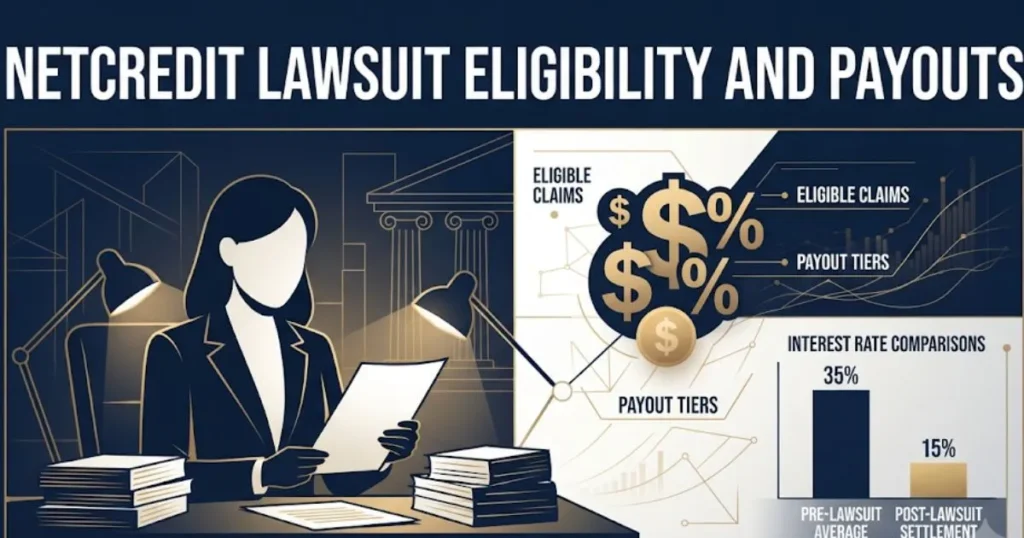
You may qualify for the NetCredit lawsuit in Florida if you are a Florida resident who took out a loan from NetCredit and were charged an APR above 18%. That covers the vast majority of NetCredit borrowers in the state.
Eligibility is broad because the core claim is straightforward. If your interest rate exceeded Florida’s legal cap, you were potentially harmed.
Here are the typical eligibility factors:
| Eligibility Factor | Requirement |
|---|---|
| Residency | Florida resident at time of loan |
| Lender | Loan originated by NetCredit or NC Financial Solutions |
| APR | Above 18% (most NetCredit loans qualify) |
| Loan Type | Personal installment loan |
| Timeframe | Loans originated within the statute of limitations period |
| Documentation Needed | Loan agreement, payment history, bank statements |
The statute of limitations in Florida for usury claims is generally four years from the date of the loan. For fraud-related claims, it can extend to four years from when you discovered the issue.
If your loan is older than four years, you may still qualify if the payments were ongoing. Courts sometimes treat each excessive payment as a separate violation, which restarts the clock.
Borrowers who have already paid off their NetCredit loans can still file claims. You don’t need to have an open balance. What matters is that you were charged illegal rates.
Key Takeaway: Most Florida residents who borrowed from NetCredit at rates above 18% APR likely qualify for the lawsuit, whether the loan is active or already paid off.
NetCredit Interest Rate Lawsuit: What APRs Are at Stake?
The interest rates at the center of this lawsuit are staggering. NetCredit has charged Florida borrowers APRs ranging from 34% to 155%, with many loans falling in the 90% to 130% range.
To put that in perspective, a borrower who took a $3,000 loan at 120% APR would owe $3,600 in interest alone after just one year. That is more than the original loan amount.
Compare that to what Florida law allows:
| Loan Source | Typical APR |
|---|---|
| Credit Union Personal Loan | 8% to 12% |
| Bank Personal Loan | 10% to 18% |
| Florida Legal Cap | 18% |
| NetCredit (Reported Range) | 34% to 155% |
| Difference vs. Legal Cap | 16% to 137% excess |
The lawsuit argues that every percentage point above 18% represents money that was illegally taken from borrowers. Over thousands of Florida customers, that excess interest adds up to millions.
NetCredit’s own marketing materials describe its loans as an alternative to payday lending. But critics point out that the APRs are not much better than payday loans, which Florida has separately capped and regulated under Florida Statute 560.404.
The interest rate evidence is some of the strongest ammunition plaintiffs have. Loan agreements clearly state the APR. There is no ambiguity about what borrowers were charged.
How to Sue NetCredit in Florida
Florida borrowers can sue NetCredit individually or join a group legal action. Individual lawsuits are filed in Florida state court, typically in the county where you live or where the loan was serviced.
To bring a case, you will need:
- Your original loan agreement showing the APR and terms
- Payment records from your bank showing amounts deducted
- Any correspondence from NetCredit, including emails and account statements
- Proof of Florida residency at the time of the loan
Filing a lawsuit in Florida generally costs between $300 and $400 in court fees. Many consumer rights attorneys take these cases on contingency, meaning you pay nothing upfront and the attorney gets a percentage of any recovery.
Small claims court is an option for amounts under $8,000 in Florida. This route is simpler, does not require an attorney, and moves faster than circuit court.
For larger claims or class action participation, you will want an attorney experienced in consumer finance litigation. Look for lawyers who specialize in usury, predatory lending, or CFPB-related cases.
One thing to keep in mind: before filing, you may need to address the arbitration clause in your NetCredit loan agreement. We cover that in a later section.
NetCredit Lawsuit: How to File a Claim
Filing a claim against NetCredit depends on whether a class action settlement has been approved or whether you are pursuing an individual case. In 2026, no class settlement fund is open yet, so the primary path is individual legal action or joining an ongoing class effort.
Here is the step-by-step process:
- Gather your documents: Loan agreement, payment history, bank statements, any emails from NetCredit
- Calculate your damages: Add up all interest paid above 18% APR
- Contact a consumer rights attorney: Many offer free case evaluations
- File a complaint with the Florida Office of Financial Regulation: This creates an official record
- File a complaint with the CFPB: Federal complaints add regulatory pressure
- Decide your legal path: Individual lawsuit, small claims, or class action participation
| Filing Step | Detail |
|---|---|
| Document Collection | Loan agreement, bank records, emails |
| Damage Calculation | Total interest paid minus 18% cap amount |
| Attorney Consultation | Free evaluations available from consumer law firms |
| State Complaint | Florida Office of Financial Regulation |
| Federal Complaint | Consumer Financial Protection Bureau |
| Court Filing | State court or small claims |
If a class action is certified and you match the class definition, you may be automatically included unless you opt out. Watch for notices from the court or class counsel.
Timing matters. The statute of limitations is running. Filing sooner protects your right to recover.
Key Takeaway: You can file a claim against NetCredit by gathering your loan documents, calculating excess interest, and working with a consumer rights attorney or filing complaints with state and federal agencies.
Can the NetCredit Arbitration Clause Stop Your Case?
NetCredit’s loan agreements include a mandatory arbitration clause that attempts to force disputes into private arbitration instead of court. This clause also typically includes a class action waiver, meaning you agree not to participate in group lawsuits.
Does this actually stop you? Not necessarily.
Florida courts have the power to strike down arbitration clauses that are unconscionable. An unconscionable clause is one that is so unfair it shocks the conscience of the court. Several factors could make NetCredit’s arbitration clause unenforceable:
- The clause was buried in fine print that borrowers did not meaningfully review
- Borrowers had no real choice: they needed the money and had no bargaining power
- The underlying loan itself may be illegal under Florida usury law
- If the entire contract is void due to usury, the arbitration clause within it may also be void
This last point is powerful. Under the legal doctrine of void ab initio, if a contract is illegal from the start, every provision in it, including arbitration, can be thrown out.
Some courts have taken the opposite view, ruling that arbitration clauses must be enforced even in potentially usurious loans. This remains a contested area of law.
In 2026, the enforceability of NetCredit’s arbitration clause in Florida is still being litigated. The outcome will have a major impact on whether a class action moves forward or borrowers must pursue individual arbitration claims.
NetCredit Debt Collection Lawsuit in Florida
Some Florida borrowers are not just suing NetCredit. They are also fighting back against NetCredit’s debt collection practices. Borrowers who fell behind on payments have reported aggressive collection tactics.
Reported issues include:
- Repeated phone calls to borrowers and their family members
- Threats of legal action even when statutes of limitations had expired
- Reporting derogatory information to credit bureaus for debts that may be unenforceable
- Continuing to collect on loans that arguably violate Florida usury law
Under the Fair Debt Collection Practices Act (FDCPA), collectors cannot use deceptive or abusive tactics. Under the Florida Consumer Collection Practices Act (FCCPA), borrowers have additional state-level protections.
Here is the interesting twist. If a loan is usurious under Florida law, the debt itself may be uncollectible. A lender cannot legally enforce a contract that violates state law. That means collection efforts on void loans could constitute violations of both federal and state collection statutes.
Borrowers who are being hounded by NetCredit for payments on high-interest loans should document every contact. Save voicemails, screenshot text messages, and keep records of credit report entries.
These debt collection violations can become separate legal claims, meaning you could potentially recover damages for the collection harassment on top of recovering excess interest paid.
Florida Consumer Protection and NetCredit
Florida’s consumer protection framework gives borrowers multiple tools to fight back against lenders like NetCredit. The Florida Deceptive and Unfair Trade Practices Act (FDUTPA) is one of the most potent.
Under FDUTPA, any business practice that is unfair, deceptive, or unconscionable is illegal. Borrowers can seek:
- Actual damages (the money lost due to unfair practices)
- Attorney fees (the losing side pays the winner’s legal costs)
- Injunctive relief (a court order forcing NetCredit to stop the practice)
| Florida Consumer Protection Tool | What It Covers |
|---|---|
| FDUTPA | Unfair and deceptive business practices |
| Florida Usury Statute (687.03) | Interest rate caps and penalties |
| FCCPA | Debt collection abuses |
| Florida Statute 516 | Consumer finance company licensing |
| CFPB Oversight | Federal consumer finance regulation |
The Florida Attorney General’s office also has authority to investigate and sue companies that violate consumer protection laws. Consumer complaints filed with the AG’s office can trigger investigations.
What makes Florida particularly strong for borrowers is the fee-shifting provision in FDUTPA. If you win, NetCredit has to pay your attorney fees. This removes one of the biggest barriers to litigation for individual consumers.
The combination of state usury law, consumer protection statutes, and debt collection rules creates a legal environment where NetCredit faces exposure on multiple fronts.
Key Takeaway: Florida borrowers have strong legal tools including usury statutes, the FDUTPA, and debt collection laws that create multiple avenues for holding NetCredit accountable.
NetCredit Loan Forgiveness Through the Lawsuit
Loan forgiveness is one of the most attractive potential outcomes for Florida borrowers in the NetCredit lawsuit. If a court rules that NetCredit’s loans violate Florida’s usury law, the entire interest obligation could be voided.
That means you would only owe the original principal you borrowed, minus any payments already made. For many borrowers who have been paying for months or years at triple-digit APRs, this could mean their loans are already paid in full. Some may even be owed refunds.
Here is how the math works:
| Scenario | Loan Amount | Total Paid | Principal Owed | Net Result |
|---|---|---|---|---|
| Borrower A | $3,000 | $4,500 | $3,000 | Overpaid by $1,500 |
| Borrower B | $5,000 | $3,200 | $5,000 | Owes $1,800 (no interest) |
| Borrower C | $2,500 | $6,000 | $2,500 | Overpaid by $3,500 |
Loan forgiveness through litigation is different from voluntary forgiveness programs. It is not a favor. It is a legal consequence of the lender breaking the law.
If a class action settlement is reached, the terms may include partial or full cancellation of outstanding balances. Some past online lending settlements have included both cash refunds and debt cancellation.
Borrowers who are still making payments to NetCredit should keep paying until a court order or settlement agreement says otherwise. Stopping payments on your own could hurt your credit and weaken your legal position.
Frequently Asked Questions
Can I still join the NetCredit lawsuit in Florida in 2026?
Yes, Florida borrowers can still pursue claims against NetCredit in 2026.
The statute of limitations for usury claims is generally four years.
Contact a consumer rights attorney for a free case evaluation.
How much money could I get from the NetCredit settlement?
Individual payouts could range from a few hundred to several thousand dollars.
The amount depends on your loan size, APR charged, and total interest paid.
No official settlement amount has been announced yet.
Does NetCredit’s arbitration clause prevent me from suing?
Not always. Florida courts can strike down arbitration clauses deemed unconscionable.
If the loan itself is illegal under usury law, the arbitration clause may be void too.
An attorney can evaluate whether the clause applies to your specific situation.
Is NetCredit allowed to charge over 100% APR in Florida?
No. Florida law caps most consumer loan interest at 18% per year.
Rates above 25% may constitute criminal usury under Florida Statute 687.03.
NetCredit’s rates of 34% to 155% APR appear to exceed these limits.
Will my NetCredit debt be forgiven if the lawsuit succeeds?
If a court voids the interest on your loan, you would only owe the original principal.
Many borrowers who have been paying for a long time may have already overpaid.
Debt cancellation could be part of a class action settlement if one is reached.
What to Do Right Now
The NetCredit lawsuit in Florida is moving. 2026 could bring court rulings that change everything for borrowers who were charged rates well above what the law allows.
Pull out your loan documents today. Check your APR. Calculate how much interest you have paid. Those numbers are your ammunition.
File complaints with the Florida Office of Financial Regulation and the CFPB. Talk to an attorney who handles consumer lending cases. The window to act is open, and waiting only helps NetCredit.







