

NEC lawsuit qualifications come down to a few core factors: a premature infant fed cow’s milk-based formula in a hospital setting who then developed necrotizing enterocolitis. If that describes your child’s experience, you likely meet the basic criteria to pursue a claim in 2026.
Thousands of families have already filed lawsuits against the makers of Similac and Enfamil. The cases are consolidated in a federal MDL in Illinois, and the litigation is picking up speed heading into 2026.
This article breaks down every qualification requirement in plain language. You’ll learn which products are named, how NEC staging affects your claim, what evidence you need, and what kind of settlement money is on the table.
One detail that surprises most parents: over 90% of NEC cases occur in babies born before 37 weeks of gestation who were fed formula in the NICU. That pattern is the foundation of this entire litigation.
NEC Lawsuit Qualifications Explained
NEC lawsuit qualifications are the specific criteria a family must meet to bring a legal claim against baby formula manufacturers like Abbott Laboratories or Mead Johnson. These qualifications center on three things: prematurity, formula exposure, and an NEC diagnosis.
The lawsuits allege that cow’s milk-based formulas, including certain Similac and Enfamil products, increase the risk of necrotizing enterocolitis in premature infants. Manufacturers allegedly knew about this risk and failed to warn hospitals or parents.
You don’t need to prove your child’s case went to the worst extreme. Families whose infants survived NEC with lasting complications can still qualify.
The basic qualifying checklist looks like this:
| Qualification Factor | What It Means |
|---|---|
| Premature birth | Baby born before 37 weeks gestation |
| Formula exposure | Fed cow’s milk-based formula in NICU |
| NEC diagnosis | Confirmed NEC at any stage (I, II, or III) |
| Injury or death | Infant suffered surgery, complications, or death |
| Named products | Similac or Enfamil brand formula products |
Meeting all five factors gives you the strongest possible claim. Missing one does not automatically disqualify you, but it weakens the case significantly.
Who Qualifies for a NEC Lawsuit
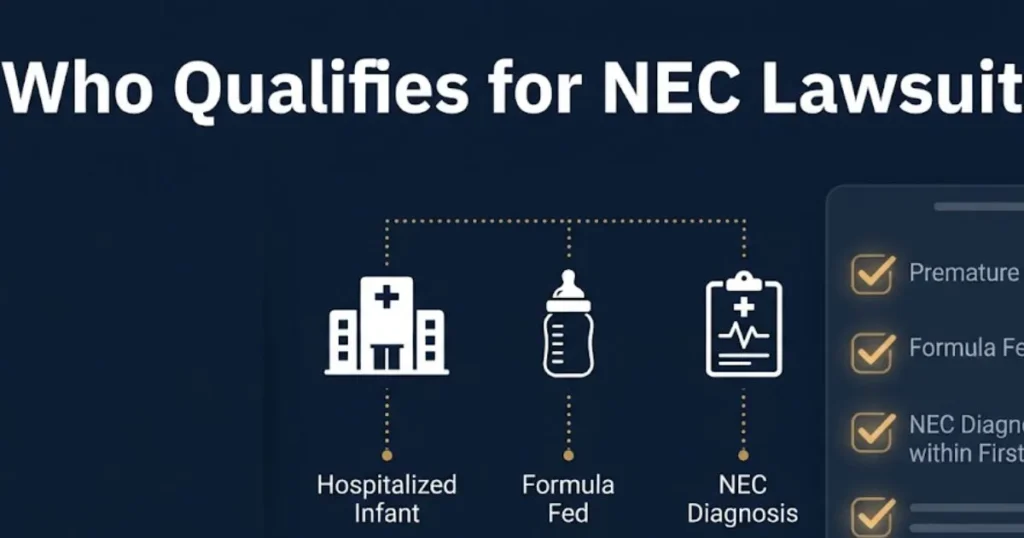
Parents or legal guardians of premature infants who developed NEC after being fed cow’s milk-based baby formula qualify to file a NEC lawsuit. The child must have received formula in a neonatal intensive care unit.
Both surviving children and families who lost a baby to NEC-related complications can file. In wrongful death cases, the parents typically file on behalf of the deceased child’s estate.
Here’s who specifically qualifies:
- Parents of preterm babies (born before 37 weeks) fed Similac or Enfamil in the NICU
- Families of infants who developed confirmed NEC within days or weeks of formula feeding
- Guardians of children who survived NEC but now live with long-term conditions like short bowel syndrome
- Parents who lost a child to NEC or NEC-related surgical complications
Age of the child at the time of filing matters less than the timing of the NEC event. Some children affected are now toddlers or older. Their families can still file if the statute of limitations allows it.
You do not need to have filed a complaint with any agency beforehand. There is no prerequisite FDA report or hospital grievance required.
NEC Baby Formula Lawsuit Qualifications
NEC baby formula lawsuit qualifications focus specifically on the type of formula your infant received. Not every formula brand is part of this litigation. The lawsuits target cow’s milk-based products, particularly those designed for premature or low birth weight infants.
The key products named in the lawsuits include:
- Similac Special Care
- Similac Human Milk Fortifier
- Similac NeoSure
- Enfamil NeuroPro EnfaCare
- Enfamil Human Milk Fortifier
- Enfamil Premature
If your baby received one of these products in the NICU, that’s a strong qualifying factor. Hospital feeding records typically document which formula brand and type was administered.
Breast milk-only feeding generally does not qualify. The lawsuits specifically target the cow’s milk protein in these formulas as the alleged cause of intestinal damage.
Some cases involve mixed feeding, where the baby received both breast milk and formula. These situations still qualify as long as the formula was a cow’s milk-based product and NEC developed afterward.
| Formula Type | Qualifies? |
|---|---|
| Cow’s milk-based formula (Similac/Enfamil) | Yes |
| Soy-based formula | Possibly, case-by-case |
| Breast milk only | No |
| Mixed (breast milk + cow’s milk formula) | Yes |
| Donor human milk only | No |
Key Takeaway: You qualify for a NEC lawsuit if your premature baby was fed cow’s milk-based formula in the NICU and then developed necrotizing enterocolitis, regardless of whether the child survived.
NEC Lawsuit Eligibility Requirements
NEC lawsuit eligibility requirements go beyond just having a diagnosis. Attorneys evaluating these cases look for a clear connection between formula feeding and the onset of NEC symptoms.
The eligibility requirements typically include:
- Gestational age under 37 weeks at birth
- NICU admission where cow’s milk-based formula was administered
- Documented NEC diagnosis confirmed by medical professionals through imaging or surgery
- Injury severity ranging from surgical intervention to organ damage or death
- Identifiable product from Abbott Laboratories or Mead Johnson Nutrition
The timing between formula exposure and NEC onset matters. Most qualifying cases show NEC developing within 2 to 12 weeks after formula introduction. Cases where NEC appeared before any formula feeding are much harder to pursue.
You also need access to medical records that confirm the formula type. If hospital records are incomplete, an attorney can subpoena them. But having them ready speeds up the process.
One thing to note: these are civil lawsuits, not criminal cases. The standard of proof is lower. You need to show it’s “more likely than not” that formula caused or contributed to NEC. You don’t need to prove it beyond all doubt.
NEC Stages and Lawsuit Eligibility
NEC staging directly affects your lawsuit eligibility and the potential value of your claim. Doctors classify NEC using Bell’s staging criteria, which range from Stage I (suspected) to Stage III (advanced with perforation).
| NEC Stage | Description | Lawsuit Eligibility |
|---|---|---|
| Stage I (Suspected) | Mild symptoms like feeding intolerance, mild bloating | Weakest claims; may still qualify |
| Stage II (Definite) | Confirmed NEC with intestinal inflammation, pneumatosis on X-ray | Strong claims; most common in lawsuits |
| Stage III (Advanced) | Intestinal perforation, sepsis, possible death | Strongest claims; highest potential payouts |
Stage II and Stage III cases form the backbone of the NEC litigation. These involve confirmed medical imaging, surgical records, or pathology reports that clearly document the disease.
Stage I cases are trickier. If symptoms resolved without surgery and no long-term harm occurred, some attorneys may decline the case. But if Stage I NEC led to extended hospitalization or developmental delays, it could still qualify.
The severity of NEC also influences settlement value. A child who required multiple surgeries and now lives with short bowel syndrome has a very different case than a child whose NEC resolved with antibiotics alone.
Think of it like car accident claims. A fender bender and a totaled vehicle are both accidents. But the compensation looks very different.
NEC Lawsuit for Premature Babies
The NEC lawsuit is primarily a lawsuit for premature babies. Nearly all qualifying cases involve infants born before 37 weeks of gestation, and the majority involve babies born before 32 weeks.
Premature infants have underdeveloped digestive systems. Their intestinal lining is fragile. When exposed to cow’s milk protein in formula, that fragile tissue can become inflamed and start to die. That’s necrotizing enterocolitis.
Research published in medical journals has consistently shown that premature infants fed formula have a significantly higher risk of developing NEC compared to those fed exclusively on human breast milk.
Quick Facts:
- Babies born before 28 weeks have the highest NEC risk
- NEC affects roughly 5% to 12% of very low birth weight infants
- Mortality rates for surgical NEC range from 20% to 50%
- Survivors often face lifelong digestive and developmental challenges
Full-term babies rarely develop NEC. If your baby was born at or after 37 weeks and developed NEC, a lawsuit is still possible but much less common. Attorneys will look more closely at other risk factors in those situations.
The central argument in these lawsuits is simple: formula manufacturers knew premature babies were at higher risk and still marketed their cow’s milk products for NICU use without adequate warnings.
Key Takeaway: NEC staging and gestational age at birth are the two biggest factors that determine both eligibility and potential payout in a NEC lawsuit.
Similac NEC Lawsuit Qualifications
Similac NEC lawsuit qualifications apply to families whose premature infants were fed Similac brand cow’s milk-based formula products manufactured by Abbott Laboratories before developing NEC.
Abbott is one of two primary defendants in the NEC litigation. Their NICU-targeted products are at the center of the allegations.
The Similac products most commonly named in lawsuits include:
- Similac Special Care: Designed specifically for premature and low birth weight infants
- Similac Human Milk Fortifier: A cow’s milk-based additive mixed into breast milk for extra calories
- Similac NeoSure: Marketed for premature infants after NICU discharge
- Similac Alimentum: A hydrolyzed formula, less commonly named but included in some cases
To qualify under the Similac track, you need to show that your child was fed one of these products and subsequently developed NEC. NICU feeding logs typically document the specific brand and product used.
Abbott has denied that its products cause NEC. The company maintains that its formulas are safe and that NEC has multiple contributing factors. That defense will be tested as bellwether trials move forward in 2026.
If you’re unsure which product your baby received, hospital records should contain that information. Most NICUs keep detailed feeding charts that include product names, quantities, and dates.
Enfamil NEC Lawsuit Qualifications
Enfamil NEC lawsuit qualifications target families whose premature babies were fed Enfamil brand products made by Mead Johnson Nutrition, now a subsidiary of Reckitt Benckiser.
Mead Johnson is the second major defendant in the NEC MDL. Their premature infant formula line is directly implicated in the litigation.
The Enfamil products most frequently named include:
- Enfamil Premature: Formulated for low birth weight and premature infants
- Enfamil NeuroPro EnfaCare: Designed for premature babies transitioning from NICU to home
- Enfamil Human Milk Fortifier: A cow’s milk-based supplement added to breast milk
| Enfamil Product | Target Use | Named in Lawsuits? |
|---|---|---|
| Enfamil Premature | NICU feeding for preterm infants | Yes |
| Enfamil NeuroPro EnfaCare | Post-discharge nutrition | Yes |
| Enfamil Human Milk Fortifier | Breast milk supplement | Yes |
| Enfamil Infant (standard) | Full-term infant feeding | Rarely |
Like Abbott, Mead Johnson has denied its products cause NEC. The company argues that NEC is a complex condition with many risk factors unrelated to formula.
Qualifying under the Enfamil track follows the same basic pattern. Premature baby, NICU stay, Enfamil formula exposure, NEC diagnosis. Hospital records documenting the product are essential.
Some families aren’t sure whether their baby received Similac or Enfamil. In those cases, attorneys can request records from the hospital and the formula distributor to verify.
What Is the Necrotizing Enterocolitis Lawsuit
The necrotizing enterocolitis lawsuit is a mass tort litigation alleging that cow’s milk-based baby formulas cause a life-threatening intestinal disease called NEC in premature infants. It targets Abbott Laboratories and Mead Johnson Nutrition, the two largest infant formula manufacturers in the United States.
NEC itself is a devastating condition. The intestinal tissue becomes inflamed and begins to die. In severe cases, the intestine perforates. Bacteria leak into the abdomen. The baby can develop sepsis and organ failure.
This litigation began gaining traction around 2022 when studies linking formula to NEC became more widely known. By 2023, hundreds of individual lawsuits were consolidated into a multidistrict litigation, or MDL, in the Northern District of Illinois.
The core allegation is failure to warn. Plaintiffs say that Abbott and Mead Johnson had access to decades of medical research showing that cow’s milk formula increases NEC risk in premature infants. Despite this evidence, neither company added adequate warnings to their NICU products.
Quick Facts:
- Over 1,000 cases are currently pending in the MDL
- The litigation is designated as MDL No. 3026
- Cases are consolidated before federal judges in Chicago, Illinois
- Both individual injury and wrongful death claims are included
This isn’t a class action. Each family files an individual lawsuit. But the cases are grouped for pretrial proceedings to keep things efficient.
Key Takeaway: The NEC lawsuit is an individual mass tort case, not a class action, and every qualifying family files their own claim against the formula makers.
NEC Lawsuit Update 2026
The NEC lawsuit is entering a critical phase in 2026 as bellwether trials are expected to begin and settlement discussions could accelerate. Activity in the MDL has been building steadily throughout 2025, with case management orders, expert discovery, and trial preparation all moving forward.
As of early 2026, several important developments have shaped the litigation:
- Bellwether trial selections are underway, with a small group of representative cases being prepared for trial
- Expert witnesses on both sides have been disclosed, including neonatologists, epidemiologists, and formula scientists
- Daubert hearings to challenge expert testimony are expected in 2026
- Discovery between the parties has produced internal company documents related to formula safety research
The outcome of bellwether trials will set the tone for the entire litigation. If plaintiffs win the first trial, it puts enormous pressure on defendants to negotiate a global settlement. If defendants win, it could slow the process.
Both Abbott and Mead Johnson continue to deny liability. They argue that NEC is caused by prematurity itself and other factors, not formula. Plaintiffs counter with internal documents and published research showing the companies were aware of the formula-NEC link.
New cases are still being accepted into the MDL in 2026. Families who haven’t filed yet still have time, but the window narrows as the litigation matures.
NEC Lawsuit MDL Status 2026
The NEC lawsuit MDL, designated as MDL No. 3026, is consolidated in the U.S. District Court for the Northern District of Illinois. In 2026, the MDL is in an advanced pretrial phase with bellwether trial preparation driving the schedule.
| MDL Detail | Information |
|---|---|
| MDL Number | 3026 |
| Court | Northern District of Illinois |
| Location | Chicago, Illinois |
| Defendants | Abbott Laboratories, Mead Johnson (Reckitt) |
| Case Type | Individual mass tort (not class action) |
| Status (2026) | Bellwether trial preparation, expert discovery |
| Estimated Pending Cases | Over 1,000 |
An MDL groups similar cases together for pretrial efficiency. All cases share the same discovery process, the same rulings on motions, and the same expert challenges. But each case retains its individual facts and potential outcome.
Bellwether trials function like test runs. The court picks a handful of representative cases to try first. The results help both sides gauge what juries think about the evidence, which guides settlement negotiations.
If you file a new case in 2026, it will be transferred into this MDL. You don’t get to choose a different court for the pretrial phase. Your case joins the consolidated proceedings in Chicago.
The MDL structure benefits families because it forces the defendants to respond to all cases at once rather than fighting each one individually in separate courts across the country.
NEC Lawsuit Settlement Amounts 2026
NEC lawsuit settlement amounts in 2026 have not been finalized because no global settlement has been reached yet. However, legal analysts and attorneys project settlement ranges based on case severity, comparable mass torts, and bellwether trial signals.
Estimated settlement ranges vary widely depending on case specifics:
| Case Severity | Estimated Settlement Range |
|---|---|
| NEC Stage I, resolved without surgery | $50,000 to $250,000 |
| NEC Stage II, required surgery | $250,000 to $1,000,000 |
| NEC Stage III, severe complications | $500,000 to $3,000,000 |
| Wrongful death from NEC | $1,000,000 to $5,000,000+ |
These are projections, not guarantees. Actual settlement amounts depend on bellwether trial outcomes, the strength of individual evidence, and the defendants’ willingness to negotiate.
Cases involving infant death or lifelong disability like short bowel syndrome will command the highest values. Cases where NEC resolved with minimal treatment will settle for less.
No individual settlements from the NEC MDL have been publicly reported as of early 2026. Some cases filed in state courts may have settled privately, but those amounts are typically confidential.
Think of these numbers as a range on a thermometer. Where your case falls depends on the severity, the documentation, and how the first trials go.
Key Takeaway: No global NEC settlement has been announced yet, but projected payouts range from $50,000 for mild cases to over $5 million for wrongful death, with bellwether trials in 2026 likely to shape final numbers.
NEC Lawsuit Payout Per Person
NEC lawsuit payout per person will depend on individual case facts, not a flat-rate distribution. Unlike class action settlements where everyone gets the same check, this mass tort litigation assigns value to each case based on its own severity and evidence.
Several factors determine your individual payout:
- NEC severity and staging (Stage I vs. Stage III)
- Type of injury (surgery, short bowel syndrome, developmental delays, death)
- Duration of hospitalization related to NEC
- Long-term medical costs for ongoing treatment
- Quality of documentation proving formula exposure and NEC diagnosis
- State laws affecting damages caps or wrongful death rules
A family whose child underwent emergency bowel resection surgery and now requires lifelong nutritional support will receive a significantly larger payout than a family whose child’s NEC resolved with antibiotic treatment.
Wrongful death cases tend to command the highest payouts. The loss of a child carries enormous emotional weight, and juries in bellwether trials often award substantial damages in these situations.
Attorney fees will also reduce the net payout. Most NEC attorneys work on contingency, typically taking 33% to 40% of the settlement. Court costs and case expenses are usually deducted separately.
Your payout also depends on timing. Cases settled earlier in the litigation sometimes accept lower amounts. Cases that go through trial may receive more, or nothing at all.
How to File a NEC Lawsuit
Filing a NEC lawsuit starts with contacting an attorney who handles baby formula NEC cases. Most of these attorneys offer free case evaluations, and they work on a contingency fee basis, meaning you pay nothing upfront.
Here is the step-by-step process:
Step 1: Gather your child’s medical records from the NICU, including feeding logs, NEC diagnosis documentation, surgical records, and discharge summaries.
Step 2: Contact a law firm experienced in NEC litigation. Provide them with a summary of your child’s birth, formula exposure, and NEC diagnosis.
Step 3: The attorney reviews your case and determines if it meets the qualification criteria. This review is typically free.
Step 4: If you qualify, the attorney files a complaint on your behalf. For MDL cases, this means filing in federal court, where the case gets transferred to the Northern District of Illinois.
Step 5: Your case enters the MDL pretrial process. Discovery, expert review, and potential settlement negotiations happen from there.
| Filing Step | What Happens | Your Role |
|---|---|---|
| Initial contact | Free case evaluation | Provide medical history |
| Record collection | Attorney gathers documentation | Sign medical release forms |
| Case filing | Complaint filed in court | Review and approve filing |
| MDL transfer | Case joins consolidated proceedings | Stay in communication with attorney |
| Resolution | Settlement or trial | Accept or reject offer |
You do not need to travel to Chicago for the MDL. Your attorney handles all court appearances and filings remotely.
NEC Lawsuit Evidence Needed
NEC lawsuit evidence must establish two things: that your premature infant was fed cow’s milk-based formula and that the infant developed NEC. The stronger your evidence, the stronger your case.
The types of evidence attorneys look for include:
- NICU feeding records showing which formula product was used
- Medical imaging (X-rays, abdominal scans) confirming NEC diagnosis
- Surgical reports if the infant required bowel resection or other procedures
- Pathology reports from tissue removed during surgery
- Physician notes documenting NEC symptoms and treatment course
- Discharge summaries from the NICU stay
Circumstantial evidence can also help. If a nurse or doctor told you that formula might have contributed to the NEC, that testimony can be documented and used.
You don’t need to have all of this evidence in hand before contacting an attorney. Experienced NEC lawyers know how to obtain hospital records, subpoena documents, and work with medical experts to build the case.
One piece of evidence stands above the rest: the feeding log. This is the document that proves your baby was given a specific formula product. Without it, connecting the formula to the NEC diagnosis becomes much harder.
Photographs, personal journals, or notes you kept during your baby’s NICU stay can also support your timeline and narrative.
Key Takeaway: The single most important piece of evidence in a NEC lawsuit is the NICU feeding log that documents which formula product your baby received and when.
NEC Lawsuit Medical Records Required
NEC lawsuit medical records are the foundation of every case. Without proper documentation from the hospital, it’s nearly impossible to prove the connection between formula feeding and NEC.
Here are the specific medical records required:
| Record Type | Why It Matters |
|---|---|
| NICU feeding log | Proves which formula brand and product was given |
| Birth records | Confirms gestational age and prematurity |
| NEC diagnosis records | Documents when NEC was identified and how |
| Imaging reports (X-rays) | Shows pneumatosis intestinalis or perforation |
| Surgical reports | Details any bowel resection or emergency procedures |
| Pathology reports | Confirms intestinal tissue death from removed tissue |
| Physician progress notes | Tracks symptoms, treatment decisions, and outcomes |
| Discharge summary | Summarizes the entire NICU stay and diagnosis |
To obtain these records, you’ll need to sign a medical records release form. Your attorney sends this to the hospital’s health information department. Hospitals are required by law to provide copies, though it can take weeks.
Keep copies of everything you receive. Digital copies stored securely are ideal. Your attorney will review these records and identify which ones are most useful for proving your case.
If records were lost or destroyed, attorneys can sometimes reconstruct timelines using billing records, pharmacy records, or testimony from treating physicians.
Starting this process early is smart. Medical records requests can take 30 to 60 days. Having them ready before your attorney needs them speeds up the entire filing process.
NEC Lawsuit Statute of Limitations
The NEC lawsuit statute of limitations varies by state and determines how long you have to file a claim after the injury occurred. Missing this deadline can permanently bar your case, no matter how strong the evidence.
Most states set personal injury statutes of limitations at 2 to 3 years from the date of injury. For minors, many states pause or “toll” the clock until the child reaches the age of majority, typically 18.
| State Category | Statute of Limitations | Tolling for Minors? |
|---|---|---|
| States with 2-year limit | Must file within 2 years of injury | Usually tolled until age 18 |
| States with 3-year limit | Must file within 3 years of injury | Usually tolled until age 18 |
| States with discovery rule | Clock starts when injury is discovered | Varies by state |
The “discovery rule” applies in some states. This means the statute of limitations doesn’t start until you knew or should have known that formula caused the NEC. Given the relatively recent public awareness of the formula-NEC link, this rule can extend filing windows.
Even with tolling, waiting too long is risky. Evidence gets harder to find. Medical records may be archived or destroyed. Witnesses move or forget details.
Don’t assume you’ve missed your window. State laws vary dramatically, and an attorney can quickly check your specific deadline. Some states offer surprisingly generous extensions for cases involving injuries to children.
NEC Lawsuit Filing Deadline 2026
There is no single nationwide NEC lawsuit filing deadline in 2026, but the practical window to file a strong case is narrowing. As the MDL progresses toward bellwether trials and potential settlement, cases filed later may face disadvantages.
Several factors create urgency in 2026:
- State statutes of limitations may expire for older NEC cases
- The MDL is maturing, meaning late-filed cases may miss pretrial discovery benefits
- Settlement negotiations could begin after bellwether trials, and only filed cases participate
- Evidence preservation becomes harder as time passes
If your child’s NEC occurred in 2022 or 2023, some state deadlines could expire in 2025 or 2026 without the minor tolling protection. Check your state’s specific rules immediately.
Quick Facts:
- There is no federal deadline for all NEC cases
- Each state sets its own statute of limitations
- Minor tolling extends the deadline in most states
- Cases filed in 2026 can still join the MDL
- Late filing may reduce settlement leverage
The best approach is to act as soon as possible. Even if you’re unsure about your deadline, filing protects your rights. You can always withdraw a case later. You can’t un-miss a deadline.
Attorneys handling NEC cases can determine your exact filing deadline within a single phone call. There’s no cost for that initial assessment.
Key Takeaway: There is no universal 2026 deadline for NEC lawsuits, but state statutes of limitations and the advancing MDL timeline mean filing sooner is always better than waiting.
Frequently Asked Questions
What are the qualifications for a NEC lawsuit in 2026?
You qualify if your premature infant was fed cow’s milk-based formula in the NICU and developed necrotizing enterocolitis.
The baby must have been born before 37 weeks gestation and fed Similac or Enfamil products.
Both surviving children and wrongful death cases qualify.
How much money can I get from a NEC lawsuit settlement?
Settlement projections range from $50,000 for mild cases to over $5 million for wrongful death.
Your payout depends on NEC severity, surgery history, and long-term health impact.
No global settlement has been finalized as of early 2026.
Can I still file a NEC lawsuit in 2026?
Yes, new NEC lawsuits are still being accepted into the MDL in 2026.
Your eligibility depends on your state’s statute of limitations and whether the deadline has passed.
Most states toll the deadline for injuries to minors, giving families extra time.
Does my baby’s NEC stage affect lawsuit eligibility?
Yes, NEC staging directly impacts both eligibility and potential payout.
Stage II and Stage III cases are the strongest and most commonly pursued.
Stage I cases may qualify if they resulted in extended hospitalization or lasting complications.
What baby formula brands are involved in the NEC lawsuit?
The two brands named are Similac (made by Abbott Laboratories) and Enfamil (made by Mead Johnson Nutrition).
Specific products include Similac Special Care, Enfamil Premature, and both companies’ Human Milk Fortifier products.
Only cow’s milk-based formulas designed for premature infants are targeted.
The NEC lawsuit gives families a path to hold formula manufacturers accountable for harm done to the most vulnerable patients. If your child developed NEC after being fed Similac or Enfamil in the NICU, 2026 is the time to act.
Check your state’s filing deadline. Gather your child’s NICU records. Contact an attorney who handles NEC cases for a free evaluation.
The bellwether trials ahead will shape the future of this litigation. Being part of the process starts with filing your claim.
META BLOCK
Meta Title: NEC Lawsuit Qualifications: Who Can File a Claim 2026
Meta Title Chars: 55/59
Meta Desc: Learn the NEC lawsuit qualifications for 2026. See who qualifies, eligibility requirements, settlement amounts, filing deadlines, and how to file your claim.
Meta Desc Chars: 155/159
Focus Keywords: nec lawsuit qualifications, who qualifies for nec lawsuit, nec lawsuit settlement amounts 2026, nec lawsuit eligibility requirements, nec baby formula lawsuit qualifications
Slug: /nec-lawsuit-qualifications/
PHASE 5: IMAGE PROMPTS
Image Prompt 1 (Hero Banner):
A professional editorial-style horizontal banner with bold white text reading “NEC Lawsuit Qualifications” centered on the upper third of the image. Background features a deep navy blue gradient with a subtle abstract pattern of legal scales and a baby bottle silhouette in muted gold tones. On the right side, a stylized gold gavel icon rests on a stack of documents. The left side has open breathing room for potential text overlay. Clean modern typography with a sans-serif font. High contrast between the navy background and white title text. Gold accent lines frame the bottom edge. No human faces. No logos. No watermarks. Professional quality matching Bloomberg Law or Reuters legal section aesthetics. 1920×1080 landscape format.
Alt Text 1: NEC lawsuit qualifications hero banner with legal scales and baby formula imagery
Image Prompt 2 (Supporting Image):
A mid-article supporting graphic in horizontal landscape format with the text “Who Qualifies for NEC Lawsuit” displayed in bold white typography across the top. Below the text, a clean infographic-style layout shows three icon columns: a hospital building silhouette, a baby bottle icon, and a medical chart icon, each connected by dotted gold lines on a deep navy background. A subtle checklist graphic appears on the right side with gold checkmarks. The design is minimal, modern, and editorial. White space on the left allows for additional overlay text. No human faces. No stock photo aesthetic. Color palette uses deep navy, crisp white, and warm gold accents. High contrast clean lines. 1920×1080 format.
Alt Text 2: Who qualifies for NEC lawsuit infographic with eligibility icons and checklist







