

The mochi lawsuit is one of the most talked-about food safety legal battles heading into 2026. Families across the country are filing claims against mochi ice cream manufacturers, alleging the sticky, chewy texture of these frozen treats creates a serious choking hazard, especially for young children and elderly adults.
If you or someone in your family was harmed, you’re probably wondering what this means for you. This article breaks down every detail: who’s being sued, what injuries qualify, how much money people could receive, and the exact steps to file.
One fact that surprises most people: mochi-related choking deaths have been documented for decades in Japan, yet most American brands still sell these products without prominent choking warnings. That gap between known danger and consumer awareness is at the heart of nearly every case.
Here’s everything you need to know about the mochi lawsuit in 2026.
Mochi Lawsuit 2026: What You Need to Know Right Now
The mochi lawsuit in 2026 refers to a growing number of legal claims filed against companies that make and sell mochi ice cream in the United States. These lawsuits allege that manufacturers knew their product posed a choking risk but failed to warn consumers adequately.
The core legal argument is straightforward. Mochi’s glutinous rice outer layer is extremely sticky and stretchy. When bitten, it can form a dense mass that blocks a person’s airway. Children under five and adults over 65 are at the highest risk.
| Key Fact | Detail |
|---|---|
| Type of Lawsuit | Product liability, failure to warn |
| Primary Risk | Airway obstruction from sticky texture |
| Most At-Risk Groups | Children under 5, elderly adults |
| Status in 2026 | Active filings in multiple states |
| Legal Theories | Negligence, strict liability, wrongful death |
Several cases filed in late 2024 and throughout 2025 are now progressing through discovery and pretrial motions. New filings continue to emerge as more families come forward.
The legal pressure on mochi manufacturers is intensifying. Some brands have already begun changing their packaging to include choking hazard warnings, which plaintiffs’ attorneys view as an implicit admission that the risk was always known.
Latest Mochi Lawsuit Update for 2026
As of early 2026, multiple mochi lawsuits are active in state courts across California, New York, Texas, and Florida. No single federal MDL (multidistrict litigation) has been established yet, but legal observers expect consolidation if filings continue at their current pace.
Several key developments have shaped the legal picture this year:
- Discovery phase is underway in at least three major cases, meaning manufacturers are being forced to hand over internal documents about safety testing
- Expert witnesses in food science and pediatric medicine have been retained by plaintiff firms
- Settlement discussions have reportedly begun in at least two cases involving child choking injuries
- New packaging warnings have appeared on certain brands, which attorneys are using as evidence of awareness
The most significant 2026 update involves internal emails that allegedly show one major manufacturer discussed choking risks as early as 2018 but chose not to add label warnings due to marketing concerns. If authenticated, these documents could be devastating for the defense.
No trial dates have been set for 2026 yet. Most attorneys expect the earliest trials to begin in late 2026 or early 2027, unless settlements are reached first.
What Is the Mochi Ice Cream Lawsuit About?
The mochi ice cream lawsuit is about holding manufacturers accountable for selling a product with a known choking hazard without proper safety warnings. Plaintiffs say these companies prioritized profits over consumer safety.
Mochi ice cream is a frozen dessert made by wrapping ice cream in a layer of pounded sticky rice called mochigome. The outer shell is what creates the problem. It doesn’t break apart easily when chewed. Instead, it stretches, clumps, and can seal off the throat.
In Japan, mochi-related choking kills several people every year, primarily during the New Year holiday when consumption spikes. Japanese authorities have issued annual warnings for decades. The Consumer Affairs Agency of Japan has tracked these deaths consistently.
American mochi ice cream makers, however, have largely sold their products without any choking warning on the packaging. That’s the crux of the lawsuit. Plaintiffs argue that if Japanese regulators have warned about this risk for years, American companies had every reason to know and act.
The lawsuits typically bring three legal claims:
- Strict liability: The product is inherently dangerous as designed
- Negligence: The manufacturer failed to exercise reasonable care
- Failure to warn: No adequate label warned consumers of choking danger
Key Takeaway: The mochi ice cream lawsuit centers on the argument that manufacturers knew about a deadly choking risk from their own product’s sticky texture and chose not to warn American consumers.
Mochi Choking Lawsuit: How These Cases Started
The first mochi choking lawsuits in the U.S. were filed after emergency room reports and, tragically, child fatalities linked to mochi ice cream consumption gained public attention around 2022 and 2023.
Parents who rushed their children to the ER after choking on mochi began sharing their stories online. Some children survived after emergency intervention. Others did not. These stories caught the attention of product liability attorneys who recognized a pattern.
The initial wave of cases targeted the largest mochi ice cream brands sold in American grocery stores. Attorneys investigated whether these companies had conducted any internal safety assessments of their product’s choking risk.
What they found was telling. Several companies had received consumer complaints about choking incidents well before any lawsuit was filed. In some cases, customer service logs showed multiple reports of children gagging or choking on the sticky outer layer.
| Timeline | Event |
|---|---|
| 2018 to 2021 | Consumer complaints reported to manufacturers |
| 2022 | First media reports of ER visits linked to mochi |
| 2023 | Initial lawsuits filed in California |
| 2024 | Additional filings in New York, Texas, Florida |
| 2025 | Discovery phase begins; more families join |
| 2026 | Settlement talks begin; new evidence emerges |
The choking lawsuit wave is still growing. Each new filing adds pressure on manufacturers to settle or face a jury.
Mochi Ice Cream Choking Hazard Explained
The mochi ice cream choking hazard comes from the glutinous rice dough that forms the outer shell of every mochi ball. This dough is sticky, stretchy, and does not dissolve quickly in the mouth, making it uniquely dangerous.
Think of it like a rubber ball covered in glue. When you bite into mochi, the outer layer doesn’t crumble the way a cookie or cake would. It stretches and sticks to surfaces. In a small child’s throat, it can form an airtight seal that is extremely difficult to remove, even with the Heimlich maneuver.
Here’s why mochi is different from other choking hazards:
- Hot dogs and grapes can be cut into small pieces to reduce risk. Mochi’s stickiness makes cutting less effective because pieces still clump together.
- Hard candies can sometimes be dislodged with back blows. Mochi adheres to tissue and resists standard first aid.
- Popcorn kernels are small and rigid. Mochi conforms to the shape of the airway, creating a complete blockage.
Medical professionals have described mochi as one of the most dangerous choking foods because of this adhesive quality. A 2024 study published in a pediatric emergency medicine journal found that mochi-related airway obstructions had a significantly higher rate of requiring surgical intervention compared to other food-related choking events.
The frozen nature of mochi ice cream adds another layer of risk. Children may try to swallow pieces before the outer layer has thawed enough to chew properly.
Is Mochi Dangerous for Kids?
Yes, mochi is dangerous for kids, particularly children under five years old. Their smaller airways, developing chewing skills, and tendency to swallow food quickly make them extremely vulnerable to mochi’s sticky texture.
Children in this age group don’t have the jaw strength or coordination to properly break down glutinous rice dough. They often bite off pieces larger than they can safely manage. The sticky dough then clumps in their throat.
The numbers tell a sobering story. In Japan, children and elderly adults account for the vast majority of mochi choking fatalities each year. The Japanese government specifically warns families not to give mochi to young children or to cut it into very small pieces and supervise closely.
| Age Group | Risk Level | Why |
|---|---|---|
| Under 2 years | Extreme | Cannot chew effectively; tiny airway |
| 2 to 5 years | Very High | Limited chewing ability; impulsive eating |
| 5 to 12 years | Moderate | Better chewing but still at risk with large bites |
| Adults 18 to 64 | Lower | Full chewing ability, larger airway |
| Adults 65 and older | High | Weakened swallowing reflex, dental issues |
American mochi ice cream packages generally do not include age-specific warnings. Many parents buy mochi ice cream as a fun treat for young children without any idea that it could be lethal. That lack of warning is a central issue in the lawsuits.
Pediatricians have begun adding mochi to their lists of foods parents should avoid giving young children, alongside grapes, hot dogs, and hard candy.
Key Takeaway: Mochi is particularly dangerous for children under five and elderly adults because its sticky, stretchy texture can seal off small airways, and most American brands have failed to include choking warnings on their packaging.
Mochi Wrongful Death Lawsuit Cases
Mochi wrongful death lawsuits have been filed by families whose children or elderly relatives died after choking on mochi ice cream. These cases carry the highest potential damages and generate the most public attention.
Wrongful death claims in product liability cases seek compensation for the loss of life caused by a defective or inadequately labeled product. In mochi cases, families allege that their loved one would still be alive if the manufacturer had included a simple choking warning.
The details in these cases are heartbreaking. Court filings describe toddlers who were given mochi ice cream at birthday parties or as after-dinner treats. Parents had no reason to suspect danger because nothing on the package suggested one.
Wrongful death damages in these cases can include:
- Medical expenses from emergency treatment attempts
- Funeral and burial costs
- Loss of companionship and parental grief damages
- Punitive damages if the manufacturer’s conduct is found to be reckless or willful
Punitive damages are the wild card. If internal documents prove a manufacturer knew about the choking risk and deliberately chose not to warn consumers, juries can award punitive damages well into the millions.
At least three wrongful death mochi cases are known to be active in 2026. The families involved have indicated they are not interested in quick, quiet settlements. They want public accountability.
Mochi Class Action Lawsuit: Individual vs. Group Claims
The mochi class action lawsuit question comes up constantly, but the truth is that most mochi cases in 2026 are being filed as individual lawsuits, not class actions. The reason has to do with how different each victim’s injuries are.
Class actions work best when a large group of people suffered the same harm in the same way. Think of a data breach where millions of people had identical information stolen. Everyone’s damage is basically the same.
Mochi cases are different. One family might have a child who choked and recovered. Another might have a child who suffered brain damage from oxygen deprivation. A third might have a wrongful death claim. These injuries vary wildly in severity and value, making a single class action impractical.
| Legal Structure | Best For | How It Works |
|---|---|---|
| Class Action | Identical injuries across many people | One lawsuit represents the whole group |
| Mass Tort | Similar product, different injuries | Individual cases grouped for efficiency |
| Individual Lawsuit | Unique circumstances | Filed separately, full control over your case |
Some attorneys are exploring whether a mass tort structure might work for mochi cases. This would keep cases individual but allow pretrial procedures like discovery to be shared, saving time and money.
If you’re wondering whether to join a class action or file individually, the answer depends on how serious the injury was. Serious injuries and deaths are almost always better served by individual lawsuits where the full value of your specific harm can be presented to a jury.
Which Mochi Brands Have Been Sued?
Several major mochi ice cream brands have been named in lawsuits, though the specific defendants vary by case. The brands most frequently mentioned in legal filings and media reports include some of the best-selling names in American grocery stores.
The brands most commonly associated with mochi lawsuit activity include:
- My/Mo Mochi Ice Cream (one of the largest U.S. mochi brands)
- Mikawaya (a historic Japanese-American mochi maker)
- Trader Joe’s branded mochi (sold under their store label)
- Bubbies mochi ice cream
- Little Moons (popular in the UK and increasingly in the U.S.)
Retailers like Costco, Walmart, and Target have not been named as primary defendants in most cases. However, some lawsuits include retailers as co-defendants under the theory that they had a duty to ensure products on their shelves included adequate safety warnings.
| Brand | Headquarters | Named in Lawsuits? | Changed Packaging? |
|---|---|---|---|
| My/Mo Mochi | Los Angeles, CA | Yes | Partial updates |
| Mikawaya | Los Angeles, CA | Yes | Under review |
| Trader Joe’s (store brand) | Monrovia, CA | In some cases | No confirmed changes |
| Bubbies | Honolulu, HI | Yes | Warning added in 2025 |
| Little Moons | London, UK | Limited U.S. filings | Not applicable in U.S. |
Not every brand faces the same number of claims. My/Mo and Mikawaya have the most exposure due to their market share and distribution reach.
Key Takeaway: The largest U.S. mochi ice cream brands, including My/Mo, Mikawaya, and Bubbies, have been named in choking hazard lawsuits, while some have started updating packaging in response to legal pressure.
Mochi Recall 2026: Product Safety Actions
As of 2026, there has been no nationwide mandatory recall of mochi ice cream products by the FDA or CPSC. However, some brands have voluntarily modified their packaging, and advocacy groups continue to push for formal regulatory action.
This absence of a recall is actually a key argument in the lawsuits. Plaintiffs point out that other known choking hazards, like small toy parts, require clear warning labels under federal law. Yet food products with a documented choking risk, including mochi, face no similar federal labeling requirement.
Several things have happened on the regulatory side:
- The FDA has received reports of mochi-related choking incidents through its adverse event reporting system
- The CPSC does not typically regulate food products, so its involvement has been limited
- Consumer advocacy groups have petitioned the FDA to require choking hazard warnings on mochi packaging
- Some state legislators have introduced bills that would require warning labels on high-risk food textures
Voluntary actions by manufacturers tell their own story. When a company quietly adds a choking warning to its package in 2025 without being forced to, it suggests the company recognized the danger. Plaintiffs’ attorneys are using these voluntary changes as evidence.
If a formal recall or mandatory labeling rule is issued in 2026, it could dramatically affect pending litigation by establishing an official government acknowledgment of the hazard.
Mochi Lawsuit Eligibility Requirements
Mochi lawsuit eligibility depends on whether you or a family member experienced a choking incident or injury related to mochi ice cream consumption. You don’t need to have been hospitalized to qualify, though more serious injuries result in stronger claims.
The basic eligibility criteria look like this:
- You or a family member choked on mochi ice cream
- The choking caused physical harm (injury to the throat, oxygen deprivation, ER visit, hospitalization, or death)
- The mochi product did not have an adequate choking hazard warning
- The incident occurred within the applicable statute of limitations
| Eligibility Factor | What’s Required |
|---|---|
| Product Involved | Mochi ice cream (any brand) |
| Incident Type | Choking, airway obstruction, aspiration |
| Injury Level | Ranges from ER visit to wrongful death |
| Warning on Package | No adequate choking warning at time of purchase |
| Time Limit | Within your state’s statute of limitations |
| Documentation | Medical records, purchase receipts helpful |
You do not need to prove you still have the exact package. Photos, store receipts, loyalty card purchase history, or even credit card statements showing a purchase can serve as evidence.
Cases involving children or elderly adults tend to be the strongest because those groups face the highest documented risk. But adults of any age who suffered a choking injury may still qualify.
Who Qualifies for the Mochi Lawsuit?
Anyone who suffered a choking-related injury from mochi ice cream may qualify for the mochi lawsuit, but certain groups have the strongest claims. The legal standard revolves around whether the product caused harm and whether the manufacturer failed to warn you.
Here’s a breakdown of who typically qualifies:
- Parents or guardians of children who choked on mochi ice cream
- Family members of elderly adults who experienced a choking incident
- Any adult consumer who suffered a choking injury from mochi
- Surviving family members in wrongful death cases
- Individuals who required emergency medical treatment after a mochi choking event
You qualify even if the person fully recovered. A trip to the emergency room, an ambulance call, or administration of the Heimlich maneuver all count as harm. The emotional distress of watching your child choke and turn blue carries legal weight too.
What strengthens your case:
- Medical records from the ER or hospital
- 911 call records documenting the emergency
- Photos of the product or packaging
- Witness statements from people present during the incident
- Receipts or proof of purchase
If you aren’t sure whether you qualify, the simplest test is this: did someone choke on mochi, and did it cause any physical or emotional harm? If yes, you likely have a viable claim.
Key Takeaway: You qualify for the mochi lawsuit if you or a family member experienced a choking incident from mochi ice cream that caused injury, required medical treatment, or resulted in death, regardless of whether the person fully recovered.
How to File a Mochi Lawsuit
Filing a mochi lawsuit starts with gathering your evidence and contacting a product liability attorney who handles food injury cases. The process is simpler than most people expect, and most attorneys take these cases on contingency, meaning you pay nothing upfront.
Here’s the step-by-step process:
Step 1: Collect Your Evidence
Gather medical records, ER reports, 911 call logs, product photos, purchase receipts, and any written account of what happened. The more documentation you have, the stronger your case.
Step 2: Contact a Product Liability Attorney
Look for attorneys or firms that specifically handle food safety lawsuits or product liability. Most offer free case evaluations and work on contingency.
Step 3: Case Evaluation
Your attorney will review the facts, assess the strength of your claim, and determine the best legal strategy (individual lawsuit, joining a mass tort, etc.).
Step 4: Filing the Complaint
Your attorney drafts and files a legal complaint in the appropriate court. This document names the defendant (manufacturer and/or retailer) and outlines your claims.
Step 5: Discovery and Negotiation
Both sides exchange evidence. This phase often reveals internal company documents. Many cases settle during or after discovery.
| Filing Step | What Happens | Your Role |
|---|---|---|
| Evidence Collection | Gather medical records, receipts, photos | Active |
| Attorney Consultation | Free case review | Provide details |
| Complaint Filed | Lawsuit officially begins | Sign documents |
| Discovery | Evidence exchange between parties | Respond to requests |
| Settlement or Trial | Case resolves | Approve any settlement |
You don’t need to go to court in most cases. The vast majority of product liability lawsuits settle before trial.
Mochi Lawsuit Deadline: Key Dates to Watch
The mochi lawsuit deadline depends on your state’s statute of limitations for product liability and personal injury cases. In most states, you have two to three years from the date of the injury to file a claim.
This is not a one-size-fits-all deadline. Each state sets its own rules:
| State | Statute of Limitations (Personal Injury) | Wrongful Death |
|---|---|---|
| California | 2 years | 2 years |
| New York | 3 years | 2 years |
| Texas | 2 years | 2 years |
| Florida | 2 years (as of 2024 reform) | 2 years |
| Illinois | 2 years | 2 years |
| Pennsylvania | 2 years | 2 years |
If a child was injured, many states toll (pause) the statute of limitations until the child turns 18. This means the deadline could extend much further. An attorney can calculate the exact deadline for your situation.
Missing the deadline is permanent. Once the statute of limitations expires, you lose your right to file. No exceptions. No extensions. That’s why acting sooner rather than later matters.
Key dates to watch in 2026:
- Ongoing: New filings still being accepted in most states
- Mid-2026: Expected pretrial rulings in early-filed cases
- Late 2026: Possible first settlement announcements
- 2027: Earliest projected trial dates
Key Takeaway: Most states give you two to three years from the date of a mochi choking injury to file a lawsuit, but deadlines vary by state, and waiting too long means losing your right to sue permanently.
Mochi Lawsuit Settlement Overview
Mochi lawsuit settlements are expected to become a major focus in late 2026 and into 2027 as discovery wraps up in the earliest-filed cases. While no large-scale settlement has been announced yet, preliminary negotiations are reportedly underway in several cases.
Settlement is how most product liability lawsuits end. Going to trial is expensive, unpredictable, and time-consuming for both sides. Manufacturers often prefer to settle quietly rather than risk a large jury verdict and the negative publicity of a trial.
Several factors will influence whether manufacturers agree to settle:
- Strength of evidence from internal documents discovered during litigation
- Number of plaintiffs filing claims (more plaintiffs means more financial pressure)
- Severity of injuries across the cases
- Public attention and media coverage
- Voluntary packaging changes that could be seen as admissions of fault
If settlements do occur, they could take different forms:
- Individual settlements: Each case resolves separately with its own negotiated amount
- Global settlement: The manufacturer creates a settlement fund to resolve all claims at once
- Structured settlement: Payments made over time rather than in a lump sum
For consumers watching these cases, the key thing to understand is that settling doesn’t mean the manufacturer admits wrongdoing. It means they decided the cost of settling was lower than the risk of losing at trial.
Mochi Lawsuit Settlement Amounts by Injury Type
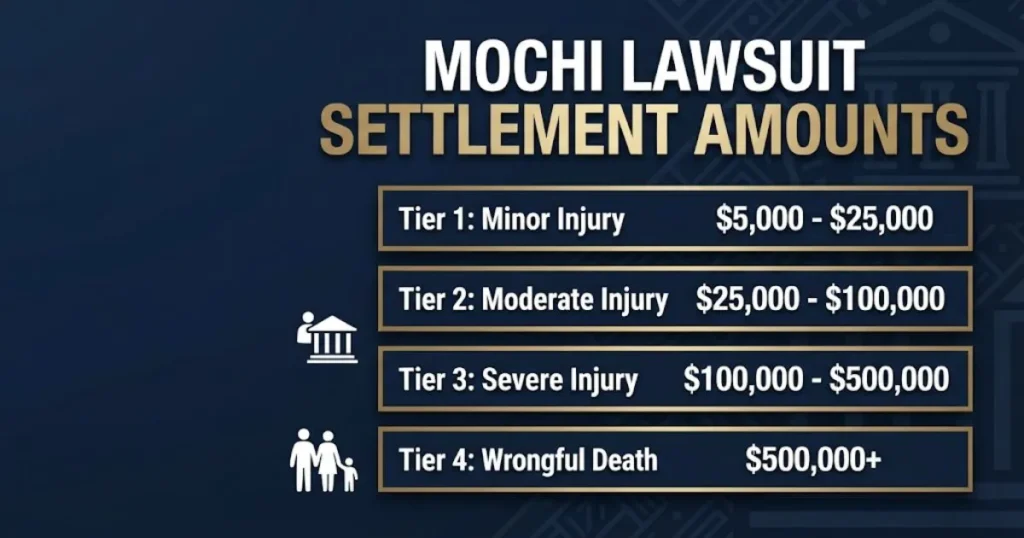
Mochi lawsuit settlement amounts will vary widely based on the severity of the injury. Based on comparable food choking lawsuits and product liability case data, here are the projected ranges.
| Injury Type | Estimated Settlement Range | Key Factors |
|---|---|---|
| Choking with no ER visit | $5,000 to $25,000 | Documented incident, emotional distress |
| ER visit, full recovery | $25,000 to $100,000 | Medical bills, pain and suffering |
| Hospitalization | $100,000 to $500,000 | Length of stay, procedures required |
| Brain damage from oxygen loss | $500,000 to $5,000,000+ | Permanent disability, ongoing care costs |
| Wrongful death (child) | $1,000,000 to $10,000,000+ | Punitive damages likely |
| Wrongful death (elderly) | $500,000 to $3,000,000+ | Varies by state damage caps |
These are estimates based on historical food liability settlements. Actual amounts in mochi cases will depend on the specific facts, the jurisdiction, the defendant’s financial resources, and whether punitive damages are awarded.
Cases with strong evidence of manufacturer knowledge, where internal documents show the company knew about choking risks and chose not to act, will likely command the highest settlements.
Punitive damages can multiply the base settlement by three to ten times in some jurisdictions. If a jury finds that a manufacturer acted with conscious disregard for consumer safety, the financial consequences can be enormous.
Families with the strongest documentation, including medical records, product photos, and witness statements, will be in the best position to receive higher settlement amounts.
Mochi Lawsuit Payout: When Will You Get Paid?
Mochi lawsuit payouts are not expected to begin for most claimants until late 2026 at the earliest, with the majority of payments likely arriving in 2027 or beyond. Legal timelines in product liability cases move slowly.
Here’s a realistic timeline for when you might see money:
| Phase | Expected Timing | What Happens |
|---|---|---|
| Filing Your Claim | Now through 2026 | You file; case enters the system |
| Discovery | 2026 | Evidence exchange; depositions |
| Settlement Talks | Late 2026 to mid-2027 | Negotiations between parties |
| Settlement Approval | Mid to late 2027 | Court reviews any group settlements |
| Payout Distribution | Late 2027 to 2028 | Checks mailed or wired to claimants |
| Trial (if no settlement) | 2027 to 2028 | Cases go before a jury |
Individual settlements can happen faster than class-wide ones. If your attorney negotiates a separate deal with the manufacturer, you could receive payment within months of the agreement.
Attorney fees typically take 33% to 40% of the settlement amount on a contingency basis. This means if you receive a $100,000 settlement, your attorney would take $33,000 to $40,000, and case expenses would be deducted from the remainder.
The speed of your payout depends on how quickly your specific case moves and whether the defendant fights or folds. Early filers generally receive payment before later filers.
Key Takeaway: Most mochi lawsuit payouts will arrive in late 2027 or 2028, but individual settlements could come sooner for cases with strong evidence and serious injuries.
Frequently Asked Questions
How much money can I get from the mochi lawsuit?
Settlement amounts range from $5,000 for minor choking incidents to over $10,000,000 for wrongful death cases involving children.
The amount depends on injury severity, medical documentation, and whether punitive damages apply.
Most cases with ER visits and full recovery fall in the $25,000 to $100,000 range.
Who qualifies for the mochi ice cream lawsuit in 2026?
Anyone who suffered a choking injury from mochi ice cream may qualify, including parents filing on behalf of children.
You need evidence of the incident such as medical records, 911 calls, or witness accounts.
Cases involving products sold without a choking warning are the strongest.
Is there a deadline to file a mochi lawsuit?
Yes, most states require you to file within two to three years of the injury.
California, Texas, and Florida have a two-year statute of limitations for personal injury claims.
Claims involving minors may have extended deadlines under state tolling rules.
Has mochi ice cream been recalled?
No nationwide mandatory recall of mochi ice cream has been issued as of 2026.
Some brands have voluntarily updated packaging to include choking hazard warnings.
Consumer advocacy groups are petitioning the FDA for mandatory labeling requirements.
What brands of mochi are involved in lawsuits?
My/Mo Mochi, Mikawaya, Bubbies, and Trader Joe’s store-brand mochi have all been named in lawsuits.
Little Moons has faced limited U.S. legal action.
Retailers like Costco and Target have been named as co-defendants in some filings.
Stay Ahead of the Mochi Lawsuit in 2026
This case is moving. New filings, new evidence, and settlement talks could change the picture fast.
If you have any connection to a mochi choking incident, start collecting your evidence now. Medical records, purchase history, photos, and written accounts of what happened are your strongest tools.
Don’t let the filing deadline pass you by. The sooner you act, the better your position. Check your state’s statute of limitations and get your case on the record before time runs out.







