

The Lexington Law firm lawsuit resulted in one of the largest FTC enforcement actions ever taken against a credit repair company. Millions of consumers paid for services that federal regulators called illegal, and now a court-appointed receiver is working to return that money.
If you ever paid Lexington Law for credit repair, you might be owed a refund. The FTC secured a judgment worth over $2.7 billion against the company and its affiliates. That number reflects what consumers lost, though the actual recovery will be a fraction of that total.
This article breaks down every part of the case as it stands in 2026. You will learn who qualifies, how much you might receive, how to file a claim, and what deadlines matter. We also cover the difference between the FTC action and the class action lawsuits, because they are not the same thing and most people mix them up.
Roughly 4.6 million consumers were affected. If you are one of them, the clock is ticking on some important dates.
Lexington Law Firm Lawsuit Overview
The Lexington Law firm lawsuit refers to multiple legal actions targeting the company’s business practices between 2014 and 2023. The primary case was brought by the FTC, but private class action lawsuits were filed as well.
Lexington Law operated as a credit repair service under the legal entity John C. Heath, PBC. Its parent company was Progrexion Holdings, which also owned CreditRepair.com. Both brands were swept up in the same federal enforcement action.
The FTC alleged that Lexington Law charged customers illegal advance fees before any work was completed. Under the Telemarketing Sales Rule, credit repair companies cannot collect payment until they deliver the promised results. Lexington Law collected fees upfront from millions of people, which the government said was a clear violation.
| Detail | Info |
|---|---|
| Primary Case | FTC v. Progrexion Holdings et al. |
| Court | U.S. District Court, Central District of California |
| Judgment Amount | Over $2.7 billion |
| Consumers Affected | Approximately 4.6 million |
| Key Law Violated | Telemarketing Sales Rule (TSR) |
The case also involved allegations of deceptive marketing. Lexington Law used third-party lead generators who made misleading claims about what the service could do. Consumers were promised specific credit score improvements that the company could not guarantee.
Federal authorities moved to shut down the entire operation. A receiver was appointed to take control of the company’s assets and distribute whatever money could be recovered to affected customers.
Lexington Law Firm Class Action Lawsuit Explained
The Lexington Law firm class action lawsuit is separate from the FTC enforcement case, though both target the same conduct. Private attorneys filed class action claims on behalf of consumers who paid for services they say were misrepresented.
Think of it like two lanes on the same highway. The FTC case is the government suing the company. The class action is regular people banding together to sue the company. Both cases allege similar wrongdoing, but they move through the courts differently.
Several class action lawsuits were filed in various states. The core claims include:
- Breach of contract: Lexington Law allegedly failed to deliver the credit repair results it promised.
- Unjust enrichment: The company collected fees for services it did not properly perform.
- Violations of state consumer protection laws: Multiple states have their own credit repair regulations that Lexington Law allegedly broke.
- CROA violations: The Credit Repair Organizations Act prohibits certain practices that Lexington Law allegedly engaged in.
Some of these class actions were consolidated or stayed pending the outcome of the FTC case. In practical terms, the FTC’s massive judgment took priority because it represented the broadest group of affected consumers.
For most people, the FTC redress process is the primary path to getting money back. But the class actions remain relevant for consumers whose specific situations fall outside the FTC’s scope.
Lexington Law Lawsuit Update for 2026
As of 2026, the Lexington Law lawsuit is in the asset recovery and distribution phase. The courtroom battles are mostly over. Now it’s about collecting money and getting it to consumers.
The court-appointed receiver has been liquidating Progrexion’s remaining assets since 2023. This includes selling off intellectual property, collecting on outstanding receivables, and pursuing funds from company executives.
Key developments heading into 2026:
- The receiver filed detailed accounting reports with the court in late 2025, outlining total recoverable assets.
- A consumer redress plan was submitted to the court for approval.
- Individual defendants, including company founders and executives, faced personal liability determinations.
- The court evaluated whether certain assets shielded by executives could be clawed back into the redress fund.
| Timeline | Event |
|---|---|
| 2023 | FTC wins judgment; receiver appointed |
| 2024 | Asset liquidation begins; company operations cease |
| 2025 | Receiver reports to court; redress plan drafted |
| 2026 | Consumer redress distribution expected to begin |
The biggest question consumers have is simple: when will I see money? The answer depends on how quickly the court approves the final distribution plan. Based on the receiver’s filings, initial distributions could begin in mid to late 2026.
However, these timelines can shift. If executives challenge asset seizures or if new assets are discovered, the process stretches further. FTC redress programs in cases of this size typically take 2 to 4 years from judgment to first payment.
Key Takeaway: The Lexington Law case involves both an FTC enforcement action and private class actions, with consumer payouts expected to begin in mid to late 2026 after the court approves the receiver’s distribution plan.
Lexington Law Settlement Payout Details
The Lexington Law settlement payout will come primarily from the FTC’s consumer redress fund, not from a traditional class action settlement. This is an important distinction that most people miss.
In a typical class action, there is a negotiated settlement amount. Here, the court entered a judgment exceeding $2.7 billion against Progrexion and its subsidiaries. That is the total harm calculated. The actual payout pool will be whatever the receiver can collect from the company’s remaining assets.
Based on similar FTC cases, the recoverable amount is usually a small percentage of the total judgment. Think of it like this: the company did $2.7 billion in harm, but it doesn’t have $2.7 billion sitting in a bank account.
Early estimates suggest the receiver may recover somewhere between $50 million and $200 million in total assets. That money gets split among 4.6 million affected consumers, which means individual payouts will be modest.
Expected payout factors:
- Total assets recovered by the receiver
- Administrative costs of the distribution process
- Court-approved priority tiers (some consumers may get more based on how much they paid)
- Whether the FTC pursues additional funds from individual defendants
No checks have been mailed yet as of early 2026. When distributions begin, the FTC will likely notify eligible consumers by email and postal mail.
Lexington Law Settlement Amount Per Person
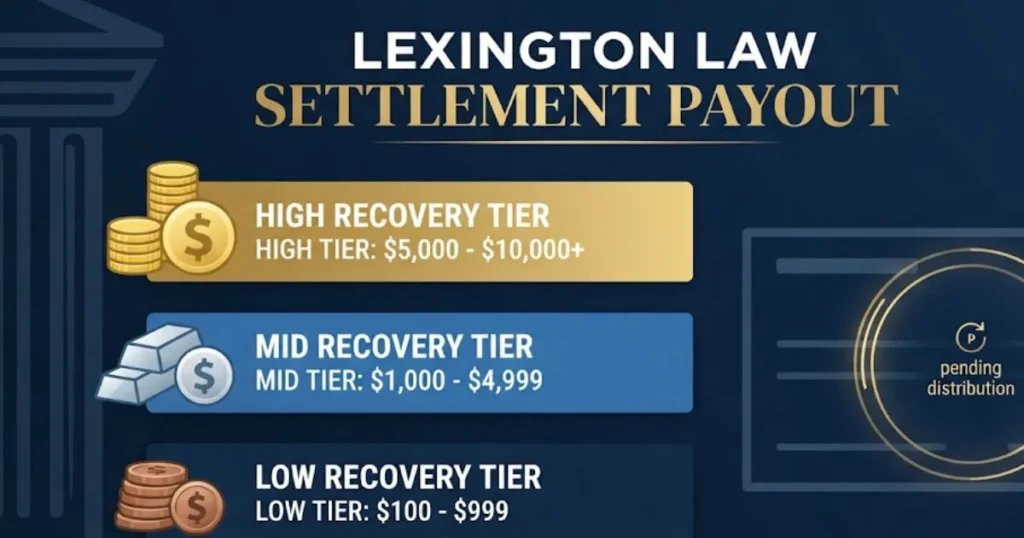
The Lexington Law settlement amount per person will likely range from $10 to $100 for most consumers, based on projections from the receivership’s asset recovery reports and the size of the affected consumer pool.
That range might sound low when you paid hundreds or even thousands to Lexington Law. But the math is brutal. Even if the receiver collects $150 million, dividing that among 4.6 million people works out to roughly $32 per person. Higher-paying customers may receive proportionally more.
| Scenario | Total Recovery | Per Person Estimate |
|---|---|---|
| Low Recovery | $50 million | $10 to $15 |
| Mid Recovery | $150 million | $30 to $50 |
| High Recovery | $250 million | $50 to $100 |
The FTC typically uses a pro rata distribution method. That means your refund is proportional to what you actually paid. If you paid $1,500 over two years, you would get a larger share than someone who paid $300 for three months.
Some consumers may receive full refunds if the recovered funds are sufficient, but that outcome is unlikely given the massive number of claimants. The FTC has stated its goal is to return as much money as possible, but it cannot promise full restitution.
Your best bet is to make sure the FTC and the receiver have your current contact information. Missing a notice could mean missing your payment entirely.
Who Is Eligible for the Lexington Law Lawsuit
You are eligible for the Lexington Law lawsuit if you paid for credit repair services from Lexington Law (John C. Heath, PBC) and were acquired as a customer through telemarketing channels. The FTC’s case specifically targets customers obtained through third-party lead generators.
Here is the tricky part. Not every Lexington Law customer qualifies automatically. The FTC’s enforcement action focused on consumers who were signed up through telemarketing, which includes online leads that converted to phone sales. If you found Lexington Law through a web ad, got a call, and then signed up over the phone, you likely qualify.
Eligibility criteria based on the FTC case:
- You paid Lexington Law for credit repair services
- You were contacted or signed up through telemarketing (phone calls, including calls initiated after online inquiries)
- You paid advance fees before credit repair work was completed and verified
- Your enrollment occurred during the period covered by the FTC’s complaint (roughly 2014 to 2023)
| Eligibility Factor | Details |
|---|---|
| Service Used | Lexington Law credit repair |
| Sign-Up Method | Telemarketing or phone-based enrollment |
| Fee Type | Advance fees paid before results delivered |
| Time Period | Approximately 2014 to 2023 |
If you signed up directly through the Lexington Law website without any phone interaction, your eligibility under the FTC action is less clear. You may still have a claim under the separate class action lawsuits, which have broader eligibility criteria.
Key Takeaway: Eligibility for the FTC redress fund depends on whether you were signed up through telemarketing and paid advance fees, while the class action lawsuits cast a wider net for all Lexington Law customers.
Lexington Law Refund for Customers
Lexington Law refunds for customers will come through the FTC’s court-ordered consumer redress program, not directly from the company. Lexington Law itself no longer operates, so there is no customer service line to call for a refund.
The refund process works like this. The receiver collects assets. The court approves a distribution plan. Then the FTC or the receiver mails checks or sends electronic payments to eligible consumers.
Here is what you need to do right now to protect your refund eligibility:
- Keep records of any payments you made to Lexington Law. Bank statements, credit card records, and email confirmations all count.
- Update your contact information with the FTC if you have moved since you last used Lexington Law.
- Watch your mail and email for notices from the FTC or the court-appointed receiver. These notices will explain how to confirm your claim.
- Do not pay anyone who contacts you claiming they can get your refund faster. Scammers target people in exactly this situation.
The FTC has a track record of sending refund checks that expire after a set period, usually 60 to 90 days. When your check arrives, cash it immediately. People lose money every year by letting FTC refund checks expire because they think it is a scam. It is not.
If the FTC already has your information from Lexington Law’s customer records, you may not need to do anything. The receiver obtained the company’s databases, which include customer payment histories.
How to File a Claim in the Lexington Law Lawsuit
To file a claim in the Lexington Law lawsuit, you need to respond to the FTC’s consumer redress notice when it arrives. For most consumers, the process will be straightforward because the FTC already has your customer data.
The FTC typically handles large consumer redress cases in one of two ways:
Option 1: Automatic identification. The FTC uses company records to identify eligible consumers and sends payments automatically. No claim form needed.
Option 2: Claims process. The FTC sets up a claims portal where consumers submit their information and verify their identity. This happens when records are incomplete.
Based on the size of this case, the FTC will likely use a hybrid approach. Consumers whose records are clear will receive automatic payments. Those with incomplete records will be asked to submit a claim form.
Steps to prepare:
- Gather proof of payments (bank statements, credit card bills, Lexington Law invoices)
- Verify that your mailing address and email address are current
- Check the FTC’s refund page periodically for updates on this specific case
- Respond promptly to any communication from the receiver or the FTC
| Step | Action | When |
|---|---|---|
| 1 | Gather payment records | Now |
| 2 | Update contact info with FTC | Now |
| 3 | Watch for FTC redress notice | Mid 2026 |
| 4 | Submit claim form if required | Within deadline stated in notice |
| 5 | Cash refund check immediately | When received |
Do not hire a third-party company to file your claim for you. The FTC redress process is free. Anyone charging you a fee to “file your Lexington Law claim” is running a scam.
The FTC Lawsuit Against Lexington Law
The FTC lawsuit against Lexington Law was filed in 2023 and accused the company of violating the Telemarketing Sales Rule by charging consumers illegal advance fees for credit repair services. The FTC called it one of the largest credit repair frauds in history.
The FTC’s complaint named multiple defendants:
- Progrexion Holdings (parent company)
- John C. Heath, PBC (doing business as Lexington Law)
- CreditRepair.com (sister company under the same corporate umbrella)
- Multiple individual executives who directed the illegal practices
The core violation was simple but devastating. The TSR says a credit repair company that uses telemarketing to get customers cannot charge those customers until the promised results are achieved and verified. Lexington Law charged monthly fees the moment customers enrolled. Many consumers paid for months without seeing any meaningful credit improvement.
The FTC also alleged deceptive practices. The company’s third-party lead generators told consumers their credit scores would improve by specific amounts, that negative items would definitely be removed, and that results were guaranteed. None of those promises could be made legally.
Key FTC findings:
- Lexington Law collected more than $2.7 billion in fees from affected consumers
- The company used more than 100 third-party lead generators to funnel customers
- Consumers were charged illegal advance fees in violation of the TSR
- Marketing materials contained false and misleading claims about results
The court sided with the FTC and entered a permanent injunction banning the defendants from the credit repair industry.
Key Takeaway: The FTC proved that Lexington Law collected $2.7 billion in illegal advance fees through deceptive telemarketing, resulting in a permanent industry ban for the company and its executives.
What Happened to Lexington Law
Lexington Law was shut down by federal court order after the FTC proved the company charged illegal fees and used deceptive marketing to sign up millions of customers for credit repair services that often failed to deliver results.
The company had been one of the biggest names in credit repair for over two decades. At its peak, Lexington Law employed hundreds of attorneys and support staff across multiple offices. It marketed itself as a law firm that could legally remove inaccurate items from consumer credit reports.
The problem was not credit repair itself. The problem was how Lexington Law acquired and charged its customers. Using telemarketing and online lead generation, the company funneled millions of consumers into paid programs before doing any work on their credit files.
When the FTC filed suit, the company tried to fight the charges. But the evidence was overwhelming. Internal documents showed that executives knew about the advance fee prohibition and structured the business to work around it, or simply ignored it.
Timeline of Lexington Law’s downfall:
- 2019: FTC begins formal investigation into Progrexion and subsidiaries
- 2022: FTC ramps up enforcement activity; company faces mounting legal pressure
- 2023: FTC files lawsuit; court appoints receiver; company operations halt
- 2024: Asset liquidation and consumer redress planning begin
- 2025: Receiver files financial reports; court considers distribution plan
- 2026: Consumer refund distributions expected
The brand no longer exists in any operational form. The website is down. The phone lines are disconnected. Lexington Law is, for all practical purposes, gone.
Did Lexington Law Firm Shut Down
Yes, Lexington Law firm shut down in 2023 after a federal court placed it under receivership following the FTC’s lawsuit. The company is no longer operational, and its offices have closed permanently.
The shutdown was not voluntary. The court ordered it. When the FTC won its case, the judge appointed a receiver to take control of all company assets. That receiver’s job is to wind down operations, sell off assets, and prepare funds for consumer refunds.
Progrexion Holdings, the parent company, also shut down. So did CreditRepair.com, the sister brand. The entire corporate structure collapsed under the weight of the FTC’s enforcement action.
What shutdown means for consumers:
- You cannot contact Lexington Law for service, refunds, or account information
- Your payment records are now in the receiver’s possession
- Any recurring charges from Lexington Law should have stopped; if they have not, dispute them with your bank
- The receiver is the only entity authorized to communicate about refunds
Some consumers report still seeing charges on old credit card statements from Lexington Law as recently as early 2024. If you notice any post-shutdown charges, file a dispute with your credit card company immediately. Those charges are unauthorized.
The company’s closure does not mean the legal case is over. The receivership process continues as the receiver works to maximize the amount of money available for consumer refunds.
Lexington Law Illegal Fees Lawsuit
The Lexington Law illegal fees lawsuit centers on the company charging customers upfront fees before delivering any credit repair results, a practice that violates federal telemarketing law. This was the single biggest legal issue that brought the company down.
Under the Telemarketing Sales Rule, any company that uses telemarketing to sell credit repair services must wait until the results are achieved and verified before collecting payment. There is no exception. No loophole. No workaround.
Lexington Law charged fees in three ways, all of which the FTC deemed illegal for telemarketing-acquired customers:
- First work fee: A one-time charge when the customer enrolled
- Monthly subscription fee: Ongoing charges ranging from roughly $90 to $130 per month
- Additional service fees: Extra charges for credit monitoring and identity protection add-ons
| Fee Type | Typical Amount | Legal Under TSR? |
|---|---|---|
| First Work Fee | $14.99 to $89.99 | No |
| Monthly Subscription | $89.95 to $129.95 | No (if charged before results) |
| Add-On Services | $24.95 to $49.95 | No (if bundled with credit repair) |
Many consumers paid these fees for months or even years without seeing meaningful changes to their credit reports. Some saw temporary score bumps that disappeared when disputed items were re-verified by creditors.
The fees added up fast. A typical customer paying $99.95 per month for 12 months spent nearly $1,200. Multiply that across 4.6 million customers, and the total harm exceeds $2.7 billion.
Key Takeaway: Lexington Law charged illegal advance fees ranging from $90 to $130 per month to millions of telemarketing-acquired customers, collecting over $2.7 billion before the FTC shut it down.
Lexington Law Telemarketing Violations
Lexington Law’s telemarketing violations were the legal foundation of the FTC’s entire case. The company built its business on a model that federal law specifically prohibits for credit repair services sold through telemarketing.
Here is what the TSR says in plain terms. If you sell credit repair services and you get your customers through telemarketing, you cannot charge them until:
- The promised results are actually achieved
- The customer is informed of the results
- At least six months have passed since the results were achieved (to verify permanence)
Lexington Law charged customers immediately upon enrollment. Sometimes within minutes of the sales call. That is a textbook TSR violation, and the company did it millions of times.
The telemarketing violations went deeper than just fee timing. The FTC documented additional problems:
- Third-party lead generators made false claims about guaranteed credit score improvements
- Sales scripts contained misleading success rates that were not based on actual customer outcomes
- Customers were not clearly told that they had a right to dispute credit report errors on their own for free
- Robocalls and unsolicited texts were used to contact potential customers
The FTC’s investigation revealed that Lexington Law used over 100 lead generation companies. These lead generators operated websites that collected consumer information and then sold those leads to Lexington Law. Many of these websites made bold claims about credit score improvements that Lexington Law knew were misleading but accepted anyway.
The telemarketing violations were not a gray area. They were repeated, systematic, and well-documented.
Lexington Law Firm Consumer Complaints
Consumer complaints against Lexington Law firm numbered in the thousands before the FTC even filed its lawsuit. Customers reported being charged for services they never received, seeing no improvement in their credit scores, and struggling to cancel their subscriptions.
The most common complaints fell into predictable categories:
- No results: Customers paid for months without any negative items being removed from their credit reports
- Difficulty canceling: Many consumers reported that canceling their subscription required multiple phone calls and that charges continued after they thought the service was terminated
- Misleading promises: Sales representatives allegedly told customers their credit scores would improve by specific point amounts within specific timeframes
- Hidden fees: Customers discovered charges for add-on services they did not knowingly authorize
- Poor communication: Months would pass without any updates on the status of credit disputes
The Better Business Bureau received hundreds of complaints about Lexington Law. State attorneys general offices also logged consumer grievances. These complaints formed part of the evidentiary basis for the FTC’s investigation.
| Complaint Type | Frequency |
|---|---|
| No credit improvement | Very common |
| Billing and cancellation issues | Very common |
| Misleading sales promises | Common |
| Unauthorized add-on charges | Moderately common |
| Lack of communication | Common |
What made the situation worse was that many Lexington Law customers were already in financially vulnerable positions. They signed up because they had bad credit and were desperate for help. Paying $100 or more per month for a service that delivered nothing was a financial blow they could not afford.
Lexington Law Receivership Update
The Lexington Law receivership is the court-supervised process of collecting the company’s remaining assets and preparing to distribute those funds to affected consumers. As of 2026, the receiver has been working for nearly three years.
A receiver in this context acts like a court-appointed business manager for a company that no longer operates. The receiver’s job includes:
- Identifying and seizing all company assets (bank accounts, property, intellectual property)
- Selling assets that can be converted to cash
- Investigating whether executives hid assets or transferred money improperly
- Filing reports with the court detailing what has been collected
- Developing a distribution plan for consumer refunds
Receivership progress as of 2026:
- The receiver took control of Progrexion’s offices, equipment, and digital assets
- Customer databases containing payment records for millions of consumers were secured
- The receiver pursued clawback actions against certain executives and insiders who may have received improper payments
- A detailed financial accounting was submitted to the court in late 2025
| Receivership Milestone | Status |
|---|---|
| Asset identification | Complete |
| Asset liquidation | Ongoing |
| Executive clawback actions | Ongoing |
| Financial accounting filed | Complete (late 2025) |
| Consumer distribution plan | Pending court approval |
| First consumer payments | Expected mid to late 2026 |
The receivership process is slow by design. Courts want to make sure every recoverable dollar is found before distributing funds. Rushing the process could mean leaving money on the table that should go to consumers.
Key Takeaway: The court-appointed receiver has secured Lexington Law’s customer records and assets, filed financial reports, and submitted a consumer distribution plan that is awaiting court approval for payouts expected in mid to late 2026.
Is Lexington Law Still in Business in 2026
No, Lexington Law is not in business in 2026. The company ceased all operations in 2023 after a federal court placed it under receivership and banned its principals from the credit repair industry.
If you see a website or social media account claiming to be Lexington Law, it is either a scam or an outdated page. The real Lexington Law has no active business operations, no employees, and no ability to provide credit repair services.
The court’s permanent injunction goes beyond just shutting down the company. The individual executives named in the FTC’s case are personally banned from working in the credit repair industry. They cannot start a new company offering similar services under a different name.
What this means for you:
- Do not sign up for any service claiming to be Lexington Law or its successor
- Do not pay anyone claiming to represent Lexington Law for refund processing
- The only legitimate source of refund information is the FTC and the court-appointed receiver
- Any “new Lexington Law” is fraudulent
Some former Lexington Law employees have started their own credit repair businesses. These are separate entities with no connection to the original company. They are not inheritors of Lexington Law’s brand or client relationships, and they have no authority to process refunds from the FTC case.
The credit repair industry itself still exists. Other companies operate legally. But Lexington Law as a brand and business entity is permanently finished.
Lexington Law Alternatives After Shutdown
With Lexington Law gone, consumers looking for credit repair help have several alternatives, but they should approach any credit repair company with extreme caution given what happened. The FTC’s case against Lexington Law exposed problems that exist across the entire industry.
Free options you should try first:
- Dispute errors yourself. You have the right to dispute inaccurate items on your credit report directly with the three major credit bureaus (Equifax, Experian, TransUnion) for free. This is exactly what Lexington Law was doing on your behalf, just with a fee attached.
- Nonprofit credit counseling. Organizations approved by the National Foundation for Credit Counseling provide free or low-cost credit counseling. They can help you create a plan to improve your credit.
- Your bank or credit union. Many financial institutions now offer free credit monitoring and credit score tracking tools.
If you choose a paid credit repair company, watch for these red flags:
- They demand payment before doing any work
- They guarantee specific credit score improvements
- They pressure you to sign up immediately
- They tell you not to contact credit bureaus directly
- They suggest creating a “new credit identity” (this is illegal)
| Option | Cost | Pros | Cons |
|---|---|---|---|
| DIY credit disputes | Free | No cost; same process companies use | Takes time and effort |
| Nonprofit credit counseling | Free to low cost | Professional guidance; no conflict of interest | May not dispute items for you |
| Paid credit repair company | $50 to $150/month | Handles paperwork; saves time | Risk of scams; same process you can do for free |
The honest truth is that most legitimate credit repair involves disputing errors on your credit report. That is something you can do yourself with a few letters and some patience. Paying someone $100 a month to send those letters for you is your choice, but know what you are paying for.
Frequently Asked Questions
How much money will I get from the Lexington Law lawsuit?
Most consumers will likely receive between $10 and $100, depending on total assets recovered and how much you paid.
The exact amount is based on a pro rata distribution of the receiver’s collected funds.
Payments are expected to begin in mid to late 2026.
Is there a deadline to file a claim against Lexington Law?
The FTC has not yet announced a formal claims deadline as of early 2026.
When the distribution plan is approved, the FTC will set a deadline and notify eligible consumers.
Watch for official notices by mail or email from the FTC or the court-appointed receiver.
Does the Lexington Law class action lawsuit include all customers?
The FTC enforcement action primarily covers customers acquired through telemarketing.
Separate class action lawsuits may include a broader group of customers.
If you paid Lexington Law for any reason between 2014 and 2023, you should monitor both the FTC case and any class action developments.
What did the FTC find Lexington Law guilty of?
The FTC found Lexington Law violated the Telemarketing Sales Rule by charging illegal advance fees before delivering results.
The company also engaged in deceptive marketing through third-party lead generators.
The total consumer harm was calculated at over $2.7 billion.
Is Lexington Law still operating in 2026?
No, Lexington Law is completely shut down and not operating in any form.
A federal court placed the company under receivership in 2023 and banned its executives from the credit repair industry.
Any entity claiming to be Lexington Law today is not legitimate.
What to Do Now
The Lexington Law story is a warning about an industry with too little oversight and too many promises. But if you were a customer, your focus should be practical.
Gather your payment records. Make sure the FTC has your current address and email. Watch for official notices about the refund process.
The money is coming, even if it takes time. Stay informed, act quickly when the notice arrives, and do not let your refund check expire.







