

A lemon lawsuit in 2026 can force a car manufacturer to give you a full refund, a replacement vehicle, or a cash settlement. If your car keeps breaking down despite repeated dealer repairs, you likely have a case.
Every state has some version of a lemon law. But what most people do not realize is that filing an actual lemon lawsuit, one that goes to court, often produces significantly better results than going through a manufacturer’s arbitration program. We are talking about full vehicle buybacks plus thousands in additional damages.
This article breaks down everything you need to know about lemon lawsuits in 2026. You will learn who qualifies, what your car defect could be worth, how to file, and what mistakes to avoid. One stat worth knowing right now: lemon lawsuits that reach litigation settle in the consumer’s favor roughly 90% of the time, according to data from consumer rights attorneys across multiple states.
Whether you bought new, used, or leased, and whether you drive a gas car or an EV, keep reading. The rules have shifted heading into 2026.
What Is a Lemon Lawsuit
A lemon lawsuit is a legal action filed against an auto manufacturer when a vehicle has a serious defect that the maker cannot fix after a reasonable number of repair attempts. It is different from simply complaining to a dealer or filing a warranty claim.
Think of it this way. You bought a car that was supposed to work. It does not. The company had multiple chances to fix it. They failed. A lemon lawsuit is your way of saying, “Pay me back.”
Most lemon lawsuits are based on state lemon laws, which are consumer protection statutes designed specifically for this situation. Some cases also rely on the federal Magnuson-Moss Warranty Act, which covers any product sold with a written warranty.
The goal of a lemon lawsuit is to get one of three outcomes:
- Full vehicle buyback (the manufacturer repurchases your car)
- Vehicle replacement (you get a new car of equal value)
- Cash settlement (the manufacturer pays you money to resolve the dispute)
| Lemon Lawsuit Basics | Details |
|---|---|
| What It Is | A lawsuit against a car manufacturer for selling a defective vehicle |
| Legal Basis | State lemon laws, Magnuson-Moss Warranty Act, UCC Article 2 |
| Common Outcomes | Buyback, replacement, or cash settlement |
| Who Files It | The vehicle owner, through an attorney |
| Cost to Consumer | Usually nothing upfront (contingency fee basis) |
You do not need to be a legal expert to file one. But you do need to understand the basics before you start.
Lemon Lawsuit Settlement Amounts in 2026
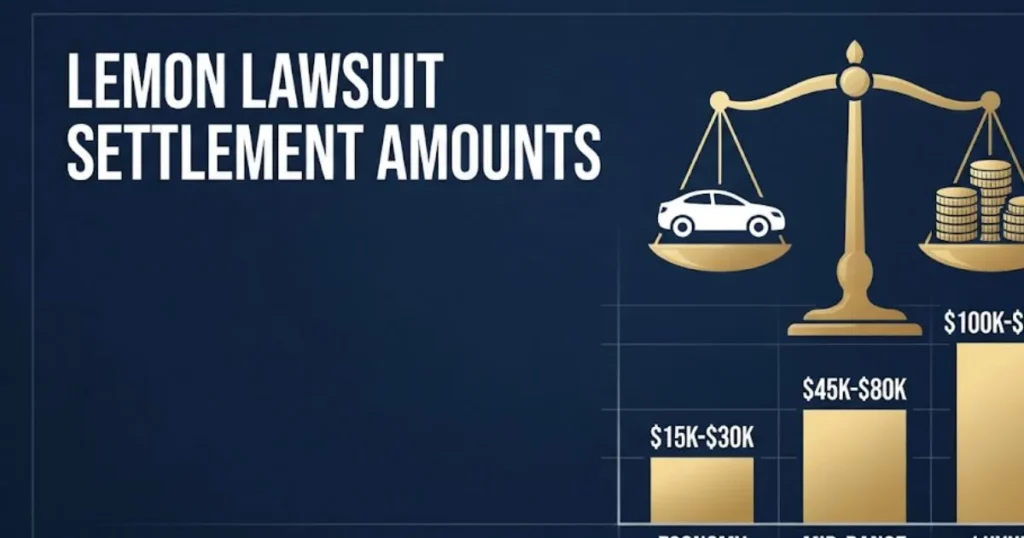
Lemon lawsuit settlement amounts in 2026 typically range from $15,000 to over $150,000, depending on the vehicle’s value, the severity of the defect, and your state’s laws. Some cases involving luxury vehicles or repeat safety defects have settled for even more.
Here is the reality most websites will not tell you. Your settlement is not just the price of the car. In many states, you can recover:
- The full purchase price of the vehicle
- All monthly payments already made
- Registration and tax costs
- Incidental expenses (towing, rental cars, missed work)
- Civil penalties (up to two times the vehicle’s value in some states like California)
The manufacturer will subtract a “mileage offset” for the miles you drove before the first repair attempt. That amount varies by state formula.
| Vehicle Type | Typical Settlement Range (2026) |
|---|---|
| Economy car (under $30K) | $15,000 to $40,000 |
| Mid-range sedan/SUV ($30K to $55K) | $30,000 to $75,000 |
| Luxury vehicle ($55K to $100K) | $55,000 to $120,000 |
| High-end EV or truck ($100K+) | $80,000 to $150,000+ |
The biggest variable is whether your state allows civil penalties. California’s Song-Beverly Act, for example, lets courts award a penalty of up to two times the actual damages if the manufacturer willfully violated the law. That can double your payout.
Getting a strong settlement usually requires solid documentation and an experienced lemon law attorney. Do not guess at your car’s value. Know it.
What Qualifies as a Lemon Car in 2026
A car qualifies as a lemon in 2026 if it has a defect covered by the manufacturer’s warranty that substantially impairs its use, value, or safety, and the manufacturer has been unable to fix it after a reasonable number of repair attempts.
That definition sounds simple. But every word in it matters. Let’s break it apart.
“Covered by warranty” means the defect must have appeared while the car was still under the original manufacturer’s warranty. Extended warranties and third-party warranties usually do not count, though some states have exceptions.
“Substantially impairs” means the problem has to be serious. A loose cup holder probably will not cut it. A transmission that slips, brakes that fail, an engine that stalls, or an electrical system that randomly shuts down? Those qualify.
“Reasonable number of repair attempts” varies by state. Most states consider two to four repair attempts for the same defect to be reasonable. Some states also have a “days out of service” rule. If your car has been in the shop for 30 or more cumulative days, it may qualify even if the exact same repair was not repeated.
| Qualification Factor | Common Standard |
|---|---|
| Repair attempts for same defect | 2 to 4 attempts |
| Days out of service | 30+ cumulative days |
| Safety defect repairs | 1 to 2 attempts |
| Warranty status | Must be within original warranty period |
| Time/mileage limit | Usually 18 to 24 months or 18,000 to 24,000 miles |
One thing that catches people off guard: the defect does not need to make the car undrivable. If it significantly reduces the car’s value or makes it unreliable, that can be enough.
Key Takeaway: A lemon lawsuit can recover far more than just the car’s price, and your vehicle may qualify with as few as two failed repair attempts for the same defect.
How to File a Lemon Lawsuit
Filing a lemon lawsuit starts with gathering your repair records and contacting a lemon law attorney. Most consumers do not need to pay anything upfront because these attorneys work on contingency.
Here is the step-by-step process most successful lemon lawsuits follow in 2026:
Step 1: Collect your documents. You need every repair order, work invoice, and service record from the dealer. These papers prove the manufacturer had chances to fix the problem and could not.
Step 2: Send a demand letter. In many states, you must notify the manufacturer in writing before filing suit. This letter describes the defect, your repair history, and what you want (buyback or replacement).
Step 3: Consult a lemon law attorney. Most offer free case evaluations. They will review your records and tell you whether your case qualifies. If they take your case, the manufacturer typically pays their fees at the end, not you.
Step 4: File the lawsuit. Your attorney files the case in state or federal court. The manufacturer’s legal team responds, and the discovery process begins.
Step 5: Negotiate or go to trial. The vast majority of lemon lawsuits settle before trial. Manufacturers prefer settling to the bad publicity and expense of a court fight.
- Keep every text, email, and voicemail from the dealer
- Save receipts for towing, rental cars, and rideshares
- Never trade in or sell the vehicle before your case resolves
- Do not let the dealer pressure you into accepting a lowball offer
Missing even one repair record can weaken your case. Treat your documentation like evidence, because that is exactly what it is.
Lemon Lawsuit Eligibility Requirements
Lemon lawsuit eligibility depends on your state, the age of your vehicle, its mileage, the type of defect, and how many times the dealer attempted repairs. Not every broken car is a lemon.
The core requirements in most states boil down to three things:
1. The defect is substantial. It must affect your ability to safely drive the vehicle, or it must significantly reduce the car’s market value. Cosmetic issues rarely qualify unless they are extreme.
2. The manufacturer had enough chances to fix it. You cannot take your car in once and file a lawsuit the next day. The manufacturer gets a fair opportunity to repair the problem. Most states require two to four repair visits for the same issue, or one to two visits for a defect that could cause death or serious injury.
3. The problem appeared during warranty coverage. If the defect showed up after the warranty expired, most state lemon laws will not help. However, federal claims under the Magnuson-Moss Act sometimes have broader timelines.
| Eligibility Factor | Typical Requirement |
|---|---|
| Vehicle age | Within first 18 to 24 months of purchase |
| Mileage | Under 18,000 to 24,000 miles (varies by state) |
| Defect type | Must substantially impair use, value, or safety |
| Repair attempts | 2 to 4 for same issue, or 1 to 2 for safety defects |
| Days in shop | 30+ cumulative days out of service |
| Warranty status | Defect must appear during original warranty |
Some buyers think they are out of luck if their car has too many miles. That is not always true. Several states measure eligibility by time from purchase, not just mileage.
If you are on the fence, get your records reviewed. Most lemon law attorneys will tell you within a few days whether you have a case.
How a Lemon Law Lawsuit Works
A lemon law lawsuit works by holding the vehicle manufacturer legally responsible for selling you a car with a defect they cannot or will not fix. It is a civil lawsuit, meaning you are suing for money, not pressing criminal charges.
Here is what the process looks like from the inside. Your attorney files a complaint in court. That complaint names the manufacturer (not the dealer, in most cases) as the defendant. It lays out the facts: what defect your car has, how many times it went in for repairs, and what the manufacturer failed to do.
The manufacturer’s lawyers respond. They almost always deny everything at first. That is standard.
Next comes discovery. Both sides exchange documents. Your repair records go to the manufacturer’s attorneys. Their internal service bulletins and technical documents come to yours. This phase often reveals that the manufacturer already knew about the defect, which strengthens your case.
Most cases settle during or after discovery. If they do not, the case goes to trial. A judge or jury decides whether your car is a lemon and what the manufacturer owes you.
- The dealer is usually not the defendant. The manufacturer is.
- You typically do not need to appear in court. Your attorney handles it.
- Settlements often include a confidentiality clause from the manufacturer.
- If you win at trial, the manufacturer may owe your attorney fees on top of your payout.
The entire process is designed to pressure the manufacturer into doing the right thing. And when the evidence is solid, they usually fold.
Key Takeaway: Filing a lemon lawsuit targets the manufacturer directly, and discovery often uncovers evidence the automaker already knew about the defect before selling the car.
Lemon Lawsuit vs Lemon Law Claim
A lemon lawsuit is a court case filed by an attorney, while a lemon law claim is typically an informal complaint or arbitration request handled outside of court. The distinction matters because the outcomes can be very different.
Most manufacturers offer voluntary arbitration programs. Some states even require consumers to attempt arbitration before filing a lawsuit. Programs like BBB Auto Line or manufacturer-run panels review your complaint and make a recommendation.
The problem? Arbitration panels are not courts. They do not have the same power. Arbitrators often side with the manufacturer more than you would expect. And even when they rule in your favor, the remedy may be less than what a court would award.
| Feature | Lemon Law Claim (Arbitration) | Lemon Lawsuit (Court) |
|---|---|---|
| Decision maker | Arbitration panel | Judge or jury |
| Attorney needed | Optional | Strongly recommended |
| Cost to consumer | Free | Usually free (contingency) |
| Typical outcome | Partial refund or repair order | Full buyback, replacement, or cash + penalties |
| Civil penalties available | No | Yes (in many states) |
| Binding on consumer | Usually not | Yes |
| Binding on manufacturer | Varies by state | Yes |
| Timeline | 30 to 90 days | 3 to 18 months |
Think of arbitration like a negotiation where someone else picks the number. A lawsuit is where you present evidence and a judge decides based on the law. The leverage in a lawsuit is simply stronger.
Many attorneys recommend starting with arbitration only if your state requires it. If arbitration fails or produces a weak offer, you can still file a lawsuit in most states.
Can You File a Lemon Lawsuit for Used Cars
Yes, you can file a lemon lawsuit for a used car, but the rules are stricter and vary significantly by state. Only about a dozen states have lemon laws that specifically cover used vehicles.
Here is where it gets tricky. Most state lemon laws were written for new cars. They protect you when you buy a brand-new vehicle with a manufacturer’s warranty and that vehicle turns out to be defective. Used car buyers do not always have that same warranty protection.
However, several legal paths still exist for used car buyers:
- State used car lemon laws: States like New York, Massachusetts, Connecticut, and Minnesota have specific lemon protections for used vehicles purchased from dealers.
- Implied warranty claims: Even without a written warranty, most states impose an “implied warranty of merchantability.” If the car breaks down shortly after purchase, you may have a claim.
- Magnuson-Moss Warranty Act: If the used car came with any written warranty (even a limited dealer warranty), federal law may give you grounds to sue.
- Certified pre-owned (CPO) vehicles: These come with manufacturer-backed warranties. A defective CPO car can often be treated similarly to a new car lemon.
| Used Car Lemon Law Status | States |
|---|---|
| Specific used car lemon law | NY, MA, CT, MN, NJ, RI, and others |
| No specific used car lemon law | Most remaining states |
| CPO vehicles covered under new car law | Varies; CA, FL, TX often apply |
If you bought a used car from a private seller with no warranty and an “as-is” disclosure, your chances are slim. But if a dealer sold it to you with a warranty, or if the manufacturer’s original warranty was still active, you may have a real case.
Lemon Lawsuit for Electric Vehicles
Electric vehicles qualify for lemon lawsuits just like gas-powered cars, and EV lemon complaints have surged heading into 2026 due to battery defects, software glitches, and charging system failures. The same state lemon laws apply.
EVs are essentially computers on wheels. When the software crashes, the entire car can become undrivable. Common EV defects that trigger lemon lawsuits include:
- Battery degradation or failure far below the manufacturer’s rated range
- Charging system malfunctions that prevent the car from accepting a charge
- Software bugs causing phantom braking, screen blackouts, or drive system errors
- Motor or inverter failures that leave the car stranded
- Thermal management problems leading to overheating or reduced performance
Tesla, Rivian, Lucid, Hyundai (Ioniq line), and Chevrolet (Bolt) have all faced lemon law claims in recent years. Tesla lemon cases, in particular, have become extremely common due to the company’s reliance on over-the-air software updates that sometimes create new problems while fixing old ones.
| Common EV Lemon Defects | Affected Brands (Examples) |
|---|---|
| Battery range loss | Tesla, Chevy Bolt, Hyundai Ioniq 5 |
| Phantom braking | Tesla Model 3, Model Y |
| Charging failures | Rivian R1T, Lucid Air |
| Screen/software crashes | Tesla, Ford Mustang Mach-E |
| Drive unit failures | Tesla Model S, Rivian R1S |
One unique issue with EV lemon cases: manufacturers sometimes argue that a software update “fixed” the defect. Courts have increasingly pushed back on this, ruling that a fix is only valid if it actually resolves the problem permanently.
If your EV keeps malfunctioning despite dealer visits and software patches, you likely have a lemon.
Key Takeaway: EVs are not exempt from lemon lawsuits; in fact, electric vehicle lemon claims are growing faster than any other category heading into 2026.
Lemon Lawsuit for Leased Vehicles
Leased vehicles are covered by lemon laws in most states, and you can file a lemon lawsuit even if you do not technically own the car. The lease agreement does not strip away your consumer protection rights.
This is a common misconception. People assume that because the leasing company holds the title, they cannot pursue a lemon claim. That is wrong. You are the consumer who is stuck with the defective vehicle. You are the one making payments on a car that does not work. State lemon laws protect the “buyer,” and courts have consistently ruled that lessees qualify.
Here is what a successful lemon lawsuit looks like for a leased car:
- Lease termination: The manufacturer takes back the vehicle and refunds your lease payments, minus a mileage offset.
- Cash settlement: The manufacturer pays you a lump sum while you return the vehicle.
- Replacement: Some states allow the manufacturer to provide a comparable replacement vehicle under a new lease.
| Leased Vehicle Lemon Lawsuit | What You Can Recover |
|---|---|
| Monthly payments made | Yes, typically refunded |
| Down payment | Yes |
| Security deposit | Yes |
| Taxes and fees | Yes (registration, sales tax) |
| Incidental costs | Yes (towing, rentals, lost wages in some states) |
| Remaining lease obligation | Cancelled |
One wrinkle: you need to keep the leasing company informed. They hold the title, so they have a legal interest in the outcome. Your attorney will typically handle that communication for you.
Do not assume that turning in the car at lease-end solves everything. If you had a lemon, you may still be entitled to recover all the money you spent on a defective vehicle.
Lemon Lawsuit Attorney Fees Explained
In most lemon lawsuits, you pay nothing out of pocket because the manufacturer is legally required to cover your attorney fees if you win. This is one of the most consumer-friendly aspects of lemon law litigation.
Both state lemon laws and the federal Magnuson-Moss Warranty Act include “fee-shifting” provisions. That means the losing manufacturer pays the winning consumer’s legal costs. Your attorney takes the case on contingency, knowing that the manufacturer will cover the bill at the end.
Here is how it works in practice:
- You pay $0 upfront. No retainer. No hourly billing.
- Your attorney works the case. They invest their own time and money.
- If you win or settle, the manufacturer pays your attorney’s fees separately from your settlement. Your payout stays intact.
- If you lose, most lemon law attorneys absorb the loss. You owe nothing.
| Fee Structure | Details |
|---|---|
| Upfront cost | $0 for most lemon law attorneys |
| Fee arrangement | Contingency (attorney paid only if you win) |
| Who pays attorney fees | The manufacturer, by law |
| Typical attorney fee range | $5,000 to $30,000+ (paid by manufacturer) |
| Consumer risk | Minimal to none |
Some attorneys do charge a small percentage of the settlement on top of the manufacturer-paid fees. Ask about this during your free consultation. A reputable lemon law attorney will explain their fee structure clearly before you sign anything.
The fee-shifting rule is precisely why manufacturers prefer to settle. Every month a case drags on, the attorney fees pile up, and the manufacturer ends up paying more. It is a built-in incentive for the automaker to resolve your case quickly.
Types of Lemon Lawsuit Compensation
Lemon lawsuit compensation falls into several categories: vehicle buyback, replacement, cash-and-keep settlements, incidental damages, and civil penalties. The type you receive depends on your state, your case facts, and what you negotiate.
Let’s go through each one.
Vehicle buyback is the most common outcome. The manufacturer repurchases your car at the original sale price, minus a mileage offset for the miles you drove before the first repair attempt. You get a check. They get the car back.
Vehicle replacement means the manufacturer provides you with a new vehicle of comparable value. This is less common because most consumers prefer cash, but it is an option in every state.
Cash-and-keep settlement is a deal where the manufacturer pays you a lump sum and you keep the vehicle. This usually happens when the defect is annoying but not dangerous, or when the car has been partially repaired. The amount is typically lower than a full buyback.
Incidental and consequential damages cover your out-of-pocket expenses. Towing bills, rental car costs, rideshare receipts, and even lost wages from missing work due to breakdowns can all be recovered.
Civil penalties are the big kicker. In states like California, if the manufacturer knew about the defect and refused to buy back the car, the court can award a penalty of up to two times the actual damages. That is real money.
- Buyback: full price minus mileage offset
- Replacement: new vehicle of equal value
- Cash-and-keep: negotiated lump sum, you keep the car
- Incidental damages: towing, rentals, lost wages
- Civil penalties: up to 2x damages in states that allow it
Always push for the maximum. Manufacturers start with lowball offers. That is their job. Your attorney’s job is to get you what the law says you deserve.
Key Takeaway: Lemon lawsuit compensation goes beyond just the car’s price; in states with civil penalty provisions, your total recovery can be double the vehicle’s value.
Lemon Lawsuit Evidence Requirements
The most important evidence in a lemon lawsuit is your repair records from the dealer, showing repeated failed attempts to fix the same defect under warranty. Without these records, your case is extremely difficult to prove.
Your repair orders are the backbone of everything. Each one should show the date you brought the car in, the complaint you described, what the dealer diagnosed, and what they did (or did not) fix. If the same problem appears across multiple repair orders, you have a pattern. That pattern is your case.
Beyond repair orders, here is what strengthens a lemon lawsuit:
- Purchase or lease agreement showing the date, price, and warranty terms
- Communication records with the dealer or manufacturer (emails, texts, letters)
- Photos and videos of the defect in action (dashboard warning lights, stalled engine, leaking fluid)
- Towing and rental receipts proving the vehicle was unusable
- Independent mechanic’s diagnosis if you sought a second opinion
- NHTSA complaint filings showing you reported the defect to the federal safety agency
- Technical service bulletins (TSBs) or recalls related to your vehicle’s defect
| Evidence Type | Why It Matters |
|---|---|
| Dealer repair orders | Proves repeated failed repair attempts |
| Purchase/lease agreement | Establishes warranty coverage and vehicle value |
| Communication records | Shows you reported the problem promptly |
| Photos/videos of defect | Visual proof that the defect exists |
| Towing and rental receipts | Supports incidental damage claims |
| NHTSA complaint | Creates a public federal record |
| TSBs or recalls | Proves the manufacturer knew about the issue |
One common mistake: people call the dealer to complain but never bring the car in for a documented repair visit. Phone calls without a corresponding repair order do not count as repair attempts in most courts.
Every visit counts. Document everything. If the defect is intermittent, take a video the moment it happens.
Lemon Lawsuit Timeline: How Long Does It Take
A lemon lawsuit typically takes 3 to 12 months from filing to settlement, though complex cases or those that go to trial can stretch to 18 months or longer. Most cases settle within 6 to 9 months.
The timeline depends on several factors. How quickly you gathered your evidence matters. How aggressively the manufacturer fights the case matters. Whether your state requires pre-suit arbitration adds time. And how crowded the local court docket is plays a role too.
Here is a rough breakdown of the major phases:
| Phase | Typical Duration |
|---|---|
| Gathering documents and consulting attorney | 1 to 4 weeks |
| Sending demand letter to manufacturer | 2 to 4 weeks (some states require a waiting period) |
| Filing the lawsuit | 1 to 2 weeks |
| Discovery (document exchange) | 2 to 4 months |
| Settlement negotiations | 1 to 3 months |
| Trial (if no settlement) | 6 to 12 months from filing |
| Payment after settlement | 30 to 60 days |
Some manufacturers drag their feet deliberately. They hope you will get frustrated, accept a lowball offer, or trade in the car and give up. A good attorney will keep the pressure on and not let that happen.
On the faster end, cases with overwhelming evidence (four or more repair attempts for the same defect, clear safety risk, well-documented records) sometimes settle in under three months. The manufacturer sees the writing on the wall and writes a check.
Patience pays off in lemon cases. Rushing to accept the first offer almost always leaves money on the table.
Lemon Lawsuit by State: Key Differences
Every state has its own lemon law with different rules about which vehicles qualify, how many repair attempts are required, what remedies are available, and whether used cars are covered. There is no single national lemon law.
This is where things get complicated, and it is where most generic lemon law articles fall short. Your rights depend heavily on where you live. A case that qualifies easily in California might not meet the threshold in Texas.
Here are some key state-by-state differences:
| State | Repair Attempts Required | Used Cars Covered | Civil Penalties Available | Notable Feature |
|---|---|---|---|---|
| California | 2+ for same defect or 30+ days in shop | No (new only under Song-Beverly) | Yes, up to 2x damages | Strongest consumer protections |
| New York | 4+ attempts or 30+ days | Yes (separate used car law) | No | Used car lemon law is rare nationally |
| Texas | 2+ for serious defects or 4+ for others | No | No | Requires NHTSA complaint in some cases |
| Florida | 3+ attempts or 15+ days for serious defects | No (new only) | No | Applies to first 24 months |
| New Jersey | 3+ attempts or 20+ days | Yes (limited) | Yes | Covers leased vehicles explicitly |
California is widely considered the best state for lemon lawsuits. The Song-Beverly Consumer Warranty Act provides the most aggressive protections and the highest potential payouts.
Texas is one of the tougher states. The Texas Lemon Law only covers new vehicles purchased or leased in Texas, and it uses a specific complaint process through the Texas Department of Motor Vehicles.
Florida requires you to give the manufacturer a “final repair attempt” notification before filing. Miss that step, and your case could be dismissed.
Your state’s rules are not suggestions. They are strict legal requirements. An attorney licensed in your state will know exactly which boxes need to be checked.
Key Takeaway: State laws vary dramatically, and filing in the wrong way or missing a procedural step can kill an otherwise strong lemon lawsuit.
Federal Lemon Lawsuit Options
The Magnuson-Moss Warranty Act is the federal law that gives consumers the right to sue any manufacturer that breaches a written warranty, and it applies to vehicles in every state. It is your backup when state lemon laws fall short.
State lemon laws have limits. Some exclude used cars. Some have tight mileage or time restrictions. Some do not cover certain types of defects. When your situation falls outside your state’s lemon law, the Magnuson-Moss Act can fill the gap.
Under this federal law, you can sue a manufacturer in federal court if:
- The vehicle came with a written warranty (manufacturer’s warranty, dealer warranty, or extended warranty)
- The manufacturer breached that warranty by failing to repair a covered defect
- You gave the manufacturer a reasonable opportunity to fix the problem
The Magnuson-Moss Act also includes a fee-shifting provision. If you win, the manufacturer pays your attorney fees and costs.
| Feature | State Lemon Law | Magnuson-Moss (Federal) |
|---|---|---|
| Scope | Varies by state | All 50 states |
| Vehicles covered | Usually new only | New, used, or leased with a warranty |
| Warranty type | Manufacturer’s original warranty | Any written warranty |
| Attorney fee shifting | Most states, yes | Yes |
| Civil penalties | Some states | No |
| Filing location | State court | Federal or state court |
One advantage of a federal claim: the rules are the same everywhere. If you bought a car in one state and moved to another, or if you purchased from an out-of-state dealer, the Magnuson-Moss Act avoids the jurisdictional headaches that state claims can create.
Many attorneys file both state and federal claims simultaneously. This gives you the maximum leverage against the manufacturer.
Lemon Lawsuit Success Rate in 2026
The success rate for lemon lawsuits is estimated at 85% to 95% when the consumer has proper documentation and is represented by an experienced attorney. Most cases settle before ever reaching a courtroom.
That number might sound high, and it is. But there is a reason. Lemon law attorneys are selective about the cases they take. Because they work on contingency and only get paid if they win, they screen out weak cases before filing. The cases that make it to court tend to have strong evidence.
Manufacturers know this. They also know that going to trial is expensive, time-consuming, and creates public records they would rather avoid. A car company does not want a judge on the record saying their product is defective. So they settle.
Here is a breakdown of how lemon lawsuits typically resolve:
| Outcome | Approximate Percentage |
|---|---|
| Settlement before trial | 70% to 80% |
| Settlement during trial | 10% to 15% |
| Verdict in consumer’s favor at trial | 5% to 8% |
| Case dismissed or lost | 5% to 10% |
The cases that fail usually share common problems:
- Insufficient repair attempts (only one dealer visit)
- No written documentation of the defect
- The defect is cosmetic, not substantial
- The warranty had already expired
- The consumer traded in or sold the vehicle before filing
If your case checks the main boxes, the odds are heavily in your favor. Lemon lawsuits are not coin flips. They are structured legal claims with a strong track record for consumers who are prepared.
Key Takeaway: Lemon lawsuits succeed at very high rates because attorneys screen cases carefully, and manufacturers prefer to settle rather than face public trial records.
Frequently Asked Questions
How much money can you get from a lemon lawsuit?
Most lemon lawsuit settlements range from $15,000 to $150,000 depending on the vehicle’s value and your state’s laws.
In states with civil penalty provisions, your total payout could be double the vehicle’s purchase price.
The final amount depends on your documentation, the defect’s severity, and how aggressively the manufacturer fights.
Does a lemon lawsuit cost anything upfront?
No, most lemon law attorneys work on a contingency fee basis, meaning you pay nothing out of pocket.
The manufacturer is legally required to cover your attorney fees if you win under most state and federal lemon laws.
Some attorneys may take a small percentage of the settlement, so ask about this during your free consultation.
Can you file a lemon lawsuit on a used car?
Yes, but only in certain states and under specific conditions.
About a dozen states have lemon laws that cover used vehicles purchased from dealers.
Even without a state used car lemon law, you may have a federal claim under the Magnuson-Moss Warranty Act if the car came with any written warranty.
How long does a lemon lawsuit take to settle?
Most lemon lawsuits settle within 6 to 9 months from the date of filing.
Cases with strong evidence and clear defect patterns can settle in as little as 3 months.
Cases that go to trial may take 12 to 18 months or longer.
What is the success rate of lemon lawsuits?
Lemon lawsuits succeed approximately 85% to 95% of the time when the consumer has proper documentation and attorney representation.
Most cases settle before trial because manufacturers want to avoid public court records about their defective products.
Cases that fail usually involve insufficient evidence or defects that do not meet the legal threshold for “substantial impairment.”
The 2026 lemon lawsuit landscape is clear. If you are stuck with a defective car that the manufacturer cannot fix, you have strong legal options. Start by organizing your repair records and getting a free case review from a lemon law attorney in your state.
Do not wait. Lemon laws have strict time and mileage limits. The sooner you act, the stronger your case will be.
Your car was supposed to work. If it does not, the law is on your side. Use it.







