

Lawsuit loans in Missouri let you borrow money against a pending legal case before it settles. In 2026, these cash advances remain one of the fastest ways for Missouri plaintiffs to cover bills while waiting on a resolution.
The catch? Interest rates can eat into your settlement if you are not careful. Some Missouri funding companies charge rates that compound monthly, and a $10,000 advance can cost you $15,000 or more over 18 months.
This article covers how lawsuit loans work in Missouri this year, what they cost, who qualifies, and when they make sense. You will also learn about Missouri-specific regulations, the biggest risks, and better alternatives that most funding companies will never mention.
One fact most people miss: Missouri does not cap interest rates on lawsuit funding the way some other states do. That means the difference between a good deal and a terrible one comes down to which company you choose.
Lawsuit Loans in Missouri
Lawsuit loans in Missouri are cash advances given to plaintiffs who have active, pending legal cases. They are not traditional loans. You receive money now and repay it from your settlement later.
The term “lawsuit loan” is actually a bit misleading. Technically, these are non-recourse funding agreements. That means if you lose your case, you owe nothing. The funding company absorbs the loss entirely.
In Missouri, these products are available for personal injury cases, car accidents, slip-and-fall claims, medical malpractice suits, and certain employment disputes. The amount you can borrow depends on the estimated value of your case.
| Feature | Detail |
|---|---|
| Product Type | Non-recourse cash advance |
| Repayment Source | Your future settlement |
| If You Lose | You owe nothing |
| Typical Advance | $500 to $100,000 |
| Approval Time | 24 to 72 hours |
| Credit Check Required | No |
Most Missouri plaintiffs use lawsuit loans to pay rent, cover medical bills, or handle daily expenses while their attorney negotiates a better settlement. The pressure to accept a lowball offer drops significantly once your immediate bills are covered.
Think of it like this: a lawsuit loan buys you time. And in legal disputes, time usually works in the plaintiff’s favor.
How Lawsuit Loans Work in Missouri
Lawsuit loans work by letting a funding company invest in the outcome of your case. You apply, the company reviews your case with your attorney, and they offer you a portion of your expected settlement upfront.
The process starts when you contact a funding company and provide details about your pending case. Your attorney must cooperate. Without attorney participation, no legitimate funding company will approve you.

Once the company reviews the case merits, they assess how much your claim is likely worth. They then offer you a percentage of that estimated value, typically between 10% and 20% of the projected settlement.
Here is how the typical process flows in Missouri:
- Step 1: You submit an application with your case details
- Step 2: The funding company contacts your attorney
- Step 3: Your attorney provides case documents
- Step 4: The company evaluates case strength and estimated value
- Step 5: You receive a funding offer within 24 to 48 hours
- Step 6: If you accept, money hits your account within 1 to 3 business days
You never make monthly payments. The full repayment, including fees and interest, comes directly from your settlement proceeds. Your attorney handles the disbursement when the case resolves.
If the case takes longer than expected, interest keeps accumulating. That is the trade-off for having no monthly payment obligation.
Pre-Settlement Funding in Missouri
Pre-settlement funding in Missouri refers to any cash advance a plaintiff receives before their case reaches a settlement or verdict. It is the same product as a lawsuit loan, just described differently.
Some companies prefer the term “funding” because Missouri regulators have debated whether these products should be classified as loans. The distinction matters legally. If they are classified as loans, consumer lending laws and interest caps could apply.
As of 2026, Missouri still treats most pre-settlement funding arrangements as purchase agreements rather than loans. This means the funding company is technically purchasing a portion of your future settlement proceeds.
| Term | What It Means |
|---|---|
| Pre-Settlement Funding | Cash advance before case resolves |
| Post-Settlement Funding | Advance after settlement, before disbursement |
| Lawsuit Loan | Common term; technically a purchase agreement |
| Litigation Finance | Broader industry term covering all case funding |
The practical difference for you as a plaintiff? Not much. You get money now. You pay it back later from your settlement. The terminology mainly affects how the product is regulated.
Missouri plaintiffs can access pre-settlement funding for cases filed in any Missouri court, including St. Louis, Kansas City, Springfield, and Columbia jurisdictions.
Key Takeaway: Lawsuit loans, pre-settlement funding, and litigation cash advances are the same product in Missouri, just marketed under different names, and all are repaid only if you win.
Lawsuit Loan Requirements in Missouri
The main requirement for a lawsuit loan in Missouri is having an active, pending case with a licensed attorney. Without representation, no reputable funding company will touch your application.
Beyond that, the requirements are surprisingly relaxed compared to traditional lending. Your credit score does not matter. Your employment status does not matter. Your income does not matter.
What does matter is the strength and estimated value of your case. Funding companies are betting on your lawsuit, not on you personally.
Here are the standard requirements across most Missouri funding companies in 2026:
- You must have a pending lawsuit or legal claim filed in Missouri
- An attorney must be actively representing you
- Your case must have clear liability (meaning someone else is at fault)
- The case must have a realistic settlement value above $10,000
- You cannot already owe more than 20% of the case value to other funders
- Your attorney must agree to cooperate with the funding company
Some case types get approved faster than others. Car accident claims with clear police reports, for example, move through review much quicker than complex medical malpractice suits.
One thing that will kill your application instantly: if your own attorney does not believe the case is strong. Funding companies rely heavily on attorney assessments, so if your lawyer lacks confidence, the funder will too.
How to Apply for Lawsuit Loans in Missouri
Applying for a lawsuit loan in Missouri takes about 10 to 15 minutes. Most applications happen online or over the phone, and you can often get an answer within 24 hours.
Start by gathering your basic case information. You will need your attorney’s name and contact information, the type of case, and a brief description of what happened. You do not need to provide financial documents, pay stubs, or tax returns.
Here is the step-by-step application process:
- Choose a funding company: Compare at least 3 companies before applying
- Fill out the application: Provide your name, case details, and attorney contact info
- Wait for attorney contact: The funder will reach out to your lawyer directly
- Case review period: This takes 24 to 72 hours for most cases
- Receive your offer: The company tells you how much they will advance and what the fees are
- Accept or decline: You are never obligated to take the offer
- Get your money: Funds arrive via direct deposit or check within 1 to 3 business days
One critical tip: never accept the first offer without comparing it to at least two other companies. Rates and terms vary wildly in the Missouri market. A $10,000 advance from one company might cost you $14,000 to repay, while the same amount from another could run $17,000.
Your attorney should review the funding agreement before you sign. Any company that discourages you from having your lawyer look at the contract is a red flag.
How Much Can I Get from a Lawsuit Loan in Missouri
Most Missouri plaintiffs can expect to receive between $500 and $100,000 from a lawsuit loan, depending on the estimated value of their case. The typical advance ranges from $2,500 to $25,000.
Funding companies will not advance the full value of your expected settlement. They usually cap their offer at 10% to 20% of what they project you will receive. This protects both you and the funding company.
Here is a rough breakdown of what you might receive based on case type:
| Case Type | Typical Settlement Range | Likely Advance Amount |
|---|---|---|
| Car Accident | $15,000 to $75,000 | $1,500 to $15,000 |
| Slip and Fall | $10,000 to $50,000 | $1,000 to $10,000 |
| Medical Malpractice | $50,000 to $500,000 | $5,000 to $50,000 |
| Trucking Accident | $50,000 to $1,000,000 | $5,000 to $100,000 |
| Product Liability | $25,000 to $250,000 | $2,500 to $25,000 |
| Workers Comp (third-party) | $20,000 to $100,000 | $2,000 to $20,000 |
The biggest factor is liability. If the other party is clearly at fault and insurance coverage is available, you will qualify for more. Cases with disputed fault or minimal insurance coverage receive smaller offers.
You can sometimes request additional funding later if your case drags on. This is called a “second round” advance. Just know that each round adds more interest to your balance.
Key Takeaway: The amount you can borrow depends almost entirely on your case value, not your personal finances, and most Missouri plaintiffs receive between $2,500 and $25,000.
Lawsuit Loan Interest Rates in Missouri
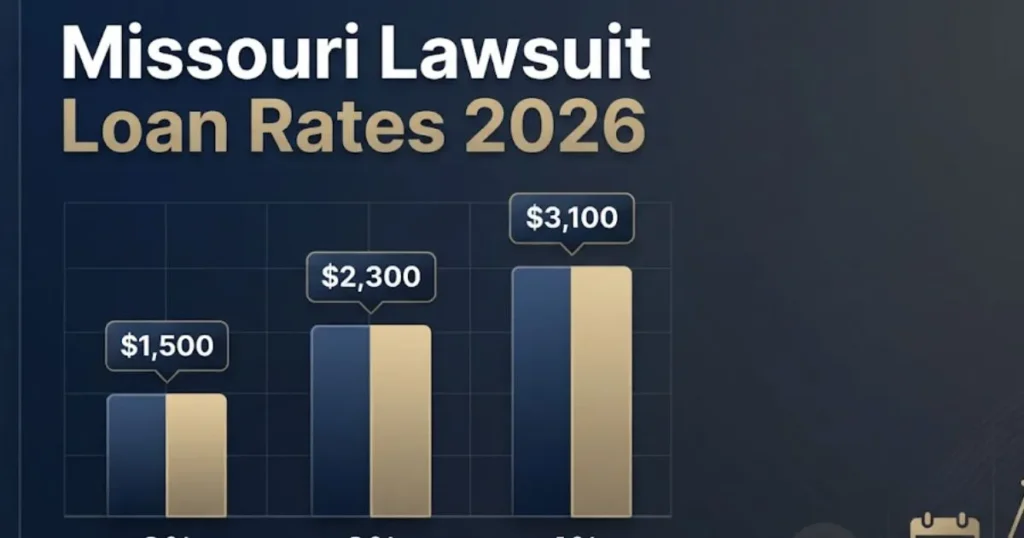
Lawsuit loan interest rates in Missouri typically range from 2% to 4% per month in 2026, with some companies charging as high as 5% monthly for riskier cases.
That might not sound like much, but it adds up fast. A 3% monthly rate on a $10,000 advance becomes $3,600 in interest after just 12 months. After 18 months, the interest alone exceeds $5,400.
Here is what different monthly rates actually cost you on a $10,000 advance:
| Monthly Rate | After 6 Months | After 12 Months | After 18 Months | After 24 Months |
|---|---|---|---|---|
| 2.0% | $11,262 | $12,682 | $14,282 | $16,084 |
| 3.0% | $11,941 | $14,258 | $17,024 | $20,328 |
| 3.5% | $12,293 | $15,111 | $18,575 | $22,833 |
| 4.0% | $12,653 | $16,010 | $20,258 | $25,633 |
These rates compound. That means you pay interest on your interest, not just on the original amount. Compounding is the single biggest cost driver in lawsuit funding.
Some companies offer simple interest instead of compound interest. Simple interest means you only pay interest on the original advance amount. On a $10,000 advance at 3% simple monthly interest, you would owe $13,600 after 12 months instead of $14,258 with compounding.
Always ask whether the rate is simple or compound. This one question could save you thousands of dollars.
Missouri does not impose a cap on lawsuit funding interest rates as of 2026. That makes comparison shopping absolutely essential.
Lawsuit Loan Repayment in Missouri
Lawsuit loan repayment in Missouri happens automatically when your case settles. You do not write checks, set up autopay, or make monthly installments.
When your case resolves, your attorney receives the settlement funds. Before distributing your share, your attorney pays the funding company directly from the proceeds. Whatever remains after paying the funder, attorney fees, and medical liens goes to you.
Here is how a typical settlement disbursement looks for a Missouri plaintiff who took a $10,000 advance:
| Settlement Component | Amount |
|---|---|
| Total Settlement | $60,000 |
| Attorney Fees (33%) | $19,800 |
| Medical Liens | $8,000 |
| Lawsuit Loan Repayment | $14,500 |
| Your Take-Home | $17,700 |
That example assumes 12 months at a 3% compound rate. If the case takes 24 months, the repayment jumps to over $20,000, and your take-home drops to around $12,200.
The lesson? Every month your case takes to resolve costs you real money when you have an outstanding funding advance. This creates an awkward tension. Your attorney wants to negotiate for a higher settlement, but every month of negotiation increases your repayment obligation.
If you lose your case entirely, you repay nothing. That is the non-recourse protection. But losses are rare for funded cases because funding companies only approve claims with strong evidence of liability.
Missouri Personal Injury Lawsuit Loans
Missouri personal injury lawsuit loans are the most common type of litigation funding in the state. They cover any case where someone else’s negligence caused you physical harm.
Personal injury cases make up roughly 70% of all lawsuit loan applications in Missouri. The reason is straightforward: these cases often involve months or years of waiting, and injured plaintiffs need money for bills that cannot wait.
Qualifying personal injury case types in Missouri include:
- Car and truck accidents
- Motorcycle crashes
- Pedestrian accidents
- Dog bite injuries
- Slip and fall incidents
- Construction site injuries
- Defective product injuries
- Medical malpractice claims
- Nursing home abuse cases
- Assault and battery (civil claims)
Your personal injury case must have clear evidence that another party is at fault. A police report, medical records, and witness statements all strengthen your application.
The average personal injury lawsuit loan in Missouri in 2026 is approximately $8,000 to $12,000. Larger advances are possible for severe injuries involving surgery, long-term disability, or catastrophic harm.
One advantage of personal injury cases: they tend to settle faster than other lawsuit types. The average Missouri personal injury case resolves within 12 to 18 months, which keeps your interest costs lower compared to cases that drag on for years.
Key Takeaway: Personal injury cases are the easiest to fund in Missouri because they have clear liability, predictable settlement ranges, and relatively fast resolution timelines.
Car Accident Lawsuit Loans in Missouri
Car accident lawsuit loans are the single most approved type of lawsuit funding in Missouri. Police reports and insurance documentation make these cases easy for funders to evaluate.
Missouri is an at-fault state for car accidents. That means the driver who caused the crash is responsible for your damages. This clear liability structure is exactly what funding companies want to see.
If you were hit by another driver in Missouri and have an attorney pursuing your claim, you are a strong candidate for lawsuit funding. Cases involving drunk drivers, distracted drivers, or rear-end collisions get approved at the highest rates.
| Car Accident Factor | Impact on Funding Approval |
|---|---|
| Police report filed | Strongly positive |
| Other driver cited | Strongly positive |
| Clear medical treatment | Positive |
| Disputed fault | Reduces approval odds |
| No attorney | Automatic denial |
| Minimal injury | Lower advance amount |
Most car accident lawsuit loans in Missouri range from $2,000 to $15,000. If your accident involved a commercial truck, Uber or Lyft vehicle, or a government vehicle, the funding amount can be significantly higher because these cases carry larger settlement potential.
One thing to watch: if you share any fault for the accident, Missouri’s comparative fault rules come into play. Missouri follows pure comparative negligence, meaning you can still recover even if you are 99% at fault, but your settlement drops accordingly. Funders will reduce your advance based on your percentage of fault.
Workers Comp Lawsuit Loans in Missouri
Workers comp lawsuit loans in Missouri are available, but they come with an important distinction. Standard workers compensation claims are generally not eligible. Third-party liability claims related to workplace injuries are.
Here is the difference. A standard workers comp claim is filed against your employer through Missouri’s workers compensation system. These claims have set benefit schedules and are handled administratively, not through the civil court system. Most funding companies will not advance money against these claims.
However, if your workplace injury involved a third party, like a negligent subcontractor, a defective equipment manufacturer, or a reckless driver who hit you while working, you may have a separate personal injury lawsuit. That third-party claim is eligible for lawsuit funding.
- Eligible: Third-party liability claims from workplace injuries
- Not eligible: Standard workers comp claims filed with your employer’s insurer
- Sometimes eligible: Cases involving employer intentional misconduct (rare in Missouri)
The advance amounts for workers comp-related third-party claims typically run between $3,000 and $20,000. These cases can take longer to resolve than standard car accident claims, so be prepared for higher total interest costs.
If you are unsure whether your workplace injury involves a third-party claim, ask your attorney. Many injured workers do not realize they have both a workers comp claim and a separate personal injury lawsuit running at the same time.
Lawsuit Funding with No Credit Check in Missouri
Lawsuit funding in Missouri requires no credit check. Your credit score, credit history, and existing debts are irrelevant to the approval decision.
This is one of the biggest differences between lawsuit loans and traditional lending products. Banks care about your ability to repay. Lawsuit funding companies care about your case’s ability to pay.
The funding company is betting on the outcome of your lawsuit, not on your financial history. Even if you have bankruptcies, collections, or a credit score below 500, you can still qualify for lawsuit funding in Missouri.
Here is a side-by-side comparison:
| Factor | Traditional Loan | Lawsuit Loan |
|---|---|---|
| Credit Score | Required (usually 600+) | Not checked |
| Income Verification | Required | Not required |
| Employment Status | Must be employed | Does not matter |
| Collateral | May be required | Your case is the collateral |
| Monthly Payments | Yes | None |
| Repayment If You Lose | Still owed | Nothing owed |
This makes lawsuit funding accessible to people who could not get approved for any other type of borrowing. If you are out of work due to your injury, have mounting bills destroying your credit, and cannot qualify for a personal loan, lawsuit funding may be your only realistic option.
Just remember: “no credit check” does not mean “no cost.” The interest rates on lawsuit loans are much higher than traditional lending products. You trade credit risk for case risk, and the funding company prices that risk into their fees.
Key Takeaway: Missouri lawsuit funding companies never check your credit because they are investing in your case, not in you personally, but this convenience comes with higher interest rates than traditional loans.
Non-Recourse Lawsuit Funding in Missouri
Non-recourse lawsuit funding means you owe nothing if your case loses. Zero. The funding company writes off the entire advance as a loss.
This is the defining feature that separates lawsuit loans from every other type of borrowing. With a bank loan, a credit card, or even a payday loan, you owe the money regardless of what happens in your life. Lawsuit funding works differently.
If your case goes to trial and the jury rules against you, your balance disappears. If your case gets dismissed, your balance disappears. If your attorney withdraws and the case falls apart, your balance disappears.
The non-recourse structure exists because funding companies thoroughly vet each case before approving it. They reject weak cases to protect their investment. According to industry data, most legitimate funding companies approve fewer than 50% of applications because they are picky about case strength.
| Scenario | What You Owe |
|---|---|
| Case settles for more than your advance | Repay advance plus fees |
| Case settles for less than your advance | Some companies cap repayment at settlement amount |
| Case loses at trial | You owe nothing |
| Case gets dismissed | You owe nothing |
| Case takes 3+ years | Interest keeps compounding until resolution |
Here is the fine print to watch: some funding agreements include language that could limit the non-recourse protection in certain situations. Read every page of the contract. Make sure the non-recourse provision is clearly stated, unconditional, and not buried behind exceptions.
Your attorney should review any funding agreement before you sign. A good attorney will catch problematic language that could expose you to repayment even in a loss scenario.
Best Lawsuit Loan Companies in Missouri
The best lawsuit loan companies in Missouri in 2026 combine low rates, transparent terms, fast funding, and fair repayment caps. No single company dominates the market, so comparing multiple offers is essential.
When evaluating funding companies, focus on these specific factors:
- Monthly interest rate (lower is better; look for 2% to 3%)
- Simple vs. compound interest (simple is always cheaper)
- Repayment cap (some companies cap total repayment at 2x or 3x the original advance)
- Funding speed (24 to 48 hours is standard for good companies)
- Transparency (all fees disclosed upfront in the contract)
- Attorney reviews (does the company encourage you to have your lawyer review the agreement?)
Here is a comparison framework for evaluating Missouri lawsuit funding companies:
| Criteria | Good Sign | Red Flag |
|---|---|---|
| Interest Type | Simple interest | Compound interest |
| Rate Range | 2% to 3% monthly | Above 4% monthly |
| Repayment Cap | Capped at 2x to 3x advance | No cap |
| Hidden Fees | None disclosed | Application fees, processing fees, broker fees |
| Attorney Communication | Company works with your lawyer | Company discourages attorney review |
| Contract Length | Clear, readable agreement | Dense, confusing language |
The American Legal Finance Association sets voluntary standards for member companies. While membership is not a guarantee of quality, ALFA members generally follow more transparent practices than non-members.
Get at least three quotes before committing. The difference between a fair deal and an expensive one can amount to thousands of dollars over the life of your case.
Missouri Lawsuit Loan Regulations in 2026
Missouri does not have a comprehensive state law specifically regulating lawsuit funding as of 2026. This puts Missouri in the majority of states that leave litigation finance largely unregulated.
Unlike states such as Arkansas, Indiana, and Oklahoma, which have passed specific lawsuit funding statutes, Missouri has not enacted targeted legislation. This means there are no state-mandated interest rate caps, no required disclosure formats, and no licensing requirements specific to litigation funders operating in Missouri.
Here is how Missouri’s regulatory environment compares to neighboring states:
| State | Specific Lawsuit Funding Law | Interest Rate Cap | Required Disclosures |
|---|---|---|---|
| Missouri | No | No | No |
| Illinois | Yes (2024) | Yes | Yes |
| Arkansas | Yes | Yes | Yes |
| Kansas | No | No | No |
| Oklahoma | Yes | Varies | Yes |
| Iowa | No | No | No |
The Missouri Attorney General’s office can investigate lawsuit funding companies for deceptive trade practices under existing consumer protection statutes. If a company misleads you about rates, fees, or terms, you can file a complaint.
Several Missouri legislators have introduced bills to regulate the industry in recent sessions. As of early 2026, no comprehensive bill has passed. However, the momentum toward regulation is building, particularly around mandatory disclosure requirements and interest rate transparency.
The bottom line for Missouri consumers: since the state does not regulate this industry heavily, the burden falls on you to read contracts carefully and compare offers aggressively.
Key Takeaway: Missouri has no specific lawsuit funding regulations in 2026, which means consumers must protect themselves by comparing offers, reading contracts thoroughly, and insisting their attorney review every agreement.
Risks of Lawsuit Loans in Missouri
The biggest risk of lawsuit loans in Missouri is the total cost. Compound interest can consume a massive portion of your settlement if your case takes longer than expected.
Let us put real numbers to this risk. Say you take a $15,000 advance at 3% compound monthly interest. If your case settles in 12 months, you repay roughly $21,387. But if it stretches to 24 months, you owe about $30,492. That is more than double your original advance.
Here are the primary risks every Missouri plaintiff should understand:
- Interest accumulation: Every month your case stays open costs you money
- Reduced settlement take-home: Your share shrinks as repayment obligations grow
- Pressure to settle early: Some plaintiffs accept lower offers to stop interest from growing
- Multiple funding rounds: Taking second or third advances compounds the problem
- Unregulated companies: Without state oversight, some funders use predatory terms
- Contract complexity: Dense agreements can hide fees and unfavorable provisions
Another underappreciated risk involves how lawsuit funding affects your relationship with your attorney. Some attorneys dislike working with funding companies because the funder’s lien on the settlement complicates the disbursement process. A few attorneys have been known to delay cooperating with funders, which slows down your approval.
The risk of losing your case entirely is actually low for funded plaintiffs. Funding companies screen cases carefully, so if they approved you, they believe you will win. Still, no outcome is guaranteed in legal disputes.
The smartest approach? Borrow only what you absolutely need. Every dollar you do not borrow is a dollar you do not pay interest on.
Alternatives to Lawsuit Loans in Missouri
Lawsuit loans are not your only option in Missouri. Several alternatives cost less and carry fewer risks, depending on your financial situation.
Before committing to a lawsuit funding agreement, consider these alternatives:
Personal loans from banks or credit unions. If your credit is decent, a personal loan charges far less interest than lawsuit funding. Even a 15% APR personal loan is dramatically cheaper than a 36% to 48% effective annual rate from a litigation funder.
Credit card cash advances. Expensive by normal standards, but still cheaper than most lawsuit loans. A credit card at 25% APR costs less per year than a lawsuit loan at 3% monthly compound interest.
Borrowing from family or friends. Uncomfortable, yes. But a $10,000 loan from a family member at 0% interest saves you thousands compared to any funding company.
| Alternative | Typical Annual Cost | Credit Required | Repayment Obligation |
|---|---|---|---|
| Personal Loan | 8% to 15% APR | Yes | Yes, regardless of case outcome |
| Credit Card Advance | 20% to 30% APR | Yes | Yes, regardless of case outcome |
| 401(k) Loan | 4% to 6% APR | No | Yes, repay to yourself |
| Family/Friend Loan | 0% to 5% | No | Depends on arrangement |
| Lawsuit Loan | 24% to 60% effective APR | No | Only if you win |
Negotiating payment plans with creditors. Many landlords, hospitals, and utility companies will work with you if you explain your situation. Medical providers are especially open to payment plans when they know a settlement is coming.
Hardship programs. Missouri offers various state and local assistance programs for rent, utilities, and food. These programs exist specifically for situations like yours.
The one genuine advantage of lawsuit funding over all these alternatives: you pay nothing if you lose. That non-recourse protection has real value, especially for plaintiffs facing uncertain case outcomes.
Missouri Lawsuit Cash Advance
A Missouri lawsuit cash advance is the same product as a lawsuit loan or pre-settlement funding, just marketed under a different label. The terms, costs, and process are identical.
Funding companies use different names for strategic reasons. “Cash advance” sounds less like borrowing, which can make plaintiffs more comfortable. But do not let the terminology confuse you. Whether it is called a lawsuit loan, pre-settlement funding, litigation finance, or a cash advance, you are receiving money now and repaying it from your future settlement.
Here is a quick summary of what to expect from a Missouri lawsuit cash advance in 2026:
| Detail | Info |
|---|---|
| Typical Amount | $2,500 to $25,000 |
| Approval Time | 24 to 72 hours |
| Interest Rate | 2% to 4% per month |
| Interest Type | Usually compound (ask for simple) |
| Credit Check | None |
| Monthly Payments | None |
| Repayment Trigger | Case settlement or verdict |
| If You Lose | Owe nothing |
The most important thing you can do before accepting a cash advance is to calculate the total repayment amount across multiple timeframes. Ask the funding company to show you what you will owe at 6, 12, 18, and 24 months. If they refuse to provide that breakdown, walk away.
Missouri plaintiffs in 2026 have more choices than ever when it comes to litigation cash advances. The competition works in your favor, but only if you shop around and negotiate.
Key Takeaway: “Lawsuit cash advance,” “lawsuit loan,” and “pre-settlement funding” are all the same product in Missouri, so focus on the interest rate, repayment terms, and total cost rather than the marketing label.
Frequently Asked Questions
Do I have to repay a lawsuit loan in Missouri if I lose my case?
No, you owe nothing if your case loses.
Lawsuit loans in Missouri are non-recourse, meaning the funding company absorbs the loss entirely.
This applies whether your case is dismissed, loses at trial, or settles for zero.
How fast can I get lawsuit funding in Missouri?
Most Missouri plaintiffs receive funds within 24 to 72 hours of approval.
Some companies offer same-day funding for straightforward cases.
The speed depends on how quickly your attorney responds to the funder’s request for case information.
What credit score do I need for a lawsuit loan in Missouri?
You do not need any credit score.
Lawsuit funding companies in Missouri do not run credit checks.
Approval is based entirely on the strength and estimated value of your pending case.
Can I get a lawsuit loan for a workers comp case in Missouri?
Standard workers comp claims are not eligible for lawsuit loans in Missouri.
However, if your workplace injury involves a third-party liability claim, you may qualify.
Ask your attorney whether your case includes any third-party defendants.
What is the average interest rate on lawsuit loans in Missouri in 2026?
The average monthly interest rate ranges from 2% to 4% in 2026.
This translates to an effective annual rate of roughly 27% to 60%, depending on whether interest compounds.
Always ask whether the rate is simple or compound before signing any agreement.
Take Action Now
Lawsuit loans in Missouri can be a lifeline, but they come with real costs that grow every month. Shop at least three companies, insist on simple interest, and never borrow more than you absolutely need.
Have your attorney review every funding agreement before you sign. Keep track of your repayment obligations so you know exactly what to expect when your case settles.
The money is available if you need it. Just make sure you are getting a fair deal in 2026.







