

Lawsuit discovery is the pretrial phase where both sides exchange evidence, and it’s often the longest and most expensive part of any civil case. If you’re involved in a lawsuit in 2026, understanding discovery can save you time, money, and a lot of stress.
This article breaks down exactly what lawsuit discovery means, how the process works, what types exist, how long it takes, and what it costs. You’ll learn what happens during depositions, how to handle interrogatories, and why discovery often forces settlements before trial ever starts.
Here’s a fact that surprises most people: roughly 90% to 95% of civil cases in the United States settle before reaching trial. Discovery is the reason why. Once evidence comes out, both sides usually find a deal.
Whether you’re dealing with a personal injury claim, a class action, or a product liability case, this guide covers every angle of discovery in plain English.
What Is Discovery in a Lawsuit
Discovery in a lawsuit is the formal pretrial process where both sides gather and share evidence before trial. It’s governed by court rules, and both parties are legally required to participate.
Think of it like opening the books. Each side gets to look at the other side’s cards before the game starts. No surprises at trial, at least in theory.
The legal foundation for discovery in federal cases comes from Rules 26 through 37 of the Federal Rules of Civil Procedure (FRCP). Every state has its own version of these rules too, and they follow similar principles.
Discovery exists because the American legal system believes trials work better when both sides have access to the same facts. Without it, lawsuits would be guessing games.
| Discovery Basics | Details |
|---|---|
| What it is | Pretrial evidence exchange |
| Governed by | FRCP Rules 26 to 37 (federal); state rules vary |
| Who participates | Both plaintiff and defendant |
| When it happens | After filing, before trial |
| Is it mandatory | Yes, with limited exceptions |
The process can involve written questions, document requests, sworn testimony, and physical inspections. Each tool serves a different purpose, and most cases use several of them together.
How Discovery in a Lawsuit Works
Discovery in a lawsuit works through a structured series of exchanges between the parties, overseen by the court. It begins shortly after the lawsuit is filed and the defendant responds.
The process kicks off with what’s called a Rule 26(f) conference in federal court. Both sides meet (often by phone) to discuss the scope of discovery, agree on timelines, and address any special issues like electronically stored information.
After that conference, the court issues a scheduling order. This order sets hard deadlines for every stage of discovery. Missing those deadlines can mean losing the right to present certain evidence.
From there, the actual exchange begins. Lawyers send written questions, request documents, and schedule depositions. Both sides have obligations to search for and turn over relevant materials.
Here’s what catches many people off guard: discovery is not optional. If you’re a party to a lawsuit, you must respond. Ignoring discovery requests can lead to court sanctions, fines, or even having your case dismissed.
- The plaintiff sends discovery requests to the defendant
- The defendant sends discovery requests to the plaintiff
- Both sides respond within court-ordered deadlines
- Disputes go to the judge for resolution
The judge acts as referee. If one side thinks the other is being unreasonable, they can file a motion to compel. That forces the other side to hand over what they’re hiding.
Understanding Lawsuit Discovery
Lawsuit discovery refers to the entire body of pretrial evidence-gathering activities that happen between the complaint and the trial. It’s the backbone of civil litigation.
Most people hear “lawsuit” and picture a courtroom. The reality is different. The vast majority of a lawsuit’s life is spent in discovery. Courtrooms come later, if they come at all.
To put it in everyday terms: discovery is the investigation phase. Detectives gather evidence before making an arrest. Lawyers gather evidence before going to trial. Same idea, different setting.
What makes discovery powerful is its breadth. Courts allow parties to seek any information that’s relevant to any party’s claim or defense. That’s a wide net. You don’t have to prove the information will be used at trial. You just have to show it could lead to relevant evidence.
| Common Discovery Misconception | Reality |
|---|---|
| Discovery is a quick step | It’s often the longest part of a case |
| Only lawyers deal with it | Clients actively participate in gathering documents and answering questions |
| Everything is private | Some discovery materials become public record |
| You can hide bad evidence | Hiding evidence leads to severe penalties |
Since the 2015 amendments to the FRCP, courts also apply a proportionality standard. Discovery must be proportional to the needs of the case. A small-dollar dispute won’t get the same discovery scope as a billion-dollar class action.
Key Takeaway: Discovery is the mandatory pretrial evidence exchange that drives most civil lawsuits and often determines whether cases settle or go to trial.
Purpose of Discovery in a Lawsuit
The purpose of discovery in a lawsuit is to eliminate surprises, promote fairness, and give both sides equal access to relevant facts before trial.
Courts designed discovery with one philosophy in mind: trials should be decided on evidence, not tricks. Without discovery, the side with more resources could ambush the other with hidden evidence at trial.
Discovery serves several specific goals:
- Preserves testimony before witnesses forget details or become unavailable
- Identifies key evidence both sides need to build their arguments
- Narrows the issues so the trial focuses on what actually matters
- Encourages settlement by showing both sides the strength (or weakness) of their case
- Prevents fraud by requiring parties to disclose information under oath
That last point matters more than people realize. When you answer interrogatories or sit for a deposition, you’re doing so under penalty of perjury. Lying during discovery is a crime.
Discovery also helps judges manage their dockets. By the time a case reaches trial, both sides should know what evidence exists. This makes trials shorter and more efficient.
In practice, discovery is where cases are won and lost. A plaintiff who uncovers a damaging internal email during document production might force a massive settlement. A defendant who proves the plaintiff lied in interrogatories might get the case thrown out.
Discovery Process in a Lawsuit Step by Step
The discovery process in a lawsuit follows a predictable sequence of steps, starting with initial disclosures and ending when the court’s discovery deadline expires.
Here’s how it unfolds in most civil cases:
Step 1: Initial Disclosures (Rule 26(a))
Both sides automatically share basic information within 14 days of their Rule 26(f) conference. This includes names of witnesses, copies of relevant documents, damage calculations, and insurance agreements.
Step 2: Written Discovery
Lawyers exchange interrogatories (written questions), requests for production of documents, and requests for admission. Each side typically has 30 days to respond.
Step 3: Depositions
Witnesses give sworn testimony in front of a court reporter. Lawyers ask questions, and the witness answers under oath. Depositions can last hours or even multiple days.
Step 4: Expert Discovery
Both sides disclose their expert witnesses and provide written reports. The opposing side gets to depose those experts.
Step 5: Discovery Disputes and Motions
If one side refuses to cooperate, the other files a motion to compel. The judge rules on disputes.
| Step | Timeline | Key Action |
|---|---|---|
| Initial Disclosures | Within 14 days of Rule 26(f) | Share basic witness and document info |
| Written Discovery | 30 days to respond | Interrogatories, document requests |
| Depositions | Scheduled by agreement | Sworn oral testimony |
| Expert Discovery | Per court schedule | Expert reports and depositions |
| Discovery Cutoff | Set by judge | All discovery must be complete |
Step 6: Discovery Closes
The court’s scheduling order sets a hard cutoff. After that date, no new discovery requests can be filed without special permission.
The Discovery Phase of a Lawsuit Explained
The discovery phase of a lawsuit is the period between the initial pleadings and trial where evidence gathering takes place. It’s typically the longest single phase of litigation.
Many people think filing a lawsuit means heading straight to court. Not even close. After the complaint is filed and the defendant answers, the case enters discovery. This is where the real work begins.
During this phase, both sides are doing three things at once. They’re building their own case, poking holes in the other side’s case, and figuring out whether settling makes more sense than going to trial.
The discovery phase has a definite start and end. It begins after the Rule 26(f) planning conference and ends on the date the judge sets in the scheduling order. Anything a party wants to discover must happen within that window.
Here’s what most people don’t expect: the discovery phase can feel slow. Weeks go by waiting for responses. Depositions get rescheduled. Lawyers argue over what’s relevant. It’s the legal equivalent of a construction project running behind schedule.
- Discovery starts after the defendant files an answer
- Both sides conduct written and oral discovery simultaneously
- The judge sets a firm deadline for completion
- Late discovery requests require court approval
Patience matters during this phase. The timeline isn’t always in your control, but the quality of your responses absolutely is.
What Happens During Discovery in a Lawsuit
During discovery in a lawsuit, both sides exchange documents, answer written questions under oath, take depositions, and request admissions of fact. It’s an active, sometimes contentious process.
Picture two teams of lawyers sending each other homework assignments. That’s discovery in practice. One side sends questions; the other has 30 days to answer. One side requests every email from the last five years; the other has to search for and produce them.
Several things happen simultaneously during discovery:
- Document searches: Parties comb through files, emails, texts, and databases for relevant materials
- Privilege reviews: Lawyers identify documents protected by attorney-client privilege and create a privilege log
- Litigation holds: Companies must preserve all potentially relevant electronic data
- Witness preparation: Key witnesses prepare for deposition testimony
- Objections and negotiations: Lawyers argue over what’s relevant and what’s off-limits
Disputes are common. One side might claim a document is privileged. The other might argue the questions are too broad. When parties can’t agree, they go to the judge.
| Discovery Activity | Who Does It | Typical Duration |
|---|---|---|
| Responding to interrogatories | Parties with their lawyers | 30 days per set |
| Producing documents | Parties and third parties | Weeks to months |
| Depositions | Witnesses under oath | 1 day per witness (up to 7 hours) |
| Expert reports | Retained expert witnesses | Per court schedule |
| Resolving disputes | Judge or magistrate | Days to weeks |
The pace depends on case complexity. A simple car accident case might finish discovery in three months. A mass tort involving millions of documents could take two years.
Key Takeaway: Discovery is a structured, multi-step process where both sides exchange evidence under court deadlines, and disputes are resolved by a judge.
Types of Discovery in a Lawsuit
The main types of discovery in a lawsuit are interrogatories, depositions, requests for production of documents, requests for admission, and physical or mental examinations. Each serves a distinct purpose.
Not every case uses every type. Your lawyer picks the tools that fit the situation. A contract dispute might rely heavily on document production. A personal injury case might focus on depositions and medical exams.
Here’s a breakdown of each type:
| Type | What It Is | Best Used For |
|---|---|---|
| Interrogatories | Written questions answered under oath | Getting basic facts and identifying witnesses |
| Depositions | Live sworn testimony recorded by a court reporter | Testing credibility and locking in testimony |
| Requests for Production | Demands for documents, emails, photos, records | Finding the “smoking gun” evidence |
| Requests for Admission | Statements the other side must admit or deny | Narrowing issues before trial |
| Physical/Mental Exams | Court-ordered medical examinations | Personal injury cases where health is disputed |
| Subpoenas | Orders to third parties to produce documents or testify | Getting evidence from non-parties |
The first four types apply in almost every civil case. Physical exams require a court order and only apply when someone’s physical or mental condition is genuinely at issue.
Subpoenas deserve special attention. These allow parties to get evidence from people and companies who aren’t part of the lawsuit. Banks, employers, phone companies, and hospitals all receive subpoenas regularly during discovery.
Interrogatories in Discovery
Interrogatories in discovery are written questions sent from one party to the other, requiring answers under oath within a set deadline. Federal courts limit each side to 25 interrogatories unless the court says otherwise.
They’re usually the first discovery tool lawyers reach for. Interrogatories help map out the basic facts: Who are your witnesses? What damages are you claiming? When did you first notice the problem?
Answering interrogatories is a team effort between you and your lawyer. You provide the factual information. Your lawyer shapes the answers to be accurate and legally careful.
Here’s what a typical interrogatory looks like in a product liability case:
- “Identify all healthcare providers who treated you for injuries related to this product.”
- “State the dates you used the product and the frequency of use.”
- “Describe in detail the injuries you claim were caused by the defendant’s product.”
| Interrogatory Facts | Details |
|---|---|
| Federal limit | 25 per party (including subparts) |
| Response deadline | 30 days from service |
| Must be answered under oath | Yes |
| Can you object | Yes, on relevance or burden grounds |
| State court limits | Varies; some allow 30 or 40 |
One strategic note: interrogatories have limits because courts don’t want lawyers burying the other side in hundreds of questions. Quality matters more than quantity here. A well-crafted interrogatory can reveal case-changing information in a single answer.
If you receive interrogatories, don’t ignore them. Failing to respond can result in the court treating certain facts as admitted against you.
Depositions During Discovery
Depositions during discovery are live, sworn question-and-answer sessions where a witness testifies in front of a court reporter, usually at a lawyer’s office. Federal Rule 30 governs depositions.
If interrogatories are homework, depositions are oral exams. There’s no time to look up answers. No chance to carefully wordsmith your response. You answer in real time, under oath, and everything you say gets transcribed.
Depositions happen in person or by video. Since 2020, remote video depositions have become standard practice, and courts in 2026 continue to allow them in most cases.
Here’s what the experience looks like for a witness:
- You sit at a table with lawyers from both sides
- A court reporter records every word
- The opposing lawyer asks questions for up to 7 hours (federal limit)
- Your lawyer can object but generally can’t coach your answers
- The transcript becomes part of the case record
| Deposition Details | Info |
|---|---|
| Federal time limit | 7 hours of testimony per witness |
| Who can be deposed | Parties, fact witnesses, experts, corporate representatives |
| Format | In-person or video |
| Cost per deposition | $1,000 to $5,000+ (court reporter, videographer, transcript) |
| Can it be used at trial | Yes, especially if the witness is unavailable |
Depositions are where cases often turn. A witness who contradicts their own emails can destroy a defense. A plaintiff who stays calm and consistent under pressure can strengthen their case dramatically.
Preparation is everything. Witnesses who practice with their lawyer beforehand perform better. Those who wing it often regret it.
Request for Production of Documents
A request for production of documents is a formal demand for the other side to hand over specific records, files, emails, photos, videos, or any other tangible evidence relevant to the case. Federal Rule 34 governs this process.
This is where the real evidence lives. Emails between executives discussing a product defect. Text messages showing someone knew about a safety risk. Financial records proving the actual cost of damages. Documents don’t lie, and they don’t forget.
The requesting party describes what they want in specific categories. The responding party must search their files, identify responsive documents, and produce them, usually in electronic format.
Common document requests include:
- All emails between specific people during a certain time period
- Internal reports, memos, or meeting notes about the product or incident
- Financial records showing profits, costs, or losses
- Photographs, videos, or surveillance footage
- Medical records, insurance policies, or repair invoices
| Document Production Facts | Details |
|---|---|
| Response deadline | 30 days (federal court) |
| Format | Usually electronic (PDF, native files) |
| Can you object | Yes, but you must state specific reasons |
| Privilege protection | Must create a privilege log for withheld documents |
| Third-party documents | Obtained via subpoena, not Rule 34 |
One thing that trips people up: you can’t just hand over the helpful documents and hide the rest. The obligation covers all responsive documents, whether they help your case or hurt it. Withholding relevant documents is called spoliation, and courts punish it severely.
Key Takeaway: The core discovery tools, interrogatories, depositions, and document requests, work together to build a complete picture of the evidence before either side steps into a courtroom.
E-Discovery in Lawsuits
E-discovery in lawsuits refers to the process of identifying, collecting, and reviewing electronically stored information (ESI) as part of litigation discovery. In 2026, it dominates nearly every case.
Paper discovery is mostly a thing of the past. Today, the evidence lives in email servers, cloud platforms, Slack channels, text messages, social media accounts, and company databases. E-discovery is how lawyers get to all of it.
The volume is staggering. A single corporate lawsuit can involve millions of electronic documents. Reviewing them manually would take years. That’s why courts and law firms now use AI-powered review tools like predictive coding and Technology Assisted Review (TAR).
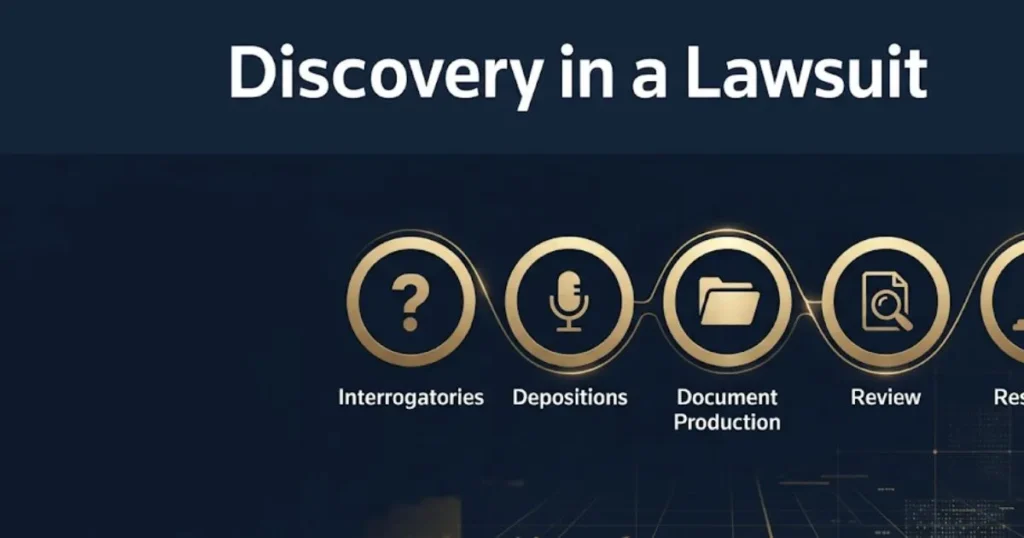
Here’s how e-discovery typically works:
- Identification: Determine where ESI exists (servers, phones, cloud storage)
- Preservation: Issue a litigation hold to prevent deletion
- Collection: Extract data from sources using forensic tools
- Processing: Convert files into reviewable formats and remove duplicates
- Review: Lawyers and AI tools assess relevance and privilege
- Production: Deliver relevant documents to the other side
| E-Discovery in 2026 | Key Facts |
|---|---|
| Primary evidence type | Emails, texts, social media, cloud files |
| AI review tools | Predictive coding, TAR, large language models |
| Biggest cost driver | Document review (often 60% to 80% of discovery budget) |
| Key rule | FRCP Rule 34 and 37(e) for ESI |
| Emerging challenge | AI-generated documents and deepfake concerns |
Courts in 2026 increasingly require parties to discuss e-discovery plans at the Rule 26(f) conference. Judges want to know what technology you’re using, how you’re preserving data, and whether the scope is proportional to the case.
Deleting relevant electronic data after litigation starts, or even when litigation is reasonably anticipated, triggers spoliation sanctions. These can include adverse inference instructions, monetary penalties, or case dismissal.
How Long Does Discovery Take in a Lawsuit
Discovery in a lawsuit typically takes 3 to 12 months, depending on the case type, complexity, and court. Some large cases stretch discovery past two years.
There’s no single answer because every case is different. A fender-bender personal injury case might wrap discovery in 90 days. A pharmaceutical mass tort with hundreds of thousands of claimants could spend three years in discovery alone.
The judge sets the timeline through a scheduling order. That order includes specific deadlines:
| Case Type | Typical Discovery Duration |
|---|---|
| Simple personal injury | 3 to 6 months |
| Contract disputes | 4 to 8 months |
| Employment lawsuits | 6 to 12 months |
| Product liability | 8 to 18 months |
| Class actions and mass torts | 12 to 36 months |
| Complex commercial litigation | 12 to 24 months |
Several factors affect the timeline:
- Volume of documents: More documents means more time to collect, review, and produce
- Number of parties: Cases with multiple defendants or plaintiffs take longer
- Discovery disputes: Fights over what’s relevant slow everything down
- Court backlogs: Some jurisdictions move faster than others
- Expert witnesses: Retaining, reporting, and deposing experts adds months
Extensions are common. Lawyers frequently ask the court for more time, especially when document volumes are large or key witnesses are hard to schedule. Courts grant extensions when there’s good cause but push back on delays caused by laziness or gamesmanship.
One practical tip: keep your own records organized from the start. Clients who have their documents ready make discovery faster and cheaper.
How Discovery Affects Settlement
Discovery directly affects settlement because it reveals the strength of each side’s case, often making trial unnecessary. Most civil cases settle during or shortly after discovery.
Here’s the dynamic at play. Before discovery, each side has their own version of events. After discovery, both sides see the actual evidence. That reality check changes calculations.
A defendant who discovers the plaintiff has strong medical records and consistent testimony might decide settling is cheaper than risking a trial verdict. A plaintiff who learns the defendant has solid documentation might accept a lower offer rather than gamble on a jury.
The numbers back this up. According to court data, over 90% of federal civil cases resolve without trial. Discovery is the engine driving those settlements.
| Settlement Trigger During Discovery | How It Works |
|---|---|
| Damaging documents uncovered | Internal emails or memos showing the defendant knew about a risk |
| Strong deposition testimony | A witness who performs well under cross-examination |
| Weak plaintiff evidence | Discovery reveals gaps in the plaintiff’s story |
| High discovery costs | Both sides realize trial costs aren’t worth it |
| Court-ordered mediation | Judges often require mediation after discovery closes |
Discovery creates leverage. The party with stronger evidence gains negotiating power. The party with weaker evidence starts looking for the exit.
Timing matters too. Many settlements happen right after depositions. That’s when both sides have the clearest picture of how a trial would go. Seeing a key witness struggle under questioning, or perform brilliantly, changes the math for everyone.
Key Takeaway: Discovery is the single biggest factor in whether a case settles, because it forces both sides to see the real evidence and adjust their expectations.
Discovery in Class Action Lawsuits
Discovery in class action lawsuits follows the same basic rules as individual cases but operates on a much larger scale, with unique procedural layers tied to class certification.
Class actions add complexity because they involve potentially thousands or millions of plaintiffs. Before a class is even certified, discovery focuses on whether the case meets the requirements of Federal Rule 23: numerosity, commonality, typicality, and adequacy.
This pre-certification discovery is a battleground. Defendants fight to limit it, arguing the class shouldn’t be certified at all. Plaintiffs push for broad access to prove the case qualifies as a class action.
Once the class is certified, merits discovery begins. This is the full evidence exchange on the actual claims. In large class actions, this phase can generate tens of millions of documents.
| Class Action Discovery Stage | Focus |
|---|---|
| Pre-certification discovery | Whether class requirements under Rule 23 are met |
| Merits discovery | Evidence on the actual claims and defenses |
| Bellwether discovery | Selected individual cases tried as test cases |
| Settlement discovery | Financial records to evaluate proposed settlements |
Mass tort cases handled through multidistrict litigation (MDL) follow similar patterns. Discovery is centralized before a single federal judge, which avoids duplicate work across hundreds of individual cases.
In MDLs, courts often appoint lead counsel and create discovery committees. These committees coordinate document requests, deposition schedules, and expert disclosures for all plaintiffs at once.
The scale is enormous. The talc powder MDL, for example, involved millions of pages of internal company documents. The 3M earplug MDL produced over 22 million documents during discovery.
Can You Refuse Discovery in a Lawsuit
You cannot simply refuse discovery in a lawsuit without facing serious legal consequences. Courts treat discovery obligations as mandatory, and ignoring them can damage or destroy your case.
That said, there are legitimate reasons to push back on specific discovery requests. These aren’t refusals so much as legal objections, and they follow a process.
Valid reasons to object to a discovery request:
- Relevance: The request seeks information that has nothing to do with the case
- Privilege: Attorney-client communications or work product are protected
- Burden: The request is disproportionate to the needs of the case
- Overbreadth: The request is too broad or vague to be reasonable
- Privacy: The request seeks sensitive personal information without justification
Even when you object, you can’t just ignore the request. You must respond by the deadline, state your objections clearly, and produce whatever you can while preserving your objections.
| If You Refuse Discovery… | What Happens |
|---|---|
| Ignore requests entirely | Motion to compel, sanctions, adverse inference |
| Fail to appear for deposition | Court order, contempt, monetary penalties |
| Destroy evidence | Spoliation sanctions, possible case dismissal |
| Raise legitimate objections | Court rules on the objection; may narrow the request |
When disputes arise, courts expect both sides to meet and confer before involving the judge. This means the lawyers talk to each other, try to resolve the disagreement, and only go to court if they genuinely can’t work it out.
Judges have little patience for parties who stonewall discovery without good reason. The penalties for noncompliance are real and can be case-ending.
Discovery Abuse in Lawsuits
Discovery abuse in lawsuits occurs when a party misuses the discovery process to harass, delay, or impose excessive costs on the other side. Courts actively punish it through sanctions under FRCP Rule 37.
It happens more often than you’d think. Both plaintiffs and defendants engage in discovery abuse, and it takes several forms.
Common types of discovery abuse:
- Document dumps: Producing millions of irrelevant documents to bury important evidence in the pile
- Stonewalling: Refusing to produce documents or answer questions without valid justification
- Boilerplate objections: Objecting to every request with generic language, hoping the other side gives up
- Destroying evidence: Deleting emails, shredding documents, or wiping hard drives after litigation starts
- Excessive discovery requests: Sending hundreds of interrogatories or subpoenas designed to overwhelm
Courts take spoliation of evidence especially seriously. In the landmark case Zubulake v. UBS Warburg, the court imposed sanctions after a company failed to preserve key emails. That case still shapes e-discovery obligations today.
| Type of Sanction | When It Applies |
|---|---|
| Monetary fines | Unreasonable refusal to comply |
| Adverse inference instruction | Jury told to assume destroyed evidence was harmful to the spoliator |
| Issue preclusion | Party barred from arguing certain points |
| Default judgment or dismissal | Extreme cases of willful destruction or repeated noncompliance |
In 2026, courts are paying closer attention to AI-related discovery abuse. Some parties have attempted to use AI tools to selectively filter out damaging documents during review. Judges and opposing counsel are developing methods to audit these processes.
The 2015 proportionality amendments were partly a response to discovery abuse. By requiring discovery to be proportional to the case’s needs, courts gave judges more power to rein in excessive requests from both sides.
Key Takeaway: Discovery abuse carries severe penalties, including fines, adverse inferences, and case dismissal, so parties must take their obligations seriously and respond in good faith.
Cost of Discovery in a Lawsuit
The cost of discovery in a lawsuit ranges from a few thousand dollars in simple cases to tens of millions of dollars in complex litigation. Document review is consistently the biggest expense.
For individuals in smaller cases, discovery costs might run between $3,000 and $15,000. That covers basic interrogatories, a few depositions, and limited document production.
Corporate defendants in large cases face a completely different reality. A single corporate lawsuit can generate discovery costs exceeding $1 million, and class actions or MDLs can push well past $10 million in discovery alone.
Here’s where the money goes:
| Cost Category | Typical Range |
|---|---|
| Interrogatory preparation and response | $500 to $3,000 |
| Deposition (per witness, including transcript) | $1,000 to $10,000 |
| Document collection and processing | $5,000 to $100,000+ |
| Document review (attorney time or AI tools) | $10,000 to $5,000,000+ |
| Expert witness fees | $5,000 to $50,000+ per expert |
| E-discovery vendor costs | $10,000 to $500,000+ |
| Motion practice (discovery disputes) | $2,000 to $25,000 per motion |
AI and technology have brought some costs down. Predictive coding can reduce document review time by 60% to 80% compared to manual review. But the technology itself isn’t cheap, and someone still needs to train and validate the AI models.
Several factors affect your total discovery bill:
- Case complexity and the number of parties
- Volume of electronically stored information
- Number of depositions needed
- Whether discovery disputes require court intervention
- Geographic location (attorney rates vary significantly)
For plaintiffs in personal injury and mass tort cases, discovery costs are often covered by the law firm on a contingency basis. You don’t pay out of pocket; the firm covers costs and gets reimbursed from the settlement or verdict.
That’s the silver lining for individuals. The discovery system is expensive, but in many consumer cases, the financial burden falls on the lawyers, not the clients.
Frequently Asked Questions
What is the discovery phase of a lawsuit?
The discovery phase is the pretrial period where both sides exchange evidence and information.
It includes written questions, document requests, depositions, and expert disclosures.
This phase typically begins after the defendant files an answer and ends on a court-set deadline.
How long does discovery take in a typical lawsuit?
Most discovery periods last 3 to 12 months depending on case complexity.
Simple personal injury cases may finish in 90 days.
Large class actions or mass torts can take two to three years.
What are the main types of discovery in a lawsuit?
The five main types are interrogatories, depositions, requests for production, requests for admission, and physical examinations.
Each type serves a different purpose in gathering evidence.
Most cases use a combination of several types.
Can you refuse to answer discovery questions?
You can object to specific questions on grounds like relevance, privilege, or undue burden.
However, you cannot simply ignore discovery requests without facing court sanctions.
All objections must be stated formally and on time.
How much does the discovery process cost in 2026?
Simple cases may cost $3,000 to $15,000 for discovery.
Complex corporate or class action cases can exceed $1 million in discovery expenses.
For plaintiffs on contingency, the law firm typically covers these costs upfront.
What to Do Now
Lawsuit discovery is the engine that drives civil cases toward resolution. Whether you’re a plaintiff building a claim or a defendant preparing a defense, understanding how discovery works gives you a real advantage.
If you’re involved in a lawsuit, start organizing your documents now. Respond to every discovery request on time. Prepare thoroughly for depositions.
Stay informed about your case’s discovery schedule, and make sure you know every deadline. The discovery phase is where cases are won, lost, and settled.







