

The Kroger class action lawsuit 2021 wave triggered multiple legal battles that are still affecting millions of shoppers and employees in 2026. From a massive data breach to overcharging scandals, Kroger has faced serious legal heat over the past five years.
If you shopped at Kroger, filled a prescription there, or worked for the company, you might be owed money. Some settlements have already paid out. Others are still in progress.
This article covers every major Kroger class action from 2021 through today. You will learn who qualifies, how much people are getting, and whether you can still file a claim. One data breach alone exposed the personal records of over 1.5 million people. That is not a small number.
Kroger Class Action Lawsuit 2021: What Started It All
The Kroger class action lawsuit 2021 refers to a series of lawsuits filed against The Kroger Co. during 2021 over data breaches, consumer pricing issues, and employment practices. It was not a single case but rather a cluster of legal actions that hit America’s largest supermarket chain within the same year.
The biggest trigger was the Accellion data breach discovered in late January 2021. Hackers exploited a vulnerability in Accellion’s FTA file transfer service, which Kroger used to handle sensitive data. The breach exposed personal and health information belonging to Kroger pharmacy customers and employees.
At the same time, shoppers in multiple states filed separate lawsuits claiming Kroger overcharged for products at self-checkout and mislabeled package weights. Employment-related claims also surfaced, with workers alleging wage theft and labor law violations.
| Case Category | Year Filed | Primary Allegation |
|---|---|---|
| Data Breach (Accellion) | 2021 | Exposure of personal and pharmacy data |
| Overcharging | 2021 | Incorrect pricing at checkout |
| Employee Wage Claims | 2021 | Unpaid overtime and labor violations |
| Product Weight/Pricing | 2021 | Mislabeled package weights |
These lawsuits named The Kroger Co. as the primary defendant. Several also named Kroger subsidiaries including Harris Teeter, Ralphs, Fred Meyer, and Fry’s.
The sheer volume of cases filed in 2021 made it one of the most legally turbulent years in Kroger’s corporate history. Many of these cases have since progressed through settlement, appeal, or dismissal.
Kroger Class Action Lawsuit Update for 2026
As of 2026, most Kroger class action lawsuits from 2021 have reached resolution. The Accellion data breach litigation settled. Several overcharging cases concluded through class-wide settlements or individual arbitration. A few employment-related claims remain in late-stage proceedings.
The data breach settlement was the largest and most high-profile resolution. It went through final approval and claims were processed. Payments were distributed to verified claimants who filed before the deadline.
Overcharging lawsuits had mixed outcomes. Some were settled for undisclosed amounts. Others were dismissed when courts found insufficient evidence of systematic fraud. A handful of state-level cases continue in limited form.
Employment class actions involving Kroger warehouse workers and store employees have seen the slowest progress. Some cases consolidated into broader wage-and-hour actions. Others settled individually with confidential terms.
| Case Type | 2026 Status | Notes |
|---|---|---|
| Accellion Data Breach | Settled and paid | Claims closed |
| Overcharging (self-checkout) | Mostly resolved | Some state cases ongoing |
| Employee Wage Claims | Partially active | Late-stage proceedings |
| Weight/Pricing Mislabeling | Settled | Payments distributed |
Key Takeaway: If you had a valid claim from a 2021 Kroger lawsuit, the window to collect has largely closed, but a few cases still offer late-filing options.
Kroger Data Breach Lawsuit 2021 Explained
The Kroger data breach lawsuit 2021 stemmed from a cyberattack on Accellion’s file transfer appliance in January 2021. Hackers accessed files that Kroger stored using Accellion’s service, compromising pharmacy records, employee data, and customer personal information.
Kroger disclosed the breach in February 2021. The compromised data included names, Social Security numbers, dates of birth, phone numbers, home addresses, email addresses, and some health insurance and prescription information. For employees, the breach exposed HR records and financial details.
Think of it like a landlord using a third-party storage unit that gets robbed. The landlord did not break the lock, but they chose the storage company and put your stuff inside it. That is essentially what happened with Kroger and Accellion.
Multiple lawsuits were filed in federal court within weeks of the disclosure. Plaintiffs argued that Kroger failed to protect sensitive data by relying on a file transfer system with known vulnerabilities.
The cases were consolidated for more efficient handling. Kroger initially denied liability, arguing that Accellion bore responsibility for the security failure. But affected consumers pushed back, pointing out that Kroger chose to use the service and collected the data in the first place.
- Over 1.5 million people were potentially affected
- Data included pharmacy and health records
- Breach was discovered in January 2021
- Kroger disclosed it publicly in February 2021
- Lawsuits were filed in multiple federal courts
The litigation took several years to wind through the court system before reaching a settlement agreement.
The Kroger Accellion Data Breach Settlement
The Kroger Accellion data breach settlement resolved claims from consumers whose personal data was exposed in the January 2021 hack. The settlement provided monetary relief to affected individuals along with credit monitoring services and identity protection benefits.
Under the terms, class members could claim reimbursement for documented out-of-pocket expenses caused by the breach. This included costs for credit monitoring services they purchased on their own, identity theft losses, and time spent dealing with fraud.
Kroger also agreed to provide free credit monitoring and identity restoration services to all class members for a set period. The exact settlement fund amount was not fully disclosed in all court documents, but estimates placed the total value in the tens of millions of dollars when accounting for credit services and cash payments combined.
| Settlement Benefit | Details |
|---|---|
| Cash Reimbursement | For documented out-of-pocket losses |
| Credit Monitoring | Free for qualifying class members |
| Identity Restoration | Included in settlement package |
| Alternative Cash Payment | Small flat payment for those without documented losses |
Final approval was granted by the court after a fairness hearing. Objection rates were low, which courts typically interpret as a sign that the settlement terms were reasonable.
The settlement administrator processed claims and distributed payments. Anyone who received a notice from the administrator was confirmed as a class member.
Kroger Lawsuit Settlement Amount Breakdown
The Kroger lawsuit settlement amount varied widely depending on the type of case. Data breach claimants received different payouts than overcharging or employment plaintiffs. There was no single dollar figure that applied to everyone.
For the Accellion data breach settlement, the total settlement fund was structured to cover both cash payments and credit monitoring services. Individual payouts depended on whether claimants submitted proof of losses or opted for the alternative flat payment.
Overcharging settlements tended to be smaller on a per-person basis. In some cases, class members received store credits or small cash payments. These settlements were typically in the low millions total.
Employee-related settlements ranged more broadly. Wage-and-hour cases involving large employee classes sometimes reached seven-figure totals, but individual payouts depended on hours worked and the specific violation alleged.
| Case Type | Estimated Total Settlement | Per-Person Range |
|---|---|---|
| Data Breach (Accellion) | Tens of millions (estimated) | $50 to $5,000+ |
| Overcharging | Low millions | $5 to $50 |
| Employee Wage Claims | Varies by case | $100 to $2,000+ |
| Weight/Pricing | Undisclosed | $10 to $100 |
The wide range reflects the nature of class actions. People with strong documentation of actual harm received more. Those who filed basic claims without receipts received the minimum tier.
Kroger Class Action Settlement Payout Details
Kroger class action settlement payouts were distributed through court-appointed settlement administrators. The process followed standard class action payout procedures: notice, claim filing, verification, and then payment.
After final court approval, the administrator sent notices to class members by mail and email. Claimants had a set window to submit their claim forms. Once the deadline passed, the administrator reviewed claims for validity.
Payments went out in batches. People who filed early did not necessarily get paid first. The administrator typically waited until all claims were processed before distributing funds. This ensured the per-person amount was calculated fairly based on the total number of valid claims.
- Step 1: Court grants final approval
- Step 2: Settlement administrator sends notices
- Step 3: Claimants submit forms before deadline
- Step 4: Administrator verifies claims
- Step 5: Payments distributed by check or electronic transfer
Some claimants reported receiving checks within 6 to 12 months of final approval. Others waited longer due to appeals or disputes that delayed distribution.
If you received a settlement check, it typically had an expiration date printed on it. Failing to cash the check within that window meant losing the payment. Uncashed funds were either redistributed to other claimants or donated to a court-approved charity.
Key Takeaway: Settlement payouts followed a strict timeline, and claimants who missed deadlines or failed to cash checks lost their money permanently.
Kroger Data Breach Settlement Payout Per Person
The Kroger data breach settlement payout per person ranged from roughly $50 to over $5,000, depending on the type and severity of harm each claimant could document. People who suffered actual identity theft or financial fraud received the most.
Class members fell into different payment tiers based on their claim. The basic tier offered a small flat payment to anyone confirmed as a class member, even without proof of specific losses. This amount was typically in the range of $50 to $200.
The higher tier covered people who could show receipts for credit monitoring purchased after the breach, bank statements showing fraudulent charges, or documentation of time spent resolving identity theft. These claimants could receive up to several thousand dollars.
| Claim Tier | Proof Required | Estimated Payout |
|---|---|---|
| Basic (no documented loss) | None beyond class membership | $50 to $200 |
| Documented expenses | Receipts, statements | $200 to $2,000 |
| Identity theft / fraud | Police reports, credit reports | $2,000 to $5,000+ |
The per-person amount also depended on how many total claims were filed. Class action settlements work like a pie. More claimants means smaller slices for everyone.
Reports suggest that the response rate for this settlement was moderate. Not every affected person filed a claim, which meant those who did file likely received amounts closer to the higher end of estimates.
Kroger Lawsuit: How Much Will I Get?
How much you will get from a Kroger lawsuit depends entirely on which case you are part of and what evidence you submitted. There is no universal payout number for all Kroger lawsuits combined.
For the data breach case, basic claimants received between $50 and $200. Documented loss claimants received more. For overcharging cases, payouts were often under $50 per person, sometimes paid as store credit rather than cash.
Employee class action payouts varied the most. Workers in wage-theft cases sometimes received over $1,000 if they were employed during the full violation period. Part-time workers with shorter employment records received less.
Here is a realistic way to think about it. Imagine splitting a restaurant bill among everyone at the table. If only five people show up, each person pays a lot. If fifty people show up, the per-person cost drops. Class action payouts work the same way but in reverse: fewer claimants means bigger individual checks.
- Data breach basic claim: $50 to $200
- Data breach with proof of harm: $200 to $5,000+
- Overcharging case: $5 to $50
- Employee wage case: $100 to $2,000+
If you are still wondering about a specific case, the settlement administrator’s records are the most accurate source. Court documents filed with the settlement typically include the formula used to calculate individual payments.
Kroger Lawsuit Eligibility Requirements
Kroger lawsuit eligibility requirements depended on the specific case. Each class action defined its own class, meaning you had to meet certain criteria to qualify for that particular settlement.
For the Accellion data breach lawsuit, you qualified if Kroger or its subsidiaries held your personal information that was compromised in the January 2021 breach. This included Kroger pharmacy customers, employees, and anyone who provided personal data to Kroger-affiliated services.
For overcharging lawsuits, eligibility was typically tied to shopping at specific Kroger locations during a defined time period. Some cases required proof of purchase. Others only required that you shopped at a Kroger-owned store within the class period.
Employee class actions required that you worked for Kroger during the relevant time and in a qualifying role. Hourly workers in certain states were the most common class members.
| Case | Who Qualified |
|---|---|
| Data Breach | Pharmacy customers, employees with exposed data |
| Overcharging | Shoppers at specific stores during class period |
| Wage/Hour | Hourly employees in qualifying states and roles |
| Weight/Pricing | Purchasers of specific mislabeled products |
If you received a mailed or emailed notice from a settlement administrator, that was strong confirmation that you were identified as a class member. People who did not receive notice could still check eligibility through the administrator.
Key Takeaway: Eligibility was case-specific, and receiving a direct notice from the settlement administrator was the clearest sign you qualified.
How to File a Claim Against Kroger
Filing a claim against Kroger in a class action required submitting a claim form to the court-appointed settlement administrator before the stated deadline. The process was designed to be straightforward for everyday consumers.
For most Kroger settlements, the claim form was available on the settlement administrator’s website. You filled it out with your personal information, your connection to the case (customer, employee, etc.), and any supporting documentation.
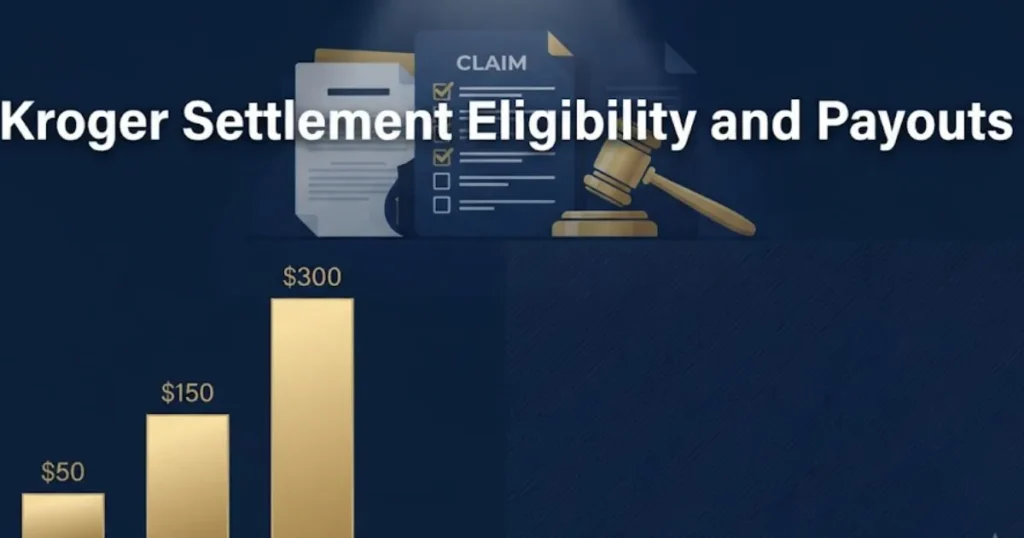
Here is what the typical filing process looked like:
- Get your claim form from the settlement notice or administrator
- Fill in your details: name, address, contact info
- Describe your connection: when you shopped, worked, or were affected
- Attach documentation if applicable: receipts, statements, proof of identity theft
- Submit before the deadline by mail or online
Some settlements allowed online submission through a secure portal. Others required paper forms mailed to a physical address. The method depended on the settlement administrator handling the case.
For people who missed the original filing window, some settlements offered a late-claim process. Late claims were accepted at the court’s discretion and typically received reduced payouts.
If you are trying to file a new individual lawsuit against Kroger in 2026 for a 2021 issue, statutes of limitations may apply. The window for most consumer protection claims is two to four years depending on the state.
Kroger Lawsuit Deadline to File a Claim
The Kroger lawsuit deadline to file a claim varied by case, but most 2021-era class action deadlines have already passed as of 2026. If you missed the original deadline, your options are limited.
For the Accellion data breach settlement, the claim filing deadline was set by the court during the settlement approval process. It was typically 60 to 120 days after the final approval date. That window closed years ago.
Overcharging and pricing lawsuits had similar deadline structures. Once the court approved the settlement and the notice period ended, claimants had a fixed number of days to submit forms.
| Case | Approximate Claim Deadline | Status in 2026 |
|---|---|---|
| Accellion Data Breach | 2022 to 2023 (estimated) | Closed |
| Overcharging Lawsuits | 2022 to 2024 (varied) | Mostly closed |
| Employee Wage Cases | 2023 to 2025 (varied) | Some still open |
| Weight/Pricing | 2023 (estimated) | Closed |
A few employee-related class actions had extended deadlines because of appeals or amended settlement terms. If you worked for Kroger and believe you are part of an active wage claim, checking with the settlement administrator is still worthwhile.
For any new claims in 2026, statutes of limitations are the controlling factor. Most states set a two- to four-year limit on consumer protection and employment claims. A 2021 incident would be at or past the limit in most states by now.
The Kroger Overcharging Lawsuit
The Kroger overcharging lawsuit accused the grocery chain of charging customers more at checkout than the price displayed on store shelves. Several lawsuits alleged that this happened systematically, not just as occasional errors.
Plaintiffs claimed that Kroger’s pricing systems, particularly at self-checkout kiosks, frequently scanned items at higher prices than advertised. Some complaints focused on sale items that did not ring up at the discounted price. Others alleged that regular shelf prices did not match register prices.
State consumer protection laws generally prohibit charging more than the displayed price. Michigan’s scanner law, for example, requires retailers to pay consumers a penalty for each overcharge. Similar laws exist in other states.
- Allegations centered on self-checkout and scanner errors
- Complaints spanned multiple Kroger-owned chains
- Some states have specific scanner accuracy laws
- Penalties in some states include automatic payments to overcharged customers
Several of these cases settled. Settlement terms typically included small per-person payments or store credit to affected shoppers. Kroger did not admit wrongdoing in most settlements but agreed to improve pricing accuracy procedures.
The total impact on individual shoppers was relatively small. Most overcharge amounts were a few dollars per transaction. But across millions of transactions, the alleged pattern added up to significant sums.
Key Takeaway: Kroger overcharging lawsuits centered on systematic scanner errors, and while individual payouts were small, the cases pushed the company to improve pricing accuracy.
Kroger Weight and Pricing Lawsuit
The Kroger weight and pricing lawsuit alleged that Kroger sold products with inaccurate weight labels, meaning customers paid for more product than they actually received. This type of claim falls under consumer fraud and weights-and-measures laws.
Specific complaints targeted Kroger’s store-brand meat, deli, and bakery products. Plaintiffs claimed that the labeled weight on packages was higher than the actual weight of the contents. Paying $8.99 per pound for chicken that is labeled at 2.5 pounds but actually weighs 2.2 pounds means you overpaid.
State departments of agriculture and weights-and-measures agencies regulate package accuracy. When retailers consistently mislabel weights, they violate these regulations and can face both government fines and private lawsuits.
| Allegation | Products Involved | Legal Basis |
|---|---|---|
| Overstated package weight | Meat, deli items, baked goods | State weights-and-measures laws |
| Price not matching weight | Pre-packaged store brands | Consumer protection statutes |
| Systematic pattern | Multiple store locations | Class action eligibility |
These cases were harder to prove on a class-wide basis because weight discrepancies varied by product and location. Some cases were dismissed. Others settled with Kroger agreeing to audit its packaging processes.
Shoppers who kept receipts and could document specific overweight charges had the strongest claims. The settlements in these cases were generally modest compared to the data breach litigation.
Kroger Employee Class Action Lawsuit
The Kroger employee class action lawsuit refers to several lawsuits filed by current and former Kroger workers alleging wage theft, unpaid overtime, missed meal breaks, and labor law violations. These cases targeted both Kroger stores and warehouse operations.
Hourly employees in distribution centers were among the most active plaintiffs. They alleged that Kroger required off-the-clock work, failed to pay overtime rates, and did not provide legally required rest periods.
Store-level employees filed similar claims in multiple states. California, where labor laws are particularly strict, saw several of these cases. Workers there alleged violations of state-specific meal and rest break requirements.
- Off-the-clock work: Employees required to work before clocking in or after clocking out
- Unpaid overtime: Failure to pay time-and-a-half for hours over 40 per week
- Missed breaks: Not providing legally mandated meal and rest periods
- Misclassification: Treating eligible workers as exempt from overtime
Some of these cases consolidated into larger multi-plaintiff actions. Others settled individually, often with confidential terms that prevent disclosure of the amounts.
As of 2026, a few Kroger employee class actions remain in late-stage litigation. Workers in certain states still have claims moving through the courts. If you worked for Kroger between 2019 and 2023 and believe you were not properly compensated, some of these cases may still apply to you.
Kroger Product Liability Lawsuit
Kroger product liability lawsuits involve claims that Kroger-brand or Kroger-sold products caused harm to consumers. These range from food contamination cases to defective household products sold under store-brand labels.
Product liability claims against retailers like Kroger can be based on manufacturing defects, design defects, or failure to warn. When Kroger sells a product under its own brand (like Simple Truth or Kroger Value), it assumes a level of responsibility for that product’s safety.
Food contamination lawsuits have been the most common product liability claims. Several cases involved Kroger-brand items recalled due to contamination with listeria, salmonella, or undeclared allergens.
| Product Issue | Legal Theory | Example |
|---|---|---|
| Food contamination | Manufacturing defect | Bacteria in packaged salads |
| Undeclared allergens | Failure to warn | Missing allergen labels |
| Defective household item | Design defect | Faulty store-brand appliance |
| Contaminated supplements | Strict liability | Tainted vitamins or supplements |
These lawsuits are typically individual cases rather than class actions, unless a large number of consumers are affected by the same contaminated product. When contamination is widespread, class actions can form quickly.
Kroger has settled some product liability claims quietly. Others went to trial. The outcomes depended heavily on the severity of harm and the strength of evidence linking the product to the injury.
Key Takeaway: Product liability claims against Kroger are ongoing and separate from the 2021 class actions, but they represent another legal front for the grocery giant.
Full Kroger Class Action Lawsuit List
Here is a complete list of major Kroger class action lawsuits from 2021 onward that have had the most significant impact on consumers and employees. This is not every lawsuit ever filed against the company, but it covers the cases that reached class certification or settlement.
| Lawsuit | Year Filed | Category | Status (2026) |
|---|---|---|---|
| Accellion Data Breach | 2021 | Data breach / privacy | Settled |
| Self-Checkout Overcharging | 2021 | Consumer protection | Settled |
| Package Weight Mislabeling | 2021 | Weights and measures | Settled |
| Distribution Center Wage Theft | 2021 | Employment / labor | Partially active |
| California Meal Break Violations | 2021 | Employment / labor | Settled |
| Pharmacy Data Exposure | 2021 | Privacy / data breach | Settled (part of Accellion) |
| Store-Brand Product Contamination | 2022 | Product liability | Individual cases |
| Digital Coupon Price Discrepancy | 2022 | Consumer protection | Dismissed |
| Hazard Pay Dispute | 2021 | Employment / COVID-related | Dismissed |
This list captures the lawsuits that generated the most legal activity and public attention. Smaller individual cases and state-level actions are not included but may still be relevant to specific consumers.
Keep in mind that Kroger operates under multiple brand names. If you shopped at Harris Teeter, Ralphs, Fred Meyer, Fry’s, King Soopers, QFC, or any other Kroger subsidiary, you may have been included in one of these class actions without realizing it.
Is There a Kroger Lawsuit Right Now?
Yes, there are active lawsuits against Kroger in 2026, though most are not related to the 2021 class action wave. New cases have been filed on different issues, and a few older employment cases are still being litigated.
As of early 2026, the most active legal areas for Kroger include:
- Employee wage and hour disputes in several states
- Product liability claims related to food safety recalls
- Consumer privacy concerns tied to Kroger’s loyalty program data practices
- Antitrust scrutiny related to the proposed Kroger-Albertsons merger
The Kroger-Albertsons merger attempt generated significant legal action from state attorneys general and the Federal Trade Commission. While not a class action in the traditional sense, it created legal uncertainty that affected consumers and employees across both companies.
For shoppers wondering if new class actions are forming, the answer is: always possibly. Kroger is one of the largest retailers in the country. With that scale comes constant legal exposure.
If you believe you have been harmed by Kroger’s practices in 2025 or 2026, you have the right to report issues to your state attorney general’s office or to connect with a law firm investigating potential class actions.
| Current Legal Area | Status | Who Is Affected |
|---|---|---|
| Employee wage disputes | Active in some states | Hourly Kroger workers |
| Food safety / recalls | Ongoing as incidents arise | Shoppers of recalled items |
| Loyalty program data | Under investigation | Kroger Plus cardholders |
| Kroger-Albertsons merger | Blocked/challenged | Employees, consumers |
Frequently Asked Questions
How much money will I get from the Kroger class action lawsuit?
Most claimants received between $50 and $200 for basic data breach claims.
Those with documented identity theft or financial losses received up to $5,000 or more.
Overcharging settlements paid much less, typically under $50 per person.
Is the Kroger data breach lawsuit from 2021 still open?
No, the Accellion data breach settlement has been finalized and claims are closed.
Payments were distributed to verified claimants who filed before the deadline.
New claims related to the 2021 breach are no longer being accepted.
How do I know if I qualify for a Kroger settlement?
You qualified if you were identified as a class member and received a notice from the settlement administrator.
Eligibility depended on the specific case: data breach, overcharging, or employment.
If you never received a notice, you may still check eligibility through court records.
What is the deadline to file a Kroger class action claim?
Most claim deadlines for 2021 Kroger lawsuits have already passed as of 2026.
Data breach claim deadlines closed in approximately 2022 to 2023.
A few employee-related cases may still have open filing windows.
Can Kroger employees join the class action lawsuit?
Yes, employees were eligible for both the data breach lawsuit and separate employment class actions.
The data breach exposed employee HR records and personal data.
Wage-and-hour lawsuits were filed specifically on behalf of hourly Kroger workers.
The Kroger class action lawsuit 2021 wave reshaped how millions of consumers and workers interacted with the grocery giant’s legal obligations. Most settlements are done, but the consequences continue.
If you were affected and have not yet checked your claim status, now is the time to look into it. Settlement administrators maintain records, and court filings are public.
Stay alert for new Kroger lawsuits forming in 2026. Large companies attract legal action, and your rights as a consumer or employee do not expire just because the headlines fade.







