

Knee replacement lawsuit settlement amounts in 2026 are projected between $50,000 and $1.5 million per person, depending on the severity of injury and the manufacturer involved. The biggest wave of cases centers on Exactech, whose defective polyethylene knee inserts triggered a massive recall affecting tens of thousands of patients.
If you got a knee implant that failed early, caused bone damage, or forced you into revision surgery, you might be sitting on a significant claim. This article breaks down the real dollar figures, who qualifies, how to file, and what the 2026 litigation timeline actually looks like.
Over 1,600 lawsuits are now consolidated in federal court. Bellwether trials are approaching, and the pressure on manufacturers to settle is building fast.
Here’s everything you need to know, explained in plain English.
Knee Replacement Lawsuit Settlement Amounts
Knee replacement lawsuit settlement amounts currently range from $50,000 to over $1.5 million, with the final number depending on your specific injuries. No global settlement has been finalized yet in the Exactech MDL, but individual case values are becoming clearer as discovery progresses.
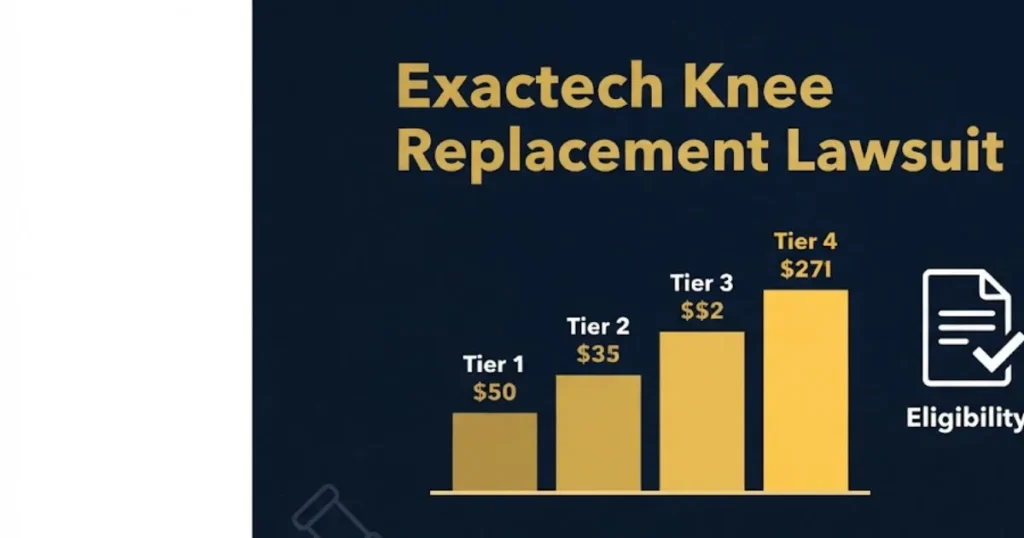
Attorneys handling these cases generally sort claims into tiers. Your tier determines your likely payout.
| Injury Tier | Description | Estimated Settlement Range |
|---|---|---|
| Tier 1 | Chronic pain, no revision surgery | $50,000 to $150,000 |
| Tier 2 | Single revision surgery required | $150,000 to $500,000 |
| Tier 3 | Multiple revisions or serious bone loss | $500,000 to $1,000,000 |
| Tier 4 | Permanent disability, amputation risk | $1,000,000 to $1,500,000+ |
These numbers are based on comparable medical device settlements and early case evaluations. The DePuy ASR hip implant settlement, for example, averaged about $250,000 per claimant. Knee cases with revision surgery tend to fall in a similar range.
Your age, overall health, lost income, and medical expenses all factor into where you land on this scale. Someone who needed two revision surgeries and lost their job will get far more than someone managing pain without surgery.
Average Knee Replacement Settlement Amount
The average knee replacement settlement amount is expected to fall between $200,000 and $400,000 for cases involving at least one revision surgery. That range reflects the middle ground of the settlement tiers above.

Think of it like car insurance claims. A fender bender pays out less than a totaled vehicle. Same logic applies here. The worse your medical outcome, the higher the payout.
Historical medical device settlements help paint this picture:
| Device Settlement | Average Per Claimant | Total Fund |
|---|---|---|
| DePuy ASR Hip | $250,000 | $4 billion |
| Stryker LFIT Hip | $200,000 to $300,000 | $1.4 billion |
| Biomet M2a Hip | $200,000+ | $1 billion+ |
| Exactech Knee (projected) | $200,000 to $400,000 | TBD |
No two cases are identical. But if you had an Exactech knee implant that failed and required revision, the data strongly suggests a six-figure settlement at minimum.
Claimants with documented complications like osteolysis (bone erosion around the implant) tend to receive higher offers. Medical records showing progressive bone loss are powerful evidence.
Knee Replacement Lawsuit Payout Per Person
Knee replacement lawsuit payout per person depends on three main factors: the severity of your injury, the strength of your medical documentation, and the timing of your claim.
Here are the core variables that determine individual payouts:
- Type of complication: Revision surgery pays more than pain management alone
- Number of surgeries: Multiple revisions mean higher compensation
- Bone damage severity: Osteolysis and bone loss increase case value
- Lost wages: Time off work or permanent job loss adds to the total
- Medical costs: Out-of-pocket expenses for treatment and rehabilitation
- Pain and suffering: Ongoing disability, reduced mobility, chronic pain
- Age at time of failure: Younger patients with decades of expected activity ahead tend to get more
A 55-year-old construction worker who needed two revision surgeries and can no longer work will likely receive a payout above $500,000. A 78-year-old retiree with moderate pain but no revision might receive closer to $75,000 to $125,000.
These are not guaranteed numbers. They are projections based on attorney consultations and precedent from similar medical device cases. The exact amounts will become clearer once bellwether verdicts are reached or a global settlement is announced.
Key Takeaway: Knee replacement lawsuit payouts are projected between $50,000 and $1.5 million, with revision surgery cases averaging $200,000 to $400,000 based on historical medical device settlement data.
Exactech Knee Recall Settlement Amounts
Exactech knee recall settlement amounts are not yet finalized, but early projections point to a range of $150,000 to $600,000 for most claimants who underwent revision surgery. The Exactech cases make up the largest share of the current knee replacement litigation.
Exactech recalled its Optetrak and Truliant knee systems in February 2022. The recall covered devices implanted as far back as 2004. The core defect involved polyethylene inserts packaged in non-conforming bags that allowed oxygen to degrade the plastic over time.
This degradation caused the inserts to wear out far sooner than expected. Patients experienced:
- Early implant loosening
- Bone erosion (osteolysis)
- Severe joint pain
- Need for revision surgery
The recall affected an estimated 140,000 patients worldwide. According to FDA data, the polyethylene inserts in the affected devices were packaged in bags that lacked a proper oxygen barrier. The plastic broke down inside the body, generating debris that attacked surrounding bone.
| Exactech Recall Detail | Info |
|---|---|
| Recall Date | February 2022 |
| Products Affected | Optetrak, Truliant knee systems |
| Component | Connexion GXL polyethylene insert |
| Defect | Non-conforming packaging, oxygen degradation |
| Patients Affected | Approximately 140,000 |
| MDL Court | Eastern District of New York |
Settlement negotiations are expected to intensify in 2026 as bellwether cases move forward. Attorneys involved in the litigation have indicated that Exactech and its parent company, TPG Capital, face enormous financial exposure.
Knee Replacement Lawsuit
A knee replacement lawsuit is a legal claim filed against the manufacturer of a defective knee implant. These lawsuits allege that companies sold implants they knew (or should have known) were defective, causing patients to suffer preventable injuries.
The legal theories behind these cases typically include:
- Product liability: The device was defectively designed or manufactured
- Negligence: The manufacturer failed to exercise reasonable care
- Failure to warn: The company did not adequately inform doctors or patients about risks
- Breach of warranty: The implant did not perform as promised
Most knee replacement lawsuits are filed as individual cases but consolidated into multidistrict litigation (MDL) for efficiency. The largest current MDL is MDL 3044, which covers Exactech knee, hip, and ankle implant claims.
This MDL is housed in the U.S. District Court for the Eastern District of New York under Judge Nina Gershon. As of early 2025, over 1,600 cases are pending in this MDL, and the number continues to grow.
Not every knee replacement failure leads to a lawsuit. The key question is whether the failure was caused by a defect in the device rather than normal wear, surgical error, or patient-specific factors like obesity or infection.
Exactech Knee Replacement Lawsuit
The Exactech knee replacement lawsuit targets Exactech Inc. for selling knee implants with defective polyethylene liners that degraded inside patients’ bodies. This is the single largest active knee implant litigation in the United States.
Exactech is a Gainesville, Florida-based orthopedic device company. TPG Capital, a private equity firm, acquired Exactech in 2021 for approximately $1.5 billion, just months before the massive recall.
The core allegation is straightforward. Exactech used a type of polyethylene insert called the Connexion GXL. These inserts were sealed in vacuum packaging. But internal documents suggest the packaging did not meet specifications for blocking oxygen.
Oxygen seeped in. The plastic oxidized. Oxidized polyethylene wears out faster. Tiny plastic particles shed into the joint space. Those particles triggered an immune response that attacked healthy bone.
Patients who received these implants between 2004 and 2022 may be affected. Many did not learn about the defect until the February 2022 recall, by which point significant damage had already occurred.
Quick Facts:
- Manufacturer: Exactech Inc. (owned by TPG Capital)
- Headquarters: Gainesville, Florida
- Recall date: February 7, 2022
- FDA classification: Class II recall
- MDL number: 3044
- Presiding judge: Nina Gershon, EDNY
Defective Knee Replacement Lawsuit
A defective knee replacement lawsuit focuses on implants that failed due to a manufacturing or design flaw, not because of normal aging or surgical complications. The distinction matters because it determines who is legally responsible.
When a knee implant fails “normally” after 15 to 20 years, there is usually no legal claim. Implants are not designed to last forever. But when an implant fails after just 3, 5, or 8 years because of a known defect, the manufacturer bears responsibility.
Signs that your implant may have been defective include:
- Premature failure (well before the 15 to 20 year expected lifespan)
- A device that appears on an FDA recall list
- Bone erosion visible on X-rays or CT scans
- Loosening of the tibial or femoral component
- Need for revision surgery within 10 years of original implant
The lawsuit does not require you to prove that the manufacturer acted with malice. Under strict product liability laws in most states, you only need to show that the product was defective and that the defect caused your injury.
Beyond Exactech, other knee implant manufacturers have faced similar lawsuits over the years. Zimmer Biomet settled thousands of claims related to its NexGen knee system. Stryker has faced litigation over its Triathlon knee implant.
Key Takeaway: Defective knee replacement lawsuits target manufacturers who sold implants with known design or packaging flaws, and strict liability laws in most states make these claims viable without proving the company acted intentionally.
Knee Implant Recall 2026
Knee implant recalls in 2026 continue to be led by the Exactech recall, which remains the most significant orthopedic device recall of the decade. No new large-scale knee implant recalls have been announced as of early 2026, but the Exactech situation keeps evolving.
The FDA recall database shows that Exactech’s recall has been updated multiple times since the initial February 2022 announcement. The scope expanded from certain specific lot numbers to essentially all Connexion GXL polyethylene inserts manufactured since 2004.
| Recall Status | Detail |
|---|---|
| Initial Recall | February 2022, limited lots |
| Expanded Recall | June 2022, all GXL inserts since 2004 |
| Devices Covered | Knee, hip, and ankle implants |
| FDA Classification | Class II |
| Status in 2026 | Active, monitoring ongoing |
Patients who received Exactech implants should continue to get regular imaging to monitor for signs of polyethylene wear and bone loss. Even if you feel fine right now, hidden damage could be progressing.
Doctors typically recommend annual X-rays for patients with recalled implants. Some orthopedic specialists suggest more advanced imaging like CT scans if early signs of loosening appear.
If your surgeon identifies a failing implant, that medical documentation becomes the foundation of your lawsuit claim. Keeping every imaging report, surgical note, and follow-up record is critical.
Who Qualifies for Knee Replacement Lawsuit
You may qualify for a knee replacement lawsuit if you received a defective knee implant and experienced complications such as early failure, revision surgery, bone loss, or chronic pain. The most common qualifying factor right now is having an Exactech Optetrak or Truliant knee implant.
Here is a quick eligibility checklist:
- Did you receive a knee implant between 2004 and 2022?
- Was your implant manufactured by Exactech?
- Did your implant fail prematurely?
- Did you need revision surgery?
- Have you experienced bone loss, loosening, or chronic pain?
If you answered yes to at least two of these questions, you likely have a viable claim.
You do not need to have had revision surgery to qualify. Patients with documented implant problems on imaging who are being monitored by their surgeon can still file. The key is that the defect caused or is causing harm.
Family members of deceased patients may also file claims. If a loved one died from complications related to a defective knee implant, a wrongful death lawsuit may be appropriate.
Patients who received knee implants from other manufacturers (Zimmer Biomet, Stryker, DePuy, Smith & Nephew) may also have claims if those devices were subject to recalls or had known defects.
Knee Replacement Lawsuit Eligibility Requirements
Knee replacement lawsuit eligibility requirements include having a recalled or defective implant, documented medical complications, and filing within the applicable legal deadline. Meeting all three is essential.
Here is a breakdown of the standard requirements:
| Requirement | Details |
|---|---|
| Defective Device | Implant must be on an FDA recall list or have a known defect |
| Medical Harm | Documented complications: pain, loosening, revision, bone loss |
| Causation | The defect must be the cause of your injury, not unrelated factors |
| Filing Deadline | Claim must be filed within the statute of limitations for your state |
| Medical Records | Hospital records, imaging, surgical notes are required as evidence |
Your medical records are the backbone of your case. Without them, even a strong claim falls apart. Make sure you have copies of your original implant surgery records, including the device identification card or sticker.
That device card contains the manufacturer name, model number, lot number, and serial number. If your implant matches a recalled product, you have a clear path to filing.
Patients sometimes worry that their weight, age, or activity level might disqualify them. Generally, these factors do not disqualify you. The question is whether the device was defective, not whether you were a perfect patient.
Knee Replacement Revision Surgery Lawsuit
A knee replacement revision surgery lawsuit is specifically for patients who had to undergo a second (or third) surgery to replace or repair a failed knee implant. Revision surgery cases carry the highest settlement values in knee replacement litigation.
Revision surgery is a bigger, harder, and riskier operation than the original knee replacement. Surgeons must remove the old implant, deal with any bone loss, and install new components. Recovery takes longer. Outcomes are often worse.
Why revision cases are worth more:
- Higher medical bills (revision surgery can cost $50,000 to $100,000+)
- Longer recovery time (often 6 to 12 months vs. 3 to 6 months for original surgery)
- Greater pain and suffering
- Higher risk of complications like infection
- Possible need for additional future surgeries
- Reduced mobility and quality of life
Patients who needed multiple revisions have the strongest cases. Each additional surgery compounds the damages.
If you have not yet had revision surgery but your doctor has recommended it, you can still file a lawsuit. Many attorneys will take cases where revision is medically indicated even if the patient has not yet undergone the procedure.
Key Takeaway: Revision surgery cases are the highest-value claims in knee replacement litigation, with potential payouts of $250,000 to $1 million or more, depending on the number of surgeries and extent of bone damage.
Knee Implant Failure Lawsuit Compensation
Knee implant failure lawsuit compensation covers several categories of damages, including medical expenses, lost wages, pain and suffering, and reduced quality of life. You do not get a single lump sum for “having a bad knee.” Your compensation is calculated across multiple damage categories.
Here is how compensation typically breaks down:
| Damage Category | What It Covers |
|---|---|
| Medical Expenses | Past and future surgery, hospital stays, rehab, medications, imaging |
| Lost Wages | Income lost during recovery periods |
| Reduced Earning Capacity | If you can no longer work in your previous occupation |
| Pain and Suffering | Physical pain, emotional distress, mental anguish |
| Loss of Enjoyment | Inability to participate in activities you enjoyed before the injury |
| Loss of Consortium | Impact on your relationship with your spouse |
Medical expenses and lost wages are called economic damages because they have specific dollar amounts attached. Pain and suffering falls under non-economic damages, which are harder to quantify but often make up a large portion of the total.
In some cases, punitive damages may also be awarded. These are designed to punish the manufacturer for especially reckless behavior. If evidence shows that Exactech knew about the packaging defect and failed to act, punitive damages could significantly increase payouts.
Punitive damages are rare but not unheard of in medical device cases. The DePuy ASR hip litigation, for example, resulted in several punitive damage awards during bellwether trials.
How to File a Knee Replacement Lawsuit
Filing a knee replacement lawsuit starts with gathering your medical records and contacting an attorney who handles medical device litigation. The process is not as complicated as most people expect.
Step-by-step filing process:
- Collect your medical records: Get your original knee replacement surgical report, implant identification card, and all follow-up records including imaging
- Identify your implant: Confirm the manufacturer, model, and lot number. Check if it matches a recalled device.
- Contact a medical device attorney: Look for firms experienced in mass tort or MDL cases
- Free case evaluation: Most attorneys offer a no-cost review of your records to determine if you have a viable claim
- File the complaint: Your attorney drafts and files the legal complaint in the appropriate court
- Join the MDL: If your case involves Exactech, it will likely be transferred to MDL 3044 in the Eastern District of New York
| Filing Phase | Estimated Duration |
|---|---|
| Record gathering | 2 to 4 weeks |
| Attorney consultation | 1 to 2 weeks |
| Case evaluation | 2 to 6 weeks |
| Complaint filing | 1 to 2 weeks |
| MDL transfer | 4 to 8 weeks |
| Total from start to MDL | 3 to 5 months |
Most medical device attorneys work on a contingency fee basis. That means you pay nothing upfront. The attorney takes a percentage (typically 33% to 40%) of your settlement only if you win.
You do not need to appear in court. Most of the process happens through your attorney. You may need to provide a deposition (recorded testimony), but many claimants never set foot in a courtroom.
Knee Replacement Lawsuit Statute of Limitations
The statute of limitations for a knee replacement lawsuit varies by state and typically ranges from 2 to 6 years from the date you discovered (or should have discovered) the defect. Missing this deadline can permanently bar your claim.
This is where things get tricky. The clock does not always start on the date of your surgery. Many states use the discovery rule, which starts the clock when you first learned that your implant was defective. For many patients, that date is the February 2022 recall announcement.
| State | Statute of Limitations | Discovery Rule |
|---|---|---|
| California | 2 years | Yes |
| Texas | 2 years | Yes |
| Florida | 4 years | Yes |
| New York | 3 years | Yes |
| Illinois | 2 years | Yes |
| Pennsylvania | 2 years | Yes |
| Ohio | 2 years | Yes |
Some states also have a statute of repose, which sets an absolute outer deadline regardless of when you discovered the problem. In states with a 10-year statute of repose, for example, a patient who received an implant in 2010 would need to file by 2020 regardless of when the recall happened.
If you are unsure about your state’s deadline, act fast. The safest approach is to get a case evaluation as soon as possible. Waiting only increases the risk that your claim expires.
Key Takeaway: Statutes of limitations vary by state, but the discovery rule in most jurisdictions means the clock likely started in February 2022 when the Exactech recall was announced, making 2024 through 2026 the critical window to file.
Knee Replacement Lawsuit Timeline
The knee replacement lawsuit timeline stretches across several phases, and most cases will not resolve before late 2026 or 2027. Mass tort litigation moves slowly, but the Exactech MDL is progressing toward key milestones.
Here is the typical timeline for a case from start to resolution:
| Phase | Time Frame | What Happens |
|---|---|---|
| Filing | 2022 to 2026 | Individual cases filed and transferred to MDL |
| Discovery | 2023 to 2025 | Evidence exchange, depositions, expert reports |
| Bellwether Selection | 2025 to 2026 | A small number of representative cases chosen for trial |
| Bellwether Trials | 2026 to 2027 | Test trials to gauge jury reactions and establish case values |
| Settlement Negotiations | 2026 to 2028 | Global settlement discussions based on trial outcomes |
| Payouts | 2027 to 2029 | Claims processing and distribution of funds |
Bellwether trials are the tipping point. These are a handful of cases selected to go to trial first. The outcomes of these trials tell both sides what juries think the cases are worth. If the manufacturer loses big at trial, settlement negotiations accelerate dramatically.
Compare this to the DePuy ASR hip litigation. Bellwether trials began in 2013. A $8.3 million verdict in the first trial prompted DePuy to establish a multi-billion-dollar settlement fund within two years.
Patience is part of the process. But the wheels are turning, and 2026 is expected to be a pivotal year.
Knee Replacement MDL Update 2026
The knee replacement MDL update for 2026 shows significant momentum in MDL 3044, with bellwether case selection underway and discovery nearing completion. This is the most active phase of the litigation so far.
MDL 3044 was established in June 2022 and consolidated in the Eastern District of New York before Judge Nina Gershon. Since then, the caseload has grown steadily.
2026 MDL Status:
- Over 1,600 cases pending in the MDL
- Discovery phase largely complete for early-filed cases
- Bellwether case selection process initiated
- Expert reports being finalized on both sides
- Daubert hearings (challenges to expert testimony) scheduled
- First bellwether trial dates expected to be set in 2026
The MDL process works like a funnel. All cases are managed together for pretrial purposes (discovery, motions, scheduling). But each case retains its individual characteristics for settlement or trial.
Exactech’s legal team has been fighting to limit the scope of expert testimony and exclude certain damage theories. Plaintiffs’ attorneys, in turn, have pushed for broad discovery into Exactech’s internal communications about the packaging defect.
Court documents suggest that Exactech engineers raised concerns about the polyethylene packaging years before the recall. If those internal warnings become trial evidence, they could significantly increase pressure to settle.
Exactech Knee Recall 2026 Update
The Exactech knee recall 2026 update confirms that the recall remains active, more patients continue to be identified, and litigation is entering its most critical phase. There is no indication that Exactech has resolved all affected cases or fully addressed the defective packaging issue.
Key developments in 2026 include:
- Continued patient identification: Orthopedic surgeons are still finding patients with recalled Exactech implants during routine follow-ups
- Expanded monitoring: FDA has maintained active oversight of the recall
- Device registries: Hospital joint replacement registries are being cross-referenced with recall data to identify additional affected patients
- Insurance coordination: Some patients’ revision surgeries are being covered by Exactech’s recall fund, separate from the lawsuit
If you have not been contacted about the recall but believe you have an Exactech implant, check with your surgeon. Your operative report will identify the device manufacturer and model number.
Quick Facts: 2026 Recall Status
- Recall status: Active
- Regulatory oversight: Ongoing FDA monitoring
- New cases being identified: Yes
- Litigation phase: Bellwether preparation
- Settlement talks: Preliminary, not yet public
Patients should not wait for a settlement announcement to take action. Filing now ensures you preserve your legal rights and get in line for compensation when a resolution is reached.
Key Takeaway: The Exactech recall remains fully active in 2026, and with bellwether trials on the horizon, this year represents the most important window for affected patients to file their claims before deadlines close.
Frequently Asked Questions
How much are knee replacement lawsuit settlements worth in 2026?
Most settlements are projected between $50,000 and $1.5 million per person.
The average for revision surgery cases is expected to be $200,000 to $400,000.
Exact amounts depend on injury severity, medical costs, and the number of surgeries required.
Do I qualify for the Exactech knee replacement lawsuit?
You likely qualify if you received an Exactech Optetrak or Truliant knee implant between 2004 and 2022 and experienced complications.
Complications include early failure, revision surgery, bone loss, or chronic pain.
Check your surgical records for the device manufacturer and model number.
What is the deadline to file a knee replacement lawsuit?
Deadlines vary by state and generally range from 2 to 6 years from the discovery of the defect.
For most Exactech patients, the discovery date is the February 2022 recall.
Some state deadlines may have already passed or will close soon in 2026.
How long does a knee replacement lawsuit take to settle?
Most cases in the Exactech MDL are expected to take 3 to 5 years from filing to resolution.
Bellwether trials anticipated in 2026 to 2027 will drive settlement timelines.
Payouts could begin as early as late 2027 or 2028 if a global settlement is reached.
Can I still file a knee replacement lawsuit if my surgery was years ago?
Yes, in most cases you can still file even if your surgery happened years ago.
The statute of limitations typically starts when you discovered the defect, not when the surgery occurred.
The February 2022 recall is considered the discovery date for most Exactech claims.
The knee replacement lawsuit landscape in 2026 is reaching a turning point. Bellwether trials, expanding recall data, and mounting evidence against Exactech all point toward significant settlements ahead.
If you received a knee implant that failed early, gather your medical records now. Get a case evaluation from a medical device attorney. The window to file is open, but statutes of limitations are closing in certain states.
Your claim has a shelf life. Use it before it expires.







