

The Kia class action lawsuit engine litigation is one of the largest automotive defect cases still active in 2026. Millions of Kia owners with defective engines could be owed money for repairs, replacements, diminished vehicle value, and fire-related damages.
This legal battle has been building since 2017. The core allegation? Kia sold vehicles with engines it knew were prone to catastrophic failure. We’re talking engine seizures on highways, fires in parking lots, and repair bills that sometimes exceeded the car’s value.
In this guide, you’ll find every detail that matters right now. That includes which models qualify, how much money is on the table, filing deadlines, claim forms, and the latest 2026 case updates.
Here’s a stat worth knowing: NHTSA has logged more than 6,000 complaints related to Kia engine fires and failures. That number keeps climbing.
Kia Class Action Lawsuit Engine Overview
The Kia class action lawsuit engine litigation targets defective engines installed in millions of Kia vehicles sold between 2011 and 2024. Multiple lawsuits allege that Kia knowingly sold cars with engines designed and manufactured with critical flaws.
The primary defect involves metal shavings left inside the engine block during manufacturing. These debris particles restrict oil flow to the connecting rod bearings. Over time, the bearings fail, causing the engine to seize, stall, or catch fire.
Plaintiffs argue that Kia was aware of the problem years before issuing recalls. Internal engineering documents and warranty claim data suggest the company tracked rising failure rates but delayed action to protect profits.
| Detail | Info |
|---|---|
| Primary Defendant | Kia America Inc. |
| Parent Company | Hyundai Motor Group |
| Engines Affected | Theta II GDI, Theta II MPI, Nu GDI, Gamma |
| Vehicles Sold | Estimated 6+ million in the U.S. |
| First Lawsuits Filed | 2017 |
| Key Court | U.S. District Court, Central District of California |
The litigation spans both federal class actions and individual state court cases. Some claims have already settled. Others are still pending or in active negotiation as of early 2026.
Owners don’t need to have experienced a fire to qualify. Engine stalling, knocking, excessive oil consumption, and warning light activation can all serve as the basis for a claim.
Kia Engine Class Action Lawsuit 2026 Status
As of 2026, the Kia engine class action litigation is in a mixed phase. Some settlement programs are distributing payments while new claims continue to be filed for recently affected vehicles.
The landmark $760 million settlement reached in 2023 between Hyundai/Kia and affected consumers received final court approval in early 2024. Claims processing under that settlement is ongoing, with payouts still being distributed through mid-2026.
Separately, newer lawsuits filed in 2024 and 2025 target additional engine families beyond the Theta II. These cases involve the Nu GDI and Gamma engine lines, expanding the pool of affected owners significantly.
- Settlement payments from the $760M fund are still going out in 2026
- New class action complaints target engines beyond the original Theta II scope
- NHTSA continues to investigate Kia engine fires reported in 2025 and 2026
- Additional recall campaigns may trigger supplemental legal claims
Courts are currently reviewing motions for class certification in the newer cases. If certified, these could bring a second wave of settlements affecting owners who were excluded from the original case.
The legal situation is active, not closed. Kia owners who experienced engine issues in 2024 or 2025 may have fresh claims that fall outside the original settlement.
Kia Engine Failure Lawsuit Settlement Breakdown
The Kia engine failure lawsuit settlement centers on the $760 million global resolution that covers engine-related losses for qualifying Kia and Hyundai owners. This is the largest automotive engine defect settlement in recent U.S. history.
The settlement fund covers several categories of damages. Each category has different payout ranges based on what the owner experienced and what documentation they can provide.
| Settlement Category | Coverage | Estimated Range |
|---|---|---|
| Engine Replacement (out of pocket) | Full or partial reimbursement | $2,000 to $8,000 |
| Engine Repair Costs | Documented repair expenses | $500 to $3,500 |
| Vehicle Fire Damage | Fire-related losses | $3,000 to $6,300 |
| Diminished Value | Loss of resale value | $150 to $375 per vehicle |
| Rental/Towing Costs | Out-of-pocket transportation | Up to $500 |
| Oil Consumption Repairs | Excessive oil use fixes | $200 to $1,500 |
Owners who paid for engine replacements at non-dealership shops can still file. The key is having receipts, invoices, or credit card statements showing the expense.
Those who had repairs covered under warranty may still qualify for diminished value payments. The settlement acknowledges that even a “fixed” car loses resale value once it’s known to have had a defective engine.
Key Takeaway: The $760 million settlement covers far more than just engine replacements. Rental cars, towing fees, and even diminished resale value are all eligible for reimbursement.
Kia Class Action Lawsuit Payout Estimates
Kia class action lawsuit payout amounts vary widely depending on the type of damage and the strength of documentation a claimant provides. Not everyone gets the same check.
Owners who replaced an engine entirely and have full receipts will see the highest payouts. Those filing for diminished value with no documented repairs will receive smaller amounts.
Based on the settlement structure and early distribution data, here’s what real people are reporting and what the claims administrator has outlined:
| Claim Type | Low Estimate | High Estimate |
|---|---|---|
| Full engine replacement (self-paid) | $3,500 | $8,000 |
| Partial engine repair | $750 | $3,500 |
| Fire damage (vehicle not totaled) | $2,500 | $6,300 |
| Fire damage (vehicle totaled) | Actual cash value | Varies by vehicle |
| Diminished value only | $150 | $375 |
| Towing and rental expenses | $100 | $500 |
A few important notes about these numbers. The claims administrator reviews each submission individually. Payouts depend on the specific vehicle, model year, engine type, and how well the claim is documented.
Some claimants have reported receiving checks in the $200 to $400 range for diminished value claims. Others with full engine replacements have received $5,000 or more.
The fund is large, but millions of people are filing. That dilution factor affects per-person payouts.
Kia Engine Lawsuit Settlement Amount by Category
The Kia engine lawsuit settlement amount breaks down into distinct tiers. Understanding which tier your claim falls into helps set realistic expectations.
Tier 1: Catastrophic Engine Failure. This covers engine seizure, fire, or total engine destruction. Claimants who experienced these issues and paid for replacement out of pocket sit at the top of the payout scale. Documented costs above $5,000 have been reimbursed in full for many Tier 1 claimants.
Tier 2: Significant Repair Costs. Owners who needed major engine work but not a full replacement fall here. Think short block replacements, connecting rod bearing repairs, or catalytic converter replacements caused by engine debris. Payouts range from $1,000 to $3,500.
Tier 3: Minor Repairs and Oil Consumption. This covers oil consumption tests, oil top-offs, sensor replacements, and minor engine work. Payouts are lower, typically $200 to $1,000.
Tier 4: Diminished Value (No Repair). Even if your engine hasn’t failed yet, owning an affected model means your car is worth less than it should be. The settlement pays $150 to $375 per vehicle for diminished value.
- Tier 1 claimants should include repair invoices, towing receipts, and fire reports
- Tier 2 claimants need mechanic records showing engine-related work
- Tier 3 claimants should document oil purchase receipts and service records
- Tier 4 claimants only need proof of vehicle ownership
The better your paper trail, the faster and higher your payout.
Who Qualifies for the Kia Engine Lawsuit
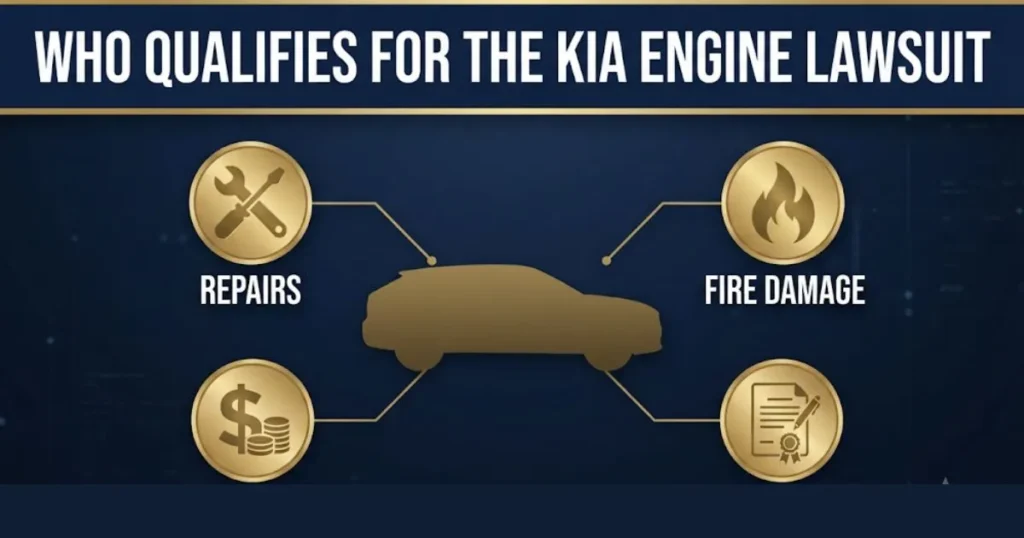
Who qualifies for the Kia engine lawsuit depends on three factors: the vehicle model, the model year, and the engine type installed. You don’t need to have experienced a fire or total engine failure to be eligible.
The broadest eligibility window covers owners and lessees of affected Kia vehicles from model years 2011 through 2024. Both current and former owners can file claims in most cases.
Here’s the basic qualification checklist:
- You owned or leased a Kia with an affected engine during the class period
- Your vehicle is one of the models listed in the settlement
- You experienced engine failure, fire, excessive oil consumption, or engine-related repairs
- Or you simply owned an affected vehicle and qualify for diminished value
| Qualification Factor | Requirement |
|---|---|
| Vehicle Ownership | Must have owned or leased the vehicle |
| Model Year Range | 2011 to 2024 (varies by model) |
| Engine Type | Theta II GDI, Theta II MPI, Nu GDI, or Gamma |
| Documented Damage | Preferred but not required for diminished value claims |
| U.S. Purchase | Vehicle must have been purchased in the United States |
People who sold their car before any engine problem appeared can still file. Former owners qualify for diminished value claims even if the engine never actually failed during their ownership.
You do not need a lawyer to file a claim. The class action settlement has a claims process designed for individuals to submit directly.
Key Takeaway: You don’t need a blown engine or a car fire to qualify. Simply owning an affected Kia model during the class period makes you eligible for at least a diminished value payment.
Kia Engine Defect Models Affected
The Kia engine defect models affected span a wide range of popular vehicles. The defects are not limited to one model or one engine family.
Here is the full list of Kia models included across the various lawsuits and settlement programs:
| Kia Model | Affected Model Years | Engine Type |
|---|---|---|
| Kia Optima | 2011 to 2020 | Theta II GDI, Theta II MPI |
| Kia Sorento | 2012 to 2021 | Theta II GDI |
| Kia Sportage | 2011 to 2023 | Theta II GDI, Nu GDI |
| Kia Soul | 2012 to 2020 | Nu GDI, Gamma |
| Kia Forte | 2014 to 2023 | Nu GDI, Gamma |
| Kia K5 | 2021 to 2024 | Theta II GDI |
| Kia Seltos | 2021 to 2023 | Nu GDI |
| Kia Cadenza | 2014 to 2019 | Theta II GDI |
The Kia Optima and Kia Sorento have the highest number of reported engine failures. These two models account for roughly 60% of all NHTSA complaints related to the defect.
The Kia Sportage is a close third, with complaints spanning over a decade of model years. Newer models like the K5 and Seltos were added to the affected list after additional defects surfaced in 2023 and 2024.
If your specific model year and engine combination appears on this list, you are in the class. Check your vehicle’s build sticker or VIN decoder to confirm which engine is installed.
Kia Theta II Engine Lawsuit Explained
The Kia Theta II engine lawsuit is the original and largest piece of this litigation. The Theta II engine is the one that started it all, and it remains the most problematic powerplant in Kia’s lineup.
Theta II engines come in two variants: the GDI (gasoline direct injection) version and the MPI (multi-point injection) version. Both have been linked to catastrophic failures, but the GDI version has a significantly higher failure rate.
The core problem with Theta II engines is a manufacturing defect in the crankshaft and connecting rod bearings. During production, metal shavings were not properly cleaned from the engine block. These tiny particles circulated through the oil system, scoring the bearings and eventually causing them to fail.
When a connecting rod bearing fails at highway speed, the results are violent. The piston can punch through the engine block, spraying hot oil onto the exhaust manifold. That’s how many Kia engine fires start.
- Over 3.4 million Theta II engines were recalled between 2017 and 2024
- NHTSA issued multiple recall campaigns specifically for this engine
- Kia extended the powertrain warranty to 15 years/150,000 miles for some Theta II vehicles
- Despite recalls, new failures continue to be reported in 2025 and 2026
The Theta II lawsuit has produced the largest share of settlement dollars. If your Kia has this engine, your claim is likely among the strongest.
Kia Engine Fire Lawsuit Claims
The Kia engine fire lawsuit claims represent the most serious allegations in the entire litigation. Dozens of vehicle fires have been linked directly to the engine defect, and at least three deaths are associated with Kia engine fires.
When a Theta II or Nu GDI engine seizes, it can rupture internally. Hot engine oil leaks onto the exhaust system, igniting almost instantly. Some owners report their cars catching fire while parked and turned off, hours after driving.
NHTSA data shows that Kia engine fire complaints spiked between 2018 and 2023. The agency opened a formal investigation in 2019, and that investigation remains active as supplemental data is reviewed.
| Fire Claim Detail | Info |
|---|---|
| Total NHTSA Fire Complaints (Kia) | 3,100+ |
| Deaths Attributed to Kia Engine Fires | At least 3 confirmed |
| Injuries Reported | 100+ |
| Peak Complaint Year | 2021 |
| Settlement Payout for Fire Damage | $2,500 to $6,300+ |
Owners who experienced a vehicle fire should gather every piece of evidence available. Fire department reports, insurance claim files, photos of the vehicle, and any communication with Kia’s customer service team all strengthen a claim.
Fire claims receive priority processing in the settlement. The claims administrator recognizes that fire damage represents the most severe category of harm, and these claims are reviewed on an expedited basis.
Key Takeaway: Kia engine fire claims are the highest-priority category in the settlement, with documented fires qualifying for up to $6,300 or more depending on total losses.
Kia Engine Seizure Lawsuit Details
Kia engine seizure lawsuit claims focus on engines that locked up suddenly while driving. This is different from a fire claim because the engine simply stops working, often without warning, creating a dangerous loss of power on the road.
Engine seizure happens when the connecting rod bearings fail completely. Without functioning bearings, the crankshaft can’t rotate. The engine locks solid, the car loses power steering, and in some cases the wheels can momentarily lock as well.
Thousands of Kia owners describe the same sequence of events. They hear a loud knocking sound. A warning light appears. Seconds later, the engine dies completely. Many of these incidents happen on highways at 60 miles per hour or faster.
- Sudden loss of engine power at highway speed
- Loss of power steering making it difficult to steer to safety
- Loud metallic knocking or banging noise before seizure
- Engine oil light or check engine light illumination seconds before failure
- Complete inability to restart the vehicle
The safety risk here is extreme. A car that suddenly loses engine power in heavy traffic is a rolling hazard. Several accidents have resulted from Kia engine seizures, including rear-end collisions when the vehicle abruptly slowed.
Seizure claims qualify for Tier 1 or Tier 2 settlement payouts depending on whether the owner replaced the engine or abandoned the vehicle. Towing costs and rental car expenses are also reimbursable.
Kia Engine Recall 2026 Updates
The Kia engine recall 2026 situation involves both ongoing recalls from previous years and the possibility of new recall campaigns based on continued failure reports.
As of early 2026, the most significant active recalls include:
| Recall Campaign | Vehicles Affected | Issue | Status |
|---|---|---|---|
| 19V-601 | 2011-2014 Optima, 2012-2014 Sorento | Theta II bearing failure | Active, remedy available |
| 20V-701 | 2014-2016 Sportage, Sorento | Engine fire risk | Active, remedy available |
| 23V-585 | 2012-2020 various models | Knock sensor detection software | Active, software update |
| 24V-XXX | 2021-2023 K5, Sportage, Seltos | Nu GDI engine defect | Under review |
The knock sensor detection software update (23V-585) was Kia’s most widespread recall remedy. This software monitors for abnormal engine vibrations and limits engine power if a bearing failure is detected, potentially preventing a fire.
However, consumer advocates and plaintiffs’ attorneys argue the software fix is a band-aid. It doesn’t repair the underlying defect. It just tries to catch the failure before it becomes catastrophic.
NHTSA has signaled that additional investigation into 2021 to 2023 model year vehicles is ongoing. A new recall campaign for those vehicles is possible in 2026 if the agency determines the current remedies are insufficient.
Owners should check their VIN on the NHTSA recall lookup tool to see which recalls apply to their vehicle. Completing recall work does not disqualify you from filing a settlement claim.
Kia and Hyundai Engine Lawsuit Connection
The Kia and Hyundai engine lawsuit cases are deeply connected. Both brands are owned by Hyundai Motor Group, and both used the same defective Theta II engine across multiple models.
Hyundai vehicles affected by the same engine defect include the Sonata, Santa Fe, and Tucson. The manufacturing defect is identical. Metal shavings left in the engine block during production cause bearing failure in both Kia and Hyundai vehicles.
The $760 million settlement covers both brands. Claims from Kia and Hyundai owners are processed through the same administrator and the same fund. The settlement does not separate the two brands into different pools.
| Brand | Key Affected Models | Engine | Same Defect? |
|---|---|---|---|
| Kia | Optima, Sorento, Sportage, Soul | Theta II, Nu, Gamma | Yes |
| Hyundai | Sonata, Santa Fe, Tucson, Veloster | Theta II, Nu, Gamma | Yes |
| Shared Parent | Hyundai Motor Group | Same manufacturing plants | Same root cause |
This shared liability is significant because it doubled the pressure on Hyundai Motor Group. With both brands affected, the company faced coordinated litigation from multiple plaintiff groups across the country.
If you own both a Kia and a Hyundai with affected engines, you can file separate claims for each vehicle. Each VIN is treated as an individual claim.
Key Takeaway: Kia and Hyundai share the same parent company, the same defective engines, and the same settlement fund. Owners of either brand file through the same claims process.
Kia Engine Warranty Extension Lawsuit
The Kia engine warranty extension lawsuit addresses Kia’s decision to extend powertrain warranties for affected vehicles. While that sounds helpful, the lawsuit alleges the extensions were inadequate and came with restrictive conditions.
Kia voluntarily extended the engine warranty to 15 years or 150,000 miles for certain Theta II equipped vehicles. This extension was part of the company’s response to mounting legal and regulatory pressure.
However, many owners discovered the warranty extension had catches:
- Only covered failures caused by the specific connecting rod bearing defect
- Required the vehicle to have completed the knock sensor software recall
- Did not cover consequential damages like towing, rental cars, or lost wages
- Some dealerships denied warranty claims by blaming “lack of maintenance” instead of the defect
- Did not apply to all affected engine families
The lawsuit argues that Kia used the warranty extension as a shield to deflect responsibility while still leaving owners exposed to significant costs. An engine that catches fire might be “covered” for replacement, but the owner’s personal property in the car, towing costs, and weeks without transportation were not.
| Warranty Detail | Original | Extended |
|---|---|---|
| Powertrain Coverage | 10 years / 100,000 miles | 15 years / 150,000 miles |
| Applies To | Standard defects | Specific bearing defect only |
| Consequential Damages | Not covered | Not covered |
| Recall Completion Required | No | Yes (knock sensor software) |
Owners who were denied warranty coverage for engine repairs have particularly strong claims in the class action. Denial letters from Kia dealerships serve as valuable evidence.
How to File a Kia Engine Class Action Claim
How to file a Kia engine class action claim is straightforward, and you can do it without hiring a lawyer. The settlement has a claims process designed for individual consumers to submit their own paperwork.
Here are the steps:
Step 1: Verify Your Vehicle. Confirm that your Kia model, model year, and engine type fall within the settlement’s scope. Use your VIN to check eligibility through the settlement’s claims portal.
Step 2: Gather Documentation. Collect every piece of paper related to your engine issues. This includes repair invoices, dealer service records, towing receipts, rental car bills, warranty denial letters, and photos of damage.
Step 3: Choose Your Claim Category. Decide whether you’re filing for engine replacement reimbursement, repair costs, fire damage, diminished value, or a combination of categories.
Step 4: Complete the Claim Form. Fill out the official claim form, which asks for your personal information, vehicle details, description of the engine problem, and documentation uploads.
Step 5: Submit and Track. Submit your completed claim through the designated portal. You’ll receive a confirmation number. Use that number to track the status of your claim.
| Filing Step | What You Need |
|---|---|
| Vehicle Verification | VIN, model year, engine type |
| Documentation | Receipts, invoices, service records, photos |
| Claim Category Selection | Identify your damage type |
| Form Completion | Personal info, vehicle details, damage description |
| Submission | Online portal or mail-in option |
Processing times vary. Simple diminished value claims may be resolved in 30 to 60 days. Complex engine replacement or fire claims can take 90 to 180 days.
Kia Engine Class Action Claim Form Process
The Kia engine class action claim form is the official document you need to submit to request compensation. It’s available through the settlement administrator’s portal and can be completed online or printed and mailed.
The form itself is divided into sections. The first section captures your identity and contact information. The second section asks for vehicle details including VIN, purchase date, and current mileage. The third section is where you describe the engine problem and select your claim category.
One area where people make mistakes is the documentation upload. The form allows you to attach supporting files, and you should attach everything you have. More documentation almost always results in a better outcome.
- Do include dealer repair orders that mention engine-related work
- Do include independent mechanic invoices if repairs were done outside a dealership
- Do attach photos of your engine, dashboard warning lights, or fire damage
- Do include towing company receipts and rental car agreements
- Don’t leave the documentation section blank, even for diminished value claims
- Don’t submit multiple claims for the same vehicle under different names
If you no longer have receipts, contact the service provider. Most dealerships and repair shops can reprint invoices going back several years. Credit card statements showing the charges are accepted as backup documentation.
The mail-in option is available for people who prefer paper. The claims administrator provides a mailing address on the form itself.
Key Takeaway: The claim form is simple to fill out, but your payout depends heavily on the documentation you upload. Gather every receipt, invoice, and photo before you start.
Kia Engine Lawsuit Deadline 2026
The Kia engine lawsuit deadline 2026 varies depending on which settlement or case you’re filing under. Missing a deadline means losing your right to compensation entirely, so these dates matter.
For the original $760 million settlement covering Theta II engines:
| Deadline Type | Date | Notes |
|---|---|---|
| Initial Claims Deadline | Passed (2024) | Original filing window closed |
| Extended Claims Window | Through mid-2026 | For newly discovered failures |
| Late Claims Exception | Case by case | Requires showing good cause |
| Newer Lawsuits (Nu/Gamma) | TBD | Pending class certification |
Some claimants who missed the original deadline may still file under the extended claims window. This extension applies to owners whose engines failed after the initial deadline but during the settlement period.
If your engine failed or caught fire in 2025 or 2026, you likely fall within the extended window. The claims administrator has shown flexibility for recent failures, particularly those involving models added to recall campaigns after the original settlement was approved.
For the newer lawsuits targeting Nu GDI and Gamma engines, no firm claims deadline has been set yet. These cases are still in the class certification phase. Once a settlement is reached or a class is certified, specific deadlines will be announced.
The safest move is to file as soon as possible. Waiting until the last minute risks technical issues with the portal, missing documentation, and processing delays.
Kia Engine Problems Class Action Update
The Kia engine problems class action update for 2026 shows a case that continues to expand rather than wind down. New developments keep surfacing as more owners report failures and regulators dig deeper.
Here’s what’s happening right now:
Settlement Payments Continuing. The claims administrator for the $760M settlement is still processing and mailing checks. Claimants who filed in late 2024 and 2025 are receiving payments throughout the first half of 2026.
New Lawsuits Filed. Additional class action complaints were filed in late 2025 targeting the Nu GDI and Gamma engine families. These lawsuits allege the same type of manufacturing defect found in the Theta II but in smaller displacement engines used in the Soul, Forte, and Seltos.
NHTSA Investigation Update. The federal safety agency has expanded its probe into Kia engine fires. A preliminary evaluation opened in 2024 for model year 2021 to 2023 vehicles is now in the engineering analysis phase, which is the step before a potential recall order.
- $760M settlement claims still being processed
- New class actions for Nu GDI and Gamma engines moving forward
- NHTSA engineering analysis could trigger additional recalls
- Kia has not announced any new voluntary recall for 2026
- Consumer complaints continue at a pace of roughly 50 per month on NHTSA’s database
Congressional Attention. Several U.S. senators sent letters to NHTSA in late 2025 urging the agency to accelerate its investigation and consider a mandatory recall if Kia does not act voluntarily. Political pressure could speed up the timeline for new remedies.
This is not a closed case. It’s an evolving situation that could produce additional settlements, recalls, and compensation opportunities throughout 2026 and beyond.
Key Takeaway: The Kia engine class action is still active in 2026 with payments going out, new lawsuits filed, and federal investigators expanding their probe into additional engine families.
Frequently Asked Questions
How much money will I get from the Kia engine class action lawsuit?
Most claimants receive between $150 and $8,000 depending on their claim type.
Diminished value claims pay $150 to $375, while full engine replacement claims with receipts can reach $8,000.
Payments are still being distributed through mid-2026.
Which Kia models are included in the engine class action lawsuit?
Affected models include the Optima, Sorento, Sportage, Soul, Forte, K5, Seltos, and Cadenza from model years 2011 to 2024.
The specific model years vary by vehicle and engine type.
Check your VIN to confirm whether your car is in the class.
What is the deadline to file a Kia engine lawsuit claim in 2026?
The extended claims window for the $760M settlement runs through mid-2026 for recently discovered engine failures.
Newer lawsuits covering Nu GDI and Gamma engines do not yet have a firm deadline.
Filing as early as possible is the best strategy to avoid missing any cutoff.
Can I still join the Kia engine class action lawsuit if my car was repaired?
Yes. Owners whose engines were repaired under warranty or at their own expense can still file claims.
You may qualify for reimbursement of out-of-pocket repair costs, towing, rental cars, and diminished vehicle value.
Even a successful warranty repair does not disqualify you from the class.
Is the Kia engine lawsuit the same as the Hyundai engine lawsuit?
The Kia and Hyundai engine lawsuits are closely related but technically separate legal actions consolidated under the same settlement.
Both brands used the same defective Theta II engine manufactured by their shared parent company, Hyundai Motor Group.
Claims for both brands are processed through the same $760 million settlement fund.
The Kia engine class action remains one of the most significant consumer cases active in 2026. Whether your engine seized, caught fire, or simply sits in the affected model list, you have rights.
Check your VIN against the affected models. Gather your documentation. File your claim before the 2026 deadlines close.
The money is there. The process is open. The only thing that can cost you compensation is waiting too long to act.







