

The Johnson Johnson OGX lawsuit is one of the biggest consumer product cases heading into 2026. Thousands of people claim that OGX shampoos and conditioners contain a chemical called DMDM hydantoin that caused serious hair loss, scalp irritation, and lasting damage.
Johnson and Johnson, which acquired the OGX brand, is facing class action and individual lawsuits in courts across the country. The company sold these products for years without warning consumers about the potential risks of formaldehyde-releasing ingredients hiding in the formula.
In this article, you will find everything about the lawsuit’s 2026 status. That includes estimated payouts, which products are covered, who qualifies, filing deadlines, and exactly what evidence you need. Some claimants could receive payouts ranging from $100 to over $2,000 depending on the severity of their injuries.
If you used OGX products and noticed your hair falling out, this case may directly affect your wallet.
Johnson Johnson OGX Lawsuit: What You Need to Know
The Johnson Johnson OGX lawsuit is a series of legal actions accusing the company of selling hair care products with a dangerous preservative called DMDM hydantoin. Plaintiffs say this chemical releases formaldehyde over time, which led to hair loss, hair thinning, and scalp damage.
The first lawsuits were filed in 2021. Since then, hundreds of consumers have joined the legal fight. The cases target Johnson and Johnson Consumer Inc., which took over the OGX brand after acquiring Vogue International in 2016.
At the heart of every claim is a simple argument. Johnson and Johnson knew, or should have known, that DMDM hydantoin posed health risks. They sold the products anyway without putting a warning on the label. That is a textbook failure-to-warn product liability claim.
| Key Fact | Detail |
|---|---|
| Defendant | Johnson & Johnson Consumer Inc. |
| Product Line | OGX shampoos, conditioners, styling products |
| Chemical at Issue | DMDM hydantoin (formaldehyde releaser) |
| First Lawsuits Filed | 2021 |
| Case Type | Class action and individual product liability |
| Primary Injuries Alleged | Hair loss, scalp irritation, hair thinning |
The lawsuits are filed in both federal and state courts. Some cases have been consolidated to streamline proceedings. The litigation has been growing steadily as more consumers learn about the connection between their hair loss and OGX products.
Think of it like discovering the paint in your house contains lead. You trusted the brand. You bought it off the shelf. Nobody told you what was really inside.
Johnson and Johnson OGX Lawsuit Background and History
The Johnson and Johnson OGX lawsuit traces back to late 2021 when a wave of social media attention brought DMDM hydantoin into public awareness. Consumers began connecting their unexplained hair loss to the OGX shampoo they used every day.
Vogue International originally created the OGX brand. Johnson and Johnson purchased Vogue International for approximately $3.3 billion in 2016. That purchase gave J&J full control over OGX formulas, manufacturing, and marketing.
The first class action complaint was filed in the Eastern District of New York in late 2021. Plaintiff Larissa Whipple alleged that OGX products caused her significant hair loss. Her complaint argued J&J failed to disclose that DMDM hydantoin releases formaldehyde, a known human carcinogen classified by the International Agency for Research on Cancer.
More lawsuits followed quickly. By early 2022, similar cases were filed in New Jersey, California, and Illinois. Plaintiffs included men and women of various ages who all reported the same pattern: they used OGX products regularly and began losing hair at alarming rates.
- 2016: Johnson and Johnson acquires Vogue International and the OGX brand
- 2021: First class action complaints filed after social media outcry
- 2022: Multiple lawsuits filed across state and federal courts
- 2023 to 2024: Discovery phase and case consolidation efforts
- 2025: Settlement discussions and pre-trial motions
- 2026: Expected resolution phase for key cases
Johnson and Johnson has denied the claims throughout. Their legal team argues that DMDM hydantoin is an FDA-permitted preservative and that OGX products are safe when used as directed. That defense remains the central battleground of the litigation.
OGX Lawsuit Update 2026: Where Things Stand Now
As of 2026, the OGX lawsuit is in an active phase with several cases approaching trial readiness and settlement negotiations ongoing. Multiple courts are handling related claims, and new filings continue to come in.
The most significant development in 2026 is the push toward resolution. Several bellwether cases, which serve as test trials for the larger group of claims, are being prepared. These cases will help both sides gauge how juries might respond to the evidence.
Settlement talks have intensified during 2025 and into early 2026. While no global settlement has been publicly announced as of this writing, legal observers expect Johnson and Johnson to weigh settlement options seriously. The company faces mounting litigation costs and increasing public pressure.
| 2026 Status Item | Current Situation |
|---|---|
| New Filings | Still being accepted in many jurisdictions |
| Settlement Talks | Ongoing, no public global settlement yet |
| Bellwether Trials | Being prepared for potential trial dates |
| Discovery | Substantially complete in lead cases |
| J&J’s Position | Continues to deny wrongdoing |
Some individual settlements have reportedly been reached on a case-by-case basis. Details of those agreements are typically confidential. Plaintiffs with strong medical documentation and clear purchase histories are in the strongest position.
The 2026 landscape for this case is active and moving. If you have a claim, now is not the time to wait.
Key Takeaway: The Johnson Johnson OGX lawsuit is entering a critical resolution phase in 2026 with bellwether trials being prepared and settlement negotiations intensifying across multiple courts.
Johnson and Johnson Class Action Lawsuit OGX Explained
A class action lawsuit allows a large group of people with the same complaint to sue together as one unit. In the Johnson and Johnson class action lawsuit OGX, the “class” is made up of consumers who bought OGX products containing DMDM hydantoin and suffered harm.
The class action approach makes sense here because thousands of people bought the same products from the same company. Each person experienced similar injuries. Filing thousands of individual lawsuits would overwhelm the courts and cost each person far more money.
In a class action, a few named plaintiffs represent the entire group. If the class wins or reaches a settlement, everyone in the group gets a share. You don’t have to go to court yourself. You just have to qualify and submit a claim.
There are two main types of claims in the OGX litigation:
- Class action claims: These focus on the consumer deception angle. J&J sold products without warning about formaldehyde-releasing chemicals. Everyone who bought the products was potentially deceived.
- Individual product liability claims: These focus on personal injury. If you suffered serious hair loss or medical issues, your case may warrant its own individual lawsuit for higher compensation.
The class action route typically results in smaller per-person payouts but requires less effort from each claimant. Individual lawsuits can yield much larger awards but require more evidence, time, and legal involvement.
It is a bit like the difference between splitting a restaurant bill evenly versus each person paying for exactly what they ordered. Both approaches work, but the math is different.
OGX Hair Loss Lawsuit Settlement Details
The OGX hair loss lawsuit settlement process is still developing as of 2026, with both class-wide and individual settlement frameworks being discussed. No single, final settlement fund has been publicly confirmed yet for the entire class.
Several factors will determine the settlement structure:
- Total number of claimants in the class
- Severity tiers based on injury type and duration
- Proof of purchase and product usage history
- Medical documentation supporting hair loss claims
- Johnson and Johnson’s willingness to settle versus go to trial
Based on similar consumer product class action settlements in recent years, legal analysts expect the OGX settlement to follow a tiered payout structure. More serious injuries would receive higher compensation.
| Settlement Tier | Injury Level | Estimated Range |
|---|---|---|
| Tier 1 | Purchased products, no documented injury | $25 to $75 |
| Tier 2 | Mild hair thinning or scalp irritation | $100 to $500 |
| Tier 3 | Significant hair loss with medical treatment | $500 to $2,000 |
| Tier 4 | Severe or permanent hair loss, emotional distress | $2,000 to $10,000+ |
These numbers are estimates based on comparable cases. The actual settlement amounts could vary significantly depending on the final terms negotiated. Individual lawsuits that go to trial could result in much larger jury awards.
If Johnson and Johnson agrees to a global settlement, a claims administrator would be appointed. That administrator would process claims, verify eligibility, and distribute payments. The timeline from settlement approval to checks in the mail typically runs 6 to 18 months.
OGX Lawsuit Payout Per Person: How Much Could You Get?
The OGX lawsuit payout per person will depend on the strength of your individual claim, the evidence you provide, and the final settlement terms. Based on comparable product liability class actions, most claimants can expect somewhere between $25 and $2,000.
That is a wide range, so let’s break it down.
If you simply bought OGX products and want a refund-style payout, expect the lower end. These “no injury” claims are common in class actions and usually pay $25 to $75 per person. You may just need to confirm you bought the product.
If you experienced noticeable hair loss or scalp problems, your payout climbs. Claimants with medical records showing treatment for hair loss or dermatitis related to OGX products are looking at $500 to $2,000 or more.
The highest payouts go to people who suffered severe, lasting hair loss. If you can document permanent damage, ongoing medical treatment, or significant emotional distress, individual claims or settlements could reach $5,000 to $10,000+.
- No documented injury: $25 to $75
- Mild symptoms with self-reported evidence: $100 to $500
- Medical treatment for hair loss: $500 to $2,000
- Severe or permanent damage: $2,000 to $10,000+
- Individual trial verdicts: Potentially much higher
Keep in mind, class action payouts are split among all eligible claimants. The more people who file, the smaller each share becomes. That is why strong evidence matters so much. It separates you from the crowd and can bump you into a higher payout tier.
Key Takeaway: Your OGX lawsuit payout depends entirely on how well you can document your injuries, with amounts ranging from $25 for basic purchase claims to $10,000 or more for severe, well-documented hair loss.
Who Qualifies for the OGX Lawsuit?
You may qualify for the OGX lawsuit if you purchased and used OGX hair care products containing DMDM hydantoin and experienced hair loss, hair thinning, scalp irritation, or related health problems. Both men and women across the United States are eligible.
Here are the basic eligibility requirements:
- You purchased OGX brand shampoo, conditioner, or styling products
- The products you used contained DMDM hydantoin as an ingredient
- You experienced hair loss, scalp sores, hair breakage, or related symptoms
- Your symptoms began during or after using OGX products
- You are a resident of the United States
You do not necessarily need a receipt to qualify, though proof of purchase strengthens your claim. Many claimants have used bank statements, online order histories from Amazon or Walmart, or loyalty program records as alternatives.
| Eligibility Factor | Required? | Notes |
|---|---|---|
| Purchased OGX products | Yes | Any qualifying OGX product |
| Product contained DMDM hydantoin | Yes | Check the ingredient label |
| Experienced symptoms | Recommended | Hair loss, scalp irritation, breakage |
| Medical documentation | Helpful, not always required | Strengthens higher-tier claims |
| Proof of purchase | Helpful, not always required | Receipts, bank records, order history |
| U.S. resident | Yes | Cases filed in U.S. courts |
Even if your hair loss was temporary, you may still qualify. The class action portion of the lawsuit focuses partly on consumer deception, meaning you were sold a product without being told about potentially harmful ingredients. That alone may entitle you to compensation.
If you are unsure whether your specific OGX product is covered, check the back of the bottle for DMDM hydantoin in the ingredients list.
OGX Products Included in the Lawsuit
The OGX products included in the lawsuit are primarily shampoos and conditioners that list DMDM hydantoin as an ingredient. Not every OGX product contains this chemical, so checking the label matters.
Here are the most commonly cited OGX products in court filings:
- OGX Thick & Full Biotin & Collagen Shampoo
- OGX Thick & Full Biotin & Collagen Conditioner
- OGX Extra Strength Damage Remedy Coconut Miracle Oil Shampoo
- OGX Renewing Argan Oil of Morocco Shampoo
- OGX Renewing Argan Oil of Morocco Conditioner
- OGX Nourishing Coconut Milk Shampoo
- OGX Nourishing Coconut Milk Conditioner
- OGX Tea Tree Mint Shampoo
- OGX Hydrating Macadamia Oil Shampoo
- OGX Extra Strength Refreshing Scalp + Teatree Mint Shampoo
This is not a complete list. OGX sells dozens of product variants, and formulas can change between production runs. The key question is whether your specific bottle contained DMDM hydantoin. That ingredient is what links the product to the lawsuit.
| Product Category | Examples in Lawsuit | DMDM Hydantoin Present? |
|---|---|---|
| Shampoos | Biotin & Collagen, Argan Oil, Coconut Milk | Yes (in named products) |
| Conditioners | Biotin & Collagen, Argan Oil, Coconut Milk | Yes (in named products) |
| Styling Products | Select styling creams and serums | Check individual labels |
| Body Washes | Generally not included | Varies |
If you still have an old bottle, flip it over and look at the ingredient list. DMDM hydantoin is typically listed near the end among the preservatives. If you already threw the bottle away, your purchase records can help identify what you bought.
Some reports suggest Johnson and Johnson has quietly reformulated certain OGX products to remove DMDM hydantoin in recent years. That reformulation could actually help plaintiffs argue that J&J knew the ingredient was problematic.
OGX DMDM Hydantoin Lawsuit: The Chemical at the Center
DMDM hydantoin is a preservative used in cosmetics and personal care products to prevent bacterial growth. It works by slowly releasing small amounts of formaldehyde over time. That formaldehyde release is the core issue in the OGX DMDM hydantoin lawsuit.
Formaldehyde is classified as a known human carcinogen by the International Agency for Research on Cancer (IARC). While the small amounts released by DMDM hydantoin may not cause cancer from normal shampoo use, they can trigger other serious reactions.
The health effects linked to formaldehyde exposure from DMDM hydantoin include:
- Hair loss and hair thinning
- Scalp irritation and burning
- Allergic contact dermatitis
- Hair breakage and brittleness
- Scalp sores and redness
- Eye irritation during use
The FDA allows DMDM hydantoin in cosmetics, and Johnson and Johnson has used this fact as a primary defense. However, plaintiffs argue that “allowed” does not mean “safe.” The FDA has limited authority over cosmetic ingredients and does not pre-approve formulas before they reach store shelves.
Key Takeaway: DMDM hydantoin releases formaldehyde, a known carcinogen, and the FDA’s allowance of this ingredient does not mean Johnson and Johnson had no duty to warn consumers about potential hair loss and scalp damage risks.
OGX Formaldehyde Lawsuit: Why This Preservative Matters
The OGX formaldehyde lawsuit centers on the fact that consumers were never told their shampoo released a chemical linked to cancer and tissue damage. Formaldehyde is not listed on the OGX label. DMDM hydantoin is. Most shoppers have no idea the two are connected.
That gap between what is on the label and what is actually happening inside the bottle is the legal argument. Plaintiffs say Johnson and Johnson had a duty to clearly disclose that DMDM hydantoin is a formaldehyde-releasing agent. They chose not to.
Formaldehyde, even at low concentrations, can damage hair follicles. When you apply a shampoo containing a formaldehyde releaser to your scalp daily or multiple times per week, the cumulative exposure adds up. Hair follicles are sensitive structures. Repeated chemical exposure can weaken them, cause inflammation, and eventually lead to hair shedding.
| Formaldehyde Fact | Detail |
|---|---|
| IARC Classification | Group 1: Known human carcinogen |
| How it appears in OGX | Released by DMDM hydantoin over time |
| Listed on OGX label? | No, only DMDM hydantoin is listed |
| FDA regulation of this ingredient | Permitted but not pre-approved |
| Primary health concern in this case | Hair loss, scalp damage, dermatitis |
The cosmetics industry has been slowly moving away from formaldehyde-releasing preservatives. Many competing brands now advertise “formaldehyde-free” formulas. That industry shift undercuts J&J’s argument that the ingredient is standard and safe.
When a gas station puts up a sign saying the fuel contains ethanol, that is disclosure. Johnson and Johnson effectively skipped that step for a chemical linked to cancer. That omission is what drives this lawsuit.
OGX Shampoo Hair Loss Claims: What Victims Report
OGX shampoo hair loss claims describe a consistent pattern of symptoms that begins shortly after regular use of OGX products. Victims report losing alarming amounts of hair during washing, brushing, and even just running their hands through their hair.
The most common complaints from OGX users include:
- Clumps of hair falling out during and after shampooing
- Visible thinning at the crown, temples, or hairline
- Scalp redness, itching, and burning that worsened over time
- Hair becoming brittle and dry despite using a “nourishing” product
- Bald patches developing after months of use
- Symptoms stopping after switching to a different shampoo brand
Many plaintiffs describe the same frustrating timeline. They chose OGX because the branding promised healthy, thick, fuller hair. The Biotin & Collagen line, for example, is marketed specifically for volume and thickness. Instead, users got the opposite result.
What makes these claims particularly strong is the pattern of reversal. Multiple plaintiffs report that their hair loss slowed or stopped after they quit using OGX products. That “stop and see” evidence is powerful in product liability cases because it draws a direct line between the product and the harm.
Some claimants sought medical treatment. Dermatologists diagnosed conditions like telogen effluvium, a form of stress-related hair shedding, and allergic contact dermatitis triggered by chemical exposure. Those medical records become critical evidence in individual claims.
The emotional toll is significant too. Hair loss affects self-confidence, professional life, and mental health. Several complaints include claims for emotional distress damages on top of physical injury claims.
OGX Class Action Settlement Amount: What to Expect
The OGX class action settlement amount has not been finalized as of early 2026, but legal experts expect the total fund to range between $50 million and $200 million based on the scope of claims and comparable settlements.
To put that in perspective, consider similar cases:
| Comparable Case | Settlement Amount | Product Type |
|---|---|---|
| WEN Hair Care Class Action | $26 million | Hair care products causing hair loss |
| Suave Keratin Infusion Settlement | Undisclosed (individual claims) | Shampoo causing hair loss/breakage |
| Johnson & Johnson Talc Litigation | $8.9 billion (proposed) | Talcum powder cancer claims |
| Procter & Gamble Pantene Lawsuit | Settled (confidential terms) | Hair care product liability |
The WEN Hair Care settlement is the closest comparison. That case involved nearly identical allegations: a hair care product containing harsh chemicals that caused hair loss. The $26 million WEN settlement resulted in individual payouts ranging from a few dollars to several thousand, depending on injury severity.
Given that OGX has a much larger market share than WEN, and Johnson and Johnson has significantly deeper pockets, the OGX settlement fund could be substantially larger. OGX was one of the top-selling drugstore shampoo brands in the country, with millions of bottles sold annually.
The final amount will depend on how many people file valid claims. If 100,000 claimants split a $100 million fund, the average payout would be $1,000 per person before legal fees. Attorney fees in class actions typically run 25% to 33% of the total settlement.
Is There a Settlement for the OGX Lawsuit?
There is no finalized global settlement for the OGX lawsuit as of early 2026. Settlement negotiations are ongoing, and some individual cases have reportedly been resolved through confidential agreements. A class-wide settlement could come later in 2026 or into 2027.
The legal process for reaching a class action settlement involves several stages:
- Negotiation: Attorneys for both sides discuss terms
- Preliminary approval: A judge reviews the proposed settlement
- Notice period: Class members are notified and given a chance to opt out or object
- Final approval hearing: The judge decides whether the settlement is fair
- Claims period: Eligible claimants submit their claims
- Distribution: Payments go out to approved claimants
This entire process can take 12 to 24 months from the moment a deal is reached. So even if Johnson and Johnson agrees to settle tomorrow, you might not see a check until late 2026 or 2027.
There are signs pointing toward settlement. Johnson and Johnson has been dealing with multiple large-scale litigation fronts, including talc powder lawsuits. Settling the OGX case would allow the company to close one front and reduce ongoing legal costs.
Key Takeaway: No global OGX settlement exists yet in 2026, but negotiations are active and individual settlements are being reached, so filing your claim now positions you for payment when a deal is finalized.
How to File an OGX Lawsuit Claim
To file an OGX lawsuit claim, you need to contact a law firm handling OGX cases, provide your product usage history, and share any medical documentation related to your hair loss or scalp problems. Most attorneys take these cases on contingency, meaning you pay nothing upfront.
Here is the step-by-step process:
Step 1: Gather your information. Collect any evidence of OGX product purchases. This includes receipts, credit card statements, online order confirmations, or even photos of the products in your home.
Step 2: Document your symptoms. Write down when you started using OGX, when you first noticed hair loss, and when (if ever) you stopped using the product. Take photos of hair thinning or scalp damage if visible.
Step 3: Get medical records. If you visited a doctor or dermatologist for hair loss, request copies of those records. Medical documentation significantly increases your claim value.
Step 4: Contact a qualified attorney. Reach out to a law firm that is actively handling OGX product liability cases. Most offer free case evaluations.
Step 5: Submit your claim. Your attorney will file the necessary legal paperwork on your behalf. If a class action settlement is approved, you will receive instructions on how to submit a claim form.
| Filing Step | What You Need | Time Required |
|---|---|---|
| Gather purchase evidence | Receipts, statements, photos | 1 to 2 hours |
| Document symptoms | Written timeline, photos | 30 minutes to 1 hour |
| Get medical records | Doctor visit records, dermatologist notes | 1 to 2 weeks |
| Contact attorney | Free consultation call | 15 to 30 minutes |
| Submit claim | Attorney handles paperwork | Varies |
You do not need to appear in court. You do not need to testify. Your attorney handles everything. The contingency fee structure means legal costs come out of your settlement, not your pocket.
Johnson and Johnson OGX Lawsuit Deadline
The Johnson and Johnson OGX lawsuit deadline varies by state and by the type of claim you are filing. Most product liability claims have a statute of limitations of 2 to 6 years depending on the state where you live or where you purchased the product.
Here is why deadlines matter. If you wait too long, you lose your legal right to file. Period. The clock typically starts running from the date you discovered (or should have discovered) that OGX caused your injury.
| State | Statute of Limitations for Product Liability |
|---|---|
| California | 2 years |
| New York | 3 years |
| Texas | 2 years |
| Florida | 4 years |
| Illinois | 2 years |
| New Jersey | 2 years |
| Pennsylvania | 2 years |
| Ohio | 2 years |
These timeframes are general guidelines. Some states have “discovery rules” that extend the deadline if you did not know the product caused your injury until later. An attorney can tell you exactly where you stand.
For the class action component, the filing deadline will be set by the court once a settlement is approved. Class members will be notified of the exact deadline through mail, email, or public notice. Those deadlines are strict and non-negotiable.
The safest approach is to act in 2026 rather than waiting. Filing early protects your rights and gives your attorney time to build a stronger case.
Key Takeaway: Lawsuit deadlines vary by state but most fall between 2 and 6 years from injury discovery, so filing your OGX claim in 2026 is the safest way to protect your legal rights.
OGX Lawsuit Evidence Needed to Support Your Claim
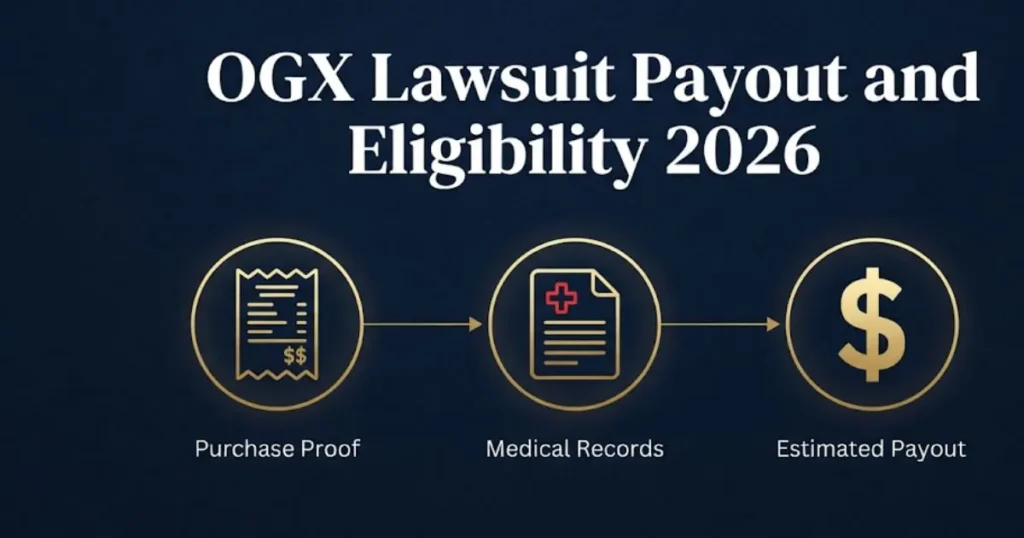
The evidence needed for an OGX lawsuit claim includes proof that you purchased OGX products, documentation of your symptoms, and ideally medical records connecting your hair loss to product use. Stronger evidence means a higher potential payout.
Here is what you should try to collect:
Purchase evidence (any of these will work):
- Store receipts showing OGX product purchases
- Credit or debit card statements with matching charges
- Online order history from Amazon, Walmart, Target, or similar retailers
- Photos of OGX products in your home, especially showing ingredient labels
- Loyalty card records from drugstores like CVS, Walgreens, or Rite Aid
Symptom documentation:
- A written timeline of when you started using OGX and when symptoms appeared
- Photographs showing hair loss, thinning, bald patches, or scalp irritation
- Notes about when symptoms improved after stopping OGX use
Medical documentation:
- Dermatologist visit records
- Diagnosis records for conditions like telogen effluvium or contact dermatitis
- Prescription records for hair loss treatments
- Trichologist assessments or hair analysis reports
| Evidence Type | Impact on Claim | Difficulty to Obtain |
|---|---|---|
| Purchase receipts | Medium | Easy if recent |
| Bank/card statements | Medium | Easy to request |
| Photos of product bottles | Medium | Easy if you still have them |
| Photos of hair loss | High | Moderate |
| Written symptom timeline | Medium | Easy to create now |
| Dermatologist records | Very High | Requires medical visit |
| Before/after hair photos | Very High | Depends on existing photos |
You do not need all of this evidence. Even partial documentation helps. But the more you can provide, the better your position. Claimants with medical records and clear purchase proof consistently receive higher settlements than those with self-reported claims alone.
If you threw away your OGX bottles, do not panic. Bank records, photos on your phone, or even social media posts showing the products can serve as evidence.
OGX Shampoo Lawsuit 2026: What Happens Next
The OGX shampoo lawsuit 2026 outlook includes potential bellwether trials, continued settlement negotiations, and a growing number of new claimants joining the case. This year could be the turning point that determines how and when everyone gets paid.
Several key events are expected in 2026:
- Bellwether trial selections: Courts may choose a handful of representative cases to go to trial. The outcomes of these trials strongly influence settlement amounts for everyone else.
- Settlement framework proposals: If bellwether results favor plaintiffs, Johnson and Johnson will face immense pressure to propose a global settlement. If the results favor J&J, the company may push for dismissal of weaker claims.
- Continued new filings: The statute of limitations has not expired for many consumers, especially those who only recently learned about DMDM hydantoin risks. New cases will keep coming in throughout 2026.
- Potential reformulation admissions: If Johnson and Johnson confirms that it changed OGX formulas to remove DMDM hydantoin, that could be interpreted as an admission that the original formula was problematic.
| 2026 Event | Expected Timeline | Significance |
|---|---|---|
| Bellwether trial prep | Q1 to Q2 2026 | Sets tone for settlement talks |
| Settlement negotiations | Ongoing through 2026 | Could produce global settlement |
| New case filings | Throughout 2026 | Expands the plaintiff class |
| Claims processing (if settlement) | Q3 2026 to Q2 2027 | Payments begin after approval |
The biggest variable is whether Johnson and Johnson decides to fight or settle. Their track record with the talc powder litigation shows they are willing to use aggressive legal strategies, including attempting corporate restructuring through bankruptcy-like maneuvers. However, the OGX case is smaller in scale and might be resolved more directly.
For consumers, 2026 is the year to get your claim on file. Waiting could mean missing deadlines or receiving less money from a settlement fund that has already been partially distributed.
Frequently Asked Questions
How much money can I get from the Johnson Johnson OGX lawsuit?
Most claimants can expect between $25 and $2,000 depending on their injury level and evidence.
Severe, well-documented hair loss cases could receive $5,000 to $10,000 or more through individual claims.
Exact payouts will not be finalized until a settlement is approved by the court.
What OGX products are part of the class action lawsuit?
OGX shampoos and conditioners containing DMDM hydantoin are included in the lawsuit.
Popular products named in complaints include OGX Biotin & Collagen, Argan Oil of Morocco, and Coconut Milk lines.
Check your product’s ingredient list for DMDM hydantoin to confirm it is covered.
Is there a deadline to file an OGX lawsuit claim in 2026?
Product liability statutes of limitations range from 2 to 6 years depending on your state.
Many consumers still have time to file in 2026, especially if they recently discovered the link between OGX and their hair loss.
Filing sooner protects your rights and gives your attorney more time to build your case.
What is DMDM hydantoin and why is it in the OGX lawsuit?
DMDM hydantoin is a preservative that releases formaldehyde, a known carcinogen, over time.
It was used in OGX products to prevent bacterial growth in the formula.
Plaintiffs argue Johnson and Johnson failed to warn consumers about the formaldehyde connection and its link to hair loss.
Do I need a receipt to join the OGX class action lawsuit?
No, a receipt is not strictly required to join the class action.
Alternative proof like bank statements, online order history, photos of the product, or loyalty card records can substitute.
However, having purchase proof strengthens your claim and can increase your payout amount.
This lawsuit matters because millions of people trusted OGX products to make their hair healthier. Instead, a hidden chemical may have done the opposite. If that happened to you, 2026 is the year to act.
Check your old bottles for DMDM hydantoin. Gather your evidence. Get your claim on file before deadlines pass.
Your hair loss was not your fault. Make sure you are part of the case that holds Johnson and Johnson accountable.







