

The Johnson and Johnson mesh lawsuit update 2022 marked a turning point in one of the largest mass tort cases in American history. By that year, J&J and its subsidiary Ethicon had already faced over 100,000 lawsuits from patients who suffered serious complications after receiving surgical mesh implants.
Now in 2026, the story has changed dramatically. Billions have been paid. Trials have concluded. Some filing windows have closed while others remain open.
This article breaks down everything from the 2022 starting point to where things stand today. You will learn who qualifies, what settlements look like, and whether you can still take action.
One fact that surprises most people: some individual mesh verdicts exceeded $35 million before being reduced on appeal. That gives you a sense of the stakes involved.
Johnson and Johnson Mesh Lawsuit Update 2022: Where It All Stood
In 2022, the J&J mesh litigation was one of the biggest mass tort cases pending in U.S. federal courts. Tens of thousands of claims remained active in multidistrict litigation overseen by Judge Joseph R. Goodwin in the Southern District of West Virginia.
By that point, J&J and Ethicon had already lost several bellwether trials. Juries had returned massive verdicts against the company. Some of those awards reached eight figures before courts adjusted them.
Settlement negotiations were ongoing but slow. J&J had resolved some individual cases and small batches of claims. No single global settlement had been announced to cover all pending cases.
| 2022 Snapshot | Details |
|---|---|
| Pending Federal Cases | Approximately 25,000+ |
| MDL Location | Southern District of West Virginia |
| Presiding Judge | Judge Joseph R. Goodwin |
| Key Defendant | Ethicon Inc. (J&J subsidiary) |
| Settlement Status | Partial, case-by-case |
| Major Verdicts Won by Plaintiffs | Multiple, including $35M+ awards |
The backlog was enormous. Many plaintiffs had been waiting years for their cases to move. Courts were working through discovery, depositions, and trial scheduling at a pace that frustrated everyone involved.
State court lawsuits added another layer. Cases in California, New Jersey, and other states were moving on separate tracks. Some state courts produced verdicts and settlements independent of the federal MDL.
For patients who had been harmed, 2022 felt like a year of waiting. The legal machinery was turning, but payouts for most individuals had not yet arrived.
Johnson and Johnson Mesh Settlement 2026: Current Status
As of 2026, J&J and Ethicon have resolved the vast majority of their surgical mesh claims. The company has spent billions settling cases across both federal and state courts.
The federal MDL has wound down significantly. Most cases that were going to settle have settled. Remaining active claims involve either late filers, disputed medical records, or cases with unique complications.
J&J has not admitted fault in any of the settlements. The company maintains that its mesh products were safe and effective. Every settlement agreement includes language stating that the payments are not an admission of liability.
| Settlement Status 2026 | Details |
|---|---|
| Total Estimated Payouts | Over $8 billion across all mesh litigation |
| Federal MDL Status | Winding down, most cases resolved |
| State Court Cases | Largely settled, some still pending |
| Global Settlement Deal | No single global deal; resolved in batches |
| J&J Position | Denies wrongdoing, settled to avoid trial risk |
A handful of cases are still active in court. These tend to involve plaintiffs who filed late or who have medical situations that do not fit neatly into settlement categories.
For people who already settled, most payments have been distributed. The processing of checks and fund distributions took time, but the bulk of that work is now complete.
Anyone who has not yet resolved their claim should understand that options are narrowing. The window for easy resolution is closing as courts clear their dockets.
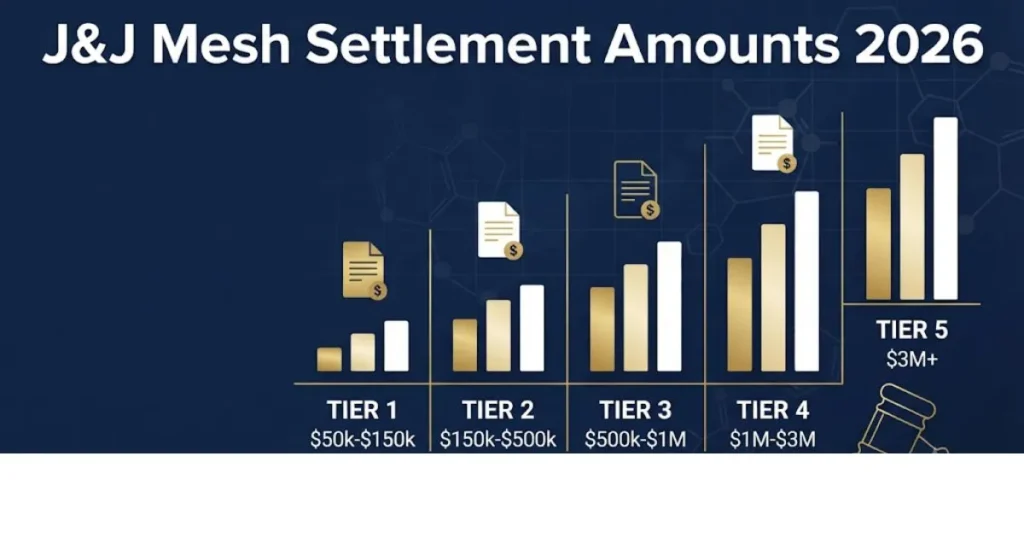
J&J Mesh Lawsuit Settlement Amounts: What Has Been Paid
Settlement amounts in J&J mesh lawsuits have varied widely based on the severity of injuries and the type of mesh involved. Individual payouts ranged from around $25,000 for minor complications to well over $1 million for the most serious cases.
The largest settlements went to patients who needed multiple revision surgeries. People who experienced mesh erosion into organs or suffered permanent damage received the highest compensation.
Batch settlements handled by law firms often averaged between $50,000 and $250,000 per plaintiff. These figures reflect the negotiated value after attorney fees and litigation costs were deducted from the gross settlement.
| Injury Severity | Estimated Settlement Range |
|---|---|
| Minor complications, no revision surgery | $25,000 to $75,000 |
| Single revision surgery required | $75,000 to $250,000 |
| Multiple surgeries or mesh erosion | $250,000 to $750,000 |
| Permanent injury or organ damage | $750,000 to $1,500,000+ |
| Wrongful death related to mesh | $1,000,000+ |
These numbers are estimates based on publicly reported settlements and legal analysis. Every case is different.
Factors that pushed settlements higher included:
- Documented mesh erosion or migration
- Chronic, untreatable pain
- Permanent loss of sexual function
- Multiple corrective surgeries
- Infections requiring hospitalization
- Organ perforation
Think of it like car insurance claims. A fender bender pays less than a totaled vehicle with injuries. The same logic applies here. Worse damage equals bigger payouts.
Key Takeaway: Settlement amounts ranged from $25,000 to over $1 million, with the worst injuries receiving the highest compensation.
Johnson and Johnson Mesh Lawsuit Payout Per Person
The payout per person in a J&J mesh lawsuit depends on individual circumstances. There was no flat payment that every plaintiff received. Each case was evaluated on its own medical evidence and damages.
On average, plaintiffs who settled without going to trial received somewhere between $60,000 and $300,000 after attorney fees. That is the money that actually landed in their bank accounts.
Before fees, gross settlement amounts were higher. Most mesh attorneys worked on contingency, taking between 33% and 40% of the total recovery. Litigation expenses like expert witnesses and medical record retrieval came out of the settlement too.
| Payout Breakdown | Typical Range |
|---|---|
| Gross Settlement Amount | $100,000 to $500,000 |
| Attorney Fees (33% to 40%) | $33,000 to $200,000 |
| Litigation Costs | $5,000 to $25,000 |
| Net Payout to Plaintiff | $60,000 to $300,000 |
Some plaintiffs received much less. Others received much more. The key variables were the severity of complications, the strength of medical documentation, and whether the plaintiff needed revision surgery.
Plaintiffs who went to trial and won received larger verdicts. But trials carry risk. A jury could also return a defense verdict, leaving the plaintiff with nothing.
The timing of the settlement mattered too. Early settlers sometimes accepted lower amounts. Those who held out longer occasionally received better offers as J&J grew more motivated to close cases.
Johnson and Johnson Mesh Lawsuit Average Settlement
The average settlement in J&J mesh lawsuits is estimated at roughly $150,000 to $200,000 before attorney fees. That figure comes from analysis of publicly reported batch settlements and individual case resolutions.
This average is heavily skewed by the range of injuries. Many cases involving minor complications settled for under $50,000. A smaller number of severe injury cases pushed the average upward.
No official average has been published by J&J or the courts. Settlement agreements typically include confidentiality clauses. The estimates used by legal analysts come from aggregate data rather than individual disclosures.
Here is how the J&J mesh average compares to other major medical device settlements:
| Medical Device Lawsuit | Average Settlement Estimate |
|---|---|
| J&J / Ethicon Mesh | $150,000 to $200,000 |
| Boston Scientific Mesh | $100,000 to $175,000 |
| C.R. Bard Mesh | $125,000 to $200,000 |
| DePuy Hip Implant (J&J) | $250,000 to $350,000 |
| Essure (Bayer) | $20,000 to $50,000 |
The J&J mesh average falls in the middle of major device settlements. Hip implant cases tended to pay more because replacement surgeries are more complex and costly.
What matters most is not the average. It is what your specific case is worth based on your injuries, your medical records, and the strength of your evidence.
Who Qualifies for J&J Mesh Lawsuit
You may qualify for a J&J mesh lawsuit if you received a surgical mesh product made by Ethicon (a J&J subsidiary) and experienced complications afterward. The mesh could have been used for hernia repair, pelvic organ prolapse, or stress urinary incontinence.
Qualifying typically requires meeting these conditions:
- You had a mesh implant manufactured by Ethicon or J&J
- You experienced medical complications related to the mesh
- You can provide medical records showing the implant and the complications
- You have not already settled or released your claims
- You fall within the statute of limitations for your state
The most common qualifying complications include mesh erosion, chronic pain, infection, mesh contraction, organ perforation, and the need for revision surgery.
| Eligibility Factor | Requirement |
|---|---|
| Mesh Manufacturer | Ethicon / Johnson & Johnson |
| Type of Surgery | Hernia repair, pelvic organ prolapse, SUI |
| Complications Required | Yes, documented medical complications |
| Medical Records | Must show mesh implant and resulting harm |
| Prior Settlement | Must not have already settled |
| Statute of Limitations | Must file within your state’s deadline |
You do not need to know the exact product name. A mesh attorney can obtain your surgical records and identify the manufacturer and model.
Even if your mesh was implanted years ago, you might still qualify. The statute of limitations often starts from the date you discovered (or should have discovered) the injury, not the date of surgery.
Key Takeaway: Qualification depends on having an Ethicon mesh implant, documented complications, medical records, and meeting your state’s filing deadline.
How to File a J&J Mesh Lawsuit
Filing a J&J mesh lawsuit starts with contacting an attorney who handles mass tort or product liability cases. Most mesh lawyers offer free case evaluations and work on contingency, meaning you pay nothing upfront.
Here is the typical process from start to finish:
Step 1: Free Case Review
You share basic information about your surgery, your mesh product, and your complications. The attorney determines if you have a viable claim.
Step 2: Gather Medical Records
Your legal team obtains surgical records, pathology reports, and documentation of all mesh-related treatments. This is the backbone of your case.
Step 3: File the Complaint
Your attorney files a formal complaint in the appropriate court. This could be in federal MDL, state court, or both.
Step 4: Discovery and Case Building
Both sides exchange evidence. Depositions may be taken. Expert witnesses review your medical records.
Step 5: Settlement Negotiation or Trial
Most cases settle before trial. If J&J makes a fair offer, you can accept. If not, your case proceeds to trial.
| Filing Step | What Happens | Typical Duration |
|---|---|---|
| Case Evaluation | Attorney reviews your claim | 1 to 2 weeks |
| Medical Records | Records gathered and analyzed | 2 to 6 months |
| Filing Complaint | Lawsuit officially filed | 1 to 4 weeks |
| Discovery | Evidence exchange and depositions | 6 to 18 months |
| Resolution | Settlement or trial | 1 to 3 years total |
You do not need to appear in court in most cases. The vast majority of mesh lawsuits settle without the plaintiff ever stepping into a courtroom.
Can I Still File a Mesh Lawsuit in 2026
Yes, some people can still file a mesh lawsuit in 2026, but the window is closing. Whether you can file depends almost entirely on your state’s statute of limitations and when you discovered your mesh injury.
Many states apply a “discovery rule” for medical device injuries. The clock does not start when the mesh was implanted. It starts when you knew or should have known the mesh caused your problems.
If you only recently learned your complications are linked to the mesh, you may still be within the deadline. Some patients go years before a doctor confirms the mesh is the source of their pain.
Situations where filing in 2026 may still be possible:
- You recently had mesh removed and complications were confirmed
- You were only recently diagnosed with mesh erosion or migration
- Your state has a longer statute of limitations (some allow up to 6 years)
- You are a minor or were legally incapacitated, which can pause the clock
Situations where it is likely too late:
- You knew about mesh complications years ago but never filed
- Your state has a 2-year statute of limitations and your discovery happened before 2024
- You already signed a settlement release
The only way to know for certain is to have an attorney review your specific dates and your state’s laws. Do not assume it is too late without checking.
Johnson and Johnson Mesh Lawsuit Statute of Limitations
The statute of limitations for J&J mesh lawsuits varies by state. Most states give you 2 to 4 years from the date you discovered (or reasonably should have discovered) your mesh injury.
This is not measured from the date of your surgery. That distinction is critical. A person who had mesh implanted in 2012 but did not develop complications until 2023 would have their clock start in 2023.
| State | Statute of Limitations | Discovery Rule |
|---|---|---|
| California | 2 years | Yes |
| Texas | 2 years | Yes |
| Florida | 4 years | Yes |
| New York | 3 years | Yes |
| Pennsylvania | 2 years | Yes |
| New Jersey | 2 years | Yes |
| Ohio | 2 years | Yes |
| Illinois | 2 years | Yes |
| Georgia | 2 years | Yes |
| Michigan | 3 years | Yes |
Some states have special rules that can extend or shorten these deadlines. Tolling provisions may apply for people who were incapacitated, minors, or in active military service.
Missing the statute of limitations means your case gets dismissed. Period. No exceptions in most courts. The deadline is not flexible.
If you are unsure whether you are still within the window, get a legal opinion immediately. Every day you wait is a day closer to a potential deadline.
Key Takeaway: Statutes of limitations vary by state but typically run 2 to 4 years from the date you discovered your mesh injury, not from the surgery date.
J&J Mesh Lawsuit Timeline
The J&J mesh lawsuit timeline stretches back over a decade. Here is how the litigation evolved from its origins through 2026.
| Year | Key Event |
|---|---|
| 2008 to 2010 | Early lawsuits filed against Ethicon over pelvic mesh complications |
| 2012 | FDA orders new safety studies for all surgical mesh used in pelvic repair |
| 2012 | MDL 2327 (Ethicon pelvic mesh) established in Southern District of West Virginia |
| 2014 | First bellwether trials begin; plaintiffs win several large verdicts |
| 2016 | J&J and Ethicon voluntarily withdraw Physiomesh from the market |
| 2017 | Hernia mesh lawsuits begin increasing alongside pelvic mesh claims |
| 2019 | FDA orders manufacturers to stop selling mesh for transvaginal pelvic repair |
| 2020 | Thousands of additional claims filed; pandemic delays some proceedings |
| 2022 | Over 25,000 federal claims still active; settlement negotiations intensify |
| 2023 | J&J begins large-batch settlements to reduce case backlog |
| 2024 | Federal MDL approaches wind-down phase; most claims resolved or in negotiation |
| 2025 | Remaining active cases shrink to a few thousand; final bellwether trials conclude |
| 2026 | MDL largely complete; late filers pursue remaining claims in state courts |
This litigation took over 15 years from the first complaints to the near-final resolution. That is typical for mass tort cases involving medical devices. These things do not move fast.
The 2022 period was a pivot point. Before 2022, most of the action was trials and legal maneuvering. After 2022, the focus shifted to settlement processing and claim resolution.
Johnson and Johnson Pelvic Mesh Lawsuit
The Johnson and Johnson pelvic mesh lawsuit is the largest segment of the overall mesh litigation. Pelvic mesh products were used to treat two conditions: pelvic organ prolapse (POP) and stress urinary incontinence (SUI).
Ethicon sold several pelvic mesh products, including the Prolift, TVT, and Gynecare lines. These products were implanted in hundreds of thousands of women in the United States alone.
The problems were severe. The polypropylene mesh material contracted, eroded through vaginal tissue, and caused chronic pain. Many women needed multiple surgeries to remove mesh fragments. Some suffered permanent damage.
Key facts about the pelvic mesh litigation:
- Over 95,000 federal lawsuits were filed against Ethicon for pelvic mesh
- The first bellwether trial resulted in a $3.27 million verdict for the plaintiff
- The FDA banned transvaginal mesh for POP repair in April 2019
- Many women reported loss of sexual function and chronic infections
- Revision surgery to remove mesh is complex and not always successful
The pelvic mesh cases made up the bulk of the MDL 2327 docket in West Virginia. These cases were emotionally charged because the injuries affected intimate aspects of women’s health and quality of life.
By 2026, most pelvic mesh cases have been resolved through settlement. But the physical and emotional scars remain for many of the women who were affected.
Hernia Mesh Lawsuit Update 2026
Hernia mesh lawsuits against J&J and Ethicon have followed a different path than the pelvic mesh cases. While pelvic mesh litigation peaked earlier, hernia mesh claims continued to grow through 2023 and 2024.
The key hernia mesh product at the center of litigation is the Ethicon Physiomesh Flexible Composite Mesh. Ethicon pulled Physiomesh from the market in May 2016 after studies showed higher-than-expected rates of recurrence and reoperation.
As of 2026, hernia mesh lawsuits are still being processed. Some cases remain active in state courts. The federal litigation has slowed, but new filings still trickle in from patients who only recently connected their complications to the Physiomesh product.
| Hernia Mesh Update 2026 | Status |
|---|---|
| Physiomesh Market Status | Withdrawn since 2016 |
| Active Federal Claims | Few hundred remaining |
| State Court Claims | Several hundred still pending |
| Settlement Activity | Ongoing for qualifying cases |
| New Filings | Limited but still possible |
Hernia mesh complications include mesh migration, bowel obstruction, infection, adhesion to organs, and the need for additional surgeries to remove or replace the mesh.
If you had Ethicon Physiomesh implanted and have experienced complications, your claim may still be viable in 2026. Hernia mesh cases generally have more recent discovery dates, which means statutes of limitations may not have expired yet.
Key Takeaway: Hernia mesh lawsuits are still active in 2026, with Physiomesh cases driving most of the remaining litigation against Ethicon and J&J.
Pelvic Mesh vs Hernia Mesh Lawsuit Differences
Pelvic mesh and hernia mesh lawsuits against J&J share the same defendant but differ in almost every other way. Understanding the differences matters because they affect eligibility, settlement amounts, and case status.
| Factor | Pelvic Mesh Lawsuit | Hernia Mesh Lawsuit |
|---|---|---|
| Primary Patients | Women | Men and women |
| Conditions Treated | Pelvic organ prolapse, SUI | Inguinal, ventral, incisional hernias |
| Key Products | Prolift, TVT, Gynecare | Physiomesh, Proceed |
| MDL Number | MDL 2327 | Consolidated with pelvic or separate |
| FDA Action | Banned for transvaginal POP in 2019 | Physiomesh withdrawn voluntarily 2016 |
| Common Injuries | Mesh erosion, vaginal pain, infection | Mesh migration, bowel obstruction |
| Litigation Stage (2026) | Mostly resolved | Some cases still active |
| Average Settlement | $150,000 to $200,000 | $100,000 to $175,000 |
The pelvic mesh cases generally settled for more. The injuries were often more severe, affecting quality of life in profound ways. Loss of sexual function and chronic vaginal pain added non-economic damages that juries valued highly.
Hernia mesh cases sometimes involve more straightforward surgical complications. But bowel obstructions and mesh adhesion to organs can be life-threatening, which pushes some hernia cases into higher settlement brackets.
Think of it this way: same company, same material, but completely different body locations and completely different sets of injuries. Your case is defined by what happened to you, not by the category of mesh.
Johnson and Johnson Mesh Complications
Johnson and Johnson mesh complications range from mild discomfort to life-threatening medical emergencies. The most common issues stem from the body’s reaction to the polypropylene mesh material used in Ethicon products.
The most frequently reported complications include:
- Mesh erosion: The mesh wears through surrounding tissue, sometimes protruding through the vaginal wall or abdominal wall
- Chronic pain: Persistent, untreatable pain at the implant site
- Infection: Bacterial infections around the mesh that can require hospitalization
- Mesh contraction: The mesh shrinks after implantation, pulling on surrounding tissue
- Organ perforation: The mesh cuts into or punctures nearby organs like the bladder or bowel
- Mesh migration: The mesh shifts from its original placement
- Adhesion: The mesh bonds to organs or tissue it was never supposed to touch
- Autoimmune response: Some patients develop systemic inflammatory reactions
- Need for revision surgery: Surgical removal or replacement of the mesh
Many of these complications do not appear immediately. Some patients experience problems months or even years after implantation. That delayed onset is why the discovery rule matters so much for statute of limitations purposes.
| Complication | How Common | Severity |
|---|---|---|
| Mesh erosion | Very common | Moderate to severe |
| Chronic pain | Very common | Moderate to severe |
| Infection | Common | Moderate to life-threatening |
| Mesh contraction | Common | Moderate |
| Organ perforation | Less common | Severe to life-threatening |
| Mesh migration | Less common | Severe |
| Revision surgery needed | Common | Significant |
The FDA itself acknowledged the risks. In 2008, the agency issued a public health notification about complications from surgical mesh. By 2019, the FDA took the extraordinary step of banning transvaginal mesh for pelvic organ prolapse repair entirely.
Ethicon Mesh Recall Lawsuit
Ethicon, the J&J subsidiary that manufactured surgical mesh products, faced lawsuits tied to both voluntary market withdrawals and alleged failure to recall defective products sooner. The term “recall” is used loosely in public discussion, but the legal reality is more specific.
Ethicon voluntarily withdrew Physiomesh from the global market in May 2016. The company cited data from two independent hernia registries showing that Physiomesh had higher rates of reoperation and recurrence compared to other mesh products.
This was not a formal FDA recall. It was a voluntary market withdrawal. The distinction matters legally because a formal recall carries different regulatory and legal implications.
Lawsuits argued that Ethicon knew about problems with its mesh products long before taking action. Plaintiffs claimed the company had internal data showing higher complication rates but continued selling the products to protect profits.
Key arguments in Ethicon mesh recall lawsuits:
- Ethicon allegedly knew about mesh erosion risks as early as 2002
- The company continued marketing mesh products despite mounting evidence of harm
- Internal communications reportedly showed awareness of design defects
- Ethicon failed to adequately warn surgeons and patients about known risks
- The 2016 Physiomesh withdrawal came years after complications were widely documented
Juries in several bellwether trials found these arguments persuasive. Verdicts in favor of plaintiffs often cited Ethicon’s failure to warn as a primary basis for liability.
Key Takeaway: Ethicon lawsuits focused on the company’s alleged knowledge of mesh defects and its failure to recall or adequately warn about dangerous products sooner.
Ethicon Mesh Products Recalled
Several Ethicon mesh products were removed from the market or restricted due to safety concerns. Here is a breakdown of the key products involved.
| Product Name | Type | Market Action | Year |
|---|---|---|---|
| Physiomesh Flexible Composite Mesh | Hernia repair | Voluntarily withdrawn worldwide | 2016 |
| Prolift Pelvic Floor Repair System | Pelvic organ prolapse | Voluntarily withdrawn | 2012 |
| Prolift+M | Pelvic organ prolapse | Voluntarily withdrawn | 2012 |
| Prosima Pelvic Floor Repair System | Pelvic organ prolapse | Voluntarily withdrawn | 2012 |
| Gynecare TVT Secur | Stress urinary incontinence | Voluntarily withdrawn | 2012 |
Ethicon’s pelvic mesh products were pulled from the U.S. market in 2012. The company said the decision was based on “commercial reasons” rather than safety concerns. Plaintiffs’ attorneys contested that characterization, pointing to growing evidence of complications.
The Physiomesh withdrawal in 2016 was different. Ethicon explicitly cited safety data from the European Hernia Society registry and the Americas Hernia Society Quality Collaborative database.
Some Ethicon mesh products remain on the market. The TVT (Tension-free Vaginal Tape) for stress urinary incontinence was not withdrawn in the U.S., though it has been removed in some international markets. The Proceed Surgical Mesh for hernia repair also remained available.
Not every Ethicon mesh product was defective. But the products listed above were the primary targets of litigation. If you received one of these specific products, your case may be stronger than claims involving products still on the market.
J&J Mesh Lawsuit Bellwether Trials
Bellwether trials are test cases selected from a mass tort to help both sides gauge how juries will respond. In the J&J mesh litigation, bellwether trials played a huge role in pushing the company toward settlements.
Several bellwether trials resulted in large plaintiff verdicts:
| Trial / Case | Year | Verdict Amount | Outcome |
|---|---|---|---|
| Audet v. Ethicon | 2014 | $3.27 million | Plaintiff win |
| Huskey v. Ethicon | 2014 | $1.2 million | Plaintiff win (reduced on appeal) |
| Gross v. Ethicon | 2017 | $35 million | Plaintiff win (later reduced) |
| Mesigian v. Ethicon | 2017 | $20 million | Plaintiff win |
| Barba v. Ethicon | 2019 | $120 million | Plaintiff win (punitive damages included) |
These verdicts sent a clear message. Juries were sympathetic to mesh plaintiffs. They were willing to punish Ethicon with significant punitive damages on top of compensatory awards.
Not every bellwether went the plaintiffs’ way. Ethicon won some test cases too. But the overall trend favored plaintiffs, which gave plaintiffs’ attorneys stronger negotiating positions during settlement talks.
The bellwether results from 2014 through 2019 directly shaped the settlement values that followed. When J&J could see that juries were consistently siding with injured patients, the financial calculus shifted toward settling rather than risking more trial losses.
By 2022, the bellwether phase was essentially complete. The data was in. Both sides knew what juries thought about these products. The remaining work was resolving the tens of thousands of individual claims.
Key Takeaway: Bellwether trials produced massive plaintiff verdicts that forced J&J to accelerate settlement negotiations across the entire mesh litigation.
Frequently Asked Questions
How much money can I get from a Johnson and Johnson mesh lawsuit?
Most plaintiffs received between $60,000 and $300,000 after attorney fees.
The exact amount depends on injury severity, number of surgeries, and medical documentation.
Cases involving permanent injury or organ damage settled for $750,000 or more.
Is it too late to file a J&J mesh lawsuit in 2026?
It depends on when you discovered your mesh injury and your state’s statute of limitations.
If you only recently learned the mesh caused your complications, you may still have time.
An attorney can review your specific dates and tell you whether your claim is viable.
What mesh products did Johnson and Johnson recall?
Ethicon withdrew Physiomesh in 2016 and several pelvic mesh products including Prolift and Gynecare TVT Secur in 2012.
These were voluntary market withdrawals, not formal FDA recalls.
The products were removed after data showed unacceptable complication rates.
What are the most common complications from J&J surgical mesh?
The most common complications are mesh erosion, chronic pain, infection, and mesh contraction.
Many patients also experienced organ perforation and needed revision surgery.
Symptoms can appear months or years after the original implant surgery.
How long does a Johnson and Johnson mesh lawsuit take to settle?
Most J&J mesh lawsuits took 1 to 3 years from filing to settlement.
Cases that went to trial took longer, sometimes 4 to 5 years.
In 2026, remaining cases may resolve faster because the litigation framework is already established.
What to Do Next
The J&J mesh litigation is in its final stages. If you have been affected, the time to act is now, not later.
Check whether your state’s filing deadline has passed. Gather your surgical records. Talk to a mass tort attorney who handles mesh cases.
Billions have already been paid. Your claim could still be part of that. But waiting too long could mean losing your right to compensation permanently.







