

The Jeep class action lawsuit story in 2026 affects millions of owners across multiple models and model years. If you drive a Jeep or recently sold one, there is a real chance your vehicle falls under an active or pending legal claim tied to defects that Stellantis knew about but failed to fix properly.
This guide breaks down every active Jeep lawsuit heading into 2026. You will find which models qualify, what payouts look like, key deadlines, and exact steps to file.
Some of these cases have been grinding through courts for years. Others are brand new. Either way, Stellantis faces billions in potential liability, and individual owners could see payments ranging from a few hundred dollars to several thousand depending on the claim.
Here is everything you need to know, organized by lawsuit type, model, and defect.
Jeep Class Action Lawsuit 2026: What You Need to Know
The Jeep class action lawsuit in 2026 encompasses at least six major active cases targeting defects in transmissions, steering systems, engines, and fire-prone components across nearly a dozen Jeep models. These are not small complaints. They involve safety failures that have caused crashes, injuries, and at least one line of fatalities linked to fuel system fires.
Stellantis, the parent company that owns the Jeep brand, inherited many of these legal headaches from Fiat Chrysler Automobiles (FCA). The merger did not erase liability. Courts have repeatedly confirmed that Stellantis bears full responsibility for defects originating under FCA leadership.
| Key Fact | Detail |
|---|---|
| Number of Active Cases | 6 or more major class actions |
| Parent Company | Stellantis NV (formerly FCA) |
| Models Affected | Grand Cherokee, Wrangler, Cherokee, Compass, Gladiator, Wagoneer |
| Model Years Covered | 2014 through 2025 (varies by case) |
| Types of Defects | Transmission failure, death wobble, engine stall, fire risk |
| Courts Involved | U.S. District Courts in Michigan, New Jersey, California |
The scope is wide. Some cases target a single model year range. Others sweep across the entire Jeep lineup. What connects them all is a pattern: Stellantis allegedly knew about these problems through warranty data, internal testing, and NHTSA complaints, yet continued selling vehicles without adequate warnings or permanent repairs.
If you own or owned a Jeep built between 2014 and 2025, the odds are decent that at least one of these lawsuits applies to your situation.
Jeep Lawsuit Update 2026
The biggest Jeep lawsuit developments in early 2026 center on two fronts: the ZF 9-speed transmission multidistrict litigation moving toward settlement talks, and expanded NHTSA investigations into Jeep Grand Cherokee L steering failures that could fuel new class certification.
In late 2025, a federal judge in the Eastern District of Michigan consolidated several transmission-related cases, streamlining what had been a messy patchwork of state and federal claims. This consolidation typically signals that the court expects the case to either settle or proceed to trial within 12 to 18 months.
On the recall front, NHTSA opened a new engineering analysis in 2025 covering roughly 330,000 Jeep Grand Cherokee L and Jeep Wagoneer vehicles for potential electronic power steering loss. This investigation often acts as rocket fuel for class action attorneys because it provides government-backed evidence of a systemic defect.
- Transmission MDL consolidation completed in late 2025
- New NHTSA investigation into Grand Cherokee L and Wagoneer steering
- Jeep Wrangler death wobble case approaching class certification hearing in mid-2026
- Fire risk litigation continues with discovery phase expected through Q3 2026
- Stellantis financial pressures creating motivation for faster settlements
Stellantis reported declining North American sales in 2025. Financial analysts have noted that settling costly litigation could help stabilize the company’s balance sheet. That is good news for plaintiffs. Companies facing financial pressure tend to settle sooner rather than fight cases to trial.
Jeep Class Action Settlement
Jeep class action settlements vary widely depending on the defect, the model, and the stage of litigation. Some past settlements have created funds in the range of $30 million to $100 million. Newer cases are still being negotiated, with projected settlement ranges based on the number of affected vehicles and the severity of the defect.
One of the most significant recent settlements involved the Jeep Cherokee and Chrysler 200 ZF 9-speed transmission defect. That case resulted in a settlement offering affected owners reimbursement for past repairs, extended warranty coverage, and cash payments for diminished vehicle value.
| Settlement Type | Typical Range |
|---|---|
| Cash Payment (individual) | $200 to $3,000 |
| Repair Reimbursement | Up to $5,000 for documented repairs |
| Extended Warranty | 2 to 5 additional years of powertrain coverage |
| Vehicle Buyback (severe cases) | Fair market value minus usage deduction |
| Diminished Value Claim | 5% to 15% of purchase price |
It is worth understanding that class action settlements almost never make you “whole.” They compensate a portion of your losses. If your Jeep left you stranded, caused an accident, or became undrivable, the settlement might feel small compared to what you went through. But it is still money you are owed.
Pending settlements in 2026 are expected to follow similar structures. Cash payments, repair cost reimbursement, and extended warranties remain the standard building blocks.
Key Takeaway: Most Jeep class action settlements in 2026 will offer a combination of cash payments between $200 and $3,000, repair reimbursements, and extended warranty coverage, with exact amounts depending on your model and documented losses.
Jeep Lawsuit Payout Amounts
Payout amounts in Jeep class action lawsuits depend on three main factors: the specific defect, whether you have documentation of repairs and expenses, and the tier structure of the settlement agreement.
Class action settlements rarely offer a flat payment to everyone. Instead, they create tiers. Owners who spent thousands on repairs and kept every receipt will receive significantly more than someone who experienced the defect but never paid out of pocket.
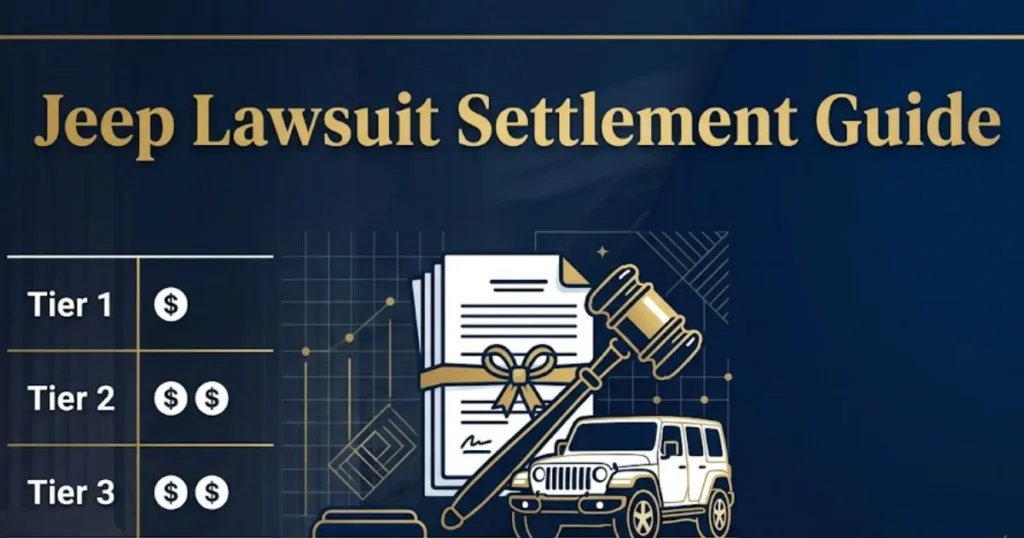
| Payout Tier | Criteria | Estimated Payment |
|---|---|---|
| Tier 1 (Highest) | Multiple documented repairs, vehicle buyback request | $2,000 to $5,000+ |
| Tier 2 (Mid) | One or more documented repairs with receipts | $500 to $2,000 |
| Tier 3 (Low) | Experienced defect, no documented repairs | $100 to $500 |
| Tier 4 (Minimum) | Owned affected vehicle, no reported issues | $50 to $150 |
Think of it like an insurance claim. The more evidence you bring, the bigger your check. That is why keeping repair invoices, dealer work orders, and any written complaints to Stellantis or NHTSA matters so much.
For lemon law cases handled individually rather than through a class action, payouts can be much higher. Some Jeep owners have received full vehicle buybacks worth $30,000 to $60,000 through state lemon law arbitration.
The lesson here is simple. If your Jeep has a known defect, start a paper trail today. Every receipt, every service record, every complaint you file strengthens your claim.
Who Qualifies for the Jeep Class Action
You qualify for a Jeep class action if you currently own, lease, or previously owned a Jeep model and model year covered by an active lawsuit, and your vehicle experienced the specific defect at the center of the case.
Qualification is not automatic just because you own a Jeep. The class definition in each lawsuit specifies exact models, model years, and sometimes even production date ranges or VIN ranges. You need to check whether your particular vehicle falls within those boundaries.
General eligibility requirements across most Jeep class actions:
- You purchased or leased the vehicle in the United States
- Your Jeep falls within the specified model year range
- Your vehicle experienced the alleged defect (transmission shudder, death wobble, engine stall, fire risk component, etc.)
- You have not already settled an individual claim for the same defect
- You did not opt out of the class during the notice period
| Qualifying Factor | What It Means |
|---|---|
| Vehicle Ownership | Current or former owner/lessee |
| Model and Year Match | Must be within the lawsuit’s defined class |
| Defect Experience | Your vehicle must have shown symptoms |
| Geographic Requirement | Purchased or registered in the U.S. |
| No Prior Settlement | Cannot have already settled individually for the same issue |
One important point: you do not need to have filed a complaint or taken your vehicle to a dealer to qualify for most class actions. If your vehicle falls within the class definition and experienced the defect, you are typically included automatically unless you choose to opt out.
Selling your Jeep does not disqualify you either. Former owners can still receive compensation for losses they suffered while they owned the vehicle.
Jeep Grand Cherokee Class Action Lawsuit
The Jeep Grand Cherokee class action lawsuit covers multiple defects across several generations of one of Stellantis’s best-selling vehicles. The most prominent claims involve the 2014 to 2020 Grand Cherokee’s ZF 8-speed automatic transmission and the 2021 to 2024 Grand Cherokee L’s electronic steering system failures.
Grand Cherokee transmission complaints describe harsh shifting, delayed engagement, unexpected lurching, and complete transmission failure at low mileage. NHTSA’s complaint database contains thousands of entries from Grand Cherokee owners describing these exact symptoms.
The newer Grand Cherokee L faces a different but equally concerning issue. Reports of sudden loss of power steering assist while driving have prompted a formal NHTSA engineering analysis. Losing steering control at highway speeds is about as dangerous as it gets.
- 2014 to 2020 Grand Cherokee: ZF 8-speed transmission defect, harsh shifting, premature failure
- 2021 to 2024 Grand Cherokee L: Electronic power steering loss, sudden assist failure
- 2011 to 2013 Grand Cherokee: Older litigation related to Totally Integrated Power Module (TIPM) electrical failures
- All years with EcoDiesel engine: Emissions-related claims tied to the diesel cheating scandal settlement
| Grand Cherokee Issue | Model Years | Case Status |
|---|---|---|
| ZF 8-speed transmission | 2014 to 2020 | Active, approaching settlement |
| Electronic steering loss | 2021 to 2024 | Investigation phase, class action expected |
| TIPM electrical failure | 2011 to 2013 | Settled, claim period may be closed |
| EcoDiesel emissions | 2014 to 2016 | Settled, payments distributed |
The Grand Cherokee is Jeep’s flagship. It also carries the heaviest class action exposure of any model in the lineup. If you own one built between 2014 and 2024, check the specific case details carefully.
Key Takeaway: Jeep Grand Cherokee owners face the widest range of active class action claims in 2026, spanning transmission defects, steering failures, electrical issues, and emissions fraud across more than a decade of model years.
Jeep Wrangler Class Action Lawsuit
The Jeep Wrangler class action lawsuit primarily targets two defects: the notorious “death wobble” steering vibration and frame rust/corrosion issues. Both problems have generated massive complaint volumes and real safety concerns for Wrangler owners.
Death wobble is the dominant issue. Wrangler JK (2007 to 2018) and JL (2018 to present) owners report violent shaking of the front end at highway speeds, typically triggered by hitting a bump or road imperfection. The vibration is so severe that drivers sometimes cannot maintain control of the vehicle.
Stellantis has issued technical service bulletins (TSBs) addressing death wobble but has refused to acknowledge it as a design defect. Instead, the company has framed it as a maintenance issue requiring replacement of the front track bar or steering damper. Plaintiffs in the class action argue this is a band-aid fix that does not address the root cause.
- Death wobble affects JK and JL Wranglers from 2007 to present
- Frame rust claims target JK Wranglers sold in northern states with road salt exposure
- Clutch failure complaints are growing for manual transmission Wrangler JL models
- Oil consumption issues reported in 2.0L turbocharged four-cylinder Wrangler JL models
The death wobble class action is expected to reach a class certification hearing in mid-2026. If certified, it would cover potentially hundreds of thousands of Wrangler owners nationwide.
Frame rust cases are more geographically concentrated. Owners in the Midwest and Northeast, where roads are heavily salted in winter, report frame perforation and structural compromise in Wranglers with fewer than 80,000 miles.
Jeep Cherokee Class Action
The Jeep Cherokee class action focuses almost entirely on the ZF 9-speed automatic transmission installed in the 2014 to 2022 Cherokee KL. This transmission, manufactured by ZF Friedrichshafen AG, has been the single most complained-about component in any modern Jeep.
Owners describe a range of symptoms. Harsh shifts between gears. Long hesitation when accelerating from a stop. Sudden jerking at low speeds. Complete loss of power while driving. Some owners report that their Cherokee has been in the shop five, six, or seven times for the same transmission issue without a permanent fix.
| Cherokee Transmission Symptom | Frequency in NHTSA Database |
|---|---|
| Harsh or rough shifting | Very common |
| Delayed gear engagement | Very common |
| Sudden loss of power | Common |
| Transmission warning light | Common |
| Complete transmission failure | Less common but reported |
The ZF 9-speed was supposed to be a fuel economy improvement over the older 6-speed. On paper, nine gears meant the engine could always run at peak efficiency. In reality, the transmission’s software calibration and mechanical design created constant problems, especially in stop-and-go traffic.
Stellantis released more than a dozen software updates attempting to fix the 9-speed’s behavior. Plaintiffs argue these updates prove the company knew about the defect and could never fully resolve it.
The Cherokee transmission MDL consolidation in late 2025 grouped many of these individual and state-level claims together. Settlement discussions are expected to begin in earnest during 2026.
Jeep Transmission Lawsuit
Jeep transmission lawsuits span multiple models and transmission types, making this one of the broadest categories of Jeep litigation in 2026. The ZF 9-speed in the Cherokee, the ZF 8-speed in the Grand Cherokee, and the 8-speed in the Ram 1500 (which shares a platform with some Jeep models) have all generated class action claims.
The core allegation is the same across cases. Stellantis and its predecessor FCA sold vehicles with transmissions they knew were defective. Internal warranty data showed abnormally high rates of transmission complaints and repairs. Yet the company kept installing these transmissions without warning buyers.
- ZF 9-speed (Cherokee, Compass, Renegade): Rough shifting, delayed engagement, power loss
- ZF 8-speed (Grand Cherokee, Wrangler, Gladiator): Harsh shifts, premature failure
- Manual transmission (Wrangler JL, Gladiator): Premature clutch wear, grinding gears
| Transmission | Models Affected | Primary Complaint |
|---|---|---|
| ZF 9HP 9-speed auto | Cherokee, Compass, Renegade | Rough shifting, hesitation |
| ZF 8HP 8-speed auto | Grand Cherokee, Wrangler, Gladiator | Harsh shifts, failure |
| Aisin 6-speed manual | Wrangler JL, Gladiator | Premature clutch failure |
What makes transmission defects particularly damaging in court is the safety angle. A transmission that suddenly drops out of gear or hesitates during acceleration creates obvious crash risks. That elevates these cases beyond simple warranty complaints into product liability territory.
If your Jeep needed a transmission rebuild or replacement before 100,000 miles, that is a red flag that your vehicle may fall within one of these class actions.
Key Takeaway: Transmission defects are the single largest category of Jeep class action litigation in 2026, affecting the Cherokee, Grand Cherokee, Wrangler, Gladiator, Compass, and Renegade across both automatic and manual gearboxes.
Jeep Death Wobble Lawsuit
The Jeep death wobble lawsuit targets a violent front-end shaking that occurs in Wrangler and Gladiator models, typically at speeds between 45 and 65 miles per hour. The wobble is triggered by hitting a bump, pothole, or uneven road surface, and it makes the steering wheel shake so hard that many drivers pull over immediately, fearing they will lose control.
Death wobble is not a minor vibration. Drivers describe it as feeling like the front axle is about to tear itself out from under the vehicle. The shaking can last several seconds and often returns repeatedly, even after dealer repairs.
Stellantis has issued TSBs recommending replacement of the steering damper and front track bar. Plaintiffs argue these repairs are temporary fixes for a fundamental design flaw in the solid front axle geometry.
| Death Wobble Fact | Detail |
|---|---|
| Models Affected | Wrangler JK, Wrangler JL, Gladiator JT |
| Typical Speed at Onset | 45 to 65 mph |
| Common Trigger | Bumps, potholes, uneven pavement |
| Stellantis Response | TSBs for damper and track bar replacement |
| Plaintiff Argument | Design defect in front axle geometry |
| NHTSA Complaints | Thousands filed across model years |
NHTSA investigated the death wobble issue in 2020 and ultimately closed its investigation without ordering a recall, citing that the issue could be addressed through component replacement. Class action attorneys challenge this conclusion, arguing that a defect requiring repeated paid repairs is not truly “addressed.”
The class certification hearing scheduled for mid-2026 is a pivotal moment. If the court certifies the class, it could include every Wrangler JK and JL owner in the country, creating massive settlement pressure on Stellantis.
Jeep Recall Lawsuit
Jeep recall lawsuits arise when owners argue that a recall did not go far enough, came too late, or failed to compensate them for losses they suffered before the recall was announced. Accepting a recall repair does not automatically bar you from joining a related class action.
This is one of the most misunderstood areas of Jeep litigation. Many owners assume that once they get a recall repair, the matter is closed. That is not true. A recall fixes the immediate safety issue. It does not compensate you for repair costs you paid before the recall, rental car expenses, lost time, diminished vehicle value, or the danger you faced while driving a defective vehicle.
Recent Jeep recalls with related class action potential:
- 2024 recall of 338,000 Grand Cherokee and Grand Cherokee L vehicles for fuel line connector leaks creating fire risk
- 2024/2025 recall of Wrangler 4xe plug-in hybrids for battery fire risk
- 2023 recall of 132,000 Cherokee models for transmission control module software errors
- 2022 expanded recall of older Grand Cherokee models for TIPM-related airbag deployment failures
| Recall Year | Models | Issue | Vehicles Affected |
|---|---|---|---|
| 2024 | Grand Cherokee, Grand Cherokee L | Fuel line leak, fire risk | 338,000 |
| 2024/2025 | Wrangler 4xe | Battery fire risk | 32,000+ |
| 2023 | Cherokee | Transmission software | 132,000 |
| 2022 | Grand Cherokee (older) | TIPM airbag failure | 200,000+ |
The key legal principle here is that recalls address the safety defect but do not address the economic harm. If you paid $2,000 to fix your transmission before Stellantis acknowledged the problem, you deserve reimbursement. A recall does not provide that. A class action settlement can.
Jeep Fire Recall Lawsuit
Jeep fire recall lawsuits target vehicles with fuel system defects and battery malfunctions that create a risk of vehicle fires. These are among the most serious Jeep cases because fire risks can cause catastrophic injury or death.
The highest-profile fire-related Jeep litigation involves the Wrangler 4xe plug-in hybrid. Reports of battery fires prompted Stellantis to halt sales of the 4xe in 2024, issue a stop-drive notice, and eventually recall affected vehicles for battery pack inspection and replacement.
Separately, older Jeep Grand Cherokee models (2011 to 2013) were subject to the massive rear-mounted fuel tank recall following fatal rear-impact fires. That litigation largely settled years ago, but it established a pattern of Jeep fire-safety concerns that continues today.
- Wrangler 4xe battery fires: 2022 to 2024 model years, lithium-ion battery pack defect
- Grand Cherokee fuel line leaks: 2022 to 2024 models, fuel connector loosening over time
- Older Grand Cherokee rear fuel tank fires: 2011 to 2013 models, rear impact vulnerability
| Fire Risk Case | Models | Root Cause | Status in 2026 |
|---|---|---|---|
| Wrangler 4xe battery fire | 2022 to 2024 Wrangler 4xe | Lithium-ion battery defect | Active litigation, discovery phase |
| Grand Cherokee fuel line | 2022 to 2024 Grand Cherokee | Fuel connector leak | Recall issued, class action pending |
| Rear fuel tank (older) | 2011 to 2013 Grand Cherokee | Rear-mounted fuel tank | Settled |
The Wrangler 4xe situation is particularly troubling because Stellantis marketed the vehicle as its green, forward-thinking product. Buyers paid a premium for the plug-in hybrid technology. Getting a stop-drive notice and learning your vehicle could catch fire is a jarring experience that no marketing campaign can undo.
Key Takeaway: Jeep fire-related lawsuits in 2026 carry the highest stakes of any Jeep class action because they involve potential catastrophic injury, and the Wrangler 4xe battery fire case is expected to be one of the most closely watched automotive lawsuits of the year.
Stellantis Jeep Lawsuit
The Stellantis Jeep lawsuit connection matters because Stellantis NV is the legal entity responsible for all Jeep-related claims, even those originating from decisions made by Fiat Chrysler Automobiles before the 2021 merger. When FCA merged with Groupe PSA to form Stellantis, the new company assumed all existing liabilities.
Stellantis has faced intense financial pressure in 2025 and into 2026. North American sales declined. Inventory piled up on dealer lots. CEO changes created leadership uncertainty. All of this affects lawsuit outcomes because a company under financial stress is more likely to settle rather than spend years fighting in court.
Plaintiffs’ attorneys have used this leverage in settlement negotiations. The argument is straightforward: Stellantis cannot afford prolonged litigation on multiple fronts while simultaneously trying to stabilize its business operations and invest in electric vehicle development.
- Stellantis inherited all FCA liabilities including pending Jeep lawsuits
- The company’s 2025 financial results showed declining profitability in North America
- Leadership turnover at CEO level created strategic uncertainty
- Settlement talks have accelerated across several Jeep cases in late 2025 and early 2026
| Stellantis Factor | Impact on Lawsuits |
|---|---|
| FCA merger liability assumption | Stellantis responsible for all pre-merger defects |
| Declining NA sales (2025) | Financial pressure to settle rather than litigate |
| CEO transition | Strategic priority shifts may favor resolving legal exposure |
| EV investment demands | Cash preservation incentive favors settlements |
Think of it like a homeowner dealing with five different plumbing leaks. At some point, it is cheaper to call in a team and fix everything at once rather than fighting each leak individually. That is where Stellantis finds itself with Jeep litigation in 2026.
Jeep Defect Lawsuit Settlement
Jeep defect lawsuit settlements follow a predictable pattern. They typically offer a mix of cash payments, extended warranties, repair reimbursements, and sometimes vehicle buyback options for the most severely affected owners.
The settlement structure depends heavily on the type of defect. Safety-critical defects like fires and steering failures tend to produce larger per-person payouts than quality-of-life defects like rough shifting. Courts and settlement administrators also consider how long the owner dealt with the problem and how much money they spent trying to fix it.
Typical settlement components in Jeep defect cases:
- Direct cash payment to class members (ranging from $100 to $3,000)
- Reimbursement for documented out-of-pocket repair costs
- Extended warranty coverage beyond the original factory warranty
- Goodwill repair credits at authorized Stellantis dealerships
- Vehicle buyback or repurchase at fair market value (rare, for severe cases only)
| Settlement Component | Likelihood | Typical Value |
|---|---|---|
| Cash payment | Very likely | $100 to $3,000 |
| Repair reimbursement | Very likely | Up to $5,000 with receipts |
| Extended warranty | Likely | 2 to 5 extra years |
| Dealer repair credit | Sometimes | $500 to $1,500 |
| Vehicle buyback | Rare | Fair market value |
Past Jeep settlements show a consistent theme. Owners who documented everything received the most. Those who complained to the dealer, filed NHTSA complaints, kept repair invoices, and wrote letters to Stellantis customer service created a paper trail that directly translated into higher settlement tier placement.
If your case is still pending, the single best thing you can do right now is organize your records.
How to File a Jeep Lawsuit
Filing a Jeep lawsuit in 2026 starts with determining whether your situation fits an existing class action or requires an individual claim. For most owners, joining a class action is free and requires no upfront payment to an attorney.
Here is the step-by-step process:
Step 1: Identify Your Vehicle’s Eligibility
Check your Jeep’s VIN against active recall and class action databases. NHTSA’s website allows VIN-based recall lookups. Class action settlement websites (when established) will have VIN checkers as well.
Step 2: Gather Documentation
Pull together every piece of evidence you have.
- Purchase or lease agreement
- All repair invoices and dealer work orders
- Written correspondence with Stellantis or dealers about the defect
- NHTSA complaint confirmation (if you filed one)
- Photos or videos of the defect in action
- Rental car receipts or towing bills
Step 3: Join the Class Action or File Individually
For class actions, you are typically included automatically if your vehicle falls within the class definition. You may need to submit a claim form when a settlement is announced.
For individual claims (lemon law, personal injury, severe property damage), contact a consumer protection or product liability attorney. Most work on contingency, meaning they only get paid if you win.
Step 4: File an NHTSA Complaint
Even if you are joining a class action, file a complaint with NHTSA. This creates an official federal record of your experience. It strengthens both your individual claim and the overall case.
| Filing Step | Action | Cost |
|---|---|---|
| 1 | Check VIN eligibility | Free |
| 2 | Gather documentation | Free |
| 3 | Join class action or retain attorney | Free (class) / Contingency (individual) |
| 4 | File NHTSA complaint | Free |
Key Takeaway: Filing a Jeep class action claim costs nothing for most owners, and the most important thing you can do to maximize your payout is organize your repair records and file an NHTSA complaint before any settlement deadline.
Jeep Lemon Law Claims
Jeep lemon law claims are separate from class action lawsuits and can offer significantly larger payouts, including full vehicle buybacks. Every U.S. state has its own lemon law, and the rules vary, but the core idea is the same: if your new or leased vehicle has a defect that the manufacturer cannot fix after a reasonable number of repair attempts, you may be entitled to a refund or replacement.
Lemon laws typically apply to vehicles still under the original manufacturer warranty. Some states extend coverage to used vehicles purchased from dealers with remaining warranty.
Common lemon law thresholds:
- Three or more repair attempts for the same defect
- One repair attempt for a defect likely to cause death or serious injury
- Vehicle out of service for 30 or more cumulative days for warranty repairs
- Defect substantially impairs the vehicle’s use, value, or safety
| Lemon Law Factor | Typical Requirement |
|---|---|
| Repair attempts for same defect | 3 or more |
| Days out of service | 30+ cumulative |
| Severity threshold | Substantially impairs use, value, or safety |
| Warranty status | Must be under original warranty (most states) |
| Outcome if successful | Refund, replacement, or cash settlement |
Jeep models with the highest lemon law claim rates include the Cherokee (transmission), Wrangler 4xe (battery/fire), Compass (transmission), and Grand Cherokee L (steering and electrical).
Lemon law claims are individual, not class actions. You hire an attorney who represents you specifically. Most lemon law attorneys work on contingency or have their fees paid by the manufacturer if they win, meaning you pay nothing out of pocket in most cases.
The advantage of a lemon law claim over a class action is the payout size. A class action might get you $500. A successful lemon law claim could get you a $40,000 vehicle buyback. The tradeoff is that lemon law claims require more effort and a stronger individual case.
Frequently Asked Questions
How much money can I get from the Jeep class action lawsuit?
Most class members can expect between $100 and $3,000 depending on the specific case and documentation.
Owners with extensive repair records and receipts receive the highest tier payments.
Individual lemon law claims can result in full vehicle buybacks worth $30,000 to $60,000.
Is there a deadline to join the Jeep class action lawsuit in 2026?
Deadlines vary by case, but most active Jeep class actions have claim filing windows that remain open through at least mid-2026.
Once a settlement receives final court approval, class members typically have 60 to 120 days to submit a claim.
Opt-out deadlines are usually earlier, so watch for court notices carefully.
Does getting a Jeep recall repair stop me from joining a lawsuit?
No, accepting a recall repair does not disqualify you from a class action.
Recalls fix the safety defect but do not compensate you for out-of-pocket costs, rental expenses, or diminished vehicle value.
You can participate in both the recall and the class action.
Which Jeep models are included in the 2026 class action?
Active lawsuits cover the Grand Cherokee, Wrangler, Cherokee, Gladiator, Compass, Renegade, and Wagoneer.
Model years range from 2007 to 2024 depending on the specific case and defect.
Check your VIN against active cases to confirm eligibility.
How long will the Jeep class action settlement take to pay out?
Settlement payouts typically begin 6 to 12 months after a court grants final approval.
Some cases in 2026 are still in the settlement negotiation phase, meaning payments may not arrive until late 2026 or early 2027.
Claims with complete documentation are usually processed and paid faster than those requiring additional verification.
The Jeep class action lawsuits in 2026 represent real money for affected owners. Whether you are dealing with a shaking steering wheel, a transmission that won’t shift right, or a fire risk recall, there is likely a legal path forward.
Start by checking your VIN against active cases. Gather every repair record you can find. File an NHTSA complaint if you have not already.
The clock is ticking on some of these filing deadlines. The sooner you act, the stronger your position.







