

The j&j ovarian cancer lawsuit is one of the largest mass tort cases in American history, and 2026 brings major turning points for claimants. Johnson & Johnson faces roughly 100,000 pending claims from women who say the company’s talcum powder products caused their ovarian cancer.
If you used Johnson’s Baby Powder and received an ovarian cancer diagnosis, this article tells you everything you need to know right now. You’ll find payout estimates, eligibility requirements, filing deadlines, and a full breakdown of J&J’s controversial bankruptcy strategy.
The proposed settlement fund could reach $8 billion or more. But whether claimants actually see that money depends on court rulings expected throughout 2026. The clock is ticking, and decisions made this year will shape the outcome for tens of thousands of families.
J&J Ovarian Cancer Lawsuit
The J&J ovarian cancer lawsuit refers to tens of thousands of legal claims alleging Johnson & Johnson’s talc-based products caused ovarian cancer. Women across the United States filed these claims after using products like Johnson’s Baby Powder and Shower to Shower for years, often decades.
The core allegation is straightforward. J&J knew its talc contained trace amounts of asbestos, a known carcinogen, and failed to warn consumers. Internal company documents dating back to the 1970s showed J&J was aware of contamination risks.
This is not a single lawsuit. It’s a massive collection of individual cases consolidated into multidistrict litigation (MDL) in federal court, plus thousands of cases in state courts across the country.
| Key Detail | Information |
|---|---|
| Total Pending Claims | Approximately 100,000 |
| Main Products | Johnson’s Baby Powder, Shower to Shower |
| Primary Allegation | Talc products contained asbestos |
| MDL Court | District of New Jersey |
| First Major Verdict | 2016 (St. Louis, Missouri) |
Several juries have already returned massive verdicts against J&J. In 2018, a St. Louis jury awarded $4.69 billion to 22 women who claimed talc products caused their ovarian cancer. That verdict was later reduced but remained in the billions.
J&J discontinued its talc-based Baby Powder in North America in 2020 and switched to a cornstarch formula globally by 2023. The company has consistently denied its products cause cancer, even as it set aside billions to resolve claims.
Johnson and Johnson Ovarian Cancer Lawsuit Update 2026
As of 2026, the Johnson and Johnson ovarian cancer lawsuit update centers on J&J’s third attempt at resolving talc claims through a bankruptcy-related settlement. After two prior bankruptcy filings were rejected by courts, J&J created a new subsidiary called Red River Talc LLC to pursue a fresh strategy.
The company has proposed an $8 billion settlement fund to resolve the vast majority of current and future talc-related cancer claims. This amount was increased from earlier proposals of $6.5 billion after prior plans failed to secure enough claimant support.
In early 2025, Red River Talc filed a pre-packaged Chapter 11 bankruptcy petition in the U.S. Bankruptcy Court for the Southern District of Texas. The case is being overseen by Judge Christopher Lopez.
A critical vote among claimants took place, with J&J claiming more than 75% of voting claimants supported the plan. However, opponents argue the voting process was flawed and that many claimants were pressured into accepting.
- J&J’s third bankruptcy attempt filed through Red River Talc LLC
- Settlement fund proposed at $8 billion, paid over 25 years
- Claimant vote reportedly exceeded the 75% threshold
- Opposition groups challenged the vote’s legitimacy
- Federal appellate courts may review the plan throughout 2026
The next major milestone in 2026 is a confirmation hearing in bankruptcy court. If the judge approves the plan, it would channel all talc claims into the trust and block individual lawsuits. If it fails, J&J faces trial in thousands of cases.
J&J Ovarian Cancer Lawsuit Status
The current status of the J&J ovarian cancer lawsuit is active but in limbo. Individual trials are largely paused while bankruptcy proceedings play out. The MDL cases remain consolidated but have seen very few trials since J&J’s bankruptcy strategy began in 2021.
Here is where things stand for each major legal track:
| Legal Track | Current Status (2026) |
|---|---|
| Federal MDL (New Jersey) | Cases stayed pending bankruptcy resolution |
| State Court Cases | Most stayed; some states resisting the stay |
| Bankruptcy Proceeding | Confirmation hearing phase in Texas |
| Appeals | Expected at Third Circuit and possibly Supreme Court |
| Individual Trials | Very few proceeding; most on hold |
Some state courts have pushed back against the automatic stay. Judges in California and Missouri have argued that a subsidiary’s bankruptcy should not freeze cases against the parent company. These jurisdictions may allow some trials to move forward in 2026.
The U.S. Supreme Court could weigh in as well. In 2024, the Court declined to take up the previous bankruptcy case, but a new petition is likely if the Third Circuit rules on the current plan. A Supreme Court decision would set a precedent affecting mass tort cases far beyond talc.
For claimants, the status means waiting. Those who voted yes on the plan are waiting for confirmation. Those who voted no are waiting for an opportunity to take their cases to trial.
Key Takeaway: The J&J ovarian cancer lawsuit involves roughly 100,000 claims, and the entire case hinges on whether J&J’s third bankruptcy-based settlement plan survives court scrutiny in 2026.
J&J Ovarian Cancer Lawsuit Payout
The J&J ovarian cancer lawsuit payout depends on whether the proposed $8 billion settlement trust is approved and how individual claims are evaluated within that trust. Not every claimant will receive the same amount. Payouts will be tiered based on several factors.
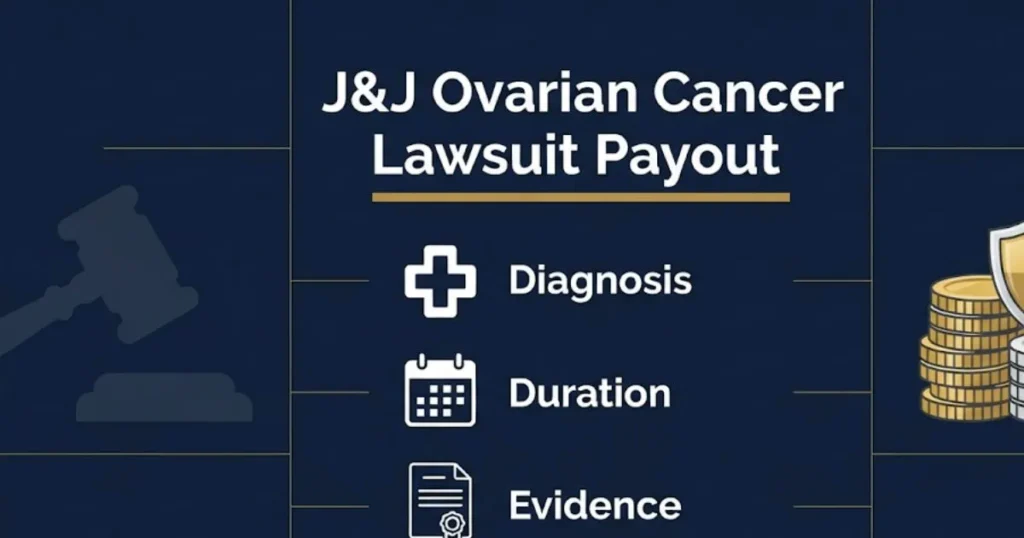
Under the proposed plan, the trust would distribute funds over a 25-year period. Payments would be prioritized based on the severity of a claimant’s cancer, how long they used talc products, and whether they can provide supporting medical and purchase records.
| Payout Factor | How It Affects Your Payment |
|---|---|
| Cancer Type | Ovarian cancer claims valued higher than non-malignant claims |
| Cancer Severity/Stage | Later-stage diagnoses receive larger payouts |
| Duration of Talc Use | Longer use periods may increase payout |
| Medical Documentation | Stronger medical records support higher claims |
| Death of Claimant | Wrongful death claims may receive additional value |
Think of it like an insurance claim after a car accident. The worse the damage and the better your documentation, the more you receive. Claimants with stage IV ovarian cancer and decades of talc use will be at the top of the payment hierarchy.
Previous jury verdicts give some context for potential value. Individual trial awards have ranged from $25 million to over $2 billion, though most were reduced on appeal. Settlement payouts through the trust will almost certainly be far lower than jury awards.
Opponents of the plan argue that $8 billion divided among 100,000 claimants results in an average of roughly $80,000 per claim, which they say is far too low given the severity of the injuries.
Johnson and Johnson Lawsuit: How Much Will I Get?
The amount you’ll receive from the Johnson and Johnson lawsuit depends on your specific circumstances, but most estimates suggest individual payouts ranging from $25,000 to $500,000 or more under the proposed settlement trust. That range is broad because the trust uses a tiered evaluation system.
Here’s what determines where you fall on the scale:
- Diagnosis type: Confirmed ovarian cancer receives the highest value
- Stage at diagnosis: Stage III or IV cancer is valued higher than Stage I
- Duration of product use: Using talc for 10+ years strengthens your claim
- Proof of use: Receipts, brand loyalty records, or sworn testimony
- Living vs. deceased claimant: Wrongful death claims may include additional compensation
Nobody can give you an exact dollar figure before the trust is finalized. But historical data from similar mass tort settlements, like asbestos trusts, provides a rough blueprint.
| Claim Tier (Estimated) | Projected Payout Range |
|---|---|
| Tier 1: Fatal ovarian cancer, long-term use, strong docs | $200,000 to $500,000+ |
| Tier 2: Ovarian cancer, moderate use, good docs | $75,000 to $200,000 |
| Tier 3: Ovarian cancer, limited use or weak docs | $25,000 to $75,000 |
| Tier 4: Non-malignant claims | Under $25,000 |
These are estimates based on the total fund size and comparable settlements. Actual amounts will be determined by the trust’s distribution procedures, which haven’t been finalized as of early 2026.
If you’re comparing this to what juries have awarded, keep in mind that settlements almost always pay less than trial verdicts. The tradeoff is certainty. A settlement means guaranteed payment. A trial verdict can be appealed and reduced or reversed.
J&J Talc Lawsuit Settlement Amount
The total J&J talc lawsuit settlement amount proposed by the company stands at approximately $8 billion. This figure represents the sum J&J has committed to fund a claimant trust through its subsidiary’s bankruptcy plan. The money would be distributed over 25 years to resolve both current and future talc-related cancer claims.
That $8 billion number didn’t come out of nowhere. It was revised upward from J&J’s earlier offer of $6.5 billion after the first two bankruptcy attempts were rejected. The company increased the pot to attract more claimant support and meet the voting threshold.
For context, J&J reported annual revenues of over $85 billion in recent years. Critics point out that $8 billion, spread over a quarter century, is a manageable expense for a company of J&J’s size, especially when it resolves all current and future liability in one sweep.
| Settlement Detail | Amount/Info |
|---|---|
| Total Proposed Fund | $8 billion |
| Payment Period | 25 years |
| Number of Claims | ~100,000 |
| Average Per Claim (rough) | ~$80,000 |
| Previous Offer | $6.5 billion (rejected) |
Compare that to the $4.69 billion a single jury awarded to just 22 plaintiffs in 2018. The math is stark. Jury trials can produce enormous awards, but they also carry risk, take years, and face appeals.
The settlement amount is designed to be a “global resolution.” If approved, it would cover not just current claimants but also anyone who develops talc-related cancer in the future. That’s a key point, because it means the fund has to stretch to cover claims that haven’t been filed yet.
Key Takeaway: J&J has proposed $8 billion to settle all talc cancer claims, but individual payouts could range widely from $25,000 to over $500,000 depending on cancer severity and documentation.
J&J Talc Settlement Payout Per Person
The J&J talc settlement payout per person will vary significantly based on individual claim details. There is no flat-rate payment for everyone. The proposed trust uses a point-based system that assigns value to each claim based on medical evidence, product usage history, and other factors.
Here’s how the point system is expected to work. Each claim gets scored. Higher scores mean higher payouts. The total fund is then divided proportionally based on all approved claim scores.
Factors that increase your point value:
- Pathology-confirmed ovarian cancer (serous or endometrioid subtypes receive highest weight)
- Duration of genital/perineal talcum powder use exceeding 5 years
- Diagnosis that occurred within a recognized latency window
- Death resulting from ovarian cancer
- Strong corroborating evidence (medical records, product purchase history, witness statements)
| Scenario | Estimated Per-Person Payout |
|---|---|
| Deceased claimant, 20+ years of use, full documentation | $300,000 to $500,000+ |
| Living claimant, 10+ years of use, strong medical records | $100,000 to $300,000 |
| Living claimant, shorter use, limited documentation | $25,000 to $100,000 |
It’s worth comparing this to asbestos trust payouts, which operate on a similar model. In most asbestos trusts, the average payout per mesothelioma claim ranges from $50,000 to $250,000, depending on the trust’s funding level.
The J&J talc trust is better funded than many asbestos trusts. But with 100,000 claims and potential future claimants, the per-person payout will depend heavily on how many people actually file and qualify.
Early payments may go out faster to claimants with the most severe cases. The trust will likely establish an expedited review process for those who are terminally ill or facing urgent financial need.
J&J Talcum Powder Lawsuit Settlement
The J&J talcum powder lawsuit settlement is the proposed resolution to decades of litigation over cancer risks linked to Johnson & Johnson’s talc products. If the current bankruptcy plan is confirmed, this settlement would end all individual lawsuits and channel every claim through a single trust fund.
This isn’t a traditional class action settlement where everyone gets the same check. It’s structured as a bankruptcy trust, similar to how asbestos litigation was handled for companies like Johns Manville and W.R. Grace.
Here’s how the settlement structure works:
- J&J funds the trust with $8 billion over 25 years
- Red River Talc LLC enters bankruptcy to create the trust
- All current and future claims are channeled into the trust
- Individual lawsuits against J&J are permanently stopped
- The trust evaluates and pays each claim based on its merits
The settlement offers one major advantage: certainty. Claimants know they’ll receive compensation without waiting years for a trial. They avoid the risk of losing at trial or having a verdict overturned on appeal.
The major disadvantage is that settlement payouts will be a fraction of what juries have awarded. Women who believe they have strong cases may feel shortchanged by accepting trust payments instead of pursuing multi-million-dollar verdicts.
Some plaintiff attorneys have advised their clients to reject the settlement and continue pushing for individual trials. They argue that J&J is using bankruptcy as a shield, not because it’s actually insolvent, but to limit its financial exposure.
Who Qualifies for J&J Ovarian Cancer Lawsuit?
Women who used Johnson & Johnson talcum powder products on or near their genital area and were later diagnosed with ovarian cancer are the primary group who qualifies for the J&J ovarian cancer lawsuit. Family members of deceased users may also file wrongful death claims on their behalf.
Here are the basic qualification criteria:
- Used J&J talcum powder products (Johnson’s Baby Powder or Shower to Shower)
- Applied the product in the genital or perineal area
- Received a diagnosis of ovarian cancer (certain subtypes weighted more heavily)
- The diagnosis came after a period of regular talc use
- Can provide some form of documentation (medical records, testimony, purchase records)
| Qualification Factor | Required? |
|---|---|
| Use of J&J talc product | Yes |
| Genital/perineal application | Strongly preferred |
| Ovarian cancer diagnosis | Yes |
| Medical records | Yes |
| Purchase receipts | Helpful but not required |
| Statute of limitations met | Must be checked by state |
You don’t need to prove you bought the product at a specific store or have decades of receipts. Personal testimony about regular use can serve as evidence, especially when combined with medical records showing a cancer diagnosis.
Mesothelioma claims related to talc are handled differently and may have separate eligibility standards. If your diagnosis is mesothelioma rather than ovarian cancer, the claim process and payout structure may differ.
Key Takeaway: If you used J&J talcum powder in your genital area and were diagnosed with ovarian cancer, you likely qualify to file a claim, even without purchase receipts, as long as you can provide medical documentation and testimony.
J&J Ovarian Cancer Lawsuit Eligibility
J&J ovarian cancer lawsuit eligibility is determined by a combination of product use, cancer diagnosis, and applicable state laws. Meeting the basic criteria is the first step, but your state’s statute of limitations plays a critical role in whether your claim can proceed.
Most states set the statute of limitations for personal injury claims at 2 to 3 years from the date of diagnosis or the date you discovered (or should have discovered) the link between talc and your cancer. This “discovery rule” is important because many women didn’t learn about the talc-cancer connection until news coverage brought it to light.
| State | Statute of Limitations | Discovery Rule? |
|---|---|---|
| California | 2 years | Yes |
| Texas | 2 years | Yes |
| New York | 3 years | Yes |
| Missouri | 5 years | Yes |
| Florida | 2 years (recently changed) | Yes |
If the bankruptcy settlement plan is confirmed, statutes of limitations may become less relevant. The trust would set its own filing deadlines, potentially giving claimants more time to submit claims regardless of their state’s typical limitations.
Certain cancers strengthen eligibility more than others. High-grade serous ovarian carcinoma is the subtype most commonly linked to talc exposure in scientific research. If your pathology report confirms this type, your claim carries more weight.
Eligibility extends to estates and family members. If a woman died from ovarian cancer after using talc products, her estate or surviving family members can file a wrongful death claim.
How to File a J&J Ovarian Cancer Claim
Filing a J&J ovarian cancer claim in 2026 involves two potential paths: submitting a claim through the proposed bankruptcy trust or filing an individual lawsuit if the bankruptcy plan is rejected. The path you take depends on how the bankruptcy proceedings unfold.
Path 1: Filing Through the Bankruptcy Trust (if approved)
- Wait for confirmation of the Red River Talc bankruptcy plan
- Submit a proof of claim form to the trust administrator
- Provide medical records, pathology reports, and evidence of talc use
- The trust reviews your claim and assigns a point value
- You receive a payment based on your claim’s score
Path 2: Filing an Individual Lawsuit (if bankruptcy fails)
- Retain a personal injury attorney experienced in talc litigation
- Your attorney files a complaint in the appropriate state or federal court
- The case enters the MDL or proceeds in state court
- Discovery, depositions, and potential trial follow
- You may receive a jury verdict or reach a private settlement
| Filing Step | Trust Claim | Individual Lawsuit |
|---|---|---|
| Attorney needed? | Recommended but not required | Yes, strongly recommended |
| Filing cost to you | Usually free (contingency fee) | Usually free (contingency fee) |
| Typical timeline | 6 to 18 months after trust established | 2 to 5 years |
| Potential payout | $25,000 to $500,000+ | $100,000 to millions (if successful) |
Gather your documents now regardless of which path opens up. The most important records are: your cancer diagnosis and pathology report, treatment history, a personal statement describing your talcum powder usage, and any other evidence that ties your product use to your diagnosis.
J&J Ovarian Cancer Lawsuit Deadline 2026
The J&J ovarian cancer lawsuit deadline in 2026 is not a single fixed date but rather a series of deadlines that vary depending on the legal track your claim follows. The most important upcoming deadline relates to the bankruptcy trust claim filing window, which will be set once (and if) the plan is confirmed.
If the bankruptcy plan is approved, the trust is expected to establish a claims filing deadline that gives claimants a window of 1 to 3 years to submit their paperwork. That deadline would be announced after the confirmation hearing.
| Deadline Type | Expected Timing |
|---|---|
| Bankruptcy confirmation hearing | Mid-2026 (estimated) |
| Trust claims filing window | Opens after confirmation |
| Trust filing deadline | 1 to 3 years after trust is established |
| State statute of limitations | Varies by state (2 to 5 years from diagnosis) |
| Appeal deadlines | 30 to 90 days after confirmation order |
Don’t wait for a final deadline to start preparing. Many attorneys are already reviewing cases and helping clients assemble documentation. Waiting until the last minute risks missing deadlines, especially if you need to track down old medical records.
If the bankruptcy plan fails, state statutes of limitations kick back in as the controlling deadlines. Some claimants who waited too long may find their window has closed. That’s why filing sooner is always safer than filing later.
Key Takeaway: There’s no single deadline yet for 2026, but the bankruptcy confirmation hearing expected mid-year will trigger the claim filing window; start gathering your medical records and evidence now.
Talcum Powder Ovarian Cancer Lawsuit
The talcum powder ovarian cancer lawsuit is the broader legal action encompassing claims against multiple talc product manufacturers, though Johnson & Johnson is by far the largest defendant. These lawsuits allege that regular use of talcum powder in the genital area increases the risk of developing ovarian cancer.
The litigation began gaining traction in the mid-2010s after several plaintiffs’ verdicts made national headlines. The first major trial win came in 2016 in St. Louis, where a jury awarded $72 million to the family of a woman who died from ovarian cancer after decades of Baby Powder use.
Since then, juries have awarded billions in total verdicts. Here are some of the most notable:
- 2016: $72 million verdict (St. Louis, single plaintiff)
- 2017: $417 million verdict (Los Angeles, single plaintiff; later reduced)
- 2018: $4.69 billion verdict (St. Louis, 22 plaintiffs)
- 2020: $750 million verdict (later reversed on appeal)
Not every trial has gone the plaintiffs’ way. J&J has won some cases, and several large verdicts have been reduced or overturned on appeal. The legal record is mixed, which is one reason J&J pushed for a global settlement rather than facing thousands of individual trials.
The lawsuits aren’t just about ovarian cancer. Some claims involve mesothelioma, a cancer typically associated with asbestos exposure, based on allegations that J&J’s talc was contaminated with asbestos fibers. These cases are often handled on a separate track.
Johnson and Johnson Baby Powder Cancer
Johnson and Johnson Baby Powder cancer claims center on the allegation that the company’s iconic product contained asbestos-contaminated talc that caused ovarian cancer and mesothelioma in long-term users. The product was a household staple for over a century before J&J pulled the talc version from U.S. shelves in 2020.
Internal J&J documents, many unsealed during litigation, showed that company scientists and executives were aware of asbestos contamination in their talc supply as early as the 1970s. A 2018 Reuters investigation revealed internal memos, test results, and strategy documents spanning decades.
The company’s own testing found trace asbestos in some talc samples. Yet J&J continued to market Baby Powder as safe, pure, and gentle enough for infants.
| Timeline | Event |
|---|---|
| 1970s | Internal J&J tests detect asbestos traces in talc |
| 1999 | Mining supplier reports asbestos concerns |
| 2018 | Reuters publishes damning investigation |
| 2020 | J&J discontinues talc Baby Powder in U.S. and Canada |
| 2023 | J&J switches to cornstarch formula globally |
Think of it like a car manufacturer discovering faulty brakes in the 1970s but continuing to sell the same car for 50 more years. That’s the picture plaintiffs paint: a company that prioritized profits over consumer safety for decades.
J&J maintains that its Baby Powder was safe and that independent testing confirmed the product was asbestos-free. The company points to regulatory reviews and scientific studies that found no conclusive cancer link. But juries have repeatedly sided with plaintiffs when presented with the internal documents.
Talcum Powder Cancer Risk
The talcum powder cancer risk is supported by epidemiological research showing a statistically significant association between genital talc use and ovarian cancer. The International Agency for Research on Cancer (IARC), part of the World Health Organization, classified talc used in the genital area as “possibly carcinogenic to humans” (Group 2B) in 2006.
Multiple studies have examined the connection:
- A 2003 meta-analysis published in the journal Anticancer Research found a 33% increased risk of ovarian cancer among women who used talc in the genital area
- The Women’s Health Initiative observational study found modest increased risk among talc users
- A 2016 Harvard study found a 33% increased risk of the serous subtype of ovarian cancer
- A 2020 study published in JAMA found no overall increased risk, but noted limitations in the data
The scientific evidence is not unanimous. That’s an honest assessment. Some large studies found elevated risk. Others did not. The disagreement has given J&J ammunition to argue the science is inconclusive.
| Study/Source | Finding |
|---|---|
| IARC (WHO), 2006 | Genital talc use “possibly carcinogenic” |
| Meta-analysis, 2003 | 33% increased ovarian cancer risk |
| Harvard Study, 2016 | 33% increased serous carcinoma risk |
| JAMA Study, 2020 | No overall increased risk found |
| NTP (pending review) | Under review for potential reclassification |
What complicates the picture is asbestos contamination. Even researchers who question the talc-cancer link acknowledge that asbestos-contaminated talc is undeniably carcinogenic. The lawsuits focus heavily on the contamination angle, arguing that J&J’s talc supply was not as pure as the company claimed.
If you used talcum powder and you’re worried about cancer risk, the most direct step is to stop using talc-based products and talk to your doctor about screening, particularly if you have a family history of ovarian cancer.
Key Takeaway: Scientific research shows a statistically significant association between genital talcum powder use and ovarian cancer, with some studies finding a 33% increased risk, though the evidence is debated.
J&J Bankruptcy Talc Lawsuit
The J&J bankruptcy talc lawsuit strategy involves the company creating subsidiary corporations, transferring talc-related liabilities to them, and then filing those subsidiaries for Chapter 11 bankruptcy. This maneuver is commonly called the “Texas Two-Step” because it was initially filed in Texas and uses a two-step corporate restructuring process allowed under that state’s laws.
Here’s how it works in plain English. J&J doesn’t file for bankruptcy itself. It’s a profitable company worth hundreds of billions. Instead, it creates a brand-new company on paper, dumps all the talc lawsuits onto that company, and then that company files for bankruptcy.
The first subsidiary was LTL Management LLC, created in 2021. It filed for bankruptcy in the Western District of North Carolina, then the case was moved to New Jersey. The Third Circuit Court of Appeals dismissed that bankruptcy in January 2023, ruling that LTL was not in financial distress.
J&J tried again. LTL filed a second bankruptcy in 2023. That was also dismissed, with the Third Circuit ruling in January 2024 that it did not meet good-faith filing requirements.
Now there’s a third attempt through Red River Talc LLC, filed in 2025.
| Attempt | Subsidiary | Filed | Court | Outcome |
|---|---|---|---|---|
| First | LTL Management | October 2021 | New Jersey | Dismissed by Third Circuit (2023) |
| Second | LTL Management | January 2023 | New Jersey | Dismissed by Third Circuit (2024) |
| Third | Red River Talc | 2025 | Southern District of Texas | Pending (2026) |
Critics, including the U.S. Department of Justice’s bankruptcy watchdog (the U.S. Trustee), have argued that this strategy abuses the bankruptcy system. The tactic allows a healthy company to use bankruptcy protections designed for genuinely insolvent businesses.
Supporters say the bankruptcy trust approach is the most efficient way to resolve 100,000 claims and ensure every claimant gets paid. Without it, they argue, individual lawsuits could drag on for decades and some plaintiffs might never see a dime.
J&J Talc Prepackaged Bankruptcy Plan
The J&J talc prepackaged bankruptcy plan is a legal strategy where the company negotiates a settlement deal and secures claimant votes before filing for bankruptcy, then presents the pre-approved plan to the court for confirmation. It’s called “prepackaged” because the plan arrives ready-made on the bankruptcy judge’s desk.
This is different from a traditional bankruptcy where a company files first and then negotiates with creditors. In a prepackaged filing, the heavy lifting happens before the court is involved.
Here’s the sequence of events:
- J&J negotiates settlement terms with plaintiff attorneys
- Claimants vote on whether to accept the plan
- If 75% of voting claimants approve, the plan is considered accepted
- Red River Talc files for Chapter 11 with the pre-voted plan
- The bankruptcy court holds a confirmation hearing
- If confirmed, the plan becomes binding on all claimants, even those who voted no
| Plan Detail | Information |
|---|---|
| Plan vehicle | Red River Talc LLC |
| Settlement fund | $8 billion over 25 years |
| Required vote | 75% of voting claimants |
| Reported vote result | Over 75% in favor (disputed) |
| Confirmation status | Hearing expected mid-2026 |
| Binding effect | Covers all current and future claims |
The most controversial aspect is the binding effect on objectors. If the plan is confirmed, even claimants who voted against it lose their right to sue J&J individually. This is a fundamental tension: the majority’s choice overrides the minority’s preference.
Plaintiff attorneys opposing the plan argue that J&J hand-picked the voting pool and worked with certain law firms to deliver yes votes. They claim the vote was not truly representative of all claimants.
The confirmation hearing in 2026 will be heavily contested. Both sides will present expert witnesses, financial projections, and legal arguments. The bankruptcy judge’s ruling will be appealed almost immediately by whichever side loses.
If the plan is rejected a third time, J&J could face a wave of individual trials. Plaintiff attorneys say they have thousands of cases ready to go before juries. J&J’s legal risk in that scenario would be enormous, potentially exceeding $100 billion by some estimates.
Key Takeaway: J&J’s prepackaged bankruptcy plan through Red River Talc is the company’s third attempt to resolve all talc claims through a single trust fund, and the confirmation hearing expected in mid-2026 will determine whether claimants receive settlement payouts or return to individual litigation.
Frequently Asked Questions
How much money will I get from the J&J ovarian cancer lawsuit?
Most claimants can expect between $25,000 and $500,000 under the proposed settlement trust.
The exact amount depends on your cancer diagnosis, how long you used talc, and the strength of your documentation.
Payments are expected to begin after the bankruptcy plan is confirmed, possibly in late 2026 or 2027.
What is the deadline to file a J&J talcum powder claim in 2026?
No final filing deadline has been set yet because the bankruptcy plan is still awaiting court confirmation.
Once confirmed, the trust will announce a filing window of 1 to 3 years.
In the meantime, your state’s statute of limitations (typically 2 to 5 years from diagnosis) still applies if you pursue an individual lawsuit.
Does talcum powder really cause ovarian cancer?
Multiple studies show a statistically significant link between genital talc use and ovarian cancer, with some finding a 33% increased risk.
The IARC classifies genital talc use as “possibly carcinogenic.”
The science is debated, but internal J&J documents also suggest the company’s talc was contaminated with asbestos, a known carcinogen.
Can I still file a J&J ovarian cancer lawsuit in 2026?
Yes, you can still file a claim in 2026.
If the bankruptcy plan is confirmed, you’ll file through the settlement trust.
If it’s rejected, individual lawsuits will resume, and you can file in your state’s court system as long as you meet the statute of limitations.
What happens if J&J’s bankruptcy plan is approved?
If approved, all current and future talc cancer claims will be channeled into a trust funded with $8 billion.
Individual lawsuits against J&J will be permanently blocked.
Claimants will receive payment based on a tiered evaluation of their claim’s strength, with distributions expected to begin within months of confirmation.
The J&J ovarian cancer lawsuit is heading toward a decisive moment in 2026. Whether the bankruptcy plan is confirmed or rejected, this year will reshape the future for tens of thousands of claimants.
If you used Johnson’s Baby Powder and were diagnosed with ovarian cancer, start gathering your medical records, pathology reports, and any evidence of product use now. Don’t wait for a deadline to catch you off guard.
Stay informed. The outcome of the mid-2026 confirmation hearing will determine whether you file through a trust or take your case to trial.







