

The J&J baby powder lawsuit is one of the largest mass tort cases in American history, with over 100,000 plaintiffs claiming talc-based powder caused their cancer. In 2026, this litigation reaches a make-or-break moment as Johnson & Johnson’s settlement plan faces its biggest test yet.
If you used baby powder and developed ovarian cancer or mesothelioma, the next several months could determine whether you receive compensation. J&J has proposed paying roughly $8 billion to resolve the claims, but the path to actual checks in the mail is far from simple.
This article breaks down every detail that matters to you right now. You will learn about settlement amounts, eligibility rules, compensation tiers, filing deadlines, and the 2026 timeline for payouts.
One fact worth knowing from the start: J&J stopped selling talc-based baby powder in North America in 2020 and worldwide in 2023. The company switched to cornstarch. That decision alone tells you something.
J&J Baby Powder Lawsuit
The J&J baby powder lawsuit refers to tens of thousands of legal claims alleging that Johnson & Johnson’s talc-based baby powder contained asbestos and caused cancer in long-term users. These lawsuits have been building since the early 2000s, but the wave became a tsunami after 2016.
Plaintiffs in these cases are mostly women who used baby powder for feminine hygiene and later developed ovarian cancer. A smaller but significant group includes men and women diagnosed with mesothelioma, a rare cancer linked to asbestos exposure.
Johnson & Johnson has consistently denied that its baby powder contains asbestos or causes cancer. The company has pointed to decades of testing and regulatory reviews. But juries have not always agreed with that defense.
| Key Fact | Detail |
|---|---|
| Total Plaintiffs | Over 100,000 |
| Main Cancers Alleged | Ovarian cancer, mesothelioma |
| Product at Issue | Johnson’s Baby Powder (talc-based) |
| Company’s Position | Denies contamination and causation |
| Product Discontinued | Talc version stopped globally in 2023 |
Several juries have awarded massive verdicts against J&J. In 2018, a St. Louis jury awarded $4.69 billion to 22 women who claimed baby powder caused their ovarian cancer. That verdict was later reduced but remains one of the largest product liability awards in history.
The litigation is centralized as a multidistrict litigation (MDL 2738) in the U.S. District Court for the District of New Jersey under Judge Freda Wolfson.
Baby Powder Lawsuit Update 2026
The baby powder lawsuit update for 2026 centers on Johnson & Johnson’s third attempt to resolve the litigation through a bankruptcy-related settlement strategy. After two failed attempts using a subsidiary called LTL Management, J&J restructured its approach through a new entity called Red River Talc LLC.
In 2025, a critical vote took place among talc claimants on whether to accept J&J’s proposed settlement plan. According to J&J, approximately 75% of voting claimants approved the deal. That threshold matters because bankruptcy law requires a supermajority for a reorganization plan to move forward.
The bankruptcy court in Houston, Texas, is now reviewing whether to confirm the plan. If the judge approves it, a talc trust would be established to process and pay claims. If the judge rejects it, the litigation goes back to square one with individual trials.
Here is what to watch in 2026:
- Court confirmation hearing for the proposed settlement plan
- Potential appeals if the plan is approved or rejected
- Trust establishment and initial claims processing if confirmed
- Trial dates for individual cases if the plan falls apart
The stakes are enormous. Approval means structured payouts over several years. Rejection means continued chaos in courtrooms across the country.
Johnson and Johnson Baby Powder Lawsuit 2026
The Johnson and Johnson baby powder lawsuit in 2026 represents a crossroads for the company and the plaintiffs who have waited years for answers. J&J is betting everything on a global settlement through bankruptcy court rather than fighting cases one at a time.
J&J’s strategy is not traditional. The company is not bankrupt. It is a Fortune 50 corporation worth hundreds of billions. Instead, it created a subsidiary, loaded it with the talc liabilities, and filed for bankruptcy on behalf of that subsidiary. This tactic is called a “Texas Two-Step” bankruptcy.
Critics, including many plaintiff attorneys, have called this move an abuse of the bankruptcy system. They argue a profitable company should not be able to shield itself from jury verdicts by putting a shell company into Chapter 11.
Supporters say the alternative is decades more litigation, with many sick plaintiffs dying before seeing a dime. A structured trust fund, they argue, is more fair and efficient.
| Position | Argument |
|---|---|
| J&J / Pro-Settlement | Faster resolution, certainty of payment, avoids decades of trials |
| Plaintiff Attorneys / Critics | Abuse of bankruptcy, reduces total compensation, strips jury rights |
| Bankruptcy Court | Must decide if plan meets legal requirements |
The outcome of the 2026 court proceedings will set a precedent for how large corporations handle mass tort litigation in the future. This is bigger than just baby powder.
Key Takeaway: The J&J baby powder lawsuit in 2026 hinges on whether a bankruptcy court approves a proposed settlement plan that could distribute roughly $8 billion to over 100,000 claimants.
Talcum Powder Lawsuit Settlement Amounts
Talcum powder lawsuit settlement amounts vary widely depending on the type of cancer, the severity of illness, and the strength of the individual claim. Under J&J’s proposed plan, the total settlement pool is approximately $8 billion, to be distributed over 25 years.
That sounds like a lot of money. But divide $8 billion among 100,000 or more claimants, and the math gets real. The average payout per person could range from a few thousand dollars to several hundred thousand, depending on the tier a claimant falls into.
Past jury verdicts have been much larger. Individual trial awards have ranged from $25 million to over $2 billion in some cases. But those verdicts were for specific plaintiffs with strong evidence. Most claimants would never see those numbers at trial.
Here is a rough breakdown of expected ranges under the proposed settlement:
| Claim Category | Estimated Payout Range |
|---|---|
| Mesothelioma (highest tier) | $300,000 to $750,000+ |
| Ovarian Cancer (advanced stage) | $50,000 to $300,000 |
| Ovarian Cancer (early stage, recovered) | $5,000 to $50,000 |
| Other Cancers (lower tier) | $1,000 to $10,000 |
These figures are estimates based on similar mass tort trust distributions and public reporting on the proposed plan. Actual amounts will depend on the final trust distribution procedures.
The settlement amounts are a fraction of what juries have awarded. That is the tradeoff: certainty and speed versus the chance of a larger verdict at trial.
J&J Baby Powder Settlement Payout
The J&J baby powder settlement payout will not arrive as a single check for most claimants. Under the proposed trust structure, payments would be spread over a 25-year period. Think of it like a structured fund, not a lottery win.
Once the trust is established, claimants would submit their claims with supporting documentation. A claims administrator would review each case and assign it to a compensation tier. The tier determines the payout amount.
Speed is a real concern. Even after the trust is approved, the claims review process could take 12 to 24 months before the first payments go out. Claimants with the most severe diagnoses, like mesothelioma, are expected to be prioritized for early payment.
Key details about the payout process:
- Payment period: 25 years
- Priority claims: Mesothelioma and terminal diagnoses
- Claims review timeline: 12 to 24 months after trust established
- Payment method: Likely direct deposit or check
- Reductions possible: If more claims are filed than expected, individual amounts may decrease
The payout structure is designed to ensure the fund does not run dry before all claimants are compensated. That is why payments are spread over decades rather than distributed all at once.
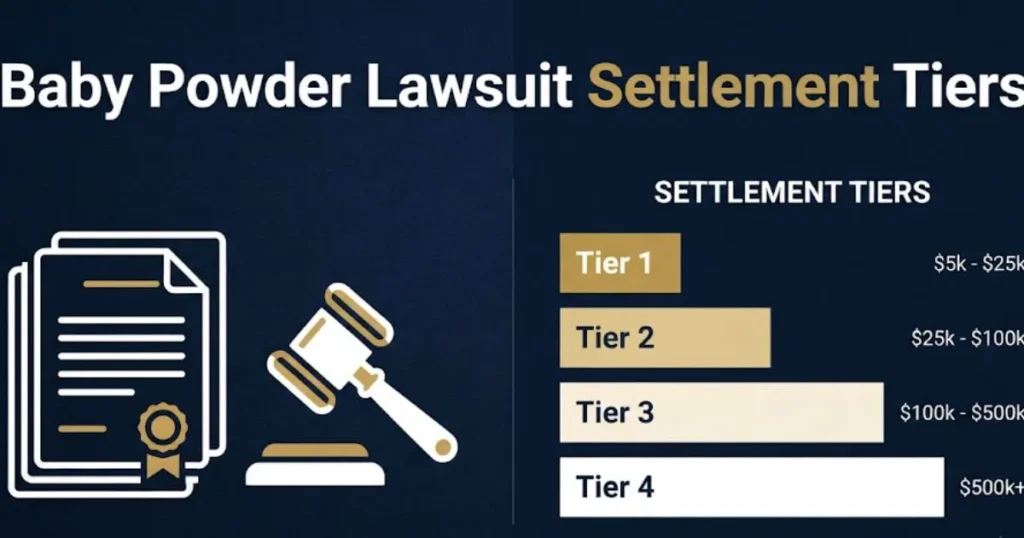
J&J Baby Powder Lawsuit Compensation Tiers
The J&J baby powder lawsuit compensation tiers are based on a points system that weighs several factors about each claimant’s case. Not everyone gets the same amount. The system is designed to pay the most severely affected people the highest compensation.
Think of it like an insurance claims process. Your diagnosis, your age, how long you used the product, and what documentation you have all feed into a formula that determines your tier placement.
Here is how the tier system generally works in mass tort trusts:
| Tier | Criteria | Estimated Range |
|---|---|---|
| Tier 1 (Highest) | Mesothelioma, strong asbestos exposure proof | $300,000 to $750,000+ |
| Tier 2 | Advanced ovarian cancer, heavy talc use, strong medical records | $100,000 to $300,000 |
| Tier 3 | Early-stage ovarian cancer, moderate use, good documentation | $20,000 to $100,000 |
| Tier 4 | Cancer diagnosis with limited talc use history or documentation gaps | $5,000 to $20,000 |
| Tier 5 (Lowest) | Minimal evidence, weak causation link | $1,000 to $5,000 |
Factors that push you into a higher tier include:
- Duration of baby powder use (years or decades of regular use)
- Type and stage of cancer at diagnosis
- Medical records linking talc exposure to your condition
- Expert medical opinion supporting causation
- Proof of product purchase or use
The more documentation you have, the better your tier placement. This is why gathering records now matters more than most people realize.
Key Takeaway: Settlement payouts are tier-based, and the amount you receive depends heavily on your cancer type, usage history, and the strength of your medical and purchase records.
Who Qualifies for Baby Powder Lawsuit
You may qualify for the baby powder lawsuit if you regularly used Johnson & Johnson’s talc-based baby powder and were later diagnosed with ovarian cancer or mesothelioma. Family members of deceased users may also be eligible to file on behalf of their loved ones.
The lawsuit is not limited to women. Men who used baby powder and developed mesothelioma have also filed claims. However, the vast majority of plaintiffs are women who applied the powder to their genital area for hygiene purposes over extended periods.
Here are the primary eligibility factors:
- Used J&J talc-based baby powder (not cornstarch version)
- Diagnosed with ovarian cancer or mesothelioma
- Regular use for at least several years
- Diagnosis occurred after a period of consistent product use
- Within the statute of limitations for your state (or within the bankruptcy claim window)
Family members who lost a loved one to talc-related cancer can file a wrongful death claim. The deceased person’s usage history and medical records become the basis for the case.
| Qualifying Factor | What Counts |
|---|---|
| Product Used | Johnson’s Baby Powder (talc), Shower to Shower |
| Cancer Type | Ovarian cancer, mesothelioma, peritoneal mesothelioma |
| Usage Duration | Multiple years of regular use |
| Who Can File | User, surviving spouse, children, estate representative |
Not every cancer qualifies. The scientific evidence is strongest for ovarian cancer and mesothelioma. Claims involving other cancers face a much harder path.
Baby Powder Lawsuit Eligibility Requirements
Baby powder lawsuit eligibility requirements are more specific than just “I used the product.” You need to connect three dots: product use, cancer diagnosis, and a plausible link between the two. Missing any one of these makes your claim significantly weaker.
The first requirement is straightforward. You must have used a talc-based baby powder product made by Johnson & Johnson. The most common product is Johnson’s Baby Powder, but Shower to Shower (which J&J sold to Valeant Pharmaceuticals in 2012) also counts if you used it during J&J’s ownership.
The second requirement is a qualifying medical diagnosis. Ovarian cancer and mesothelioma are the two diagnoses with the strongest scientific support. Some claimants with other cancers, like endometrial cancer, have also filed, but those claims are harder to prove.
The third requirement involves timing and causation. Your medical records should show a timeline where product use preceded the cancer diagnosis. An oncologist or pathologist who can provide a medical opinion linking talc exposure to your cancer strengthens the claim enormously.
Required documentation typically includes:
- Medical records showing cancer diagnosis and treatment history
- Pathology reports confirming cancer type
- Usage history (how long, how often, where applied)
- Purchase records if available (not always required but helpful)
- Death certificate if filing on behalf of a deceased family member
You do not need to prove you purchased the product at a specific store. A detailed personal statement about your usage habits, combined with medical records, is often sufficient.
Baby Powder Ovarian Cancer Lawsuit
The baby powder ovarian cancer lawsuit is the largest subset of the talc litigation. Thousands of women claim that applying baby powder to their genital area for decades caused or contributed to their ovarian cancer diagnosis. Scientific research has supported a link between perineal talc use and increased ovarian cancer risk.
A landmark study by Dr. Daniel Cramer of Harvard Medical School, published as far back as 1982, found a statistically significant association between talcum powder use in the genital area and ovarian cancer. Multiple studies since then have echoed those findings, though some have reached different conclusions.
The International Agency for Research on Cancer (IARC), part of the World Health Organization, classified genital use of talc-based body powder as “possibly carcinogenic to humans” (Group 2B). That classification means there is limited but credible evidence of a cancer link.
| Study / Finding | Result |
|---|---|
| Cramer (1982) | Significant association between perineal talc use and ovarian cancer |
| IARC Classification | Group 2B: “possibly carcinogenic” |
| Women’s Health Initiative (2014) | No significant overall association found |
| African American Women Study (2019) | Elevated risk among frequent, long-term users |
Ovarian cancer claims make up roughly 80% or more of all talc lawsuits against J&J. These plaintiffs tend to be women over 50 who used baby powder regularly for 10 to 30 years or longer before their diagnosis.
The strength of an ovarian cancer claim depends on usage duration, cancer stage, and whether the woman’s medical records document talc exposure as a potential factor.
Key Takeaway: Women who used baby powder in the genital area for many years and later developed ovarian cancer make up the overwhelming majority of talc lawsuits, and scientific evidence supporting the link has been building since the 1980s.
Baby Powder Mesothelioma Lawsuit
The baby powder mesothelioma lawsuit focuses on claims that J&J’s talc was contaminated with asbestos, a known carcinogen that causes mesothelioma. Mesothelioma is a rare and aggressive cancer that attacks the lining of the lungs, abdomen, or heart.
Unlike the ovarian cancer claims, which center on talc itself as a potential carcinogen, the mesothelioma claims are about what was allegedly hiding inside the talc: asbestos. J&J has denied that its products ever contained asbestos, but internal company documents and independent testing have painted a more complicated picture.
A 2018 Reuters investigation revealed that J&J knew for decades that asbestos lurked in its baby powder. The company’s own internal memos and testing records, dating back to the 1970s, showed that talc ore from some mines contained trace amounts of asbestos fibers.
Mesothelioma claimants include:
- Consumers who used baby powder regularly
- Miners who worked in talc mines
- Factory workers who processed talc products
- Family members exposed to talc dust on a worker’s clothing (secondary exposure)
| Mesothelioma Claim Facts | Details |
|---|---|
| Average Latency Period | 20 to 50 years from exposure to diagnosis |
| Survival Rate | About 12 to 21 months median survival |
| Settlement Priority | Highest tier in proposed trust |
| Estimated Payout | $300,000 to $750,000+ |
Mesothelioma claims are typically valued higher than ovarian cancer claims because the cancer is almost always fatal, the link to asbestos is well-established, and the suffering is severe. These claimants are expected to be among the first paid if the trust is approved.
Talcum Powder Lawsuit Evidence Needed
The talcum powder lawsuit evidence needed boils down to three categories: proof of product use, proof of cancer diagnosis, and proof that one caused the other. The stronger your evidence in each category, the higher your potential compensation.
Product Use Evidence:
Ideally, you would have purchase receipts or photos showing the product in your home. Realistically, most people do not keep receipts for baby powder purchased 20 years ago. A detailed personal declaration describing your usage habits is accepted in most cases. Statements from family members who witnessed your use can also help.
Medical Evidence:
This is the backbone of any talc claim. You need medical records showing your cancer diagnosis, including pathology reports, surgical records, and treatment history. The records should confirm the type of cancer, the stage at diagnosis, and the treatment timeline.
Causation Evidence:
This is where many claims get tricky. You need some form of expert medical opinion connecting your talc use to your cancer. This could be a letter from your oncologist, a pathology analysis, or testimony from a medical expert retained by your legal team.
| Evidence Type | Examples | Importance Level |
|---|---|---|
| Product Use | Personal statement, family witness, photos | High |
| Purchase Records | Receipts, store loyalty program data | Helpful but not required |
| Medical Records | Pathology report, surgical notes, treatment records | Critical |
| Expert Opinion | Oncologist letter, expert witness report | Very High |
| Usage Duration | Calendar estimates, personal history | High |
Start gathering your records now. Medical providers sometimes destroy old records after a certain number of years. The sooner you request them, the better your chances of building a strong file.
How to File a Baby Powder Lawsuit
Filing a baby powder lawsuit in 2026 involves several steps, and the process differs depending on whether the bankruptcy settlement is approved or whether individual lawsuits resume. Either way, the first move is the same: get your information together.
Step 1: Gather your records. Collect medical records showing your cancer diagnosis, treatment history, and any notes about talc exposure. Pull together a personal history of how long and how often you used baby powder.
Step 2: Contact a law firm that handles talc cases. Most firms handling baby powder lawsuits work on a contingency fee basis. That means you pay nothing upfront. The firm takes a percentage of your settlement or verdict, typically between 25% and 40%.
Step 3: Case evaluation. The firm reviews your records and determines whether you have a viable claim. They assess your cancer type, usage history, and available evidence.
Step 4: File the claim. If the bankruptcy settlement is approved, you file a claim with the talc trust through a standardized form. If individual lawsuits continue, your attorney files a lawsuit on your behalf in the appropriate court.
Step 5: Wait for review and payout. The trust administrator or court processes your claim. This can take months to years depending on the path.
Key filing considerations:
- No upfront cost with most law firms (contingency fee)
- Statute of limitations varies by state (typically 2 to 3 years from diagnosis)
- Bankruptcy claim deadline may apply if trust is approved
- Family members can file on behalf of deceased users
Key Takeaway: Filing a baby powder lawsuit starts with gathering medical records and usage history, then working with a contingency-fee law firm that handles talc cases, and the process may flow through a bankruptcy trust or traditional court depending on 2026 rulings.
Baby Powder Lawsuit Deadline 2026
The baby powder lawsuit deadline in 2026 depends on which track the litigation takes. If the bankruptcy settlement is approved, a specific claims filing deadline will be set by the trust. If the settlement is rejected, traditional statute of limitations rules apply.
Under a bankruptcy trust scenario, the court typically sets a “bar date.” This is the last day you can submit a claim to the trust. Miss it, and you may lose your right to compensation permanently. Bar dates are usually announced months in advance, giving claimants time to prepare.
Under traditional litigation rules, each state has its own statute of limitations for personal injury claims. Most states give you 2 to 3 years from the date of diagnosis to file a lawsuit. Some states use a “discovery rule,” meaning the clock starts when you knew or should have known that baby powder caused your condition.
| Deadline Type | Typical Timeframe | Notes |
|---|---|---|
| Bankruptcy Trust Bar Date | Set by court, typically 6 to 12 months after trust approval | Applies to all claimants regardless of state |
| State Statute of Limitations | 2 to 3 years from diagnosis | Varies by state |
| Discovery Rule (some states) | 2 to 3 years from when you learned talc caused your cancer | Extends deadline for late-diagnosed cases |
| Wrongful Death | 1 to 3 years from date of death | Shorter window in many states |
The biggest risk in 2026 is waiting too long. If you have not started the process, now is the time. Deadlines in mass tort litigation can shift quickly, and once they pass, the door closes.
Is It Too Late to File Baby Powder Lawsuit
It is not too late to file a baby powder lawsuit for most people in 2026, but the window is narrowing. Whether you can still file depends on when you were diagnosed, where you live, and whether the bankruptcy trust is approved with a future bar date.
If you were diagnosed within the last 2 to 3 years, you are likely still within the statute of limitations in most states. If your diagnosis was 5 or 10 years ago, you may have missed the traditional filing window. However, the bankruptcy process could reopen the door for some of those claimants.
Here is the good news: bankruptcy trust claims often have more flexible deadlines than individual lawsuits. The proposed J&J settlement plan may allow claimants who would otherwise be time-barred to submit a claim if they meet the trust’s eligibility criteria.
Situations where it may be too late:
- Diagnosed more than 3 years ago and never filed any claim
- Living in a state with a strict statute of limitations and no discovery rule
- No attorney contact made and no preservation of evidence
Situations where you likely still have time:
- Diagnosed recently (within the last 1 to 3 years)
- Bankruptcy trust bar date not yet set or still open
- Discovery rule applies in your state and you recently learned about the talc-cancer link
Do not assume you are out of time without checking. The worst outcome is finding out you could have filed but didn’t because you assumed the deadline had passed.
Johnson and Johnson Bankruptcy Baby Powder
Johnson and Johnson used a bankruptcy strategy to try to resolve baby powder lawsuits, but the company itself is not bankrupt. J&J created subsidiary companies, loaded them with talc liabilities, and then put those subsidiaries into Chapter 11 bankruptcy. This controversial approach has been called the “Texas Two-Step.”
Here is how it worked. In 2021, J&J created a subsidiary called LTL Management LLC. J&J transferred all of its talc legal liabilities to LTL, then LTL filed for bankruptcy in North Carolina. The goal was to force all talc claimants into bankruptcy court instead of letting them pursue jury verdicts.
The first bankruptcy filing was dismissed in 2023 when the Third Circuit Court of Appeals ruled that LTL did not face genuine financial distress. A second filing met the same fate. J&J tried a third time in 2024 through a different subsidiary called Red River Talc LLC, this time filing in Houston, Texas.
| Bankruptcy Attempt | Year | Subsidiary | Outcome |
|---|---|---|---|
| First Filing | 2021 | LTL Management LLC | Dismissed by Third Circuit (2023) |
| Second Filing | 2023 | LTL Management LLC | Dismissed again |
| Third Filing | 2024 | Red River Talc LLC | Pending in Houston bankruptcy court |
The third attempt included a sweetener: J&J increased the proposed settlement fund to approximately $8 billion and secured what it claimed was a supermajority claimant vote in favor of the plan. The bankruptcy court is now deciding whether to approve this plan in 2026.
Critics compare this strategy to a healthy person faking an illness to get disability benefits. Supporters say it is the most practical way to resolve over 100,000 claims without 50 years of individual trials.
Key Takeaway: J&J is not bankrupt, but it has used a subsidiary bankruptcy strategy three times to try to force all talc claims into a single settlement, and the third attempt is under review in 2026.
Baby Powder Class Action Lawsuit Status
The baby powder class action lawsuit is technically not a class action. It is a mass tort, which is an important distinction. In a class action, one lawsuit represents everyone. In a mass tort, each person has their own individual case, but all the cases are grouped together for efficiency.
The baby powder cases are consolidated in a multidistrict litigation, or MDL, in the U.S. District Court for the District of New Jersey. This MDL, numbered 2738, brings together thousands of individual federal cases under one judge for pretrial proceedings.
In addition to the federal MDL, thousands of cases have been filed in state courts, particularly in Missouri, California, and New Jersey. Some of the largest verdicts against J&J came from state court juries, not the federal system.
The current status as of 2026:
- Federal MDL 2738 remains active but largely paused pending the bankruptcy proceedings
- State court cases are similarly on hold in most jurisdictions due to the bankruptcy automatic stay
- Bellwether trials (test cases designed to gauge jury reactions) were conducted before the bankruptcy pause
- If bankruptcy fails, individual trials would resume in both federal and state courts
| Litigation Track | Status in 2026 |
|---|---|
| Federal MDL 2738 | Active, paused for bankruptcy |
| State Court Cases | Mostly stayed pending bankruptcy |
| Bankruptcy Proceedings | Under review in Houston |
| Individual Trials | Paused, would resume if settlement rejected |
The mass tort structure means each claimant’s case is evaluated individually. Your outcome is not automatically tied to what happens with someone else’s claim. That can be an advantage if you have strong evidence.
J&J Talcum Powder Lawsuit Timeline
The J&J talcum powder lawsuit timeline stretches back over two decades. Understanding where things have been helps you understand where they are going in 2026 and beyond.
Early 2000s: First lawsuits filed by women alleging talcum powder caused ovarian cancer. Cases proceed slowly with little media attention.
2013: A federal jury in South Dakota delivers one of the first significant plaintiff verdicts in a talc cancer case.
2016: Juries in Missouri award large verdicts to multiple plaintiffs. Baby powder lawsuits gain national media attention. Filing numbers surge.
2018: A St. Louis jury awards $4.69 billion to 22 women. Reuters publishes its investigation revealing J&J’s internal knowledge of asbestos in talc.
2020: J&J stops selling talc-based baby powder in the U.S. and Canada. Company says the decision is driven by “misinformation” and changing consumer habits, not safety concerns.
2021: J&J creates LTL Management and files for bankruptcy to halt talc trials.
2023: Third Circuit Court of Appeals dismisses LTL’s first bankruptcy. Second filing also dismissed. J&J announces it will stop selling talc-based baby powder worldwide.
2024: J&J creates Red River Talc LLC and files a third bankruptcy in Houston. Proposes approximately $8 billion settlement fund. Conducts claimant vote.
2025: Claimant vote results announced. J&J claims supermajority support. Bankruptcy court begins reviewing the plan.
2026: Confirmation hearings proceed. Court decision expected. If approved, trust establishment begins. If rejected, litigation resumes.
| Year | Key Event |
|---|---|
| 2013 | First significant jury verdict |
| 2016 | Major Missouri verdicts, media spotlight |
| 2018 | $4.69 billion verdict, Reuters asbestos investigation |
| 2020 | Talc-based powder discontinued in U.S. |
| 2021 | LTL Management bankruptcy filed |
| 2023 | Bankruptcy dismissed twice, global talc sales ended |
| 2024 | Red River Talc bankruptcy filed, $8B settlement proposed |
| 2025 | Claimant vote, supermajority claimed |
| 2026 | Confirmation hearing, expected court ruling |
J&J Talcum Powder Cancer Claims
J&J talcum powder cancer claims center on two distinct theories of harm, and understanding the difference matters for your case. The first theory is that talc itself is carcinogenic when applied to the genital area. The second theory is that J&J’s talc was contaminated with asbestos, a well-known carcinogen.
For ovarian cancer claims, the primary argument is that talc particles travel through the reproductive tract and reach the ovaries, where they cause chronic inflammation that leads to cancer over time. This theory does not require asbestos contamination. It is about talc itself.
For mesothelioma claims, the argument shifts entirely to asbestos contamination. Mesothelioma is almost exclusively caused by asbestos exposure. If J&J’s talc contained even trace amounts of asbestos, consumers who inhaled or applied the product could have been exposed without knowing it.
J&J has faced both types of claims, and the evidence differs for each:
- Ovarian cancer: Epidemiological studies showing increased risk with perineal talc use
- Mesothelioma: Internal J&J documents showing knowledge of asbestos in talc ore, independent lab testing confirming contamination in some samples
| Claim Type | Causation Theory | Key Evidence |
|---|---|---|
| Ovarian Cancer | Talc particles cause inflammation leading to cancer | Epidemiological studies, expert testimony |
| Mesothelioma | Asbestos contamination in talc | Internal documents, independent lab tests, product testing records |
The distinction between these two claim types affects everything: which tier you fall into, how much you can expect, and what evidence you need. If you are unsure which category your case falls into, a medical record review can clarify.
Key Takeaway: Talc cancer claims involve two separate theories of harm, talc as a carcinogen and asbestos contamination, and the type of cancer you developed determines which theory applies to your case and how much compensation you might receive.
Frequently Asked Questions
How much money can I get from the J&J baby powder lawsuit?
Most claimants can expect between $5,000 and $750,000 depending on their cancer type and evidence strength.
Mesothelioma cases are valued highest, while early-stage ovarian cancer claims fall into lower tiers.
Actual payouts depend on the final trust distribution procedures if the bankruptcy settlement is approved.
What is the deadline to file a baby powder lawsuit in 2026?
No single universal deadline exists yet, as the bankruptcy trust bar date has not been finalized.
State statutes of limitations typically give you 2 to 3 years from your cancer diagnosis.
If the bankruptcy plan is approved, a specific claims filing deadline will be announced by the court.
Does baby powder really cause cancer?
Scientific evidence links long-term perineal use of talc-based baby powder to an increased risk of ovarian cancer.
The IARC classifies genital talc use as “possibly carcinogenic to humans.”
Mesothelioma claims are based on asbestos contamination found in some talc products, and asbestos is a confirmed carcinogen.
Can I still file a J&J baby powder lawsuit if I was diagnosed years ago?
You may still be able to file, especially if the bankruptcy trust sets a future bar date.
Some states have a discovery rule that starts the clock when you learned talc may have caused your cancer.
Contact a talc litigation firm to evaluate whether your claim is still viable based on your state’s laws.
How long will it take to receive a baby powder settlement payout?
If the bankruptcy plan is approved in 2026, initial payouts could begin in late 2026 or 2027.
The claims review process alone may take 12 to 24 months after the trust is established.
Priority claimants, such as those with mesothelioma or terminal diagnoses, are expected to receive payments first.
What to Do Right Now
The J&J baby powder lawsuit is at its most critical moment. If you or someone you love used talc-based baby powder and developed cancer, the time to act is 2026. Waiting another year could mean missing your window.
Gather your medical records. Write down your usage history. Reach out to a law firm that handles talc cases on a contingency basis so it costs you nothing to start.
This case has been building for over 20 years. The resolution is close. Make sure you are part of it.







