

The It Works lawsuit is alive and active in 2026. Multiple legal actions target It Works! Global for running what plaintiffs call a pyramid scheme disguised as a wellness company.
Former distributors and customers claim they lost thousands. Some bought products that never worked as promised. Others joined the business only to discover the real money went to people at the top.
If you bought It Works! products or signed up as a distributor, you might be entitled to compensation. This article breaks down every claim type, payout estimate, eligibility requirement, and filing deadline you need to know about right now.
One striking detail: income disclosure data showed that roughly 73% of It Works! distributors earned zero commissions in some reporting years. That number tells the whole story.
It Works Lawsuit Overview
The It Works lawsuit refers to a collection of legal actions filed against It Works! Global, a multi-level marketing company based in Palmetto, Florida. These cases allege fraud, deceptive marketing, and an illegal business structure.
It Works! launched in 2001 and built its brand around body wraps, supplements, and skinny coffees. The company recruited hundreds of thousands of independent distributors who sold products through social media.
The lawsuits fall into several categories. Product buyers claim false advertising. Distributors claim they were lured into a rigged compensation plan. Consumer advocacy groups have filed formal complaints with federal regulators.
| Detail | Info |
|---|---|
| Company | It Works! Global (It Works! Marketing Inc.) |
| Headquarters | Palmetto, Florida |
| Founded | 2001 |
| Primary Products | Body wraps, supplements, skinny coffee |
| Types of Legal Claims | Pyramid scheme, false advertising, product liability |
| Regulatory Complaints | FTC, state attorneys general, BBB |
The legal pressure on It Works! has been building for years. What started as scattered complaints has grown into coordinated litigation. Both individual lawsuits and class action efforts are part of the picture now.
The core question across all these cases is simple. Did It Works! make money by selling products, or by recruiting new distributors into a system designed to fail?
It Works Lawsuit 2026: What You Need to Know
The It Works lawsuit in 2026 involves ongoing litigation and potential new filings as more former distributors come forward with financial loss claims. This year is shaping up to be a turning point.
Several factors make 2026 significant. Statutes of limitations on certain claims are approaching. Courts are processing motions that could determine whether class certification moves forward. Regulatory agencies have been reviewing evidence submitted in prior years.
The company’s financial health is also under scrutiny. Revenue declines in the direct selling industry have made it harder for companies like It Works! to fund legal defenses while maintaining operations.
| 2026 Legal Timeline | Expected Activity |
|---|---|
| Q1 2026 | Court motions on class certification |
| Q2 2026 | Discovery phase for pending cases |
| Q3 2026 | Potential settlement negotiations |
| Q4 2026 | Statute of limitations deadline for some claims |
Distributors who left the company between 2020 and 2024 should pay close attention. Their window to file may be closing.
Anyone still sitting on the fence about joining the lawsuit should know that 2026 could be the last realistic year to act on certain claims. Court calendars don’t wait.
Morgan McIntyre and the It Works Lawsuit
Morgan McIntyre is a central figure in the It Works lawsuit because of her role as a top leader within the company’s distributor network and her high-profile promotion of the business opportunity.
McIntyre became one of the most visible faces of It Works! on social media. She recruited aggressively and promoted income claims that plaintiffs say were misleading. Her posts painted a picture of luxury, freedom, and effortless wealth.
The reality for most recruits looked nothing like that picture. Court filings reference the type of income testimonials McIntyre and other top earners shared as evidence of deceptive recruiting practices.
Her involvement matters because lawsuits don’t just target the corporate entity. Individual promoters who made specific income claims can face personal liability. The Morgan McIntyre It Works lawsuit connection highlights how top distributors may share legal exposure.
- McIntyre promoted income claims on social media platforms
- Her recruitment efforts brought in large numbers of new distributors
- Plaintiffs argue her testimonials created false expectations
- Top earner income claims are a key piece of evidence in pyramid scheme cases
Think of it this way. If a car dealership lets its salespeople promise the cars get 100 miles per gallon, the dealership is liable. But the salesperson who made the promise isn’t off the hook either.
That same logic applies to MLM promoters who made bold financial claims to recruit people into a system where most participants lost money.
Key Takeaway: The It Works lawsuit in 2026 spans multiple claim types, and high-profile promoters like Morgan McIntyre face scrutiny for the income promises that pulled people into the business.
It Works Class Action Lawsuit Explained
An It Works class action lawsuit is a legal case where a group of people with similar claims sue the company together instead of filing hundreds of individual lawsuits. This approach gives small claimants real power.
Class actions work well in MLM cases because individual losses are often in the hundreds or low thousands. Nobody’s hiring a lawyer over $800 in wasted product. But combine 50,000 people who each lost $800, and suddenly you’re talking about a $40 million case.
For a class action to proceed, a court must certify the class. This means the judge agrees that the claims are similar enough and the group is large enough to justify collective treatment.
| Class Action Element | How It Applies to It Works |
|---|---|
| Commonality | All plaintiffs allege deceptive business practices |
| Numerosity | Thousands of affected distributors and customers |
| Typicality | Lead plaintiffs’ claims mirror the group’s experience |
| Adequacy | Proposed class representatives can fairly represent all members |
Potential class members don’t usually need to do anything to join at the early stages. If the class gets certified, notice goes out. You then decide whether to stay in or opt out.
Opting out means you can file your own lawsuit later. Staying in means you share whatever settlement the group negotiates. Most people stay in because it’s easier and costs nothing upfront.
It Works Pyramid Scheme Lawsuit Claims
The It Works pyramid scheme lawsuit alleges that the company’s business model rewards recruitment over actual product sales, which is the legal definition of a pyramid scheme.
Here’s the test courts use. If distributors make more money by signing up new recruits than by selling products to real customers, the structure looks like a pyramid. Plaintiffs argue It Works! fails this test badly.
Income disclosure statements support that argument. In multiple years, the vast majority of It Works! distributors earned little to no commission. Meanwhile, a tiny percentage at the top earned six and seven figures.
- Over 70% of distributors reported zero income in certain years
- Top 1% of earners collected the majority of total commissions
- Recruitment bonuses made up a large share of compensation
- Product purchases were often required to maintain distributor status
The Herbalife case from 2016 set an important precedent here. The FTC found Herbalife’s structure rewarded recruitment over retail sales and imposed a $200 million settlement. Plaintiffs in the It Works case are citing that precedent.
The distinction between a legal MLM and an illegal pyramid scheme comes down to one thing: where the money actually comes from. If it comes from selling products to outside customers, it’s legal. If it comes from the wallets of new recruits, it’s a pyramid.
It Works Lawsuit Settlement Details
The It Works lawsuit settlement refers to any agreement reached between the company and plaintiffs to resolve claims without going to trial. Settlement talks have been part of the process, though no final global settlement has been publicly confirmed as of early 2026.
Settlements in MLM cases typically involve a fund. The company pays a lump sum into the fund. A claims administrator then distributes money to qualified claimants based on documented losses.
In comparable cases, the Herbalife settlement created a $200 million fund. AdvoCare, another MLM, paid $150 million to settle FTC charges. These numbers give a rough benchmark for what an It Works settlement could look like.
| Company | Settlement Amount | Year |
|---|---|---|
| Herbalife | $200 million | 2016 |
| AdvoCare | $150 million | 2019 |
| LuLaRoe | $4.75 million (Washington state) | 2021 |
| It Works! (projected) | TBD | 2026 |
Settlement terms usually include more than just money. Companies often agree to change their business practices, revise income disclosures, and stop making certain product claims.
For affected individuals, the most important thing is getting on the claimant list. You can’t receive money from a settlement fund if you never file a claim form.
Key Takeaway: While no final global settlement has been confirmed, comparable MLM cases have produced settlements in the hundreds of millions, and anyone affected by It Works should prepare to file a claim when the time comes.
It Works Lawsuit Payout Amounts
It Works lawsuit payout amounts will depend on the type of claim, the size of documented losses, and the total settlement fund. Individual payouts in MLM class actions typically range from a few hundred to several thousand dollars.
Distributor claims tend to receive higher payouts than product-only claims. That’s because distributors often spent more money overall, between starter kits, monthly autoship orders, and event tickets.
A distributor who spent $5,000 over three years will likely receive more than a customer who bought one box of body wraps for $99. The math is proportional.
| Claimant Type | Estimated Payout Range | Basis |
|---|---|---|
| Product-only customer | $25 to $200 | Based on product purchases |
| Short-term distributor (under 1 year) | $100 to $800 | Based on startup costs and autoship |
| Long-term distributor (1 to 3 years) | $500 to $3,000 | Based on total documented spending |
| High-volume distributor (3+ years) | $2,000 to $10,000+ | Based on extensive losses and recruitment costs |
These are estimates based on precedent from similar MLM settlements. Actual amounts won’t be finalized until a settlement agreement is approved by the court.
Keep every receipt, bank statement, and screenshot you have. Documentation is everything. Claimants with strong paper trails always receive higher payouts than those who file with no proof.
Who Qualifies for the It Works Lawsuit
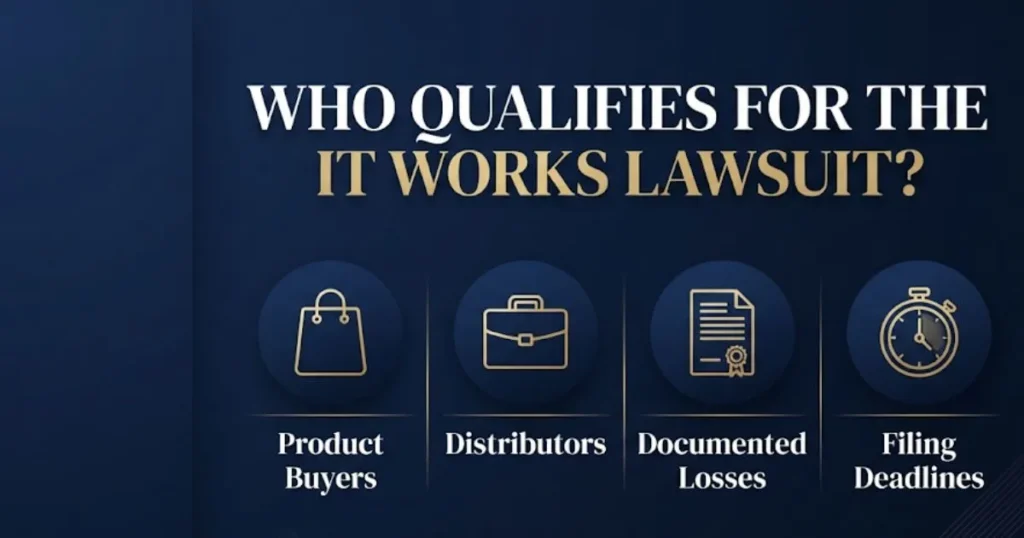
Anyone who purchased It Works! products or joined as a distributor and suffered financial loss may qualify for the It Works lawsuit. Eligibility depends on what you bought, when you bought it, and how much you lost.
The broadest category includes product buyers. If you purchased any It Works! product based on health or weight loss claims that turned out to be exaggerated or false, you have a potential claim.
Distributors have an even stronger case in most situations. If you signed up, paid for a starter kit, maintained autoship orders, and earned little or nothing in commissions, your financial loss is clear and documented.
You likely qualify if:
- You purchased It Works! products between 2015 and 2025
- You signed up as a distributor and paid for a starter kit
- You maintained required monthly autoship orders
- You were shown income claims or testimonials that influenced your decision
- You lost money overall despite following the company’s recommended business plan
You may not qualify if:
- You never purchased any products or joined the company
- You earned a net profit as a distributor
- Your claims fall outside the statute of limitations for your state
State laws vary on filing deadlines. Most states allow 2 to 4 years from the date of the loss. If you left It Works! in 2022, your deadline in a state with a 4-year statute would be 2026. Time matters.
How to File an It Works Lawsuit Claim
Filing an It Works lawsuit claim involves gathering your evidence, contacting a law firm handling the case, and submitting a claim form when one becomes available. The process is straightforward if you prepare in advance.
Start by collecting your financial records. Pull credit card statements, bank records, PayPal transactions, and any emails or receipts from It Works!. Screen capture your distributor back office if you still have access.
Next, document the promises that were made to you. Save social media posts, screenshots of income testimonials, training videos, and any messages from your upline about how much money you could earn.
Step-by-step filing process:
- Gather all financial records showing money spent on It Works!
- Document income claims and marketing promises you received
- Calculate your total net loss (money spent minus any commissions earned)
- Contact a consumer protection attorney or a firm handling MLM class actions
- Submit your information for a free case review
- Complete the formal claim form when it is released by the claims administrator
| Document Type | Why It Matters |
|---|---|
| Bank/credit card statements | Proves how much money you spent |
| Distributor agreement | Shows the terms you agreed to |
| Income claim screenshots | Proves misleading promises were made |
| Commission statements | Shows how little you actually earned |
| Autoship records | Documents required monthly purchases |
Most firms handling these cases work on contingency. That means you pay nothing upfront. The attorney gets paid only if you win or settle.
Key Takeaway: Qualifying for the It Works lawsuit depends on documented financial losses from product purchases or distributor participation, and the filing process starts with gathering every piece of evidence you have.
It Works Distributor Lawsuit Claims
The It Works distributor lawsuit focuses specifically on people who signed up as independent distributors and lost money through the company’s compensation plan. These claims are among the strongest in the case.
Distributors were required to buy a starter kit, often priced between $99 and $199. On top of that, most were required to maintain a monthly autoship order of $80 to $120 to stay “active” and eligible for commissions.
The math never worked for most people. Monthly costs of $100 or more, combined with the difficulty of actually selling products to outside customers, meant most distributors operated at a loss every single month.
Distributor claims typically allege:
- Misrepresentation of the income opportunity
- Required product purchases disguised as “personal use” inventory
- A compensation plan that mathematically guaranteed losses for the majority
- Pressure to recruit rather than sell products
- Lack of meaningful retail customer base
The company’s own income disclosure statements are damning evidence. When 70% or more of your sales force earns nothing, the “business opportunity” starts looking more like a money transfer from the bottom to the top.
Former distributors who kept records of their monthly spending, commission checks, and upline communications have the best chance of recovering their losses. The more detail you can provide, the stronger your claim becomes.
It Works False Advertising Lawsuit
The It Works false advertising lawsuit targets the company’s product marketing claims, particularly around weight loss, body contouring, and health benefits. Plaintiffs say these claims were exaggerated, unproven, or outright false.
The flagship product was the Ultimate Body Applicator, a body wrap that supposedly tightened, toned, and firmed skin in just 45 minutes. That claim drew massive skepticism from doctors and scientists who said a topical wrap cannot produce lasting fat loss or body contouring.
Other products carried similar bold claims. Skinny Brew and Keto Coffee promised weight loss. It Works! Greens claimed to alkalize and detoxify the body. ThermoFight was marketed as a thermogenic fat burner.
| Product | Advertising Claim | Criticism |
|---|---|---|
| Ultimate Body Applicator | Tightens, tones, firms in 45 minutes | No scientific evidence for lasting results |
| Skinny Brew | Promotes weight loss | Insufficient clinical backing |
| It Works! Greens | Alkalizes and detoxifies | “Alkalizing” the body is a debunked concept |
| ThermoFight | Burns fat thermogenically | Modest ingredient evidence, overstated claims |
False advertising claims in lawsuits like this rely on a simple standard. Would a reasonable consumer be misled by the claim? If the answer is yes, and the company cannot back up the claim with solid evidence, the claim is false advertising.
Truth in Advertising (TINA.org) compiled a database of hundreds of deceptive marketing examples from It Works! distributors. That database has become a key resource in the litigation.
It Works Income Claims Lawsuit
The It Works income claims lawsuit challenges the earnings representations made by the company and its top distributors. Plaintiffs argue these income claims painted a fantasy that had no basis in reality for the average participant.
Income claims came in many forms. Social media posts showing luxury cars. Photos of big commission checks. Testimonials about quitting day jobs. Captions like “this business changed my life” paired with images of expensive vacations.
The problem is that these testimonials came almost exclusively from the tiny fraction of top earners. The average distributor’s experience looked nothing like those posts.
- Top earners represented roughly 1% of the distributor base
- Their income came heavily from recruitment bonuses, not product sales
- Average distributor income was near zero or negative after expenses
- Required product purchases were not deducted from “income” figures in official disclosures
The FTC has been clear on this issue. Companies and their representatives cannot make income claims unless those claims are typical and substantiated. Showing the lifestyle of the top 1% without disclosing that 99% earn almost nothing is deceptive.
Income claims are particularly powerful evidence in pyramid scheme litigation. They show that the company’s primary recruiting tool was the promise of money, not the value of the products themselves.
Key Takeaway: Distributor financial losses, false product advertising, and misleading income claims form the three pillars of the It Works lawsuit, and each is backed by the company’s own data and public marketing materials.
It Works Product Liability Claims
It Works product liability claims allege that certain products caused adverse health effects or failed to perform as advertised, causing financial harm. These claims add a personal injury dimension to the broader litigation.
Some consumers reported skin irritation, allergic reactions, and rashes from the body wraps. Others experienced digestive issues from supplements like It Works! Greens and ThermoFight.
The dietary supplement industry has less FDA oversight than pharmaceuticals. Products can reach the market without proving safety or efficacy first. This regulatory gap means consumers sometimes discover problems only after using a product.
| Reported Issue | Products Involved | Type of Claim |
|---|---|---|
| Skin irritation and rashes | Ultimate Body Applicator | Product liability, failure to warn |
| Digestive problems | Greens, ThermoFight | Product liability, defective product |
| No weight loss results | Skinny Brew, Keto Coffee | Breach of warranty, false advertising |
| Allergic reactions | Various supplements | Failure to warn, negligence |
Product liability claims require showing that the product was defective, that it caused harm, and that the company failed to warn about risks. Medical records and doctor visits strengthen these claims significantly.
If you experienced health issues from any It Works! product, document everything. Medical bills, photos of skin reactions, and records of symptoms all serve as evidence. Save the product packaging too, since ingredient lists and batch numbers can be important.
It Works FTC Investigation
The It Works FTC investigation refers to federal scrutiny of the company’s business practices by the Federal Trade Commission. The FTC has received numerous complaints about It Works! and has been reviewing its marketing and compensation structure.
TINA.org filed a formal complaint with the FTC in 2019, presenting a database of deceptive health and income claims made by It Works! distributors. That complaint included over 1,000 examples of problematic marketing.
The FTC has not announced a formal enforcement action against It Works! as of early 2026. But the agency’s track record with similar companies suggests investigation is ongoing. The FTC took action against Herbalife in 2016, AdvoCare in 2019, and several other MLMs in subsequent years.
Signs the FTC is watching It Works!:
- Formal complaint filed by TINA.org with supporting evidence database
- Consumer complaints submitted through the FTC complaint portal
- Pattern matches with companies the FTC has already taken action against
- Company’s income disclosure data mirrors patterns seen in confirmed pyramid schemes
When the FTC does act, the consequences are severe. Enforcement actions can include massive fines, required refunds to consumers, permanent business practice changes, and even forced company shutdowns.
For claimants in private lawsuits, an FTC action would be a huge boost. It essentially validates the claims already made in court and often leads to faster, larger settlements.
It Works Body Wraps Lawsuit
The It Works body wraps lawsuit specifically targets the company’s signature product, the Ultimate Body Applicator, which was marketed as a revolutionary body contouring treatment. Plaintiffs say the product simply does not work as advertised.
The body wraps were It Works!’ biggest seller. Distributors marketed them aggressively on Instagram, Facebook, and TikTok. Before-and-after photos flooded social media feeds, showing dramatic results in just 45 minutes.
Medical professionals consistently disputed these claims. Dermatologists and plastic surgeons pointed out that a topical wrap cannot remove fat, permanently tighten skin, or produce the kind of body contouring results shown in marketing photos.
| Claim | Reality |
|---|---|
| “Tightens and tones in 45 minutes” | Temporary water loss may reduce measurements briefly |
| “Permanently reduces body fat” | No topical product can target or reduce fat cells |
| “Works on cellulite” | No clinical evidence supports this claim |
| Before/after photos show dramatic change | Photos often taken with different lighting, posture, and angles |
The body wraps typically sold for $25 to $30 per applicator, or $59 to $99 for a pack of four. Millions of units were sold over the company’s history.
Customers who purchased body wraps based on these claims and saw no results have a strong false advertising case. The gap between what was promised and what was delivered is wide enough to drive a truck through.
Key Takeaway: From product liability issues to FTC scrutiny to the body wraps that started it all, the evidence against It Works! comes from multiple angles, and regulatory attention could accelerate the legal process in 2026.
Is It Works a Pyramid Scheme?
Whether It Works is a pyramid scheme depends on whether its compensation structure rewards recruitment over genuine product sales. Based on available evidence, many legal experts and consumer advocates argue it meets the legal criteria.
The FTC defines a pyramid scheme as a business where participants earn money primarily by recruiting new members rather than selling products to end consumers. The key question is always: who’s actually buying the products?
In It Works!’ case, a significant portion of product purchases came from distributors themselves, not outside customers. Monthly autoship requirements meant distributors were often their own best customers. That’s a red flag regulators look for.
Pyramid scheme warning signs present in It Works!:
- High percentage of revenue from distributor purchases, not retail customers
- Income concentration at the top of the structure
- Required monthly product purchases to maintain active status
- Heavy emphasis on recruitment in training and compensation
- Income claims focused on the earning potential of the “opportunity”
- Majority of participants earning zero or losing money
Compare it to a legitimate retail business. If you opened a shoe store, you’d make money by selling shoes to people who walk in. You wouldn’t make money by convincing other people to open shoe stores underneath you and buy shoes from your warehouse every month.
That’s the difference. And it’s the exact argument plaintiffs are making in court.
The legal determination hasn’t been finalized in all pending cases. But the data patterns match what regulators found in Herbalife, AdvoCare, and other companies that were ultimately classified as pyramid schemes or forced to restructure.
It Works Lawsuit Update 2026
The latest It Works lawsuit update for 2026 shows continued legal activity across multiple fronts, with key court dates and potential settlement developments expected throughout the year.
Several developments are worth watching. Class certification motions are pending in federal court. Discovery processes are revealing internal company documents. Former executives and top distributors are being deposed.
The company has also seen leadership changes and declining revenue in recent years. These factors can influence settlement calculations because a company’s ability to pay matters in negotiations.
2026 Key Dates and Developments:
| Event | Status |
|---|---|
| Class certification ruling | Pending, expected mid-2026 |
| Discovery phase | Ongoing through Q2 2026 |
| Settlement discussions | Preliminary talks reported |
| Statute of limitations (most states) | Approaching for 2022 losses |
| FTC review | Status undisclosed, believed active |
If class certification is granted, the case gains enormous momentum. It signals to the company that fighting each claim individually is not an option and that a settlement is the most practical path.
Industry observers expect 2026 to produce either a significant settlement announcement or a trial date. Either way, the year ahead is critical for anyone with a stake in the outcome.
Stay current on developments. Cases like this can move quickly once they reach the settlement negotiation stage. Claimants who are already on file with attorneys will be in the best position when money starts moving.
Frequently Asked Questions
How much money can I get from the It Works lawsuit?
Most claimants can expect between $25 and $3,000 depending on their role and losses.
Product-only buyers will receive less than long-term distributors who documented significant spending.
Final payout amounts will be determined once a settlement is approved by the court.
Is It Works still facing lawsuits in 2026?
Yes, It Works! faces active litigation in 2026 across class action and individual claims.
Key motions on class certification and settlement talks are expected this year.
The company has not resolved all pending legal actions as of early 2026.
Can former It Works distributors file a claim?
Former distributors who suffered a net financial loss are among the strongest potential claimants.
You should gather bank statements, autoship records, and commission histories as evidence.
Contact a consumer protection attorney handling MLM cases to submit your information for review.
What did Morgan McIntyre have to do with the It Works lawsuit?
Morgan McIntyre was a high-profile It Works! promoter whose income claims and recruitment tactics are cited in lawsuit filings.
Plaintiffs argue her social media posts created false expectations about earning potential.
Top distributors who made specific income representations may face personal legal exposure alongside the company.
How long does the It Works lawsuit settlement process take?
MLM class action settlements typically take 2 to 4 years from initial filing to final payout distribution.
Cases currently pending could see settlement funds distributed by late 2026 or 2027.
The timeline depends on court schedules, appeals, and the claims review process.
The It Works lawsuit in 2026 represents a real opportunity for people who lost money to this company. Whether you bought products that didn’t work or joined a business that was rigged against you, the legal system is catching up.
Gather your records now. Contact an attorney handling MLM class actions. Get your name on the list before deadlines pass.
The window is open, but it won’t stay open forever. Act while you still can.







