

The Hartford company lawsuit situation in 2026 involves thousands of policyholders fighting back against denied claims, underpaid benefits, and bad faith insurance practices. If The Hartford has wrongfully denied your disability, auto, life, property, or workers comp claim, you may have legal options right now.
This article breaks down every type of lawsuit against The Hartford. You will learn who qualifies, how much money people are getting, and how to file your own claim before deadlines pass.
Here is a number that should get your attention: The Hartford collected over $22 billion in revenue in recent years while facing hundreds of lawsuits from policyholders who say they were cheated out of benefits they paid for.
Whether you are dealing with a denied disability claim or a lowball auto insurance offer, this guide covers it all for 2026.
Hartford Company Lawsuit
A Hartford company lawsuit is a legal action filed against The Hartford Financial Services Group for failing to honor insurance obligations or acting in bad faith toward policyholders. These lawsuits span nearly every type of insurance The Hartford sells.
The Hartford is one of the largest insurance companies in the United States. It is headquartered in Hartford, Connecticut, and offers disability, auto, property, life, and workers compensation coverage to millions of people and businesses.
Despite its size and reputation, The Hartford has faced consistent legal trouble. Policyholders allege the company routinely denies valid claims, delays payments, and uses aggressive tactics to avoid paying out benefits.
| Fact | Detail |
|---|---|
| Company Name | The Hartford Financial Services Group |
| Headquarters | Hartford, Connecticut |
| CEO | Christopher Swift |
| Annual Revenue | Over $22 billion |
| Common Lawsuit Types | Bad faith, disability denial, ERISA violations |
| Primary Courts | Federal district courts, state superior courts |
These lawsuits are not just about one bad experience. Many cases reveal patterns of behavior. Internal company documents in past litigation have shown that claims adjusters sometimes follow playbooks designed to minimize payouts.
That pattern is what separates a simple dispute from a full-blown lawsuit. When a company systematically underpays or denies claims, the legal system treats it differently than a one-time mistake.
The Hartford Lawsuit 2026
The Hartford lawsuit activity in 2026 centers on disability denial claims, ERISA violations, and bad faith insurance practices across multiple states. New cases continue to be filed in both federal and state courts.
Several trends define the 2026 landscape for Hartford litigation. First, ERISA disability cases remain the single largest category. These cases involve employer-sponsored group disability plans administered by Hartford Life and Accident Insurance Company.
Second, bad faith claims in auto and property insurance are growing. Policyholders in states like Florida, California, Texas, and Pennsylvania are filing individual lawsuits after receiving lowball settlement offers.
Third, class action activity is picking up again. At least two proposed class actions are working through federal courts in 2026, alleging systematic underpayment practices.
- ERISA disability denials remain the top lawsuit category
- Bad faith auto claims are increasing in high-population states
- Class action filings are gaining traction in federal courts
- Property insurance disputes are rising after recent natural disaster seasons
If you had a claim denied or underpaid by The Hartford in the last two to four years, 2026 could be a critical window. Statutes of limitations vary by state, but many run between two and six years from the date of denial.
Hartford Insurance Lawsuit
A Hartford insurance lawsuit is any legal claim brought by a policyholder or beneficiary against The Hartford for breach of contract, bad faith, or violations of state or federal insurance law. These cases cover every line of insurance The Hartford writes.
Think of it this way. You pay premiums every month for years. When something goes wrong and you file a claim, the whole point of insurance is that the company pays. When The Hartford refuses to hold up its end of that deal, the law gives you the right to fight back.
| Insurance Type | Common Lawsuit Allegation |
|---|---|
| Disability | Wrongful denial of long-term benefits |
| Auto | Lowball offers, delayed payments |
| Property | Underpayment after storm or fire damage |
| Life | Refusal to pay death benefits |
| Workers Comp | Premature termination of benefits |
Hartford insurance lawsuits are filed in both state and federal courts. The venue depends on the type of policy. Employer-sponsored group plans typically go to federal court under ERISA. Individual policies usually go through state court systems.
The distinction matters because ERISA cases have different rules. In many ERISA lawsuits, you cannot get punitive damages. State court bad faith cases, on the other hand, can result in punitive damage awards that are several times larger than the original claim value.
Key Takeaway: The Hartford faces lawsuits across every insurance line it sells, with ERISA disability denials and bad faith claims dominating the 2026 caseload.
Hartford Bad Faith Lawsuit
A Hartford bad faith lawsuit alleges that The Hartford intentionally or recklessly failed to honor its obligations under an insurance policy. Bad faith goes beyond a simple disagreement about a claim. It means the company acted unfairly or dishonestly.
Every state has laws against insurance bad faith. Some states define it very strictly. Others give insurance companies more room. But the core idea is the same everywhere: if you pay for insurance, the company must handle your claim fairly and in good faith.
Common examples of bad faith by The Hartford include:
- Denying a claim without a reasonable investigation
- Ignoring medical evidence that supports a disability claim
- Delaying payment for months or years without explanation
- Offering far less than the claim is actually worth
- Misrepresenting policy language to justify a denial
- Failing to communicate claim decisions in writing
In states like California, bad faith lawsuits can result in both compensatory and punitive damages. A policyholder who proves bad faith might recover the original claim amount, emotional distress damages, attorney fees, and a punitive damage award.
| Bad Faith Element | What It Means |
|---|---|
| Unreasonable Denial | Denying a valid claim without proper basis |
| Failure to Investigate | Not reviewing evidence before making a decision |
| Lowball Offer | Offering far less than fair market value |
| Delay Tactics | Stalling payment for no legitimate reason |
| Misrepresentation | Twisting policy language to avoid paying |
Punitive damages are the big stick in bad faith cases. Courts use them to punish insurance companies for especially egregious conduct. Some Hartford bad faith verdicts have resulted in punitive damages of $1 million or more.
Hartford Disability Denial Lawsuit
A Hartford disability denial lawsuit is filed when The Hartford wrongfully denies or terminates long-term disability benefits. This is the most common type of lawsuit against The Hartford, and it affects thousands of claimants every year.
The Hartford is one of the largest group disability insurers in the country. Employers purchase group long-term disability policies from Hartford Life and Accident Insurance Company. When an employee becomes disabled, they file a claim through Hartford.
Here is where the problems start. Claimants report that Hartford frequently denies claims even when strong medical evidence supports disability. In many cases, Hartford relies on “independent” medical reviews conducted by doctors who never physically examine the patient.
These paper reviews often contradict the opinions of treating physicians. Courts have criticized this practice repeatedly. Federal judges in ERISA cases have noted that Hartford’s reliance on file-review doctors creates a structural conflict of interest.
- Hartford denies claims using paper-only medical reviews
- Treating doctor opinions are frequently overruled
- Mental health disability claims face especially high denial rates
- Hartford often cuts benefits at the 24-month “own occupation” to “any occupation” transition
| Disability Claim Stage | Common Hartford Action |
|---|---|
| Initial Claim | Delay, request excessive documentation |
| Own Occupation Period | Approve, then monitor aggressively |
| 24-Month Transition | Terminate benefits at definition change |
| Appeal | Deny using new file-review doctor |
| Lawsuit | Defend in federal court under ERISA |
If Hartford denied your disability claim, the first step is filing an administrative appeal. Under ERISA, you must exhaust your appeal rights before you can sue. That appeal is your most important opportunity because the evidence you submit during the appeal is often the only evidence the court will consider later.
Hartford ERISA Lawsuit
A Hartford ERISA lawsuit is a federal court case brought under the Employee Retirement Income Security Act against Hartford for wrongfully denying benefits under an employer-sponsored plan. ERISA governs most group disability, life, and health insurance policies provided through employers.
ERISA is a federal law from 1974. It was supposed to protect employees. But in practice, ERISA creates significant hurdles for people trying to sue insurance companies. Under ERISA, you typically cannot get punitive damages or emotional distress damages. Your recovery is usually limited to the benefits you were owed plus attorney fees.
That is a tough pill to swallow. Imagine fighting for years to get your disability benefits restored, and the most you can win is the money they should have paid you in the first place.
| ERISA Rule | Impact on Your Case |
|---|---|
| No Jury Trial | Judge decides your case, not a jury |
| No Punitive Damages | Cannot punish Hartford for bad behavior |
| Limited Discovery | Cannot always depose Hartford employees |
| Administrative Record | Court usually only reviews the appeal file |
| Exhaustion Required | Must complete all appeals before suing |
| Arbitrary and Capricious Standard | Hartford’s decision gets significant deference |
Despite these limitations, people do win ERISA cases against Hartford. The key is building the strongest possible administrative record during the appeal. That means getting detailed reports from your doctors, vocational experts, and other specialists before the appeal deadline.
Courts apply different standards of review. If the policy gives Hartford discretion to decide claims, courts use the “arbitrary and capricious” standard, which is very deferential to Hartford. If the policy does not grant discretion, courts use the “de novo” standard and make their own independent judgment.
Key Takeaway: ERISA limits your damages in lawsuits against Hartford, so building a strong appeal record before going to court is the most important step you can take.
Hartford Class Action Lawsuit
A Hartford class action lawsuit is a case where a group of policyholders with similar complaints band together to sue The Hartford as a single unit. Class actions are powerful because they let ordinary people take on a large corporation without each person bearing the full cost of litigation.
Several class actions have been filed against The Hartford over the years. Past class actions have targeted Hartford’s claims handling practices, alleging that the company systematically underpaid certain types of claims or used unfair algorithms to calculate benefits.
In 2026, at least two proposed class actions are in various stages of court proceedings. One involves allegations that Hartford systematically underpaid auto insurance claims by using biased valuation tools. Another targets Hartford’s handling of disability claim offsets.
| Class Action Factor | Detail |
|---|---|
| Minimum Class Size | Usually 40 or more plaintiffs with similar claims |
| Lead Plaintiff | One or more named plaintiffs represent the class |
| Certification | Court must approve the class before the case proceeds |
| Settlement | If settled, all class members share the payout |
| Opt-Out Rights | You can usually leave the class and sue individually |
Not all class actions succeed. Hartford aggressively fights class certification. The company argues that each policyholder’s situation is too different to be handled as a group. Courts sometimes agree and deny certification, which forces people to pursue individual lawsuits instead.
If you receive a class action notice in the mail from a Hartford lawsuit, read it carefully. You will typically have the choice to stay in the class, opt out and pursue your own case, or do nothing. Doing nothing usually means you stay in the class but give up your right to sue individually.
Hartford Lawsuit Settlement Amounts
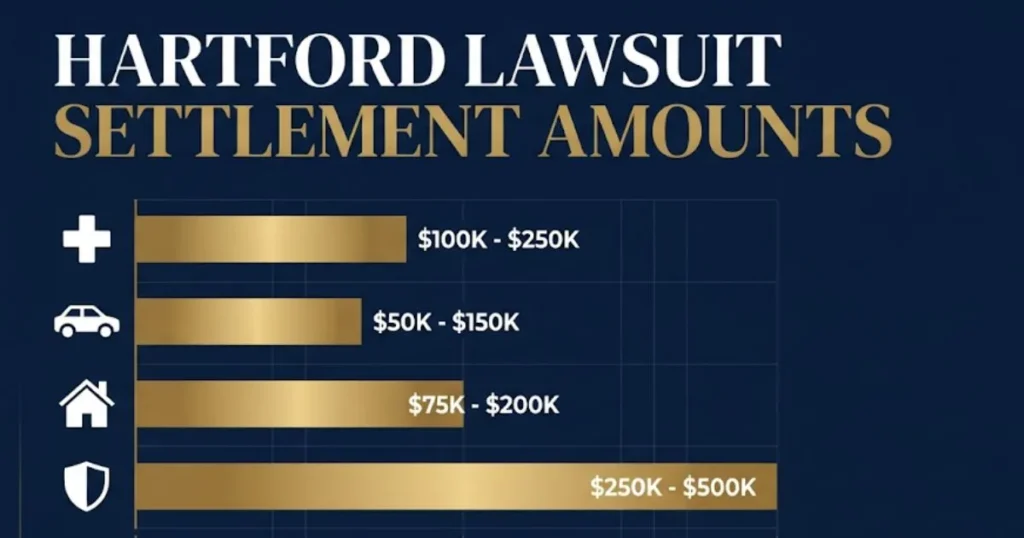
Hartford lawsuit settlement amounts range from a few thousand dollars to several million, depending on the type of claim, the strength of evidence, and whether the case involves bad faith or punitive damages. There is no single number that applies to everyone.
For disability denial cases under ERISA, settlements typically range from $50,000 to $500,000. The amount depends on how many months or years of benefits were denied, the monthly benefit rate, and whether future benefits are included.
Bad faith cases in state court can settle for significantly more. When punitive damages are on the table, Hartford has a much stronger incentive to settle. Some bad faith settlements have exceeded $1 million.
| Case Type | Typical Settlement Range |
|---|---|
| ERISA Disability Denial | $50,000 to $500,000 |
| Auto Insurance Bad Faith | $25,000 to $250,000 |
| Property Insurance Underpayment | $10,000 to $150,000 |
| Life Insurance Denial | $100,000 to $1,000,000+ |
| Workers Comp Dispute | $20,000 to $200,000 |
| Class Action (per claimant) | $50 to $5,000 |
Keep in mind that these are ranges, not guarantees. Your case could settle for more or less depending on your specific facts. Cases with strong medical evidence, clear policy language, and documented bad faith tend to settle at the higher end.
Hartford prefers to settle cases quietly. The company does not want bad publicity or precedent-setting court decisions. That preference works in your favor during settlement negotiations.
Hartford Lawsuit Payout Estimates
Hartford lawsuit payout estimates for 2026 depend on three main factors: the type of insurance involved, the total value of denied benefits, and whether your state allows bad faith or punitive damage claims. Understanding these factors helps you set realistic expectations.
Think of payout estimates like a three-layer cake. The base layer is the actual benefits Hartford owes you. The middle layer is interest and attorney fees. The top layer, which only exists in certain cases, is punitive damages for bad faith conduct.
Base Layer: Owed Benefits
- Monthly disability benefits multiplied by months denied
- Fair market value of property damage minus what Hartford already paid
- Full death benefit amount for life insurance denials
Middle Layer: Extras
- Prejudgment interest (varies by state, typically 6% to 10% annually)
- Attorney fees (in ERISA cases, the court can order Hartford to pay)
- Court costs and expert witness fees
Top Layer: Punitive Damages (State Court Only)
- Available in bad faith cases in most states
- Can be two to ten times the compensatory damages
- Not available in ERISA cases
| Payout Factor | Impact |
|---|---|
| Policy Benefit Amount | Higher monthly benefits mean higher payouts |
| Duration of Denial | More months denied equals more back pay |
| State Law | Some states allow bigger bad faith awards |
| Evidence Strength | Strong medical and documentary evidence increases value |
| Hartford’s Conduct | More egregious behavior can trigger punitive damages |
For a rough estimate, take your monthly benefit amount and multiply it by the number of months you were denied. Then add 20% to 40% for interest and fees. If your case involves bad faith in state court, the total could be two to five times that base number.
Key Takeaway: Settlement amounts vary widely by case type, but disability denial cases under ERISA typically settle between $50,000 and $500,000, while bad faith cases in state court can exceed $1 million.
Hartford Workers Comp Lawsuit
A Hartford workers comp lawsuit is a legal action against The Hartford for improperly handling a workers compensation insurance claim, typically involving an employer’s policy that Hartford underwrites or administers. These cases work differently from other Hartford lawsuits.
Workers compensation insurance is purchased by employers to cover employees who get hurt on the job. The Hartford is one of the largest workers comp insurers in the country. When an employee files a workers comp claim, Hartford is the company that decides whether to approve it and how much to pay.
Common complaints against Hartford in workers comp cases include:
- Prematurely cutting off medical treatment
- Denying coverage for injuries Hartford claims are not work-related
- Using surveillance to challenge the severity of injuries
- Pressuring injured workers to return to work too soon
- Disputing the need for surgery or specialist care
Workers comp disputes typically go through state workers compensation boards or commissions rather than regular courts. Each state has its own workers comp system with specific rules, deadlines, and appeal processes.
| Workers Comp Issue | Hartford’s Typical Response |
|---|---|
| Denied Claim | Claims injury is not work-related |
| Reduced Benefits | Argues partial disability, not total |
| Medical Treatment Dispute | Requires independent medical exam |
| Surveillance | Hires investigators to monitor claimant |
| Return to Work Pressure | Sends claimant to company-approved doctor |
If Hartford is disputing your workers comp claim, you generally need to file a petition with your state’s workers compensation board. The process involves hearings before an administrative law judge. You do not need to go to a regular courtroom in most states.
Some workers comp disputes can also give rise to separate bad faith lawsuits. If Hartford acted unreasonably in denying or delaying your workers comp claim, you may have grounds for a bad faith tort action in addition to the workers comp proceeding.
Hartford Auto Insurance Lawsuit
A Hartford auto insurance lawsuit involves claims that The Hartford underpaid, delayed, or wrongfully denied an auto insurance claim after a vehicle accident. These lawsuits are growing in 2026, particularly in states with strong consumer protection laws.
If you have ever been in a car accident and dealt with an insurance company, you know the drill. You file your claim, provide documentation, and wait. With Hartford, many policyholders say the waiting never seems to end, and when it does, the offer is insultingly low.
Common auto insurance lawsuit allegations against Hartford include:
- Total loss underpayment: Hartford values the vehicle far below fair market value
- Repair disputes: Hartford insists on cheaper aftermarket parts
- Delay tactics: Taking months to process straightforward claims
- Rental car denials: Refusing to cover rental costs during repairs
- Uninsured motorist claim disputes: Denying UM/UIM coverage
| Auto Claim Issue | What Policyholders Report |
|---|---|
| Vehicle Valuation | Hartford uses lowball comparable sales |
| Parts Quality | Insists on non-OEM aftermarket parts |
| Processing Time | Claims take 60 to 120 days for resolution |
| Communication | Adjusters are unresponsive or hard to reach |
| Settlement Offers | First offer is typically 30% to 50% below fair value |
In states like Florida, California, and Texas, auto insurance bad faith lawsuits against Hartford can result in significant damages. If Hartford refuses to pay a valid claim and a court finds bad faith, you could recover your claim amount plus emotional distress damages, attorney fees, and punitive damages.
One tactic that works well in auto cases is getting an independent appraisal. Many Hartford policies include an appraisal clause. If you and Hartford disagree on the value of your vehicle, each side picks an appraiser, and those appraisers pick an umpire. The umpire’s decision is usually binding.
Hartford Life Insurance Lawsuit
A Hartford life insurance lawsuit is filed when The Hartford denies or delays payment of death benefits to a beneficiary. These cases carry especially high emotional stakes because families are grieving while simultaneously fighting an insurance company for money they need to survive.
Hartford Life and Accident Insurance Company is the entity that typically issues group life insurance policies through employers. When an employee dies, the beneficiary files a claim. In many cases, Hartford pays without issue. But when Hartford denies a life insurance claim, the results can be devastating for families.
Common reasons Hartford denies life insurance claims:
- Material misrepresentation: Hartford claims the deceased lied on the application
- Contestability period: Death occurred within the first two years of the policy
- Lapsed coverage: Hartford claims premiums were not paid
- Excluded causes of death: Suicide exclusion or other policy exclusions
- Beneficiary disputes: Multiple people claim the death benefit
| Life Insurance Issue | Hartford’s Position |
|---|---|
| Misrepresentation | Deceased failed to disclose medical condition |
| Contestability | Policy was in force less than two years |
| Premium Lapse | Coverage ended before death occurred |
| Exclusion | Cause of death falls under a policy exclusion |
| Beneficiary Conflict | Competing claims from family members |
The contestability period is a big one. During the first two years of a life insurance policy, the insurer can investigate and deny a claim if the deceased misrepresented any information on the application. After two years, the policy becomes “incontestable,” and Hartford can only deny for nonpayment of premiums.
If Hartford has denied a life insurance claim and you believe the denial is wrong, acting quickly is essential. Life insurance denial lawsuits have strict deadlines that vary by state, and the longer you wait, the harder it becomes to gather evidence.
Key Takeaway: Hartford faces lawsuits in workers comp, auto, and life insurance categories, with auto claims underpayment and life insurance denial cases growing significantly in 2026.
Hartford Property Insurance Lawsuit
A Hartford property insurance lawsuit involves claims that The Hartford underpaid or denied a property insurance claim after damage from storms, fires, water events, or other covered losses. These cases are especially common after major weather events.
The Hartford sells commercial and personal property insurance across the country. When a policyholder suffers property damage, they file a claim with Hartford and expect fair compensation. Too often, policyholders say Hartford’s adjusters undervalue the damage or exclude items that should be covered.
Property insurance disputes with Hartford frequently involve:
- Underpayment of repair costs: Hartford’s estimate is far below contractor bids
- Depreciation disputes: Hartford deducts excessive depreciation from payouts
- Coverage exclusions: Hartford claims certain damage is excluded
- Delayed inspections: Hartford takes weeks to send an adjuster
- Supplemental claim denials: Hartford refuses to pay for additional damage found during repairs
| Property Claim Issue | Typical Dollar Impact |
|---|---|
| Roof Damage Underpayment | $5,000 to $30,000 gap |
| Water Damage Denial | $10,000 to $100,000 denied |
| Business Interruption | $50,000 to $500,000 disputed |
| Depreciation Overcharge | 20% to 40% of claim value |
| Mold Exclusion | Full denial of related damage |
One strategy that helps in property cases is hiring a public adjuster. A public adjuster works for you, not the insurance company. They inspect the damage independently and submit their own estimate. In many cases, the public adjuster’s estimate is two to three times higher than Hartford’s.
If the gap between Hartford’s offer and the actual damage is large enough, a lawsuit or appraisal proceeding becomes worthwhile. Property insurance bad faith cases can be very lucrative for policyholders in states with strong consumer protection statutes.
Hartford Insurance Claim Denial
A Hartford insurance claim denial occurs when The Hartford reviews your claim and decides not to pay some or all of the benefits you requested. Denials can happen in any line of insurance, and Hartford’s denial rates for certain claim types are higher than the industry average.
Getting a denial letter from Hartford feels like a punch in the gut. You paid your premiums. You followed the rules. And now the company that promised to protect you is saying no.
But a denial is not the end of the road. It is the beginning of a process that can lead to a successful appeal, a settlement, or a court judgment in your favor.
Steps to take after a Hartford denial:
- Read the denial letter carefully. It must explain the specific reasons for the denial.
- Request your complete claim file. Under ERISA and most state laws, you have the right to see everything Hartford reviewed.
- Identify the weaknesses in Hartford’s reasoning.
- Gather supporting evidence that directly addresses each denial reason.
- File a written appeal within the deadline stated in the denial letter.
- Consider hiring an attorney who handles insurance denial cases.
| Denial Reason | Your Best Response |
|---|---|
| Insufficient Medical Evidence | Get detailed reports from treating doctors |
| Pre-existing Condition | Show the condition was disclosed or developed after enrollment |
| Policy Exclusion | Challenge Hartford’s interpretation of the exclusion |
| Missed Deadline | Prove you filed on time or had good cause for delay |
| Lack of Proof of Loss | Submit additional documentation and receipts |
The appeal deadline is the most critical date. For ERISA plans, you typically have 180 days from the denial to file an appeal. For non-ERISA policies, deadlines vary by state and policy language. Missing the deadline can permanently bar your claim.
Hartford Lawsuit Eligibility
Hartford lawsuit eligibility depends on the type of insurance policy involved, the reason for your dispute, your state’s laws, and whether you have met procedural requirements like filing an appeal. Not everyone with a complaint qualifies for a lawsuit, but many people who think they have no case actually do.
Here is a quick way to figure out if you might have a case. Ask yourself three questions:
- Did Hartford deny, underpay, or unreasonably delay your claim?
- Do you have a valid insurance policy with Hartford?
- Did the denial happen within your state’s statute of limitations?
If you answered yes to all three, you likely have grounds to explore legal action.
| Eligibility Factor | What You Need |
|---|---|
| Valid Policy | Active policy at the time of loss or disability |
| Denial or Underpayment | Written denial letter or lowball offer |
| Timely Filing | Within statute of limitations (2 to 6 years in most states) |
| Exhausted Appeals (ERISA) | Completed all required administrative appeals |
| Documented Loss | Medical records, repair estimates, or financial records |
| Bad Faith Evidence | Proof Hartford acted unreasonably (not required for all cases) |
For ERISA disability cases, you must exhaust your administrative appeals before you can file a lawsuit. This is a strict requirement. If you skip the appeal and go straight to court, the judge will almost certainly dismiss your case.
For non-ERISA cases like auto, property, and individual policies, most states do not require you to complete an internal appeal before suing. You can file a lawsuit as soon as Hartford denies your claim or makes an unfair offer.
Key Takeaway: Most people with a valid Hartford policy, a written denial or underpayment, and a claim within the statute of limitations have potential grounds for a lawsuit.
How to File a Lawsuit Against Hartford
Filing a lawsuit against Hartford starts with documenting your claim, exhausting any required appeals, and then filing a complaint in the appropriate court. The process is straightforward if you follow the steps in order.
Here is your step-by-step roadmap for 2026:
Step 1: Document Everything
Save every letter, email, and phone record from your interactions with Hartford. Keep copies of your policy, claim forms, denial letters, medical records, repair estimates, and receipts.
Step 2: File Your Appeal (If Required)
For ERISA cases, you must complete the administrative appeal before suing. Submit new evidence that directly contradicts Hartford’s denial reasons. Use the full 180-day appeal window.
Step 3: Consult an Attorney
Find a lawyer who specializes in insurance disputes or ERISA litigation. Many attorneys handle these cases on a contingency basis, meaning they only get paid if you win.
Step 4: File the Complaint
Your attorney will prepare and file a formal complaint in either federal or state court. The complaint lays out your claims and the relief you are seeking.
Step 5: Discovery and Negotiation
After filing, both sides exchange documents and information. This is when settlement negotiations often begin. Hartford settles the majority of cases before trial.
| Filing Step | Timeline |
|---|---|
| Document Collection | 2 to 4 weeks |
| Administrative Appeal | Up to 180 days (ERISA) |
| Attorney Consultation | 1 to 2 weeks |
| Complaint Filing | 1 to 4 weeks after appeal exhaustion |
| Discovery Phase | 3 to 12 months |
| Settlement or Trial | 6 to 24 months from filing |
One common mistake is waiting too long. Statutes of limitations vary by state. In many states, you have just two to three years from the denial date to file a lawsuit. In some states, the deadline is even shorter for certain claim types. Do not sit on your rights.
Hartford Lawsuit Timeline 2026
The Hartford lawsuit timeline in 2026 depends on the type of case, the court system, and whether the case settles or goes to trial. Most Hartford lawsuits take between 12 and 36 months from filing to resolution.
Here is what a typical timeline looks like:
| Phase | Timeframe |
|---|---|
| Claim Denial by Hartford | Day 0 |
| Internal Appeal (ERISA) | 30 to 180 days |
| Appeal Decision from Hartford | 45 to 90 days after appeal |
| Attorney Retained | 1 to 4 weeks after final denial |
| Lawsuit Filed | 2 to 6 weeks after retaining attorney |
| Hartford’s Response to Lawsuit | 20 to 30 days after service |
| Discovery Phase | 3 to 12 months |
| Mediation or Settlement Conference | 6 to 18 months |
| Trial (if needed) | 12 to 36 months from filing |
| Payout After Settlement or Verdict | 30 to 90 days after resolution |
Most cases never reach trial. Hartford knows that going to trial is expensive and risky. The company settles the vast majority of cases during the discovery or mediation phase. If your evidence is strong, Hartford’s settlement offer usually comes within the first year of litigation.
If your case does go to trial, expect the total timeline to stretch to two or three years. ERISA cases tried in federal court are typically bench trials, meaning a judge decides without a jury. These tend to move faster than jury trials in state court.
For people filing new claims in early 2026, a realistic expectation is that your case could resolve by late 2026 or sometime in 2027, assuming Hartford does not drag out the process.
Hartford Insurance Lawsuit Update 2026
The most significant Hartford insurance lawsuit update for 2026 involves ongoing federal court cases challenging Hartford’s disability claim practices and new class action filings related to auto insurance underpayment. Here is what is happening right now.
Disability Denial Cases
Federal courts continue to see a steady stream of ERISA disability denial lawsuits against Hartford Life and Accident Insurance Company. Several notable rulings in late 2025 and early 2026 have gone against Hartford, with judges finding that the company’s reliance on paper-only medical reviews was arbitrary and capricious.
Auto Insurance Class Actions
A proposed class action filed in 2025 alleging that Hartford systematically undervalued total loss auto claims is moving toward class certification in 2026. If certified, this case could affect thousands of policyholders who received lowball total loss offers.
Property Insurance Disputes
Following the severe hurricane and wildfire seasons of 2024 and 2025, property insurance lawsuits against Hartford have increased. Policyholders in Florida, Louisiana, Texas, and California are filing claims alleging underpayment of storm and fire damage.
| 2026 Update Category | Status |
|---|---|
| ERISA Disability Cases | Active, multiple favorable rulings for claimants |
| Auto Class Action | Pending class certification |
| Property Insurance Disputes | Growing caseload in disaster-affected states |
| Workers Comp Challenges | Steady filings in multiple states |
| Life Insurance Denials | Several contested cases in litigation |
Regulatory Activity
State insurance departments in Connecticut, California, and New York have increased their oversight of Hartford’s claims practices. Market conduct examinations by state regulators can sometimes result in fines, corrective action plans, or consent orders that benefit policyholders.
If you are currently dealing with a Hartford dispute, 2026 is a favorable time to take action. Courts are showing less patience with Hartford’s denial tactics. Regulatory pressure is increasing. And attorneys are getting better at winning these cases.
Key Takeaway: The 2026 lawsuit environment is favorable for policyholders challenging Hartford, with courts increasingly ruling against the company’s paper-review denial tactics and class actions gaining momentum.
Frequently Asked Questions
Can I sue The Hartford for denying my disability claim?
Yes, you can sue The Hartford for denying your disability claim.
For employer-sponsored plans, you must first exhaust your internal appeal under ERISA rules.
After that, you can file a lawsuit in federal court seeking restoration of your benefits.
How much money can I get from a Hartford lawsuit?
Most ERISA disability settlements range from $50,000 to $500,000.
Bad faith cases in state court can exceed $1 million with punitive damages.
The exact amount depends on your benefits, the duration of denial, and your state’s laws.
What is the deadline to file a lawsuit against Hartford in 2026?
Deadlines vary by state and claim type, but most statutes of limitations range from two to six years.
For ERISA cases, you typically must file within the timeframe stated in your policy or plan documents.
Acting within 12 months of your final denial is the safest approach.
Does The Hartford have any class action lawsuits right now?
Yes, there are active class action proceedings against The Hartford in 2026.
One proposed class action involves systematic auto insurance total loss underpayment.
Check court records for your specific claim type to see if you might be included.
What evidence do I need to sue Hartford for bad faith?
You need your insurance policy, all correspondence with Hartford, and your denial letter.
Medical records, repair estimates, or proof of loss documents are also essential.
Evidence showing Hartford ignored facts, delayed unreasonably, or misrepresented policy terms strengthens a bad faith claim significantly.
The Hartford company lawsuit situation in 2026 gives policyholders real options. Whether you are fighting a disability denial, a lowball auto offer, or a property claim underpayment, the legal system is on your side if you have the evidence.
Your next step is to gather your denial letter, policy documents, and supporting records. Then talk to an attorney who handles Hartford insurance disputes.
The deadlines are real. The sooner you act, the stronger your position will be.







