

The Goli Nutrition lawsuit alleges the company made false health claims about its popular apple cider vinegar gummies. Millions of Americans bought these products expecting real health benefits that may never have been backed by solid science.
As of 2026, multiple lawsuits have been consolidated, settlement talks have advanced, and affected consumers are starting to see a path toward compensation. This article breaks down every detail you need.
You will learn how much money you might receive, whether you qualify, what deadlines matter, and exactly how to file your claim. One detail that surprises most people: you might not even need a receipt to get paid.
Here is everything, section by section.
Goli Nutrition Lawsuit 2026: What You Need to Know
The Goli Nutrition lawsuit in 2026 is an active legal battle centered on allegations that Goli sold dietary supplements with exaggerated and unproven health claims. The company, founded in 2017 and based in Los Angeles, became famous for its apple cider vinegar gummies promoted by celebrities including Jennifer Lopez.
Plaintiffs argue that Goli’s marketing promised benefits like weight loss, improved digestion, better skin, and enhanced energy. The lawsuits claim these promises had no adequate scientific backing.
The cases have been filed primarily in federal courts in California. Multiple individual lawsuits were consolidated into broader class action proceedings to streamline the legal process.
| Detail | Info |
|---|---|
| Company | Goli Nutrition Inc. |
| Headquarters | Los Angeles, California |
| Primary Product | Apple Cider Vinegar Gummies |
| Main Allegation | False health claims and misleading advertising |
| Court | U.S. District Court, Central District of California |
| Status in 2026 | Active, settlement negotiations in progress |
Goli generated hundreds of millions in revenue during the height of the wellness gummy trend. That financial success is partly why these lawsuits have gained so much traction.
The core argument is simple. Goli charged premium prices for a product that, according to the plaintiffs, was not meaningfully different from a regular gummy candy with a splash of vinegar.
Goli Nutrition Lawsuit Update 2026
The most recent Goli Nutrition lawsuit update in 2026 shows that settlement negotiations are underway between plaintiffs’ attorneys and Goli’s legal team. The court has set key procedural milestones for mid to late 2026.
Earlier in the case, a federal judge denied Goli’s motion to dismiss several of the false advertising claims. That ruling was significant because it meant the case had enough merit to proceed.
Discovery has been ongoing. Plaintiffs’ attorneys have requested internal Goli documents, marketing materials, and communications related to the scientific evidence behind their product claims.
Key 2026 developments include:
- Preliminary settlement discussions opened in early 2026
- Class certification hearing scheduled for mid-2026
- Discovery phase producing internal Goli marketing documents
- Expert witnesses retained by both sides on nutritional science claims
The case is not over yet. But the direction of the proceedings strongly favors a negotiated settlement rather than a full trial. Most consumer class actions follow this pattern once discovery starts revealing uncomfortable internal documents.
If you purchased Goli products, right now is the time to gather your records. The window between settlement approval and claim filing deadlines typically moves fast.
Goli Gummies Class Action Lawsuit Explained
A class action lawsuit is a case where one or a few plaintiffs represent a much larger group of people who all experienced the same harm. The Goli gummies class action lawsuit works exactly this way.
Instead of millions of individual customers each filing their own lawsuit against Goli, a small group of named plaintiffs filed on behalf of everyone who bought the products. If the class gets certified by the court, every qualifying buyer becomes a class member automatically.
Think of it like a group complaint at a restaurant. One person speaks up, but the complaint covers everyone who ate the same bad meal.
How the Goli class action is structured:
- Named plaintiffs: Several consumers who purchased Goli gummies
- Proposed class: All U.S. purchasers of Goli products during the relevant time period
- Common claims: False advertising, unjust enrichment, breach of warranty
- Legal basis: California Consumer Legal Remedies Act, state consumer protection statutes, and the Lanham Act
The named plaintiffs do not get paid unless the class wins or settles. Their attorneys work on contingency, meaning they only collect fees if there is a recovery.
This structure keeps the process free for consumers. You don’t pay a lawyer. You don’t hire anyone. You just file a claim when the time comes.
Key Takeaway: The Goli Nutrition lawsuit in 2026 is a real, active class action case that alleges false advertising, and it is moving toward settlement with key hearings scheduled this year.
Goli Nutrition False Advertising Lawsuit Details
The Goli Nutrition false advertising lawsuit accuses the company of violating federal and state consumer protection laws by marketing its gummies with health claims that lacked sufficient scientific support.
Specifically, the lawsuits target advertising language that appeared on Goli’s website, social media accounts, product packaging, and influencer marketing campaigns. Plaintiffs say these ads created the impression that eating gummies would deliver real, measurable health improvements.
Some of the allegedly false or misleading claims include:
- “Supports weight management” when no peer-reviewed study links ACV gummies to weight loss
- “Supports healthy digestion” without FDA-approved evidence for the specific formulation
- “Improves skin health” based on general apple cider vinegar folklore, not clinical trials on gummies
- “Boosts energy and immunity” which are vague claims with no measurable standard
Under the California Consumer Legal Remedies Act, companies cannot make health claims about products unless they have competent and reliable scientific evidence to back them up. The bar is not impossibly high, but it requires actual studies, not just marketing copy.
Goli’s defense has argued that their labels used qualifying language like “supports” rather than “cures” or “treats.” The plaintiffs counter that ordinary consumers interpret “supports weight management” as a promise the product helps with weight loss.
This distinction between “supports” and “causes” is at the heart of many supplement lawsuits. Courts have increasingly sided with consumers on this issue in recent years.
Goli Gummies Health Claims Lawsuit: What Science Says
The Goli gummies health claims lawsuit rests on the gap between what Goli promised and what scientific research actually supports. Let’s look at the evidence.
Apple cider vinegar in liquid form has some limited scientific backing. A few small studies have shown modest effects on blood sugar regulation when consumed with meals. But those studies involved liquid vinegar with about 5% acetic acid, consumed in tablespoon quantities.
Goli’s gummies contain a much smaller amount of apple cider vinegar in a processed, dehydrated form. The concentration of acetic acid in a gummy is significantly lower than what was used in those studies.
| Claim | Scientific Support | Study Quality |
|---|---|---|
| Weight loss | Very weak; one small study with liquid ACV | Low quality, small sample |
| Blood sugar control | Some evidence for liquid ACV with meals | Moderate, but not for gummy form |
| Improved digestion | No direct evidence for ACV gummies | Not studied |
| Better skin | Anecdotal only | No clinical studies |
| Energy boost | No evidence | Not studied |
| Immune support | No evidence specific to ACV | Not studied |
The problem is straightforward. Goli took the thin scientific halo around liquid apple cider vinegar and draped it over a gummy candy product. The gummies do not deliver the same concentration of active ingredients.
Scientists who reviewed the claims for the plaintiffs argue that the gummy format fundamentally changes the product. The heating and processing required to make a gummy destroys much of the acetic acid content that gave liquid ACV its limited benefits in studies.
This is like a company selling decaf coffee and advertising it as an energy booster because regular coffee has caffeine.
Goli Apple Cider Vinegar Lawsuit Settlement Breakdown
The Goli apple cider vinegar lawsuit settlement is still being negotiated as of 2026, but preliminary terms have started to take shape based on court filings and plaintiff attorney communications.
Based on similar class action settlements in the dietary supplement space, legal analysts expect the total settlement fund to fall between $10 million and $25 million. The exact number will depend on how many class members file claims and what Goli’s financial situation allows.
Settlement funds in cases like this are typically divided into several categories:
- Cash payments to class members who file valid claims
- Attorney fees (usually 25% to 33% of the total fund)
- Court costs and administration expenses
- Incentive awards for named plaintiffs (typically $2,500 to $10,000 each)
| Settlement Component | Estimated Range |
|---|---|
| Total settlement fund | $10M to $25M |
| Attorney fees | 25% to 33% of fund |
| Individual payouts (with proof) | $15 to $50 per product |
| Individual payouts (without proof) | $5 to $15 flat rate |
| Named plaintiff incentives | $2,500 to $10,000 each |
No settlement has been finalized yet. These estimates are based on court filings, comparable cases like the Airborne vitamin settlement and the Bayer Probiotic settlement, and statements from plaintiffs’ counsel.
When a settlement is reached, the court must approve it as fair to the class. There will be a fairness hearing where class members can object. After approval, claim forms will be distributed.
Key Takeaway: The Goli settlement could total between $10 million and $25 million, with individual payouts likely ranging from $5 to $50 depending on proof of purchase.
Goli Nutrition Settlement Amount: How Much Is It Worth?
The Goli Nutrition settlement amount has not been finalized, but comparable supplement false advertising cases give a realistic picture of what to expect. Supplement class actions typically settle for smaller amounts per person than pharmaceutical cases.
The reason is math. When millions of people buy an inexpensive product, the total harm per person is low. A $20 bottle of gummies does not generate the same damages as a defective medical device.
Here is how the settlement math typically works in these cases:
If the total fund is $15 million (a reasonable midpoint estimate):
- Attorney fees at 30%: $4.5 million
- Administration costs: $500,000
- Named plaintiff awards: $50,000 total
- Remaining for class members: approximately $9.95 million
If 200,000 people file claims, the average payout would be around $50 per claimant. If 500,000 file, it drops to about $20 each. If only 50,000 file, it could reach $200 per person.
The fewer people who file, the more each person gets. That is how class action math always works. Most class members never bother to file, which actually helps those who do.
Goli sold an estimated $600 million or more in products during the relevant period. The settlement amount, whatever it ends up being, will represent a fraction of those revenues.
Goli Lawsuit Payout Per Person: Realistic Estimates
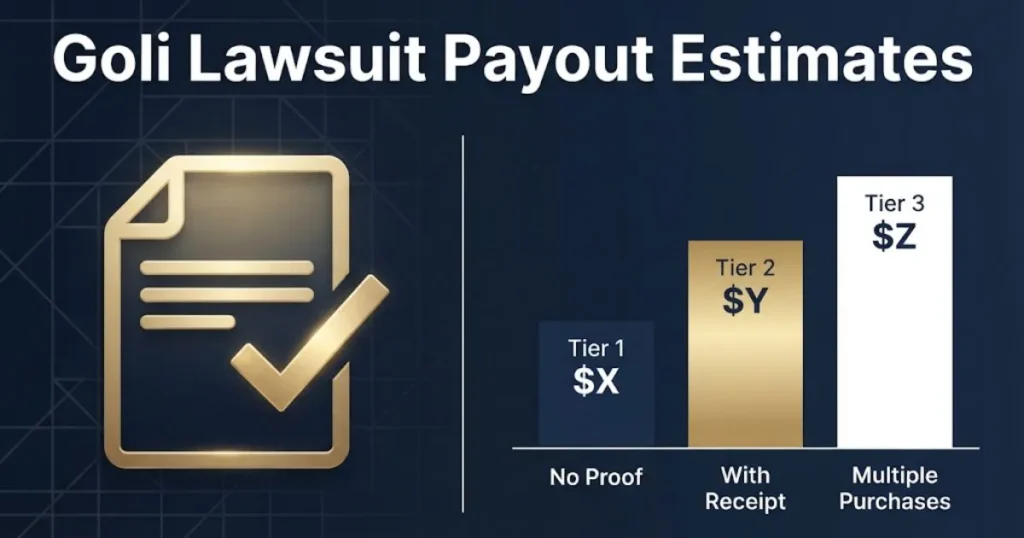
The Goli lawsuit payout per person will likely range from $5 to $50, with the possibility of higher amounts for claimants who can document large or repeated purchases. Most people should expect the lower end of that range.
This might feel disappointing. You spent $20 to $40 on a bottle of gummies and you might get back $10. But class actions are not designed to make individuals wealthy. They are designed to punish corporate behavior and deter future misconduct.
| Scenario | Estimated Payout |
|---|---|
| Filed claim with receipt | $20 to $50 |
| Filed claim without receipt | $5 to $15 |
| Bought multiple products with proof | $50 to $150+ |
| Did not file a claim | $0 |
The key factor is whether you have proof of purchase. Claimants with receipts, order confirmations, or bank statements showing Goli purchases will receive more than those who simply attest that they bought the product.
Some settlements create two tiers. Tier one is for verified purchasers with documentation. Tier two is for people who swear under penalty of perjury that they bought the product but cannot prove it. Tier two payouts are always smaller.
If you regularly bought Goli gummies for months or years, your total claim could be meaningful. Someone who spent $500 over two years might recover $75 to $150. It is not full compensation, but it is real money for filling out a form.
Who Qualifies for the Goli Lawsuit?
Anyone who purchased Goli Nutrition products in the United States during the class period likely qualifies for the Goli lawsuit. The class period has not been finalized but is expected to cover purchases made between 2019 and 2024.
You do not need to have experienced a health problem to qualify. The legal claim is about what you were told when you bought the product, not about whether the product hurt you. If you paid a premium price based on health claims that were not scientifically supported, you experienced financial harm.
You likely qualify if you:
- Bought any Goli product (ACV gummies, Ashwagandha gummies, Superfruits gummies, or others) in the U.S.
- Made the purchase during the class period (expected 2019 to 2024)
- Paid your own money for the product (gifts may not qualify)
- Have not previously released your claims against Goli in another legal proceeding
You may not qualify if you:
- Bought Goli products outside the United States
- Purchased the products for resale rather than personal use
- Are an employee, officer, or director of Goli Nutrition
- Opted out of the class action
Geographic restrictions may apply. Some claims are filed under California consumer protection law, which might limit certain relief to California purchasers. But federal claims under the Lanham Act can cover nationwide purchases.
Key Takeaway: Most U.S. consumers who bought any Goli product between 2019 and 2024 will likely qualify for this lawsuit, even without experiencing health problems.
Goli Nutrition Lawsuit Eligibility Requirements
The Goli Nutrition lawsuit eligibility requirements focus on your purchasing history, not your health outcomes. This is a false advertising case, so the question is whether you were deceived into buying, not whether you got sick.
To be eligible, you generally need to meet three basic criteria:
- You bought a Goli product. Any product counts, not just the ACV gummies.
- You bought it during the class period. This will be defined in the settlement agreement, likely spanning 2019 to 2024.
- You bought it in the United States. International purchases are excluded.
| Eligibility Factor | Requirement |
|---|---|
| Product purchased | Any Goli Nutrition product |
| Purchase location | United States |
| Purchase timeframe | Class period (est. 2019 to 2024) |
| Health injury needed? | No |
| Proof of purchase needed? | Helpful but may not be required |
| Age requirement | 18 or older (or a legal guardian can file) |
One common question involves purchases made through third-party retailers. If you bought Goli gummies at Costco, Walmart, CVS, Target, or through Amazon, you should still qualify. The lawsuit targets Goli’s marketing, not where the product was sold.
Subscription purchases count too. If you signed up for Goli’s auto-ship program and received monthly deliveries, each delivery counts as a separate purchase.
Keep in mind that eligibility is determined when the class is certified and the settlement is approved. Until then, these requirements are based on the proposed class definition in court filings.
How to File a Goli Nutrition Claim
To file a Goli Nutrition claim, you will need to submit a claim form through the official settlement website once the settlement receives final court approval. As of early 2026, the claim process has not officially opened yet.
Here is what the process will look like based on standard class action procedures:
Step 1: Wait for the settlement notice. Once the court grants preliminary approval, a settlement administrator will create a website and mail notices to known purchasers.
Step 2: Visit the settlement website. The claim form will be available online. It will ask for your name, contact information, and purchase details.
Step 3: Provide purchase information. You will enter the approximate dates, quantities, and where you bought the products. If you have receipts or order confirmations, you will upload them here.
Step 4: Submit your claim. Review everything, sign an attestation that your information is true, and submit.
Step 5: Wait for processing. The settlement administrator will review claims. Approved claimants will receive payment by check or electronic transfer.
Timeline expectations:
- Claim form available: Likely mid to late 2026
- Filing window: Usually 60 to 120 days from notice
- Payment distribution: 6 to 12 months after the claim deadline closes
Start gathering your purchase records now. Check your email for Goli order confirmations. Log into Amazon, Walmart, or other retailer accounts and search your order history. Screenshot everything.
Goli Lawsuit Proof of Purchase Requirements
Goli lawsuit proof of purchase requirements will likely be flexible, with higher payouts for those who can document their purchases and smaller flat-rate payments for those who cannot.
Acceptable forms of proof typically include:
- Email order confirmations from Goli’s website
- Amazon, Walmart, Target, or CVS order history screenshots
- Credit card or bank statements showing charges from Goli
- Physical store receipts
- Subscription confirmation emails
- Photos of the product or packaging (less common but sometimes accepted)
You do not need to save every single receipt. Even one or two documented purchases can establish a pattern.
| Proof Type | Strength | Payout Impact |
|---|---|---|
| Original receipt or email confirmation | Strong | Higher tier payout |
| Bank/credit card statement | Strong | Higher tier payout |
| Retailer account order history | Moderate to Strong | Higher tier payout |
| Self-attestation (no proof) | Weak | Lower tier payout |
| Product photo or screenshot | Supplementary | Helps support claim |
If you bought through Amazon, your entire purchase history is saved. Log in, go to “Your Orders,” and search for “Goli.” Take screenshots and save them as PDF files.
For direct purchases from Goli’s website, check your email inbox for order confirmations. Search for “Goli” or “Goli Nutrition” in your email archive.
Even if you threw away every receipt and deleted every email, you can still file a claim. You will just attest under penalty of perjury that you purchased the products. The payout will be lower, but you will still get something.
Key Takeaway: You do not need a receipt to file a claim, but having proof of purchase could double or triple your payout amount.
Goli Class Action Lawsuit Deadline: Key Dates
The Goli class action lawsuit deadline has not been officially set, but based on the case timeline, key dates are expected to fall in the second half of 2026 and into early 2027.
Class action deadlines are critical. If you miss the filing deadline, you get nothing. No exceptions, no extensions, no second chances in most cases.
Expected timeline based on case progression:
| Milestone | Expected Date |
|---|---|
| Preliminary settlement approval | Mid-2026 |
| Class notice mailed to purchasers | 30 to 60 days after preliminary approval |
| Claim filing window opens | 2 to 3 weeks after notice |
| Claim filing deadline | 60 to 120 days after notice |
| Fairness hearing | Late 2026 or early 2027 |
| Final settlement approval | Early 2027 |
| Payments distributed | Mid to late 2027 |
| Opt-out deadline | Usually same as claim deadline |
Two deadlines matter most. The claim filing deadline determines whether you get paid. The opt-out deadline determines whether you keep your right to sue Goli individually.
If you want your share of the settlement, file your claim before the deadline. If you think your individual damages are large enough to justify your own lawsuit, you can opt out of the class.
Most people should stay in the class and file a claim. Individual lawsuits over a $20 bottle of gummies are not practical or cost-effective for most consumers.
Watch for the official settlement notice. It will come by email if Goli has your email address from a direct purchase, or by mail if your physical address is on file.
Goli Nutrition FTC Investigation: What Happened?
The Goli Nutrition FTC investigation relates to broader federal oversight of dietary supplement advertising, though the FTC has not publicly announced a formal enforcement action against Goli as of 2026.
The Federal Trade Commission regulates advertising claims for dietary supplements. Under FTC guidelines, companies must have “competent and reliable scientific evidence” before making health claims about their products.
The National Advertising Division, a self-regulatory body under the Better Business Bureau, has reviewed supplement advertising in the broader industry. These reviews sometimes trigger or parallel FTC investigations.
What we know about regulatory scrutiny of Goli:
- The FTC has increased enforcement against supplement companies making unsubstantiated health claims since 2020
- Several companies selling similar products (ACV gummies, probiotic gummies) have received FTC warning letters
- Goli’s aggressive social media and influencer marketing drew attention from consumer advocacy groups
- The private class action lawsuits reference FTC advertising standards as benchmarks for what constitutes false advertising
The FTC’s involvement matters because it sets the legal standard for the private lawsuits. If the FTC were to take formal action against Goli, it would dramatically strengthen the class action case.
Even without direct FTC action, the private lawsuits borrow heavily from FTC advertising standards. Plaintiffs argue that Goli’s claims would fail the FTC’s own substantiation requirements. That argument has been persuasive with the court so far.
The FDA’s role is different. The FDA does not pre-approve dietary supplements. It can only act after products are on the market if they are adulterated or mislabeled. This regulatory gap is exactly why private lawsuits like this one exist.
Goli Gummies Side Effects Lawsuit
The Goli gummies side effects lawsuit is a separate but related legal track that involves consumers who experienced adverse health effects from using Goli products. These claims are less common than the false advertising allegations but potentially more serious.
Some consumers have reported:
- Digestive problems including nausea, stomach cramps, and diarrhea
- Tooth enamel erosion from the acidic content of the gummies
- Allergic reactions to ingredients in the gummy formulation
- Drug interactions where the ACV gummies affected absorption of medications
- Blood sugar fluctuations in diabetic patients
These side effect claims are distinct from the main class action. The class action focuses on economic harm, meaning you overpaid for a product that did not deliver what it promised. Side effect claims involve actual physical harm.
| Claim Type | What You Need to Prove | Potential Compensation |
|---|---|---|
| False advertising (class action) | You bought the product based on misleading claims | $5 to $50+ per claim |
| Side effects (individual claim) | The product caused physical harm | Could be thousands or more |
If you experienced real health problems from Goli gummies, your claim might be worth pursuing individually rather than as part of the class action. Individual product liability claims can result in much higher compensation.
Medical records linking your symptoms to Goli products are essential for side effect claims. See a doctor, document your symptoms, and save the product packaging with lot numbers.
Key Takeaway: Side effect claims are separate from the main false advertising class action, and consumers with documented health problems from Goli products may be entitled to significantly higher compensation through individual lawsuits.
Is the Goli Lawsuit Legitimate?
Yes, the Goli lawsuit is legitimate. It is a real legal proceeding filed in a real federal court by real attorneys who specialize in consumer protection class actions. It is not a scam.
Some people see ads online for “Goli lawsuit” and wonder if it is a phishing scheme or identity theft attempt. That concern is understandable. Scammers do impersonate class action settlement administrators.
How to verify the lawsuit is real:
- Check the federal court’s PACER system for the case filing
- Look up the plaintiff attorneys’ bar registration with their state bar associations
- Look for official court documents referencing the case
- Verify that any settlement website uses a court-approved domain name
Red flags that something is a scam:
- Anyone asking you to pay money to join the lawsuit
- Requests for your Social Security number before a settlement is approved
- Unsolicited phone calls claiming you are owed money
- Emails from generic addresses asking for personal financial information
Legitimate class action claims are always free to file. You never pay to join. If someone asks for money, walk away immediately.
The attorneys handling the Goli lawsuit work on contingency. They get paid from the settlement fund if they win. You pay nothing upfront, nothing during the process, and nothing at the end.
When the official claim process opens, the settlement administrator will create a dedicated website. Court filings will reference this website by name. That is the only place you should submit your claim information.
Frequently Asked Questions
How much money will I get from the Goli Nutrition lawsuit?
Most claimants can expect between $5 and $50 per valid claim.
The exact amount depends on whether you have proof of purchase and how many people file claims.
Claimants with documented purchase history will receive higher payments than those filing without receipts.
Do I need a receipt to file a Goli lawsuit claim?
No, a receipt is not strictly required.
You can file a claim by attesting under penalty of perjury that you purchased Goli products.
Having proof of purchase such as order confirmations or bank statements will qualify you for a higher payout tier.
When is the deadline to join the Goli class action lawsuit?
The exact deadline has not been set yet, but it is expected in the second half of 2026.
Once the settlement receives preliminary court approval, a notice will be sent with the specific filing deadline.
Most filing windows last between 60 and 120 days from the notice date.
Can I sue Goli Nutrition if I bought the gummies on Amazon?
Yes, Amazon purchases qualify for the class action.
The lawsuit targets Goli’s marketing and product claims, not the retailer who sold it.
Your Amazon order history serves as strong proof of purchase for your claim.
Is the Goli Nutrition lawsuit real or a scam?
The Goli Nutrition lawsuit is a real, court-filed legal proceeding.
It was filed in the U.S. District Court for the Central District of California by licensed attorneys.
Joining a class action is always free, and you should never pay anyone to participate.
The Goli Nutrition lawsuit is moving forward in 2026 with real consequences for the company and real money for consumers. If you bought their products, you have a right to file a claim.
Start collecting your purchase records today. Save order confirmations, screenshot your Amazon history, and watch for the official settlement notice. The filing window will be limited, so being prepared puts you ahead.
Your gummies might not have delivered on their promises. But this lawsuit can deliver something back to you.







