

The glass house farms lawsuit situation has grown more complex heading into 2026, with multiple legal actions touching labor disputes, environmental allegations, shareholder claims, and product liability concerns. Glass House Farms, operated under the parent company Glass House Brands Inc., is one of the largest cannabis cultivators in California, and its legal troubles reflect the growing pains of an entire industry.
If you’re an employee, consumer, investor, or neighbor of a Glass House operation, this article breaks down every angle of these lawsuits. You’ll learn who qualifies, what payouts could look like, and how to take action.
Here’s something worth knowing: Glass House Brands operates one of the largest greenhouse cannabis facilities in the world, spanning over 5.5 million square feet in Southern California. When a company that size faces legal heat, the ripple effects touch thousands of people.
This guide covers all of it. No legal jargon. No fluff. Just the facts you need right now.
Glass House Farms Lawsuit 2026: What You Need to Know
The Glass House Farms lawsuit in 2026 involves a combination of legal actions filed against Glass House Brands Inc. and its subsidiary operations in California. These cases range from labor violations and environmental complaints to shareholder disputes and product safety concerns.
Glass House Brands Inc. is a vertically integrated cannabis company headquartered in Long Beach, California. The company cultivates, manufactures, and distributes cannabis products throughout the state. Its massive greenhouse operations in Santa Barbara County and its Camarillo facility are central to several of these disputes.
The lawsuits aren’t one single case. They are a web of related legal actions filed in different courts. Some target the company directly. Others name individual executives like CEO Kyle Kazan and President Graham Farrar.
What makes the 2026 timeline significant is that several of these cases are reaching critical stages. Motions for class certification, discovery deadlines, and potential settlement negotiations are all on the calendar this year.
| Detail | Info |
|---|---|
| Company | Glass House Brands Inc. |
| Subsidiary | Glass House Farms |
| Headquarters | Long Beach, California |
| Key Facilities | Santa Barbara County, Camarillo |
| Types of Lawsuits | Labor, Environmental, Shareholder, Product Liability |
| Key Year | 2026 |
| Stock Listing | CSE: GLASF / OTC: GLASF |
If you think any of these cases might affect you, keep reading. Each section below breaks down a different type of claim.
Glass House Farms Lawsuit Update for This Year
The most recent Glass House Farms lawsuit update points to active litigation in both state and federal courts throughout early 2026. Several cases have moved past initial pleading stages and into discovery, which means both sides are exchanging evidence.
On the labor side, complaints filed with the California Labor Commissioner have triggered investigations into wage practices at the company’s cultivation facilities. These investigations are ongoing, and additional complaints have been added as more workers come forward.
Shareholder-related claims have been progressing through court proceedings tied to allegations about misleading financial statements. Court records suggest that depositions of key executives were scheduled for the first quarter of 2026.
Environmental complaints related to water usage and pesticide handling at the Santa Barbara County greenhouse have drawn attention from county regulators. Enforcement actions could follow if violations are confirmed.
Key points for 2026:
- Discovery is underway in at least two major cases
- Additional worker complaints have been filed with state agencies
- Shareholder case depositions were scheduled for Q1 2026
- Environmental regulatory reviews are in progress
- No final settlements have been announced yet
The pace of these cases suggests that late 2026 or early 2027 could bring settlement offers or trial dates. Nothing is final at this stage, but the cases are clearly moving forward.
Is There a Glass House Farms Class Action?
A Glass House Farms class action has been pursued on at least two fronts: one involving labor claims from agricultural workers and another involving shareholder fraud allegations. Class certification is the key hurdle, and both cases are working through that process.
For a class action to move forward, a court must certify that there are enough plaintiffs with similar claims to justify one collective lawsuit instead of hundreds of individual ones. In the labor case, attorneys argue that hundreds of workers at Glass House cultivation facilities experienced the same types of wage violations.
The shareholder class action involves investors who purchased Glass House Brands stock during a specific period and allege they were misled about the company’s financial health. These types of cases are common in the cannabis industry, where stock valuations can be volatile and reporting standards are still evolving.
Neither class action has received final certification as of early 2026. But the filings are active and attorneys on both sides are building their cases.
| Class Action Type | Status | Affected Group |
|---|---|---|
| Labor/Employment | Certification pending | Agricultural workers |
| Shareholder | Certification pending | Stock purchasers during key period |
If either case gets certified, it opens the door for affected individuals to join without filing their own separate lawsuit. That’s the whole point of a class action: strength in numbers.
Key Takeaway: Multiple lawsuits are active against Glass House Farms in 2026, including labor and shareholder class actions that are approaching critical stages but have not yet reached final settlements.
Glass House Farms Settlement Details
No final Glass House Farms settlement has been publicly announced as of early 2026. However, settlement discussions are likely happening behind closed doors, which is standard practice in cases that have reached the discovery phase.
In labor-related lawsuits in California’s agricultural sector, settlements often land in the range of a few thousand to tens of thousands of dollars per worker. The exact amount depends on how many pay periods were affected and the nature of the violations.
Shareholder settlements in the cannabis industry vary widely. Some recent cases involving mid-cap cannabis companies have settled for $5 million to $25 million total, divided among all qualifying shareholders. Individual payouts in those cases tend to be modest unless you held a significant number of shares.
Think of it like splitting a pizza. The total settlement might sound large, but when you divide it among thousands of class members, each slice gets smaller.
Environmental and product liability settlements are harder to predict because they often involve regulatory fines paid to government agencies rather than direct payments to individuals.
What to watch for:
- Court filings indicating settlement conferences
- Notices from class action administrators
- SEC filings from Glass House Brands disclosing legal reserves
- News reports about mediation or arbitration sessions
Stay alert to any court-ordered notices. If a settlement is reached, qualifying members will be notified directly or through public announcements.
Glass House Farms Lawsuit Payout Estimates
Glass House Farms lawsuit payout amounts will depend entirely on the type of claim, the number of people in the class, and the total settlement fund. No specific payout figures have been confirmed because no settlement has been finalized.
Based on similar cases in the cannabis and agricultural industries, here are rough estimates:
| Claim Type | Estimated Individual Payout | Basis for Estimate |
|---|---|---|
| Labor/Wage Violations | $2,000 to $15,000 per worker | California labor law precedent |
| Shareholder Fraud | $0.50 to $5.00 per share held | Similar cannabis company settlements |
| Environmental (individual) | Varies widely | Depends on proximity and harm |
| Product Liability | $500 to $10,000 per consumer | Based on cannabis product recall cases |
These are estimates based on comparable legal actions, not guaranteed amounts. The actual numbers could be higher or lower.
Workers who were employed for longer periods and can document more pay stubs will likely receive higher payouts. Shareholders who bought more stock during the alleged fraud period will also receive proportionally more.
One thing to keep in mind: attorneys typically take 25% to 33% of class action settlements as fees. So the net payout to individual class members is always less than the gross amount.
Who Qualifies for the Glass House Farms Lawsuit?
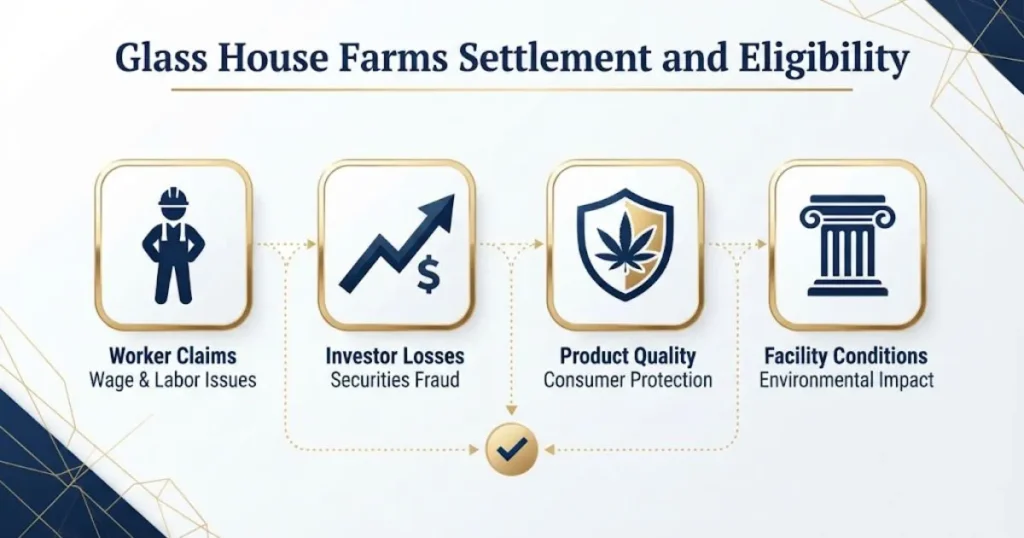
Who qualifies for the Glass House Farms lawsuit depends on which legal action you’re looking at. Each case has its own set of criteria, and meeting one set of requirements doesn’t automatically qualify you for another.
For the labor and employment claims, you likely qualify if you worked at a Glass House Farms cultivation or processing facility in California during the relevant time period. The specific dates are determined by the complaint, but most labor cases cover a four-year lookback period under California law.
For the shareholder class action, qualification typically requires proof that you purchased Glass House Brands stock (traded under ticker GLASF) during the class period. You would need to show brokerage records confirming your purchase dates and share quantities.
Environmental claims may apply if you own property or reside near a Glass House Farms facility and can demonstrate harm from pesticide drift, water contamination, or other environmental impacts.
Product liability claims could apply to consumers who purchased Glass House Farms cannabis products and experienced adverse health effects.
Quick eligibility checklist:
- Were you employed at a Glass House facility in California?
- Did you purchase GLASF stock during the alleged fraud period?
- Do you live near a Glass House cultivation site?
- Did you buy and use Glass House Farms cannabis products?
If you answered yes to any of these, you may have a valid claim.
Key Takeaway: Payouts will vary by claim type, and qualification depends on your specific relationship with the company, whether as a worker, shareholder, neighbor, or consumer.
Glass House Farms Lawsuit Eligibility Requirements
Glass House Farms lawsuit eligibility requirements are specific to each type of legal action. Meeting the basic criteria is just the first step. You also need supporting documentation.
For labor claims, eligibility typically requires:
- Proof of employment at a Glass House facility (pay stubs, W-2 forms, offer letters)
- Employment during the class period (usually covering the past 4 years)
- Evidence of specific violations (unpaid overtime, missed meal breaks, withheld wages)
For shareholder claims, eligibility typically requires:
- Brokerage statements showing purchase of GLASF shares
- Proof of loss (selling shares at a lower price than purchase)
- Transactions during the class period specified in the complaint
For environmental claims:
- Proof of residence near a Glass House facility
- Documentation of harm (medical records, property damage reports, water test results)
For product liability claims:
- Proof of purchase of Glass House Farms products
- Medical records documenting adverse effects
- Product packaging or receipts showing the specific product
The strongest claims are always backed by paper trails. If you think you qualify, start gathering your documentation now. Don’t wait until a deadline forces you to scramble.
Glass House Farms Labor Lawsuit Explained
The Glass House Farms labor lawsuit centers on allegations that the company violated California labor laws at its cultivation and processing facilities. Workers claim they were denied proper overtime pay, meal breaks, and rest periods.
California has some of the strongest worker protection laws in the country. Agricultural workers in particular gained expanded overtime rights under AB 1066, which phased in overtime protections for farmworkers. Cannabis cultivation workers fall under these protections.
Allegations in the labor complaints include:
- Failure to pay overtime after 8 hours in a workday
- Denial of 30-minute meal breaks for shifts over 5 hours
- Failure to provide 10-minute rest breaks for every 4 hours worked
- Late payment of final wages upon termination
- Inaccurate wage statements
These types of violations carry penalties under the California Labor Code. Section 226 alone allows penalties of $50 for a first violation and $100 for each subsequent violation per employee per pay period. Those numbers add up fast when you’re talking about hundreds of workers over multiple years.
| Violation | California Penalty |
|---|---|
| Unpaid Overtime | Back pay plus interest |
| Missed Meal Break | One hour of pay per violation |
| Missed Rest Break | One hour of pay per violation |
| Inaccurate Wage Statement | $50 to $100 per statement |
| Late Final Wages | Up to 30 days of waiting time penalties |
The labor case is one of the strongest claims in the Glass House legal portfolio because the evidence tends to be straightforward. Pay records either show compliance or they don’t.
Glass House Farms Employee Lawsuit Claims
The Glass House Farms employee lawsuit claims go beyond basic wage issues. Some former employees have alleged wrongful termination, retaliation, and unsafe working conditions at company facilities.
Wrongful termination claims suggest that workers were fired after complaining about safety issues or reporting labor violations to management. Under California law, firing someone for reporting legal violations is considered retaliation, and it’s illegal.
Workers at large cannabis greenhouses face specific occupational hazards. Exposure to pesticides, fertilizers, and plant allergens can cause respiratory issues and skin reactions. Some employees allege that Glass House Farms did not provide adequate protective equipment or ventilation.
OSHA standards apply to cannabis cultivation just like any other agricultural operation. If the company failed to meet those standards, it creates liability.
Common employee claims include:
- Wrongful termination after reporting safety concerns
- Retaliation for filing workers’ compensation claims
- Failure to provide proper safety equipment
- Exposure to harmful chemicals without adequate protection
- Hostile work environment allegations
These claims can be pursued individually or as part of the broader class action. Employees who were terminated under suspicious circumstances have particularly strong cases if they can show a timeline connecting their complaint to their firing.
Glass House Farms Environmental Lawsuit Allegations
Glass House Farms environmental lawsuit allegations focus on the company’s massive greenhouse operations in Santa Barbara County and their impact on surrounding communities. Concerns include water usage, pesticide runoff, and odor pollution.
Cannabis cultivation is water-intensive. Glass House operates one of the largest greenhouses in the world, and critics have raised questions about the company’s water sourcing and consumption, particularly during California’s recurring drought conditions.
Pesticide use is another hot button issue. While California has strict regulations on cannabis pesticide use through the Department of Pesticide Regulation, allegations suggest that runoff from cultivation sites may have contaminated nearby water sources or affected neighboring agricultural operations.
Odor complaints are common around large cannabis grows. The terpenes that give cannabis its distinctive smell can travel significant distances, and neighbors of Glass House facilities have reportedly filed nuisance complaints with Santa Barbara County.
| Environmental Concern | Alleged Impact |
|---|---|
| Water Usage | Strain on local water supply |
| Pesticide Runoff | Potential groundwater contamination |
| Odor Pollution | Nuisance to nearby residents |
| Waste Disposal | Improper handling of plant waste |
Environmental claims are typically harder to prove than labor cases because you need scientific evidence linking the company’s operations to specific harm. Water testing, air quality monitoring, and expert testimony all play a role.
Residents living within a few miles of Glass House operations should document any health issues or property impacts they’ve experienced. That documentation could become critical evidence.
Key Takeaway: Employee claims extend well beyond wages to include retaliation and safety issues, while environmental allegations target the physical impact of massive cannabis cultivation on surrounding communities.
Glass House Farms Product Liability Claims
Glass House Farms product liability claims involve allegations that certain cannabis products sold under the Glass House brand were contaminated, mislabeled, or otherwise unsafe for consumer use.
California requires all cannabis products to undergo testing for pesticides, heavy metals, microbials, and foreign materials before they can be sold at licensed dispensaries. If a product passes testing but later turns out to be contaminated, the manufacturer bears responsibility.
Product liability claims in the cannabis space typically fall into three categories:
- Contamination: Products containing pesticide residues, mold, or heavy metals above legal limits
- Mislabeling: THC or CBD content significantly different from what’s stated on the package
- Manufacturing defects: Vape cartridges or edibles with physical defects that cause harm
Consumers who experienced adverse reactions after using Glass House Farms products should preserve any remaining product and packaging. Lab test results, if available, are extremely valuable evidence.
The challenge with cannabis product liability is that the industry is still relatively young. Legal precedents are fewer compared to pharmaceuticals or food products. But California courts have shown willingness to apply traditional product liability frameworks to cannabis.
If you got sick after using a Glass House product and can connect the timing to the product, you may have a valid claim. Medical records showing your symptoms and treatment are essential.
Glass House Farms Shareholder Lawsuit Overview
The Glass House Farms shareholder lawsuit alleges that Glass House Brands Inc. made misleading statements about its financial performance and growth prospects, causing investors to purchase stock at artificially inflated prices.
Glass House Brands trades on the Canadian Securities Exchange under the ticker GLASF and on OTC markets in the United States. The company went public with ambitious growth targets tied to its massive California greenhouse operations.
Shareholder claims typically allege violations of securities laws, including:
- Material misstatements in earnings reports
- Failure to disclose known risks or liabilities
- Insider trading by executives who sold shares while aware of negative information
- Overly optimistic revenue projections without reasonable basis
The class period for shareholder claims is determined by when the alleged misrepresentation began and when the truth was revealed to the market. Stock drops following negative disclosures are the primary evidence of investor harm.
| Shareholder Claim Detail | Info |
|---|---|
| Company Stock | GLASF (CSE and OTC) |
| Alleged Violation | Misleading financial disclosures |
| Who Can File | Investors who bought during class period |
| Key Evidence | Stock price decline after corrective disclosure |
| Typical Resolution | Settlement fund divided among shareholders |
If you bought GLASF shares and lost money after negative information came out, you should check whether your purchase falls within the class period. Your brokerage account history will show the exact dates and prices.
Glass House Brands Lawsuit and Corporate Legal Trouble
The Glass House Brands lawsuit landscape extends beyond Glass House Farms to include the broader corporate entity. Glass House Brands Inc. is the parent company that controls farming, manufacturing, and retail operations across California.
Understanding the corporate structure matters because it affects who gets sued and where the money comes from. Glass House Brands Inc. is the publicly traded entity. Glass House Farms is a subsidiary brand. Other subsidiaries include retail dispensary operations and manufacturing facilities.
When lawsuits target the parent company, they can access corporate assets and insurance policies. When they target only a subsidiary, recovery may be more limited. Most plaintiffs’ attorneys name both the parent and the subsidiary to maximize potential recovery.
Corporate structure breakdown:
- Glass House Brands Inc.: Parent company, publicly traded
- Glass House Farms: Cultivation subsidiary
- Plus Products: Edibles manufacturing (acquired by Glass House Brands)
- Retail Operations: Multiple dispensary locations in California
The company’s annual SEC and CSE filings disclose pending litigation and legal reserves. These filings are public documents. They can tell you how seriously the company is treating its legal exposure based on how much money it has set aside.
Corporate legal trouble also affects the company’s ability to raise capital, secure licenses, and expand operations. For employees and consumers, this means the company’s long-term stability is connected to how these cases resolve.
Key Takeaway: Glass House Brands is the parent entity behind Glass House Farms, and lawsuits targeting the parent company give plaintiffs access to broader corporate assets and insurance.
Glass House Farms California Lawsuit Jurisdiction
The Glass House Farms California lawsuit cases are being litigated primarily in California state courts, with some shareholder claims potentially falling under federal jurisdiction. Venue matters because California courts tend to be more plaintiff-friendly, especially on labor and environmental issues.
Glass House operates in Santa Barbara County and Ventura County. Labor claims have been filed with the California Labor Commissioner and in Los Angeles Superior Court. Environmental complaints have involved Santa Barbara County regulatory agencies.
Shareholder claims can be filed in either state or federal court depending on the specific securities laws cited. Claims under the Securities Exchange Act of 1934 go to federal court. Claims under California state securities laws stay in state court.
California’s court system provides several advantages for plaintiffs:
- Strong labor protections under the California Labor Code
- Private Attorney General Act (PAGA) allows employees to sue on behalf of the state
- California Environmental Quality Act (CEQA) provides grounds for environmental claims
- Liberal discovery rules that make it easier to access company records
PAGA claims are particularly powerful in California. They allow a single employee to represent all affected workers and seek penalties that would normally only be available to the state labor commissioner. Glass House faces potential PAGA exposure on top of regular class action claims.
The venue for each case will affect how quickly it moves through the court system. Los Angeles Superior Court tends to have longer wait times than smaller county courts.
Glass House Farms Compensation: What Could You Receive?
Glass House Farms compensation amounts are still speculative because no settlements have been finalized. However, analyzing comparable cases gives a reasonable range of what different types of claimants might receive.
For labor claimants, California law allows recovery of:
- All unpaid wages plus interest
- Penalty wages for missed meal and rest breaks
- Waiting time penalties of up to 30 days’ pay for late final wages
- PAGA penalties starting at $100 per employee per pay period
- Attorney’s fees paid by the company, not deducted from your recovery
For shareholders, compensation is calculated based on the “out of pocket” measure: the difference between what you paid for the stock and its true value after the fraud was revealed.
| Claimant Type | Potential Compensation Range |
|---|---|
| Agricultural Worker (1 year employed) | $3,000 to $12,000 |
| Agricultural Worker (3+ years employed) | $8,000 to $25,000 |
| Shareholder (small position) | $50 to $500 |
| Shareholder (large position) | $1,000 to $10,000+ |
| Environmental (property damage) | Case by case |
| Product Liability (consumer injury) | $1,000 to $15,000 |
These figures are informed estimates. Actual compensation depends on settlement negotiations, the total number of claimants, and the strength of evidence in each case.
Workers with thorough documentation of their hours, pay stubs, and any complaints they filed during employment will be in the strongest position to maximize their compensation.
How to File a Claim Against Glass House Farms
How to file a claim against Glass House Farms depends on whether a class action has been certified and whether you are pursuing an individual or collective claim. Here’s a step-by-step breakdown of the process.
Step 1: Determine your claim type. Are you a worker, shareholder, consumer, or property owner? Each type follows a different path.
Step 2: Gather your documentation. Pull together everything relevant: pay stubs, tax forms, brokerage statements, receipts, medical records, or photographs of property damage.
Step 3: Contact a qualified attorney. Look for law firms that specialize in employment law, securities litigation, environmental law, or product liability. Many offer free initial consultations for potential class action participants.
Step 4: File your complaint or join the existing action. If a class action has been certified, you may be automatically included or may need to opt in. If no class action exists for your claim type, your attorney can file an individual lawsuit.
Step 5: Respond to all notices. If you are part of a class, you will receive notices about settlement offers, opt-out deadlines, and claim forms. Missing these deadlines can forfeit your right to compensation.
Filing checklist:
- Identify your claim type
- Collect supporting documents
- Consult with a relevant attorney
- File or join before the deadline
- Respond to all court notices promptly
Timing matters. Statutes of limitations in California vary by claim type. Labor claims generally have a 3 to 4 year window. Shareholder fraud claims may have shorter deadlines. Don’t sit on this.
Key Takeaway: Filing a claim requires identifying your specific relationship with Glass House, gathering documentation, and either joining an existing class action or filing an individual case before the statute of limitations expires.
Glass House Farms Legal Issues: A Full Breakdown
Glass House Farms legal issues span nearly every category of business litigation, making this one of the more complex legal situations in the California cannabis industry as of 2026. Here’s the full picture in one place.
The company’s rapid growth strategy, which included acquiring a massive 5.5 million square foot greenhouse facility, brought enormous operational challenges. Scaling that quickly in a heavily regulated industry inevitably creates friction with regulators, workers, and the communities where facilities operate.
Complete breakdown of legal issues:
| Category | Core Allegation | Status (Early 2026) |
|---|---|---|
| Labor/Wages | Unpaid overtime, missed breaks | Active, class certification pending |
| Employee Retaliation | Wrongful termination after complaints | Individual and class claims filed |
| Environmental | Water usage, pesticide runoff, odor | Regulatory review in progress |
| Product Liability | Contaminated or mislabeled products | Early stage claims |
| Shareholder Fraud | Misleading financial disclosures | Active, depositions scheduled |
| PAGA Claims | State penalties for labor violations | Filed, pre-trial phase |
| Regulatory | License compliance issues | Under agency review |
What ties all of these together is a pattern that plaintiffs’ attorneys will try to establish: that Glass House Brands prioritized growth and market share over compliance, worker safety, and honest communication with investors.
The company has publicly denied wrongdoing in its official statements and SEC filings. Glass House Brands has stated that it complies with all applicable laws and regulations.
For people affected by these issues, the next 12 months are critical. Several of these cases are approaching deadlines that will determine whether they move forward to trial, settle, or get dismissed.
The sheer number and variety of claims create pressure on the company to resolve cases rather than fight them all individually. Settlement is often the rational business decision when litigation costs threaten to exceed the settlement price.
If you have a connection to Glass House Farms as a worker, investor, consumer, or neighbor, 2026 is the year to pay attention and take action if you haven’t already.
Frequently Asked Questions
What is the Glass House Farms lawsuit about?
The Glass House Farms lawsuit refers to multiple legal actions against Glass House Brands Inc. and its subsidiaries.
These cases include labor violations, shareholder fraud allegations, environmental complaints, and product liability claims.
Most are being litigated in California state and federal courts.
How much money can I get from the Glass House Farms settlement?
No settlement has been finalized yet, but estimates range from $2,000 to $25,000 for labor claimants depending on employment length.
Shareholders may receive $0.50 to $5.00 per share held during the class period.
Actual amounts will depend on the total settlement fund and number of participants.
Who qualifies to join the Glass House Farms class action?
You may qualify if you worked at a Glass House facility, bought GLASF stock during the class period, or were harmed by their products.
Environmental claims may apply if you live near a Glass House cultivation site.
Documentation like pay stubs, brokerage records, or medical files strengthens your eligibility.
When is the Glass House Farms lawsuit filing deadline?
Specific filing deadlines vary by claim type and have not all been publicly announced.
California labor claims generally must be filed within 3 to 4 years of the violation.
Shareholder claims may have shorter windows, so acting quickly is recommended.
Is Glass House Brands the same company as Glass House Farms?
Glass House Brands Inc. is the publicly traded parent company.
Glass House Farms is a subsidiary brand focused on cannabis cultivation.
Lawsuits may name one or both entities depending on the nature of the claim.
The Glass House Farms lawsuit situation in 2026 is active and evolving across multiple legal fronts. Workers, investors, consumers, and community members all have potential claims worth exploring.
Don’t wait for a deadline to pass before you act. Gather your documents, review the eligibility requirements for your claim type, and reach out to a qualified attorney if you believe you’ve been affected.
The next several months could bring major developments. Stay informed and be ready to file when the opportunity opens.







