

A Fort Worth 18 wheeler accident lawsuit can recover six or even seven figures for people hurt in crashes involving commercial trucks on Texas highways. These cases are far more complex than regular car accident claims because multiple parties, federal regulations, and massive insurance policies are all in play.
If you were hit by an 18-wheeler in Fort Worth or Tarrant County, you’re probably wondering what your case is worth and how the process actually works. That’s exactly what this guide covers for 2026.
Texas saw over 38,000 crashes involving commercial motor vehicles in a single recent year, according to TxDOT data. Fort Worth sits at the intersection of I-35W, I-20, and I-30, making it one of the most dangerous corridors for truck accidents in the state.
This article breaks down settlement ranges, liability rules, filing deadlines, evidence requirements, and everything else you need to know before pursuing a claim.
Fort Worth 18 Wheeler Accident Lawsuit Overview for 2026
A Fort Worth 18 wheeler accident lawsuit is a civil legal action filed by a person injured (or the family of someone killed) in a collision with a commercial truck in the Fort Worth, Texas area. These lawsuits seek financial compensation from the at-fault parties, which often include the truck driver, the trucking company, and sometimes the cargo loader or vehicle manufacturer.
In 2026, these cases are governed by Texas state tort law and federal trucking regulations enforced by the FMCSA. Most are filed in Tarrant County District Court, though some involving interstate commerce end up in the U.S. District Court for the Northern District of Texas.
What makes these lawsuits different from a regular car crash case? The short answer is scale. 18-wheelers weigh up to 80,000 pounds fully loaded. The injuries are worse. The medical bills are higher. The insurance policies are bigger, often $1 million or more.
Trucking companies also have legal teams on speed dial. Many dispatch investigators to the crash scene within hours. That means victims who wait too long risk losing critical evidence.
| Key Fact | Detail |
|---|---|
| Court | Tarrant County District Court or U.S. District Court (Northern TX) |
| Typical Defendant(s) | Driver, trucking company, cargo loader, manufacturer |
| Minimum Insurance Required | $750,000 to $5 million (depending on cargo type) |
| Governing Law | Texas Civil Practice and Remedies Code, FMCSA regulations |
The bottom line: these cases are winnable, but they require fast action, strong evidence, and a clear understanding of who is responsible.
How Much Is an 18 Wheeler Accident Case Worth?
The value of an 18 wheeler accident case depends on the severity of your injuries, the strength of your evidence, and the insurance policy limits of the at-fault parties. Cases in Fort Worth range from $100,000 for minor injuries to well over $10 million for catastrophic harm or death.
Several factors push the value up or down. The biggest single factor is how badly you were hurt. A broken arm heals. A spinal cord injury changes your life forever. Courts and juries assign very different dollar amounts to those outcomes.
Here’s a rough breakdown based on injury type:
| Injury Severity | Estimated Case Value Range |
|---|---|
| Soft tissue injuries (whiplash, sprains) | $50,000 to $200,000 |
| Broken bones, moderate injuries | $200,000 to $750,000 |
| Herniated discs, surgery required | $500,000 to $1.5 million |
| Traumatic brain injury | $1 million to $10 million+ |
| Spinal cord injury or paralysis | $2 million to $20 million+ |
| Wrongful death | $1 million to $25 million+ |
These are estimates based on Texas truck accident verdicts and settlements from recent years. Your actual case could fall above or below these ranges.
Other factors that matter include lost wages, future medical care costs, pain and suffering, and whether the trucker or company acted recklessly. Punitive damages, which are designed to punish especially bad behavior, can double or triple the total.
Don’t let anyone give you a number without reviewing your medical records first. The math only works when it’s specific to your situation.
18 Wheeler Accident Settlement Amounts in Texas
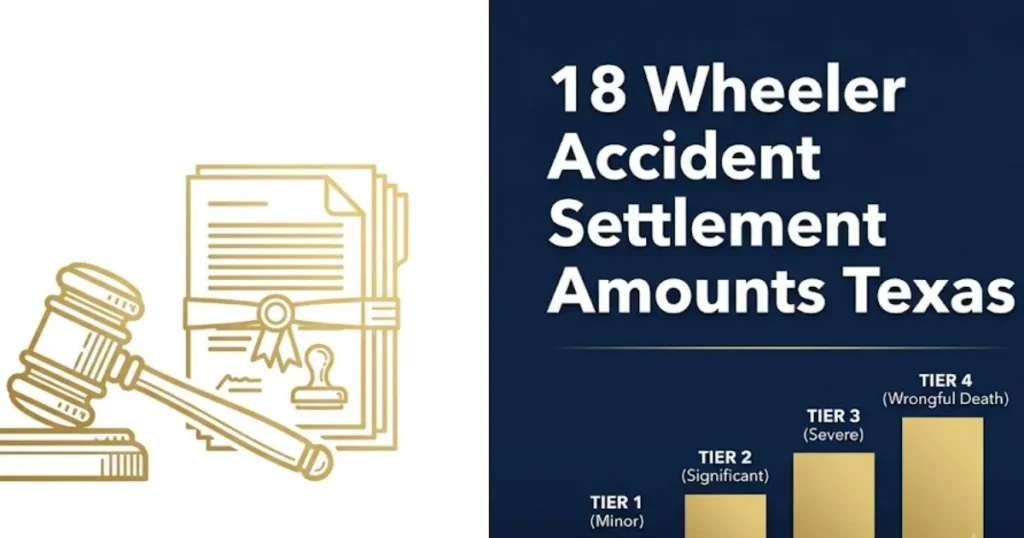
Most 18 wheeler accident cases in Texas settle before trial, and settlement amounts in 2026 typically range from $150,000 to several million dollars depending on case facts. According to data from Texas court filings and industry reports, the median truck accident settlement in Texas has climbed steadily over the past decade.
The reason settlements tend to be higher than car accident cases comes down to three things: worse injuries, higher insurance limits, and stronger evidence of negligence tied to federal violations.
Here’s what recent Texas truck accident settlements look like by case type:
| Case Type | Typical Settlement Range |
|---|---|
| Rear-end collision with minor injuries | $100,000 to $350,000 |
| T-bone crash with fractures | $300,000 to $1 million |
| Rollover or jackknife with serious injury | $750,000 to $5 million |
| Underride accident with catastrophic injury | $2 million to $10 million |
| Wrongful death (single victim) | $1.5 million to $15 million+ |
Texas has seen several “nuclear verdicts” against trucking companies in recent years, where juries awarded $20 million, $50 million, or even $100 million or more. While those are outliers, they signal that juries in Texas take these cases seriously.
Settlements happen when both sides agree on a number without going to trial. The insurance company weighs the risk of a jury verdict and often offers more money as the trial date gets closer.
- Higher settlements come from cases with strong liability evidence
- Cases where the trucker violated FMCSA rules tend to settle for more
- Documented future medical needs increase the total significantly
Key Takeaway: The average 18-wheeler settlement in Texas is significantly higher than a car accident settlement, and cases involving regulatory violations or catastrophic injuries regularly reach seven figures.
What Compensation Can You Recover in Fort Worth?
Compensation in a Fort Worth 18 wheeler accident lawsuit falls into three categories: economic damages, non-economic damages, and in rare cases, punitive damages. Texas law allows victims to recover all three when the facts support them.
Economic damages are the easiest to calculate. They cover the financial losses you can prove with receipts, bills, and pay stubs.
- Medical bills (past and future)
- Lost wages and lost earning capacity
- Rehabilitation and therapy costs
- Property damage (your vehicle, personal items)
- Out-of-pocket expenses related to the crash
Non-economic damages are harder to put a number on but often represent the largest part of a settlement. These include:
- Physical pain and suffering
- Mental anguish and emotional distress
- Loss of enjoyment of life
- Disfigurement or scarring
- Loss of consortium (for spouses)
Punitive damages in Texas are capped under Chapter 41 of the Texas Civil Practice and Remedies Code. The cap is the greater of $200,000 or two times the economic damages plus an amount equal to non-economic damages (up to $750,000). These apply only when the defendant acted with gross negligence or malice.
| Damage Type | Examples | Capped in Texas? |
|---|---|---|
| Economic | Medical bills, lost wages, property damage | No |
| Non-Economic | Pain, suffering, mental anguish | No (in most cases) |
| Punitive | Punishment for gross negligence | Yes, statutory cap applies |
Think of it this way: economic damages replace what you lost, non-economic damages compensate for what you suffered, and punitive damages punish the wrongdoer.
How to File an 18 Wheeler Accident Lawsuit in Fort Worth
Filing an 18 wheeler accident lawsuit in Fort Worth starts with an investigation of the crash, followed by a demand to the insurance company, and then a formal petition filed in Tarrant County District Court if the insurer won’t pay a fair amount. The whole process follows a predictable path, but each step matters.
Here’s the step-by-step breakdown for 2026:
Step 1: Investigate the crash. Gather police reports, medical records, photos, and witness statements. Obtain the truck’s electronic logging device (ELD) data and the driver’s records.
Step 2: Identify all responsible parties. This could include the driver, the trucking company, a cargo loading company, or a parts manufacturer.
Step 3: Send a demand letter. This formal letter to the insurance company outlines your injuries, liability, and the compensation you’re seeking.
Step 4: File the lawsuit. If the insurance company lowballs you or denies the claim, you file a petition in Tarrant County District Court (or federal court if there’s diversity jurisdiction).
Step 5: Discovery phase. Both sides exchange evidence. Depositions are taken. Experts are hired.
Step 6: Mediation. A neutral mediator tries to help both sides reach a settlement. Most cases settle at this stage.
Step 7: Trial. If mediation fails, the case goes before a judge or jury.
| Stage | What Happens | Typical Duration |
|---|---|---|
| Investigation | Evidence gathering, records collection | 1 to 3 months |
| Demand and Negotiation | Insurance claim and demand letter | 1 to 3 months |
| Filing Lawsuit | Petition filed in court | 1 to 2 weeks |
| Discovery | Depositions, document exchange, expert review | 6 to 12 months |
| Mediation | Settlement negotiations with mediator | 1 day (scheduled event) |
| Trial | Jury or bench trial | 3 to 10 days |
You don’t need to memorize every step. But you do need to start the process before evidence disappears. Trucking companies are legally allowed to destroy certain records after six months under FMCSA rules.
Who Is Liable in a Fort Worth 18 Wheeler Accident?
Liability in a Fort Worth 18 wheeler accident can fall on the truck driver, the trucking company, the cargo shipper, the vehicle or parts manufacturer, or even a government entity responsible for road maintenance. Unlike a regular car wreck, these cases often have multiple defendants.
The truck driver is the most obvious target. If they were speeding, distracted, intoxicated, or fatigued, they’re liable. But the analysis doesn’t stop with the driver.
Under the legal doctrine of respondeat superior, the trucking company is often liable for the driver’s actions if the driver was working within the scope of their employment at the time of the crash.
- Truck Driver: Speeding, fatigue, distraction, DUI, lane violations
- Trucking Company: Negligent hiring, poor maintenance, pressure to skip rest breaks
- Cargo Loader: Improperly secured or overweight cargo causing a rollover or spill
- Vehicle/Parts Manufacturer: Defective brakes, tires, or steering systems
- Government Entity: Poorly designed roads, missing signage, dangerous construction zones
Texas uses a proportionate responsibility system under Chapter 33 of the Civil Practice and Remedies Code. Each defendant is assigned a percentage of fault. You can recover damages as long as you are 50% or less at fault. If you’re 51% or more at fault, you get nothing.
| Liable Party | Common Reason for Liability |
|---|---|
| Driver | Hours of service violations, distracted driving |
| Trucking Company | Negligent hiring, failure to maintain vehicles |
| Cargo Company | Overloaded trailer, unsecured freight |
| Manufacturer | Defective brakes or tires |
| Government Entity | Dangerous road conditions |
Identifying every liable party increases the total insurance coverage available to you. That’s why thorough investigation at the start is so important.
Key Takeaway: Multiple parties can share liability in a Fort Worth 18-wheeler crash, and identifying each one directly increases the pool of money available to compensate you.
Trucking Company Negligence in Fort Worth Cases
Trucking company negligence in Fort Worth cases refers to the carrier’s failure to follow safety rules, properly train drivers, maintain vehicles, or enforce federal rest requirements. When a trucking company cuts corners to save money, and someone gets hurt because of it, the company is legally responsible.
This is often where the real money in a lawsuit comes from. Individual truck drivers may have limited personal assets. The trucking company, on the other hand, carries large commercial insurance policies and has deeper pockets.
Common forms of trucking company negligence include:
- Hiring drivers with poor safety records or invalid CDLs
- Failing to drug test drivers as required by DOT rules
- Pressuring drivers to exceed hours-of-service limits
- Skipping mandatory vehicle inspections and maintenance
- Allowing overloaded or improperly loaded trailers on the road
- Failing to install or monitor ELD (electronic logging device) data
The legal concept at work here is called “negligent entrustment.” If a company gives the keys to an 80,000-pound truck to a driver they knew (or should have known) was unfit, they’re on the hook.
In Fort Worth cases, attorneys dig into the company’s safety record using the FMCSA’s Safety Measurement System (SMS) database. This public tool shows a carrier’s crash history, inspection results, and violation rates.
| Negligence Type | How It’s Proven |
|---|---|
| Negligent hiring | Driver’s employment file, prior violation history |
| Failure to maintain | Inspection records, mechanic logs |
| Hours of service pressure | ELD data, driver communications, dispatch logs |
| Inadequate training | Training records, company policy documents |
When a trucking company’s negligence is egregious, punitive damages come into play. That’s the court’s way of saying: this wasn’t just careless, it was reckless.
How FMCSA Violations Strengthen Truck Accident Lawsuits
FMCSA violations serve as powerful evidence in 18 wheeler accident lawsuits because they prove the driver or trucking company broke federal safety rules designed to prevent exactly the type of crash that happened. When you can show a regulatory violation, you’ve taken a giant step toward proving negligence.
The Federal Motor Carrier Safety Administration (FMCSA) sets detailed rules for everything from how long a driver can be behind the wheel to how often brakes must be inspected. When those rules are broken, and a crash occurs, the violation can be used as evidence of negligence per se in Texas courts.
Here are the most common FMCSA violations that show up in Fort Worth truck accident lawsuits:
- Hours of Service (49 CFR Part 395): Drivers cannot drive more than 11 hours after 10 consecutive hours off duty. They cannot drive beyond the 14th consecutive hour after coming on duty.
- Vehicle Maintenance (49 CFR Part 396): Carriers must systematically inspect, repair, and maintain all commercial vehicles.
- Driver Qualification (49 CFR Part 391): Drivers must meet minimum standards for physical condition, driving ability, and CDL status.
- Drug and Alcohol Testing (49 CFR Part 382): Pre-employment, random, post-accident, and reasonable suspicion testing is mandatory.
- Cargo Securement (49 CFR Part 393): Loads must be properly distributed and secured to prevent shifting.
| FMCSA Regulation | What It Covers | Why It Matters in Lawsuits |
|---|---|---|
| Part 395 | Hours of service | Proves driver was fatigued |
| Part 396 | Vehicle maintenance | Proves truck was unsafe |
| Part 391 | Driver qualifications | Proves unfit driver was behind the wheel |
| Part 382 | Drug/alcohol testing | Proves impairment or testing failure |
| Part 393 | Cargo securement | Proves load caused or worsened the crash |
Think of FMCSA regulations as a rulebook. When the other team breaks the rules and you get hurt, the referee (the court) is much more likely to rule in your favor.
These violations are found through ELD records, inspection reports, driver qualification files, and maintenance logs. All of these documents can be obtained during the discovery phase of your lawsuit.
Fort Worth Truck Accident Lawsuit Timeline
A Fort Worth truck accident lawsuit typically takes 12 to 24 months from filing to resolution, though complex cases involving catastrophic injuries or multiple defendants can stretch to 36 months or longer. Cases that settle during mediation resolve faster than those that go to trial.
Here’s a realistic timeline for a 2026 case filed in Tarrant County:
| Phase | Time After Filing | What Happens |
|---|---|---|
| Petition Filed | Month 0 | Lawsuit officially begins |
| Defendant’s Answer | Month 1 to 2 | Trucking company responds |
| Written Discovery | Month 2 to 6 | Document requests, interrogatories |
| Depositions | Month 4 to 10 | Key witnesses give sworn testimony |
| Expert Reports | Month 8 to 14 | Medical, accident reconstruction, economic experts |
| Mediation | Month 10 to 16 | Settlement conference with neutral mediator |
| Trial Setting | Month 14 to 20 | Court assigns trial date |
| Trial | Month 18 to 24+ | Case presented to jury or judge |
Most cases never reach the trial phase. Insurance companies often settle once they see the strength of your evidence during discovery. The closer the trial date gets, the more pressure they feel.
Several things can speed up or slow down your case:
- Speeds it up: Clear liability, strong medical records, cooperative witnesses
- Slows it down: Disputed fault, ongoing medical treatment, corporate defendants filing motions
One important note for 2026: Tarrant County courts have been managing larger dockets in recent years. Getting a trial date can take longer than in smaller counties. Plan for at least 18 months from filing to resolution.
Key Takeaway: Most Fort Worth 18-wheeler lawsuits resolve within 12 to 24 months, with the majority settling during or after mediation rather than going to a full trial.
What Evidence Do You Need for an 18 Wheeler Accident Lawsuit?
The evidence needed for an 18 wheeler accident lawsuit includes the police crash report, your medical records, the truck’s electronic logging device data, the driver’s qualification file, maintenance records, dashcam or surveillance footage, and witness statements. Strong evidence is what separates a winning case from a losing one.
Time is your enemy when it comes to evidence in truck accident cases. Under FMCSA regulations, trucking companies are only required to keep certain records for six months. After that, they can legally destroy them. That’s why preservation letters must go out immediately.
Here’s your evidence checklist:
- Police crash report: Contains the officer’s findings, witness contacts, and any citations issued
- Medical records and bills: Documents your injuries, treatment, and prognosis
- ELD (electronic logging device) data: Shows the driver’s hours on duty and rest periods
- Driver qualification file: Includes the driver’s CDL status, training records, and employment history
- Truck maintenance and inspection logs: Shows whether the truck was safe to operate
- Black box (ECM) data: Records the truck’s speed, braking, and other mechanical data before the crash
- Dashcam, bodycam, and surveillance footage: Visual proof of what happened
- Photos of the scene, vehicles, and injuries: Taken as soon as possible after the crash
- Witness statements: From bystanders, first responders, or other drivers
- Cell phone records: To prove distracted driving
- Drug and alcohol test results: Required by FMCSA after certain types of crashes
| Evidence Type | Where to Get It | Why It Matters |
|---|---|---|
| ELD data | Trucking company (via discovery) | Proves hours of service violations |
| Black box data | Truck’s ECM unit | Shows speed and braking before crash |
| Driver qualification file | Carrier’s records | Shows hiring and training standards |
| Maintenance logs | Carrier’s records | Proves vehicle condition |
| Surveillance footage | Nearby businesses, traffic cameras | Visual proof of the crash |
The strongest cases combine multiple types of evidence to tell a complete story. One piece of evidence alone rarely wins a case. Together, they build an airtight argument.
Statute of Limitations for 18 Wheeler Accidents in Texas
The statute of limitations for an 18 wheeler accident lawsuit in Texas is two years from the date of the crash. If you miss this deadline, the court will almost certainly dismiss your case, and you’ll lose your right to compensation forever.
This two-year window comes from Section 16.003 of the Texas Civil Practice and Remedies Code. It applies to both personal injury claims and wrongful death claims.
There are a few exceptions, but they’re narrow:
- Minors: If the injured person is under 18, the clock doesn’t start until their 18th birthday.
- Incapacitated persons: If the victim is mentally incapacitated, the deadline may be extended.
- Government entities: If a city, county, or state entity is responsible (like a road defect), you may need to file a notice of claim within six months. The rules are stricter.
- Discovery rule: In rare cases where the injury wasn’t immediately apparent, the clock starts when the injury was discovered or should have been discovered.
| Claim Type | Statute of Limitations | Key Deadline |
|---|---|---|
| Personal injury | 2 years from crash date | Do not miss this |
| Wrongful death | 2 years from date of death | Can differ from crash date |
| Claims against government | 6-month notice requirement | Much shorter window |
| Minors | Tolled until age 18 | 2 years after turning 18 |
Even though you technically have two years, waiting is a bad strategy. Evidence degrades. Witnesses forget. Trucking companies destroy records after six months. The sooner you start, the stronger your case.
Filing a lawsuit early also puts the trucking company on legal notice that they must preserve all evidence. That single step can make or break your case.
Common Injury Types in Fort Worth 18 Wheeler Accidents
The most common injuries in Fort Worth 18 wheeler accidents include traumatic brain injuries, spinal cord damage, broken bones, internal organ injuries, severe burns, and crush injuries. The sheer size and weight difference between an 18-wheeler and a passenger vehicle means injuries tend to be catastrophic or fatal.
An 80,000-pound truck hitting a 4,000-pound sedan creates forces that the human body simply cannot withstand in many scenarios. The physics are brutal.
Here are the injury types that show up most often in Fort Worth 18-wheeler cases:
- Traumatic brain injuries (TBI): Range from concussions to permanent cognitive impairment. These often require lifelong care.
- Spinal cord injuries: Can result in partial or complete paralysis. Treatment costs can exceed $1 million in the first year alone.
- Broken bones and fractures: Especially to the pelvis, ribs, legs, and arms. Multiple fractures are common.
- Internal organ damage: Lacerated spleen, liver, or kidneys from blunt force trauma.
- Severe burns: From fuel fires or chemical spills. May require skin grafts and years of reconstructive surgery.
- Crush injuries: When the passenger compartment collapses. Can lead to amputations.
- Neck and back injuries: Herniated discs, soft tissue damage, and chronic pain conditions.
- PTSD and psychological trauma: Survivors often experience anxiety, depression, and flashbacks.
| Injury Type | Potential Long-Term Impact | Estimated Lifetime Cost |
|---|---|---|
| Traumatic brain injury | Cognitive impairment, personality changes | $500,000 to $10 million+ |
| Spinal cord injury (paraplegia) | Paralysis below the waist | $1 million to $5 million |
| Spinal cord injury (quadriplegia) | Paralysis in all limbs | $3 million to $15 million+ |
| Severe burns (over 30% body) | Scarring, nerve damage, surgeries | $500,000 to $5 million |
| Amputation | Prosthetics, rehabilitation, adaptive care | $750,000 to $3 million |
The injury type directly determines the value of your case. More severe injuries with longer recovery times and higher future medical costs command larger settlements and verdicts.
Key Takeaway: Injuries in 18-wheeler crashes are almost always more severe than regular car accidents, and the lifetime cost of treatment is a major factor in calculating your compensation.
Fort Worth 18 Wheeler Wrongful Death Lawsuits
A Fort Worth 18 wheeler wrongful death lawsuit is a legal action filed by the surviving spouse, children, or parents of someone killed in a truck accident. Texas law allows these family members to seek compensation for their financial and emotional losses caused by the death.
Under Texas Wrongful Death Act (Chapter 71 of the Civil Practice and Remedies Code), the following people can file a wrongful death claim:
- Surviving spouse
- Children of the deceased (including adopted children)
- Parents of the deceased
These family members can file individually or together. If no wrongful death action is filed within three months of the death, the personal representative of the deceased’s estate can file a survival action on behalf of the estate.
Damages in a wrongful death case include:
- Loss of financial support: The income the deceased would have earned over their remaining working life
- Loss of companionship and comfort: The emotional bond and guidance the family lost
- Mental anguish: The emotional suffering of surviving family members
- Loss of inheritance: The savings and assets the deceased would have accumulated
- Funeral and burial expenses: Costs incurred for final arrangements
- Medical expenses: Costs of treatment before the person died
| Wrongful Death Factor | What Courts Consider |
|---|---|
| Victim’s age | Younger victims have more years of lost earnings |
| Victim’s income | Higher earners generate larger lost income claims |
| Number of dependents | More dependents can increase the total award |
| Circumstances of death | Painful or prolonged death increases mental anguish damages |
| Defendant’s conduct | Reckless behavior opens the door to punitive damages |
Wrongful death cases against trucking companies frequently result in settlements exceeding $2 million. When the trucking company’s behavior was particularly reckless, such as knowingly allowing a fatigued or impaired driver on the road, jury verdicts have reached $20 million to $100 million or more in Texas.
The grief is real. The legal system can’t bring someone back. But it can hold the responsible parties accountable and provide financial security for the people left behind.
Fort Worth Commercial Truck Accident Claims Explained
Fort Worth commercial truck accident claims cover any collision involving a vehicle used for business purposes, including 18-wheelers, delivery vans, cement mixers, tanker trucks, and other commercial vehicles. The legal framework applies broadly to any crash where the at-fault vehicle was being operated for commercial purposes.
Not every truck on the road is an 18-wheeler, but the same legal principles apply to most commercial vehicles. If the vehicle requires a commercial driver’s license (CDL) to operate, federal and state trucking regulations likely govern it.
Types of commercial trucks commonly involved in Fort Worth accidents:
- Tractor-trailers and semi-trucks
- Tanker trucks carrying fuel or chemicals
- Flatbed trucks hauling construction materials
- Delivery trucks (box trucks, panel vans)
- Dump trucks and cement mixers
- Refrigerated trucks (reefers)
- Car carrier trucks
The I-35W corridor running through Fort Worth is one of the busiest freight routes in the United States. Thousands of commercial trucks pass through daily, connecting supply chains between Mexico, Texas, and the Midwest. This heavy commercial traffic is a major contributor to Fort Worth’s truck accident numbers.
| Truck Type | Common Causes of Crashes | Typical Injuries |
|---|---|---|
| 18-wheeler/Semi | Fatigue, distraction, mechanical failure | Catastrophic, often fatal |
| Tanker truck | Rollover due to liquid shift, hazmat spill | Burns, chemical exposure |
| Flatbed | Unsecured cargo falling onto roadway | Blunt trauma, multi-vehicle pileups |
| Delivery truck | Speeding to meet deadlines, blind spots | Moderate to severe |
| Dump truck | Overloaded, debris falling | Windshield strikes, rear-end crashes |
Filing a claim against a commercial trucking operation means dealing with commercial insurance carriers. These are not the same companies that handle your personal auto insurance. They employ experienced adjusters and defense attorneys whose job is to minimize what they pay.
Key Takeaway: Any crash involving a commercial vehicle in Fort Worth can trigger a claim under trucking laws, and the legal process is similar whether the vehicle is an 18-wheeler, tanker, or delivery truck.
Choosing a Fort Worth 18 Wheeler Accident Lawyer
Choosing the right Fort Worth 18 wheeler accident lawyer means finding someone with specific experience in truck accident litigation, not just personal injury law in general. Truck cases require knowledge of FMCSA regulations, commercial insurance policies, and the unique discovery process involved in obtaining trucking company records.
Not all personal injury attorneys handle truck accident cases. And not all who say they do have actually taken one to trial. Here’s what to look for:
Experience markers that matter:
- Has tried 18-wheeler cases to verdict in Texas courts
- Understands FMCSA regulations and how to use violations as evidence
- Has access to accident reconstruction experts, trucking industry consultants, and medical specialists
- Has handled cases against major trucking companies and their insurers
- Can fund a case through trial (truck cases are expensive to litigate)
Red flags to watch for:
- Attorney has never handled a truck accident case before
- Firm wants to settle quickly without investigating
- No trial experience; only handles pre-litigation settlements
- Charges upfront fees (most legitimate truck accident lawyers work on contingency)
| What to Ask | Why It Matters |
|---|---|
| How many truck accident cases have you handled? | Experience directly affects outcomes |
| Have you taken a truck case to trial? | Willingness to try a case pressures better settlements |
| Do you understand FMCSA regulations? | Federal rules are the backbone of these lawsuits |
| Can you fund the case through trial? | Truck cases can cost $100,000+ to litigate |
| What is your fee structure? | Most charge 33% to 40% on contingency |
A good truck accident lawyer won’t just file paperwork. They’ll send a spoliation letter within days to preserve evidence. They’ll hire investigators. They’ll bring in experts. And they’ll be ready to walk into a courtroom if the insurance company refuses to pay a fair amount.
The attorney you pick is probably the single most important decision you’ll make in your case. Take it seriously.
Frequently Asked Questions
How long do I have to file an 18 wheeler accident lawsuit in Fort Worth?
You have two years from the date of the accident under the Texas statute of limitations.
If the case involves a wrongful death, the two-year clock starts from the date of death, not the crash date.
Claims against government entities require a notice of claim filed within six months.
What is the average settlement for an 18 wheeler accident in Texas?
The average settlement ranges from $150,000 to over $2 million depending on injury severity.
Cases involving traumatic brain injuries, spinal cord damage, or death often settle for seven figures or more.
The specific amount depends on medical costs, lost income, and the defendant’s degree of fault.
Can I sue the trucking company and not just the driver?
Yes, Texas law allows you to sue the trucking company under the doctrine of respondeat superior.
The company can be held liable for the driver’s negligence if the driver was acting within the scope of employment.
You can also sue for the company’s own negligence, such as poor hiring, inadequate maintenance, or safety violations.
What if I was partially at fault for the 18 wheeler accident?
Texas follows a modified comparative fault rule under Chapter 33 of the Civil Practice and Remedies Code.
You can still recover damages as long as your percentage of fault is 50% or less.
Your total recovery is reduced by your percentage of fault; if you’re 20% at fault, you receive 80% of the total damages.
How long does a Fort Worth 18 wheeler accident lawsuit take?
Most cases resolve within 12 to 24 months from the date the lawsuit is filed.
Cases that settle at mediation resolve faster, while cases going to trial can take 24 to 36 months or longer.
The complexity of injuries, the number of defendants, and the Tarrant County court schedule all affect timing.
A Fort Worth 18 wheeler accident lawsuit in 2026 can provide real financial recovery for people whose lives were upended by a truck crash. The key is acting quickly, preserving evidence, and understanding who is responsible.
If you or someone in your family was hurt in an 18-wheeler accident in the Fort Worth area, check whether your case meets the eligibility requirements outlined above. Stay informed about filing deadlines, gather your records, and take the first step before time runs out.
Your case has a clock on it. Make sure you’re ahead of it.







